New Semester
Started
Get
50% OFF
Study Help!
--h --m --s
Claim Now
Question Answers
Textbooks
Find textbooks, questions and answers
Oops, something went wrong!
Change your search query and then try again
S
Books
FREE
Study Help
Expert Questions
Accounting
General Management
Mathematics
Finance
Organizational Behaviour
Law
Physics
Operating System
Management Leadership
Sociology
Programming
Marketing
Database
Computer Network
Economics
Textbooks Solutions
Accounting
Managerial Accounting
Management Leadership
Cost Accounting
Statistics
Business Law
Corporate Finance
Finance
Economics
Auditing
Tutors
Online Tutors
Find a Tutor
Hire a Tutor
Become a Tutor
AI Tutor
AI Study Planner
NEW
Sell Books
Search
Search
Sign In
Register
study help
physics
modern physics
Physics 10th edition David Young, Shane Stadler - Solutions
Radium is a radioactive element whose nucleus emits an
Review Conceptual Example 9 for background pertinent to this problem. Suppose that the speed of light in a vacuum were one million times smaller than its actual value, so that c = 3.00 × 10² m/s. The spring constant of a spring is 850 N/m. Determine how far you would have to compress the spring
Suppose that one gallon of gasoline produces 1.1 × 10⁸ J of energy, and this energy is sufficient to operate a car for twenty miles. An aspirin tablet has a mass of 325 mg. If the aspirin could be converted completely into thermal energy, how many miles could the car go on a single tablet?
Two kilograms of water are changed(a) From ice at 0 °C into liquid water at 0 °C(b) From liquid water at 100 °C into steam at 100 °C. For each situation, determine the change in mass of the water.
Multiple-Concept Example 6 reviews the principles that play a role in this problem. A nuclear power reactor generates 3.0 × 10⁹ W of power. In one year, what is the change in the mass of the nuclear fuel due to the energy being taken from the reactor?
Multiple-Concept Example 6 explores the approach taken in problems such as this one. Quasars are believed to be the nuclei of galaxies in the early stages of their formation. Suppose that a quasar radiates electromagnetic energy at the rate of 1.0 × 1041 W. At what rate (in kg/s) is the quasar
An electron is accelerated from rest through a potential diff erence that has a magnitude of 2.40 × 10⁷ V. The mass of the electron is 9.11 × 10⁻³¹ kg, and the negative charge of the electron has a magnitude of 1.60 × 10⁻¹⁹ C. (a) What is the relativistic kinetic energy (in joules) of the
An object has a total energy of 5.0 × 10¹⁵ J and a kinetic energy of 2.0 × 10¹⁵ J. What is the magnitude of the object's relativistic momentum?
You are driving down a two-lane country road, and a truck in the opposite lane is traveling toward you. Suppose that the speed of light in a vacuum is c = 65 m/s. Determine the speed of the truck relative to you when (a) Your speed is 25 m/s and the truck's speed is 35 m/s and (b) Your speed is 5.0
Spaceships of the future may be powered by ion-propulsion engines in which ions are ejected from the back of the ship to drive it forward. In one such engine the ions are to be ejected with a speed of 0.80c relative to the spaceship. The spaceship is traveling away from the earth at a speed of
The spaceship Enterprise 1 is moving directly away from earth at a velocity that an earth-based observer measures to be +0.65c. A sister ship, Enterprise 2, is ahead of Enterprise 1 and is also moving directly away from earth along the same line. The velocity of Enterprise 2 relative to Enterprise
A person on earth notices a rocket approaching from the right at a speed of 0.75c and another rocket approaching from the left at 0.65c. What is the relative speed between the two rockets, as measured by a passenger on one of them?
Suppose that you are traveling on board a spacecraft that is moving with respect to the earth at a speed of 0.975c. You are breathing at a rate of 8.0 breaths per minute. As monitored on earth, what is your breathing rate?
Two identical spaceships are under construction. The constructed length of each spaceship is 1.50 km. After being launched, spaceship A moves away from earth at a constant velocity (speed is 0.850c) with respect to the earth. Spaceship B follows in the same direction at a different constant
Two atomic particles approach each other in a head-on collision. Each particle has a mass of 2.16 × 10⁻²⁵ kg. The speed of each particle is 2.10 × 10⁸ m/s when measured by an observer standing in the laboratory. (a) What is the speed of one particle as seen by the other particle? (b) Determine
An electron and a positron have masses of 9.11 × 10⁻³¹ kg. They collide and both vanish, with only electromagnetic radiation appearing after the collision. If each particle is moving at a speed of 0.20c relative to the laboratory before the collision, determine the energy of the electromagnetic
The speed of an ion in a particle accelerator is doubled from 0.460c to 0.920c. The initial relativistic momentum of the ion is 5.08 × 10⁻¹⁷ kg ∙ m/s. Determine (a) The mass (b) The magnitude of the final relativistic momentum of the ion.
A Klingon spacecraft has a speed of 0.75c with respect to the earth. The Klingons measure 37.0 h for the time interval between two events on the earth. What value for the time interval would they measure if their ship had a speed of 0.94c with respect to the earth?
An unstable particle is at rest and suddenly breaks up into two fragments. No external forces act on the particle or its fragments. One of the fragments has a velocity of 10.800c and a mass of 1.67 × 10⁻²⁷ kg, and the other has a mass of 5.01 × 10⁻²⁷ kg. What is the velocity of the more massive
The table gives the total energy and the rest energy for three objects in terms of an energy increment
Twins who are 19.0 years of age leave the earth and travel to a distant planet 12.0 light-years away. Assume that the planet and earth are at rest with respect to each other. The twins depart at the same time on different spaceships. One twin travels at a speed of 0.900c, and the other twin travels
A 6.00-kg object oscillates back and forth at the end of a spring whose spring constant is 76.0 N/m. An observer is traveling at a speed of 1.90 × 10⁸ m/s relative to the fixed end of the spring. What does this observer measure for the period of oscillation?
Imagine playing golf in a world where the speed of light is only c = 3.40 m/s. Golfer A drives a ball down a fl at horizontal fairway for a distance that he measures as 75.0 m. Golfer B, riding in a cart, happens to pass by just as the ball is hit (see the figure). Golfer A stands at the tee and
The rest energy E0 and the total energy E of three particles, expressed in terms of a basic amount of energy E′ = 5.98 × 10⁻¹⁰ J, are listed in the table. The speeds of these particles are large, in some cases approaching the speed of light.Concepts:(i) Given the rest energies specified in the
A spaceship travels at a constant speed from earth to a planet orbiting another star. When the spacecraft arrives, 12 years have elapsed on earth, and 9.2 years have elapsed on board the ship. How far away (in meters) is the planet, according to observers on earth?
As observed on earth, a certain type of bacterium is known to double in number every 24.0 hours. Two cultures of these bacteria are prepared, each consisting initially of one bacterium. One culture is left on earth and the other placed on a rocket that travels at a speed of 0.866c relative to the
Suppose the straight-line distance between New York and San Francisco is 4.1 × 10⁶ m (neglecting the curvature of the earth). A UFO is flying between these two cities at a speed of 0.70c relative to the earth. What do the voyagers aboard the UFO measure for this distance?
Two particles, A and B, have the same mass, but particle A has a charge of +q and B has a charge of +2q. The particles are accelerated from rest through the same potential difference. Which one has the longer de Broglie wavelength at the end of the acceleration? (a) Particle A, because it has
Suppose that the momentum of an electron is measured with complete accuracy (i.e., the uncertainty in its momentum is zero). The uncertainty in a simultaneous measurement of the electron's position __________. (a) is also zero (b) is infinitely large (c) is some finite value between
Photons are generated by a microwave oven in a kitchen and by an X-ray machine at a dentist's office. Which type of photon has the greater frequency, the greater energy, and the greater wavelength?
A laser emits a beam of light whose photons all have the same frequency. When the beam strikes the surface of a metal, photoelectrons are ejected from the surface. What happens if the laser emits twice the number of photons per second? (a) The photoelectrons are ejected from the surface with
The surface of a metal plate is illuminated with light of a certain frequency. Which of the following conditions determine whether or not photoelectrons are ejected from the metal?1. The number of photons per second emitted by the light source2. The length of time that the light is turned on3. The
The dissociation energy of a molecule is the energy required to break the molecule apart into its separate atoms. The dissociation energy for the cyanogen molecule is 1.22 × 10⁻¹⁸ J. Suppose that this energy is provided by a single photon. Determine the (a) wavelength and (b) frequency
A proton is located at a distance of 0.420 m from a point charge of+8.30 µC. The repulsive electric force moves the proton until it is at a distance of 1.58 m from the charge. Suppose that the electric potential energy lost by the system were carried off by a photon. What would be its wavelength?
When light with a wavelength of 221 nm is incident on a certain metal surface, electrons are ejected with a maximum kinetic energy of 3.28 × 10⁻¹⁹ J. Determine the wavelength (in nm) of light that should be used to double the maximum kinetic energy of the electrons ejected from this surface.
A glass plate has a mass of 0.50 kg and a specific heat capacity of 840 J/(kg ∙ C°). The wavelength of infrared light is 6.0 × 10⁻⁵ m, while the wavelength of blue light is 4.7 × 10⁻⁷ m. Find the number of infrared photons and the number of blue photons needed to raise the temperature of the
(a) How many photons (wavelength = 620 nm) must be absorbed to melt a 2.0-kg block of ice at 0 °C into water at 0 °C? (b) On the average, how many H2O molecules does one photon convert from the ice phase to the water phase?
A light source emits a beam of photons, each of which has a momentum of 2.3 × 10⁻²⁹ kg ? m/s. (a) What is the frequency of the photons? (b) To what region of the electromagnetic spectrum do the photons belong? Consult Figure 24.9 if necessary.Figure 24.9
A photon of red light (wavelength = 720 nm) and a Ping-Pong ball (mass = 2.2 × 10⁻³ kg) have the same momentum. At what speed is the ball moving?
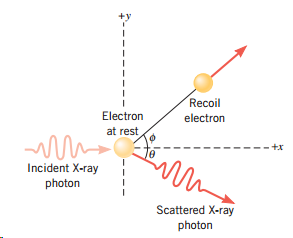
A sample is bombarded by incident X-rays, and free electrons in the sample scatter some of the X-rays at an angle of θ = 122.08 with respect to the incident X-rays (see Figure 29.10). The scattered X-rays have a momentum whose magnitude is 1.856 × 10⁻²⁴ kg?m/s. Determine the wavelength (in nm) of
An incident X-ray photon of wavelength 0.2750 nm is scattered from an electron that is initially at rest. The photon is scattered at an angle of θ = 180.0° in Figure 29.10 and has a wavelength of 0.2825 nm. Use the conservation of linear momentum to find the momentum gained by the electron.Figure
An AM radio station broadcasts an electromagnetic wave with a frequency of 665 kHz, whereas an FM station broadcasts an electromagnetic wave with a frequency of 91.9 MHz. How many AM photons are needed to have a total energy equal to that of one FM photon?
In the Compton effect, momentum conservation applies, so the total momentum of the photon and the electron is the same before and after the scattering occurs. Suppose that in Figure 29.10 the incident photon moves in the +x direction and the scattered photon emerges at an angle of θ =
Figure 29.10 shows the setup for measuring the Compton effect. With a fixed incident wavelength, a wavelength of λ′1 is measured for a scattering angle of λ′1 = 30.0°, whereas a wavelength of λ′2 is measured for a scattering angle of θ2 = 70.0°. Find the difference in wavelengths,
A photon of wavelength 0.45000 nm strikes a free electron that is initially at rest. The photon is scattered straight backward. What is the speed of the recoil electron after the collision?
An X-ray photon is scattered at an angle of θ = 180.0° from an electron that is initially at rest. After scattering, the electron has a speed of 4.67 × 10⁶ m/s. Find the wavelength of the incident X-ray photon.
A bacterium (mass = 2 × 10-15kg) in the blood is moving at 0.33 m/s. What is the de Broglie wavelength of this bacterium?
What are (a) the wavelength of a 5.0-eV photon and (b) the de Broglie wavelength of a 5.0-eV electron?
An electron and a proton have the same speed. Ignore relativistic effects and determine the ratio λelectron/ λproton of their de Broglie wavelengths.
Recall from Section 14.3 that the average kinetic energy of an atom in a monatomic ideal gas is given by K̅E̅ = 3/2 kT, where k = 1.38 × 10⁻²³ J/K and T is the Kelvin temperature of the gas. Determine the de Broglie wavelength of a helium atom (mass = 6.65 × 10⁻²⁷ kg) that has the average
In a Young's double-slit experiment that uses electrons, the angle that locates the first-order bright fringes is θA = 1.6 × 10⁻⁴ degrees when the magnitude of the electron momentum is pA = 1.2 × 10⁻²²kg? m/s. With the same double slit, what momentum magnitude pB is necessary so that an angle of
From a cliff that is 9.5 m above a lake, a young woman (mass = 41 kg) jumps from rest, straight down into the water. At the instant she strikes the water, what is her de Broglie wavelength?
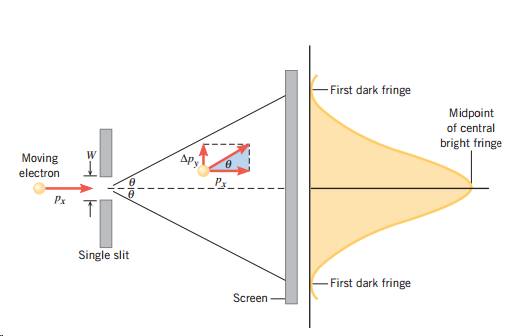
The width of the central bright fringe in a diffraction pattern on a screen is identical when either electrons or red light (vacuum wavelength = 661 nm) pass through a single slit. The distance between the screen and the slit is the same in each case and is large compared to the slit width. How
Particle A is at rest, and particle B collides head-on with it. The collision is completely inelastic, so the two particles stick together after the collision and move off with a common velocity. The masses of the particles are different, and no external forces act on them. The de Broglie
The kinetic energy of a particle is equal to the energy of a photon. The particle moves at 5.0% of the speed of light. Find the ratio of the photon wavelength to the de Broglie wavelength of the particle.
A proton is confined to a nucleus that has a diameter of 5.5 × 10⁻¹⁵ m. If this distance is considered to be the uncertainty in the position of the proton, what is the minimum uncertainty in its momentum?
Light is shining perpendicularly on the surface of the earth with an intensity of 680 W/m2. Assuming that all the photons in the light have the same wavelength (in vacuum) of 730 nm, determine the number of photons per second per square meter that reach the earth.
Particles pass through a single slit of width 0.200 mm (see Figure 29.14). The de Broglie wavelength of each particle is 633 nm. After the particles pass through the slit, they spread out over a range of angles. Assume that the uncertainty in the position of the particles is one-half the width of
The minimum uncertainty Δy in the position y of a particle is equal to its de Broglie wavelength. Determine the minimum uncertainty in the speed of the particle, where this minimum uncertainty Δvy is expressed as a percentage of the particle's speedAssume that relativistic
A subatomic particle created in an experiment exists in a certain state for a time of Δt = 7.4 × 10⁻²⁰ s before decaying into other particles. Apply both the Heisenberg uncertainty principle and the equivalence of energy and mass (see Section 28.6) to determine the minimum uncertainty involved in
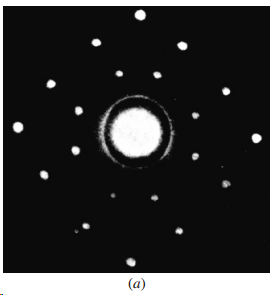
The interatomic spacing in a crystal of table salt is 0.282 nm. This crystal is being studied in a neutron diffraction experiment, similar to the one that produced the photograph in Figure 29.12a. How fast must a neutron (mass = 1.67 × 10⁻²⁷ kg) be moving to have a de Broglie wavelength of 0.282
Two sources produce electromagnetic waves. Source B produces a wavelength that is three times the wavelength produced by source A. Each photon from source A has an energy of 2.1 × 10⁻¹⁸ J. What is the energy of a photon from source B?
Find the de Broglie wavelength of an electron with a speed of 0.88c. Take relativistic effects into account.
The work function of a metal surface is 4.80 × 10⁻¹⁹J. The maximum speed of the electrons emitted from the surface is vA = 7.30 × 10⁵ m/s when the wavelength of the light is λA. However, a maximum speed of vB = 5.00 × 10⁵ m/s is observed when the wavelength is λB. Find the wavelengths λA and
How fast does a proton have to be moving in order to have the same de Broglie wavelength as an electron that is moving with a speed of 4.50 × 10⁶ m/s?
In a television picture tube the electrons are accelerated from rest through a potential difference V. Just before an electron strikes the screen, its de Broglie wavelength is 0.900 × 10⁻¹¹ m. What is the potential difference?
Multiple-Concept Example 3 reviews the concepts necessary to solve this problem. Light is incident on the surface of metallic sodium, whose work function is 2.3 eV. The maximum speed of the photoelectrons emitted by the surface is 1.2 × 10⁶ m/s. What is the wavelength of the light.
Some scientists have suggested that spacecraft with sails of the kind described in Conceptual Example 4 could be propelled by lasers. Suppose that such a sail is constructed of a highly reflective material thin enough so that one square meter of the sail has a mass of just 3.0 × 10⁻³ kg. The sail
Sunlight, whose visible wavelengths range from 380 to 750 nm, is incident on a sodium surface. The work function for sodium is W0 = 2.28 eV. Concepts: (i) Will electrons with a greater value of KEmax be emitted when the incident photons have a relatively greater or relatively smaller amount of
An electron and a proton have the same kinetic energy and are moving at speeds much less than the speed of light. Concepts: (i) How is the de Broglie wavelength l related to the magnitude p of the momentum? (ii) How is the magnitude of the momentum related to the kinetic energy of a particle of
The maximum wavelength that an electromagnetic wave can have and still eject electrons from a metal surface is 485 nm. What is the work function W0 of this metal? Express your answer in electron volts.
Radiation of a certain wavelength causes electrons with a maximum kinetic energy of 0.68 eV to be ejected from a metal whose work function is 2.75 eV. What will be the maximum kinetic energy (in eV) with which this same radiation ejects electrons from another metal whose work function is 2.17 eV?
Multiple-Concept Example 3 reviews the concepts necessary to solve this problem. Radiation with a wavelength of 238 nm shines on a metal surface and ejects electrons that have a maximum speed of 3.75 × 10⁵ m/s. Which one of the following metals is it, the values in parentheses being the work
Consider applying the Bohr model to a neutral helium atom. The model takes into account a number of factors. Which one of the following does it not take into account? (a) The quantization of the orbital angular momentum of an electron (b) The centripetal acceleration of an electron (c) The
Consider the 5f and 6h subshells in a multiple-electron atom. Which of these subshells can contain 19 electrons? (a) Only the 6h subshell (b) Only the 5f subshell (c) Both subshells (d) Neither subshell
Silver (Z = 47), copper (Z = 29), and platinum (Z = 78) can be used as the target in an X-ray tube. Rank in descending order (largest first) the energies needed for impinging electrons to knock a K-shell electron completely out of an atom in each of these targets. (a) Silver, copper, platinum (b)
The voltage applied across an X-ray tube is doubled. What happens to the cutoff wavelength in the spectrum of wavelengths emitted by the tube's metal target? (a) It also doubles. (b) It decreases by a factor of two. (c) It increases by a factor of four. (d) It decreases by a factor of four. (e)
According to the Bohr model, what determines the shortest wavelength in a given series of wavelengths emitted by the atom? (a) The quantum number ni that identifies the higher energy level from which the electron falls into a lower energy level (b) The quantum number nf that identifies the lower
According to quantum mechanics, only one of the following combinations of the principal quantum number n and the orbital quantum number, is possible for the electron in a hydrogen atom. Which combination is it? (a) n = 3, l = 3 (b) n = 2, l = 3 (c) n = 1, l = 2 (d) n = 0, l = 0 (e) n = 3, l = 1
The electron in a hydrogen atom is in the first excited state, when the electron acquires an additional 2.86 eV of energy. What is the quantum number n of the state into which the electron moves?
a) What is the ionization energy of a hydrogen atom that is in the n = 4 excited state? (b) For a hydrogen atom, determine the ratio of the ionization energy for the n = 4 excited state to the ionization energy for the ground state.
A hydrogen atom is in the ground state. It absorbs energy and makes a transition to the n = 3 excited state. The atom returns to the ground state by emitting two photons. What are their wavelengths?
In the hydrogen atom, what is the total energy (in electron volts) of an electron that is in an orbit that has a radius of 4.761 x 10⁻¹⁰ m?
Consider the Bohr energy expression (Equation 30.13) as it applies to singly ionized helium He+ (Z = 2) and doubly ionized lithium Li2+ (Z = 3). This expression predicts equal electron energies for these two species for certain values of the quantum number n (the quantum number is different for
A sodium atom (Z = 11) contains 11 protons in its nucleus. Strictly speaking, the Bohr model does not apply, because the neutral atom contains 11 electrons instead of a single electron. However, we can apply the model to the outermost electron as an approximation, provided that we use an effective
A hydrogen atom emits a photon that has momentum with a magnitude of 5.452 x 10⁻²⁷ kg ? m/s. This photon is emitted because the electron in the atom falls from a higher energy level into the n = 1 level. What is the quantum number of the level from which the electron falls? Use a value of 6.626 x
The nucleus of a hydrogen atom is a single proton, which has a radius of about 1.0 x 10⁻¹⁵ m. The single electron in a hydrogen atom normally orbits the nucleus at a distance of 5.3 x 10⁻¹¹ m. What is the ratio of the density of the hydrogen nucleus to the density of the complete hydrogen atom?
Doubly ionized lithium Li2+ (Z = 3) and triply ionized beryllium Be3+ (Z = 4) each emit a line spectrum. For a certain series of lines in the lithium spectrum, the shortest wavelength is 40.5 nm. For the same series of lines in the beryllium spectrum, what is the shortest wavelength?
(a) Derive an expression for the speed of the electron in the nth Bohr orbit, in terms of Z, n, and the constants k, e, and h. For the hydrogen atom, determine the speed in (b) The n = 1 orbit and (c) The n = 2 orbit. (d) Generally, when speeds are less than one-tenth the speed of light, the
In the Bohr model of hydrogen, the electron moves in a circular orbit around the nucleus. Determine the angular speed of the electron, in revolutions per second, when it is in (a) The ground state and (b) The first excited state.
A hydrogen atom is in its second excited state. Determine, according to quantum mechanics, (a) The total energy (in eV) of the atom, (b) The magnitude of the maximum angular momentum the electron can have in this state, and (c) The maximum value that the z component Lz of the angular momentum
The table lists quantum numbers for five states of the hydrogen atom. Which (if any) of them are not possible? For those that are not possible, explain why.
The orbital quantum number for the electron in a hydrogen atom is l = 5. What is the smallest possible value (the most negative) for the total energy of this electron? Give your answer in electron volts.
It is known that the possible values for the magnetic quantum number m, are -4, -3, -2, -1, 0, +1, +2, +3, and +4. Determine the orbital quantum number l and the smallest possible value of the principle quantum number n.
The electron in a certain hydrogen atom has an angular momentum of 8.948 x 10⁻³⁴ J.s. What is the largest possible magnitude for the z component of the angular momentum of this electron? For accuracy, use h = 6.626 x 10⁻³⁴J.s.
Review Conceptual Example 1 and use the information therein as an aid in working this problem. Suppose that you're building a scale model of the hydrogen atom, and the nucleus is represented by a ball that has a radius of 3.2 cm (somewhat smaller than a baseball). How many miles away (1 mi 5 1.61 x
An electron is in the n = 5 state. What is the smallest possible value for the angle between the z component of the orbital angular momentum and the orbital angular momentum?
Following the style used earlier, determine the electronic configuration of the ground state for yttrium Y (Z = 39).
Figure was constructed using the Pauli exclusion principle and indicates that the n = 1 shell holds 2 electrons, the n = 2 shell holds 8 electrons, and the n = 3 shell holds 18 electrons. These numbers can be obtained by adding the numbers given in the figure for the subshells contained within a
Which of the following subshell configurations are not allowed? For those that are not allowed, give the reason why. (a) 3s1 (b) 2d2 (c) 3s4 (d) 4p8 (e) 5f12
Showing 5200 - 5300
of 8241
First
46
47
48
49
50
51
52
53
54
55
56
57
58
59
60
Last
Step by Step Answers

 Get 50% OFF
Claim Now
Get 50% OFF
Claim Now


.png)
.png)
.png)
.png)
.png)
.png)
.png)
.png)
.png)
.png)


