New Semester
Started
Get
50% OFF
Study Help!
--h --m --s
Claim Now
Question Answers
Textbooks
Find textbooks, questions and answers
Oops, something went wrong!
Change your search query and then try again
S
Books
FREE
Study Help
Expert Questions
Accounting
General Management
Mathematics
Finance
Organizational Behaviour
Law
Physics
Operating System
Management Leadership
Sociology
Programming
Marketing
Database
Computer Network
Economics
Textbooks Solutions
Accounting
Managerial Accounting
Management Leadership
Cost Accounting
Statistics
Business Law
Corporate Finance
Finance
Economics
Auditing
Tutors
Online Tutors
Find a Tutor
Hire a Tutor
Become a Tutor
AI Tutor
AI Study Planner
NEW
Sell Books
Search
Search
Sign In
Register
study help
physics
modern physics
Physics 5th edition James S. Walker - Solutions
The current flowing through the 8.45-Ω resistor in FIGURE 21-44 is 1.52 A.Figure 21-44,(a) What is the voltage of the battery?(b) If the 17.2-Ω resistor is increased in value, will the current provided by the battery increase, decrease, or stay the same? Explain.
Four identical resistors are connected to a battery as shown in FIGURE 21-45. When the switch is open, the current through the battery is I0.Figure 21-45,(a) When the switch is closed, will the current through the battery increase, decrease, or stay the same? Explain.(b) Calculate the current that
Find the magnitude and direction (clockwise or counterclockwise) of the current in FIGURE 21-46.Figure 21-46,
Suppose the polarity of the 11.5-V battery in Figure 21-46 is reversed.Figure 21-46,(a) Do you expect this to increase or decrease the amount of current flowing in the circuit? Explain.(b) Calculate the magnitude and direction (clockwise or counterclockwise) of the current in this case?
It is given that point A in Figure 21-46 is grounded (V = 0).Figure 21-46,(a) Is the potential at point B greater than or less than zero? Explain.(b) Is the potential at point C greater than or less than zero? Explain.(c) Calculate the potential at point D?
Consider the circuit shown in FIGURE 21-47. Find the current through each resistor using(a) The rules for series and parallel resistors and(b) Kirchhoff's rules.Figure 21-47,
Suppose point A is grounded (V = 0) in Figure 21-47. Find the potential at points B and C.Figure 21-47,
(a) Find the current in each resistor in FIGURE 21-48.Figure 21-48,(b) Is the potential at point A greater than, less than, or equal to the potential at point B? Explain.(c) Determine the potential difference between the points A and B.
A conducting wire is quadrupled in length and tripled in diameter.(a) Does its resistance increase, decrease, or stay the same? Explain.(b) By what factor does its resistance change?
Two batteries and three resistors are connected as shown in FIGURE 21-49. How much current flows through each battery when the switch is(a) Closed(b) Open?Figure 21-49,
Two capacitors, C1 = C and C2 = 2C, are connected to a battery.(a) Which capacitor stores more energy when they are connected to the battery in series? Explain.(b) Which capacitor stores more energy when they are connected in parallel? Explain.
Two capacitors are connected in series.(a) If a third capacitor is now connected in series with the original two, does the equivalent capacitance increase, decrease, or remain the same?(b) Choose the best explanation from among the following:I. Adding a capacitor generally tends to increase the
Two capacitors are connected in parallel.(a) If a third capacitor is now connected in parallel with the original two, does the equivalent capacitance increase, decrease, or remain the same?(b) Choose the best explanation from among the following:I. Adding a capacitor tends to increase the
A 252-(F capacitor is connected in series with a 126-(F capacitor. What is the equivalent capacitance of the pair?
A 36-(F capacitor is connected in parallel with an 18-(F capacitor. What is the equivalent capacitance of the pair?
Find the equivalent capacitance between points A and B for the group of capacitors shown in FIGURE 21-50.
A 15-V battery is connected to three capacitors in series. The capacitors have the following capacitances: 4.5 (F, 12 (F, and 32 (F. Find the voltage across the 32-(F capacitor?
Three different circuits, each containing a switch and two capacitors, are shown in FIGURE 21-51. Initially, the plates of the capacitors are charged as shown. The switches are then closed, allowing charge to move freely between the capacitors. Rank the circuits in order of increasing final charge
Terminals A and B in Figure 21-50 are connected to an 18-V battery. Find the energy stored in each capacitor.Figure 21-50,
Shows a plot of current versus voltage for two different materials, A and B. Which of these materials satisfies Ohm's law? Explain.Figure 21-37,
You would like to add a second capacitor to a 24-(F capacitor to obtain an equivalent capacitance of 15 (F. (a) Should you connect the second capacitor in series or in parallel with the 24-(F capacitor? (b) Find the value of the second capacitance you will need?
Two capacitors, one 7.5 (F and the other 15 (F, are connected in parallel across a 15-V battery. (a) Find the equivalent capacitance of the two capacitors.(b) Find the charge stored in each capacitor.(c) Find the energy stored in each capacitor?
The equivalent capacitance of the capacitors shown in FIGURE 21-52 is 12.4 (F. Find the value of capacitance C?Figure 21-52,
With the switch in position A, the 11.2-(F capacitor in FIGURE 21-53 is fully charged by the 12.0-V battery, and the 9.50-(F capacitor is uncharged. The switch is now moved to position B. As a result, charge flows between the capacitors until they have the same voltage across their plates. Find
The switch on an RC circuit is closed at t = 0. Given that ( = 6.0 V, R = 92 Ω, and C = 28 (F, how much charge is on the capacitor at time t = 4.0 ms?
The capacitor in an RC circuit (R = 120 Ω, C = 45 (F) is initially uncharged. Find(a) The charge on the capacitor and(b) The current in the circuit one time constant (( = RC) after the circuit is connected to a 9.0-V battery?
Three RC circuits have the emf, resistance, and capacitance given in the accompanying table. Initially, the switch on the circuit is open and the capacitor is uncharged. Rank these circuits in order of increasing(a) Initial current (immediately after the switch is closed) and(b) Time for the
Consider an RC circuit with ( = 12.0 V, R = 195 Ω, and C = 45.7 (F. Find(a) The time constant for the circuit,(b) The maximum charge on the capacitor, and(c) The initial current in the circuit?
The resistor in an RC circuit has a resistance of 125 Ω.(a) What capacitance must be used in this circuit if the time constant is to be 4.5 ms?(b) Using the capacitance determined in part (a), calculate the current in the circuit 9.0 ms after the switch is closed. Assume that the capacitor is
A flash unit for a camera has a capacitance of 1500 (F. What resistance is needed in this RC circuit if the flash is to charge to 90% of its full charge in 21 s?
Current versus- voltage plots for two materials, A and B, are shown in Figure 21-37.(a) Is the resistance of material A greater than, less than, or equal to the resistance of material B at the voltage V1?(b) Choose the best explanation from among the following:I. Curve B is higher in value than
Shows a simplified circuit for a photographic flash unit. This circuit consists of a 9.0-V battery, a 50.0-kΩ resistor, a 140-(F capacitor, a flashbulb, and two switches. Initially, the capacitor is uncharged and the two switches are open. To charge the unit, switch S1 is closed; to fire the
The speed with which nerve impulses travel is determined in large part by the characteristic time constant ( = RC of the circuit formed by the resistivity of the axon and the capacitance of its wall. The resistance of a 1.00-mm-long segment of an axon is 25.5 MΩ.(a) For nerve axons with no
Consider the RC circuit shown in FIGURE 21-55. FindFigure 21-55,(a) The time constant and(b) The initial current for this circuit.(c) It is desired to increase the time constant of this circuit by adjusting the value of the 6.5-Ω resistor. Should the resistance of this resistor be increased or
Consider the circuit shown in FIGURE 21-56, in which three lights, each with a resistance R, are connected in series. The circuit also contains an open switch.Figure 21-56,(a) When the switch is closed, does the intensity of light 2 increase, decrease, or stay the same? Explain.(b) Do the
(a) Referring to Problem 83 and the circuit in Figure 21-56, does the current supplied by the battery increase, decrease, or remain the same when the switch is closed?Figure 21-56,(b) Choose the best explanation from among the following: I. The current decreases because only two resistors can draw
Consider the circuit shown in FIGURE 21-57, in which three lights, each with a resistance R, are connected in parallel. The circuit also contains an open switch.(a) When the switch is closed, does the intensity of light 3 increase, decrease, or stay the same?Explain.(b) Do the intensities of lights
(a) When the switch is closed in the circuit shown in Figure 21-57, does the total power dissipated in the circuit increase, decrease, or stay the same?Figure 21-57,(b) Choose the best explanation from among the following:I. Closing the switch adds one more resistor to the circuit. This makes it
Suppose that points A and B in Figure 21-41 are connected to a 12-V battery. Find the power dissipated in each of the resistors assuming that R = 65 Ω.Figure 21-41,
The circuit shown in FIGURE 21-58 shows a resistor and two capacitors connected in series with a battery of voltage V. The circuit also has an ammeter and a switch. Initially, the switch is open and both capacitors are uncharged. The following questions refer to a time long after the switch is
The three circuits shown in FIGURE 21-59 have identical batteries, resistors, and capacitors. Initially, the switches are open and the capacitors are uncharged. Rank the circuits in order of increasing(a) Final charge on the capacitor and(b) Time for the current to drop to 90% of its initial value.
A silver wire is 6.9 m long and 0.79 mm in diameter. What is its resistance?
For safety reasons, electrical codes have been established that limit the amount of current a wire of a given size can carry. For example, an 18-gauge (cross-sectional area = 0.823 mm2), rubber-insulated extension cord with copper wires can carry a maximum current of 5.0 A. Find the voltage drop in
A portable CD player uses a current of 7.5 mA at a potential difference of 3.5 V. (a) How much energy does the player use in 35 s? (b) Suppose the player has a mass of 0.65 kg. For what length of time could the player operate on the energy required to lift it through a height of 1.0 m?
An electrical heating coil is immersed in 6.6 kg of water at 22 °C. The coil, which has a resistance of 250 Ω, warms the water to 32 °C in 15 min. What is the potential difference at which the coil operates?
Consider the circuit shown in FIGURE 21-60.Figure 21-60,(a) Is the current flowing through the battery immediately after the switch is closed greater than, less than, or the same as the current flowing through the battery long after the switch is closed? Explain. (b) Find the current flowing
Two resistors are connected in series to a battery with an emf of 12 V. The voltage across the first resistor is 2.7 V and the current through the second resistor is 0.15 A. Find the resistance of the two resistors?
A pacemaker sends a pulse to a patient's heart every time the capacitor in the pacemaker charges to a voltage of 0.25 V. It is desired that the patient receive 75 pulses per minute. Given that the capacitance of the pacemaker is 110 (F and that the battery has a voltage of 9.0 V, what value should
Three resistors (R, ½ R, 2R) are connected to a battery.(a) If the resistors are connected in series, which one has the greatest rate of energy dissipation? (b) Repeat part (a), this time assuming that the resistors are connected in parallel?
Suppose we connect a 12.0-V battery to terminals A and B in Figure 21-40.Figure 21-40,(a) Is the current in the 45-Ω resistor greater than, less than, or the same as the current in the 35-Ω resistor? Explain.(b) Calculate the current flowing through each of the three resistors in this circuit.
In the United States, the National Electric Code sets standards for maximum safe currents in insulated copper wires of various diameters. The accompanying table gives a portion of the code. Notice that wire diameters are identified by the gauge of the wire, and that 1 mil = 10-3 in. Find the
The current-versus-voltage plot for a solar panel is shown in FIGURE 21-61.(a) The short-circuit current, Isc, of a solar panel is the current it can generate when a wire connects its output terminals, making the load resistance R = 0. What is Isc for this panel?(b) The open-circuit potential, Voc,
Describe how the motion of a charged particle can be used to distinguish between an electric and a magnetic field.
A current-carrying wire is placed in a region with a uniform magnetic field. The wire experiences zero magnetic force. Explain.
Proton 1 moves with a speed v from the east coast to the west coast in the continental United States; proton 2 moves with the same speed from the southern United States toward Canada.(a) Is the magnitude of the magnetic force experienced by proton 2 greater than, less than, or equal to the force
A particle with a charge of 18 µC experiences a force of 2.8 × 10⁻⁴ N when it moves at right angles to a magnetic field with a speed of 24 m/s. What force does this particle experience when it moves with a speed of 6.3 m/s at an angle of 25° relative to the magnetic field?
The current I1 is adjusted until the magnetic field halfway between the wires has a magnitude of 7.5 × 10⁻⁷ T and points into the page. Everything else in the system remains the same as in Quick Example 22-15. Find the magnitude and direction of I1.
The current I2 is adjusted until the magnetic field 5.5 cm below wire 2 has a magnitude of 2.5 × 10⁻⁶ T and points out of the page. Everything else in the system remains the same as in Quick Example 22-15. Find the magnitude and direction of I2.
An ion experiences a magnetic force of 6.2 × 10⁻¹⁶ N when moving in the positive x direction but no magnetic force when moving in the positive y direction. What is the magnitude of the magnetic force exerted on the ion when it moves in the x-y plane along the line x = y? Assume that the ion's
An electron moving with a speed of 4.0 × 10⁵ m/s in the positive x direction experiences zero magnetic force. When it moves in the positive y direction, it experiences a force of 3.2 × 10⁻¹³ N that points in the positive z direction. What are the direction and magnitude of the magnetic field?
Two charged particles with different speeds move one at a time through a region of uniform magnetic field. The particles move in the same direction and experience equal magnetic forces.(a) If particle 1 has four times the charge of particle 2, which particle has the greater speed? Explain.(b) Find
A 6.60-µC particle moves through a region of space where an electric field of magnitude 1450 N/C points in the positive x direction, and a magnetic field of magnitude 1.22 T points in the positive z direction. If the net force acting on the particle is 6.23 × 10⁻³ N in the positive x direction,
When at rest, a proton experiences a net electromagnetic force of magnitude 8.0 × 10⁻¹³ N pointing in the positive x direction. When the proton moves with a speed of 1.5 × 10⁶ m/s in the positive y direction, the net electromagnetic force on it decreases in magnitude to 7.5 × 10⁻¹³ N, still
A velocity selector is to be constructed using a magnetic field in the positive y direction. If positively charged particles move through the selector in the positive z direction,(a) What must be the direction of the electric field?(b) Repeat part (a) for the case of negatively charged particles.
Charged particles pass through a velocity selector with electric and magnetic fields at right angles to each other, as shown in FIGURE 22-42. If the electric field has a magnitude of 450 N/C and the magnetic field has a magnitude of 0.18 T, what speed must the particles have to pass through the
The velocity selector in FIGURE 22-43 is designed to allow charged particles with a speed of 4.5 × 10³ m/s to pass through undeflected. Find the direction and magnitude of the required electric field, given that the magnetic field has a magnitude of 0.96 T.Figure 22-43
Find the radius of the orbit when (a) An electron (b) A proton moves perpendicular to a magnetic field of 0.86 T with a speed of 6.47 × 10⁵ m/s.
An electron moving in the positive x direction, at right angles to a magnetic field, experiences a magnetic force in the positive y direction. What is the direction of the magnetic field?
The artery in Figure 22-14 has an inside diameter of 2.75 mm and passes through a region where the magnetic field is 0.065 T.(a) If the voltage difference between the electrodes is 195 µV, what is the speed of the blood?(b) Which electrode is at the higher potential? Does your answer depend on
An electron accelerated from rest through a voltage of 750 V enters a region of constant magnetic field. If the electron follows a circular path with a radius of 27 cm, what is the magnitude of the magnetic field?
A 10.2-µC particle with a mass of 2.80 × 10⁻⁵ kg moves perpendicular to a 0.850-T magnetic field in a circular path of radius 29.3 m.(a) How fast is the particle moving?(b) How much time will it take for the particle to complete one orbit?
When a charged particle enters a region of uniform magnetic field, it follows a circular path, as indicated in FIGURE 22-44.(a) Is this particle positively or negatively charged? Explain.(b) Suppose that the magnetic field has a magnitude of 0.180 T, the particle's speed is 6.0 × 10⁶ m/s, and
A proton with a kinetic energy of 4.6 × 10⁻¹⁶ J moves perpendicular to a magnetic field of 0.36 T. What is the radius of its circular path?
An alpha particle (the nucleus of a helium atom) consists of two protons and two neutrons, and has a mass of 6.64 × 10⁻²⁷ kg. A horizontal beam of alpha particles is injected with a speed of 1.3 × 10⁵ m/s into a region with a vertical magnetic field of magnitude 0.155 T.(a) How much time does it
An electron and a proton move in circular orbits in a plane perpendicular to a uniform magnetic field B(vector). Find the ratio of the radii of their circular orbits when the electron and the proton have (a) The same momentum (b) The same kinetic energy.
As a model of the physics of the aurora, consider a proton emitted by the Sun that encounters the magnetic field of the Earth while traveling at 4.3 × 10⁵ m/s. B(vector)(b) Calculate the time required for the proton to complete one circular orbit in the magnetic field.(c) How far parallel to
What is the magnetic force exerted on a 2.35-m length of wire carrying a current of 0.819 A perpendicular to a magnetic field of 0.920 T?
A wire with a current of 2.1 A is at an angle of 38.0° relative to a magnetic field of 0.78 T. Find the force exerted on a 2.25-m length of the wire.
Suppose particles A, B, and C in FIGURE 22-41 have identical masses and charges of the same magnitude. Rank the particles in order of increasing speed. Indicate ties where appropriate.Figure 22-41
The magnetic force exerted on a 1.2-m segment of straight wire is 1.6 N. The wire carries a current of 3.0 A in a region with a constant magnetic field of 0.50 T. What is the angle between the wire and the magnetic field?
A 0.61-m copper rod with a mass of 0.043 kg carries a current of 15 A in the positive x direction. What are the magnitude and direction of the minimum magnetic field needed to levitate the rod?
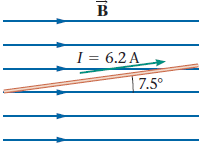
The long, thin wire shown in FIGURE 22-45 is in a region of constant magnetic field B(vector). The wire carries a current of 6.2 A and is oriented at an angle of 7.5° to the direction of the magnetic field. (a) If the magnetic force exerted on this wire per meter is 0.038 N, what is the
A wire with a length of 3.8 m and a mass of 0.65 kg is in a region of space with a magnetic field of 0.74 T. What is the minimum current needed to levitate the wire?
The coil in a loudspeaker has 50 turns and a radius of 3.8 cm. The magnetic field is perpendicular to the wires in the coil and has a magnitude of 0.33 T. If the current in the coil is 280 mA, what is the total force on the coil?
A high-voltage power line carries a current of 110 A at a location where the Earth's magnetic field has a magnitude of 0.59 G and points to the north, 72° below the horizontal. Find the direction and magnitude of the magnetic force exerted on a 250-m length of wire if the current in the wire
A metal bar of mass m and length L is suspended from two conducting wires, as shown in FIGURE 22-46. A uniform magnetic field of magnitude B points vertically downward. Find the angle u the suspending wires make with the vertical when the bar carries a current I.Figure 22-46
For each of the three situations shown in FIGURE 22-47, indicate whether there will be a tendency for the square current loop to rotate clockwise, counterclockwise, or not at all, when viewed from above the loop along the indicated axis.Figure 22-47
A rectangular loop of 280 turns is 35 cm wide and 19 cm high. What is the current in this loop if the maximum torque in a field of 0.48 T is 23 N • m?
A single circular loop of radius 0.15 m carries a current of 3.1 A in a magnetic field of 0.91 T. What is the maximum torque exerted on this loop?
Referring to Figure 22-41, what is the sign of the charge for each of the three particles? Explain.Figure 22-41
In the previous problem, find the angle the plane of the loop must make with the field if the torque is to be half its maximum value.
A square loop of wire 0.15 m on a side lies on a horizontal table and carries a counterclockwise current of 4.2 A. The component of Earth's magnetic field that is in the plane of the loop is 2.5 × 10⁻⁵ T and points toward the top of the loop.(a) Consider a horizontal axis of rotation that passes
Each of the 10 turns of wire in a vertical, rectangular loop carries a current of 0.22 A. The loop has a height of 8.0 cm and a width of 15 cm. A horizontal magnetic field of magnitude 0.050 T is oriented at an angle of u = 65° relative to the normal to the plane of the loop, as indicated in
Find the magnetic field 7.25 cm from a long, straight wire that carries a current of 6.81 A.
How much current must pass through a horizontal power transmission cable in order for the magnetic field at a location 11 m directly below it to be equal to the Earth's magnetic field, which is approximately 5.0 × 10⁻⁵ T?
You travel to the north magnetic pole of the Earth, where the magnetic field points vertically downward. There, you draw a circle on the ground. Applying Ampère's law to this circle, show that zero current passes through its area.
Some pacemakers employ magnetic reed switches to enable doctors to change their mode of operation without surgery. A typical reed switch can be switched from one position to another with a magnetic field of 5.0 × 10⁻⁴ T. What current must a wire carry if it is to produce a 5.0 × 10⁻⁴ T field at a
Two power lines, each 290 m in length, run parallel to each other with a separation of 23 cm. If the lines carry parallel currents of 120 A, what are the magnitude and direction of the magnetic force each exerts on the other?
Consider the long, straight, current-carrying wires shown in FIGURE 22-49. One wire carries a current of 6.2 A in the positive y direction; the other wire carries a current of 4.5 A in the positive x direction.(a) At which of the two points, A or B, do you expect the magnitude of the net magnetic
In Oersted's experiment, suppose that the compass was 0.15 m from the current-carrying wire. If a magnetic field of one-third the Earth's magnetic field of 5.0 × 10⁻⁵ T was required to give a noticeable deflection of the compass needle, what current must the wire have carried?
Showing 5700 - 5800
of 8241
First
51
52
53
54
55
56
57
58
59
60
61
62
63
64
65
Last
Step by Step Answers

 Get 50% OFF
Claim Now
Get 50% OFF
Claim Now


.png)
.png)
.png)
.png)
.png)
.png)
.png)
.png)
.png)
.png)
.png)
.png)
.png)
.png)
.png)
.png)
.png)
.png)
.png)
.png)
.png)
.png)
.png)
.png)
.png)
.png)
.png)
.png)
.png)
-1.png)
-2.png)
.png)
.png)
.png)
.png)
.png)
.png)
.png)
.png)
.png)
.png)


