New Semester
Started
Get
50% OFF
Study Help!
--h --m --s
Claim Now
Question Answers
Textbooks
Find textbooks, questions and answers
Oops, something went wrong!
Change your search query and then try again
S
Books
FREE
Study Help
Expert Questions
Accounting
General Management
Mathematics
Finance
Organizational Behaviour
Law
Physics
Operating System
Management Leadership
Sociology
Programming
Marketing
Database
Computer Network
Economics
Textbooks Solutions
Accounting
Managerial Accounting
Management Leadership
Cost Accounting
Statistics
Business Law
Corporate Finance
Finance
Economics
Auditing
Tutors
Online Tutors
Find a Tutor
Hire a Tutor
Become a Tutor
AI Tutor
AI Study Planner
NEW
Sell Books
Search
Search
Sign In
Register
study help
physics
solid state
Thermal Physics 2nd Edition Charles Kittel, Herbert Kroem - Solutions
Find expressions as function of temperature in the region τ < τE for the energy, heat capacity, and entropy of a gas of N non interacting bosons of spin zero confined to a volume V. Put the definite integral in dimensionless form; it need not be evaluated. The calculated heat capacity above and
Calculate the integral for Nε(τ) for a one-dimensional gas of non-interacting bosons, and show that the integral does not converge. This result suggests that a boson ground state condensate does not form in one dimension. Take λ = 1 for the calculation. (The problem should really be treated by
Consider a Fermi gas of N electrons each of rest mass m in a sphere of radius R. condition sin certain white dwarfs are such that the great majority of electrons have extreme relativistic kinetic energies ε ≈ pc, where p is the momentum. The de Broglie relation remains λ = 2πh/p. Problem 2
Show for a single orbital of a fermion system that = (1 – ),If is the average number of fermions in that orbital. Notice that the fluctuation vanishes for orbitals with energies deep enough below. The Fermi energy so that = 1. By definition, ∆N ≡ N –
If as in (11) is the average occupancy of a single orbital of a boson system, then from (5.83) show that = (1 + M).Thus if the occupancy is large, with >> 1, the fractional fluctuations are of the order of unity: / 2 ≈ 1, so that the actual fluctuations can be enormous. It has been said that
(a) Sketch carefully the chemical potential versus the number of particles for a boson gas in volume V at temperature τ, Include both classical and quantum regimes.(b) Do the same for a system of fermions.
Consider a system of N bosons of spin zero, with orbitals a the single particle energies 0 and ε. The chemical potential is μ, and the temperature is τ. Find r such that the thermal average population of the lowest orbital is twice the population of the orbital at ε. Assume N >> 1 and make what
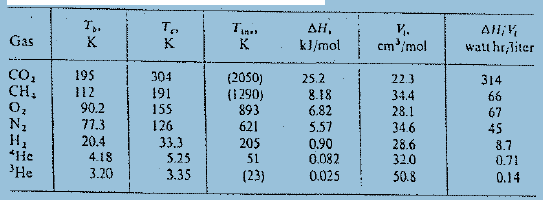
(a) Estimate the liquefaction coefficient λ for helium by treating it as a van der Waals gas. Select the van der Waals coefficients a and b in such a way that fur one mole 2Wb is the actual molar volume of liquid helium and that 2u/b is the actual inversion temperature Use the data in Table 12.1.
(a) Calculate the work WL that would be required to liquefy one mole of a monatomic ideal gas if the liquefier operated reversibly. Assume that the gas is supplied at room temperature To, and tinder the same pressure po at which the liquefied gas is removed, typically I atmosphere, Let Tb be the
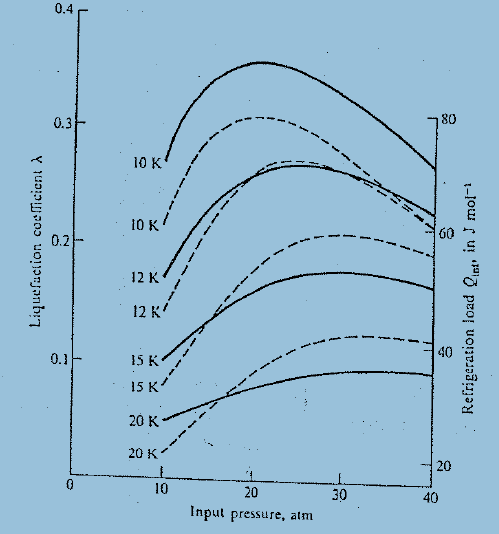
Consider a helium liquefier in which 1 mol s–1 of gas enters the Linde stage at Tin = 15K and at a pressure pin, 30 atm.(a) Calculate the rate of liquefaction, in liter hr-1. Suppose (hat all the tiquefic.1 helium is withdrawn to cool an external experimental apparatus, releasing the boiled-o
Estimate the lowest temperature T that can be achieved by evaporation cooling of liquid 4He if the cooling load is 0.1 W aid the Vacuum pump has a pump speed S = 102 liter s–1. Assume that the helium vapor pressure above the boiling helium is equal to the equilibrium vapor pressure corresponding
Consider a paramagnetic salt with a Debye temperature (Chapter) of 100K. A magnetic field of 100kG or 10tesla is available in the laboratory Estimate the temperature to which the salt must be pre-cooled by other means in order that significant magnetic cooling may subsequently be obtained by the
(a) Show that for a reversible heat pump the energy required per unit of heat delivered inside the building is given by the Carnot efficiency (6):W/Qh = ηc = (τh – τt)/τhWhat happens if the heat pump is not reversible?(b) Assume that the electricity consumed by a reversible heat pump must
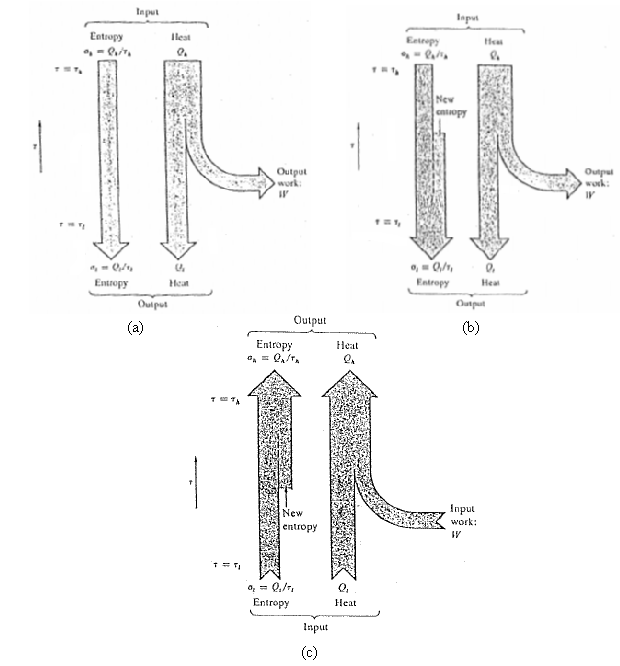
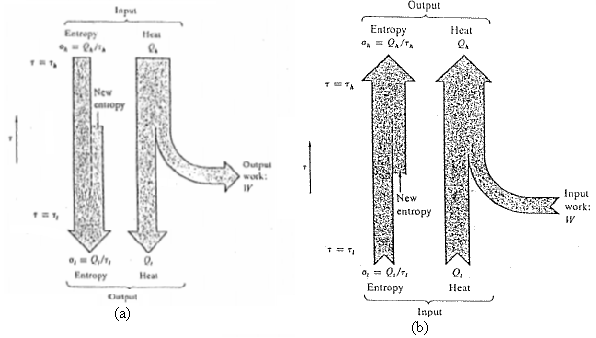
In absorption refrigerators the energy driving the process is supplied not as work, but as heat from a gas flame at a temperature τhh > τh. Mobile home and cabin refrigerators may be of this type, with propane fuel.(a) Give an energy-entropy flow diagram similar to figures for such a
Consider a carnot engine that uses as the working substance a photon gas. (a) Given τh and τl as well as V1 and V2, determine V3 and V4.(b) What is the heat Qh taken up and the work done by the gas during the first isothermal expansion? Are they equal to each other, as for the ideal gas? (c) Do
The efficiency of a heat engine is to be improved by lowering the temperature of its low-temperature reservoir to a valuer τl, below the environmental temperature τl, by means of a refrigerator. The refrigerator consumes part of the work produced by the heat engine. Assume that both the heat
A river with a water temperature Tl = 20oC is to be used as the low temperature reservoir of a large power plant, with a steam temperature of Th = 500oC. If ecological considerations limit the amount of heat that can be dumped into the river to 1500 MW, what is the largest electrical output that
A room air conditioner operates as a Carnot cycle refrigerator between an outside temperature Th and a room at a lower temperature T1. The room gains heat the outdoors at a rate A (Th – Tl); this heat is removed by the air conditioner. The power supplied to the cooling unit is P. (a) Show that
A 100 W light bulb is left burning inside a Carnot refrigerator that draws 100 W. Can the refrigerator cool below room temperature?
A very large mass M of porous hot rock is to be utilized to generate electricity by injecting water and utilizing the resulting hot steam to drive a turbine. As a result of heat extraction, the temperature of the rock drops, according to dQh = – MCdTh, where C is the specific heat of the rock,
We saw in Chapter 4 that the heat capacity of nonmetallic solids at sufficiently low temperatures is proportional to T3, as C = aT3.Assume it were possible to cool a piece of such a solid to T = 0 by means of a reversible refrigerator that uses the solid specimen as its (varying!) low-temperature
Consider a gas of N non-interacting, spin ½ fermions of mass M, initially in a volume Vi at temperature τi = 0. Let the gas expand irreversibly into a vacuum, without doing work, to a final volume Vf. What is the temperature of the gas after expansion if Vf is sufficiently large for the classical
(a) Prove the three Maxwell relations(∂V/∂τ)p = – (∂σ/∂P)τ,(∂V/∂N)p = + (∂μ/∂P)N,(∂μ/∂τ)N = – (∂σ/∂N)τ,Strictly speaking, (45α) should be written(∂μ/∂τ)p,N = – (∂σ/∂P)τ,N,And two subscripts should appear similarly in (45b) and (45c). It is
Consider the formation of atomic hydrogen in the reaction c + H+ = H, where e is an electron, as the adsorption of an electron on a proton H+. (a) Show that the equilibrium concentrations of the reactants satisfy the relation [e][H+]/[H] ≈ nQ exp(–I/τ),Where I is the energy required to ionize
A pentavalent impurity (called a donor) introduced in place of a tetravalent silicon atom in crystalline silicon acts like a hydrogen atom in free space, but with e2/ε playing the role of e2 and an effective mass m* playing the role of the electron mass m in the description of the ionization
Consider the chemical equilibrium of a solution of linear polymers made up of identical units. The basic reaction step is monomer + Nmer = (N + 1)mer. Let KN denote the equilibrium constant for this reaction.(a) Show from the law of mass action that the concentrations [∙∙∙] satisfy[N + 1] =
(a) Find a quantitative expression for the thermal equilibrium concentration n = n+ = n– in the particle-antiparticle reaction A+ + A– = 0. The reactants may be electrons and positrons; protons and antiprotons; or electrons and holes in a semiconductor. Let the mass of either particle be M;
(a) Show that the entropy of the Vander Waals gas is σ = N{log[nQ(V – nb)/N] + 5/2}.(b) Show that the energy is U = 3/2 Nτ – N2α/V(c) Show that the enthalpy H ≡ U +PV isH(τ, V) = 5/2Nτ + N2bτ/V – 2N2α/V;H(τ, P) = 5/2Nτ + NbP – 2NαP/τ.All results are given to first order in the
Calculate from the vapor pressure equation the value of dT/dp neat p = 1 atm for the liquid-vapor equilibrium of water. The heat of vaporization at 100oC is 2260Jg-1. Express the result in Kelvin/atm.
The pressure of water vapor over ice is 3.88 mm Hg at – 2oC and 4.58 mm Hg at 0oC. Estimate in J mol-1 the heat of vaporization of ice at – 1oC.
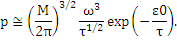
Consider a version of the example (26)–(32) in which we let the oscillators in the solid move in three dimensions.(a) Show that in the high temperature regime (τ >> hω) the vapor pressure is(b) Explain why the latent heat per atom is ε0 – 1/2τ.
Consider the gas-solid equilibrium under the extreme assumption that the entropy of the solid may be neglected over the temperature range of interest. Let –ε0 be the cohesive energy of the solid, per atom. Treat the gas as ideal and monatomic. Make the approximation that the volume accessible to
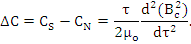
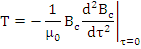
(a) Show that,in S1 units for Bc- Because Bc decreases with increasing temperature, the right side is negative. The superconducting phase has the lower entropy: it is the more ordered phase. As τ → 0, the entropy in both phases will go to zero, consistent with the third law. What does this
The Bc(τ) curves of most superconductors have shapes close to simple parabolas. Suppose that Bc(τ) = Bc0[1 – (τ/τc)2]Assume that Cs vanishes faster than linearly as τ → 0. Assume also that CN is linear in τ, as for a Fermi gas (Chapter 7). Draw on the results of problem 6 to calculate and
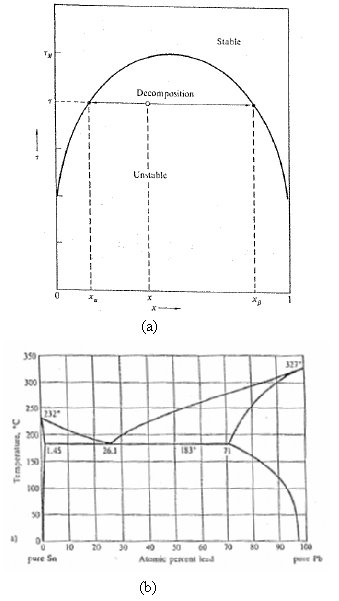
Consider a crystal that can exist in either of two structures, denoted by α and β. We suppose that the x structure is the stable low temperature form and the β structure is the stable high temperature form of the substance. If the zero of the energy scale is taken as the state of separated atoms
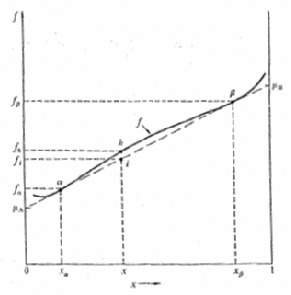
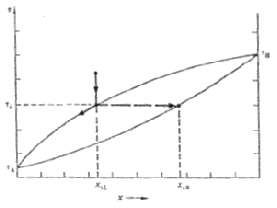
Show that the chemical potentials μA and μB of the two atomic species A and B of an equilibrium two phase mixture are given by the intercepts of the two-point tangent in Figure with the vertical edges of the diagram at x = 0 and x = 1.
The phase diagram of liquid 3He– 4He mixtures in Figure shows that the solubility of 3He in 4He remains finite (about 6 pct) as τ → 0. Similarly, the Pb-Sn phase diagram of Figure shows a finite residual solubility of Pb in solid Sn with decreasing τ. What do such finite residual solubilities
Let B be an impurity in A, with X
Consider the solidification of a binary alloy with the phase diagram of Figure. Show that, regardless of the initial composition, the melt will always become fully depleted in component B by the time the last remnant of the melt solidifies. That is, the solidification will not be complete until the
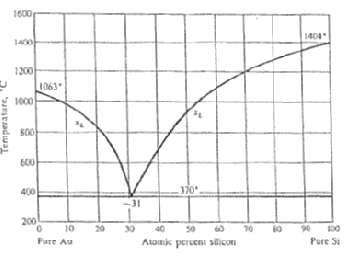
(a) Suppose a 1000 A layer of Au is evaporated onto a Si crystal, and subsequently heated to 400oC. From the Au-Si phase diagram, Figure, estimate how deep the gold will penetrate into the silicon crystal. The densities of Au and Si are 19.3 and 2.33g cm-3.(b) Redo the estimate for800oC.
Calculate the electron and hole concentrations when the net donor concentration is small compared to the intrinsic concentration. |∆|
The electrical conductivity isσ = e(nεμε + nhjih)where μe > and μh are the electron and hole mobilities. For most semiconductors μe > μh.(a) Find the net ionized impurity concentration ∆n = nd+ – nd – for which the conductivity is a minimum. Give a mathematical expression for this
A manufacturer specifics the resistivity p = 1/σ of a Ge crystal as 20 ohm cm. Take μe = 3900 cm2 V–1 s–1 and μh = 1900 cm2 V–1 s–1. What is the net impurity concentration a) if the crystal is n-type; b) if the crystal is p-type?
Derive (39), which is the form of the law of mass action when n is no longer small compared to nc.
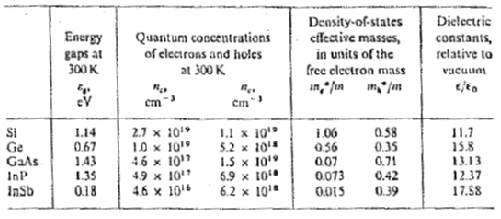
Calculate ne, nh and μ - ec for n-type lnSb at 300K, assuming nd + = 4.6 x 10cm–3 = nc. Because of the high ratio nv/nc and the narrow energy gap, the hole concentration is not negligible under these conditions, nor ms the non-degenerate approximation nc
Find the fraction of ionized donor impurities if the donor ionization energy is large enough that ∆εd is larger than τ log(nc/8nd) by several times τ. The result explains why substances with large impurity ionization energies remain insulators even if impure.
Suppose that in a p-type semiconductor the ionized acceptor concentration at x = x1, is na – = n1 > n1 at x = x2. What is the build-in electric field in the interval (x1, x2)? Give numerical values for n1/n2 = 103 and x2 – x1 = 10-5 cm. Assume T = 300K. Impurity distributions such as this occur
Use the Joyce-Dixon approximation (38) to give a series expansion of the ratio De/μe for electron concentrations approaching or exceeding nc.
Use the Joyce-Dixon approximation to calculate at t = 300K the electron-hole pair concentration in GaAs that satisfies the inversion condition (88), assuming no ionized impurities.
Assume both electron and hole concentrations in a semiconductor are raised by δn above their equilibrium values. Define a net minority carrier lifetime t by R = δn/t. give expressions for t in terms of the carrier concentrations ng and nb: the energy of the recombination level, as expressed by ng
Inside a reverse biased p-n junction both electrons and holes have been swept, out(a) Calculate the electron-hole pair generation rate under these conditions, assuming nc* = nh* and tc = th = t.(b) Find the factor by which this generation rate is higher than the generation rate in an n-type
(a) Show that the root mean square velocty vrms isBecause + +
(a) Find the mean kinetic energy in a of molecules that exits from a small hole in an oven at temperature τ. (b) Assume now that the molecules are collimated by a second hole farther down the beam, so that the molecules that pass through the second hole have only a small velocity component normal
Show for a classical gas of particles of charge q thatK/τσ = 3/2q2, or K/Tσ = 3kB2/2q2in conventional units for K awl T This is known as the Wiedemann-Franz ratio.
The thermal conductivity of copper at room temperature is largely carried by the conduction e1etrorm, one per atom. The mean free path of the electrons at 300 K is of the order of 400 x 10–8 cm.The conduction electron concentration is 13 x l022 per cm3. Estimate (a) The electron contribution to
Consider a medium with temperature gradient dτ/dx. The particle concentration is constant.(a) Employ the Boltzmann transport equation in the relaxation time approximation to find the first order non-equilibrium classical distribution:(b) Show that the energy flux in the x direct ion iswhere vx2 =
Show that when a liquid 1ows through a narrow tube under pressure difference p between the ends, the total volume flowing through the tube in unit time isV = (πa4/8ηL)p,where η is the viscosity; L is the length; a is the radius. Assume that the flow is laminar and that the flow velocity at the
Show that for air at 20◦C the speed of a tube in 1ftes per second is given by, approximately.where the length L and diameter d are in centimeters; we have tried to correct for end effects on tube of finite length by treating the ends as two halves of a hole in series with the tube.
Consider a distribution that at the initial time t = 0 has the form of a Dirac delta function δ(x). A delta function can he represented by a Fourier integral:At later times the pulse becomesor by use of(10),Evaluate the integral to obtain the result (14). The method can be extended to describe the
Diffusion in two and three dimensions. (a) Show that the diffusion equation in two dimension admits the solutionθ2(t) = (C2/t)exp (-r2/4Dt)and in three dimensions(b) Evaluate the constants C2 and C3. These solutions are analogous to (14) and describe the evolution of a delta function at t = 0.
Consider a hypothetical climate in which both the daily and the annual variations of the temperature are purely sinusoidal with amplitudes θd = 10◦C. The mean annual temperature θd = 10◦C. Take the thermal diffusivity of the soil to be 1 x 10⁻³ cm2 s–1. What is minimum depth at which
Suppose a hot slab of thickness 2a and initial uniform temperature θ1 is suddenly immersed into water of temperature θa < θ1, thereby reducing the temperature at the surface of the slab abruptly θ0 and keeping it there. Expand the temperature in the slab in a Fourier series. After some time all
Suppose a silicon crystal is p-type doped with a concentration of na = l016 cm–3 of boron atoms. If the crystal slab is heated in an atmosphere containing phosphorus atoms, the latter will diffuse as donors with a concentration nd (x) into the semiconductor. They will form a p-u junction at that
When internal heat sources are present, the continuity equation (5) must be modified to read where gu is the heat generation rate per unit volume. Examples include Joule heat generated in a wire; heat from the radio3ctive decay of trace elements inside the Earth or the Moon. Give an expression for
Extend the considerations of the preceding problem to particle diffusion, and assume that there is a net particle generation rate gu that is proportional to the local particle concentration, gu = n/t0, where t0 is a characteristic Unit Constant, Such behavior describes the neutron generation in a
Showing 200 - 300
of 265
1
2
3
Step by Step Answers

 Get 50% OFF
Claim Now
Get 50% OFF
Claim Now



![[FN+1 - FN - F1)] exp no (N)nq (1) no (N+ 1) KN](https://dsd5zvtm8ll6.cloudfront.net/si.question.images/images/question_images/1550/7/4/1/0415c6e6e31526031550741043861.jpg)