New Semester
Started
Get
50% OFF
Study Help!
--h --m --s
Claim Now
Question Answers
Textbooks
Find textbooks, questions and answers
Oops, something went wrong!
Change your search query and then try again
S
Books
FREE
Study Help
Expert Questions
Accounting
General Management
Mathematics
Finance
Organizational Behaviour
Law
Physics
Operating System
Management Leadership
Sociology
Programming
Marketing
Database
Computer Network
Economics
Textbooks Solutions
Accounting
Managerial Accounting
Management Leadership
Cost Accounting
Statistics
Business Law
Corporate Finance
Finance
Economics
Auditing
Tutors
Online Tutors
Find a Tutor
Hire a Tutor
Become a Tutor
AI Tutor
AI Study Planner
NEW
Sell Books
Search
Search
Sign In
Register
study help
business
auditing assurance services
Auditing Assurance And Risk 3rd Edition W. Robert Knechel, Steve Salterio, Brian Ballou - Solutions
What aspects should be taken into account when planning client inquiries? How can evidence collected by means of inquiry be supplemented with other types of evidence? Give examples.
One of the techniques that auditors can use when obtaining analytical evidence is ratio analysis across a number of categories. Describe these categories and provide examples of ratios in each category.
Analytical review evidence is required during two stages of the audit and allowable in another. Identify all three stages and describe how the use of analysis differs among these stages?
Although analysis can be a very helpful tool for the auditor in identifying risks, there are a number of common mistakes made when performing these procedures. Describe the most common mistakes and provide an example of each.
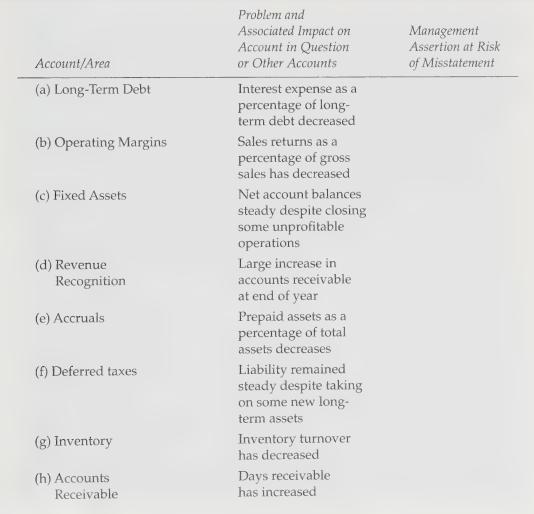
Assume that as an audit manager of a large multinational manufacturer of athletic apparel (e.g., Adidas, Nike, Reebok), you perform high-level preliminary analytical procedures on the unaudited financial statements at the beginning of the audit engagement and discover the following fluctuations:a.
For each of the items in Problem 1 above, discuss what procedure you would follow to investigate whether the change in the ratio resulted from the normal business event you hypothesized. What other ratios may give you some clues to aid your investigation?Problem 1Assume that as an audit manager of
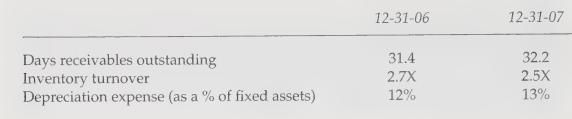
The results of the preliminary analytical review for Monk, Inc. include the following:The ratios have not changed significantly over the past year. Does this finding suggest that risk in these areas is assumed to be lower than if the ratios had changed dramatically? Give an example for each ratio
Market value ratios, such as the market-to-book ratio or dividend payout ratio, are helpful to the auditor in assessing risk for an engagement. For example, assume that you are the partner in charge of the audit of Clary Co., a publicly traded cable television company serving several medium-sized
Describe the effect of adding debt to a company's balance sheet has on the company's ROA versus its ROE. Specifically, why does ROE vary more widely for any given change in performance when the company acquires more debt? Use as an example an all-equity firm with total assets of \(\$ 100,000\) and
You are planning the audit of Ruta Corp., a privately held publisher of comic books. Step 1 of the preliminary analytical procedures requires you to gather as many facts as possible on the company's activities in the past year that may affect the financial statements. Among those facts are the
Once you have completed the preliminary analytical review stage of the audit, you will next determine the implications for audit planning from the risks identified in the analysis. Suppose you are the audit manager for McNulty Co., a large New Zealand canner of fruit and nuts sold through grocery
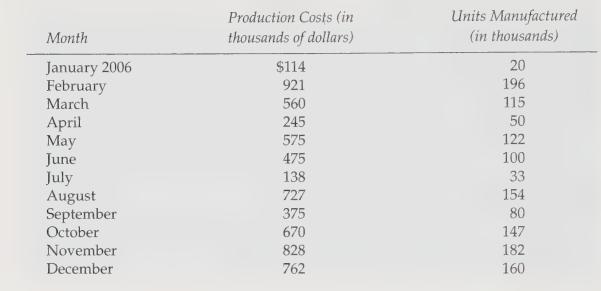
Examine the following data from the preliminary analytical procedures for HammerHead Company, a Canadian tool manufacturer, that relates manufacturing costs of a socket wrench to units manufactured.Requireda. Estimate a univariate regression where units of production predict production costs. An
Below you will find the financial statements for nine companies in different industries. Match each financial statement to the corresponding company:1. Clothing Retailer 2. Electric Utility3. Machinery Manufacturer4. Commercial Bank 5. Grocery Retailer6. Liquor Distiller7. Computer Manufacturer
Management of the Miles Davis Co. reports that sales transactions for the year were \(\$ 150\) million; the allowance for doubtful accounts was \(\$ 1\) million; and net, unrestricted accounts receivable on the balance sheet is \(\$ 11.5\) million. Discuss how all assertions for transactions,
For each of the following situations, state the category (transaction, account, presentation, and disclosure) and management assertion that is most likely violated.a. Inventory en route at the close of the accounting period and marked FOB destination is included in ending inventory.b. The purchase
Identify the type of audit procedure employed (test of control, analytical procedure, or substantive test of accounts, transactions, or disclosure), the type of evidence obtained, and management assertion addressed in each of the following situations.a. The auditor uses a sophisticated regression
For each of the following situations, choose the type(s) of audit evidence that would give the auditor the most assurance that the management assertion provided (in parentheses at end of each item) is reasonably accurate.a. The cash balance of a retail auto parts store (existence).b. The accounts
George Auditor is choosing the best audit procedures for several of his clients. He notes two alternatives for several situations. For each of the following situations- identify the type of evidence for each of the two alternatives- indicate which of the two alternatives is likely to provide the
Professional skepticism is an important necessary condition to perform an effective audit. For each of the following two conditions, describe steps that the auditor should take to help better establish a state of mind consistent with professional skepticism.a. You are a new auditor for a firm,
Suppose you are auditing the financial statements of a large publicly traded firm when you discover some material misstatements that result from error.a. Discuss the most likely scenario that would unfold when you brought these misstatements to the attention of management.b. How would that scenario
For each of the following situations: (1) determine whether an employee fraud or a management fraud has likely been committed, (2) discuss the likelihood that the auditor will discover the fraud under ordinary circumstances, and (3) discuss the implications for the audit if the fraud is not
Suppose that you are on an audit engagement when you come across evidence that the CEO has been diverting significant amounts of corporate resources for his own purposes. In other words, he is embezzling.a. What should you do?b. Why do you think an auditor does not immediately report fraudulent
Consider two cases of fraud your audit firm came across in the course of its audit of Marsalis \& Associates, an Internet service provider.- A few employees are bootlegging some of the Internet software to their friends. None of the employees is in a management position and the operations of the
You are auditing the financial statements of a regional medical center that serves a metropolitan area and the surrounding suburban areas. You identify the following situations that could lead to potentially material misstatements in their financial statements:a. Property, Plant, and Equipment is
A recent graduate tells you, "I normally set materiality at 5 percent of net profit. However, I set it at negative \(\$ 50\) million for a company that made a huge loss, and at \(\$ 5\) for a non-profit organization that has an objective of breaking even. But then the partner in charge changed my
What effect does the acceptable level of audit risk have on the materiality threshold? For example, when auditing the inventory of a well-respected company that has never been subjected to a financial statement audit, would you set the materiality threshold any lower than if this was a repeat
Many countries require auditors to alert users of financial statements when there is substantial doubt about an entity's ability to continue as a going concern. Given that this is the only forward-looking opinion offered by auditors, describe why you believe that this requirement is in place?
In late 2005, the airline industry in the United States had an unprecedented situation in which four of the five largest airlines had filed bankruptcy and were undergoing reorganization processes to try to recover. Describe how this type of economic environment affects client business risk,
For each of the following scenarios, indicate whether the auditor would issue (1) an unqualified or adverse opinion on management's assessment of ICOFR effectiveness and (2) an unqualified or adverse opinion on actual ICOFR effectiveness. Explain.a. Management identifies a less than material but
When testing for the fairness of the financial statements, auditors can reduce the extent of testing if they have assessed the risk of misstatements to be low and found that the internal controls in place to be effective. Argue why the auditor is justified to reduce substantive testing under this
When deciding to accept a new client (or retain an existing client) the auditor faces a trade-off. Describe this trade-off and discuss how auditors can and should deal with this trade-off.
Reviewing accounting estimates is a critical part of the audit engagement. List concerns that you would have when auditing an organization that consistently fails to meet its earnings targets when not incorporating two accounting estimates-allowance for doubtful accounts and estimated warranty
When an auditor disagrees with the accounting treatment selected by management for a material item, and management or those charged with governance refuses to change, what types of audit opinion are able to be issued? Why will the threat of issuing such an opinion generally result in the client
In his audit planning, why should an auditor pay specific attention to the following?- Related party transactions- Use of specialists- Use of internal auditors
Discuss the risks auditors face by not following professional auditing standards and how those risks are expected to change in the near future as a result of changes in business conditions, technology, and regulation.
Your audit firm is considering taking on as a client an Australian firm that has operated as a closely held company for its entire history. Because it is a leading exporter of wines to the United States, it is going public for the first time by registering as a public company in the United States.
As described in this chapter, auditors are required to communicate certain issues with the predecessor auditor before accepting a new engagement. These issues include the reason for the change, the nature of any disagreements with management, identification of any important risk areas or control
You have recently been hired to perform the year-end audit for Coleman Co., a manufacturer of inexpensive jewelry items for sale at mall kiosk and costume jewelry outlets. Among the results of your preliminary planning are the following:a. Management is compensated based on an aggressive,
You have been contracted to audit the financial statements of Ben Webster \& Associates, a privately held real estate investing firm. Ben has been in the business for several years and has built up a sizable portfolio of properties, mostly commercial office buildings, but has never issued audited,
In your year-end audit of The Joshua Redman Co., a defense contractor specializing in building sophisticated tracking systerns for missile defense systems, you bring in a specialist, Mal Waldron, to assist your valuation of work-in-process and finished goods inventory. Mal has conducted the same
Consider the internal audit staffs of the following two companies:Carl Company's internal auditors are college graduates who have been hired mostly from the ranks of marketing personnel who did not make sales quotas. They report to the controller of Carl Company. Their tasks include reconciling all
Specialists may be required to perform audit tasks that require knowledge or skills outside the auditor's abilities. Examples from the text include an engineer (to verify the stage of completion of electronic components) and an actuary (to evaluate pension liabilities and expenses). For each of the
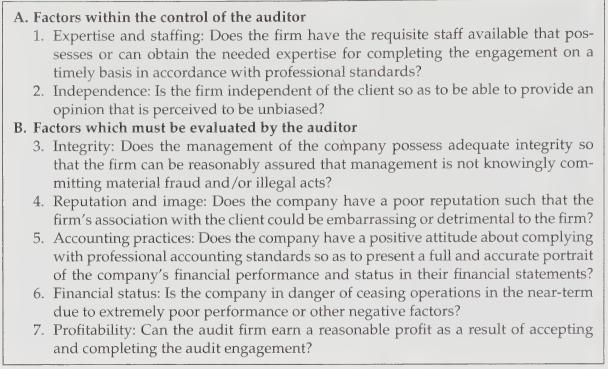
Client-acceptance decisions have become increasingly important. This is mainly due to the increased risk of litigation against audit firms in some countries as a result of being associated with failed business, unethical organizations, or perceived problems with independence. Hence, it is essential
For each scenario below, describe which of the five general conditions that undermine independence in appearance is most relevant.a. An auditor recommends its audit clients' services to other clients based on her understanding of the quality of such services.b. A partner serves an audit client even
What is strategic analysis? Discuss the types of knowledge that auditors strive to obtain from the analysis.
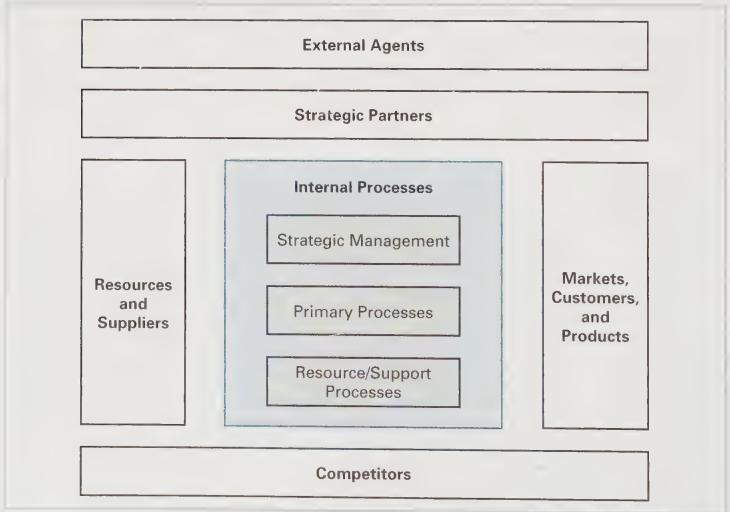
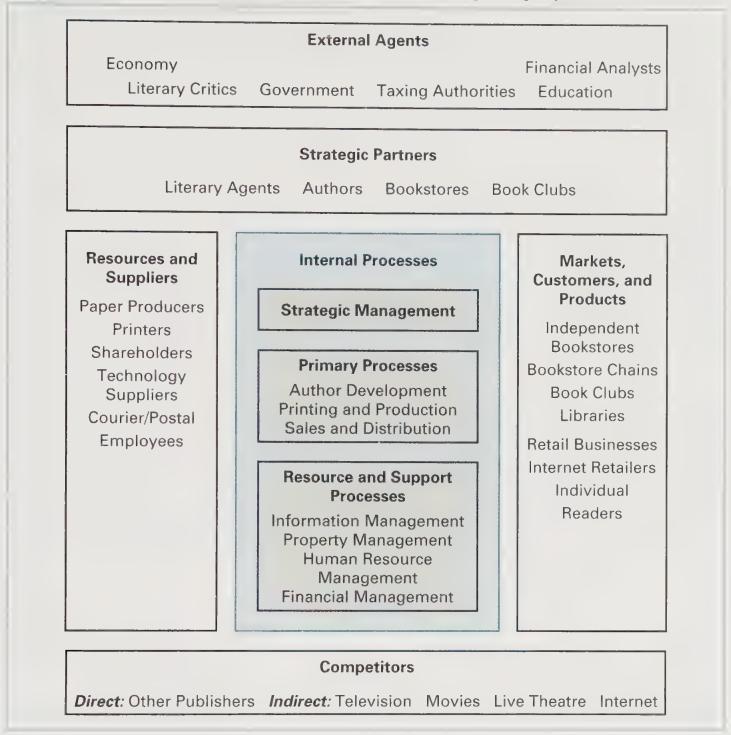
What are the elements of an organizational business model? How does this information help an auditor better develop a strategy for conducting an audit?
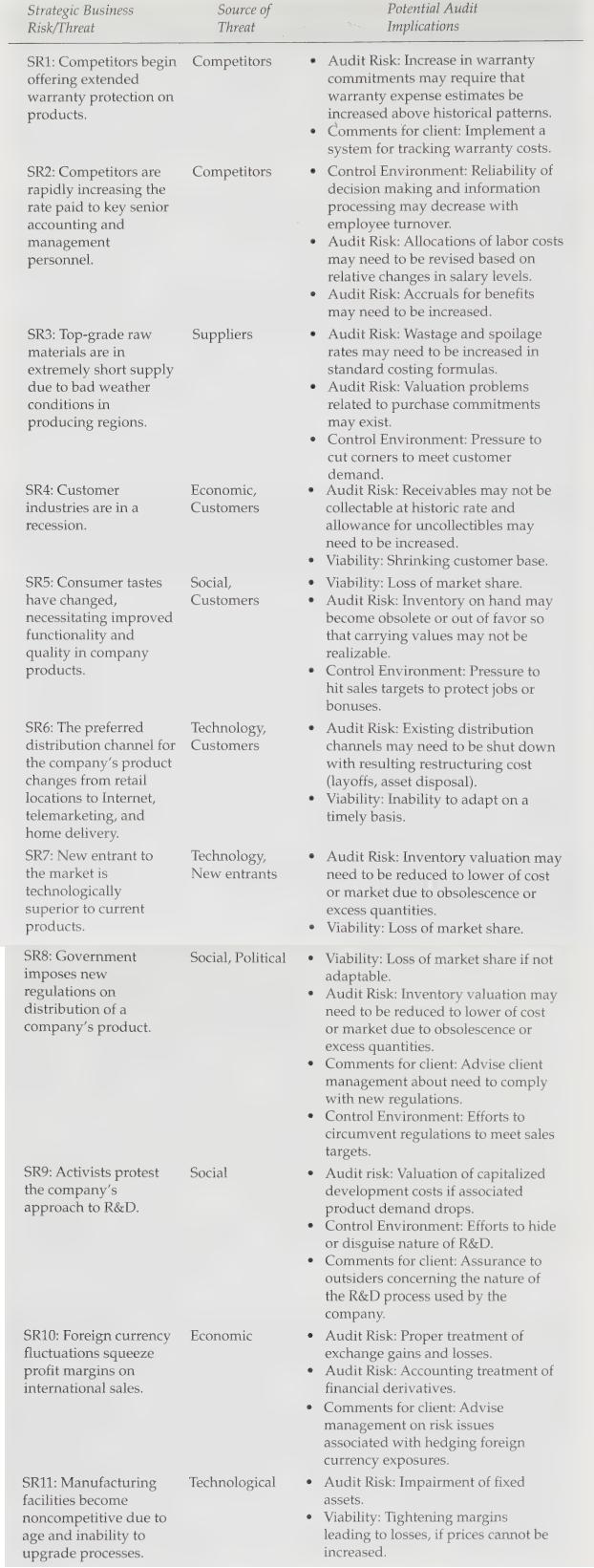
Briefly explain the five audit implications of strategic risks.
Describe and discuss the categories of strategic risks, including both macroenvironmental forces and industry forces, that the auditor should consider in strategic risk analysis.
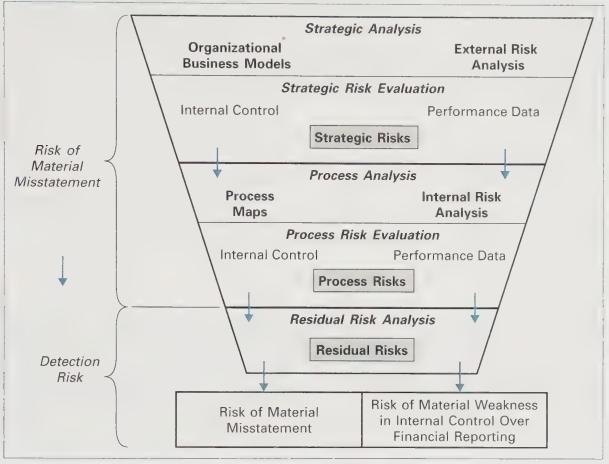
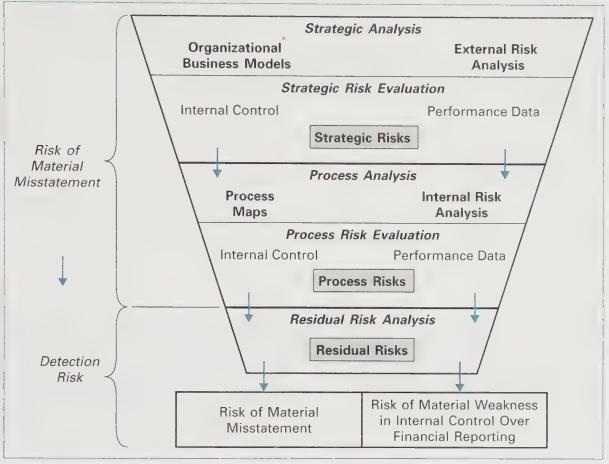
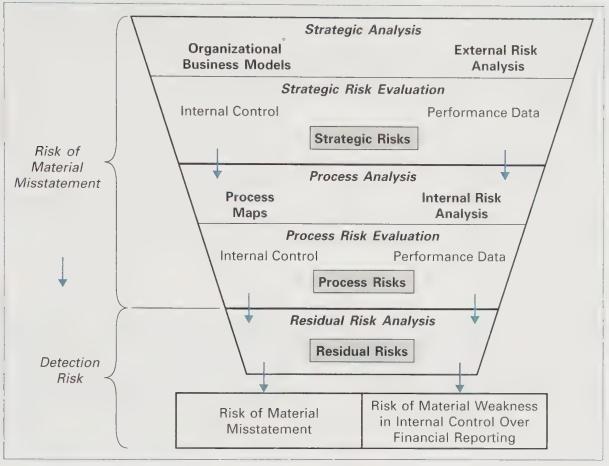
Describe the position of strategic analysis in the auditor's knowledge acquisition process and its relationship to the other parts of this process (use Figure 5-2 as a guide).Figure 5-2 Risk of Material Misstatement Strategic Analysis Organizational Business Models External Risk Analysis Strategic
Any given strategic risk can have a number of implications for the audit process. Describe the general audit implications discussed in the chapter.
What is a residual risk? What is the primary implication of residual risk for assessing the risk of material misstatement as shown in Figure 5-2?Figure 5-2 Risk of Material Misstatement Strategic Analysis Organizational Business Models External Risk Analysis Strategic Risk Evaluation Internal
Explain what procedures are involved in strategic analysis, process risk analysis, and residual risk analysis.
Give five examples of the potential indications of weak strategic management, and discuss their respective audit implication(s).
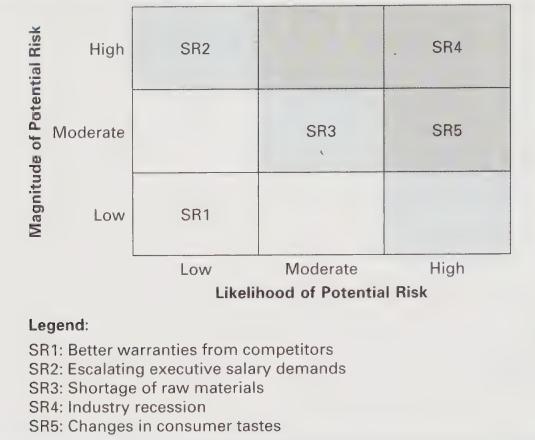
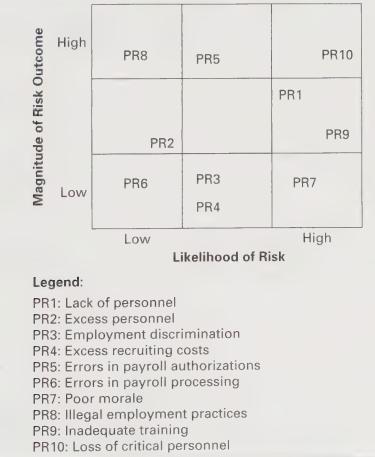
What is a risk map? What value can an auditor derive from plotting strategic risks on a risk map?
What is external risk analysis, and how does it help the auditor to better understand the residual risks associated with the classes of transactions, accounts, and disclosures?
Figure 5-2 describes a top-down perspective for understanding a client's business. Consider how an auditor can better understand how to approach testing management assertions for inventory related transactions and accounts by first working through this process (that is, by linking external risks to
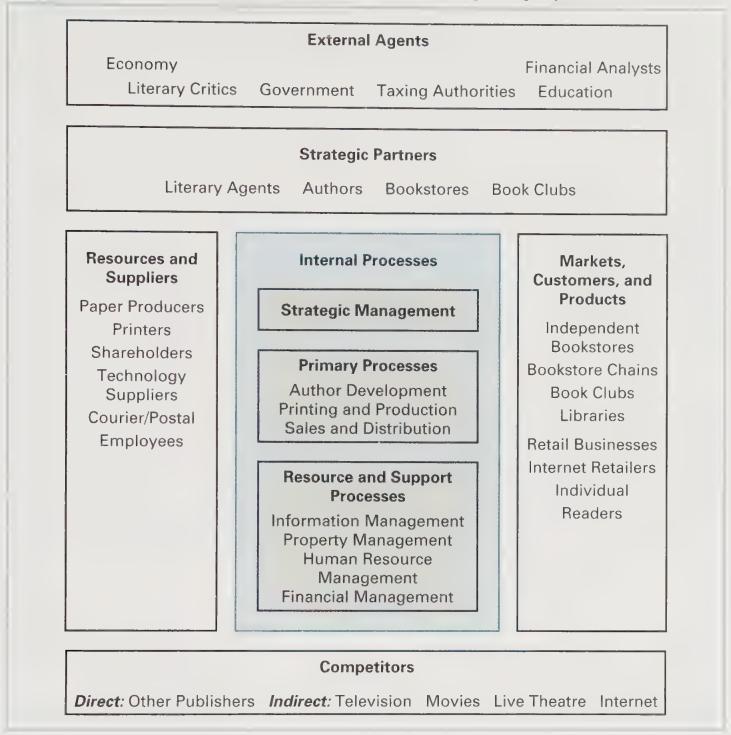
A business model analysis provides the auditor with a basis for determining the unique issues that the client faces in its operations by identifying and analyzing the firm's suppliers, competitors, buyers, external agents, and so forth. Many companies can say that they are a supplier, a competitor,
Suppose you are the auditor of a company which cuts timber and processes logs for export purpose. Construct a plausible organization business model for this company.
External risk analysis involving industry forces involves studying five risks common to all businesses. They are as follows:a. Competitive intensityb. Potential entrantsc. Substitutesd. Supplierse. Buyers Consider a sole proprietor pizzeria in the food court of a large mall. Identify the five
Conduct a strategic analysis using macroeconomic forces (PEST factors) and industry forces (Porter's Five Forces) for British Airways.
Starbucks dominates the coffee roasting, distribution, and pouring market. Starbucks owns or licenses over ten thousand stores internationally that sell primarily various coffee-related drinks featuring its gourmet roasts of coffee. To expand its market presence and increase its brand value,
Consider Dell Computer Corporation, which markets its products directly from the manufacturing facilities to customers through purchases on the Internet or via telephone.a. Discuss the macroenvironmental forces (PEST factors) that may have an affect on Dell and its ability to meet its business
You are auditing Telezee Limited, a major company in the telecommunications industry in New Zealand. Explain one audit implication for each of the following five issues that you discover during your review of business risk and strategy:a. The revenue of the industry is growing overall, but there
Access the corporate web site for The Gap, Inc., which operates The Gap, Old Navy, Banana Republic, and Forth and Towne. Search the web site for information about its business processes, products, history, and so forth, and construct a business model based on what is contained on the site (use
Use the information in the business model (prepared for question 9) and on the web site for The Gap, Inc., as a basis for identifying the company's strategic objectives and then perform an external risk analysis that addresses key threats to meeting those objectives (use Figure 5-10 as a
Use Figure 5-9 as a guide in determining the audit implications for the following possible business risks associated with Loblaw's, the largest food distributor and one of the largest retail grocers in Canada.- The grocery industry is in a state of decline, as new competitors not strictly in the
Identifying residual strategic risks (that is those that are uncontrolled or insufficiently controlled) is important for auditors to understand where the risk of material misstatements might be increased by increasing external pressures on an organization. Consider Apple, which has seen its
Consider the strategic positioning strategies described in this chapter. Discuss how the auditors might alter their audit approach to account for the company's particular differentiation strategy. Consider both strategic and process issues.- Signet (which operates under Signet Jewelers in the
What is a business process? How do organizations use them as a key part of the strategic management process at an organization?
Why should auditors develop an understanding of business processes? What impact does such understanding have on the ability to conduct an effective and efficient audit of the financial statements?
Business processes are described as being either primary processes or support processes. Compare and contrast each type of business process. Explain as part of your answer why either type of business process can be critical for an organization for achieving its strategic objectives.
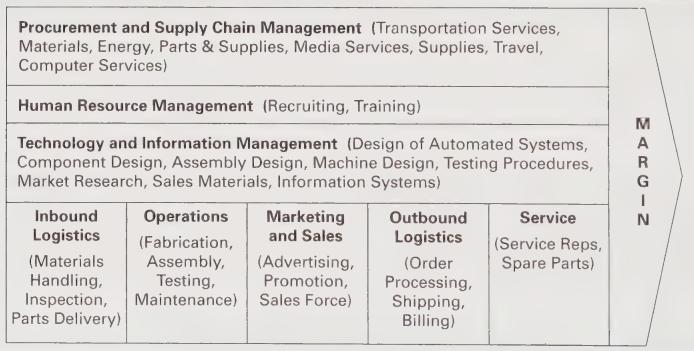
What is a value chain? Examine the sample value chain presented in Figure 6-3 and describe how breakdowns in various parts of the value chain can affect management assertions about classes of transactions on the financial statements.Figure 6-3 Procurement and Supply Chain Management (Transportation
Compare and contrast business process risks to strategic risks. When considering both types of risks, consider how management responds to each type of risk.
What is the role of business processes for financial reporting? How do information systems impact this role?
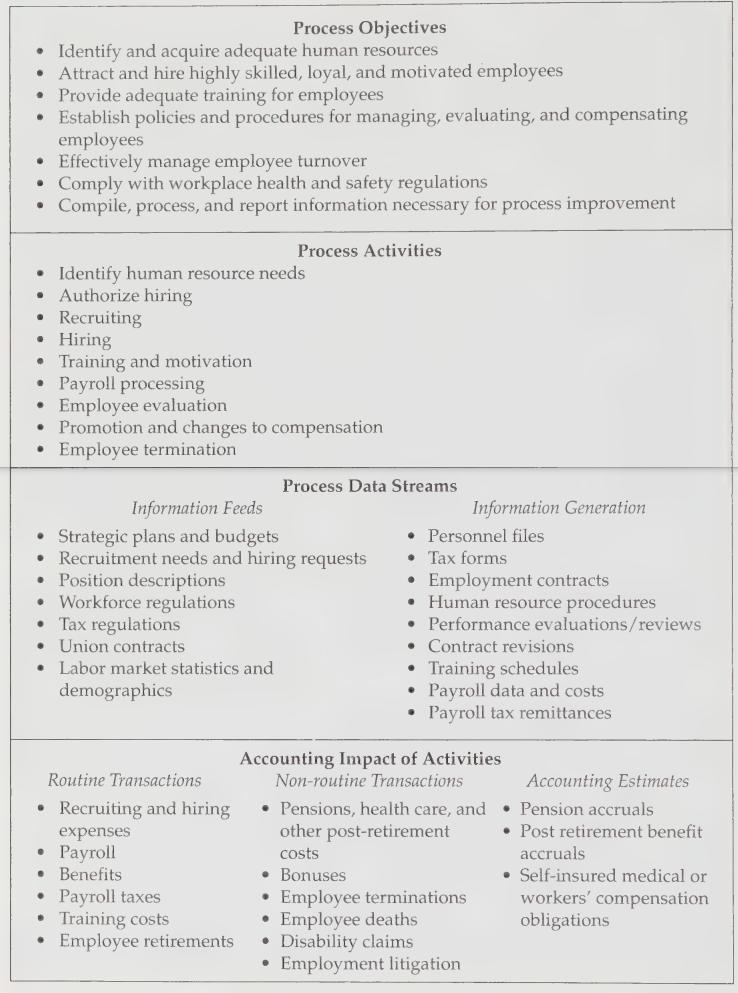
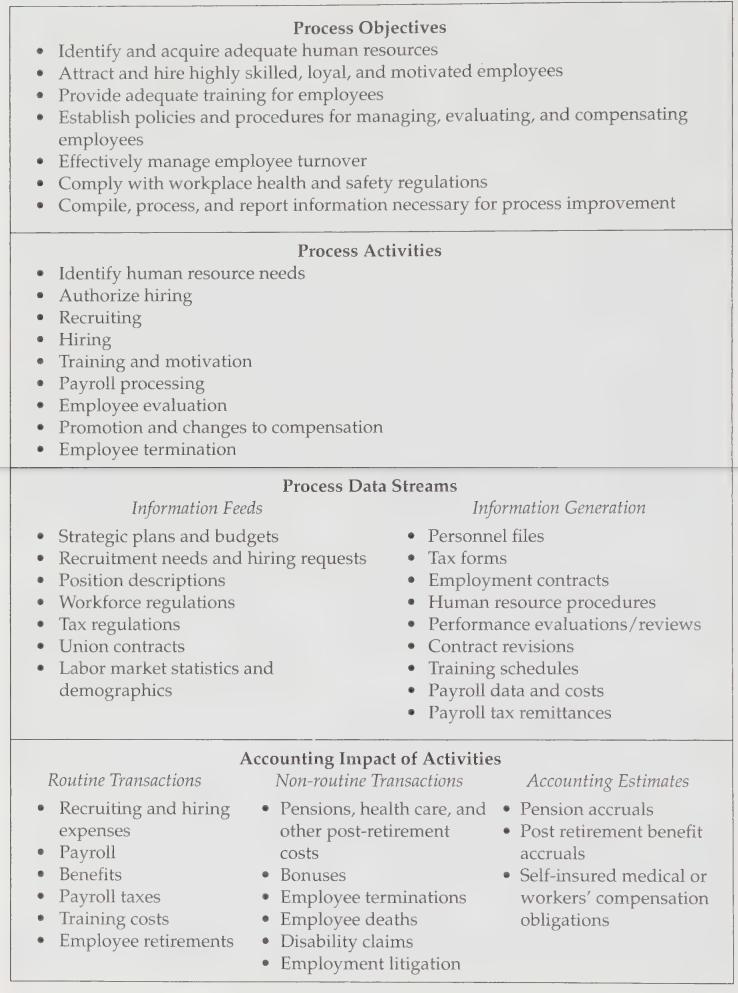
Describe the importance of understanding process objectives. Who in the organization should an auditor utilize to best understand the process objectives in place for a given business process? How should an auditor evaluate business process objectives?
Why should auditors understand and document process activities, inputs, and outputs for a process being analyzed? For example, by documenting process activities, how will the auditor's ability to develop an understanding about transactions generated within the process be impacted?
What are the key differences between routine transactions, non-routine transactions, and accounting estimates that are relevant for the auditor. As part of the discussion, consider the likelihood of misstatements across each classification and the client's motivation to develop effective controls
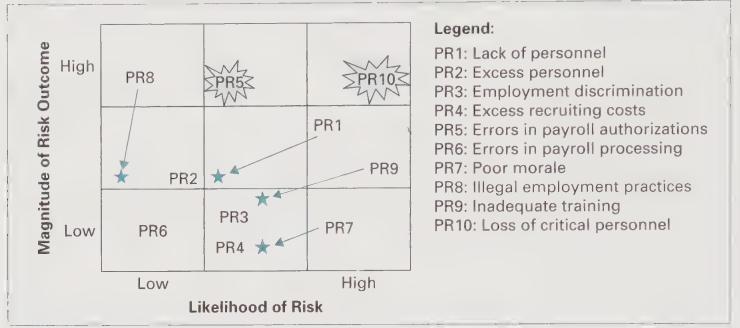
When identifying key process risks that could reduce the likelihood of achieving process objectives and impact the likelihood that transactions generated within the process could be misstated, why should the auditor consider both the likelihood and impact of the inherent risk? After assessing the
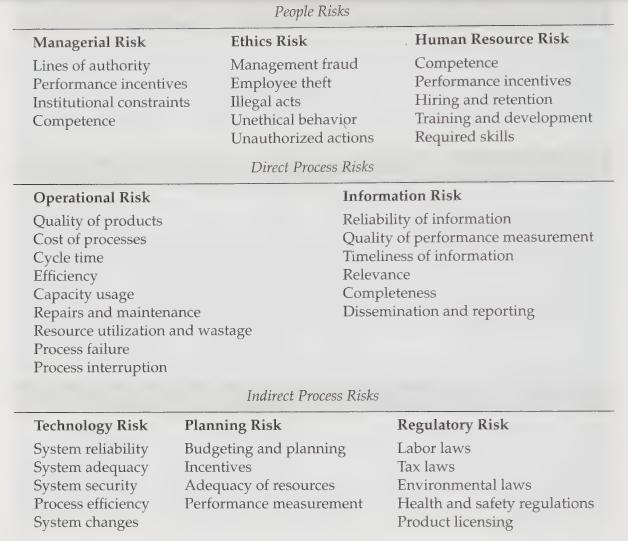
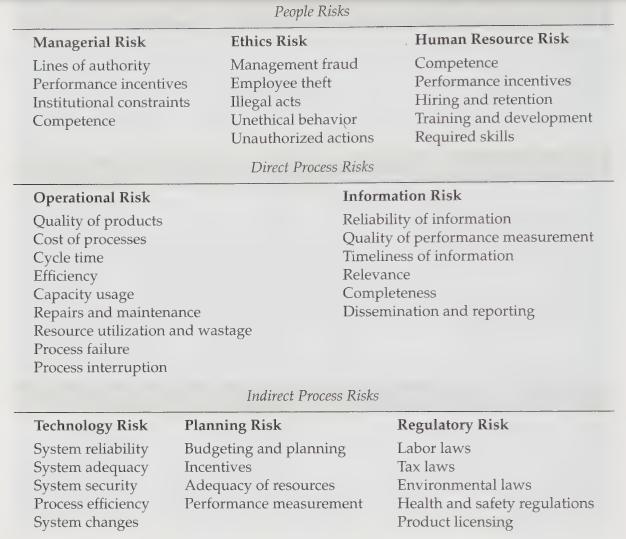
Figure 6-6 provides eight classifications of process risks that should be considered by auditors when analyzing business processes. For each broad category of risks-people risks, direct process risks, and indirect process risks-describe how the transactions generated within business processes might
Explain how business processes can reduce risk but also be a source of risk. Illustrate with an example.
What is an audit-sensitive process? When is a process considered to be audit-sensitive? Illustrate with examples.
Why is technology considered such an important source of risk?
A value chain dissects the firm into its value-adding components, including primary activities and support processes. The primary activities of the value chain model are as follows:a. Inbound logisticsb. Operationsc. Marketing and salesd. Outbound logisticse. Service Consider a value chain model
For each of the following events in a wholesale auto parts firm, identify its location in the value chain. If it is a support activity, identify the primary activity it is supporting.a. Hiring new salespeopleb. Filling an order for a large retail auto parts distributorc. Contract negotiation with
For each of the following events in a large baked goods manufacturer, identify its location in the value chain. If it is a support activity, identify the primary activity it is supporting.a. Production information system developmentb. Deliveries of baked goods to chain supermarketsc. Long-term debt
Research each of the following companies and provide three examples of business processes that are likely to be audit-sensitive processes. For each company, provide one process that is critical to achieving objectives, one that involves extensive external interactions, and one that poses high risk.
Process objectives represent an explicit statement of what a business process is trying to achieve. Most processes will have a number of objectives, of which only a few are likely to be most critical. Wal-Mart's strategy is based on offering a wide variety of desirable products at the lowest prices
Starbucks has a strategy to establish its brand name as a universal symbol of quality for premium coffee and products associated with the lifestyles of those who enjoy premium coffee. For each of the following processes likely to be in place at Starbucks, list what you believe to be the most
Because of the reliability of controls included in automated information systems, often routine transactions are not a high-risk area for substantive testing on audit engagements. Furthermore, recent evidence that estimates are often used in managing earnings and committing fraud emphasizes the
Internal risks can emanate from a number of different sources. Provide an example for each of the following internal risks for The China Construction Bank, which in 2005 became the first major bank in China to issue an initial public offering (IPO): Use Figure 6-6 to help you in completing this
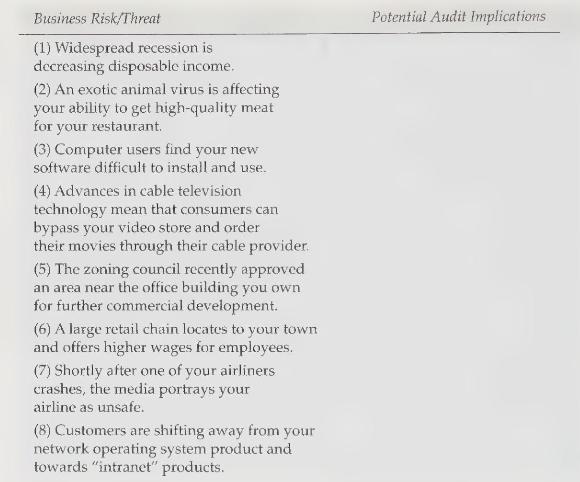
For each of the following business risks/threats, identify the potential audit implications (see Figure 6-5). Business Risk/Threat (1) Widespread recession is decreasing disposable income. (2) An exotic animal virus is affecting your ability to get high-quality meat for your restaurant. (3)
Match.com is one of the world's largest online matchmaking (i.e., dating) services. Access the company's web site and perform research to develop an idea of the matchmaking process for organization sufficient to complete the following components of a process map.a. List probable objectives for the
Describe the three objectives of internal control and explain how a failure of any of the three objectives could impact the financial statements.
The control environment is described as critical for effective internal control at an organization. Describe policies that can be instituted at an organization that would help it reflect a strong tone-at-the-top. Such a tone suggests that issuing fairly stated financial statements is a top priority
Discuss why risk assessment improves both the effectiveness and efficiency of an organization's internal control.
Why is management control important for organizations? As part of your answer, describe how each of the following four types of management controls helps organizations meet strategic objectives by mitigating strategic risks:a. Top-level reviewsb. Direct activity managementc. Performance indicators
For each of the following examples of internal control limitations, provide specific examples of how the limitation impedes one of the four management control types ability to effectively mitigate strategic risk:a. Failure by employees to internalize the organization's mission and objectivesb.
Describe strengths and weaknesses of each of the tests of management controls described in the chapter-client inquiries, observation, and review of documentation. Offer suggestions for how using combinations of these tests help auditors attain more persuasive evidence that the controls are or are
What are the four options that clients have for responding to process risks? For risks that clients have chosen to reduce, how should the auditor adjust risk assessments based on the perceived effectiveness of the mechanisms utilized to reduce the risk (e.g., if the client implements a control
After plotting strategic risks and depicting the expected residual process risks after considering any control put in place to reduce the risks, what decision about designing audit tests can the auditor make based on the perceived effectiveness of controls? In other words, how can the assessment of
Showing 2100 - 2200
of 2689
First
13
14
15
16
17
18
19
20
21
22
23
24
25
26
27
Step by Step Answers

 Get 50% OFF
Claim Now
Get 50% OFF
Claim Now