New Semester
Started
Get
50% OFF
Study Help!
--h --m --s
Claim Now
Question Answers
Textbooks
Find textbooks, questions and answers
Oops, something went wrong!
Change your search query and then try again
S
Books
FREE
Study Help
Expert Questions
Accounting
General Management
Mathematics
Finance
Organizational Behaviour
Law
Physics
Operating System
Management Leadership
Sociology
Programming
Marketing
Database
Computer Network
Economics
Textbooks Solutions
Accounting
Managerial Accounting
Management Leadership
Cost Accounting
Statistics
Business Law
Corporate Finance
Finance
Economics
Auditing
Tutors
Online Tutors
Find a Tutor
Hire a Tutor
Become a Tutor
AI Tutor
AI Study Planner
NEW
Sell Books
Search
Search
Sign In
Register
study help
business
hotel operations management
Operations Management 14th Edition William J Stevenson - Solutions
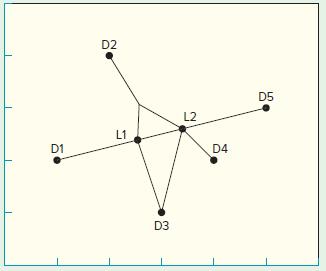
An analysis of sites for a distribution center has led to two possible sites (L1 and L2 on the map).The sites are comparable on every key factor. The one remaining factor is the center of gravity.Use the center of gravity method to select the better site. Monthly shipments will be the quantities
Explain the strategic importance of process selection and the influence it has on the organization and its supply chain. LO.1
Name the two main factors that influence process selection. LO.1
Compare the four basic processing types. LO.1
Explain the need for management of technology. LO.1
List some reasons for redesign of layouts. LO.1
Describe product layouts and their main advantages and disadvantages. LO.1
Describe process layouts and their main advantages and disadvantages. LO.1
Solve simple line-balancing problems. LO.1
Develop simple process layouts. LO.1
Briefly describe salt production, from brine production to finished round cans. LO.1
Briefly describe quality assurance efforts in round can production. LO.1
What are some of the possible reasons why the company continues to use the old processing equipment instead of buying new, more modern equipment? LO.1
Where would you place salt production in the product-process spectrum? LO.1
Determine the approximate number of tons of salt produced annually for the grocery market. Hints: one ton = 2,000 pounds, and one pound = 16 ounces. LO.1
What improvements can you suggest for the plant? LO.1
As Foxconn cuts jobs as it shifts to greater use of automation, jobs will be created in other companies. In what types of companies would you expect to see jobs created? LO.1
Many companies outsourced their manufacturing activities to Foxconn due to its low labor costs. Does Foxconn’s shift to automation make it likely that some of those companies will reconsider outsourcing in favor of shifting to automation? What are some reasons for staying with Foxconn, and what
What other sorts of companies or products could benefit from this on-demand delivery technology? LO.1
What issues or concerns make implementing this technology more difficult in developed countries like the United States than in developing countries in East Africa? LO.1
Drones have been mentioned as possible ways to deliver packages to customers. What advantages might self-driving delivery vehicles have compared to drones for package delivery? LO.1
What conflicts do you envision when self-driving vehicles coexist with human-operated vehicles? LO.1
If you have experienced a hospital room, either as a patient or a visitor, which of these features was present in that room? LO.1
If you have experienced a hospital room, which of these features was missing, but would have been desirable additions? LO.1
Explain the importance of process selection in system design. LO.1
Briefly discuss the advantages and disadvantages of automation. LO.1
Why is management of technology important? LO.1
Why might the choice of equipment that provides flexibility sometimes be viewed as a management cop-out? LO.1
What are the trade-offs that occur when a process layout is used? What are the trade-offs that occur when a product layout is used? LO.1
List some common reasons for redesigning layouts. LO.1
Briefly describe the two main layout types. LO.1
What are the main advantages of a product layout? The main disadvantages? LO.1
Why are routing and scheduling continual problems in process layouts? LO.1
Briefly outline the impact that job sequence has on each of the layout types.From this, we can see that departments 1 and 2 have the greatest interdepartmental work flow, so they should be close, perhaps at B and E. Next, work flows for 1–3 and 1–4 are high. Note, though, that the work flow for
Identify the fixed-path and variable-path material-handling equipment commonly found in supermarkets. LO.1
Name some ways that a layout can help or hinder productivity. LO.1
Explain the consequences of task time variability on line balancing.TAKING STOCK LO.1
Name three major trade-offs in process selection. LO.1
What trade-offs are involved when deciding how often to rebalance an assembly line? LO.1
Who needs to be involved in process selection? LO.1
Who needs to be involved in layout design? LO.1
In what ways does technology have an impact on process selection? How can technology impact layout decisions? LO.1
Name two unethical behaviors related to process selection and two related to layout, and the ethical principles they violate (see Chapter 1). LO.1
What are the risks of automating a production process? What are the risks for a service process? LO.1
Consider an assembly line such as the burrito assembly line at Chipotle Mexican Grill. During slow times of the day, one server can handle assembly, but during very busy times, having many servers would be prudent. Explain why either approach wouldn’t work all the time, and the benefit of
A producer of inkjet printers is planning to add a new line of printers, and you have been asked to balance the process, given the following task times and precedence relationships. Assume that cycle time is to be the minimum possible.Task Length(minutes)Immediate(Predecessor)a 0.2 –b 0.4 a c 0.3
As part of a major plant renovation project, the industrial engineering department has been asked to balance a revised assembly operation to achieve an output of 240 units per eight-hour day. Task times and precedence relationships are as follows:Task Duration(minutes)Immediate(Predecessor)a 0.2
Twelve tasks, with times and precedence requirements as shown in the following table, are to be assigned to workstations using a cycle time of 1.5 minutes. Two heuristic rules will be tried:(1) greatest positional weight, and (2) most following tasks.In each case, the tiebreaker will be the
For the given set of tasks, do the following:a. Develop the precedence diagram.b. Determine the minimum cycle time and then calculate the cycle time for a desired output of 500 units in a seven-hour day. Why might a manager use a cycle time of 50 seconds?c. Determine the minimum number of
A shop works a 400-minute day. The manager of the shop wants an output of 200 units per day for the assembly line that has the elemental tasks shown in the table. Do the following:a. Construct the precedence diagram.b. Assign tasks according to the most following tasks rule. Break ties with the
Arrange six departments into a 2 × 3 grid so that these conditions are satisfied: 1 close to 2, 5 close to 2 and 6, 2 close to 5, and 3 not close to 1 or 2. LO.1
Using the information given in the preceding problem, develop a Muther-type grid using the letters A, O, and X. Assume that any pair of combinations not mentioned have an O rating. LO.1
Using the information in the following grid, determine if the department locations shown are appropriate. If not, modify the assignments so the conditions are satisfied.Chapter Six Process Selection and Facility Layout 295 LO.1
Arrange the eight departments shown in the accompanying Muther grid into a 2 × 4 format. LO.1
Arrange the departments so they satisfy the conditions shown in the following rating grid into a 3 × 3 format. Place department 5 in the lower left corner of the 3 × 3 grid.296 Chapter Six Process Selection and Facility Layout LO.1
a. Determine the placement of departments for a newly designed facility that will minimize total transportation costs using the data in the following tables. Assume that reverse distances are the same. The locations are shown in the grid. Use a cost of $1 per trip yard.Location ALocation BLocation
Eight work centers must be arranged in an L-shaped building. The locations of centers 1 and 3 are assigned as shown in the accompanying diagram. Assuming transportation costs are $1 per load per meter, develop a suitable layout that minimizes transportation costs using the given information.Compute
Develop a process layout that will minimize the total distance traveled by patients at a medical clinic, using the following information on projected departmental visits by patients and distance between locations. Assume a distance of 35 feet between the reception area and each potential location.
Ten labs will be assigned to the circular layout shown. Recalling a similar layout’s congestion in the halls, the new lab manager has requested an assignment that will minimize traffic between offices. Department 1 must be at location A. Develop a suitable layout using the following information.J
Explain the importance of work design. LO.1
Compare and contrast the two basic approaches to job design. LO.1
Discuss the advantages and disadvantages of specialization. LO.1
Describe behavioral approaches to job design. LO.1
Discuss the impact of working conditions on job design. LO.1
Compare the advantages and disadvantages of time-based and output-based pay systems. LO.1
Explain the purpose of methods analysis and describe how methods studies are performed. LO.1
Describe four commonly used techniques for motion study. LO.1
Define a standard time. LO.1
Describe and compare time study methods and perform calculations. LO.1
Describe work sampling and perform calculations. LO.1
Compare stopwatch time study and work sampling. LO.1
What is job design, and why is it important? LO.1
What are some of the main advantages and disadvantages of specialization from a management perspective?From a worker’s perspective? LO.1
a. Contrast the meanings of the terms job enlargement and job enrichment.b. What is the purpose of approaches such as job enlargement and job enrichment? LO.1
a. What is ergonomics and why is it important in job design?b. Explain how it can relate to quality of work life. LO.1
Explain the term knowledge-based pay system. LO.1
What are self-directed work teams? What are some potential benefits of using these teams? LO.1
What are motion study principles? How are they classified? LO.1
Name some reasons why methods analyses are needed. How is methods analysis linked to productivity improvements? LO.1
How are devices such as flow process charts and worker-machine charts useful? LO.1
What is a time standard? What factors must be taken into account when developing standards? LO.1
What are the main uses of time study information? LO.1
Could performance rating be avoided by studying a group of workers and averaging their times?Explain briefly. LO.1
If an average worker could be identified, what advantage would there be in using that person for a time study? What are some reasons why an average worker might not be studied? LO.1
What are the main limitations of time study? LO.1
Comment on the following: “At any given instant, the standard times for many jobs will not be strictly correct.”a. Why is this so?b. Does this mean those standards are useless? Explain. LO.1
Why do workers sometimes resent time studies? LO.1
What is work sampling? How does it differ from time study? LO.1
What are the trade-offs in the following?a. Using self-directed teams instead of a more conventional approach with occasional use of teams.b. Deciding how often to update standard times due to minor changes in work methods.c. Choosing between time study and work sampling for work measurement. LO.1
Who uses the results of work measurement in an organization, and how do they use them? LO.1
Identify an unethical behavior for each of the five major topics in this chapter, and indicate which ethical principle (see Chapter 1) each violates.CRITICAL THINKING EXERCISES LO.1
A time study was conducted on a job that contains four elements. The observed times and performance ratings for six cycles are shown in the following table.OBSERVATIONS (minutes per cycle)Element Performance Rating 1 2 3 4 5 6 1 90% 0.44 0.50 0.43 0.45 0.48 0.46 2 85 1.50 1.54 1.47 1.51 1.49 1.52 3
Given these observed times (in minutes) for four elements of a job, determine the observed time(OT) for each element. Note: The second element only occurs every other cycle.CYCLE Element 1 2 3 4 5 6 1 4.1 4.0 4.2 4.1 4.1 4.1 2 — 1.5 — 1.6 — 1.4 3 3.2 3.2 3.3 3.2 3.3 3.3 4 2.7 2.8 2.7 2.8 2.8
Given these observed times (in minutes) for five elements of a job, determine the observed time(OT) for each element. Note: Some of the elements occur only periodically.CYCLE Element 1 2 3 4 5 6 1 2.1 2.0 2.2 2.1 2.1 —2 — 1.1 — 1.0 — 1.2 3 3.4 3.5 3.3 3.5 3.4 3.3 4 4.0 — — 4.2 — —5
Using Table 7.4, develop an allowance percentage for a job element that requires the worker to lift a weight of 10 pounds while (1) standing in a slightly awkward position, (2) in light that is slightly below recommended standards, and (3) with intermittent loud noises occurring. The monotony for
The following data were obtained by observing a three-step job of a financial manager’s assistant.a. Using the data and an allowance of 10 percent of job time, determine a standard time for the operation.b. Determine the number of observations that would be required to estimate the mean time for
The data in the following table represent time study observations for a woodworking operation.a. Based on the observations, determine the standard time for the operation, assuming an allowance of 15 percent of job time.b. How many observations would be needed to estimate the mean time for element 2
An analyst made the following observations about whether customer service representatives were busy (B) or idle (I):a. What is the percentage of idle time?b. Given these results, how many observations would be needed to estimate the actual percentage of idle time to within 6 percent with a
Explain the concept of a learning curve. LO.1
Make time estimates based on learning curves. LO.1
Showing 5600 - 5700
of 6090
First
47
48
49
50
51
52
53
54
55
56
57
58
59
60
61
Step by Step Answers

 Get 50% OFF
Claim Now
Get 50% OFF
Claim Now