New Semester
Started
Get
50% OFF
Study Help!
--h --m --s
Claim Now
Question Answers
Textbooks
Find textbooks, questions and answers
Oops, something went wrong!
Change your search query and then try again
S
Books
FREE
Study Help
Expert Questions
Accounting
General Management
Mathematics
Finance
Organizational Behaviour
Law
Physics
Operating System
Management Leadership
Sociology
Programming
Marketing
Database
Computer Network
Economics
Textbooks Solutions
Accounting
Managerial Accounting
Management Leadership
Cost Accounting
Statistics
Business Law
Corporate Finance
Finance
Economics
Auditing
Tutors
Online Tutors
Find a Tutor
Hire a Tutor
Become a Tutor
AI Tutor
AI Study Planner
NEW
Sell Books
Search
Search
Sign In
Register
study help
business
human resource management
Human Resource Management 11th Edition Derek Torrington, Laura Hall, Stephen Taylor, Carol Atkinson - Solutions
How would your boss establish a gap between your actual performance and what is expected of you?
Are those lowest in the organisational hierarchy accused of poor performance because it is easier to establish a gap that is clearly the responsibility of the person being accused?
The following article by Lucy Kellaway (2001) is light-hearted and witty, but it also raises several interesting questions about relative pay levels and how we should determine them.Pandora’s pay packet Imagine if you got into work to find you had been sent an email listing the salaries and
Consider the following list of jobs and job holders. In each case think about how much you think each currently receives annually in basic pay (i.e. excluding benefits, overtime, bonuses, etc.) and about how much you think each should be paid. Make a list of the key criteria you are using in making
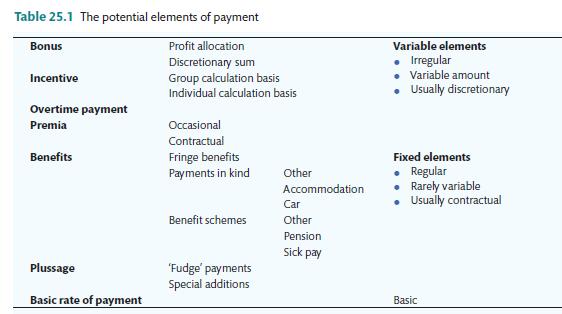
If you could design your own ‘remuneration package’ which could be made up from any of the items in Table 25.1, what proportion of each item would you choose and why? Does your answer suggest ideas for further development of salary policies? Table 25.1 The potential elements of
Do you think it is possible to identify ‘best practice’ in payment policy? What elements would you consider should make up any such package?
‘Job evaluation does not produce equitable payment: it merely produces a ramshackle method of justifying the status quo.’ Do you agree with this statement?
Why have we seen increased interest in the concept of ‘total reward’ in recent years? Why might interest grow still further in the future?
Which of the four mechanisms outlined above do you think is usually most efficient for setting the following?• Base pay• Annual cost of living increases• Executive remuneration packages• Bonus schemes
What in your view are the main advantages and disadvantages of these alternative approaches from a management perspective? Would you be more motivated by the prospect of a pay rise or a one-off bonus payment?
What are the relative advantages of: (a) A system of straight salary that is the same each month; (b) A system of salary with an individual performance-related addition so that the total payment each month varies?
Why do you think the proportion of workplaces using individual incentive payment systems seems to have grown so much in recent decades?
In what circumstances might it be appropriate to base individual payment on team performance?
A problem with sales commission is its tendency to reward the quantity of goods sold without having regard to the quality of service provided by sales staff. In which circumstances might this have negative consequences? How could a commission-based incentive scheme be adapted to incorporate
What do you think about Peter, Patrick, Joanne and Henry in the Window on Practice box early in this chapter?
Make a list of five jobs that you consider would be best rewarded by a meritbased system and five more that are best rewarded via the goal-based approach.
A number of commentators praise skills-based pay as a system which avoids some of the pitfalls associated with PRP schemes. Look back at the list of practical problems with PRP schemes above and consider which do and which do not apply to skills-based incentive systems.
The UK has always been unusual in having such a substantial occupational pensions sector. There are similar systems in the Netherlands and in the Republic of Ireland, but in most EU countries employers see no reason why they should be involved in the provision of pensions. Why do you think these
Why do you think so few people seem to have an appreciation of the value of their occupational pensions and other benefits? What could be done to raise awareness of the costs involved in their provision?
According to the 2018 Annual Reward Management Survey carried out by the Chartered Institute of Personnel and Development, the following benefits are provided for some or all employees by over 30% of UK employers:• Occupational pension scheme• Paid leave for bereavement• Training and career
Which type of occupational pension scheme would you find most attractive at the current stage in your career? Under what circumstances might you change your preference?
Draw up three flexible benefits packages: one aimed at new graduates; one at employees in their 30s; and one for those aged over 50.
It has been argued that by making occupational pensions readily transferable, by increasing the complexity of the regulatory regime and by increasing taxation levied on pension funds, successive governments have provided a major disincentive to employers considering the establishment of a scheme.
Assume that you have been offered a new job which comes with either the use of a new company car or a cash allowance. The salary is £35,000 per year. The car is worth £15,000, giving you an annual tax bill of £5,250. This is also the amount being offered by way of an annual cash allowance. Which
Sonia is 45 and has a satisfying job in the international management of an Oil Company earning £65,000. She is married to Tom who is 58 and recently retired from a finance post in the City of London with a pension of £40,000. The company wishes to move Sonia to their office in Singapore for a
The British entrepreneur Richard Branson allegedly dislikes trade unions because they bring an adversarial way of dealing with things into a situation which should be harmonious. Do you think that the recognition of unions is a failure of management? Does your answer differ between public and
The eighteenth-century political philosopher Edmund Burke said in a speech, ‘He that wrestles with us strengthens our nerve and sharpens our skill. Our antagonist is our helper.’ Is this true of negotiations in business?
Sending employees and their families to live and work for several years and then re-integrating them on return is obviously expensive. Why do companies do it instead of employing local personnel?
Imagine you are well placed in a company and now they ask you to go and spend two years working in a branch in Montreal. What incentives would you need to accept? Compare the responses of different group members and discuss how personal circumstances produce different answers.
What difference has the computer made to your working life so far? What further effect do you expect it to have in the next five years as digitalisation develops? How readily would you be (or are you) a home-worker?
The chapter opens by explaining that personnel managers for years played down their ethical/welfare role. Why do you think this was?
Thirty years ago, before the days of wheelie bins, Eric was deaf, mute and suffered from cerebral palsy. He had been unemployable all his adult life, but in his late twenties he started to follow round the local authority refuse collectors emptying dustbins. As the lorry reached the end of a
What examples can you think of that would make you feel that the demands of your job conflicted with what you regarded as being right? How would you deal with this?
Most people agree that differences in rates of pay according to value or effort are justified, but that some differences are ‘obscene’. What criteria would you suggest for setting pay differentials within a business that both are seen as fair and are effective in being able to attract and
Using a sample (say, two or three) of the most recent issues of People Management analyse the job titles, remits and competencies referred to in the articles:1. How do the job titles/job remits quoted compare with the roles identified by Ulrich and Brockbank (2005b)?2. What evidence can you find of
Does it really matter whether the most senior HR person is on the board of directors, or are personal work relationships, political alliances and personal track records more important?
The questions below encourage you to apply the principles of relationship selling to the HR function.Questions 1. Your first task is to find an article, book, video or podcast on relationship selling. Write a summary list of points you have learned from your source, no more than one side of A4.
We referred to the ‘loss of the personal touch’ in this discussion of these alternative means of providing HR services.How important is ‘the personal touch’ to the employees of today and why do you think this is so?
‘Outsourcing may be an effective solution in the medium term, but it brings shortterm disruption and long-term damage to organisational capability and success.’ To what extent do you agree or disagree with this statement?
We noted that outsourcing the whole of the HR function is a different proposition from outsourcing some specific aspects. In the context of your own organisation, or one with which you are familiar:1. If you were to outsource some specific aspects of HR, what would they be and why would you choose
Debate the following comment: ‘There has always been a debate about the extent to which day-to-day HR activities should be shared between the professional function and the line. In essence nothing has really changed.’
To what extent do you accept that working in an SME is different to working in a larger firm? What might the benefits of this be? What could the disadvantages be?
Do you agree that large firms are different in HR terms to SMEs? Why or why not?
Falcon Day Care was established in 2016 to offer day-care services for adults. Its owners had had long social services careers, but limited experience of running a business. Within 18 months, it was thriving, offering day care to 20 people with learning disabilities and mental health problems and
Why do you think that owner manager philosophy is so dominant in SMEs? Is this likely to be a benefit or a disadvantage?
‘It is usually better for an employee to work in a large rather than a small firm’. To what extent to you agree with this statement?
To what extent do you agree that transactional HR practice can be transformative in SMEs?
What are effective mechanisms for ensuring that SMEs have the HR support they need?
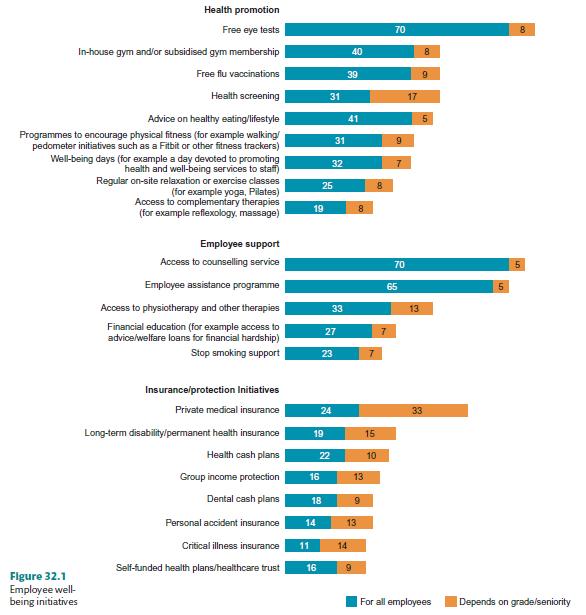
To what extent do you think that the initiatives set out in Figure 32.1 are likely to improve employee health and well-being? Where might they be successful? What issues might they miss?Figure 32.1 Health promotion Free eye tests In-house gym and/or subsidised gym membership Free flu
How feasible do you think it is for SMEs to use HR analytics? What problems might they face?
Brown reports on a British Safety Council study that warns that employer’s good intentions could lead to ineffective employee well-being initiatives. Despite their enthusiasm, employers are often genuinely ignorant as to what will make a difference to employee health and wellbeing. The study
‘The positive outcomes from health and well-being initiatives justify their significant cost.’ Discuss this statement.
What mental health support is offered by your organisation or one with which you are familiar? How effective is this in creating the necessary open culture and supportive environment?
‘An organisation does not have the right to concern itself with the weight and fitness levels of its employees.’ To what extent do you agree with this statement?
What are the key causes of reduced productivity and/or commitment in an organisation with which you are familiar? To what extent do you think that these issues will be improved or resolved by the initiatives outlined in Figure 32.1?Figure 32.1 Health promotion Free eye tests In-house gym and/or
Thinking of a job you have held, or one you have observed (e.g. your interactions with workers in fast food restaurants), analyse it in terms of the Job Characteristics Model. To what extent does it offer:• skill variety• task identity• task significance• autonomy• feedback?What are the
Evaluate the suggestion that organisations would obtain more significant benefits from designing jobs well than from providing access to free fruit and low-cost gym membership.
1. Think of where you work, or where you have worked, and identify three activities where global thinking needs to influence local action. What are the local people management implications of this?2. In the same situation what aspects of local action influence, or should influence, global thinking?
Multinational companies tend to be unpopular with social activists, who mount demonstrations against their apparent greed and serious impact on some of the societies in which they operate. What are the arguments for and against this point of view?
Over the past decade some of the most highly-rated universities in the world have experimented with off-shoring some of their activities. Starting slowly, but gaining pace in more recent years, there is now a strong trend towards the establishment of branch campuses in overseas locations. The main
Expatriate assignments frequently end in failure, in that the posting is not completed or fails to meet its initial objectives. Briscoe et al. (2009: 179) identify three types of expatriate failure:• dropout (the expatriate returns home early);• brownout (the expatriate performs poorly while
Do you think international HRM is likely to get easier or harder in the future? Justify your answer.
Why are global companies much more likely to take a harmonised approach to trade union relations, resisting decentralisation to different localities, than they are in other areas of HR activity?
What changes might occur in the future that could reverse these long-term trends in the demand for labour? Are there circumstances in which we might we see a decrease in higher-skilled job opportunities, or a reduction in higherskilled jobs?
Why can it be said to be ‘both good news and bad news’ for HR managers and the HR profession when chronic skills shortages emerge?
Some of the very tightest labour markets in the UK at present are faced by employers operating in the Information and Communication Technologies (ICT) sector. There are many more jobs available than there are people available to do them, and this has created a chronic skills shortage that has
What advice would you give to a group of teenagers who are thinking about their possible future career options? What professions should they avoid entering if they are keen to achieve longer-term job security? Which would provide them with the most secure future?
Which of the technologies identified in this chapter as likely to mature in the next twenty years do you consider poses the biggest potential disruptive force as far as jobs are concerned? Justify your answer.
To what extent do you agree with the analysis set out in the first half of this chapter about the likelihood that labour markets will tighten considerably in the UK over the next decade? How, with hindsight, might this argument turn out to be flawed in the future?
Knight and Latreille (2001) reported on research they carried out into the gender effect in unfair dismissal cases dealt with by UK employment tribunals. Some if their results were:• 69% of unfair dismissal cases were brought by men;• 71% of cases that reach a full hearing were brought by
Look at an organisation’s policy on bullying and harassment. The University of Bradford is a typical example, or one from an organisation with which you are familiar.1. What are key aspects of the policy?2. To what extent do you think it is likely to be successful in tackling bullying and
To what extent do you believe that setting challenging deadlines can be considered to be bullying?
The main emphasis in this chapter and most of recent academic and general discussion on this topic has been about the effect on the bullied individual and on the bully, but there is the associated impact on the effectiveness of the business. This was dramatically illustrated by the report of a
‘A robust policy on bullying and harassment will be effective in reducing employee perceptions that these behaviours are tolerated in the organisation.’ Discuss this statement.
What actions can be taken to prevent employees resigning as a result of bullying and harassment?
Using consultants can often fail because there is insufficient clarity in briefing them and a reluctance to work closely with them on the project.
Suggested steps in using consultants are (a) Describe the problem, (b) Work out how to solve the problem without consultants, (c) Approach consultants, (d) Decide between the alternatives (e) Own the solution.
How far do you agree with the proposition that managers should think in terms of ‘total reward’ as a means of recruiting, retaining and motivating their staff? Are praise and career development as important as pay? Would you trade some of your pay for greater recognition and development
Think of different leaders you have encountered – in particular those that were especially effective or ineffective:1. What differences can you identify in terms of their traits (personal characteristics)?2. What differences can you identify in terms of their behaviour?3. Are the trait and
Do we need leaders at all? Discuss what alternatives there might be.
For each of Goleman’s six styles think of a leader with whom you have worked, or who you know. For each of these individuals write a list of the behaviours that they use. Then consider the impact that these behaviours have on followers. Do the behaviours have the same impact on all followers? If
How likely is it that post-heroic forms of leadership will replace heroic leadership approaches?
Thinking of your own experiences of being led (at work, school or other settings), what consideration was there of the role of followers? How could including their perspective have changed events?
In what way do you think that including the perspective of followers in the study of leadership will contribute to theory?
Each of these six types of HR objective is important and necessary for organisations in different ways. However, at certain times one or more can assume greater importance than the others. Can you identify types of situation in which each could become the most significant or urgent?
What are the major advantages and disadvantages associated with HR managers seeing employees as ‘internal customers’ who need to be satisfied?
The following is an opinion piece by the business writer Bernard Marr. In it the author puts a case against typical HRM departments. Why we no longer need HR departments The time has come for HR (Human Resources) departments to call it a day. HR departments often portray themselves as a valued
Lynda Gratton (2004) reported that Tesco use the following five ‘identities’ to categorise their staff. The way that they are managed and the reward packages that are available to them can thus be tailored so as to be more appropriate to the needs and aspirations of each individual:•
How far do you agree with the view that an HR function which achieves administrative excellence adds value to an organisation just as much as one which focuses on improving its employees’ performance?
To what extent is your organisation successful in translating its ‘intended HR outcomes’ into ‘actual HR outcomes’? What could it do to make it more successful?
Would it be either possible or desirable either to reverse the globalisation process or to slow it down considerably?
Until quite recently Dixon Ticonderoga was a dominant player in the American pencil market. Able to trace its origins back to the 1790s, throughout the twentieth century the company was a household name across the USA. For 100 years the company managed to maintain a highly profitable 30–40% share
From a people management perspective who are the biggest winners and who are the biggest losers from globalisation?
We introduced ‘best practice’ thinking in HRM (see Chapter 1), a commonly held point of view which holds that there is a bundle of HR practices that, when implemented, together provide a recipe for superior business performance. Importantly, supporters of this view argue that best practice HRM
Why might it be important for managers in a nationally based organisation that is about to expand internationally to be aware of the different ways that HRM is customarily carried out in different countries?
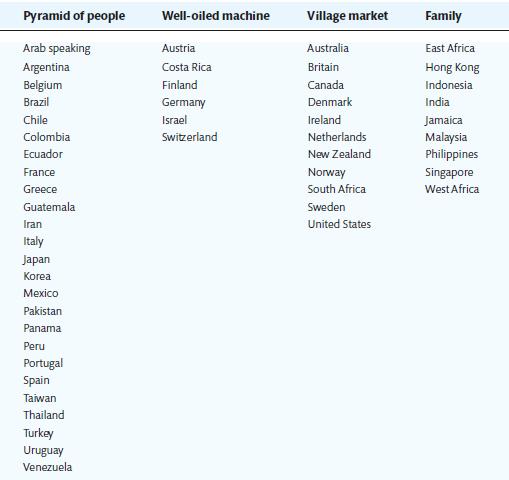
Identify your country and its type from those shown in Table3.1. If it is not there, pick one with which you are familiar.1. Do you agree with Hofstede’s description of the type of organisation that is implicit?2. Think of examples of how that implicit type of organisation affects HR
You work in the HR department of a large corporation which operates a well-known chain of fashion stores (Large Co). Your company has outlets on the high streets of all the major UK cities and is steadily increasing its presence in out-of-town shopping complexes and airports.In addition, recent
Some argue that the future will bring both increased convergence and increased divergence internationally as far as HRM practice is concerned. How is this possible?
Aside from those we have discussed in this chapter, what other examples of HR practices or established employment norms can you think of which differ from country to country? How far are these explained by cultural or by institutional differences, or is there some other explanation?
To what extent do you find the models put forward by Geert Hofstede either compelling or practically useful?
Showing 3400 - 3500
of 5068
First
28
29
30
31
32
33
34
35
36
37
38
39
40
41
42
Last
Step by Step Answers

 Get 50% OFF
Claim Now
Get 50% OFF
Claim Now