New Semester
Started
Get
50% OFF
Study Help!
--h --m --s
Claim Now
Question Answers
Textbooks
Find textbooks, questions and answers
Oops, something went wrong!
Change your search query and then try again
S
Books
FREE
Study Help
Expert Questions
Accounting
General Management
Mathematics
Finance
Organizational Behaviour
Law
Physics
Operating System
Management Leadership
Sociology
Programming
Marketing
Database
Computer Network
Economics
Textbooks Solutions
Accounting
Managerial Accounting
Management Leadership
Cost Accounting
Statistics
Business Law
Corporate Finance
Finance
Economics
Auditing
Tutors
Online Tutors
Find a Tutor
Hire a Tutor
Become a Tutor
AI Tutor
AI Study Planner
NEW
Sell Books
Search
Search
Sign In
Register
study help
business
human resource management
International Human Resource Management 5th Edition Christopher Brewster; Elizabeth Houldsworth; Paul Sparrow; Guy Vernon - Solutions
Consider the character of unions in a country with which you are familiar. How is this of relevance to managers at organisation or workplace level?
What might be the advantages to management of more centralised bargaining arrangements (multi-employer bargaining at sectoral or even multi-sectoral level)?What might be the advantages to management of decentralised arrangements (single employer or workplace bargaining)?
What might explain the fact that union membership is higher in some countries than in others?
Are unions a positive or negative in organisational communications? Is the answer dependent upon or independent of country? Give reasons for your answers.
Consider the supports and challenges that joint regulation offers to managements pursuing business performance. Do you feel that strong unions make people management more challenging for managers? Do you feel that strong unions promote organisational and business performance? Do these questions
Consultation with representative bodies is now required for all organisations over a certain size by the European Union. What reasoning might have led the EU to take such a step?
What associations and connotations might these different concepts have?
What might be some of the implications of the development of flexible working patterns foremployers, individuals and the state?
When and why might an employer prefer to offer a short-term contract rather than a permanent one?
What advantages might accrue to employers and to employees from part-time employment?
What advantages might accrue to an organisation from the introduction of family-friendly policies?
In considering work–life balance:• Might it be that an employee’s total annual working time is of more significance than specific initiatives like flexi-time and compressed working weeks, which re-order a given amount of working time?• If so, why is there so little discussion of total hours
Currently we have little but anecdotal evidence on work–life balance in developing and newly industrialising countries. What do you think the general situation in, say, India or Vietnam might be? Why?
Do the differences in flexible and work–life balance practices discussed in this chapter constitute a barrier to MNCs transferring personnel policies and practices across borders?
Why do countries respond differently in terms of flexibility and work–life balance to what seem similar economic pressures?
What country factors does an HRM specialist need insight into in order to understand the flexibility and work–life balance trade-offs that are preferred in any particular country?
Given the imperatives of modern capitalism, should we expect convergence across countries, or at least convergence across the national operations of MNCs?
Many authors on HRM suggest that organisations should seek to avoid or move away from a Taylorist organisation of work. Why should Taylorism be seen as undesirable?
In your organisation, or one that you know of, what forms of up and down direct communication are used? Elaborate!
Why should the tendency towards greater downward direct communication be stronger and more consistent across countries than the tendency towards greater upward direct communication?
What might create difficulties in the transfer of information and knowledge between individuals within an organisation?
There is no comparable study to that on the organisation of work in the EU for North America.If there were such comparable evidence, how would you imagine that the use of the four different models of work organisation in the USA and Canada would compare with European countries?
We have limited evidence on how work is typically organised in developing and newly industrialising countries, but what would you expect to be typical?
Consider the basis of your view of the work organisation typical outside the established OECD or old industrialised world. Check that it is consistent with what we do know about the comparative organisation of work.
Why is Taylorism still influential in work organisation a century after its development?
Might the importance of overcoming the gulf between managerial and non-managerial employees be more important to organisational effectiveness in some countries than others?
Which are the best methods to facilitate upward and downward communication? Are they likely to vary with different cultures?
How should an MNC in, say, retail approach work organisation in the various countries in which it operates?
To what extent do you think companies are constrained in their approaches to work organisation by what their managers, and perhaps in particular their line managers, are comfortable or confident with?
Might ‘best practice’ in work organisation be inoperable in some contexts? Is this always because it would not improve productivity performance?
How have management attitudes to the appropriate design of pay systems developed in the last few years?Does this change reflect properly the lessons of recent high-profile experiences?
What reward practices are indicative of the different pay for performance contexts in the USA, Germany, France, UK, Sweden and Japan?Which PfP practices do you think would be the easiest to converge?
Do you think that differences in reward practices across countries reflect differences in national cultures or other influences?
There are extensive discussions in the literature about the influence of national institutions, laws and culture on HRM issues, such as rewarding staff.Obviously, there is a range of different practices even within the various national boundaries. Are these boundaries the best level of analysis?In
Why might the close tying of pay to post be seen as outdated?Does this view necessarily reflect the impact of such pay systems on business performance?
What are the main cross-national differences in the nature of pay systems and practices?
How would you characterise the underlying philosophy that British HRM professionals have towards reward, compared with French HRM professionals?
What are the main ways in which national culture influences rewards behaviour?
Is there a danger of focusing too much on national culture as a driver of pay practice?
Recruitment is linked to other practices. If it is difficult to recruit the desired volume of people, or the desired competencies and qualities needed:• What reasons might there be for not being able to hit the desired recruitment volumes or competencies?• What problems have to be solved for
What sorts of things might an organisation be able to do to give a candidate a very realistic idea of what will be involved in their job?In whose interest is it to offer a realistic preview?If you know the realities of the job before you accept a job offer, will this affect the way that you behave
Is the increasing application of technology to the recruitment and selection process altering the balance of power between the recruiter and the candidates?If so, in what ways and in whose favour?
There is considerable scope within the design of an assessment centre to allow for local content and processes. Would it matter if any of the following variations in the method were made, and, if so, why?• The dimensions specified (the job requirements, or the competencies needed).• The types
In the light of increases in the use of assessment:• Can organisations use psychological tests fairly in multicultural settings?• Do the psychometric properties of tests translate to different cultural groups?• Can ‘culture-free’, ‘culture-fair’ or ‘culturereduced’ tests be
What are the main cross-national differences in the nature of recruitment and selection systems?
Take two contrasting countries – say the UK and France, or India and the USA. How would you characterise the underlying philosophy that HRM professionals from each country have towards selection? Is this evidenced in a different take-up of particular selection tools and techniques?
What are the main technical challenges faced by firms that wish to internationalise their selection and assessment approaches?
What are the main issues facing organisations as labour markets become more global?
What are the different resourcing strategies open to organisations as they operate in these global labour markets?
Spend a few moments to reflect on what performance management means to you – jot down your thoughts.• What are the organisational practices you associate with it?• If you have work experience, how have you seen it be carried out?• What is your emotional reaction to the term ‘performance
Reflect upon an appraisal you have experienced – this could be in relation to the assessment of a piece of work you have completed for your studies.• What were the elements you were assessed or judged upon (written work, presentation, group work, class participation and so on)?• How did you
Review what you know about culture from Chapter 3.Which cultural factors do you believe are likely to most impact the success of performancemanagement processes?
What are the differences between performance appraisal and performance management?
What does a performance management process typically comprise in terms of its component elements?
Where do the origins of performance management and performance appraisal lie?
What are the major challenges to the implementation of ‘global’ performance management practices?
Provide some examples of how culture impacts performance management.
Imagine you are the resourcing and training manager responsible for the establishment of a new operation. You have some influence in the selection of the location, but must meet both quality and budget requirements.What factors would you take into account when evaluating the options?
What is VET?
What implications might the difference in initial training provision between the USA and Germany have for the organisation of work and the character of relationships between managers and non-managerial employees?
What are the institutional features required to support extensive initial VET; and what are the challenges to it being sustained for the long term?
Consider some organisations from different countries:• How does their HRM function measure up against these criteria?• How much of this do they do in practice?• Do HRM specialists aspire to organise themselves this way?• Have HRM professionals from different countries got the same
Discuss the following:• As the boundaries of HRM work have expanded from the original personnel administration department into other more strategic areas, has the definition of the structure and roles of the HRM function become increasingly blurred?• What kinds of activities do HRM
How important is the professional HRM association in your country (or one you know)?What might it do to achieve more influence?
What are the advantages for the HRM department if its head is on the main board?How might cultural influences noted in previous chapters affect that?
Identify the effect that worker-directors on the supervisory board and the existence of central (company level) works councils might have on the role of the HRM department in Germany.
Discuss and explain:• the reasons for the allocation of HRM responsibilities to line managers;• the reasons for most countries still having HRM controlled mainly by the HRM department.What does this suggest for the future?
What activities, processes and capabilities might constitute a COE, and how should such units be mandated?What has to happen in terms of the ‘capability building investments’ that are needed? Is it possible to specify capabilities such as decisionmaking autonomy, requisite levels of
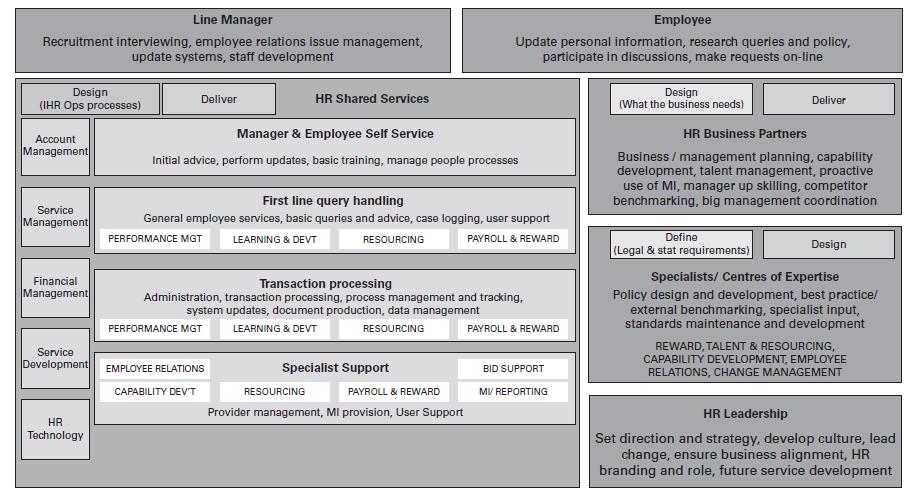
Some MNCs find it a challenge to adopt a standardised delivery model for their HRM services. Imagine that an organisation has chosen to adopt the type of structure shown in Figure 11.2 at a corporate level. This would have very significant implications at a local – or country – level. It would
Given that the notion of ‘HRM’ is seen in some countries to be more advanced than the idea of ‘personnel management’, why might the latter continue to be the preferred terminology in most of Europe?
Is a high level of assignment of HRM responsibilities to line managers a sign of HRM influence or of mistrust of HRM specialists? How might this vary by country?
What advantages and disadvantages might a line manager see in being asked to adopt greater HR responsibilities?
Choose three countries for which evidence is presented. How far does the data presented help you to identify the most significant roles in the Ulrich model for each country?
Consider three (ideally other) countries for which evidence features here. What are the key influences on cross-national comparative variation in the place and role of the HRM function?
Are shared service models going to represent a new force for convergence and standardisation of HRM practices on a global basis, or will they result in more localised and customised policies and practices?
Evidence on the role of HRM functions in developing and newly industrialising countries is currently anecdotal at best. What role would you expect them to have? On what are you basing your conjectures?
It is evident that many academic fields and their ideas are currently being challenged. Ask yourself the following two fundamental questions. Ask them first now before you have read about the main theories, models and frameworks, and then ask yourself again at the end of the chapter:• Do you
Why do managers need to be able to understand the importance of attitudes to internationalisation?How would you link them with each of the areas of HRM explored in the previous ‘functional’ chapters on HRM, for example with attitudes held towards the performance management system, recruitment
Do born-global firms create unique people management and organisational issues? What HRM functions covered in Part Two of this book become most relevant for the management of such firms?
Think of a modern type of business.• Does the argument hold true that it must work through successive stages of internationalisation before it can truly globalise?• How might an organisation safely leapfrog some stages?• What sorts of arrangements can be put in place to speed up the learning
What freedom does an international organisation have in regard to imposing its own approaches to HRM on its operations throughout the world?How can an international organisation, aware of the need to be sympathetic to local cultures, still ensure that it gains optimum value from its
Can organisations enhance their ‘absorptive capacity’?• If so, what managerial actions are the most important?• What sort of organisational culture becomes important?• What sorts of abilities and motivations do employees need?• What does this mean for the design of IHRM policies and
Think about the impact that e-commerce and more flexible networks of organisations has had on the way international business is conducted.• How has it created new complexities in the relationships between organisations or new opportunities in the way they deal with each other?• Why is this
• How would it help to know what relationships and social capital a candidate for an important international role has?• Would these relationships be more or less important than their general international skills?• Across which holes inside your organisation would it be useful to force
• In what ways, and through which structures, does greater social capital make international managers more effective?• Is social capital separate from human capital, or are there particular skills and competencies that help an international manager build social capital?• What are the role of
What evidence would satisfy you that an organisation was becoming truly global?
Which of the theoretical approaches are the most useful in explaining your organisation’s current IHRM policies and practices?
Describe the key features of a typical HRM approach under each of Heenan and Perlmutter’s (1979) orientations to internationalisation.
What sort of debates or experiences would get overlooked if professionals and researchers ignored these distinctions?How would you classify the following?• An assigned expatriate who falls in love with the country (or one of its inhabitants) and decides to stay on, either on local terms and
From your own experience:• What do you feel are the key barriers to women gaining international assignments in your own organisation?• What recommendations would you make to increase the number of women on international assignments?
Most MNEs operate ethnocentrically. Why? Can you list the advantages and the disadvantages of an ethnocentric approach to international staffing?
While and after reading the following sections, think of your own organisation, or one you know about, and answer the following questions:• How can the competencies that become important for international management be developed?• Are there situations where MNEs fail to recognise or to develop
Examine your own organisation, or one that you know. What forms of pre-departure training does it offer?
What are the potential disadvantages of the ‘no frills’ approach for:• The individual;• The organisation?
Take any one of the factors itemised above and ask yourself, what might the individual – and what might their employer – do to make adjustment to that aspect less of a problem?
What techniques might an organisation use to assess the performance of an expatriate?
• How should the organisation evaluate Mr Power’s assignment? Should local managers do it, or headquarters’ managers?• Profits were higher before he was there and improved strongly after he left. Were the expatriates who ran the affiliate before and after him better than him?• How should
• Expatriation is an expensive process. What are the reasons that cause companies to continue to use it?• In light of the ease with which we can communicate internationally through electronic means, and the ease of air transport, is it likely that there will be fewer expatriates in the future?
What factors have led organisations to take a wider view of the need for internationally experienced workers?
What can organisations do to ensure a good work–life balance for employees and their families while on international assignments?
Showing 3200 - 3300
of 5068
First
26
27
28
29
30
31
32
33
34
35
36
37
38
39
40
Last
Step by Step Answers

 Get 50% OFF
Claim Now
Get 50% OFF
Claim Now