New Semester
Started
Get
50% OFF
Study Help!
--h --m --s
Claim Now
Question Answers
Textbooks
Find textbooks, questions and answers
Oops, something went wrong!
Change your search query and then try again
S
Books
FREE
Study Help
Expert Questions
Accounting
General Management
Mathematics
Finance
Organizational Behaviour
Law
Physics
Operating System
Management Leadership
Sociology
Programming
Marketing
Database
Computer Network
Economics
Textbooks Solutions
Accounting
Managerial Accounting
Management Leadership
Cost Accounting
Statistics
Business Law
Corporate Finance
Finance
Economics
Auditing
Tutors
Online Tutors
Find a Tutor
Hire a Tutor
Become a Tutor
AI Tutor
AI Study Planner
NEW
Sell Books
Search
Search
Sign In
Register
study help
business
management information systems
Introduction To Information Systems 5th Edition R. Kelly Rainer, Brad Prince, Casey G. Cegielski - Solutions
True or false? For a market to have a coordination mechanism, money must be exchanged. Explain.(LO22-1)
What is a coordination mechanism? Give an example.(LO22-1)
A student is given the option of selecting two homework schedules—one in which three five-page papers and one one-page paper are due at the end of the semester and another in which the first three papers are due the third, sixth, and ninth weeks of the semester and the last paper is due at the
What might an economist do if he cannot solve a model analytically? (Give up is not an option.)
Can an economist who bases her models on traditional building blocks be a modern economist? Why or why not?
Is the supply/demand model a path-dependent model?Why or why not?
In one study, a group of Asian-American women were asked to take a math exam. First they were divided into two groups.Before taking the test, individuals in the first group were asked their opinions about coed dorms while the second were asked their family history. Those who had been reminded by
What does it mean to assume that people are purposeful in their behavior instead of rational?
If modern economics focuses on empirical models, does that mean that those aspects of life that cannot be quantified are shortchanged? (Institutionalist)
The book talks as if modern economists have made a large break from traditional assumptions; many heterodox economists see the two as simply minor modifications of the same approach. In what way is that true? (Austrian)
It is sometimes said that modern economists pose little questions that can be answered while sociologists pose large questions that cannot be answered. How might that description be related to the economist’s modeling approach?(Radical)
Was Mother Teresa rational? (Religious)
How might modeling itself frame an economist’s analysis, making the economist unable to see basic truths about the way in which society subjugates women? (Feminist)
State whether each of the policy recommendations is an example of a modern economist’s precepts or a traditional economist’s precepts. (LO21-4)a. More goods are preferred to fewer goods.b. Banks ought to be required to get approval for new financial instruments.c. Firms can decide what
True or false? Models provide both theorems and precepts.Explain your answer. (LO21-4)
Why is “out-of-sample” data important for testing inductive models? (LO21-3)
What is an agent-based computational model? (LO21-3)
What characteristics would you look for in data to use as a natural experiment? (LO21-3)
What is a regression? (LO21-3)
What does it mean to “let the data speak”? (LO21-3)
Why do economists rely more on empirical evidence today than they did 100 years ago? (LO21-3)
According to economist Robert Frank, why are people more likely to return $20 they’d been given in error in change than a lampshade that had not been scanned at checkout? What does this say about traditional building blocks? (LO21-2)
Why might government intervention make sense in a model of path-dependency but not a supply/demand model? (LO21-2)
What is a heuristic model? Can a heuristic model be traditional?Why or why not? (LO21-2)
In a recent study, when asked to choose between an iPod and $100, people were more likely to choose the money.But when they were given an iPod and then asked if they would trade it for $100, they were more likely to choose the iPod. (LO21-2)a. What effect does this reflect?b. Is this behavior
Name two advantages and two disadvantages of the behavioral model. (LO21-1)
Name two advantages and two disadvantages of the traditional model. (LO21-1)
One rule of thumb many people follow is “Eat until your plate is clean.” How does this rule of thumb violate the rationality assumption? (LO21-1)
How does enlightened self-interest differ from self-interest? (LO21-1)
What are the two main building blocks for traditional economists? How do they differ from the building blocks of behavioral economists? (LO21-1)
How does an inductive approach to economics differ from a deductive approach? (LO21-1)
How is a model different from the reality that it represents?Give an example. (LO21-1)
In a Vickrey auction how would a person’s bid differ if he knew that the seller had someone at the auction submitting a bid for the seller?
Say that 90 percent of the people in a market demonstrate the endowment effect and 10 percent are “rational.” Say that, initially, all people have equal wealth.a. How would you expect the wealth distribution to change over time?b. Would you expect the traditional model’s predictions, which
Suppose the two-thirds game described in the chapter were changed to the “average” game, so that the class had to guess a number between 0 and 100, and the person who wins is the person who guesses closest to the average number.a. What would the Nash equilibrium likely be?b. If your class
The game ends when there is no new bid within a specified time limit.a. When the dollar was auctioned off, do you suppose that the highest bid was less than or greater than a dollar?Why?b. Can a rational player ever lose the auction once he has started bidding?c. Is it rational to begin bidding?
Each new bid has to be higher than the current high bid.
The second-highest bidder also has to pay the amount of his last bid—and gets nothing in return.
The highest bidder wins the dollar bill and pays his bid.
In 1970 economist Martin Shubik proposed the following game that involved auctioning off a one-dollar bill with the following rules:
In 1950, economists Merrill Flood and Melvin Dresher devised an experiment to challenge the Nash equilibrium.They presented the following payoff matrix to two economists and asked them to play the following game 100 times in succession:a. What is the Nash equilibrium of this payoff matrix?b. Is the
How is investing in the stock market similar to playing the two-thirds game?
How is the fact that employers look to see that applicants took difficult courses in college, even though the subject matter has no bearing on the work they will likely do, an example of screening?
How do the findings of behavioral economics undermine the assumptions of the standard model as to the nature of human beings? (Radical)
In the opening to this chapter, the author describes a scene in the movie A Beautiful Mind. What is disturbing about that scene? Is John Nash representative of economic sensibility? (Feminist)
How does game theory demonstrate the importance of institutions?(Institutionalist)
Do you believe that women will arrive at different outcomes than men when playing a strategic game?Why? Which is preferable? (Feminist)
Austrian economist Ludwig von Mises defined economics as “the science of human action.” Does game theory or standard supply/demand analysis better fit with that definition? Why? (Austrian)
Do you believe people with religious training will arrive at different outcomes than others in a strategic game?Why? Which interaction is preferable? (Religious)
Why does it take just a few people to act rationally for the standard model to hold? (LO20-4
When consumers were given the opportunity to select a package of ground beef labeled “75% lean” or a package of ground beef labeled “25% fat,” most consumers chose“75% lean.” Why? What concept from the chapter does this illustrate? (LO20-4)
Say that you are bidding in a sealed-bid auction and that you really want the item being auctioned. Winning it would be worth $250 to you. Say you expect the nexthighest bidder to bid $100. (LO20-3)a. In a standard “highest-bid” auction, what bid would a rational person make?b. In a Vickrey
Why do sellers generally prefer a Vickrey auction to a regular sealed bid if sellers don’t receive the highest bid in the Vickrey auction? (LO20-3)
Why might the multiple-play ultimatum game have a different result than the single-play ultimatum game? (LO20-2)
True or false? If a game has a Nash equilibrium, that equilibrium will be the equilibrium that we expect to observe in the real world. (LO20-2)
Can a player have a rollback strategy in a simultaneous move game? (LO20-2)
State whether each of the following situations is a simultaneous or sequential game. Explain your answer. (LO20-2)a. A congressional vote by roll call.b. The ultimatum game.c. The Civil War.d. The segregation game (requires reading the box “The Segregation Game and Agent-Based Modeling”).
Would the results of the prisoner’s dilemma game be different if it were a sequential rather than a simultaneous game? (LO20-2)
For each of the following, state whether Player A and Player B have a dominant strategy and, if so, what each player’s dominant strategy is. (LO20-1) a. Player A X Y A: $5 A: $2 Player B X Y A: $10 B: $5 A: $8 B: $2 B: $10 B: $8
Two people are arrested and charged with the same crime. Each is given the opportunity to accuse the other of the crime. The payoff matrix shows how much time each will serve depending on who rats out whom. (LO20-1)a. What is the dominant strategy for each, if any?b. What is the Nash equilibrium,
Two firms have entered an agreement to set prices. The accompanying payoff matrix shows profit for each firm in a market depending upon whether the firm cheats on the agreement by reducing its prices. (LO20-1)a. What is the dominant strategy for each firm, if any?b. What is the Nash equilibrium, if
If a player does not have a dominant strategy, can the game still have a Nash equilibrium? (LO20-1)
Is the solution to the prisoner’s dilemma game a Nash equilibrium? Why? (LO20-1)
In the following payoff matrix, Player A announces that she will cooperate. (LO20-1)a. How is this likely to change the outcome compared to when neither cooperates?b. What does your answer to a suggest about the value of cheap talk?c. How could Player A make her pronouncement believable? Player A
Define the prisoner’s dilemma game. (LO20-1)a. What assumptions lead to the dilemma?b. What creates the possibility of escaping it?c. What does the standard model say about your answer to b? What does experimental economics say?
Joseph Gallo, the founder of the famous wine company that bears his name, said that when he first started selling wine right after Prohibition (laws outlawing the sale of alcohol), he poured two glasses of wine from the same bottle and put a price of 10 cents a bottle on one and 5 cents a bottle on
You are buying your spouse, significant other, or close friend a ring. You decide to show your reasonableness and buy a cubic zirconium ring that sells at 1⁄50 the cost of a mined diamond and that any normal person could not tell from a mined diamond just by looking at it. In fact, the zirconium
Economic experiments have found that individuals prefer an outcome where no one is made better off to an outcome where the welfare of only some is improved if that improvement in welfare is unequally distributed. Why do you think this is so?
Give an example of a recent purchase for which you used a rule of thumb in your decision-making process. Did your decision follow the principle of rational choice? Explain.
Although the share of Americans who say they are “very happy” hasn’t changed much in the last five decades, the number of products produced and consumed per person has risen tremendously. How can this be?
Nobel Prize–winning economist George Stigler explains how the famous British economist Phillip Wicksteed decided where to live. His two loves were fresh farm eggs, which were more easily obtained the farther from London he was, and visits from friends, which decreased the farther he moved away
Explain your motivation for four personal decisions you have made in the past year, using economists’ model of individual choice.
Assign a measure of utility to your studying for various courses. Do your study habits follow the principle of rational choice?
True or false? It is sometimes said that an economist is a person who knows the price of everything but the value of nothing. Why?
How would the world be different than it is if the principle of diminishing marginal utility seldom held true?
Most people believe that marginal utility diminishes with each additional dollar of income (or one more dollar is worth more to a poor person than a rich one).a. If that is true, how would you design an income tax that imposes an equal burden in lost utility on rich and poor households?b. How would
Often, people buy a good to impress others and not because they want it.a. What implications would such actions have for the application of economic analysis?b. How many goods are bought because people want them and how many goods are bought because of advertising and conspicuous
This textbook discusses the issue of decision making in reference to the individual, but generally households, not individuals, make decisions.a. How do you think decisions are actually made about issues such as consumption and allocation of time within the household?b. Does bargaining take
In his book Why Perestroika Failed: The Politics and Economics of Socialist Transformation, Austrian economist Peter Boettke argues that Soviet-style socialist countries had to fail because they could not appropriately reflect individuals’choices. What was his likely argument? (Austrian)
The book seems to suggest that all decisions are economic decisions.a. Would you agree?b. How would tithing fit into the decision-making calculus?(Religious)
Say that the ultimatum game described in the chapter was changed so that the first individual could keep the money regardless of whether the offer was accepted by the second individual or not. (LO19-4)a. What would you expect would likely happen to the offers?b. What would happen to the acceptances?
According to Thorstein Veblen, what is the purpose of conspicuous consumption? Does the utility derived from the consumption of these goods come from their price or functionality? Give an example of such a good. (LO19-4)
There is a small but growing movement known as “voluntary simplicity,” which is founded on the belief in a simple life of working less and spending less. Do Americans who belong to this movement follow the principle of rational choice? (LO19-3)
If the supply curve is perfectly inelastic, what is the opportunity cost of the supplier? (LO19-3)
State the law of supply and explain how it relates to opportunity cost. (LO19-3)
Your study partner tells you that if you are compensated for the impact on your budget of a rise in the price of a good, your purchase choices won’t change. Is he right?Explain. (LO19-3)
Suppose a large cheese pizza costs $10 and a calzone costs $5. You have $40 to spend. The marginal utility(MU) that you derive from each is as follows:(LO19-3)a. How many of each would you buy?b. Suppose the price of a calzone rises to $10. How many of each would you buy?c. Use this to show how the
State the law of demand and explain how it relates to the principle of rational choice. (LO19-3)
Early Classical economists found the following “diamond/water” paradox perplexing: “Why is water, which is so useful and necessary, so cheap, when diamonds, which are so useless and unnecessary, so expensive?”Using the utility concept, explain why it is not really a paradox.(Difficult)
The total utility of your consumption of widgets is 40; it changes by 2 with each change in widgets consumed.The total utility of your consumption of wadgets is also 40 but changes by 3 with each change in wadgets consumed.The price of widgets is $2 and the price of wadgets is $3. How many widgets
The following table gives the marginal utility of John’s consumption of three goods: A, B, and C. (LO19-2)a. Good A costs $2 per unit, good B costs $1, and good C costs $3. How many units of each should a consumer with $12 buy to maximize his or her utility?b. How will the answer change if the
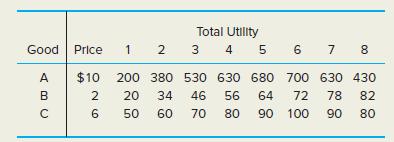
The following table gives the price and total utility of three goods: A, B, and C.As closely as possible, determine how much of the three goods you would buy with $20. Explain why you chose what you did. (LO19-2) Total Utility Good Price 1 2 3 4 5 ABC $10 200 380 530 630 680 6 7 8 700 630 430 2 20
What key psychological assumptions do economists make in their theory of individual choice? (LO19-1)
Complete the following table of Scout’s utility from drinking cans of soda and answer the questions below. (LO19-1)a. At what point does marginal utility begin to fall?b. Will Scout consume the seventh can of soda? Explain your answer.c. True or false? Scout will be following the
According to the principle of diminishing marginal utility, how does marginal utility change as more of a good is consumed? As less of a good is consumed? (LO19-1)
Explain how marginal utility differs from total utility. (LO19-1)
There are many more poor people in the United States than there are rich people. If the poor wanted to, they could exercise their power to redistribute as much money as they please to themselves. They don’t do that, so they must see the income distribution system as fair. Discuss.
In “Why Higher Real Wages May Reduce Altruism for the Poor,” Ball State economist John B. Horowitz considers whether redistribution of income is a public good or a public bad.a. How might income redistribution be considered a public good?b. How might income redistribution be considered a public
“There are lies, damned lies, and statistics. Then, there are annual poverty figures.” Both liberal and conservative economists believe U.S. poverty statistics are suspect.Here are some reasons:(1) They do not take into account in-kind benefits such as food stamps and tax credits.(2) They do
If you receive a paycheck, what percentage of it is withheld for taxes? What incentive effect does that have on your decision to work?
Showing 500 - 600
of 6652
1
2
3
4
5
6
7
8
9
10
11
12
13
14
15
Last
Step by Step Answers

 Get 50% OFF
Claim Now
Get 50% OFF
Claim Now