New Semester
Started
Get
50% OFF
Study Help!
--h --m --s
Claim Now
Question Answers
Textbooks
Find textbooks, questions and answers
Oops, something went wrong!
Change your search query and then try again
S
Books
FREE
Study Help
Expert Questions
Accounting
General Management
Mathematics
Finance
Organizational Behaviour
Law
Physics
Operating System
Management Leadership
Sociology
Programming
Marketing
Database
Computer Network
Economics
Textbooks Solutions
Accounting
Managerial Accounting
Management Leadership
Cost Accounting
Statistics
Business Law
Corporate Finance
Finance
Economics
Auditing
Tutors
Online Tutors
Find a Tutor
Hire a Tutor
Become a Tutor
AI Tutor
AI Study Planner
NEW
Sell Books
Search
Search
Sign In
Register
study help
business
probability and stochastic modeling
Applied Probability And Stochastic Processes 2nd Edition Frank Beichelt - Solutions
An insurance company has a premium income of \(\$ 106080\) per day. The claim sizes are iid random variables and have an exponential distribution with variance \(4 \cdot 10^{6}\left[\$^{2}\right]\). On average, 2 claims arrive per hour according to a homogeneous Poisson process. The time horizon is
Pramod is setting up an insurance policy for low-class cars (homogeneous portfolio) over an infinite time horizon. Based on previous statistical work, he expects that claims will arrive according to a homogeneous Poisson process with intensity \(\lambda=0.8\left[h^{-1}\right]\), and that the claim
The lifetime \(L\) of a system has a Weibull-distribution with distribution function\[F(t)=P(L \leq t)=1-e^{-0.1 t^{3}}, t \geq 0\](1) Determine its failure rate \(\lambda(t)\) and its integrated failure rate \(\Lambda(t)\).(2) The system is maintained according to Policy 1 over an infinite time
A system is maintained according to Policy 3 over an infinite time span. It has the same lifetime distribution and minimal repair cost parameter as in exercise 7.20. As with exercise 7.20, let \(c_{r}=2000\).(1) Determine the optimum integer \(n=n *\), and the corresponding maintenance cost rate
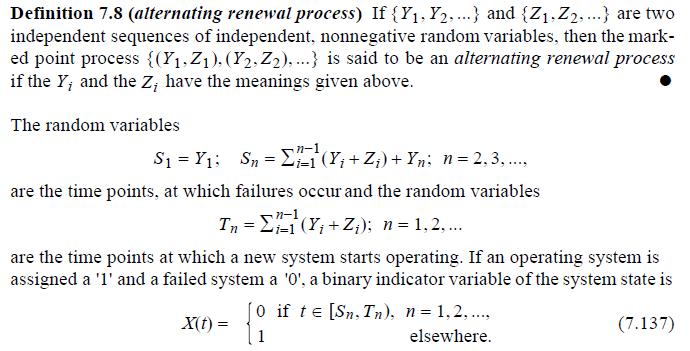
A system starts working at time \(t=0\). Its lifetime has approximately a normal distribution with mean value \(\mu=125\) hours and standard deviation \(\sigma=40\) hours. After a failure, the system is replaced with an equivalent new one in negligible time, and it immediately takes up its work.
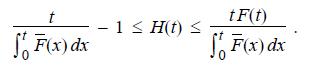
(1) Use the Laplace transformation to find the renewal function \(H(t)\) of an ordinary renewal process whose cycle lengths have an Erlang distribution with parameters \(n=2\) and \(\lambda\).(2) For \(\lambda=1\), sketch the exact graph of the renewal function and the bounds (7.117) in the
An ordinary renewal function has the renewal function \(H(t)=t / 10\). Determine the probability \(P(N(10) \geq 2)\).
A system is preventively replaced by an identical new one at time points \(\tau, 2 \tau, \ldots\) If failures happen in between, then the failed system is replaced by an identical new one as well. The latter replacement actions are called emergency replacements. This replacement policy is called
Given the existence of the first three moments of the cycle length \(Y\) of an ordinary renewal process, verify the formulas (7.112).Data from 7.112 11+02 E(S)= and E(S2) 113 2 3
(1) Verify that the probability \(p(t)=P(N(t)\) is odd) satisfies\[p(t)=F(t)-\int_{0}^{t} p(t-x) f(x) d x, \quad f(x)=F^{\prime}(x)\](2) Determine this probability if the cycle lengths are exponential with parameter \(\lambda\).
Verify that the second moment of \(N(t)\), denoted as \(H_{2}(t)=E\left(N^{2}(t)\right)\), satisfies the integral equation\[H_{2}(t)=2 H(t)-F(t)+\int_{0}^{t} H_{2}(t-x) f(x) d x .\]Verify the equation directly or by applying the Laplace transformation.
The times between the arrivals of successive particles at a counter generate an ordinary renewal process. Its random cycle length \(Y\) has distribution function \(F(t)\) and mean value \(\mu=E(Y)\). After having recorded 10 particles, the counter is blocked for \(\tau\) time units. Particles
The cycle length distribution of an ordinary renewal process is given by the distribution function \(F(t)=1-e^{-t^{2}}, t \geq 0\) (Rayleigh distribution).(1) What is the statement of theorem 7.13 if \(g(x)=(x+1)^{-2}, x \geq 0\) ?(2) What is the statement of theorem 7.15?Data from Theorem 7.15 If
Let be \(A(t)\) the forward and \(B(t)\) the backward recurrence times of an ordinary renewal process at time \(t\). For \(x>y / 2\), determine functional relationships between \(F(t)\) and the conditional probabilities(1) \(P(A(t)>y-t \mid B(t)=t-x), 0 \leq x
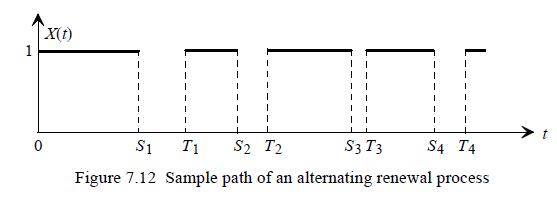
Let \((Y, Z)\) be the typical cycle of an alternating renewal process, where \(Y\) and \(Z\) have an Erlang distribution with joint parameter \(\lambda\) and parameters \(n=2\) and \(n=1\), respectively. For \(t \rightarrow \infty\), determine the probability that the system is in state 1 at time
The time intervals between successive repairs of a system generate an ordinary renewal process \(\left\{Y_{1}, Y_{2}, \ldots\right\}\) with typical cycle length \(Y\). The costs of repairs are mutually independent and independent of \(\left\{Y_{1}, Y_{2}, \ldots\right\}\).Let \(M\) be the typical
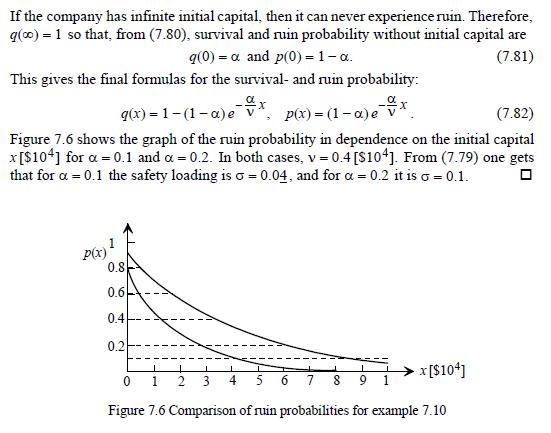
(1) Determine the ruin probability \(p(x)\) of an insurance company with an initial capital of \(x=\$ 20000\) and operating parameters\[1 / \mu=2\left[h^{-1}\right], v=\$ 800 \text { and } \kappa=1700[\$ / h]\](2) Under otherwise the same conditions, draw the the graphs of the ruin probability for
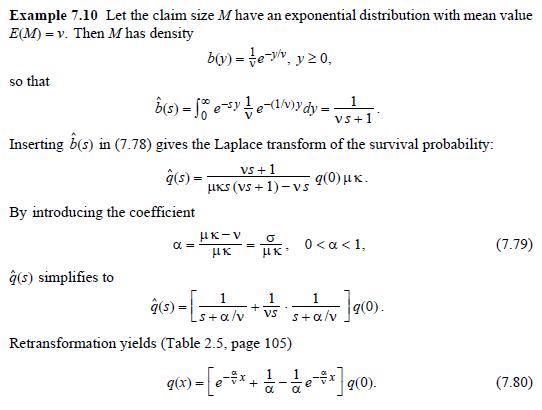
Under otherwise the same assumptions as made in example 7.10, determine the ruin probability if the random claim size \(M\) has density\[b(y)=\lambda^{2} y e^{-\lambda y}, \lambda>0, y \geq 0\]This is an Erlang-distribution with parameters \(\lambda\) and \(n=2\).Data from Example 7.10 Example
Claims arrive at an insurance company according to an ordinary renewal process \(\left\{Y_{1}, Y_{2}, \ldots\right\}\). The corresponding claim sizes \(M_{1}, M_{2}, \ldots\) are independent and identically distributed as \(M\) and independent of \(\left\{Y_{1}, Y_{2}, \ldots\right\}\). Let the
A Markov chain \(\left\{X_{0}, X_{1}, \ldots\right\}\) has state space \(\mathbf{Z}=\{0,1,2\}\) and transition matrix\[\mathbf{P}=\left(\begin{array}{ccc} 0.5 & 0 & 0.5 \\ 0.4 & 0.2 & 0.4 \\ 0 & 0.4 & 0.6 \end{array}\right)\](1) Determine \(P\left(X_{2}=2 \mid X_{1}=0, X_{0}=1\right)\) and
A Markov chain \(\left\{X_{0}, X_{1}, \ldots\right\}\) has state space \(\mathbf{Z}=\{0,1,2\}\) and transition matrix\[\mathbf{P}=\left(\begin{array}{ccc} 0.2 & 0.3 & 0.5 \\ 0.8 & 0.2 & 0 \\ 0.6 & 0 & 0.4 \end{array}\right)\](1) Determine the matrix of the 2-step transition probabilities
A Markov chain \(\left\{X_{0}, X_{1}, \ldots\right\}\) has state space \(\mathbf{Z}=\{0,1,2\}\) and transition matrix\[\mathbf{P}=\left(\begin{array}{ccc} 0 & 0.4 & 0.6 \\ 0.8 & 0 & 0.2 \\ 0.5 & 0.5 & 0 \end{array}\right)\](1) Given the initial distribution
Let \(\left\{Y_{0}, Y_{1}, \ldots\right\}\) be a sequence of independent, identically distributed binary random variables with \(P\left(Y_{i}=0\right)=P\left(Y_{i}=1\right)=1 / 2 ; i=0,1, \ldots\). Define a sequence of random variables \(\left\{X_{1}, X_{2}, \ldots\right\}\) by
A Markov chain \(\left\{X_{0}, X_{1}, \ldots\right\}\) has state space \(\mathbf{Z}=\{0,1,2,3\}\) and transition matrix\[\mathbf{P}=\left(\begin{array}{llll} 0.1 & 0.2 & 0.4 & 0.3 \\ 0.2 & 0.3 & 0.1 & 0.4 \\ 0.4 & 0.1 & 0.3 & 0.2 \\ 0.3 & 0.4 & 0.2 & 0.1 \end{array}\right)\](1) Draw the
Let \(\left\{X_{0}, X_{1}, \ldots\right\}\) be an irreducible Markov chain with state space \(\mathbf{Z}=\{1,2, \ldots, n\}\), \(n
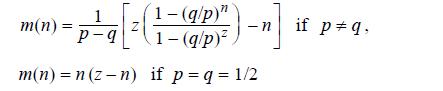
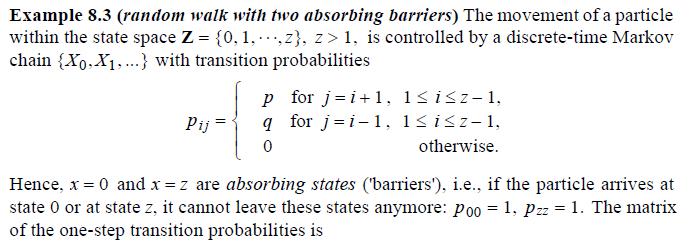
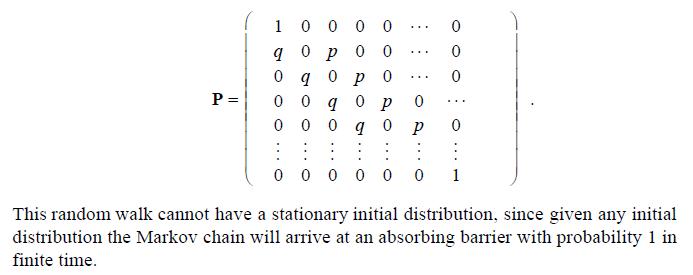
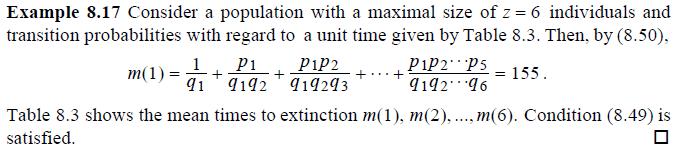
Prove formulas (8.20), page 346 , for the mean times to absorption in a random walk with two absorbing barriers (example 8.3).Data from 8.20Data from Example 8.3 1 1-(q/p)" m(n): p-q 1-(q/p). m(n) n(z-n) if p = q = 1/2 if p q.
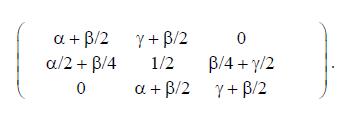
Show that the vector \(\pi=\left(\pi_{1}=\alpha, \pi_{2}=\beta, \pi_{3}=\gamma\right)\), determined in example 8.6 , is a stationary initial distribution with regard to a Markov chain which has the one-step transition matrix (8.22) (page 349).Data from 8.22Data from Example 8.6 + /2 a/2 + /4 0
A source emits symbols 0 and 1 for transmission to a receiver. Random noises \(S_{1}, S_{2}, \ldots\) successively and independently affect the transmission process of a symbol in the following way: if a ' 0 ' ('1') is to be transmitted, then \(S_{i}\) distorts it to a '1' (' 0 ') with probability
Weather is classified as (predominantly) sunny (S) and (predominantly) cloudy (C), where \(\mathrm{C}\) includes rain. For the town of Musi, a fairly reliable prediction of tomorrow's weather can only be made on the basis of today's and yesterday's weather. Let \((\mathrm{C}, \mathrm{S})\) indicate
A supplier of toner cartridges of a certain brand checks her stock every Monday. If the stock is less than or equal to \(s\) cartridges, she orders an amount of \(S-s\) cartridges, which will be available the following Monday, \(0 \leq s
A Markov chain has state space \(\mathbf{Z}=\{0,1,2,3,4\}\) and transition matrix\[\mathbf{P}=\left(\begin{array}{ccccc} 0.5 & 0.1 & 0.4 & 0 & 0 \\ 0.8 & 0.2 & 0 & 0 & 0 \\ 0 & 1 & 0 & 0 & 0 \\ 0 & 0 & 0 & 0.9 & 0.1 \\ 0 & 0 & 0 & 1 & 0 \end{array}\right)\](1) Determine the minimal closed
A Markov chain has state space \(\mathbf{Z}=\{0,1,2,3\}\) and transition matrix\[\mathbf{P}=\left(\begin{array}{cccc} 0 & 0 & 1 & 0 \\ 1 & 0 & 0 & 0 \\ 0.4 & 0.6 & 0 & 0 \\ 0.1 & 0.4 & 0.2 & 0.3 \end{array}\right)\]Determine the classes of essential and inessential states.
A Markov chain has state space \(\mathbf{Z}=\{0,1,2,3,4\}\) and transition matrix\[\mathbf{P}=\left(\begin{array}{ccccc} 0 & 0.2 & 0.8 & 0 & 0 \\ 0 & 0 & 0 & 0.9 & 0.1 \\ 0 & 0 & 0 & 0.1 & 0.9 \\ 1 & 0 & 0 & 0 & 0 \\ 1 & 0 & 0 & 0 & 0 \end{array}\right)\](1) Draw the transition graph.(2)
A Markov chain has state space \(\mathbf{Z}=\{0,1,2,3,4\}\) and transition matrix\[\mathbf{P}=\left(\begin{array}{ccccc} 0 & 1 & 0 & 0 & 0 \\ 1 & 0 & 0 & 0 & 0 \\ 0.2 & 0.2 & 0.2 & 0.4 & 0 \\ 0.2 & 0.8 & 0 & 0 & 0 \\ 0.4 & 0.1 & 0.1 & 0 & 0.4 \end{array}\right)\](1) Find the essential and
Determine the stationary distribution of the random walk considered in example 8.12 on condition \(p_{i}=p, 0Data from Example 8.12 Example 8.12 A particle jumps from x = i to x=0 with probability p; or to i + 1 with probability 1-Pi, 0
The weekly power consumption of a town depends on the weekly average temperature in that town. The weekly average temperature, observed over a long time span in the month of August, has been partitioned in 4 classes (in \(C^{0}\) ):\[\mathbf{1}=[10-15), \quad \mathbf{2}=[15-20), \quad
A household insurer knows that the total annual claim size \(X\) of clients in a certain portfolio hasy a normal distribution with mean value \(\$ 800\) and standard deviation \(\$ 260\). The insurer partitions his clients into classes 1,2, and 3 depending on the annual amounts they claim, and the
Two gamblers 1 and 2 begin a game with stakes of sizes \(\$ 3\) and \(\$ 4\), respectively. After each move a gambler either wins or loses \(\$ 1\) or the gambler's stake remains constant. These possibilities are controlled by the transition probabilities\[\begin{aligned} & p_{0}=0, p_{1}=0.5,
Analogously to example 8.17 (page 369), consider a population with a maximal size of \(z=5\) individuals, which comprises at the beginning of its observation 3 individuals. Its birth and death probabilities with regard to a time unit are\[\begin{aligned} & p_{0}=0, p_{1}=0.6, p_{2}=0.4,
Let the transition probabilities of a birth and death process be given by\[p_{i}=\frac{1}{1+[i /(i+1)]^{2}} \text { and } q_{i}=1-p_{i} ; i=1,2, \ldots ; p_{0}=1\]Show that the process is transient.
Let \(i\) and \(j\) be two different states with \(f_{i j}=f_{j i}=1\). Show that both \(i\) and \(j\) are recurrent.
The respective transition probabilities of two irreducible Markov chains 1 and 2 with common state space \(\mathbf{Z}=\{0,1, \ldots\}\) are for all \(i=0,1, \ldots\),(1)\(p_{i+1}=\frac{1}{i+2}, \quad p_{i 0}=\frac{i+1}{i+2} \quad\) and(2) \(p_{i i+1}=\frac{i+1}{i+2}, \quad p_{i
Let \(N_{i}\) be the random number of time periods a discrete-time Markov chain stays in state \(i\) (sojourn time of the Markov chain in state \(i\) ).Determine \(E\left(N_{i}\right)\) and \(\operatorname{Var}\left(N_{i}\right)\).
A Galton-Watson process starts with one individual. The random number of offspring \(Y\) of this individual has the \(z\)-transform\[M(z)=(0.6 z+0.4)^{3}\](1) What type of probability distribution has \(Y\) ?(2) Determine the probabilities \(P(Y=k)\).(3) What is the corresponding probability of
A Galton-Watson process starts with one individual. The random number of offspring \(Y\) of this individual has the \(z\)-transform\[M(z)=e^{1.5(z-1)}\](1) What is the underlying probability distribution of \(Y\) ?(2) Determine the corresponding probability of extinction.(3) Let \(T\) be the random
(1) Determine the \(z\)-transform of the truncated, \(p_{0}\) - modified geometric distribution given by formula (8.62).(2) Determine the corresponding probability of extinction \(\pi_{0}\) if\[m=6, p_{0}=0.482, \text { and } p=0.441\](3) Compare this \(\pi_{0}\) with the probability of extinction
Assume a Galton-Watson process starts with \(X_{0}=n>1\) offspring.Determine the corresponding probability of extinction given that the same GaltonWatson process, when starting with one offspring, has probability of extinction \(\pi_{0}\).
Given \(X_{0}=1\), show that the probability of extinction \(\pi_{0}\) satisfies equation\[M\left(\pi_{0}\right)=\pi_{0}\]by applying the total probability rule (condition with regard to the number of offspring of the individual in the zerouth generation). Make use of the answer to exercise
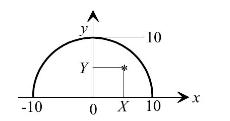
In a game reserve, the random position \((X, Y)\) of a leopard has a uniform distribution in a semicircle with radius \(r=10 \mathrm{~km}\) (figure). Determine \(E(X)\) and \(E(Y)\). V Y 10 -10 0 X 10 x
From a circle with radius \(R=9\) and center \((0,0)\) a point is randomly selected.(1) Determine the mean value of the distance of this point to the nearest point at the periphery of the circle.(2) Determine the mean value of the geometric mean of the random variables \(X\) and \(Y\), i.e.
\(X\) and \(Y\) are independent, exponentially with parameter \(\lambda=1\) distributed random variables. Determine(1) \(E(X-Y)\),(2) \(E(|X-Y|)\), and(3) distribution function and density of \(Z=X-Y\).
\(X\) and \(Y\) are independent random variables with\(E(X)=E(Y)=5, \operatorname{Var}(X)=\operatorname{Var} Y)=9\), and let \(U=2 X+3 Y\) and \(V=3 X-2 Y\).Determine \(E(U), E(V), \operatorname{Var}(U), \operatorname{Var}(V), \operatorname{Cov}(U, V)\), and \(ho(U, V)\).
\(X\) and \(Y\) are independent, in the interval \([0,1]\) uniformly distributed random variables. Determine the densities of(1) \(Z=\min (X, Y)\), and (2) \(Z=X Y\).
\(X\) and \(Y\) are independent and \(N(0,1)\)-distributed. Determine the density \(f_{Z}(z)\) of\[Z=X / Y\]Which type of probability distributions does \(f_{Z}(z)\) belong to?
\(X\) and \(Y\) are independent and identically Cauchy distributed with parameters \(\lambda=1\) and \(\mu=0\), i.e. they have densities\[f_{X}(x)=\frac{1}{\pi} \frac{1}{1+x^{2}}, \quad f_{Y}(y)=\frac{1}{\pi} \frac{1}{1+y^{2}}, \quad-\infty
The joint density of the random vector \((X, Y)\) is\[f(x, y)=6 x^{2} y, \quad 0 \leq x, y \leq 1\]Determine the distribution density of the product \(Z=X Y\).
The random vector \((X, Y)\) has the joint density\[f_{X, Y}(x, y)=2 e^{-(x+y)} \text { for } 0 \leq x \leq y
The resistance values \(X, Y\), and \(Z\) of 3 resistors connected in series are assumed to be independent, normally distributed random variables with respective mean values 200,300 , and \(500[\Omega]\), and standard deviations 5,10 , and \(20[\Omega]\).(1) What is the probability that the total
A supermarket employs 24 shopassistants. 20 of them achieve an average daily turnover of \(\$ 8000\), whereas 4 achieve an average daily turnover of \(\$ 10000\). The corresponding standard deviations are \(\$ 2400\) and \(\$ 3000\), respectively. The daily turnovers of all shopassistants are
A helicopter is allowed to carry at most 8 persons given that their total weight does not exceed \(620 \mathrm{~kg}\). The weights of the passengers are independent, identically normally distributed random variables with mean value \(76 \mathrm{~kg}\) and variance \(324 \mathrm{~kg}^{2}\).(1) What
Let \(X\) be the height of the woman and \(Y\) be the height of the man in married couples in a certain geographical region. By analyzing a sufficiently large sample, a statistician found that the random vector \((X, Y)\) has a joint normal distribution with parameters\[E(X)=168 \mathrm{~cm},
A target, which is located at point \((0,0)\) of the \((x, y)\) - coordinate system, is subject to permanent shellfire. The random coordinates \(X\) and \(Y\) of the hitting point of a shell are independent and identically as \(N\left(0, \sigma^{2}\right)\)-distributed.(1) Determine the
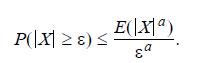
On average, \(6 \%\) of the citizens of a large town suffer from severe hypertension. Let \(X\) be the number of people in a sample of \(n\) randomly selected citizens from this town which suffer from this disease.(1) By making use of Chebyshev's inequality find the smallest positive integer
The measurement error \(X\) of a measuring device has mean value \(E(X)=0\) and variance \(\operatorname{Var}(X)=0.16\). The random outcomes of \(n\) independent measurements are \(X_{1}, X_{2}, \ldots, X_{n}\), i.e., the \(X_{i}\) are independent, identically as \(X\) distributed random
A manufacturer of \(T V\) sets knows from past experience that \(4 \%\) of his products do not pass the final quality check.(1) What is the probability that in the total monthly production of 2000 sets between 60 and 100 sets do not pass the final quality check?(2) How many sets have at least to be
The daily demand for a certain medication in a country is given by a random variable \(X\) with mean value 28 packets per day and with a variance of 64 . The daily demands are independent of each other and distributed as \(X\).(1) What amount of packets should be ordered for a year with 365 days so
According to the order, the rated nominal capacitance of condensers in a large delivery should be \(300 \mu F\). Their actual rated nominal capacitances are, however, random variables \(X\) with\[E(X)=300 \text { and } \operatorname{Var}(X)=144\](1) By means of Chebyshev's inequality determine an
A digital transmission channel distorts on average 1 out of 10000 bits during transmission. The bits are transmitted independently of each other.(1) Give the exact formula for the probability of the random event \(A\) that amongst \(10^{6}\) sent bits there are at least 80 bits distorted.(2)
Solve the problem of example 2.4 (page 51) by making use of the normal approximation to the binomial distribution and compare with the exact result.Data from Example 2.4A power station supplies power to 10 bulk consumers. They use power independently of each other and in random time intervals,
Solve the problem of example 2.6 (page 54) by making use of the normal approximation to the hypergeometric distribution and compare with the exact result.Data from Example 2.6A customer knows that on average 4% of parts delivered by a manufacturer are defective and has accepted this percentage. To
The random number of asbestos particles per \(1 \mathrm{~mm}^{3}\) in the dust of an industrial area is Poisson distributed with parameter \(\lambda=8\).What is the probability that in \(1 \mathrm{~cm}^{3}\) of dust there are(1) at least 10000 asbestos particles, and(2) between 8000 and 12000
The number of e-mails, which daily arrive at a large company, is Poisson distributed with parameter\[\lambda=22400\]What is the probability that daily between between 22300 and 22500 e-mails arrive?
In \(1 \mathrm{~kg}\) of a tapping of cast iron melt there are on average 1.2 impurities.What is the probability that in a \(1000 \mathrm{~kg}\) tapping there are at least 1400 impurities?The spacial distribution of the impurities in a tapping is assumed to be Poisson.
After six weeks, 24 seedlings, which had been planted at the same time, reach the random heights \(X_{1}, X_{2}, \ldots, X_{24}\), which are independent, identically exponentially distributed as \(X\) with mean value \(\mu=32 \mathrm{~cm}\).Based on the Gauss inequalities, determine(1) an upper
Under otherwise the same assumptions as in exercise 5.12, only 6 seedlings had been planted. Determine(1) the exact probability that the arithmetic mean\[\bar{X}_{6}=\frac{1}{6} \sum_{i=1}^{6} X_{i}\]exceeds \(\mu=32 \mathrm{~cm}\) by more than \(0.06 \mathrm{~cm}\) (Erlang distribution),(2) by
The continuous random variable \(X\) is uniformly distributed on \([0,2]\).(1) Draw the graph of the function\[p(\varepsilon)=P(|X-1| \geq \varepsilon)\]in dependence of \(\varepsilon, 0 \leq \varepsilon \leq 1\).(2) Compare this graph with the upper bound for the probability\[P(|X-1| \geq
A stochastic process \(\{X(t), t>0\}\) has the one-dimensional distribution\[\left\{F_{t}(x)=P(X(t) \leq x)=1-e^{-(x / t)^{2}}, x \geq 0, t>0\right\}\]Is this process weakly stationary?
The one-dimensional distribution of a stochastic process \(\{X(t), t>0\}\) is\[F_{t}(x)=P(X(t) \leq x)=\frac{1}{\sqrt{2 \pi t} \sigma} \int_{-\infty}^{x} e^{-\frac{(u-\mu)^{2}}{2 \sigma^{2} t}} d u\]with \(\mu>0, \sigma>0 ; x \in(-\infty+\infty)\).Determine its trend function \(m(t)\) and, for
Let \(X(t)=A \sin (\omega t+\Phi)\), where \(A\) and \(\Phi\) are independent, non-negative random variables with \(\Phi\) uniformly distributed over \([0,2 \pi]\) and \(E(A)
Let \(X(t)=A(t) \sin (\omega t+\Phi)\) where \(A(t)\) and \(\Phi\) are independent, non-negative random variables for all \(t\), and let \(\Phi\) be uniformly distributed over \([0,2 \pi]\).Verify: If \(\{A(t), t \in(-\infty,+\infty)\}\) is a weakly stationary process, then the stochastic process
Let \(\left\{a_{1}, a_{2}, \ldots, a_{n}\right\}\) be a sequence of real numbers, and \(\left\{\Phi_{1}, \Phi_{2}, \ldots, \Phi_{n}\right\}\) be a sequence of independent random variables, uniformly distributed over \([0,2 \pi]\).Determine covariance and correlation function of the process
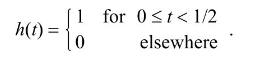
A modulated signal (pulse code modulation) \(\{X(t), t \in(-\infty,+\infty)\}\) is given by\[X(t)=\Sigma_{-\infty}^{+\infty} A_{n} h(t-n)\]where the \(A_{n}\) are independent and identically distributed random variables which can only take on values -1 and +1 and have mean value 0 . Further, let(1)
Let \(\{X(t), t \in(-\infty,+\infty)\}\) and \(\{Y(t), t \in(-\infty,+\infty)\}\) be two independent, weakly stationary stochastic processes, whose trend functions are identically 0 and which have the same covariance function \(C(\tau)\).Verify: The stochastic process \(\{Z(t), t
Let \(X(t)=\sin \Phi t\), where \(\Phi\) is uniformly distributed over the interval \([0,2 \pi]\).Verify: (1) The discrete-time stochastic process \(\{X(t) ; t=1,2, \ldots\}\) is weakly, but not strongly stationary(2) The continuous-time stochastic process \(\{X(t), t \geq 0\}\) is neither weakly
Let \(\{X(t), t \in(-\infty,+\infty)\}\) and \(\{Y(t), t \in(-\infty,+\infty)\}\) be two independent stochastic processes with trend and covariance functions\[m_{X}(t), m_{Y}(t) \text { and } C_{X}(s, t), C_{Y}(s, t)\]respectively. Further, let\[U(t)=X(t)+Y(t) \text { and } V(t)=X(t)-Y(t), t
The following table shows the annual, inflation-adjusted profits of a bank in the years between 2005 to 2015 [in \(\$ 10^{6}\) ].(1) Determine the smoothed values \(\left\{y_{i}\right\}\) obtained by applying M.A.(3).(2) Based on the \(y_{i}\), determine the trend function (assumed to be a straight
The following table shows the production figures \(x_{i}\) of cars of a company over a time period of 12 years (in \(10^{3}\) ).(1) Draw a time series plot. Is the underlying trend function linear?(2) Smooth the time series \(\left\{x_{i}\right\}\) by the Epanechnikov kernel with bandwidth
Let \(Y_{t}=0.8 Y_{t-1}+X_{t} ; t=0, \pm 1, \pm 2, \ldots\), where \(\left\{X_{t} ; t=0, \pm 1, \pm 2, \ldots\right\}\) is the purely random sequence with parameters \(E\left(X_{t}\right)=0\) and \(\operatorname{Var}\left(X_{t}\right)=1\).Determine the covariance function and sketch the correlation
Let an autoregressive sequence of order \(2\left\{Y_{t} ; t=0, \pm 1, \pm 2, \ldots\right\}\) be given by\[Y_{t}-1.6 Y_{t-1}+0.68 Y_{t-2}=2 X_{t} ; \quad t=0, \pm 1, \pm 2, \ldots\]where \(\left\{X_{t} ; t=0, \pm 1, \pm 2, \ldots\right\}\) is the same purely random sequence as in the previous
Let an autoregressive sequence of order \(2\left\{Y_{t} ; t=0, \pm 1, \pm 2, \ldots\right\}\) be given by\[Y_{t}-0.8 Y_{t-1}-0.09 Y_{t-2}=X_{t} ; t=0, \pm 1, \pm 2, \ldots\]where \(\left\{X_{t} ; t=0, \pm 1, \pm 2, \ldots\right\}\) is the same purely random sequence as in exercise (6.12).(1) Check
Two dice are thrown. Their respective random outcomes are \(X_{1}\) and \(X_{2}\). Let \(X=\max \left(X_{1}, X_{2}\right)\) and \(Y\) be the number of even components of \(\left(X_{1}, X_{2}\right) . X\) and \(Y\) have the respective ranges \(R_{X}=\{1,2,3,4,5,6\}\) and \(R_{Y}=\{0,1,2\}\).(1)
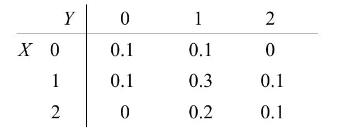
Every day a car dealer sells \(X\) cars of type 1 and \(Y\) cars of type 2 . The following table shows the joint distribution \(\left\{r_{i j}=P(X=i, Y=j) ; i, j=0,1,3\right\}\) of \((X, Y)\).(1) Determine the marginal distributions of \((X, Y)\).(2) Are \(X\) and \(Y\) independent?(3) Determine
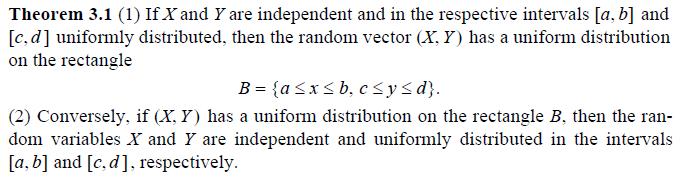
Let \(B\) be the upper half of the circle \(x^{2}+y^{2}=1\). The random vector \((X, Y)\) is uniformly distributed over \(B\).(1) Determine the joint density of \((X, Y)\).(2) Determine the marginal distribution densities.(3) Are \(X\) and \(Y\) independent? Is theorem 3.1 applicable to answer this
Let the random vector \((X, Y)\) have a uniform distribution over a circle with radius \(r=2\).Determine the distribution function of the point \((X, Y)\) from the center of this circle.
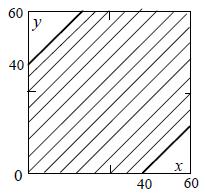
Tessa and Vanessa have agreed to meet at a café between 16 and 17 o'clock. The arrival times of Tessa and Vanessa are \(X\) and \(Y\), respectively. The random vector \((X, Y)\) is assumed to have a uniform distribution over the square\[B=\{(x, y) ; 16 \leq x \leq 17,16 \leq y \leq 17\}\]Who comes
Determine the mean length of a chord, which is randomly chosen in a circle with radius \(r\). Consider separately the following ways how to randomly choose a chord:(1) For symmetry reasons, the direction of the chord can be fixed in advance. Draw the diameter of the circle, which is perpendicular
Matching bolts and nuts have the diameters \(X\) and \(Y\), respectively. The random vector \((X, Y)\) has a uniform distribution in a circle with radius \(1 \mathrm{~mm}\) and midpoint (30mm , 30mm). Determine the probabilities(1) \(P(Y>X)\), and (2) \(P(Y \leq X
The random vector \((X, Y)\) is defined as follows: \(X\) is uniformly distributed in the interval \([0,10]\). On condition \(X=x\), the random variable \(Y\) is uniformly distributed in the interval \([0, x]\). Determine(1) \(f_{X, Y}(x, y), f_{X}(x \mid y)\), and \(f_{Y}(y \mid x)\),(2) \(E(Y),
Let\[f_{X, Y}(x, y)=c x^{2} y, 0 \leq x, y \leq 1\]be the joint probability density of the random vector \((X, Y)\).(1) Determine the constant \(c\) and the marginal densities.(2) Are \(X\) and \(Y\) independent?
The random vector \((X, Y)\) has the joint probability density\[f_{X, Y}(x, y)=\frac{1}{2} e^{-x}, \quad 0 \leq x, 0 \leq y \leq 2\](1) Determine the marginal densities and the mean values \(E(X)\) and \(E(Y)\).(2) Determine the conditional densities \(f_{X}(x \mid y)\) and \(f_{Y}(y \mid x)\). Are
Showing 5800 - 5900
of 6914
First
52
53
54
55
56
57
58
59
60
61
62
63
64
65
66
Last
Step by Step Answers

 Get 50% OFF
Claim Now
Get 50% OFF
Claim Now