New Semester
Started
Get
50% OFF
Study Help!
--h --m --s
Claim Now
Question Answers
Textbooks
Find textbooks, questions and answers
Oops, something went wrong!
Change your search query and then try again
S
Books
FREE
Study Help
Expert Questions
Accounting
General Management
Mathematics
Finance
Organizational Behaviour
Law
Physics
Operating System
Management Leadership
Sociology
Programming
Marketing
Database
Computer Network
Economics
Textbooks Solutions
Accounting
Managerial Accounting
Management Leadership
Cost Accounting
Statistics
Business Law
Corporate Finance
Finance
Economics
Auditing
Tutors
Online Tutors
Find a Tutor
Hire a Tutor
Become a Tutor
AI Tutor
AI Study Planner
NEW
Sell Books
Search
Search
Sign In
Register
study help
business
project management
Project Management A Strategic Managerial Approach 10th Edition Jack R. Meredith, Scott M. Shafer, Samuel J. Mantel Jr. - Solutions
Describe the three variances of an EV chart and explain their significance. LO6
Can you identify other symptoms of computer misuse besides those in Section 10.4? LO6
What is the purpose of “earned value”? How would the progress of the project as a whole be calculated? LO6
Describe the various ways that EV can be found. LO6
Discuss the benefits of timely, appropriate, detailed information.How can a value be assigned to these characteristics? LO6
What are the advantages for a PM of having a computerized system over a manual one? The disadvantages? LO6
A more intensive, and extensive, monitoring system is needed in project management than in a functional organization.Why? LO6
The EV chart is an attempt to put the three-dimensional concept of Figure 1.1 (see Chapter 1) into a two-dimensional format. Is it successful? What is missing? LO6
How might a variance be traced back to its source? LO6
Is it unethical, in an attempt to avoid a “shoot-the-messenger”response, to simply not mention bad news? LO6
Which method of estimating EV seems the most accurate?Which one would you recommend? Why? LO6
Find the schedule and cost variances for a project that has an actual cost at month 22 of $540,000, a scheduled cost of$523,000, and an EV of $535,000.LO1
A sales project at month 5 had an actual cost of $34,000, a planned cost of $42,000, and a value completed of $39,000.Find the cost and schedule variances and the CPI and SPI.LO1
A consulting project has an actual cost in month 10 of $23,000, a scheduled cost of $17,000, and a value completed of $20,000.Find the schedule and cost variances and the three indexes.LO1
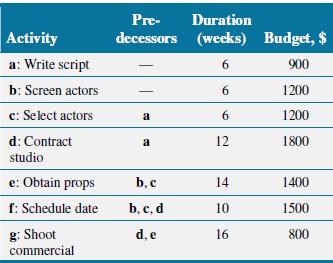
At week 24 of a project to shoot a television commercial, what should the expenditures be? If the EV is right on schedule but the actual expenses are $9000, what are the cost and schedule variances? What are the three indexes, the ETC, and the EAC? Use the proportionality rule.LO1 Activity a: Write
Resolve Exercise 8b using MSP. Omit the calculations for CPI, SPI, and CSI.LO1
Resolve the EV example of Table 10.1 by recomputing Figures 10.5 and 10.6 using the 0–100% rule.LO1
Repeat Exercise 11 using the time proportionality rule and the following new data for % completion of each task:a: 100; b: 100; c: 80 (cost 600); d: 50 (cost 200); e: 0.LO1
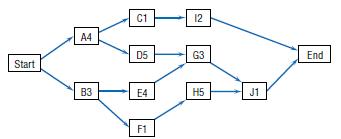
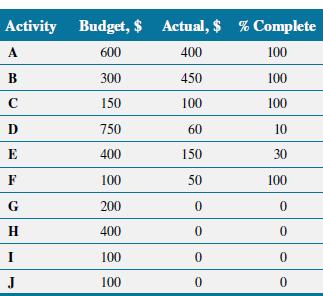
Draw an EV chart for the end of the first week (5 days)assuming the time proportionality rule for the project illustrated in the following network diagram given the following costs and percentage completions:LO1 A4 C1 12 D5 G3 Start B3 E4 H5 J1 F1 End
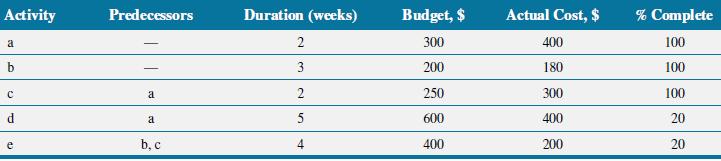
The following project is at the end of its sixth week. Find the cost and schedule variances. Also find the CPI, SPI, ETC, and EAC for the project.LO1 Activity Predecessors Duration (weeks) Budget, $ Actual Cost, $ % Complete a b 2 300 400 100 3 200 180 100 a 2 250 300 100 d a 5 600 400 20 e b, c 4
What is the purpose of control? To what is it directed?LO4
What are the three main types of control system? What questions should a control system answer?LO4
What tools are available to the PM to use in controlling a project?Identify some characteristics of a good control system.LO4
What is the mathematical expression for the CR? What does it tell a manager?LO4
How is creativity controlled?LO4
What are go/no-go controls?LO4
What is a champion?LO4
Describe a cybernetic control system.LO4
What should the postcontrol report include?LO4
How should change be controlled?LO4
Describe the phase-gate process.LO4
How might the PM integrate the various control tools into a project control system?LO4
How could a negative feedback control system be implemented in project management to anticipate client problems?LO4
How does the EV approach achieve the objective of the trend projection curve in Figure 11.5?LO4
What other project parameters besides schedule and cost might a control chart be used for? How would their limits be set?LO4
Control systems are sometimes classified into two categories, preventive and feedback. How do the three types of systems described in the chapter relate to these two categories?LO4
How do internal and external controls differ?LO4
What are some difficulties encountered when attempting project control?LO4
How might the information required for control systems be collected?LO4
How might the information collected through the control system be used on subsequent projects?LO4
How does the control of creative projects differ from the control of ordinary projects?LO4
Where might ethical issues arise for a PM in the stewardship of the company’s resources?LO4
Why is the control of change such a difficult problem for a PM? How might a change control system help?LO4
Give a numeric example where using the CSI as the CR would be misleading.LO4
Describe the life cycle of a project in terms of (1) the degree of project completion and (2) required effort.
List the main characteristics of a project and briefly describe the important features of each.
What are some sources of conflict the PM must deal with?
Would you like to be a PM? Why or why not?
Who in the governance structure has the longest serving role? LO5
Contrast the competitive necessity model with the operating necessity model. What are the advantages and disadvantages of each? LO5
What is a sacred cow? Give some examples. LO5
Give an example of a Q-Sort process for project selection. LO5
What are some of the limitations of project selection models? LO5
Contrast the real options selection approach with profitability models. LO5
How does the discounted cash flow method answer some of the criticisms of the payback period method? LO5
What are some advantages and disadvantages of the profit/profitability numeric models? LO5
What is the desired result of applying project portfolio management?What do firms usually find happens? LO5
Describe the discovery-driven planning approach. LO5
Describe the project portfolio management process. LO5
Describe the various phases of governance for strategic projects and their purpose. LO5
Why do many researchers consider the first governance phase to be the most important? LO5
Which of the many purposes of project portfolio management are most important to a firm with a low project management maturity? Which to a firm with high maturity? LO5
On what basis does the real options model select projects? LO5
What is the difference between profitability and scoring models? Describe a model that could fit both categories. LO5
Contrast the window-of-opportunity approach with discoverydriven planning. LO5
Discuss how the following project selection models are used in real-world applications. (a) Capital investment with discounted cash flow. (b) Simulation models. LO5
Why do you think managers underutilize project selection models? LO5
Would uncertainty models be classified as profitability models, scoring models, or some other type of model? LO5
Recent research on strategic projects has found that “scope”is much more important than either time or cost. Why do you think so? LO5
Are there certain types of projects that are better suited for nonnumeric selection methods as opposed to numeric ones? LO5
What important comparisons does the aggregate project plan in Figure 2.3 allow? LO5
Which roles in the governance structure do you think are the most well-defined and the least well-defined? LO5
If sustainability focuses on long-run profitability, why is it classified as a “nonnumeric” model? LO5
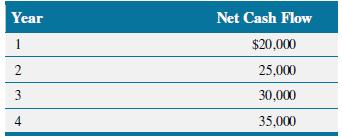
A 4-year financial project has net cash flows of $20,000;$25,000; $30,000; and $50,000 in the next 4 years. It will cost $75,000 to implement the project. If the required rate of return is 0.2, conduct a discounted cash flow calculation to determine the NPV.
What would happen to the NPV of the above project if the inflation rate was expected to be 4 percent in each of the next 4 years?
A 4-year financial project has estimates of net cash flows shown in the following table:must be invested at the beginning of the project. After the fourth year, the project will have no residual value.Using the most likely estimates of cash flows, conduct a discounted cash flow calculation assuming
Use a weighted score model to choose between three projects(A, B, C) for updating an important internal process.The relative weights for each criterion are shown in the following table as are the scores for each project on each criterion.A score of 1 represents unfavorable, 2 satisfactory, and 3
Develop a spreadsheet for Exercise 6a. What would your recommendation be if the weight for the safety went down to 10 and the weight of profitability went up to 25?b. Suppose instead that method A received a score of 3 for safety. Would your recommendation change under these circumstances?c. The
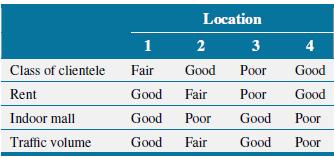
Nina is trying to decide in which of four shopping centers to locate her new boutique. Some locations attract a higher class of clientele than others, some are in an indoor mall, some have a much greater customer traffic volume than others, and, of course, rent varies considerably from one location
Referring to Exercise 8, develop a spreadsheet to help Nina select a location for her boutique. Suppose Nina is able to negotiate a lower rent at location 3 and thus raise its ranking to “good.” How does this affect the overall rankings of the four locations?
How does the project act as a stepping stone for the PM’s career?LO9
Name the categories of skills that should be considered in the selection of a PM.LO9
Discuss the PM’s responsibilities toward the project team members.LO9
What are the major differences between functional managers and PMs?LO9
What are some of the essential characteristics of effective project team members?LO9
What is the most important selection characteristic of a PM?LO9
What project goals are most important during the project life-cycle stages?LO9
Why must project management team members have good technical skills?LO9
Describe each of the four elements of culture.LO9
Identify some important types of project environments.LO9
Contrast culture, microculture, and multiculture.LO9
In what ways is language crucial in project management?LO9
Identify the five multicultural factors requiring special consideration.LO9
Can you think of several ways to assure “breadth of communication”in a project? Do you think “socialization” off the job helps or hinders?LO9
Contrast the prime law for projects, “Never surprise the boss,” with the corporate adage “Bad news never travels up.”LO9
How does a PM, in some cases, work like a politician?LO9
What are some of the conflicts that are bound to occur between stakeholders that have legitimate interests in the project?LO9
PMs must be generalists rather than specialists. Yet, team members need to have more specialized, technical skills.Can a generalist manage a team of specialists effectively?LO9
Why do you think cost drops in importance as an objective right after the formation stage?LO9
Why is it more difficult to keep the project on its time and cost schedules the later the project gets in its life cycle?LO9
Showing 4300 - 4400
of 5801
First
37
38
39
40
41
42
43
44
45
46
47
48
49
50
51
Last
Step by Step Answers

 Get 50% OFF
Claim Now
Get 50% OFF
Claim Now