New Semester
Started
Get
50% OFF
Study Help!
--h --m --s
Claim Now
Question Answers
Textbooks
Find textbooks, questions and answers
Oops, something went wrong!
Change your search query and then try again
S
Books
FREE
Study Help
Expert Questions
Accounting
General Management
Mathematics
Finance
Organizational Behaviour
Law
Physics
Operating System
Management Leadership
Sociology
Programming
Marketing
Database
Computer Network
Economics
Textbooks Solutions
Accounting
Managerial Accounting
Management Leadership
Cost Accounting
Statistics
Business Law
Corporate Finance
Finance
Economics
Auditing
Tutors
Online Tutors
Find a Tutor
Hire a Tutor
Become a Tutor
AI Tutor
AI Study Planner
NEW
Sell Books
Search
Search
Sign In
Register
study help
business
statistical sampling to auditing
Introductory Probability And Statistical Applications 2nd Edition Paul L. Meyer - Solutions
8.17. A machinist keeps a large number of washers in a drawer. About 50 percent of these washers are inch in diameter, about 30 percent are inch in diameter, and the remaining 20 percent are inch in diameter. Suppose that 10 washers are chosen at random.(a) What is the probability that there are
8.16. Four components are assembled into a single apparatus. The components originate from independent sources and p. = P(ith component is defective), i = 1,2,3,4. (a) Obtain an expression for the probability that the entire apparatus is functioning. (b) Obtain an expression for the probability
8.15. Two independently operating launching procedures are used every week for launching rockets. Assume that each procedure is continued until it produces a successful launching. Suppose that using procedure I, P(S), the probability of a successful launching, equals p1, while for procedure II,
8.14. In forming binary numbers with n digits, the probability that an incorrect digit will appear is, say 0.002. If the errors are independent, what is the probability of finding zero, one, or more than one incorrect digits in a 25-digit binary number? If the com- puter forms 106 such 25-digit
8.13. It has been found that the number of transistor failures on an electronic com- puter in any one-hour period may be considered as a random variable having a Poisson distribution with parameter 0.1. (That is, on the average there is one transistor failure every 10 hours.) A certain computation
8.12. A radioactive source is observed during 7 time intervals each of ten seconds in duration. The number of particles emitted during each period is counted. Suppose that the number of particles emitted, say X, during each observed period has a Poisson distribution with parameter 5.0. (That is,
8.11. Suppose that a book of 585 pages contains 43 typographical errors. If these errors are randomly distributed throughout the book, what is the probability that 10 pages, selected at random, will be free of errors? [Hint: Suppose that X = number of errors per page has a Poisson distribution.]
8.10. Suppose that a container contains 10,000 particles. The probability that such a particle escapes from the container equals 0.0004. What is the probability that more than 5 such escapes occur? (You may assume that the various escapes are independent of one another.)
8.9. Suppose that particles are emitted from a radioactive source and that the num- ber of particles emitted during a one-hour period has a Poisson distribution with param- eter A. Assume that the counting device recording these emissions occasionally fails to record an emitted particle.
8.8. Particles are emitted from a radioactive source. Suppose that the number of such particles emitted during a one-hour period has a Poisson distribution with param- eter A. A counting device is used to record the number of such particles emitted. If more than 30 particles arrive during any
8.7. A film supplier produces 10 rolls of a specially sensitized film each year. If the film is not sold within the year, it must be discarded. Past experience indicates that D, the (small) demand for the film, is a Poisson-distributed random variable with param- eter 8. If a profit of $7 is made
8.6. Suppose that X has a Poisson distribution. If P(X 2) P(X = 1), evaluate P(X = 0) and P(X = 3). = =
8.5. An insurance company has discovered that only about 0.1 percent of the popu- lation is involved in a certain type of accident each year. If its 10,000 policy holders were randomly selected from the population, what is the probability that not more than 5 of its clients are involved in such an
8.4. Suppose that the probability that an item produced by a particular machine is defective equals 0.2. If 10 items produced from this machine are selected at random, what is the probability that not more than one defective is found? Use the binomial and Poisson distributions and compare the
8.3. (This problem is taken from Probability and Statistical Inference for Engineers by Derman and Klein, Oxford University Press, London, 1959.) The number of oil tankers, say N, arriving at a certain refinery each day has a Poisson distribution with parameter = 2. Present port facilities can
8.2. Let X have a Poisson distribution with parameter A. Find that value of k for which P(X = k) is largest. [Hint: Compare P(X = k) with P(X = k 1).]
8.1. If X has a Poisson distribution with parameter B, and if P(X = 0) = 0.2, evaluate P(X 2).
7.48. Consider weather forecasting with two alternatives: "rain" or "no rain" in the next 24 hours. Suppose that p = Prob(rain in next 24 hours) > 1/2. The forecaster scores 1 point if he is correct and 0 points if not. In making n forecasts, a forecaster with no ability whatsoever chooses at
7.47. Suppose that both of the regression curves of the mean are in fact linear. Spe- cifically, assume that E(Yx) = x2 and E(X | y) = - (a) Determine the correlation coefficient p. (b) Determine E(X) and E(Y). 3.
7.46. If X, Y, and Z are uncorrelated random variables with standard deviations 5, 12, and 9, respectively and if U = X + Y and V = Y + Z, evaluate the correlation coefficient between U and V.
7.45. Prove Theorem 7.18.
7.44. Prove Theorem 7.17. [Hint: For the continuous case, = multiply the equation to co. Do the same E(Y x) Ax+B by g(x), the pdf of X, and integrate from thing, using xg(x) and then solve the resulting two equations for A and for B.]
7.42. For the random variable (X, Y) defined in Problem 6.15, evaluate E(X | y), E(Y | x), and check that E(X) =E[E(XY)] and E(Y) =E[E(Y | X)]. 7.43. Prove Theorem 7.16.
7.40. Suppose that A and B are two events associated with an experiment &. Suppose that P(A) > 0 and P(B) > 0. Let the random variables X and Y be defined as follows. X = 1 if A occurs and 0 otherwise, Y = 1 if B occurs and 0 otherwise. 0 implies that X and Y are independent. Prove Theorem 7.14.
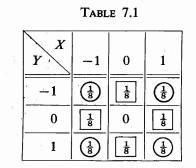
7.39. The following example illustrates that p = 0 does not imply independence. Suppose that (X, Y) has a joint probability distribution given by Table 7.1. (a) Show that E(XY) = E(X)E(Y) and hence p = 0. (b) Indicate why X and Y are not independent.(c) Show that this example may be generalized as
7.38. Suppose that the two-dimensional random variable (X, Y) has pdf given by f(x, y) = ke-, = 0, 0 < x < y < 1 elsewhere. (See Fig. 7.18.) Find the correlation coefficient pzy.
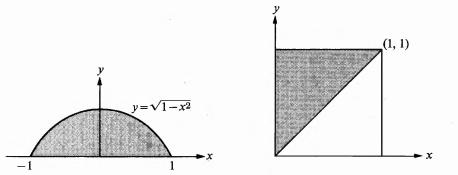
7.37. Suppose that the two-dimensional random variable (X, Y) is uniformly dis- tributed over R, where R is defined by {(x, y) | x + y 1, y 0). (See Fig. 7.17.) Evaluate pay, the correlation coefficient. y=1-x2 (1, 1) 1 -x x
7.36. Verify Eq. (7.17).
7.35. Compare the upper bound on the probability P[|X - E(X) 2V(X)] ob- tained from Chebyshev's inequality with the exact probability if X is uniformly dis- tributed over (-1,3).
7.34. (a) Suppose that the random variable X assumes the values -1 and 1 each with probability. Consider P[|X E(X) kV(X)] as a function of k, k > 0. Plot this function of k and, on the same coordinate system, plot the upper bound of the above probability as given by Chebyshev's inequality. (b) Same
7.33. Show that if X is a continuous random variable with pdf f having the property that the graph of fis symmetric about x =a, then E(X) =a, provided that E(X) exists. (See Example 7.16.)
7.32. Suppose that X and Y are independent random variables, each uniformly dis- tributed over (1, 2). Let Z=X/Y. (a) Using Theorem 7.7, obtain approximate expressions for E(Z) and V(Z). (b) Using Theorem 6.5, obtain the pdf of Z and then find the exact value of E(Z) and V(Z). Compare with (a).
7.31. Suppose that X and Y are random variables for which E(X) = E(Y) = Mys V(X), and V(Y). Using Theorem 7.7, obtain an approximation for E(Z) and V(Z), where Z = X/Y.
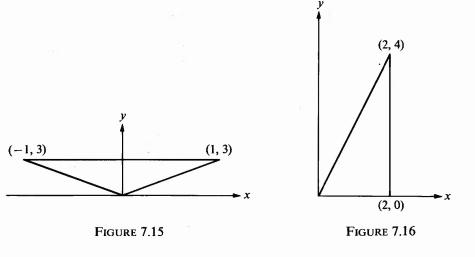
7.30. Suppose that (X, Y) is uniformly distributed over the triangle in Fig. 7.16. (a) Obtain the marginal pdf of X and of Y. (b) Evaluate (X) and V(Y). (-1,3) FIGURE 7.15 (1, 3) x (2,4) (2,0) FIGURE 7.16 x
7.29. Suppose that the two-dimensional random variable (X, Y) is uniformly dis- tributed over the triangle in Fig. 7.15. Evaluate V(X) and V(Y).
7.28. Suppose that the continuous random variable X has pdf - f(x)=2xe, x 0. Let Y = x. Evaluate E(Y): (a) directly without first obtaining the pdf of Y, (b) by first obtaining the pdf of Y.
7.27. A target is made of three concentric circles of radii 1/3, 1, and 3 feet. Shots within the inner circle count 4 points, within the next ring 3 points, and within the third ring 2 points. Shots outside the target count zero. Let R be the random variable repre- senting the distance of the hit
7.26. Suppose that X is uniformly distributed over [-a, 3a]. Find the variance of X.
7.25. Suppose that S, a random voltage, varies between 0 and 1 volt and is uniformly distributed over that interval. Suppose that the signal S is perturbed by an additive, in- dependent random noise N which is uniformly distributed between 0 and 2 volts. (a) Find the expected voltage of the signal,
7.24. Suppose that X is a random variable for which E(X) = 10 and V(X) = 25. For what positive values of a and b does Y = ax - b have expectation 0 and variance 1?
7.23. Find the expected value and variance of the random variable W of Problem 6.13.
7.22. Find the expected value and variance of the random variable H of Problem 6.11.
7.21. Find the expected value and variance of the random variable A of Problem 6.7.
7.20. Find the expected value and variance of the random variable Y of Problem 5.10 for each of the three cases.
7.19. Find the expected value and variance of the random variables V and S of Problem 5.7.
7.18. Find the expected value and variance of the random variables Y, Z, and W of Problem 5.6.
7.17. Find the expected value and variance of the random variables Y and Z of Problem 5.5.
7.16. Find the expected value and variance of the random variable Y of Problem 5.3.
7.15. Find the expected value and variance of the random variables Y and Z of Problem 5.2.
7.14. A fair die is tossed 72 times. Given that X is the number of times six appears, evaluate E(X2).
7.13. Suppose that X has pdf Let W = x. f(x) == 8/x3, x > 2. (a) Evaluate E(W) using the pdf of W. (b) Evaluate E(W) without using the pdf of W.
7.12. Suppose that X and Y are independent random variables with the following pdf's: f(x)=8/x3, x> 2; g(y) 2y, 0 < y < 1. (a) Find the pdf of Z XY. (b) Obtain E(Z) in two ways: (i) using the pdf of Z as obtained in (a). (ii) Directly, without using the pdf of Z.
7.11. (a) With N = 50, p = 0.3, perform some computations to find that value of k which minimizes E(X) in Example 7.12. (b) Using the above values of N and p and using k = 5, 10, 25, determine for each of these values of k whether "group testing" is preferable.
7.10. Suppose that D, the daily demand for an item, is a random variable with the following probability distribution: P(Dd) C2d/d!, = = d = 1, 2, 3, 4. (a) Evaluate the constant C. (b) Compute the expected demand. (c) Suppose that an item is sold for $5.00. A manufacturer produces K items daily.
7.9. A lot of 10 electric motors must either be totally rejected or is sold, depending on the outcome of the following procedure: Two motors are chosen at random and in- spected. If one or more are defective, the lot is rejected. Otherwise it is accepted. Sup- pose that each motor costs $75 and is
7.8. A lot is known to contain 2 defective and 8 nondefective items. If these items are inspected at random, one after another, what is the expected number of items that must be chosen for inspection in order to remove all the defective ones?
7.7. The first 5 repetitions of an experiment cost $10 each. All subsequent repetitions cost $5 each. Suppose that the experiment is repeated until the first successful outcome occurs. If the probability of a successful outcome always equals 0.9, and if the repetitions are independent, what is the
7.6. Suppose that an electronic device has a life length X (in units of 1000 hours) which is considered as a continuous random variable with the following pdf: f(x) =e, x > 0.Suppose that the cost of manufacturing one such item is $2.00. The manufacturer sells the item for $5.00, but guarantees a
7.5. A certain alloy is formed by combining the melted mixture of two metals. The resulting alloy contains a certain percent of lead, say X, which may be considered as a random variable. Suppose that X has the following pdf: f(x) = 10-5x(100 - x), 0 x 100. Suppose that P, the net profit realized in
7.4. In the manufacture of petroleum, the distilling temperature, say 7 (degrees centigrade), is crucial in determining the quality of the final product. Suppose that T is considered as a random variable uniformly distributed over (150,300). Suppose that it costs C dollars to produce one gallon of
7.3. The following represents the probability distribution of D, the daily demand of a certain product. Evaluate E(D). d: 1, 2, 3, 4, 5, P(D=d): 0.1, 0.1, 0.3, 0.3, 0.2.
7.2. Show that E(X) does not exist for the random variable X defined in Problem 4.25.
7.1. Find the expected value of the following random variables. (a) The random variable X defined in Problem 4.1. (b) The random variable X defined in Problem 4.2. (c) The random variable 7 defined in Problem 4.6. (d) The random variable X defined in Problem 4.18.
6.14. Suppose that the joint pdf of (X, Y) is given by f(x, y) = ev, = 0, for x > 0, elsewhere. y > x, (a) Find the marginal pdf of X.. (b) Find the marginal pdf of Y. (c) Evaluate P(X > 2|Y < 4).
6.13. When a current I (amperes) flows through a resistance R (ohms), the power generated is given by W = 12R (watts). Suppose that I and R are independent random variables with the following pdf's. I: f(i) = 6i(1 = 0, - i), 0 i 1, elsewhere. R: g(r) = 2r, 0 < r < 1, = 0, elsewhere. Determine the
6.12. The intensity of light at a given point is given by the relationship I = C/D, where C is the candlepower of the source and D is the distance that the source is from the given point. Suppose that C is uniformly distributed over (1, 2), while D is a continuous random variable with pdf f(d) =
6.11. The magnetizing force H at a point P, X units from a wire carrying a current I, is given by H21/X. (See Fig. 6.14.) Suppose that P is a variable point. That is, X is a continuous random variable uniformly distributed over (3, 5). Assume that the current I is also a continuous random vari-
6.10. Prove Theorem 6.1.
6.9. Obtain the probability distribution of the random variables V and W introduced on p. 95.
6.8. Let X represent the life length of an electronic device and suppose that X is a continuous random variable with pdf 1000 f(x) x > 1000, x2 = 0, elsewhere. Let X and X2 be two independent determinations of the above random variable X. (That is, suppose that we are testing the life length of two
6.7. Suppose that the dimensions, X and Y, of a rectangular metal plate may be con- sidered to be independent continuous random variables with the following pdf's. X: g(x) = x 1, 1 < x < 2, = -x+3, 2 < x < 3, = 0, elsewhere. Y: h(y) === 2 < y < 4, = 0, elsewhere. Find the pdf of the area of the
6.6. Suppose that the continuous two-dimensional random variable (X, Y) is uni- formly distributed over the square whose vertices are (1, 0), (0, 1), (-1, 0), and (0, -1). Find the marginal pdf's of X and of Y.
6.5. For what value of k is f(x, y) = ke-(+) a joint pdf of (X, Y) over the region 0 < x < 1, 0 < y < 1?
6.4. Suppose that two cards are drawn at random from a deck of cards. Let X be the number of aces obtained and let Y be the number of queens obtained. (a) Obtain the joint probability distribution of (X, Y). (b) Obtain the marginal distribution of X and of Y. (c) Obtain the conditional distribution
6.3. Suppose that the joint pdf of the two-dimensional random variable (X, Y) is given by f(x, y) = x + 0 < x < 1, 0 < y < 2, 3 elsewhere. Compute the following. = 0, (a) P(X > }); (b) P(Y < X); (c) P(YX < }).
6.2. Suppose that the two-dimensional random variable (X, Y) has joint pdf f(x, y) =kx(xy), = 0, 0 < x < 2, -x < y < x, elsewhere. (a) Evaluate the constant k. (b) Find the marginal pdf of X. (c) Find the marginal pdf of Y.
6.1. Suppose that the following table represents the joint probability distribution of the discrete random variable (X, Y). Evaluate all the marginal and conditional dis- tributions. X Y 1 2 3 1 12 2 0 lie -la 41609 0 3 -00 is
5.13. Suppose that P(X 0.29) = 0.75, where X is a continuous random variable with some distribution defined over (0, 1). If Y=1X, determine k so that P(Y k) = 0.25.
5.12. To measure air velocities, a tube (known as Pitot static tube) is used which enables one to measure differential pressure. This differential pressure is given by P (1/2) dV2, where d is the density of the air and V is the wind speed (mph). If Vis a random variable uniformly distributed over
5.11. The radiant energy (in Btu/hr/ft2) is given as the following function of tem- perature 7 (in degree fahrenheit): E = 0.173(7/100). Suppose that the temperature T is considered to be a continuous random variable with pdf f(1) = 2001-2, = 0, Find the pdf of the radiant energy E. 40 50,
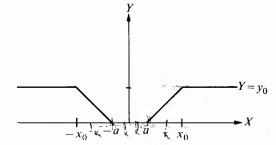
5.10. A random voltage X is uniformly distributed over the interval (-k, k). If Y is the input of a nonlinear device with the characteristics shown in Fig. 5.12, find the probability distribution of Y in the following three cases: (a) k (b) a (c) k > xo. -xo' -Y-yo X
5.9. The speed of a molecule in a uniform gas at equilibrium is a random variable V whose pdf is given by f(v) = ave-br, v > 0, where b = m/2kT and k, T, and m denote Boltzman's constant, the absolute temperature, and the mass of the molecule, respectively. (a) Evaluate the constant a (in terms of
5.8. A fluctuating electric current I may be considered as a uniformly distributed random variable over the interval (9, 11). If this current flows through a 2-ohm resistor, find the pdf of the power P = 212.
5.7. Suppose that the radius of a sphere is a continuous random variable. (Due to inaccuracies of the manufacturing process, the radii of different spheres may be dif- ferent.) Suppose that the radius R has pdf f(r) = 6r(1r), 0
5.6. Suppose that X is uniformly distributed over (-1, 1). Find the pdf of the following random variables: (a) Y = sin (T/2)X (b) Z = cos (/2)X (c) W = |X|.
5.5. Suppose that X is uniformly distributed over the interval (0, 1). Find the pdf of the following random variables: (a) Y = x + 1 (b) Z = 1/(x+1).
5.4. Suppose that the discrete random variable X assumes the values 1, 2, and 3 with equal probability. Find the probability distribution of Y = 2x + 3.
5.3. Suppose that the continuous random variable X has pdf f(x) =e, x > 0. Find the pdf of the following random variables: (a) Y = X3 (b) Z=3/(x+1).
5.2. Suppose that X is uniformly distributed over (1, 3). Obtain the pdf of the following random variables: (a) Y=3x+4 (b) Z = ex. Verify in each case that the function obtained is a pdf. Sketch the pdf.
5.1. Suppose that X is uniformly distributed over (-1, 1). Let Y = 4x. Find the pdf of Y, say g(y), and sketch it. Also verify that g(y) is a pdf.
4.30. A random variable X may assume four values with probabilities (1 + 3x)/4, (1x)/4, (1 + 2x)/4, and (14x)/4. For what values of x is this a probability distribution?
4.29. Suppose that the random variable X has possible values 1, 2, 3,... and that P(X) = k(13)-1, 0
4.28. If the random variable K is uniformly distributed over (0,5), what is the probability that the roots of the equation 4x2 + 4xK + K + 2 = 0 are real?
4.27. Referring to Example 4.10, (a) evaluate P(X = 2) if n = 4, - (b) for arbitrary n, show that P(X = n 1) = P(exactly one unsuccessful attempt) is equal to [1/(n + 1)] -1(1/0).
4.26. An experiment consists of n independent trials. It may be supposed that because of "learning," the probability of obtaining a successful outcome increases with the number of trials performed. Specifically, suppose that P(success on the ith repetition) = (i+1)/(i + 2), i = 1, 2,..., n. (a)
4.25. Suppose that the life length (in hours) of a certain radio tube is a continuous random variable X with pdf f(x) = 100/x2, x > 100, and 0 elsewhere. (a) What is the probability that a tube will last less than 200 hours if it is known that the tube is still functioning after 150 hours of
4.24. Suppose that 5 percent of all items coming off a production line are defective. If 10 such items are chosen and inspected, what is the probability that at most 2 defectives are found?
4.23. A factory produces 10 glass containers daily. It may be assumed that there is a constant probability p = 0.1 of producing a defective container. Before these containers are stored they are inspected and the defective ones are set aside. Suppose that there is a constant probability 0.1 that a
4.22. A point is chosen at random on a line of length L. What is the probability that the ratio of the shorter to the longer segment is less than ?
4.21. Suppose that X is uniformly distributed over [0, a], a > 0. Answer the ques- tions of Problem 4.20.
Showing 600 - 700
of 4976
1
2
3
4
5
6
7
8
9
10
11
12
13
14
15
Last
Step by Step Answers

 Get 50% OFF
Claim Now
Get 50% OFF
Claim Now