New Semester
Started
Get
50% OFF
Study Help!
--h --m --s
Claim Now
Question Answers
Textbooks
Find textbooks, questions and answers
Oops, something went wrong!
Change your search query and then try again
S
Books
FREE
Study Help
Expert Questions
Accounting
General Management
Mathematics
Finance
Organizational Behaviour
Law
Physics
Operating System
Management Leadership
Sociology
Programming
Marketing
Database
Computer Network
Economics
Textbooks Solutions
Accounting
Managerial Accounting
Management Leadership
Cost Accounting
Statistics
Business Law
Corporate Finance
Finance
Economics
Auditing
Tutors
Online Tutors
Find a Tutor
Hire a Tutor
Become a Tutor
AI Tutor
AI Study Planner
NEW
Sell Books
Search
Search
Sign In
Register
study help
business
supervisory management
Management 3rd Pearson New International Edition Hitt, Michael A - Solutions
What is the basic premise of the rational (classical) model of decision making and how does it differ from the bounded rationality model?
How can Mark, Kent, Whitney, and Brett improve their communication skills?
Do you think that in Scenario #2 both age and gender differences were factors, or just one and not the other, or neither (that it was just a matter of individual differences)? Explain the basis for your answer.
Is anybody “at fault” in either or both scenarios?Explain your reasoning.
What kinds of barriers to communication can you find in each scenario?
How can you apply what you have learned to your workplace interactions?
Give examples of unsuccessful media choices you have encountered. What was right or wrong in these situations?Were there harmful outcomes from the choice of an inappropriate medium?
How does this exercise relate to media richness theory?
What elements contributed to the success or failure of the instruction?
Was the fastest method also the most successful?
Which method appears to have worked best?
What are four helpful principles for effective negotiation?
In negotiation, what is the difference between an interest and a position?
What can organizations do to improve communication within them?
Discuss four ways to improve your listening skills.
What are the principal differences between high-context and low-context cultures relative to communication?
How are selective perception and frames of reference related?
What is a communication network?
What are the typical differences in content of upward, downward, and lateral communication within organizations?
What is meant by “media richness”?
Which mode of communication is the most flexible? The least flexible? Why?
What are the basic elements of the communication model?
What is communication?
Keeping in mind issues discussed in this chapter, what would you, as team leader, do now?
What stage of development does this group seem to be in?
Considering what you know about each member of the group, what type(s) of conflict would you expect to exist in this group? How would the group’s productivity likely be affected?
How can the organization assist the team in developing its effectiveness?
What team competencies will be most critical?
How much conformity and cohesion will be needed for this team to perform effectively? What could X-lent do to help the team develop an appropriate level of cohesion?
How should norms be established? This may relate to the type of team you recommend.
Discuss the best fit characteristics for this team (for example, size, composition, and roles).
What type of group should this be? (Formal or informal?Command? Project? Committee?)
What are three major indicators that can be used to identify high-performance groups?
Can managers eliminate group conflict? Should they try?
What are KSAs, and how do they relate to team competencies?
What are the advantages and disadvantages of virtual teams?
What is meant by group cohesion? Are high levels of group cohesion always desirable?
Why are norms important to groups?
Provide examples of role conflict and role ambiguity that illustrate the difference between the two terms.
What effects can diversity have on group members and on group functioning?
What is social loafing? Can managers do anything to minimize or eliminate it?
Is there an optimum group size? Why or why not?
What are the four stages of group formation? Name the important features of each.
What are the similarities and differences between a group and a team?
Pamela Jones was going to be transferred to another position in a branch about 100 miles from Vancouver. Do you think it is only her husband’s work that makes her reluctant to take this position?What other motivational elements could be influencing her attitude toward whether to accept the new
Burns was given extra work and told it was priority work, and he did it well. However, he was punished for not doing his other work. Analyze this situation according to reinforcement theory. What type of behavior would you expect from Burns in this situation, and why?
Given the comments that Jones received from her first year trainers, what would she realistically expect after finishing her training? What did she get? Using expectancy theory, explain why the situation would not be motivating for her.
Consider various need theories. What are Pamela Jones’ underlying needs that motivated her? What is the basis for your answer?
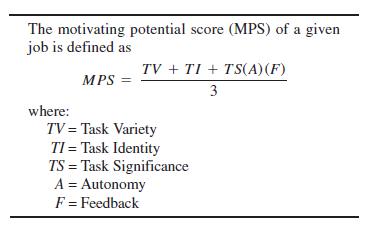
Type a report to be handed in at the next class. The report should includea. The job—who held it and why you chose it.b. The job’s initial MPS score, with your reason for scoring it the way you did.c. A detailed look at your job redesign strategyd. The job’s new MPS calculation The motivating
Once you have decided how you, as managers, could redesign this job so as to increase your employees’ motivation to perform at a high level, compute the new MPS for the job. Use the same questionnaire items below. Insert the revised MPS score here. ___________________
Brainstorm ways to redesign the job so as to improve its motivating potential score. Try to think both rationally and creatively.
Analyze the motivating potential of this job. Use the accompanying questionnaire to develop the numerical scores to plug in to the motivating potential score (MPS)formula. Come up with an initial MPS. Insert the initial MPS score here. ___________________
Choose a job at least one of your group members knows a lot about. This will probably mean a job that one of you has held.Don’t just pick a job at random because you really need to know all the responsibilities, drawbacks, challenges, pluses, and minuses of the job in order to do this exercise.
What is work centrality? Why is it important for managers to understand this concept if they want to motivate their employees?
What is the difference between a negative reinforcement and a punishment? Give an example of each.
What attributes do positive reinforcements need to have to motivate behavior?
How are content theories and process theories of motivation different?
According to expectancy theory, what can a manager do to increase an employee’s motivation? Does his or her culture make a difference?
According to equity theory, what might happen if a worker thought he or she was putting in more effort than a coworker, yet the coworker received a higher salary or larger bonus?
How can managers affect motivation by changing a job’s content?
What are some of the characteristics of an individual with a high need for achievement?
What are three major characteristics that determine motivation in organizations? What are some of the variables within each?
What are “push” and “pull” motivational forces? Give examples of each.
Are there substitutes for leadership present in this situation? What neutralizers must Grace overcome to be an effective leader?
Analyze Grace’s leadership situation in terms of her sources of power: Are there types of power she couldn’t or shouldn’t use? What types of power could she draw on, and how could she use those types to greatest effect?
Why did Grace have problems making changes and maintaining discipline when she first was promoted to a position that required leadership?
Which traits, skills, and behaviors associated with successful leaders does Grace possess? Are there characteristics she could enhance to improve her leadership ability?
What is meant by a substitute for leadership?
What is the difference between a transformational and a transactional leader? Is one necessarily better than the other? How does each bring about change?
According to House’s path–goal theory, what is a leader’s main responsibility?
Why is it important to consider the characteristics of followers?
What is the role of emotional intelligence in leadership?
What is referent power, and how can it be developed? How is it related to charisma?
What kind of power are subordinates most likely to have? Why?
Differentiate between position power and personal power.
Are leadership and management the same? Why or why not?
What is leadership? Who can be expected to exhibit leadership in an organization?
Independent surveys suggest that companies cannot easily quantify the effects of diversity.How would you suggest that Alliant measure the costs and benefits of having a diverse workforce?
Do you believe the company is forcing the issue of diversity? Is it necessary to make diversity training mandatory for all employees? Explain your answer.
Alliant Energy does not publicly report the results of its supplier-diversity initiatives. Do you think it should? What measures should be used to determine if its supplier-diversity initiatives are effective?
Why is Alliant so committed to workforce diversity?How will this benefit the company?
Suppose that other squad members tell you that a couple of the younger, single male firefighters might act a bit“macho” when they talk among themselves. If you confront these men about the problem, what will you do if they allege that the new female recruit is wrongly eavesdropping on their
What should the human resources manager do about this situation? How much of the decision should be left to the discretion of the firehouse captain?
What would satisfy you as the individual lodging the complaint?
What actions would you take as the captain?
List the five things that organizations can do to make orientation programs more effective.
Identify three written tests used in employee selection and describe their validity.
How are structured interviews different from unstructured interviews?
What does it mean for a selection technique to be valid?
What are the principal aspects of job analysis?
Why is it important to keep the firm’s strategy in mind when engaged in human resource activities such as selection?
Are the company’s changes to reshape its identity as a consumer product health care and hygiene company and its cost reduction efforts likely to improve its competitive position relative to P&G?Please explain your answer.
Was the organizational structure presented by Kimberly-Clark executives in 2004 better than the first structure proposed? Why or why not?
Why would Kimberly-Clark executives restructure the company based on “grow, sustain, and fix”categories? What disadvantages might result from such a structure?
How much formalization should the new manager develop?How much autonomy should she provide employees in each job category?
Are there other jobs that you recommend she should include?Should all people report directly to her or should there be one or more supervisors? Please be specific.
Are all the jobs listed necessary? Please explain. How many subordinates should she request in each job and why?
How many total subordinates should she request? What should be her span of control?
What organization structures are most effective for organizations operating in international markets?Explain why.
How do environmental factors and the organization’s strategy affect the type of structure it should adopt?
Showing 100 - 200
of 3214
1
2
3
4
5
6
7
8
9
10
11
12
13
14
15
Last
Step by Step Answers

 Get 50% OFF
Claim Now
Get 50% OFF
Claim Now