New Semester
Started
Get
50% OFF
Study Help!
--h --m --s
Claim Now
Question Answers
Textbooks
Find textbooks, questions and answers
Oops, something went wrong!
Change your search query and then try again
S
Books
FREE
Study Help
Expert Questions
Accounting
General Management
Mathematics
Finance
Organizational Behaviour
Law
Physics
Operating System
Management Leadership
Sociology
Programming
Marketing
Database
Computer Network
Economics
Textbooks Solutions
Accounting
Managerial Accounting
Management Leadership
Cost Accounting
Statistics
Business Law
Corporate Finance
Finance
Economics
Auditing
Tutors
Online Tutors
Find a Tutor
Hire a Tutor
Become a Tutor
AI Tutor
AI Study Planner
NEW
Sell Books
Search
Search
Sign In
Register
study help
computer science
modern database management 13th edition
Modern Database Management 13th Edition Heikki Topi, Jeffrey A Hoffer, Ramesh Venkataraman - Solutions
Interview one person from a key business function, such as finance, human resources, or marketing. Concentrate your questions on the following items: How does he or she retrieve data needed to make business decisions? From what kind of system (personal database, enterprise system, or data
Consider Figure 1-5. What are the two common methods by which users interact with data in a database? Which Sone is more convenient to users if they do not have an understanding of query language? Why?Figure 1-5
Using a table, differentiate between how data is represented in a file processing environment and how it is represented in a relational database.
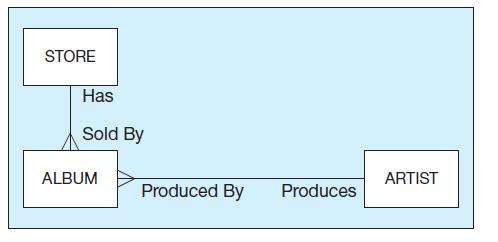
Review the example in Figure 1-2 and 1-4 regarding the differences between the file-based approach and the current database approach. Explain how these differences would impact the relationships between the different entities in the database.Figure 1-2 Figure 1-4 STORE Has Sold
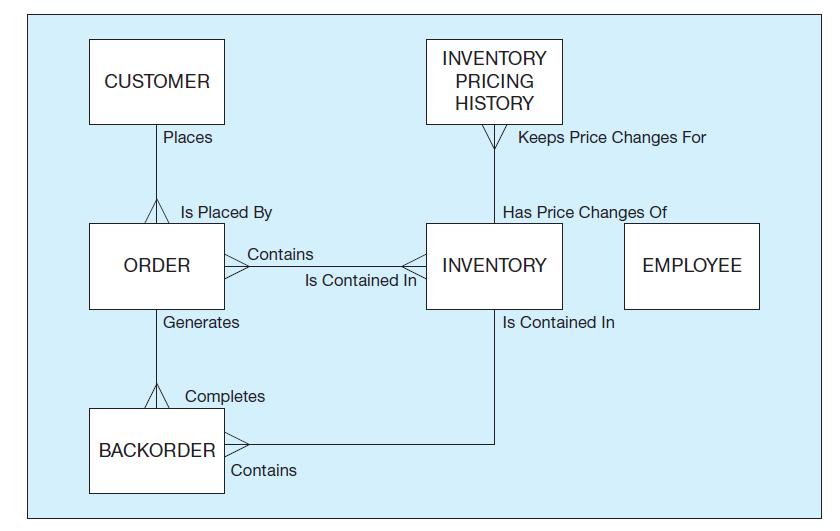
List three additional entities that might appear in an enterprise data model for Pine Valley Furniture Company.
Consider the following statement and translate it into SQL: Show me the “First Name,” “Last Name,” and “Company Name” fields from the “Contacts” table where the “City” field contains “Kansas City” and the “First Name” field starts with “R.”
A database is referred to as “an organized collection of logically related data.” What does “related data” mean? Why must data be related?
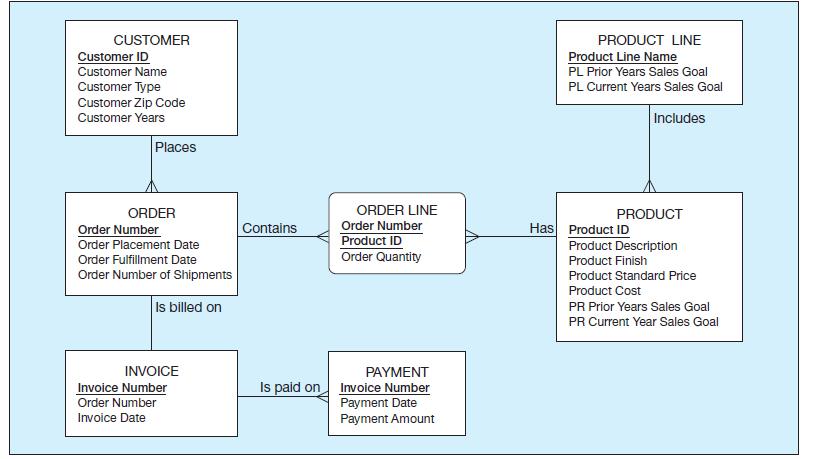
Consider Figure 1-15. While designing the attributes for the Customer table, is it necessary to designate an attribute, such as Customer ID, as a key field? Can we use an ordinary attribute, such as Customer Name, to determine the existence of a customer record? Why?Figure 1-15
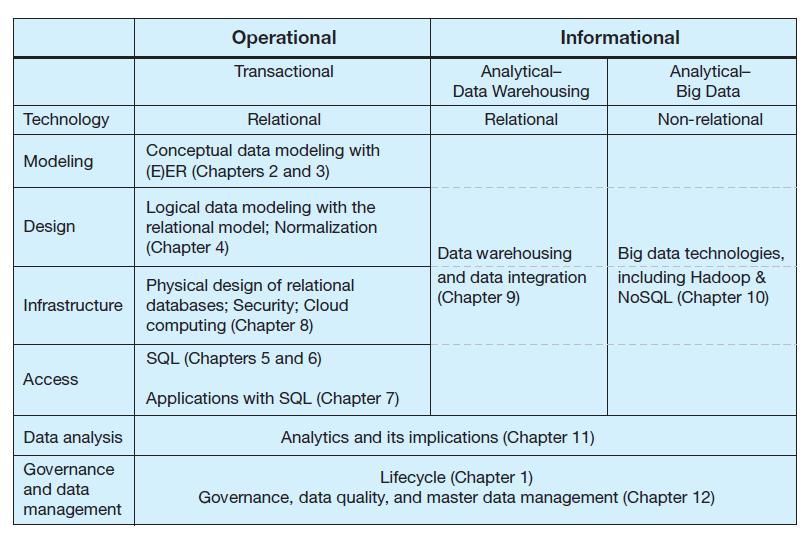
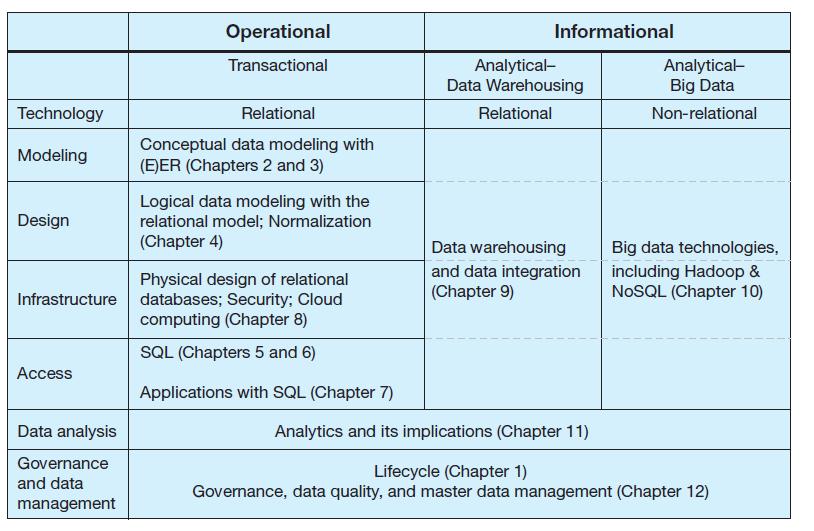
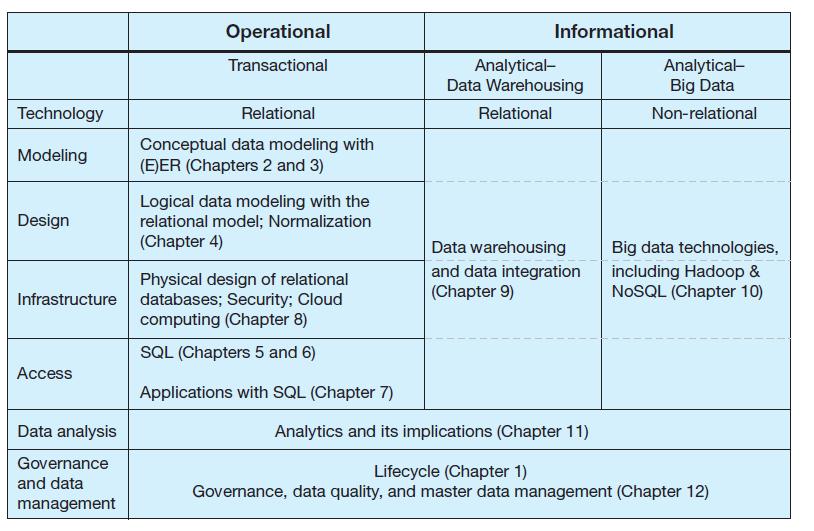
Figure 1-5 specifies categories for Operational and Informational data management systems. Describe the main difference between these two categories Operational Transactional Technology Relational Modeling Conceptual data modeling with (E)ER (Chapters 2 and 3) Design Logical data modeling with
There are various development approaches in organizations, and the traditional ones have now been complemented by the more innovative system development methods. Much has been said about the prototyping methodology and its radical features in the development cycle. Critically review the prototyping
Based on Figure 1-5, what are the four perspectives from which you will explore transactional systems in this book?What are the main competencies associated with each of these perspectives?Figure 1-5 Operational Transactional Technology Relational Modeling Conceptual data modeling with (E)ER
What is the purpose of designing an enterprise data model? How is it different from the design of a particular database?
A relationship is established between any pair of entities in an enterprise data model. Explain why a relationship is necessary.
Prototyping is an iterative process of system development in which requirements are converted into a working system that is continually revised by analysts and users. What are the circumstances under which prototyping should be used?
Specify the difference between database solutions supporting enterprise databases and departmental multitiered databases.
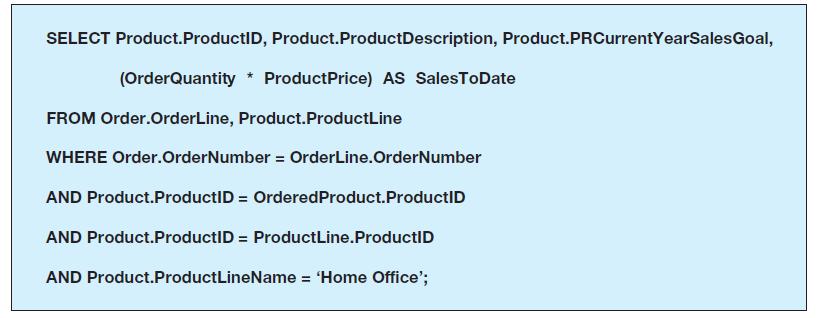
Consider the SQL example in Figure 1-19.Figure 1-19Figure 1.20a. What is the name of the table that is referred to when the SELECT statement is executed?b. How many tables are accessed when the FROM statement is executed?c. How many conditions are evaluated and met in order to display the details
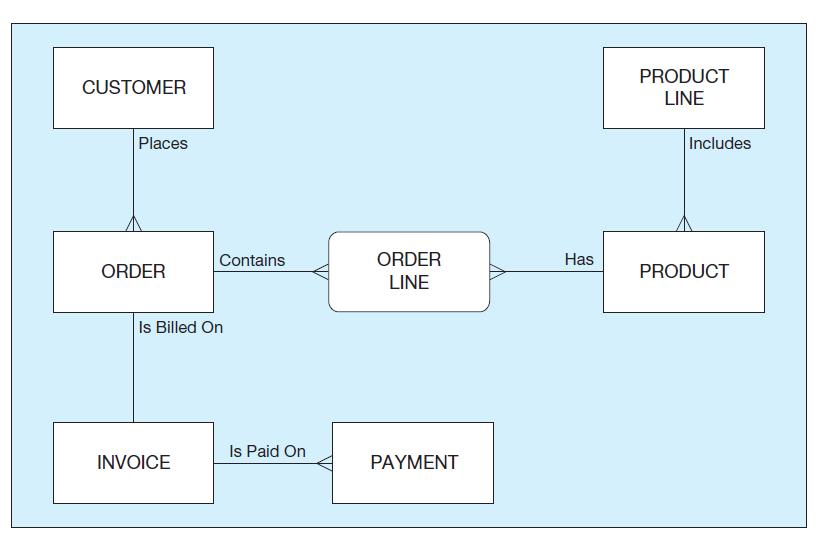
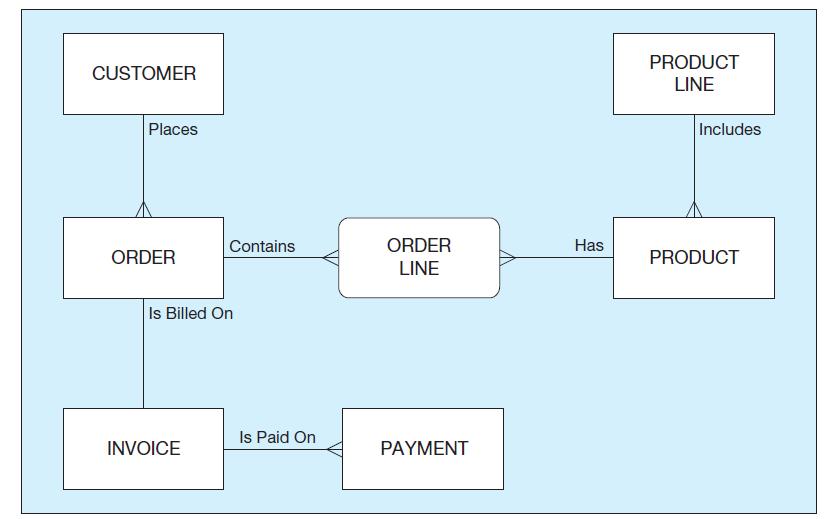
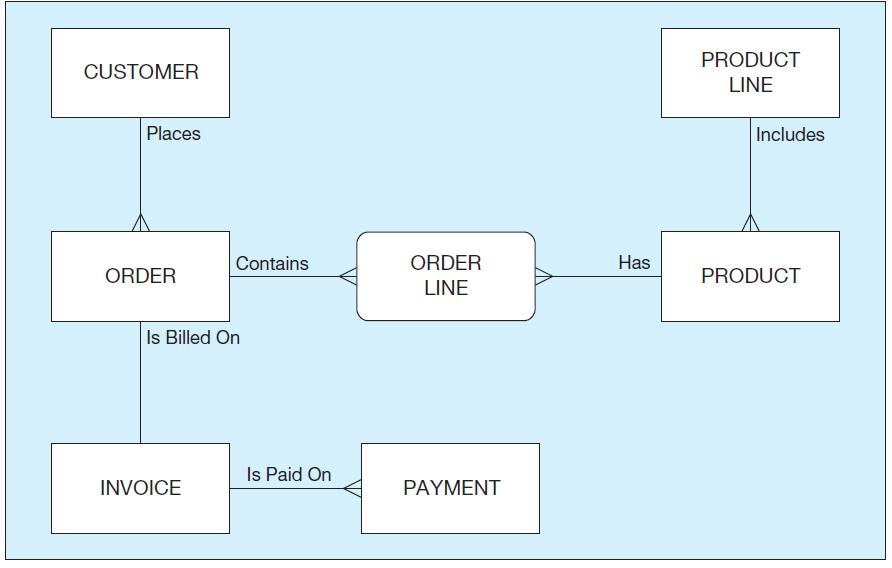
Consider Figure 1-15. Explain the meaning of the line that connects CUSTOMER to ORDER and the line that connects ORDER to INVOICE. What does this say about how Pine Valley Furniture Company does business with its customers?Figure 1-15 CUSTOMER Places ORDER Contains Is Billed On INVOICE Paid
Consider the project data model shown in Figure 1-16.a. Create a textual description of the diagrammatic representation shown in the figure. Ensure that the description captures the rules/constraints conveyed by the model.b. In arriving at the requirements document, what aspect of the diagram did
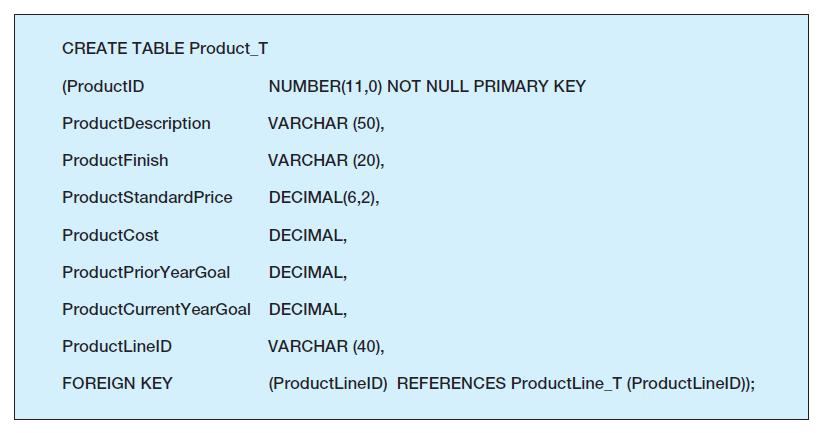
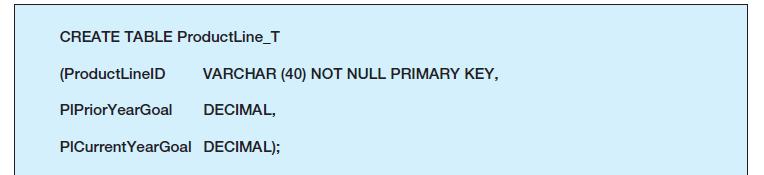
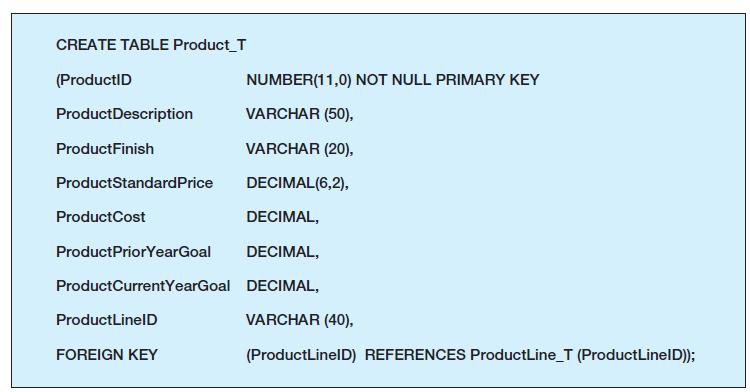
Answer the following questions concerning Figures 1-18 and 1-19:Figures 1-18Figures 1-19a. What will be the field size for the Product Line Name field in the Product table? Why?b. In Figure 1-19, how is the Product ID field in the Product table specified to be required? Why is it a required
How does the use of an agile methodology affect decisions regarding data management?
Explain why certain business environments favor specific database development methodologies. Highlight the pros and cons of each methodology and the differences in the approaches to database development. Do those differences have any impact on the design process?
a. What is the purpose of introducing an attribute called Product ID to the Product table? What is its data type?b. If the company wants to keep track of the total outstanding balances of customers, an attribute called “Customer Balances” should be introduced to which table?Consider Figure 1-15
Explain some of the advantages of large databases that organizations can benefit from considering how the amount of data processed and stored in databases will increase in the future.
What are the characteristics of good business rules?
State the differences between a term and a fact.
What is the need for time stamping in modeling time dependent data?
Discuss the main guidelines for defining relationships.
When should an attribute be linked to an entity via a relationship?
The chapter makes a distinction between a required attribute and an optional attribute. Illustrate a required attribute with a relevant example.
State the guidelines for naming entity types. Discuss why organizations customize a purchased data model.
Provide examples (other than those described in this chapter) of multiple relationships, and explain why these examples best represent this type of relationship. Discuss the role of identifiers in modeling this relationship.
Why is data modeling considered more important than process modeling?
Explain any two characteristics of a good business rule.
Why is time stamping considered an important part of the data modeling process?
Draw an ER diagram reflecting the needs of an instructor to monitor their class performance, and include entities such as class performance, grades, and attendance. This ER model will be used by the instructor to build a database for their course in the future.
Consider this situation: The faculty at a university (FACULTY entity) can also be part of Board of Studies (BOARD entity). Is there a weak entity here? Why?
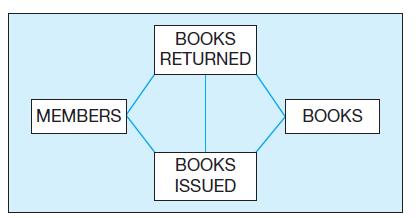
Figure 2-27 represents members of a library issuing books and returning them to the library. The members can be students, staff, or faculty, and their details are stored in the Member entity. A member can issue no more than 10 books. All the details on books are stored in the Books entity.Figure
Showing 1000 - 1100
of 1037
1
2
3
4
5
6
7
8
9
10
11
Step by Step Answers

 Get 50% OFF
Claim Now
Get 50% OFF
Claim Now