New Semester
Started
Get
50% OFF
Study Help!
--h --m --s
Claim Now
Question Answers
Textbooks
Find textbooks, questions and answers
Oops, something went wrong!
Change your search query and then try again
S
Books
FREE
Study Help
Expert Questions
Accounting
General Management
Mathematics
Finance
Organizational Behaviour
Law
Physics
Operating System
Management Leadership
Sociology
Programming
Marketing
Database
Computer Network
Economics
Textbooks Solutions
Accounting
Managerial Accounting
Management Leadership
Cost Accounting
Statistics
Business Law
Corporate Finance
Finance
Economics
Auditing
Tutors
Online Tutors
Find a Tutor
Hire a Tutor
Become a Tutor
AI Tutor
AI Study Planner
NEW
Sell Books
Search
Search
Sign In
Register
study help
computer science
modern database management 13th edition
Modern Database Management 13th Edition Heikki Topi, Jeffrey A Hoffer, Ramesh Venkataraman - Solutions
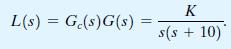
Find the value of K so that the system provides an optimum ITAE response.a. K = 1.10b. K = 12.56c. K = 51.02d. K = 104.7 K L(s)G(s)G(s) = == s(s + 10)
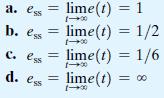
The percent overshoot of the output to a unit step input is:a. P.O. = 9,b. P.O. = 1,c. P.O. = 20,d. No overshoot Consider the closed-loop control system in Figure 5.42 for Problems 6 and 7 with = L(s)G(s)G(s) = 6 s(s+3)
The steady-state error to a unit step input R1s2 = 1>s is: a. es b. ess C. ess d. ess lime(t) = 1 1-00 lime(t) = 1/2 lime(t) = 1/6 lime(t) =
A type-1 system has a zero steady-state tracking error to a ramp input. True or False
For a second-order system with no zeros, the percent overshoot to a unit step is a function of the damping ratio only. True or False
The rise time is defined as the time required for the system to settle within a certain percentage of the input amplitude. True or False
The number of zeros of the forward path transfer function at the origin is called the type number. True or False
In general, a third-order system can be approximated by a second-order system’s dominant roots if the real part of the dominant roots is less than 1/10 of the real part of the third root. True or False
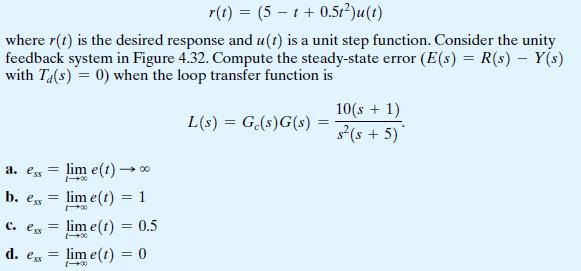
A process is designed to follow a desired path described by r(t) = (5 +0.5t)u(t) where r(t) is the desired response and u(t) is a unit step function. Consider the unity feedback system in Figure 4.32. Compute the steady-state error (E(s) = R(s) - Y(s) with Ta(s) = 0) when the loop transfer function
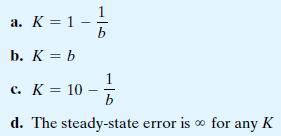
Compute the minimal value of K so that the steady-state error due to a unit step disturbance is less than 10%. a. K 1- = 1 - b b. K = b 1 c. K = 10 b d. The steady-state error is for any K 00
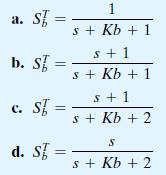
The sensitivity STb is: a. S= b. S c. ST d. S= 1 s+ Kb +1 S+1 s+ Kb +1 s+1 s+ Kb + 2 S s+ Kb + 2
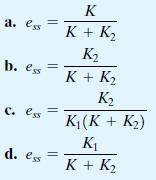
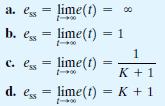
The steady-state tracking error to a unit step input R1s2 = 1>s with Td1s2 = 0 is: a. ess K K+K K b. ess K + K K C. ess K(K + K) K d. ess K + K
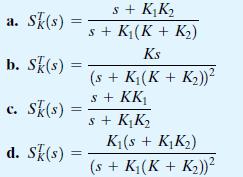
The sensitivity STK of the closed-loop system to variations in K is: a. Sk(s) = b. Sk(s) = c. Sk(s) = d. Sk(s) s+ KK s+ K(K + K) Ks (s + K(K + K)) s+ KK s+ KK K(s + KK) (s + K(K + K))
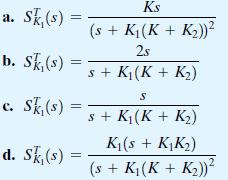
The sensitivity STK1 of the closed-loop system to variations in K1 is: a. Sk(s) = = b. Sk(s) = c. Sk(s) d. Sk(s) = Ks (s + K(K + K)) 2s s+ K(K + K) S s+ K(K + K) K(s + KK) (s + K(K + K))
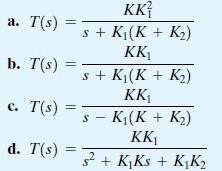
The closed-loop transfer function is: a. T(s) b. T(s) == c. T(s) = d. T(s) == KK s + K(K + K) KK s + K(K + K) KK s - K(K + K) KK s + KKs + KK
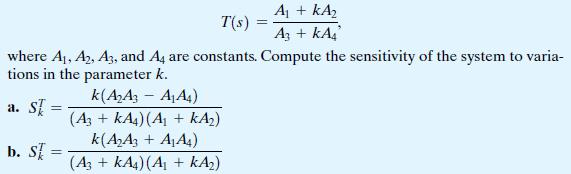
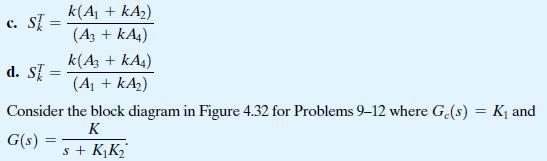
Consider the closed-loop transfer function A + KA T(s) = A3 + KA where A1, A2, A3, and A4 are constants. Compute the sensitivity of the system to varia- tions in the parameter k. a. ST = b. S == k(A2A3 - AA4) (A3+ kA4) (A + KA) k(A2A3 + AA4) (A3+ KA4) (A + KA)
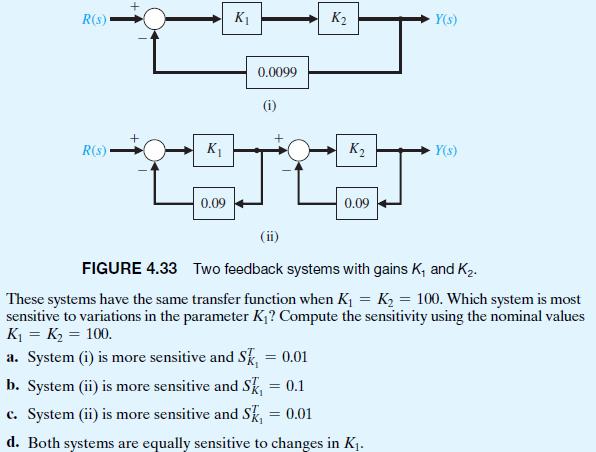
Consider the two systems in Figure 4.33. R(s) K K Y(s) R(s) K 0.0099 (i) K Y(s) 0.09 0.09 (ii) FIGURE 4.33 Two feedback systems with gains K, and K. These systems have the same transfer function when K = K = 100. Which system is most sensitive to variations in the parameter K? Compute the
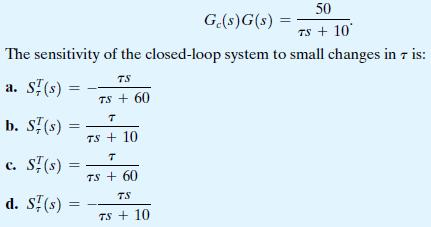
The loop transfer function of the system in Figure 4.32 is Ge(s)G(s) 50 TS + 10 The sensitivity of the closed-loop system to small changes in r is: TS a. S(s) = TS + 60 b. S(s) T c. S(s) d. S(s) TS +10 T TS +60 TS TS +10
An advantage of using feedback is a decreased sensitivity of the system to variations in the parameters of the process. True or False
A disturbance is a desired input signal that affects the system output signal. True or False
A primary advantage of an open-loop control system is the ability to reduce the system’s sensitivity. True or False
The system sensitivity is the ratio of the change in the system transfer function to the change of a process transfer function for a small incremental change. True or False
One of the most important characteristics of control systems is their transient response. True or False
A system is represented by the transfer function Y(s) R(s) T(s) 5(s + 10) 3+10s2+20s + 50
The steady-state error E(s) = Y(s) - R(s) due to a unit step disturbance Ta(s) = 1/s is:
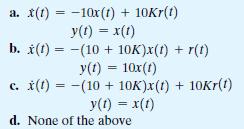
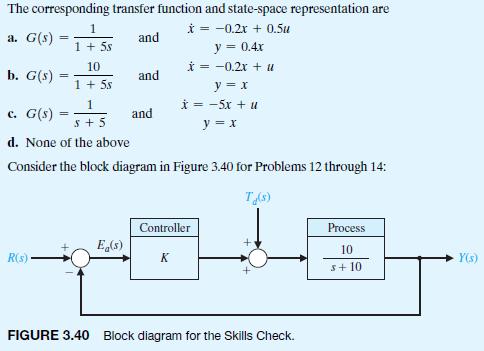
The state-space representation of the closed-loop system from R1s2 to Y1s2 is: = a. x(t) -10x(t) + 10Kr(1) y(t) = x(t) b. (t) (10 + 10K)x(t) + r(t) y(t) = 10x(t) c. x(t) (10+10K)x(t) + 10Kr(t) y(t) = x(t) d. None of the above
The effect of the input R1s2 and the disturbance Td1s2 on the output Y1s2 can be considered independently of each other because:a. This is a linear system, therefore we can apply the principle of superposition.b. The input R1s2 does not influence the disturbance Td1s2.c. The disturbance Td1s2
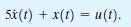
A first-order dynamic system is represented by the differential equation 5x(t) + x(t) = u(t).
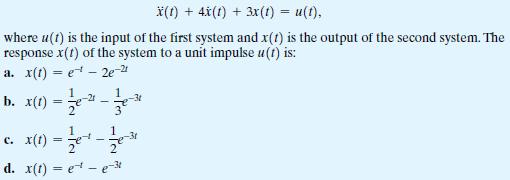
The differential equation model for two first-order systems in series is x(t) + 4x(t) + 3x(t) = u(t), where u(t) is the input of the first system and x(t) is the output of the second system. The response x(t) of the system to a unit impulse u(t) is: 2e-21 a. x(t) e == b. x(t) = - 1 -31 - 3 1 1 c.
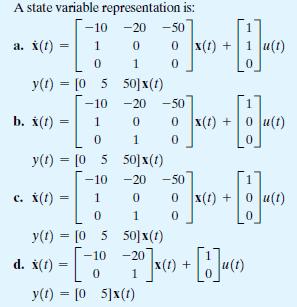
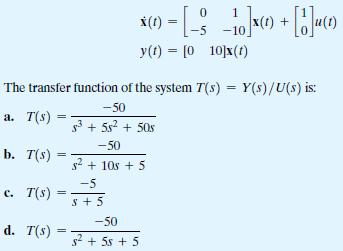
A single-input, single-output system has the state variable representation + -10 [8](0) y(t) = [010]x(t) The transfer function of the system T(s) = Y(s)/U(s) is: a. T(s) = b. T(s) = c. T(s) = d. T(s) = -50 $3 +52 + 50s -50 s+10x+5 -5 $ +5 -50 s+55 +5
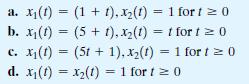
For the initial conditions x1(0) = x2(0) = 1, the response x1t2 for the zero-input response is: a. x(t)=(1+1), x2(t) = 1 for 10 b. x(t) = (5+1),x2(t) = 1 for t0 = c. x(t) (511), x2(t) = 1 for t 0 d. x(t) = x(t) = 1 for t 0
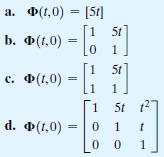
The associated state-transition matrix is: a. (1.0)= [51] b. (1,0) = [ 1 5t] c. (1,0) - [ } 1 5t 1 1 St St 127 d. (1,0) 0 11 0 0 1
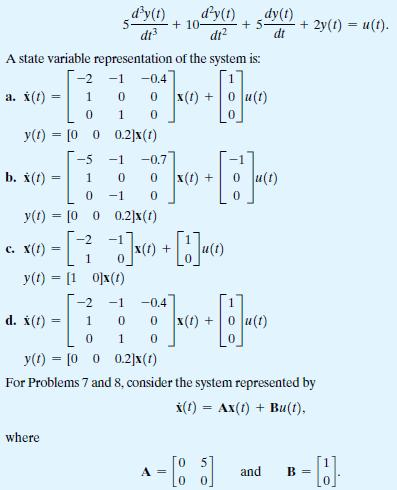
Consider a system with the mathematical model given by the differential equation: dy(t) dy(t) dy(1) +10- + 5- +2y(t) = u(t). == dt dr dt A state variable representation of the system is: -2 -1 -0.4 a. x(t) 1 0 0 1 0 == y(t) [00 0.2]x(1) -5 -1 -0.7 b. x(t) = 1 0 0 x(t) 0 -1 0 = y(t) [00 0.2]x(t) = 1
A state variable representation of a system can always be written in diagonal form. True or False
A time-invariant control system is a system for which one or more of the parameters of the system may vary as a function of time. True or False
The outputs of a linear system can be related to the state variables and the input signals by the state differential equation. True or False
The matrix exponential function describes the unforced response of the system and is called the state transition matrix. True or False
The state variables of a system comprise a set of variables that describe the future response of the system, when given the present state, all future excitation inputs, and the mathematical model describing the dynamics. True or False
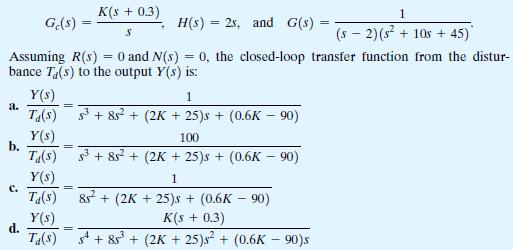
Consider the feedback system in Figure 2.74 with K(s + 0.3) Ge(s) = = H(s) 2s, and G(s) S 1 (s2)(s+10x+45)* Assuming R(s) = 0 and N(s) = 0, the closed-loop transfer function from the distur- bance Ta(s) to the output Y(s) is: Y(s) 1 a. Ta(s) s3+852 + (2K+25)s + (0.6K-90) Y(s) 100 Ta(s) s3+852 +
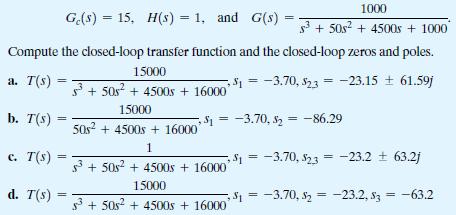
Consider the closed-loop system in Figure 2.74 with 1000 = Ge(s) 15. H(s) = 1, and G(s) = s3+50s+4500s + 1000 Compute the closed-loop transfer function and the closed-loop zeros and poles. 15000 a. T(s)=3+50s + 4500s + 16000 = b. T(s) = c. T(s) d. T(s) = 15000 $13.70, $23-23.15 61.59j 52 50s +
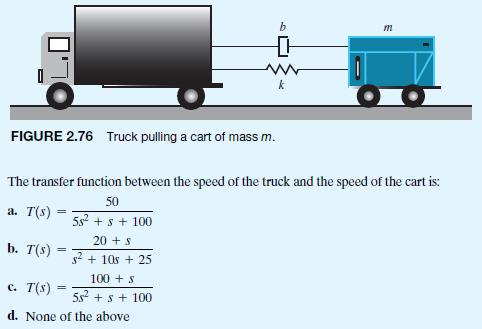
A cart of mass m = 1000 kg is attached to a truck using a spring of stiffness k =20,000 N/m and a damper of constant b = 200 Ns/m, as shown in Figure 2.76. The truck moves at a constant acceleration of a = 0.7 m/s2. b m FIGURE 2.76 Truck pulling a cart of mass m. The transfer function between the
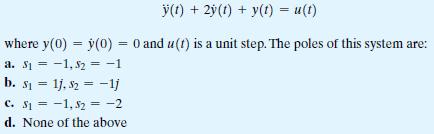
Consider the differential equation y(t) +2y(t) + y(t) = u(t) = where y(0) y(0) = 0 and u(t) is a unit step. The poles of this system are: = a. $11, 52-1 = b. s 1j. $2 -1j = c. $1-1,52 = -2 d. None of the above
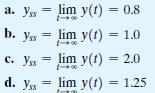
The final value of y1t2 is: a. Yss lim y(t) = 0.8 00 b. Yes lim y(t) = 1.0 c. Yss lim y(t) = 2.0 d. Yss lim y(t) = 1.25
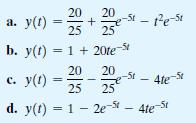
The closed-loop unit step response is: 20 a. y(t)=0+ b. y(t) - c. y(t) d. y(t) 20 25 25 e-St-1-e-St 1+20te-St 20 20 -51 22 25 25 -41e-St 1 2e-St - 4te-St 1-2e-St
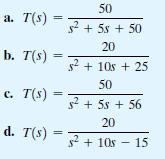
The closed-loop transfer function T1s2 = Y1s2>R1s2 is: 50 a. T(s) = s+58 +50 20 b. T(s) = s+10x+25 50 c. T(s) s + 5s + 56 d. T(s) 20 s+10x-15
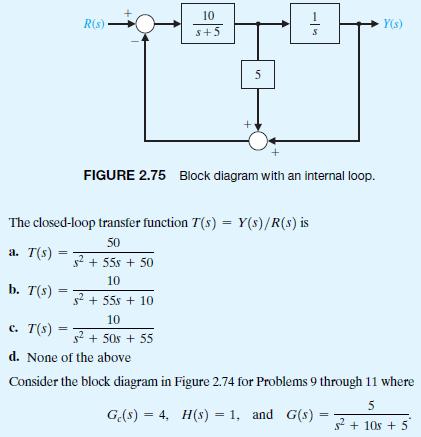
Consider a system represented by the block diagram in Figure 2.75. R(s) 10 $+5 5 + Y(s) FIGURE 2.75 Block diagram with an internal loop. The closed-loop transfer function T(s) = Y(s)/R(s) is = a. T(s) = b. T(s) c. T(s) = 50 s + 55s + 50 10 s + 55s + 10 10 s +508 +55 d. None of the above Consider
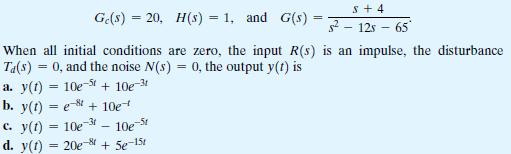
Consider the system in Figure 2.74 with S+4 = Ge(s) 20, H(s) = 1, and G(s) ==== 52-128-65 When all initial conditions are zero, the input R(s) is an impulse, the disturbance Ta(s) =0, and the noise N(s) = 0, the output y(t) is a. y(t) 10e St + 10e-31 = b. y(t)e+10e c. y(t) = 10e3-10e-St d. y(t)=20e
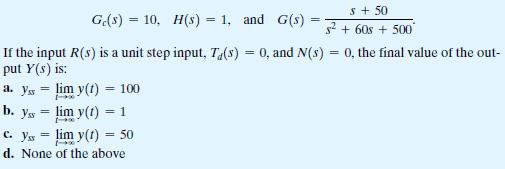
Consider the system in Figure 2.74 where S+50 Ge(s) 10. H(s) = 1, and G(s) = s + 60s + 500 If the input R(s) is a unit step input, Tr(s) = 0, and N(s) = 0, the final value of the out- put Y(s) is: a. y lim y(t) 100 b. yss = lim y(t) = 1 = c. Yss lim y(t) = 50 d. None of the above
The transfer function is the ratio of the Laplace transform of the output variable to the Laplace transform of the input variable, with all initial conditions equal to zero. True or False
A linear system satisfies the properties of superposition and homogeneity. True or False
The roots of the characteristic equation are the zeros of the closed-loop system. True or False
The s-plane plot of the poles and zeros graphically portrays the character of the natural response of a system. True or False
Very few physical systems are linear within some range of the variables. True or False
Closed-loop control systems should have which of the following properties:a. Good regulation against disturbancesb. Desirable responses to commandsc. Low sensitivity to changes in the plant parametersd. All of the above
Control engineering is applicable to which fields of engineering?a. Mechanical and aerospaceb. Electrical and biomedicalc. Chemical and environmentald. All of the above
A system with more than one input variable or more than one output variable is known by what name?a. Closed-loop feedback systemb. Open-loop feedback systemc. Multivariable control systemd. Robust control system
Complete the following sentence:An open-loop control system utilizes an actuating device to control a process .a. without using feedbackb. using feedbackc. in engineering designd. in engineering synthesis
Early pioneers in the development of systems and control theory include:a. H. Nyquistb. H. W. Bodec. H. S. Blackd. All of the above
Complete the following sentence:Control engineers are concerned with understanding and controlling segments of their environments, often called .a. systemsb. design synthesisc. trade-offsd. risk
Complete the following sentence:are intrinsic in the progression from an initial concept to the final product.a. Closed-loop feedback systemsb. Flyball governorsc. Design gapsd. Open-loop control systems
Complete the following sentence:Control of an industrial process by automatic rather than manual means is often called.a. negative feedbackb. automationc. a design gapd. a specification
Important modern applications of control systems include which of the following?a. Safe automobilesb. Autonomous robotsc. Automated manufacturingd. All of the above
Early applications of feedback control include which of the following?a. Water clock of Ktesibiosb. Watt’s flyball governorc. Drebbel’s temperature regulatord. All of the above
A multivariable system is a system with more than one input and/or more than one output. True or False
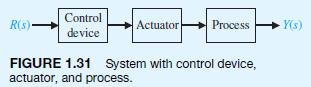
The block diagram in Figure 1.31 is an example of a closed-loop feedback system. Control R(s)- Actuator Process Y(s) device FIGURE 1.31 System with control device, actuator, and process.
Engineering synthesis and engineering analysis are the same. True or False
A closed-loop control system uses a measurement of the output and feedback of the signal to compare it with the desired input. True or False
The flyball governor is generally agreed to be the first automatic feedback controller used in an industrial process. True or False
Does normalization place any constraint on the storage of data in physical form or on its processing performance?Explain.
What do you understand by domain constraint?
Outline a shortcut to describe relations in 3NF.
Discuss how transitive dependencies in a relation can be removed when it leads to anomalies.
List the three steps to remove transitive dependencies.
What is an enterprise key, and why is it important?
Why is the natural key preserved whenever a surrogate key is created?
What are the benefits of the use of an enterprise key?
Contrast the following terms:a. Scalar aggregate; vector aggregateb. DDL; DMLc. Catalog; schema
What are the primary data integrity constraints in SQL?
How do you determine the order in which the rows in a response to an SQL query appear? What options do you have when specifying this order?
How is the HAVING clause different from the WHERE clause?
State four rules for choosing indexes for a relational database.
How can an SQL command be structured to allow parallel execution?
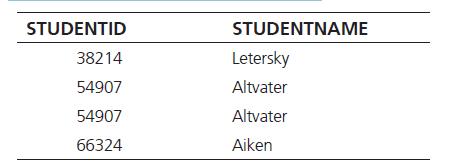
Use SQL to define the following view: STUDENTID 38214 54907 54907 66324 STUDENTNAME Letersky Altvater Altvater Aiken
Write SQL queries to answer the following questions:a. For each course included in the QUALIFIED table, list Course ID and the number of faculty members qualifiedto teach it.b. For each section included in the REGISTRATION table, list Section No and the number of students registeredfor it. Include
What are the Tutor IDs for tutors who have not yet tutored anyone?
How many students were matched with someone in the first five months of the year?
List the number of customers living at each state that is included in the Customer_T table.
For each payment made on or after March 10, 2018, list PaymentID, OrderID, PaymentAmount, and the first 10characters of Payment Comment.
What type of an impact has the significant decrease in the cost of storage space had on data warehouse and data mart design?
Describe the mechanism through which prescriptive analytics is dependent on descriptive and predictive analytics.
Research available data quality software. Describe in detail at least one technique employed by one of these tools (e.g., an expert system).
Contrast the following terms:a. Two-tier architecture; three-tier architectureb. Fat client; thin clientc. Optimistic concurrency control; pessimistic concurrency controld. Deadlock prevention; deadlock resolutione. Shared lock; exclusive lockf. Two-phase locking protocol; versioning
List the average number of customers per state (including only the states that are included in the Customer_T table).A query can be used as a table specification in the FROM clause.
Contrast the following terms:a. Horizontal partitioning; vertical partitioningb. Repository; data dictionaryc. Physical file; tablespaced. Before image; after imagee. Normalization; denormalizationf. Range control; null controlg. Transaction log; database change logh. Secondary key; primary keyi.
Using the Web and Internet resources, search for the application areas of parallel processing. Which DBMS in the market supports this feature?
Denormalization can be a controversial topic among database designers. Some believe that any database should be fully normalized (even using all the normal forms discussed in Appendix B, available on the book’s Web site). Others look for ways to demoralize to improve processing performance.
Visit the database designer or administrator of an organization that has heavy transaction-oriented applications and requires frequent updates to records in the database as well. Examples include any organization dealing with customers, point-of-sale systems, or ticketing or billing, such as banks,
Visit an organization that has implemented a database approach. Evaluate each of the following:a. The organizational placement of data administration, database administration, and data warehouse administration.b. The assignment of responsibilities for each of the functions listed in part a.c. The
Visit an organization that has implemented a database approach and interview an MIS department employee who has been involved in disaster recovery planning. Before you go for the interview, think carefully about the relative probabilities of various disasters for the organization you are visiting.
Visit an organization that has implemented a database approach and interview individuals there about the security measures they take routinely. Evaluate each of the following at the organization:a. Database security measuresb. Network security measuresc. Operating system security measuresd.
Showing 700 - 800
of 1037
1
2
3
4
5
6
7
8
9
10
11
Step by Step Answers

 Get 50% OFF
Claim Now
Get 50% OFF
Claim Now