New Semester
Started
Get
50% OFF
Study Help!
--h --m --s
Claim Now
Question Answers
Textbooks
Find textbooks, questions and answers
Oops, something went wrong!
Change your search query and then try again
S
Books
FREE
Study Help
Expert Questions
Accounting
General Management
Mathematics
Finance
Organizational Behaviour
Law
Physics
Operating System
Management Leadership
Sociology
Programming
Marketing
Database
Computer Network
Economics
Textbooks Solutions
Accounting
Managerial Accounting
Management Leadership
Cost Accounting
Statistics
Business Law
Corporate Finance
Finance
Economics
Auditing
Tutors
Online Tutors
Find a Tutor
Hire a Tutor
Become a Tutor
AI Tutor
AI Study Planner
NEW
Sell Books
Search
Search
Sign In
Register
study help
computer science
systems analysis design
Thermal Energy Systems Design And Analysis 2nd Edition Steven G. Penoncello - Solutions
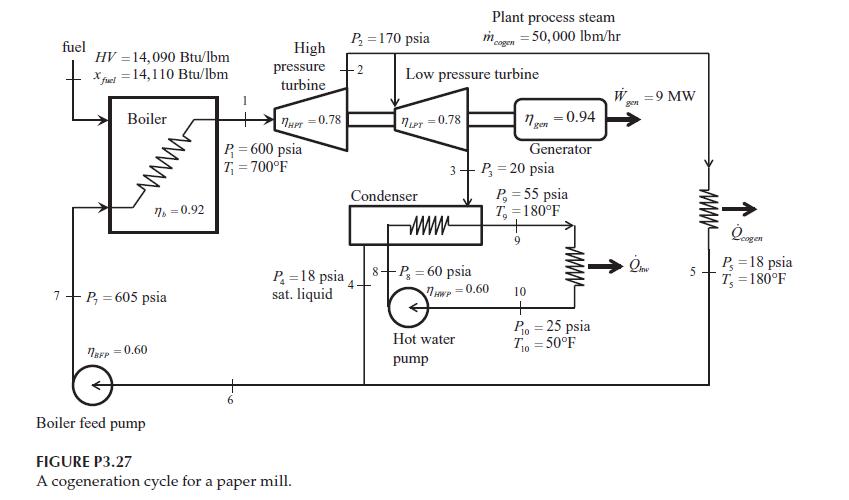
In the manufacture of paper, large amounts of electricity, process steam, and hot water are required. While these three needs could be met by individual thermal energy systems, it is prudent to develop a single system that can provide all three needs with one fuel source. A thermodynamic cycle that
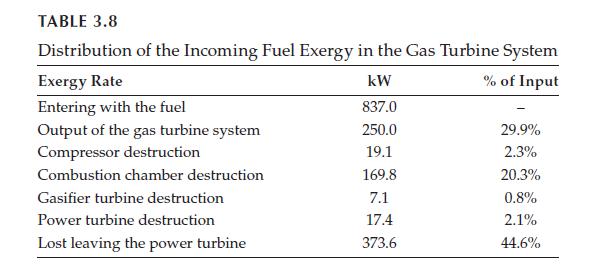
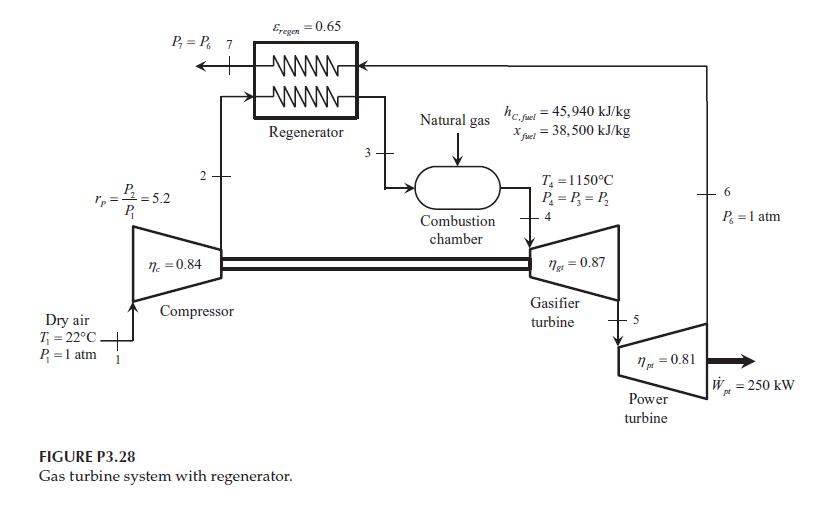
Consider the gas turbine system analyzed in Section 3.10.3. The system is modified to include a regenerator as shown in Figure P3.28. The regenerator is a counter flow heat exchanger and has an effectiveness of 0.65. The other operating parameters are the same as in Section 3.10.3 and have been
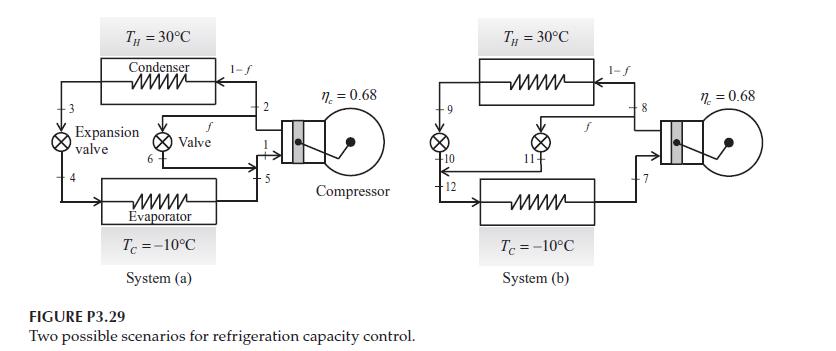
Refrigeration equipment is often installed with more cooling capacity than is needed. The best way to operate the equipment when the cooling load is lower than the capacity is to reduce the compressor speed with a variable speed motor.However, variable speed motors and controllers can be quite
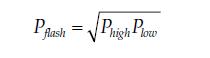
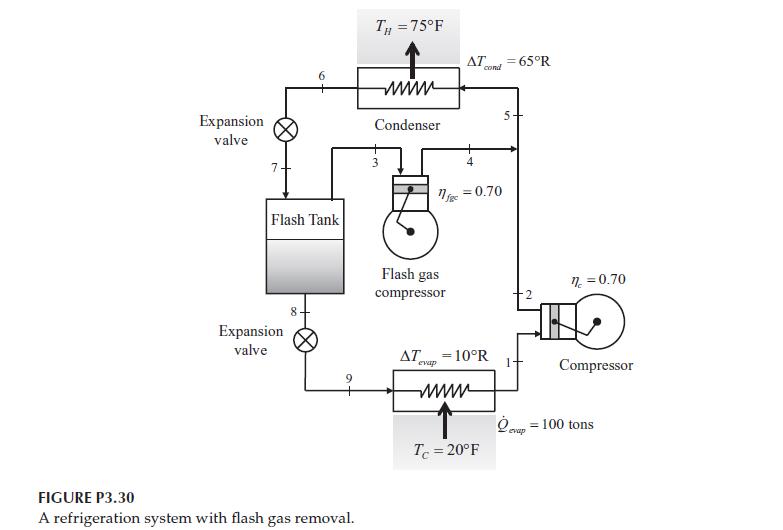
A multistage vapor compression refrigeration system with flash gas removal is being used to maintain a cold space at TC = 20°F for frozen food storage as shown in Figure P3.30. The system utilizes R134a as the working fluid. The cycle is providing 100 tons of cooling capacity to the cold space.
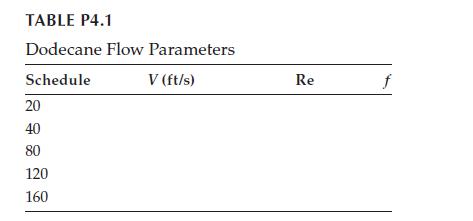
Consider an 8-nom commercial steel pipe carrying dodecane at 60°F. The volumetric flow rate of the dodecane is 800 gpm. Complete Table P4.1 showing the variation of the dodecane flow parameters inside the pipe as a function of the pipe schedule used. TABLE P4.1 Dodecane Flow Parameters Schedule V
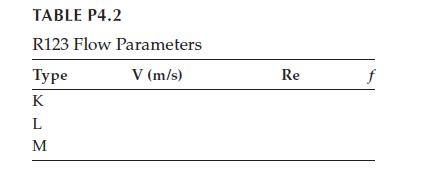
Liquid Refrigerant 123 (R123) at 120°C is passing through a ½-std copper tube at a flow rate of 1200 kg/hr. Complete Table P4.2 showing the variation of the R-123 flow parameters inside the tube as a function of the type of tubing used. TABLE P4.2 R123 Flow Parameters V (m/s) Type K L M Re f
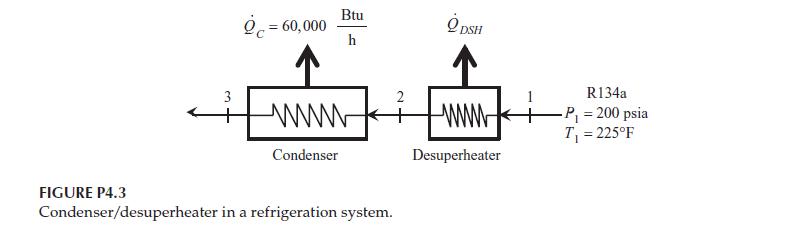
Refrigerant R134a is flowing through a ¾-std type L copper tube in a refrigeration system. In this system, a desuperheater is used to heat water as shown in Figure P4.3. The R134a enters the desuperheater at 200 psia, 225°F. The desuperheater removes enough energy, QDSH , such that the R134a
Compressed air at 500 kPa, 90°C is flowing through a 4-nom sch 40 commercial steel pipe at a volumetric flow rate of 375 m3/h. Determine the friction factor for this flow.
In a particular section of a fluid system, a 30% ethylene glycol mixture is flowing through a 6-nom xs cast iron pipe at a temperature of 0°C. In this section of piping, the velocity must be maintained in the range 1.5 m/s < V < 1.8 m/s. Determine the following,a. The range of volume flow rates
A 10-nom sch 40 horizontal commercial steel pipe is being used to transport octane. The pipe is 230 ft long. The octane is at 40°F and is flowing at 610 gpm.Determine the pressure drop of the octane as it flows through the pipe (psi).
Liquid propane is flowing through a 4 std type L copper tube. The tube is 200 m long and the outlet is 10 m higher than the inlet. The pressure drop through the tube is 90 kPa. The cyclohexane is at a temperature of −10°C. Determine the volumetric flow rate of the cyclohexane through the tube
Water is flowing through a 2½-nom xs cast iron pipe at a rate of 4 L/s. The pipe is 75 m long and its outlet is 6 m higher than the inlet. The water is at a temperature of 25°C. Determine the pressure drop of the water through the pipe.
A 20% ethylene glycol solution is flowing through a 4-nom sch 80 commercial steel pipe. The pipe is 350 ft long and is horizontal. The pressure drop through the pipe is 4 psi. The ethylene glycol is at a temperature of 20°F.a. Determine the volumetric flow rate of the ethylene glycol
A fuel line supplying fuel to several large industrial diesel engines is made of type M copper tube. The tube is 40 ft long. The fuel is dispensed by gravity feed from a tank that is 12 ft above the engines. Diesel fuel (modeled as dodecane) at 80°F is being transported through the line. The
A horizontal pipeline is used to transport ethanol (ethyl alcohol) at 20°C over a distance of 3 km. The pipe is made of commercial steel. The required flow rate of the ethanol is 40 L/s. The pump connected to this pipeline can overcome a pressure drop of 200 kPa in the pipe. Specify the
The Alaskan pipeline runs 798 miles from Prudhoe Bay to Valdez. Both cities are at sea level. The design specifications for the pipeline require a capacity of 2.4 million barrels per day (1 barrel = 42 gallons). The crude oil is maintained at 140°F in the pipeline. At this temperature, the oil has
Fluid flow can cause excessive wear on the inside surface of a pipe, resulting in a much rougher surface over time. This increased surface roughness results in a larger pressure drop which requires more pumping energy to move the fluid compared to a new pipe. Consider an expensive 14-nom sch 120
A standard 90° elbow is being used in a 8-nom commercial steel pipe. The joint between the pipe and elbow is flanged. Under a fully turbulent flow condition, the loss coefficient for the elbow is found to be K = 0.29 using the method presented by the Crane Company (2017). Use the 2K method to
Solve Problem 4.14 using the 3K method for calculating the K value of the elbow.Problem 4.14A standard 90° elbow is being used in a 8-nom commercial steel pipe. The joint between the pipe and elbow is flanged. Under a fully turbulent flow condition, the loss coefficient for the elbow is found to
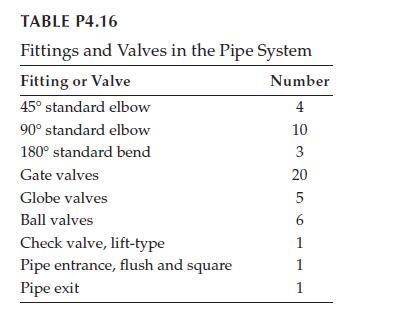
A piping system is made of 10-nom sch 80 commercial steel pipe. The pipe is transporting a 30% propylene glycol solution at a temperature of 40°C. Table P4.16 shows the number of fittings and valves in this pipe system. The joints are flanged. Determine the pressure loss (kPa) in this pipe system
The design of a pump and pipe system has been completed, except for the valves.The system is used to transport water at 120°F through 2 nom sch 40 commercial steel pipe at a required flow rate of 85 gpm. Without the valves, the pump selected has the capability to overcome an additional 18 psi of
A ½-std type M copper tube system used to make a heat exchanger has 32 180° standard bends. The joints are soldered (assume this joint type can be treated as a welded joint). The fluid flowing through the tube is liquid Refrigerant 227ea (R227ea) at 160°F. The R227ea is flowing at a rate of 1500
Air is passing through a round duct with an inside diameter of 2 ft in an air conditioning system. The air is at a temperature of 60°F and a pressure of 1 atm.The air is flowing at a rate of 5000 cfm. As the air passes through the duct system, it flows through three 90° mitered elbows with 3
A tilting disc check valve is to be installed in a 4-nom sch 40 steel pipeline.For the valve being considered, the angle α = 5°. The fluid being transported through the pipeline is a 20% ethylene glycol solution at a 20°F. The volumetric flow rate of the ethylene glycol is 425 gpm.a. Specify
Water at 80°C is flowing in a 6-nom sch 120 commercial steel pipe at a flow rate of 21 L/s. A globe-type lift check valve is to be installed in this pipe.a. Specify the size and ASME class of the check valve required.b. Determine the total pressure drop (kPa) due to the check valve and any
A 6-nom class 400 wye fitting with equal leg diameters has 650 gpm of water flowing into the fitting at 60°F. 65% of the flow leaves the fitting through the straight run and the remaining flow leaves through the branch which is at an angle of 45° to the straight run. Determine the pressure loss
Hexane enters the branch portion of a tee at 6 L/s and the straight run portion at 10 L/s. The tee is a 3-nom class 300 fitting. All ports of the tee have the same diameter. Determine the head loss (m) in the branch and straight runs.
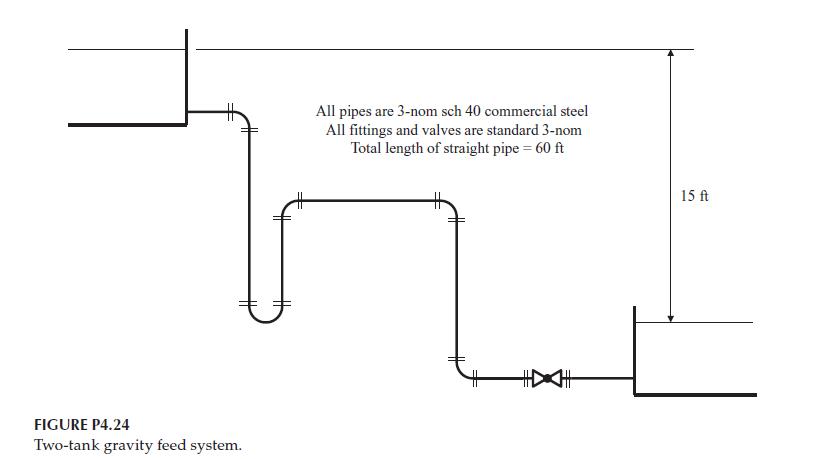
A gravity-feed piping system between two large tanks is used to transport a 20%magnesium chloride solution as shown in Figure P4.24. The magnesium chloride solution is at 80°F and the tanks are open to the atmosphere. The piping system is 3-nom sch 40 commercial steel. All fittings and valves are
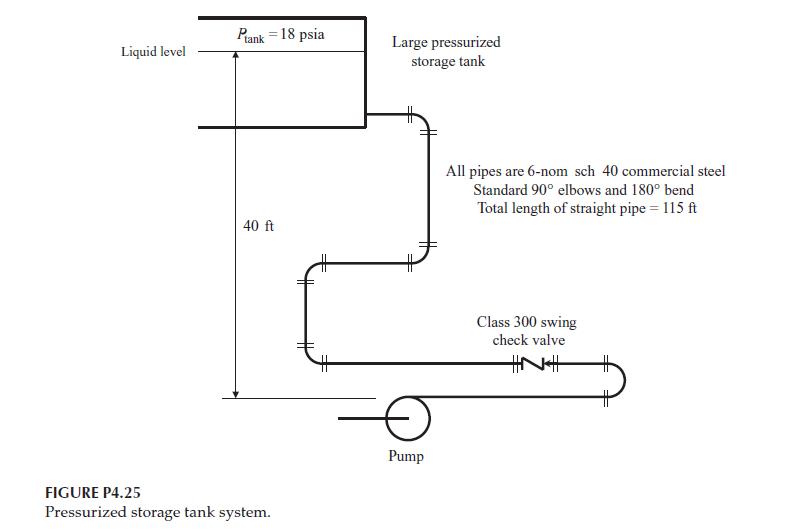
Figure P4.25 shows a pump and pipe network being used to transport heptane at 120°F to a large, elevated, closed storage tank. The tank is pressurized and maintained at 18 psia. The volumetric flow rate of the heptane is 500 gpm.a. Specify the nominal diameter of the check valve.b. Determine the
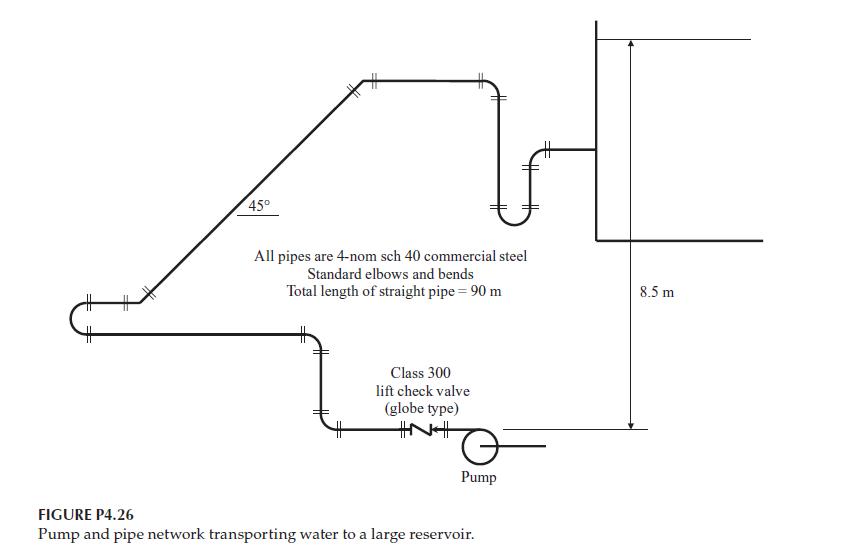
Water at 80°C is being pumped to a large reservoir 8.5 m above the discharge of the pump. The pipe network transporting the water is shown in Figure P4.26.The volumetric flow rate of the water is 10 L/s.a. Specify the nominal diameter of the check valve.b. Determine the pump head required to
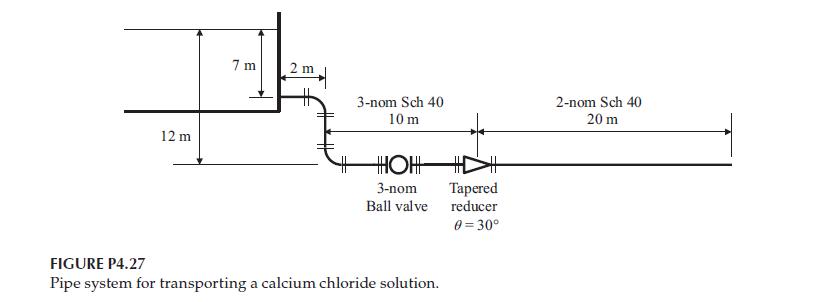
A 15% calcium chloride solution at −5°C is being delivered from a large refrigerated storage tank with the gravity-feed pipe network shown in Figure P4.27. A 30° tapered reducer is used to reduce the pipe size from 3-nom sch 40 to 2-nom sch 40 as shown in the figure. All pipes are commercial
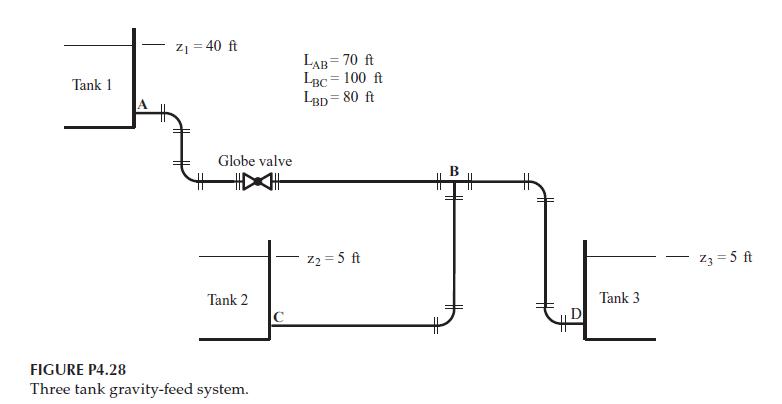
A large elevated tank (Tank 1) is being used to supply water at 60°F to two tanks at a lower elevation (Tanks 2 and 3) as shown in Figure P4.28. All pipes are 5-nom sch 40 commercial steel. The straight lengths of the piping in Sections AB, BC, and BD are indicated in the figure. The elevation
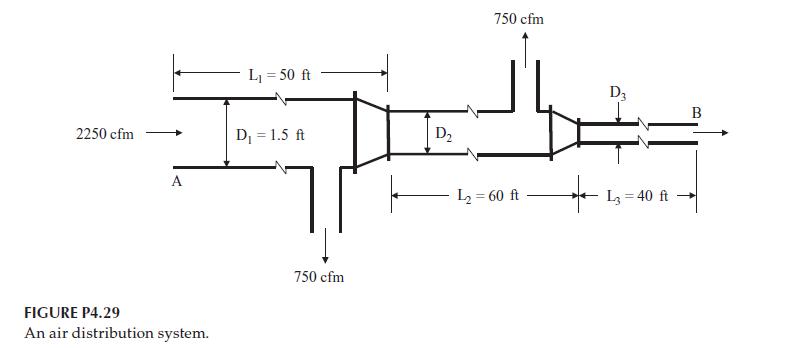
In order to properly size the fan required for a heating and air conditioning system, the pressure drop in the system must be determined. Consider the air distribution system shown in Figure P4.29. Dry air at 65°F, 1 atm enters the main duct of the system at 2250 cfm. There are two take-offs in
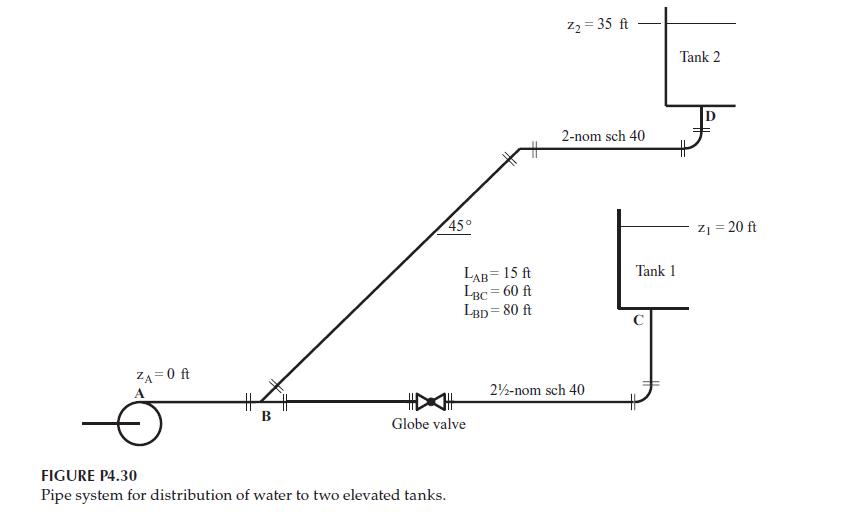
A pump is being used to deliver water at 70°F to two large, elevated tanks as shown in Figure P4.30. The pump is delivering a volumetric flow rate of 275 gpm.The pipes from A to B and B to C are 2½-nom sch 40 galvanized iron. The pipe from B to D is 2-nom sch 40 galvanized iron. The straight
A commercial steel pipe is being designed to transport liquid benzene at 185°F to a heat exchanger at a flow rate of 850 gpm. The fittings, valves, supports, and pump are estimated to cost 6 times the installed pipe cost per ft. Annual maintenance is estimated to be 1.5% of the installed pipe and
A commercial steel class 300 schedule 40 pipe is being used to transport 1000 gpm of liquid cyclohexane at 70°F. The fittings, valves, supports, and pump are estimated to cost 6.9 times the amortized installed pipe cost per ft. Annual maintenance is estimated to be 2% of the amortized installed
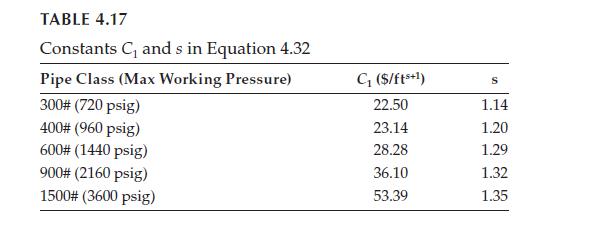
A Bell & Gossett Series e-1531 model 5BD pump operating at 1770 rpm is being used to deliver 250 m3/h of a 10% methanol solution at 5°C through a pipe network.The impeller diameter is 8.5 inches. The pipe is class 300 sch 40 commercial steel. The pump and other fittings, valves and hardware for
A production facility has a fluid transport system for liquid dimethyl carbonate. The pipeline transporting the dimethyl carbonate is made of class 400 sch 80 commercial steel. The properties of liquid dimethyl carbonate at 60°F are: ρ = 67.152 lbm/ft3, μ = 0.00043565 lbm/ft-s. Using the
A centrifugal pump is being used to deliver 250 gpm of water at 60°F. The pump head is determined to be 25 ft and its efficiency is 70%. Determine the brake horsepower input to the pump and the hydraulic horsepower input to the water.
A centrifugal pump delivers 60 L/s of toluene at 40°C. The pump head is found to be 15 m and its efficiency is 48%. Determine the shaft power input to the pump (kW) and the power input to the toluene (kW).
A centrifugal pump is being used to transport 440 gpm of benzene at 80°F. The suction pipe inlet to the pump is 6-nom sch 40 and the pump discharge pipe is 5-nom sch 40. Pressure gauges on the suction and discharge ports of the pump indicate −4 psig and 55 psig, respectively. The elevation
A centrifugal pump is being used to transport 45 m3/h of a 20% ethylene glycol solution at 0°C. The suction pipe inlet to the pump is 2½-nom sch 40 and the pump discharge pipe is 2-nom sch 40. Pressure gauges on the suction and discharge ports of the pump indicate −15 kPa and 250 kPa,
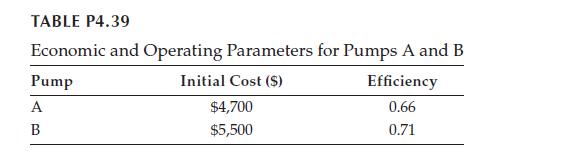
Two pumps are being considered for a pipe system. Table P4.39 shows the economic and operating parameters of each pump. The fluid being transported in the system is a 30% propylene glycol solution. The propylene glycol is flowing at 300 gpm with an average temperature of 40°F. At this condition,
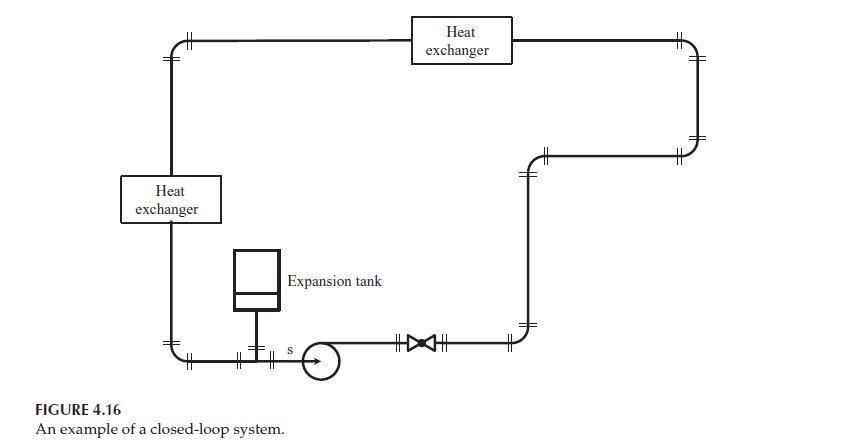
A closed-loop pipe system similar to Figure 4.16 is being designed. At 280 gpm, the system curve indicates that the pump must deliver 120 ft. A 2.5x2.5x7B Bell & Gossett Series e-80 pump operating at 3550 rpm is to be specified for this application.a. Specify the impeller diameter for this
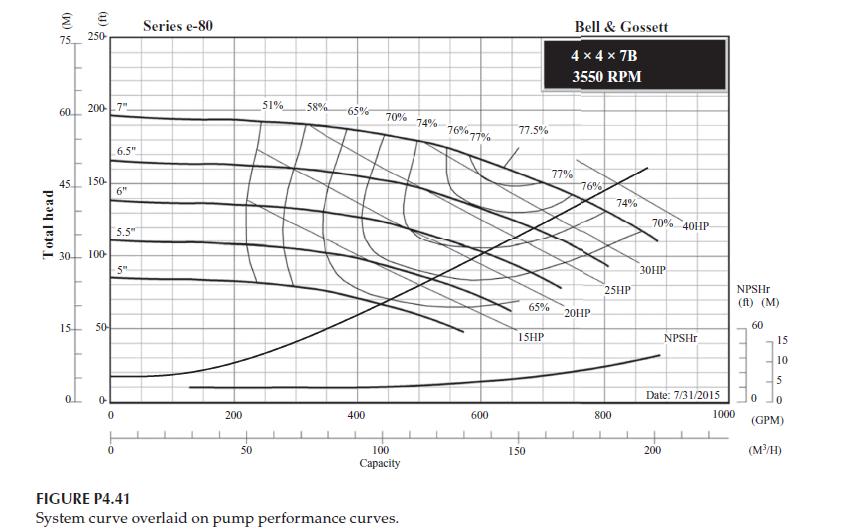
Figure P4.41 shows a system curve overlaid on a set of Bell & Gossett Series e-1531 Model 4x4x7B at 3550 rpm pump curves. The flow requirement for the system is 150 m3/h.a. Specify the pump’s impeller diameter for this application For the impeller size specified in part (a),
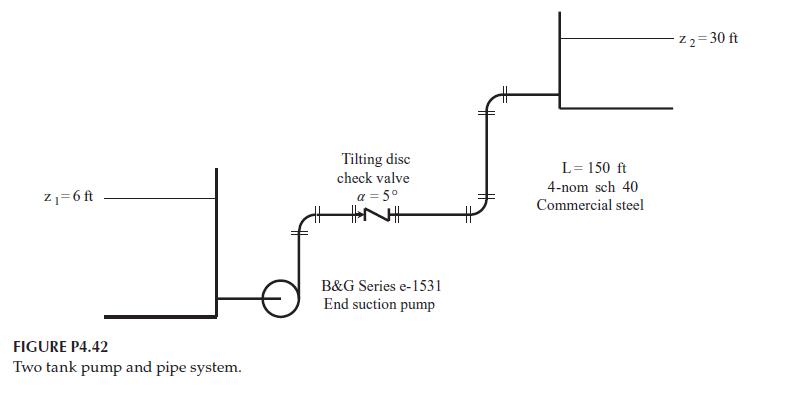
A Bell & Gossett Series e-1531 end-suction pump is to be selected for the system shown in Figure P4.42. The system is designed to move water at 60°F from the lower tank to the upper tank. The system must deliver a minimum of 500 gpm of water from the lower tank to the upper tank when the pump
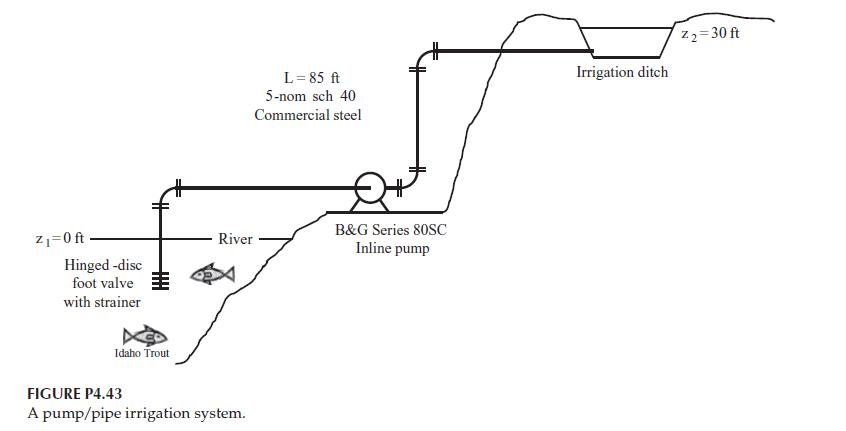
Water from a river is to be pumped to an irrigation ditch as shown in Figure P4.43. The water temperature is 55°F. The irrigation requirement is 400 gpm. The elevation difference between the river and the surface of the water in the irrigation ditch is 30 ft. A hinged-disc foot valve with a
A closed-loop pump/pipe system has a head requirement of 35 m at a flow rate of 60 m3/h. The pump is a Bell & Gossett Series e-1531 Model 2AD operating at 3550 rpm with a 6-inch impeller.a. Develop an equation for the system curve.b. Use a computer program to develop an equation for the 6-inch
A two-tank pump/pipe system has a head requirement of 23.4 ft at a flow rate of 100 gpm. The elevation difference between the fluid surfaces in the tanks is 10 ft.The pump is a Bell & Gossett Series e-80 Model 2.5x2.5x9C operating at 1170 rpm with a 7.5-inch impeller.a. Develop an equation for the
Two Bell & Gossett Series e-80 3x3x7C pumps with 6.5-inch impellers are connected together in parallel. Both pumps are operating at 3550 rpm. This parallel pump combination is connected to a pipe system that has an elevation difference (outlet to inlet)of 40 ft. At a flow rate of 500 gpm, the head
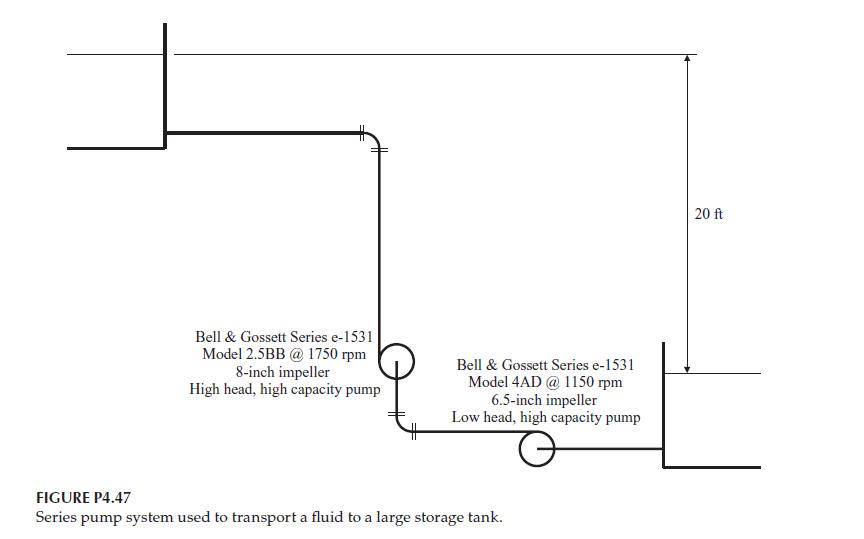
Two pumps are used in series to move a fluid to an elevated storage tank as shown in Figure P4.47. The first pump is a Bell & Gossett Series e-1531 low head, high capacity pump (Model 4AD with a 6.5-inch impeller operating at 1150 rpm).The second pump is a Bell & Gossett Series e-1531 high
Two Bell & Gossett Series e-1531 Model 6BD pumps are connected in parallel.One pump has a 9-inch impeller and the other pump has a 9.5-inch impeller.When both pumps are running in a system, the fluid flow rate is 3600 gpm.a. Construct a plot showing the individual pump performance curves and the
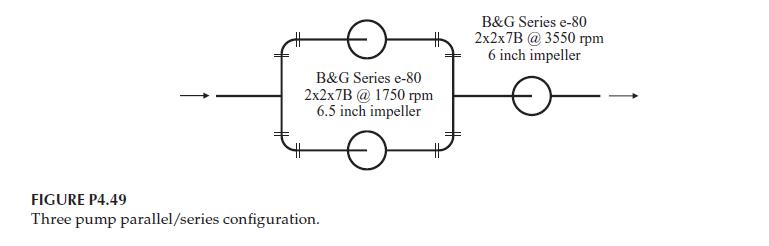
Two Bell & Gossett Series e-80 2x2x7B pumps operating at 1750 rpm with 6.5- inch impellers are connected in parallel. A third pump, a Bell & Gossett Series e-80 2x2x7B pump operating at 3500 rpm with a 6-inch impeller is connected in series with the parallel pumps as shown in Figure P4.49.
Water is being pumped through a pipe system at a temperature of 60°C.Determine the maximum absolute pressure at the eye of the pump’s impeller that would cause cavitation.
The pressure at the eye of the impeller of a pump moving water at 120°F is 2 psia.Will cavitation occur in this pump?
A pressure gauge attached to the suction port of a centrifugal pump indicates a pressure of −8 psig. The pump is being used to transport water at 70°F.Atmospheric pressure is 14.696 psia. Will cavitation occur in this pump?
The pressure at the suction port of a pump transporting water at 30°C is 4.3 kPa (absolute). Will cavitation occur in this pump?
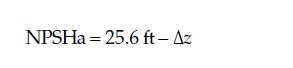
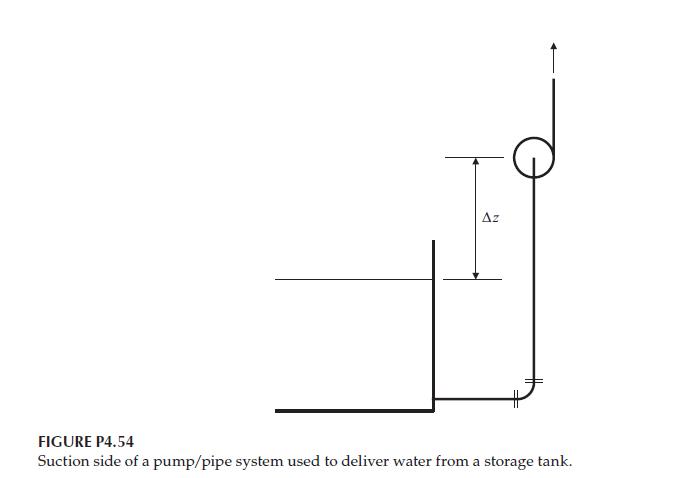
A Bell & Gossett Series e-80 5x5x7B centrifugal pump operating at 1770 rpm is fitted with a 6.5-inch impeller. The pump is being used to deliver water from a large tank as shown in Figure P4.54. The head at the operating point of the pump/pipe system is 30 ft. A suction-side pipe analysis
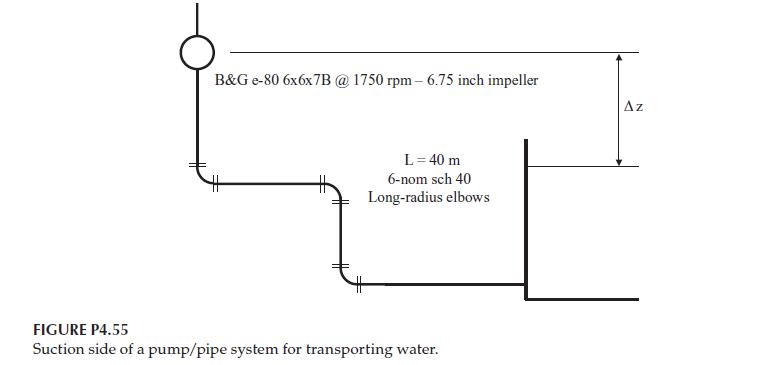
A Bell & Gossett Series e-80 6x6x7B pump operating at 1750 rpm with a 6.75-inch impeller is being used to transport water from a large tank as shown in Figure P4.55. The water is at a temperature of 20°C and is being delivered at a rate of 160 m3/h. The suction line is 6-nom sch 40 commercial
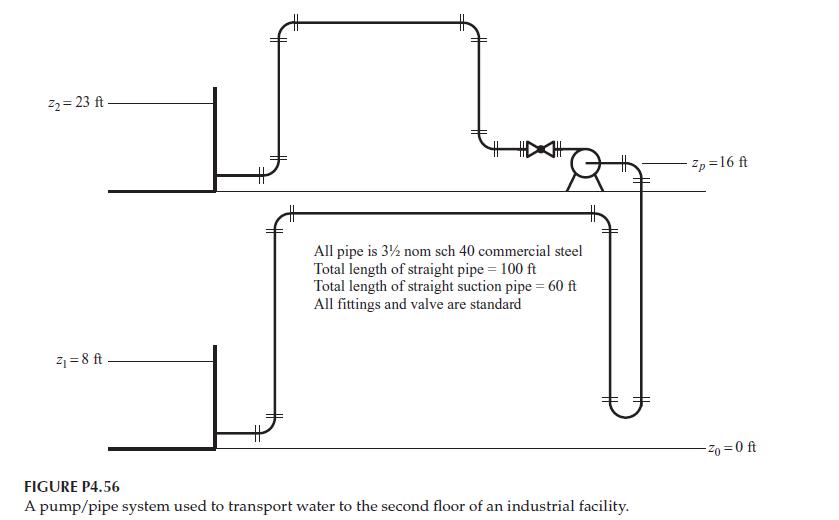
Water is being transferred from a large tank on the ground floor to the second floor of an industrial processing facility as shown in Figure P4.56. A Bell & Gossett Series e-1531 Model 3BD pump operating at 1770 rpm with an 8-inch impeller has been selected for the system. The pipe is 3½ nom
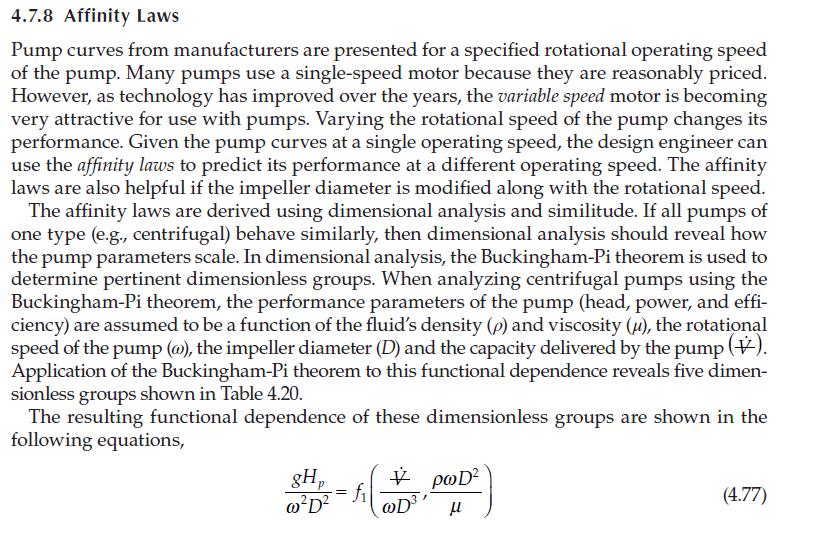
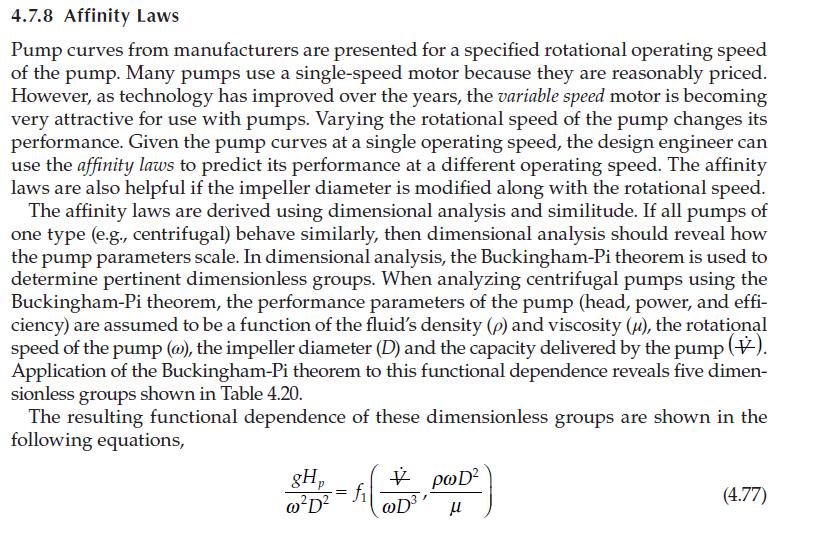
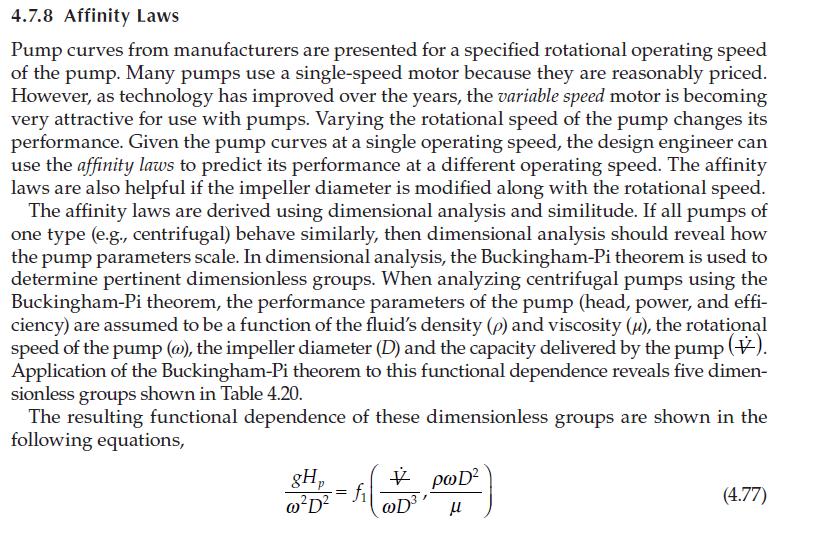
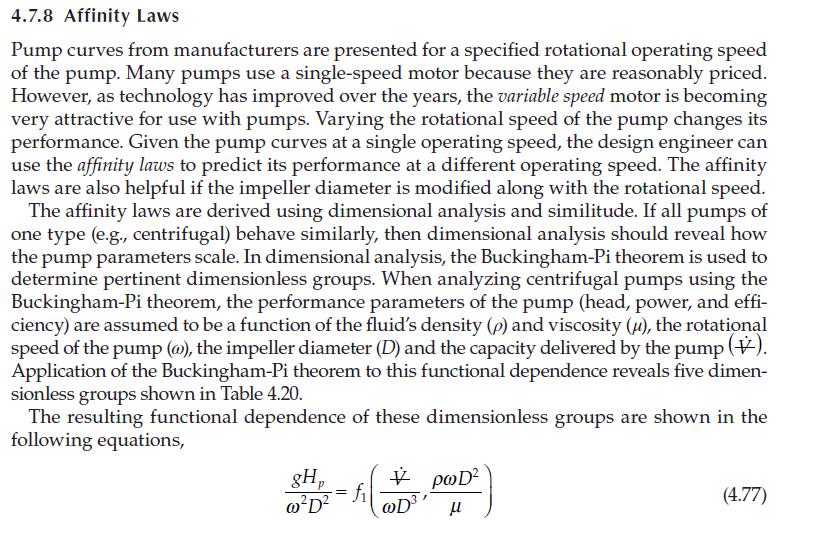
A centrifugal pump is tested in the laboratory. The pump has a 6-inch impeller and is operating at 3550 rpm. With water as the fluid, test results indicate that the pump delivers 280 gpm at 110 ft of head. Using the affinity laws, predict what the pump capacity and head would be if the rotational
A centrifugal pump is being tested with water at 60°F. The pump is operating at 1150 rpm and has a 7-inch impeller. Performance test results indicate that the pump delivers 80 gpm at a head of 32 ft with a power draw of 2.75 hp. Using the affinity laws, predict what the pump capacity, head, and
A point on the performance curve of a pump indicates that at an operational speed of 1150 rpm, a pump with a 6.5-inch impeller is capable of delivering 100 m3/h at 3.75 m of head. Use the affinity laws to predict what the pump capacity and head would be if the impeller speed remains the same, but
A centrifugal pump is capable of delivering 50 L/s of fluid at a head of 18 m while operating at 3550 rpm with a 7-inch impeller. At this condition, the pump power draw is 12 kW and the pump efficiency is 68%. Use the affinity laws to predict the pump capacity, head, power draw, and efficiency if
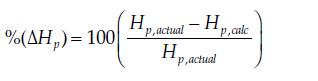
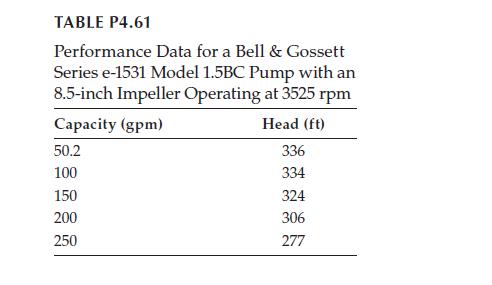
Table P4.61 shows performance data read from one of the Bell & Gossett pump curves in Appendix E.a. For each data point in Table P4.61, use the affinity laws to determine the new capacity and head of this pump if the operational speed is reduced to 1750 rpm using a variable speed motor.b. In
A Bell & Gossett Series e-80 4x4x13.5 pump has a 12.5-inch impeller and is operating at 1750 rpm. The pump is installed in a closed-loop pipe system. An analysis of the pump/pipe system at 400 gpm indicates a required pump head of 75 ft.a. Determine the operating point of the pump/pipe system
The plates in a plate and frame heat exchanger are made of Inconel 600 (k = 16 W/m-K) and are 1.5 mm thick. Consider one of the plates in this heat exchanger. The convective heat transfer coefficients on hot and cold side of the plate are 2,250 W/m2-K and 1,600 W/m2-K, respectively. The average
The plates in a plate and frame heat exchanger are made of Monel 200 (k = 38.1 Btu/hr-ft-°F) and are 0.04-in thick. Consider one of the plates in this heat exchanger. The convective heat transfer coefficients on hot and cold side of the plate are 180 Btu/hr-ft2-°F and 200 Btu/hr-ft2-°F,
A 2½-nom sch 40S stainless steel pipe (k = 16.5 W/m-K) is being used in a heat exchanger application. The pipe is 1-m long. The convective heat transfer coefficients on the inside and outside of the pipe are 1,590 W/m2-K and 1,980 W/m2-K, respectively.The fouling factor on each side of the pipe is
The convective heat transfer coefficients on the inside and outside of a ½-std type L copper tube are 150 Btu/hr-ft2-°F and 450 Btu/hr-ft2-°F, respectively. The tube is 4-ft long. An ethylene glycol solution flows on the outside of the tube and Refrigerant-22 is on the inside. The average
Liquid propane is flowing through a 6-nom galvanized iron pipe at a flow rate of 3 kg/s. The average temperature of the propane in the pipe is 0°C.a. Determine the convective heat transfer coefficient inside the pipe.b. Determine the convective heat transfer coefficient for the C2–C10
Due to extreme pressures for a particular application, a 10-ft long pipe is made of 2-nom sch 160 pipe (kpipe = 70 Btu/hr-ft-°F). The convective heat transfer coefficients inside and outside of the pipe are have been determined to be hi = 1248 Btu/hr-ft2-°F and ho = 652 Btu/hr-ft2-°F,
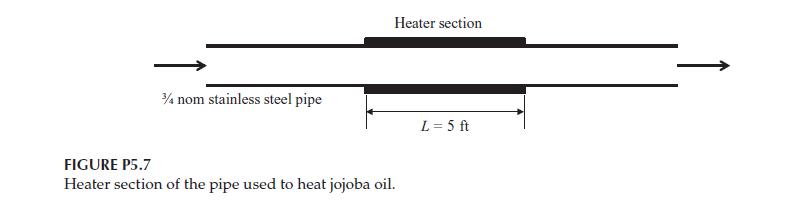
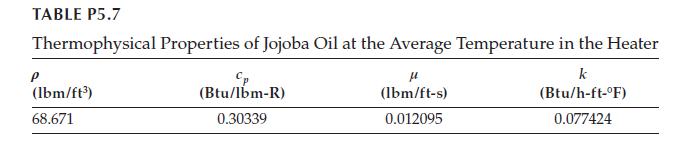
Jojoba oil is flowing through a ¾-nom stainless steel pipe at a flow rate of 1,850 lbm/h.After the velocity profile in the pipe is fully developed, the oil enters a heater, as shown in Figure P5.7. The length of the heater section is 5 ft. The properties of the jojoba oil at the average
A 15% magnesium chloride solution is flowing through a 5-nom sch 40 commercial steel pipe at a rate of 325,000 lbm/h. The average temperature of the magnesium chloride solution as it flows through the pipe is 10°F. Determine the convective heat transfer coefficient inside the pipe.
Water is flowing inside of a 3-std type K copper tube at a flow rate of 1.2 kg/s. The average temperature of the water is 50°C. Cold, dry air at a temperature of 5°C and atmospheric pressure flows outside of the tube in cross flow with a velocity of 85 m/s. Determine the UA product for this tube
An innovative engineering student has been contemplating whether or not it would be feasible to capture some of the waste heat that leaves the stack of a wood burning stove to preheat water. The proposal is to insert a 6-ft long copper coil made of ½-std type K tubing into a 4-inch (ID) stovepipe.
A building in a processing facility has been retrofitted for a new process. There is a need for hot water in this new process. The original design of the building did not include a hot water line. Adjacent to this building is another building that has a hot water line that can be used. The proposal
A heat exchanger is being used to cool 48,000 lbm/hr of oil from 150°F to 102°F by using 32,000 lbm/hr of water at an inlet temperature of 70°F. The overall heat transfer coefficient is determined to be 145 Btu/hr-ft²-°F. The average heat capacities of the oil and water can be taken as 0.5
A counter flow double pipe heat exchanger is being used to cool hot oil from 320°F to 285°F using cold water. The water, which flows through the inner tube, enters the heat exchanger at 70°F and leaves at 175°F. The inner tube is ¾-std type L copper.The overall heat transfer coefficient based
A flow of cold water enters a parallel flow heat exchanger at 20°C and leaves at 100°C. The cold water is being heated by a hot water flow that enters the heat exchanger at 160°C and leaves at 120°C. The overall heat transfer coefficient for this heat exchanger is 324 W/m2-K. The heat exchanger
A counter flow heat exchanger is being used to cool a flow of hot water using a cold 20% ethylene glycol solution. The hot water enters at 80°F with a volumetric flow rate of 500 gpm. The ethylene glycol solution enters the heat exchanger at 30°F and leaves at 60°F. The ethylene glycol solution
Solve Problem 5.15 for a parallel flow heat exchanger.Problem 5.15A counter flow heat exchanger is being used to cool a flow of hot water using a cold 20% ethylene glycol solution. The hot water enters at 80°F with a volumetric flow rate of 500 gpm. The ethylene glycol solution enters the heat
Solve Problem 5.15 for a shell and tube heat exchanger with one shell pass and two tube passes.Problem 5.15A counter flow heat exchanger is being used to cool a flow of hot water using a cold 20% ethylene glycol solution. The hot water enters at 80°F with a volumetric flow rate of 500 gpm. The
Solve Problem 5.15 for a cross flow heat exchanger where the water flow is mixed and the ethylene glycol solution flow is unmixed.Problem 5.15A counter flow heat exchanger is being used to cool a flow of hot water using a cold 20% ethylene glycol solution. The hot water enters at 80°F with a
Solve Problem 5.15 for a cross flow heat exchanger where the ethylene glycol solution flow is mixed and the water flow is unmixed.Problem 5.15A counter flow heat exchanger is being used to cool a flow of hot water using a cold 20% ethylene glycol solution. The hot water enters at 80°F with a
A counter flow heat exchanger is utilizing a cold 20% magnesium chloride solution to cool a flow of hexane. The hexane enters the heat exchanger at 26°C and the magnesium chloride solution enters at 0°C. The volumetric flow rates of the hexane and magnesium chloride solution are 30 L/s and 26
Solve Problem 5.20 for a parallel flow heat exchanger.Problem 5.20A counter flow heat exchanger is utilizing a cold 20% magnesium chloride solution to cool a flow of hexane. The hexane enters the heat exchanger at 26°C and the magnesium chloride solution enters at 0°C. The volumetric flow rates
Solve Problem 5.20 for a shell and tube heat exchanger with 1 shell pass and 2 tube passes.Problem 5.20A counter flow heat exchanger is utilizing a cold 20% magnesium chloride solution to cool a flow of hexane. The hexane enters the heat exchanger at 26°C and the magnesium chloride solution enters
Solve Problem 5.20 for a cross flow heat exchanger where the hexane flow is mixed and the magnesium chloride solution flow is unmixed.Problem 5.20A counter flow heat exchanger is utilizing a cold 20% magnesium chloride solution to cool a flow of hexane. The hexane enters the heat exchanger at 26°C
Solve Problem 5.20 for a cross flow heat exchanger where the magnesium chloride solution flow is mixed and the hexane flow is unmixed.Problem 5.20A counter flow heat exchanger is utilizing a cold 20% magnesium chloride solution to cool a flow of hexane. The hexane enters the heat exchanger at 26°C
Liquid heptane enters a counter flow heat exchanger at 45°F. The heptane is heated using a flow of hot water entering the heat exchanger at 150°F. The volumetric flow rates of the heptane and water are 280 gpm and 200 gpm, respectively. The UA product of the heat exchanger is found to be 25,675
Solve Problem 5.25 for a parallel flow heat exchanger.Problem 5.25Liquid heptane enters a counter flow heat exchanger at 45°F. The heptane is heated using a flow of hot water entering the heat exchanger at 150°F. The volumetric flow rates of the heptane and water are 280 gpm and 200 gpm,
Solve Problem 5.25 for a shell and tube heat exchanger with 1 shell pass and 2 tube passes.Problem 5.25Liquid heptane enters a counter flow heat exchanger at 45°F. The heptane is heated using a flow of hot water entering the heat exchanger at 150°F. The volumetric flow rates of the heptane and
Solve Problem 5.25 for a cross flow heat exchanger where both fluids are unmixed.Problem 5.25Liquid heptane enters a counter flow heat exchanger at 45°F. The heptane is heated using a flow of hot water entering the heat exchanger at 150°F. The volumetric flow rates of the heptane and water are
A counter flow heat exchanger is being used to heat a flow of liquid toluene. The toluene enters the heat exchanger at 5°C with a volumetric flow rate of 10 L/s. Hot water is being used to heat the toluene. The water enters the heat exchanger at 70°C and a volumetric flow rate of 18 L/s. The UA
Solve Problem 5.29 for a parallel flow heat exchanger.Problem 5.29A counter flow heat exchanger is being used to heat a flow of liquid toluene. The toluene enters the heat exchanger at 5°C with a volumetric flow rate of 10 L/s. Hot water is being used to heat the toluene. The water enters the heat
Solve Problem 5.29 for a shell and tube heat exchanger with 1 shell pass and 4 tube passes.Problem 5.29A counter flow heat exchanger is being used to heat a flow of liquid toluene. The toluene enters the heat exchanger at 5°C with a volumetric flow rate of 10 L/s. Hot water is being used to heat
Solve Problem 5.29 for a cross flow heat exchanger where the water flow is mixed and the toluene flow is unmixed.Problem 5.29A counter flow heat exchanger is being used to heat a flow of liquid toluene. The toluene enters the heat exchanger at 5°C with a volumetric flow rate of 10 L/s. Hot water
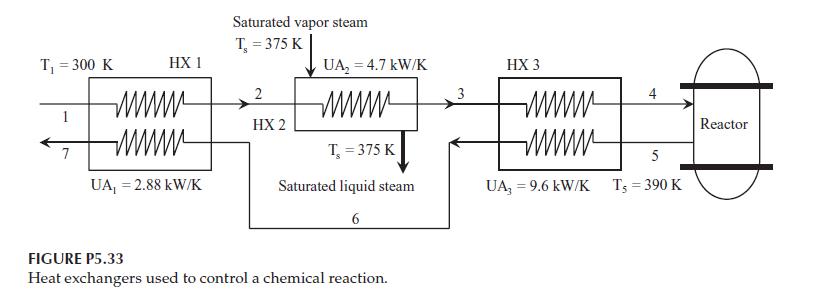
The series of heat exchangers shown in Figure P5.33 is designed to raise a liquid’s temperature so a desired chemical reaction can take place in the reactor. The specific heat of the liquid can be assumed constant at an average value of 3.2 kJ/kg-K.The liquid flow rate is 1.4 kg/s. The
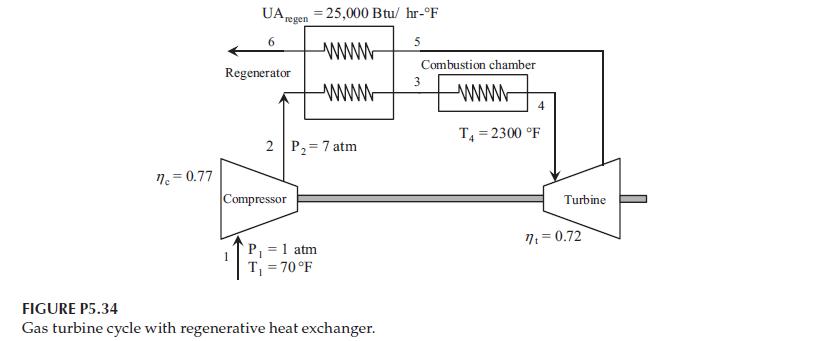
A gas turbine cycle utilizes a regenerative heat exchanger as shown in Figure P5.34.Air enters the compressor at atmospheric conditions, 1 atm and 70°F with a mass flow rate of 15,000 lbm/hr. The exhaust pressure of the compressor is 7 atm. The compressor is operating with an isentropic efficiency
Showing 4600 - 4700
of 5433
First
40
41
42
43
44
45
46
47
48
49
50
51
52
53
54
Last
Step by Step Answers

 Get 50% OFF
Claim Now
Get 50% OFF
Claim Now