New Semester
Started
Get
50% OFF
Study Help!
--h --m --s
Claim Now
Question Answers
Textbooks
Find textbooks, questions and answers
Oops, something went wrong!
Change your search query and then try again
S
Books
FREE
Study Help
Expert Questions
Accounting
General Management
Mathematics
Finance
Organizational Behaviour
Law
Physics
Operating System
Management Leadership
Sociology
Programming
Marketing
Database
Computer Network
Economics
Textbooks Solutions
Accounting
Managerial Accounting
Management Leadership
Cost Accounting
Statistics
Business Law
Corporate Finance
Finance
Economics
Auditing
Tutors
Online Tutors
Find a Tutor
Hire a Tutor
Become a Tutor
AI Tutor
AI Study Planner
NEW
Sell Books
Search
Search
Sign In
Register
study help
computer science
systems analysis design
The Analysis And Design Of Linear Circuits 10th Edition Roland E. Thomas, Albert J. Rosa, Gregory J. Toussaint - Solutions
Consider a coal gasification reactor making use of the carbon steam process in which carbon at \(25^{\circ} \mathrm{C}, 1\) bar and water vapor at \(316{ }^{\circ} \mathrm{C}, 1\) bar enter the reactor and the product gas mixture exits at \(927^{\circ} \mathrm{C}\) and \(1 \mathrm{bar}\) The
We wish to determine whether less exergy is destroyed when we drive a car with all windows closed and the air conditioner on than when we drive with the windows open and the air conditioner off. The car can be modeled as a blunt body with frontal area \(A=5 \mathrm{~m}^{2}\) traveling through air
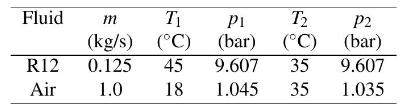
A vapor compression heat pump uses R12 as the working fluid. The condenser used in the heat pump is an air-cooled counter-flow heat exchanger. The operating parameters are:Assume air to be a perfect gas with \(C_{p}=1.0 \mathrm{~kJ} / \mathrm{kg}-\mathrm{K}\) and \(\gamma=1.4\). The temperature of
Cylinder (Dia, \(D=10 \mathrm{~cm}\), Length, \(W=100 \mathrm{~cm}\) ) arrays of a heat exchanger with an inline arrangement are exposed to a uniform velocity of \(U=2 \mathrm{~m} / \mathrm{s}\) and temperature \(T_{0}=30^{\circ} \mathrm{C}\). The Nusselt number for a cylinder in this arrangement
Discuss the procedure of material selection for mold material for casting of aluminum. How will the material be different when it is required to cast steel instead?
Determine the materials currently being used for proper functioning of the following systems: (a) Solar cells, (b) Wind turbine blade, (c) Fuel cells, (d) Automobile bodies and (e) ship bodies. Mention the relevant material properties for justifying the use of these materials.
Discuss how material selection for thermal system can play a role in green design.
Discuss the ideal coolant selection for immersion cooling of data center with proper justification.
Review the state of the art on application of artificial intelligence for material selection related to thermal management of any electronics cooling application.
A shell and tube heat exchanger with one-shell pass and multiples of two-tube passes is constructed from \(0.0254 \mathrm{~m}\) OD tube to cool \(693 \mathrm{~kg} / \mathrm{s}\) of a \(95 \%\) ethyl alcohol \(\left(C_{p}=3810 \mathrm{~J} / \mathrm{kg}-\mathrm{K}ight)\) from \(66{ }^{\circ}
A two-pass tube baffled single-pass shell; shell and tube heat exchanger is used as an oil cooler. Cooling water flows through the tubes at \(20^{\circ} \mathrm{C}\) at a flow rate of \(4.082 \mathrm{~kg} / \mathrm{s}\). Engine oil enters the shell side at a flow rate of \(10 \mathrm{~kg} /
A heat exchanger is to be designed to heat raw water by the use of condensed water at \(67{ }^{\circ} \mathrm{C}\) and \(0.2 \mathrm{bar}\), which will flow in the shell side with a mass flow rate of \(50,000 \mathrm{~kg} / \mathrm{h}\). The heat will be transferred to \(30,000 \mathrm{~kg} /
A single-pass shell and tube heat exchanger (condenser) heats \(946 \mathrm{~m}^{3} / \mathrm{h}\) of water from \(10{ }^{\circ} \mathrm{C}\) to \(38{ }^{\circ} \mathrm{C}\). The heat exchanger uses a plain steel tube \(\left(\mathrm{k}: 45 \mathrm{~W} / \mathrm{m}-{ }^{\circ} \mathrm{C}ight)\)
Air at 2 atm2 atm and 500 K500 K with a velocity of U=20 m/sU=20 m/s flows across a compact heat exchanger matrix having surface type I1.32-0737-S-R. The length of the matrix is 0.8 m0.8 m. Calculate the heat transfer coefficient and the frictional pressure drop. Use the following
The piping network shown below uses smooth cast iron pipes (C:130). The diameter and length of pipes in the network are pipe \(1:\) dia. \(=0.31 \mathrm{~m}\), length \(=609.6\) \(\mathrm{m}\); pipe 2: dia. \(=0.203 \mathrm{~m}\), length \(=609.6 \mathrm{~m}\); pipe \(3:\) dia. \(=0.1524
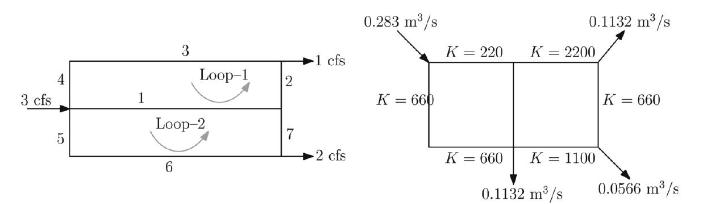
Find out the flow rate in each line of the following piping circuit. Here, \(K\) is the Hazen-Williams coefficient with \(n=2\). 3 cfs 10 1 3 6 Loop-1 Loop-2 2 7 cfs -2 cfs 0.283 m/s K = 660 K = 220 K = 660 0.1132 m/s K = 2200 K = 1100 0.1132 m/s K = 660 0.0566 m/s
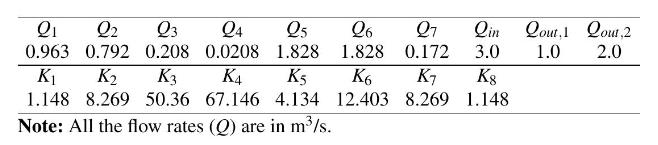
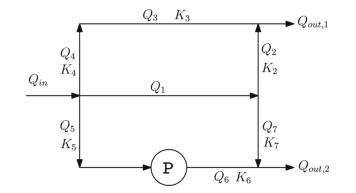
A piping circuit with a pump is shown in Figure 6.26. The pump characteristic used in the circuit is given as \(h_{f D}=0.4 Q-A\) where, \(A\) is a constant equal to the shut-off head of the pump and \(Q\) is the flow rate. Calculate the value of constant A using the following data:Figure 6.26 Q3
Write a PYTHON program to solve the following system of equations:\[\begin{gathered}3 x+2 y+z=6 \\4 x+6 y+5 z=15 \\7 x+8 y+9 z=24\end{gathered}\]The computer program is provided with the companion, please check your program and the solution.
Write a PYTHON program to solve the above system of equations using the Gauss-Seidel iteration.
Write a computer program to solve the following ODE using the fourth-order RK method:\[\begin{equation*}y^{\prime}=x y^{2}, \quad y(x=0)=1 \tag{9.27}\end{equation*}\]
Write a computer program to solve the following ODE using the fourth-order RK and shooting method:\[\begin{equation*}y^{\prime \prime}=x y^{2}, \quad y(x=0)=1, \quad y^{\prime}(x=0)=1 \tag{9.28}\end{equation*}\]
Write a computer program to solve the following ODE using the fourth-order RK method:\[\begin{equation*}y^{\prime}=x-y, \quad y(x=0)=1 \tag{9.29}\end{equation*}\]
Write a computer program to solve the following ODE using the finite difference method:\[\begin{equation*}y^{\prime \prime}=x-y, \quad y(x=0)=1, \quad y^{\prime}(x=0)=1 \tag{9.30}\end{equation*}\]
Write a computer program to solve the following ODE using the fourth-order RK method:\[\begin{equation*}y^{\prime}+y \tan x=\sin (2 x), \quad y(x=0)=1 \tag{9.31}\end{equation*}\]
Express \(f_{i}^{\prime \prime}\) in terms of \(f_{i}, f_{i+1}, f_{i+2}\) in a uniform grid.
Express \(f_{i}^{\prime \prime}\) in terms of \(f_{i}, f_{i-1}, f_{i-2}\) in a uniform grid.
Express \(f_{i}^{\prime \prime}\) in terms of \(f_{i}, f_{i+1}, f_{i+2}\) in a nonuniform grid.
Express \(f_{i}^{\prime \prime}\) in terms of \(f_{i}, f_{i-1}, f_{i-2}\) in a nonuniform grid.
Find the order of accuracy in the trapezoidal rule and Simpson's rule.
Evaluate the following integral using the trapezoidal rule, and calculate the difference between analytical and numerical solutions:\[\begin{equation*}I=\int_{0}^{10}\left(x^{2}+2 x+5ight) d x \tag{10.29}\end{equation*}\]
Evaluate the following integral using the Simpson rule, and calculate the difference between analytical and numerical solutions:\[\begin{equation*}I=\int_{0}^{10}(2 x+5) d x \tag{10.30}\end{equation*}\]
Consult any standard engineering mathematics book and solve the following PDE analytically:\[\begin{equation*}\frac{\partial u}{\partial t}=\alpha \frac{\partial^{2} u}{\partial x^{2}} \tag{11.103}\end{equation*}\]Initial and boundary conditions are given by\[\begin{equation*}u(t=0)=u_{0}(x) ;
Consult any standard engineering mathematics book and solve the following PDE analytically:\[\begin{equation*}\frac{\partial^{2} u}{\partial x^{2}}+\frac{\partial^{2} u}{\partial y^{2}}=0 \tag{11.105}\end{equation*}\]The boundary conditions are given by\[\begin{equation*}u(x=0)=u_{1},
Write a computer program, in any language, to solve 2-D transient diffusion equation using explicit method. Validate your result with an analytical solution. Clearly write the solution algorithm.
Solve the following PDE numerically using the pseudo-transient approach. Vary initial conditions to show that your final solution is independent of the initial condition.\[\begin{equation*}\frac{\partial^{2} u}{\partial x^{2}}+\frac{\partial^{2} u}{\partial y^{2}}=0 \tag{11.107}\end{equation*}\]The
Use von Neumann stability analysis to compare the stability criteria of explict, implict and Crank-Nicolson methods for a 2-D transient diffusion equation. Use \(\Delta x=\Delta y\).
Consider the steady developing flow between two parallel plates.a. Write the governing equations and the boundary conditions.b. Non-dimensionalize the governing equations and the boundary conditions.c. Develop the \(\psi-\omega\) equations and the boundary conditions.d. Write a PYTHON program to
For flows where \(\operatorname{Re}
For the lid-driven cavity problem, conduct parametric studies for \(R e=1, R e=100, R e=200\). Discuss, qualitatively, how the flow field changes with the \(R e\).
For laminar flow over an infinite parallel plate, we often assume boundary layer (BL) approximation. Under BL approximation, we often solve the Blasius equation to find the laminar boundary flow over a flat surface. In the ODE chapter, we have solved the Blasius equation. Now solve the complete
Consider a fuel cell working with carbon and oxygen. Find the reversible voltage and reversible efficiency of the cell
Can the reversible efficiency be more than 1, justify your answer.
Consider steady, 1-D heat conduction problems where we wish to use inverse technique to estimate the unknown thermal conductivity using measured temperatures at few discrete locations. In each of the following cases, formulate the inverse problem, and write the complete algorithm to estimate the
1. Carefully review the following economic concepts and make sure you have a clear understanding of them: neoclassical economics, absolute scarcity, relative scarcity, nathouseholds human-made capital, factors substitution, technical advance, an economy households, a firm, product and factor
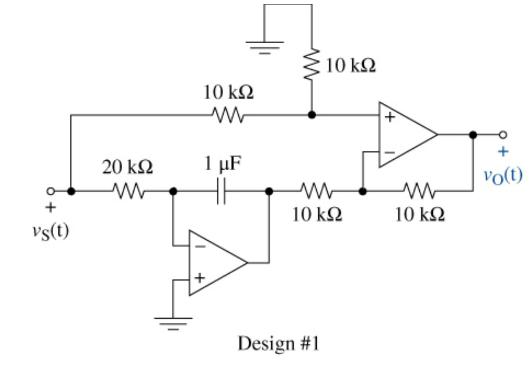
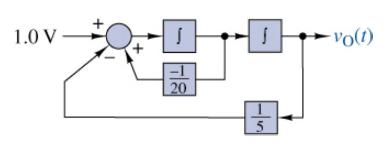
Design an OP AMP circuit that solves the following second-order differential equation for \(v_{\mathrm{O}}(t)\). Solve for the response for \(v_{\mathrm{O}}(t\) ) using Multisim. Caution: Avoid saturating the OP AMPs by distributing the gain across several OP AMPs.\[10^{-6} \frac{d^{2}
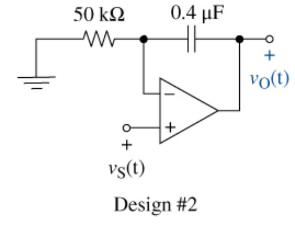
An upgrade to one of your company's robotics products requires a proportional plus integral compensator that implements the input-output relationship\[v_{\mathrm{O}}(t)=v_{\mathrm{S}}(t)+50 \int_{0}^{t} v_{\mathrm{S}}(x) d x\]The input voltage \(v_{\mathrm{S}}(t)\) comes from an OP AMP, and the
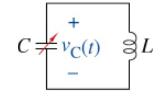
In Section 6-1, Figure 6-2 (g) shows an air-tunable capacitor as one example of the capacitor types. This type of device can vary its capacitance similar to how a potentiometer can vary its resistance. Changing the capacitance in a circuit can change the frequency at which it operates. This device
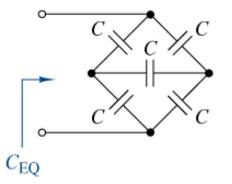
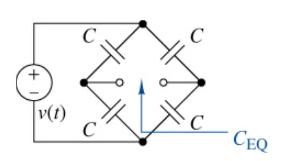
Find the equivalent capacitance of the capacitance bridge shown in Figure P6-5 6. CEO C C C C
In a particular radio frequency (RF) application, you determine there is a need for a small inductor of \(125 \mathrm{uH}\) and rather than trying to order one and wait for it to arrive, you decide to wind it yourself. The applicable equation is\[L=\frac{r^{2} N^{2}}{9 r+10 l}\]where \(L\) is the
Circuits with memory storage are very useful in designing circuits that are frequency selective. Consider the circuit shown in Figure P6-5 . Build that circuit in Multisim. For the source, use the ac power source. Set the amplitude at \(1 \mathrm{~V}\) and the frequency at \(1 \mathrm{~Hz}\). For
Using Multisim, create the following waveforms and state if each waveform is causal or noncausal, periodic or nonperiodic:(a) A step voltage switching from 0 to \(5 \mathrm{~V}\) at \(t=100 \mathrm{~ms}\).(b) A triangular wave that has amplitude of \(75 \mathrm{~V}\) and a period of \(10
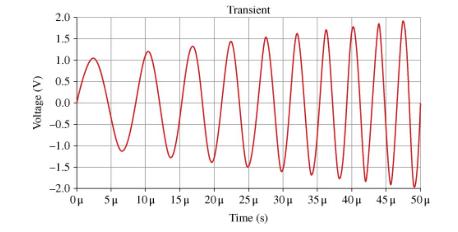
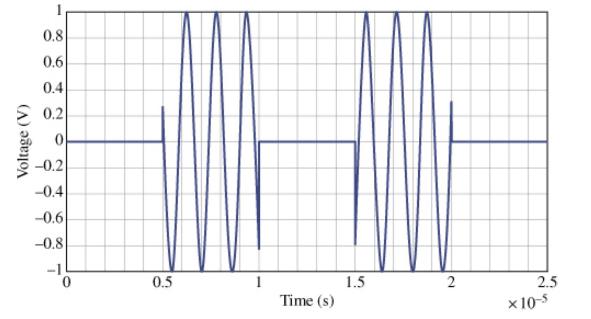
Compressed High-Intensity Radiated Pulse (CHIRP) are signals that change frequency and possibly also amplitude. They have uses in radar detection when applied at GHz frequencies. Another common application is with sonar. The navy uses it to detect objects including mines, seabed, outcroppings, and
Several of the time descriptors used in digital data communication systems are based on exponential signals. In this problem, we explore three of these descriptors.(a) The time constant of fall is defined as the time required for a pulse to fall from \(70.7 \%\) to \(26.0 \%\) of its maximum value.
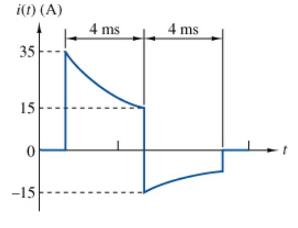
Ventricular fibrillation is a life-threatening loss of synchronous activity in the heart. To restore normal activity, a defibrillator delivers a brief but intense pulse of electrical current through the patient's chest. The pulse waveform is of interest because different waveforms may lead to
Timing digital circuits is vital to the operation of any digital device. Using an ideal OP AMP (running open-loop, i.e., without feedback) and appropriate resistors, design a way to convert a sinusoid into a square wave that varies from o \(\mathrm{V}\) to \(5 \mathrm{~V}\) with a period of \(2
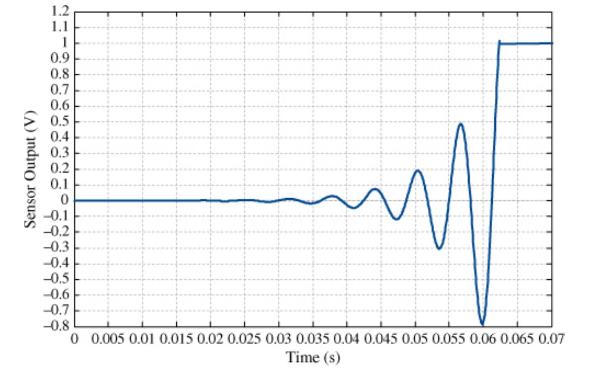
A test is being run in a wind tunnel when a sensor on the trailing edge of a wing produces the response shown in Figure P5 \(-4 \underline{6}\). When the sensor output reached \(1 \mathrm{~V}\), the test was terminated. You are asked to analyze the results. The oscillation could be tolerated if it
Most dc voltmeters measure the average value of the applied signal. A dc meter that measures the average value can be adapted to indicate the rms value of an ac signal. The input is passed through a rectifier circuit. The rectifier output is the absolute value of the input and is applied to a dc
Create a MATLAB function to analyze signals represented numerically. The function should have the following two inputs:(1) a vector containing equally spaced samples of the signal of interest and (2) the time step used to sample the signal contained in the vector. The function should display the
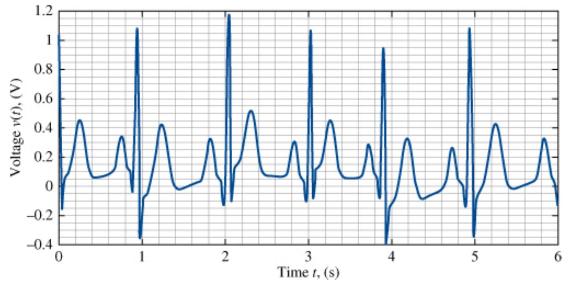
A simulated ECG signal obtained from a patient is shown in Figure P5-4.9. Identify any abnormal pulses. For the normal pulses, estimate the PR interval, the QRS interval, and the ST segment. Does the heart rate fall in the normal range of a healthy individual? Voltage v(t), (V) 2 3 Time r, (s) 1.2
Cars are becoming increasingly autonomous. One necessary accessory is a collision avoidance radar. Such a radar emits a high-frequency modulated pulse traveling at the speed of light (3 \(\times 10^{8} \mathrm{~m} / \mathrm{s}\) ). The pulse strikes an object and returns to the radar receiver in
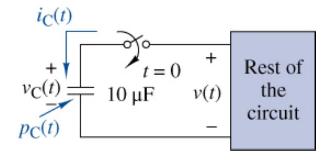
For \(t \geq 0\), the voltage across a \(1-\mu \mathrm{F}\) capacitor is \(v_{\mathrm{C}}(t)\) \(=10 u(t) \mathrm{V}\). Derive expressions for \(i_{\mathrm{C}}(t)\) and \(p_{\mathrm{C}}(t)\). Is the capacitor absorbing power, delivering power, or both?
The voltage across a 10000-pF capacitor is \(v_{\mathrm{C}}(t)=100\) \(\sin \left(2 \pi 10^{4} tight) \mathrm{V}\). Derive expressions for \(i_{\mathrm{C}}(t)\) and \(p_{\mathrm{C}}(t)\). Is the capacitor absorbing power, delivering power, or both?
The current through a \(0.2-\mu \mathrm{F}\) capacitor is a rectangular pulse with an amplitude of \(3 \mathrm{~mA}\) and a duration of 5 \(\mathrm{ms}\). Find the capacitor voltage at the end of the pulse when the capacitor voltage at the beginning of the pulse is \(-50 \mathrm{~V}\).
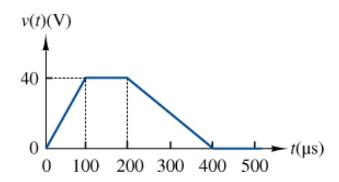
The voltage across a 0.001- \(\mu \mathrm{F}\) capacitor is shown in Figure P6-1. Prepare sketches of \(i_{\mathrm{C}}(t), p_{\mathrm{C}}(t)\), and \(w_{\mathrm{C}}(t)\). Is the capacitor absorbing power, delivering power, or both? v(1)(V) 40 0 100 200 300 400 500 -t(s)
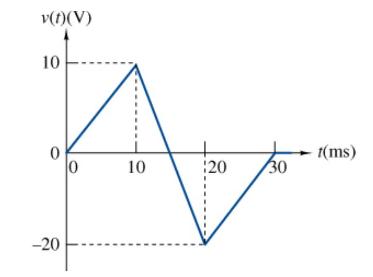
The voltage across a \(0.01-\mu \mathrm{F}\) capacitor is shown in Figure P6-5 . Prepare sketches of \(i_{\mathrm{C}}(t), p_{\mathrm{C}}(t)\), and \(w_{\mathrm{C}}(t)\). Is the capacitor absorbing power, delivering power, or both? v()(V) 10 -20 0 10 120 /30 t(ms)
For \(t \geq 0\), a current source delivers \(i_{\mathrm{S}}(t)=10\) \(\cos (4000 \pi t) \mathrm{mA}\) to two \(2.0-\mu \mathrm{F}\) capacitors connected in series. Using Multisim, plot \(v_{\mathrm{C}}(t)\) across each capacitor versus time when \(v_{\mathrm{C}}(0)=-5 \mathrm{~V}\) across the
A 100- \(\mu \mathrm{F}\) capacitor has no voltage across it at \(t=0\). A current flowing through the capacitor is given as \(i_{\mathrm{C}}(t)=2 u(t\) )\(-3 u(t-3)+u(t-6) \mathrm{mA}\). Find the voltage across the capacitor at \(t=4 \mathrm{~s}\). Repeat for \(t=6 \mathrm{~s}\).
For \(t \geq 0\), the current through a \(3300-\mu \mathrm{H}\) inductor is \(i_{\mathrm{L}}(t)\) \(=2 e^{-20,000 t} \mathrm{~A}\). Find \(v_{\mathrm{L}}(t), p_{\mathrm{L}}(t)\), and \(w_{\mathrm{L}}(t)\) for \(t \geq 0\). Is the inductor absorbing power, delivering power, or both?
For \(t \geq 0\), the voltage across a \(220-\mathrm{mH}\) inductor is \(v_{\mathrm{L}}(t)=25 e^{-200 t} \mathrm{~V}\). Plot \(i_{\mathrm{L}}(t)\) versus time when \(i_{\mathrm{L}}(\mathrm{o})=100\) \(\mathrm{mA}\).(a) Solve using Multisim. In Multisim, use the exponential voltage source, and set
Repeat Problem 6-9 when the voltage across a 20-mH inductor is \(v_{\mathrm{L}}(t)=100 e^{-2500 t} \mathrm{~V}\). Plot \(i_{\mathrm{L}}(t)\) versus time when \(i_{\mathrm{L}}(\mathrm{o})=+1 \mathrm{~A}\).Data From Exercise 6-9For \(t \geq 0\), the voltage across a \(220-\mathrm{mH}\) inductor is
A voltage \(v_{\mathrm{L}}(t)=5 \cos (1000 n t) \mathrm{V}\) appears across a \(50-\mathrm{mH}\) inductor, where \(n\) is a positive integer that controls the frequency of the input signal. The amplitude of the input signal is constant. Assume \(i_{\mathrm{L}}(\mathrm{O})=0 \mathrm{~A}\). Use
A 1- \(\mu \mathrm{F}\) capacitor with \(\mathrm{o} \mathrm{V}\) initial value is connected i to an exponential source with the following properties: initial value: \(\mathrm{OV}\), final value: \(1 \mathrm{~V}\), rising time constant: \(1 \mathrm{~ms}\). Using Multisim, plot the power stored in
The capacitor in Figure P6-13 carries an initial voltage \(v_{\mathrm{C}}(0)=-25 \mathrm{~V}\). At \(t=0\), the switch is closed, and thereafter the voltage across the capacitor is \(v_{\mathrm{C}}(t)=-100+75 e^{-2000 t} \mathrm{~V}\). Derive expressions for \(i_{\mathrm{C}}(t)\) and
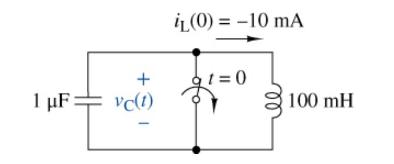
A1- \(\mu \mathrm{F}\) capacitor and a 100-mH inductor are connected in parallel with a closed switch as shown in Figure P6-14. The inductor has \(-10 \mathrm{~mA}\) flowing through it at \(t=0\). The switch opens at \(t=0\).(a) Find the initial voltage across the capacitor at \(t=0\).(b) Write an
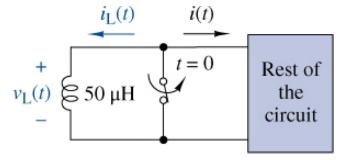
The inductor in Figure P6-15 carries an initial current of \(i_{\mathrm{L}}(0)=20 \mathrm{~mA}\). At \(t=0\), the switch opens, and thereafter the voltage across the inductor is \(v_{\mathrm{L}}(t)=-6 e^{-1000 t}\) \(\mathrm{mV}\). Derive expressions for \(i_{\mathrm{L}}(t)\) and
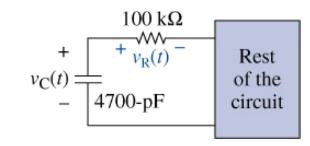
A 4700-pF capacitor is connected in series with a \(100-\mathrm{k} \Omega\) resistor as shown in Figure P6-16. The voltage across the capacitor is \(v_{\mathrm{C}}(t)=10 \cos (1000 t) \mathrm{V}\). What is the voltage across the resistor? + vc(t) 100 www VR(1) 4700-pF Rest of the circuit
For \(t>0\), the voltage across an energy storage element is \(v(t)=5 \times 10^{5}\left(1-e^{-100 t}ight) \mathrm{V}\) and the current through the element is \(i(t)=5 e^{-100 t} \mathrm{~mA}\). What are the element, the element value, and its initial condition?
For \(t>0\), the voltage across a circuit element is \(v(t)=5\) \(t e^{-100 t} \cos (1000 t) \mathrm{V}\) and the current through the element is \(i(\) \(t)=2.5 t e^{-100 t} \cos (1000 t) \mu \mathrm{A}\). What are the element, the element value, and its initial condition?
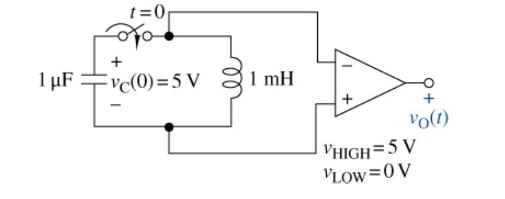
The capacitor in Figure P6-19. has a 5 -V charge across it. The comparator is one-sided with \(v_{\text {HIGH }}=5 \mathrm{~V}\) and \(v\) LOW \(=0 \mathrm{~V}\). At \(t=0\), the switch closes. Using Multisim plot \(v_{\mathrm{C}}(t\) ) and \(v_{\mathrm{O}}(t)\) on the same axes for \(t>0\). 1 F
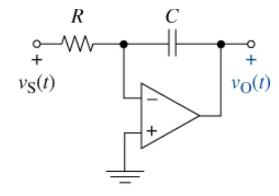
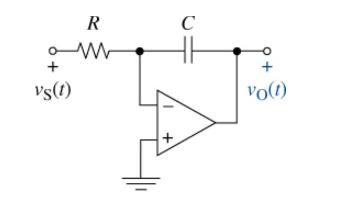
The OP AMP integrator in Figure P6-20 has \(R=22\) \(\mathrm{k} \Omega, \mathrm{C}=0.068 \mu \mathrm{F}\), and \(v_{\mathrm{O}}(0)=10 \mathrm{~V}\). The input is \(v_{\mathrm{S}}(t)=6 e\) \(-250 t u(t) \mathrm{V}\). The OP AMP has a \(V_{\mathrm{CC}}= \pm 15 \mathrm{~V}\).(a) Find
Build the OP AMP circuit of Figure P6-20 in Multisim. Let \(R=33 \mathrm{k} \Omega, C=0.056 \mu \mathrm{F}\), and \(v_{\mathrm{O}}(0)=15 \mathrm{~V}\). The input is \(10\left(1-e^{-500 t}ight) u(t) \mathrm{V}\). The OP AMP has a \(V_{\mathrm{CC}}= \pm 15\) \(V\). Plot the output
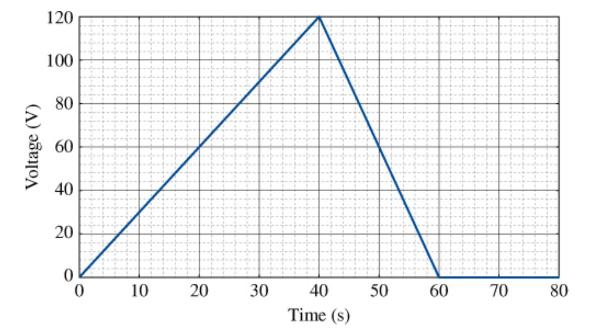
An OP AMP integrator with \(R=1 \mathrm{M} \Omega, C=1 \mu \mathrm{F}\), and \(v_{\mathrm{O}}\) (o) \(=0 \mathrm{~V}\) has the output waveform shown in Figure P6-22. Sketch \(v_{\mathrm{S}}(t)\) for \(t>0\). Voltage (V) 120 100 80 60 40 20 0 10 20 30 40 Time (s) 50 60 70 80
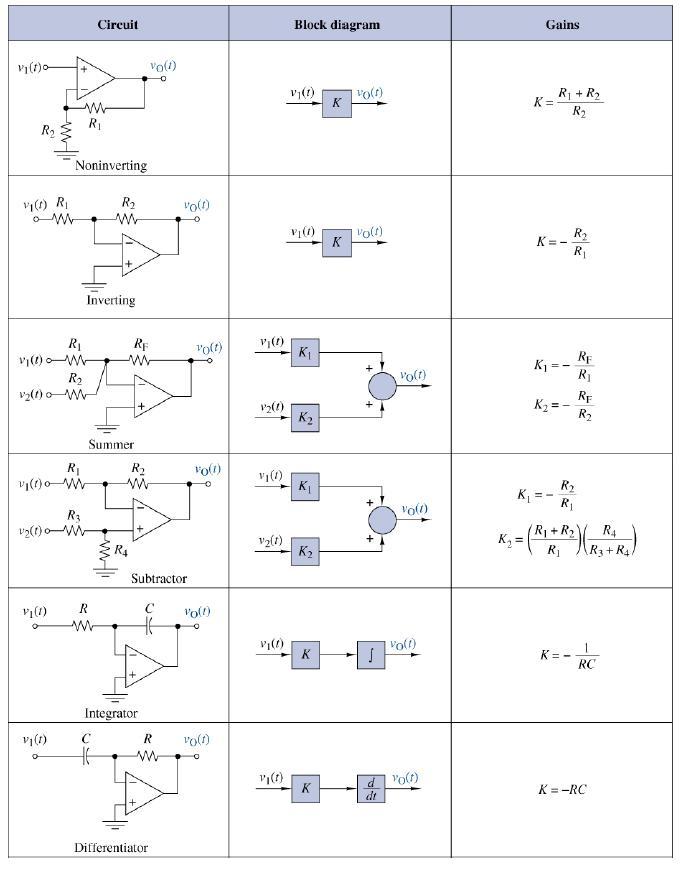
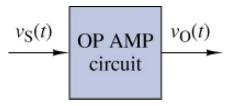
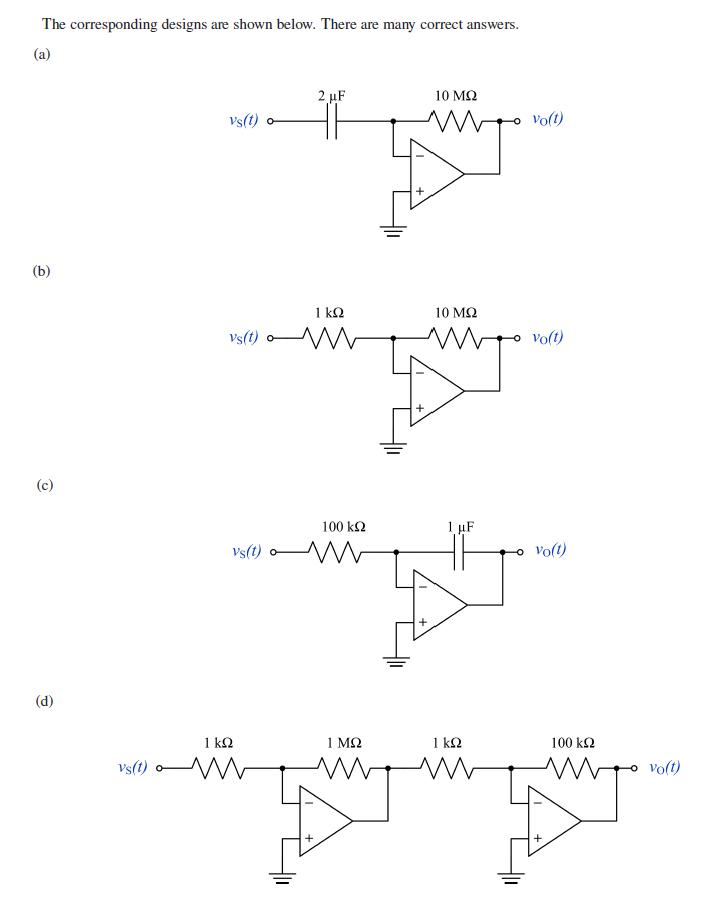
Design appropriate OP AMP circuits that will realize each of the functions in Problem 6-23. The OP AMPs available have a maximum \(K\) of 10,000 and a \(V_{\mathrm{CC}}= \pm 15 \mathrm{~V}\).Data From Problem 6-23An OP AMP circuit from Figure 6-18 is in the box shown in Figure P6-23. The input and
The OP AMP integrator in Figure P6-20 has \(R=22\) \(\mathrm{k} \Omega, C=0.001 \mu \mathrm{F}\), and \(v_{\mathrm{O}}(\mathrm{o})=\mathrm{o} \mathrm{V}\). The input is \(v_{\mathrm{S}}(t)=2 \sin\) \((\omega t) u(t) \mathrm{V}\). Derive an expression for \(v_{\mathrm{O}}(t)\) and find the smallest
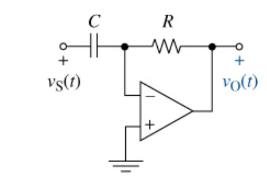
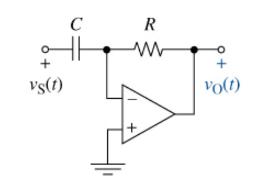
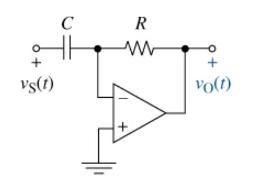
The OP AMP differentiator in Figure P6-26 with \(R=33\) \(\mathrm{k} \Omega\) and \(C=0.62 \mu \mathrm{F}\) has the input \(v_{\mathrm{S}}(t)=10\left(1-e^{-50 t}ight) u(t)\) \(\mathrm{V}\). Find \(v_{\mathrm{O}}(t)\) for \(t>0\). If the OP AMP has a \(V_{\mathrm{CC}}= \pm 15 \mathrm{~V}\), will
Redesign the circuit of Figure P6-26 using an \(R L\) circuit rather than the \(R C\) approach shown. vs(t) C R ww + vo(t)
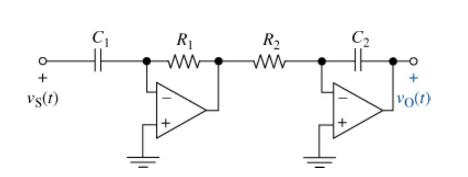
Consider the circuit of Figure P6-28 \(\cdot R_{1}=R_{2}=1\) \(\mathrm{M} \Omega, C_{1}=C_{2}=1 \mu \mathrm{F}\), and the capacitors have zero initial conditions, the output should, in theory, be the same as the input as long as the OP AMPs are not saturated.(a) Demonstrate that this is true.(b)
The input to the OP AMP differentiator in Figure \(\underline{\mathrm{P} 6-26}\) is \(v_{\mathrm{S}}(t)=5\left[\sin \left(2 \pi \times 10^{6} tight)ight] u(t) \mathrm{mV}\). Select \(R\) and \(C\) so that the output sinusoid has extreme values of at least \(\pm 11 \mathrm{~V}\) but does not
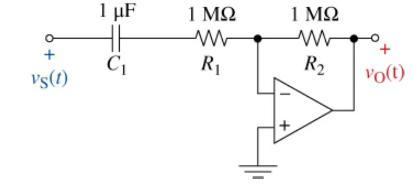
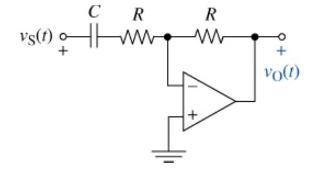
Find the input-output relationship of the RC OP AMP circuit in Figure P6-30 . vs(t)o CR R + Vo(1)
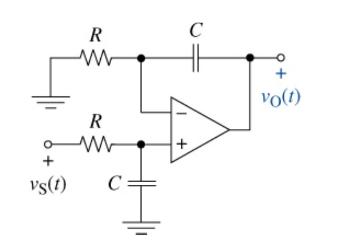
Show that the RC OP AMP circuit in Figure P6-31 is a noninverting integrator whose input-output relationship is\[v_{\mathrm{O}}(t)=\frac{1}{R \mathrm{C}} \int_{0}^{t} v_{\mathrm{S}}(x) d x+v_{\mathrm{O}}(0)\] + vs(t) R ww R C: + C + vo(t)
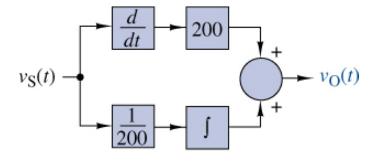
Design an RC OP AMP circuit to implement the block diagram in Figure P6-32 . vs(t) d dt 200 1 -200-0 -Vo(1)
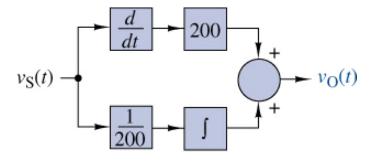
Repeat Problem 6-32 but use an RL OP AMP circuit.Data From Exercise 6-32Design an RC OP AMP circuit to implement the block diagram in Figure P6-32 . vs(t) d dt 1 200 200 S vo(1)
For the block diagram shown in Figure P6-34:(a) Find the differential equation it represents.(b) Design an RC OP AMP circuit to implement the block diagram using integrators.(c) Design an RC OP AMP circuit to implement the block diagram using differentiators.(d) Build the integrator solution and
In this problem you will design an oscillator. The equation for your oscillator is\[\frac{d^{2} v_{\mathrm{O}}(t)}{d t^{2}}+v_{\mathrm{O}}(t)=0 \mathrm{~V}\](a) Draw a block diagram to solve your equation ( \(v_{\mathrm{O}}(t)\) should be your output) using differentiators.(b) Draw a block diagram
For the differential equation:\[v_{\mathrm{O}}(t)=10 v_{\mathrm{S}}(t)+\frac{1}{10} \frac{d v_{\mathrm{S}}(t)}{d t}+\frac{1}{20} \frac{d^{2} v_{\mathrm{S}}(t)}{d t^{2}}\](a) Draw a block diagram using only integrators, summers, and amplifiers.(b) Design an OP AMP circuit to solve the block diagram
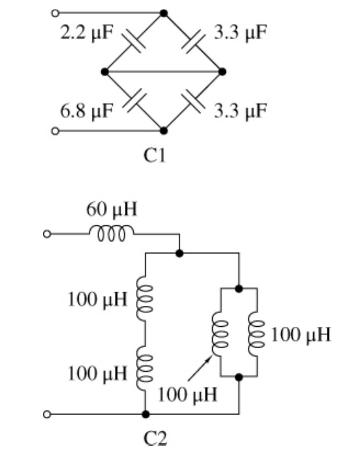
Find a single equivalent element for each circuit in Figure P6-37. 2.2 6.8 60 1000 100 100 Cl 000 rele 3.3 C2 3.3 2000 100 ell 100
Use the lookback method to find the equivalent capacitance of the circuit shown in Figure P6-3 (+1 v(t) C C C CEO
You need to have an equivalent inductance of \(235 \mathrm{mH}\) for a particular application. However, you only have \(100-\mathrm{mH}\) inductors available. How might you connect these to get within \(\pm 5 \%\) of the desired value?
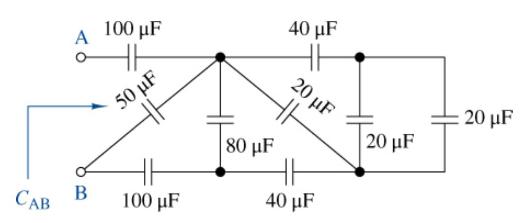
Find the equivalent capacitor in the circuit of Figure P6\(4 \underline{0}\). CAB 100 F A B 50 uF 100 F 80 F 40 F 20 uF 40 F 20 F 20 F
What is the equivalent capacitance and initial voltage of a series connection of a 33- \(\mu \mathrm{F}\) capacitor with \(100 \mathrm{~V}\) stored and a \(47-\mu \mathrm{F}\) capacitor with \(50 \mathrm{~V}\) stored?
Showing 4100 - 4200
of 5433
First
35
36
37
38
39
40
41
42
43
44
45
46
47
48
49
Last
Step by Step Answers

 Get 50% OFF
Claim Now
Get 50% OFF
Claim Now