New Semester
Started
Get
50% OFF
Study Help!
--h --m --s
Claim Now
Question Answers
Textbooks
Find textbooks, questions and answers
Oops, something went wrong!
Change your search query and then try again
S
Books
FREE
Study Help
Expert Questions
Accounting
General Management
Mathematics
Finance
Organizational Behaviour
Law
Physics
Operating System
Management Leadership
Sociology
Programming
Marketing
Database
Computer Network
Economics
Textbooks Solutions
Accounting
Managerial Accounting
Management Leadership
Cost Accounting
Statistics
Business Law
Corporate Finance
Finance
Economics
Auditing
Tutors
Online Tutors
Find a Tutor
Hire a Tutor
Become a Tutor
AI Tutor
AI Study Planner
NEW
Sell Books
Search
Search
Sign In
Register
study help
engineering
engineering mechanics statics
Engineering Mechanics Statics & Dynamics 15th Edition Russell C. Hibbeler - Solutions
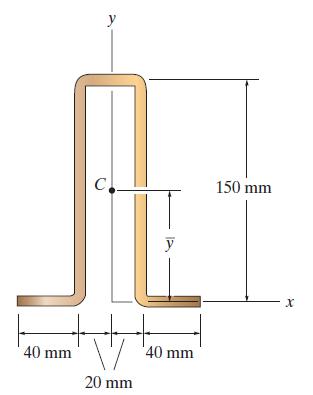
Determine the location y̅ of the centroid C of the “rollformed” member. Neglect the thickness of the material and any slight bends at the corners. 40 mm y C 20 mm 40 mm 150 mm X
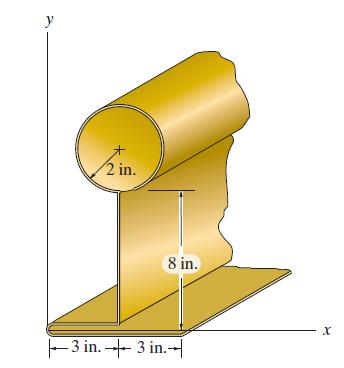
Determine the location (x̅, y̅) of the centroid of the sheet metal cross section. Neglect the thickness of the material and slight bends at the corners. y + 2 in. 8 in. -3 in.3 in. X
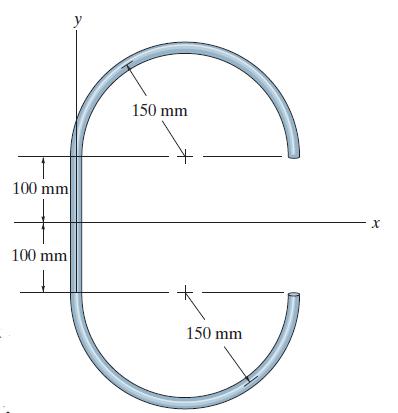
Determine the location (x̅, y̅) of the centroid of the rod. Neglect the rod’s thickness. 100 mm 100 mm y 150 mm 150 mm X
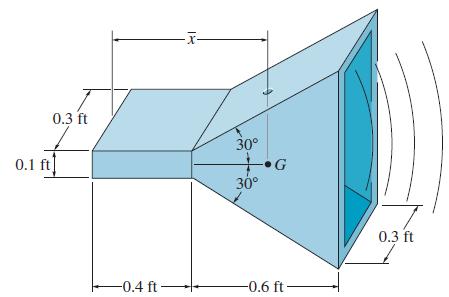
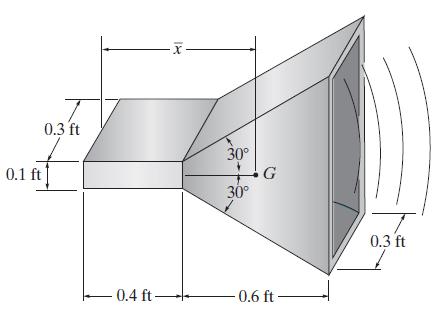
The rectangular horn antenna is used for receiving microwaves. Determine the location x̅ of its center of gravity G. The horn is made of plates having a constant thickness and density and is open at each end. 0.1 ft 0.3 ft -0.4 ft- -X- 30° +G 30° -0.6 ft- 0.3 ft
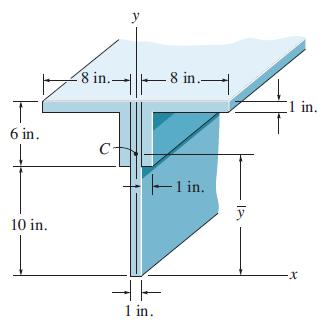
Locate the centroid y̅ of the cross-sectional area of the beam. T 6 in. 10 in. y 8 in. 8 in. HE 1 in. 1 in. y 1 in. -X
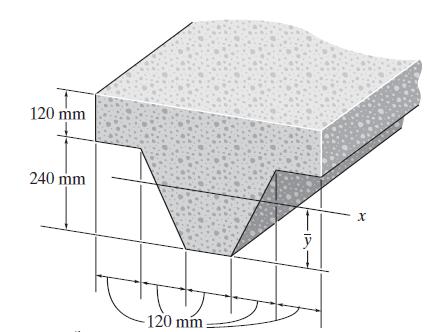
Locate the centroid y̅ for the beam’s cross-sectional area. 120 mm 240 mm -120 mm X
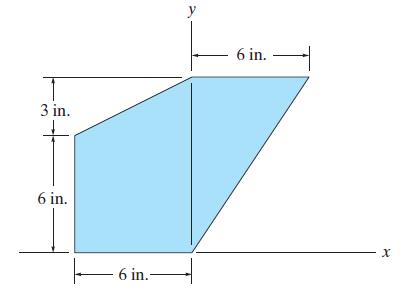
Locate the centroid (x̅, y̅) of the area. 3 in. 6 in. F 6 in.- y 6 in. X
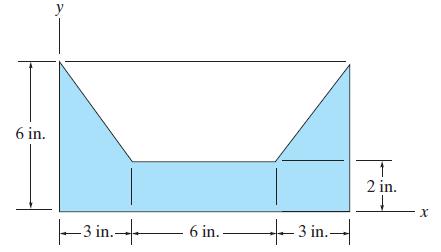
Determine the location (x̅, y̅) of the centroid of the area. 6 in. y 3 in. 6 in. 3 in. 1 2 in. ↓ X
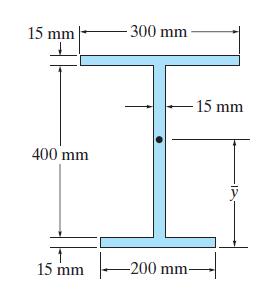
Determine the location y of the centroid for the beam’s cross-sectional area. 15 mm 400 mm 15 mm - 300 mm -200 mm- 15 mm
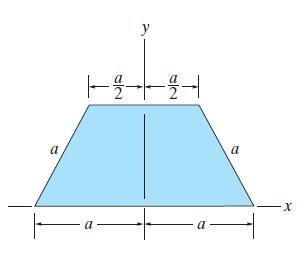
Determine the location y̅ of the centroid of the area. a y 마을과 을의 a a a IT X
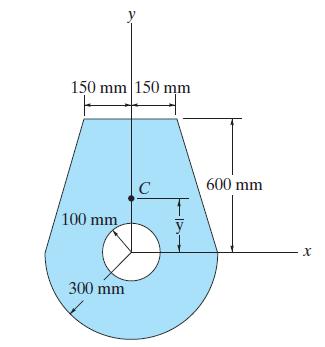
Determine the distance y̅ to the centroid of the area. 150 mm 150 mm 100 mm y 300 mm C y 600 mm
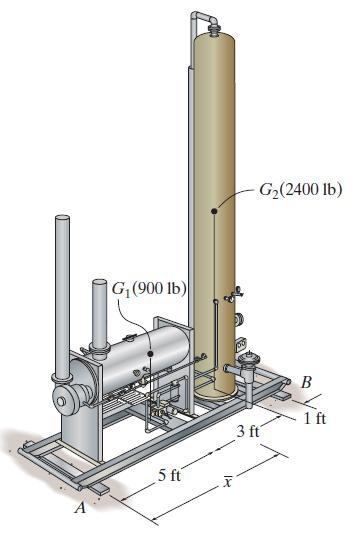
Determine the distance x̅ to the center of gravity of the gas dehydrator assembly. The weight and the center of gravity of each of the various components are indicated. What are the vertical reactions at A and B needed to support the assembly? G₁ (900 lb) 5 ft X yog G₂ (2400 lb) 3 ft B 1 ft
The rectangular horn antenna is used for receiving microwaves. Determine the location x̅ of its center of gravity G. The horn is made of plates having a constant thickness and density and is open at each end. 0.3 ft 0.1 ft X -0.4 ft- 30° 30° G 0.6 ft- 0.3 ft
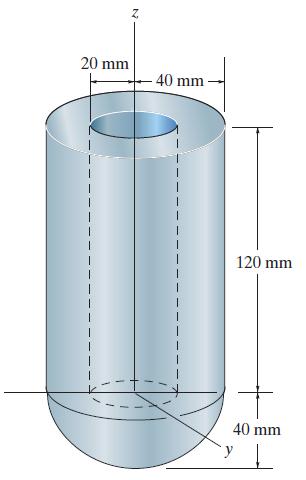
Determine the distance z to the center of mass of the casting that is formed from a hollow cylinder having a density of 8 Mg/m3 and a hemisphere having a density of 3 Mg/m3. 20 mm - 40 mm 120 mm 40 mm y
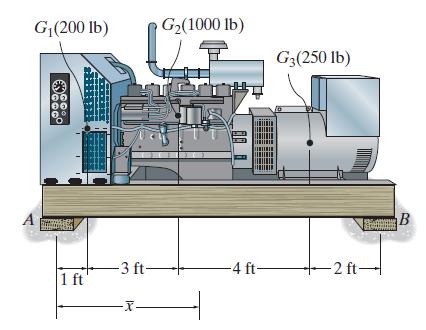
Determine the distance x̅ to the center of gravity of the generator assembly. The weight and the center of gravity of each of the various components are indicated. What are the vertical reactions at blocks A and B needed to support the assembly? G₁(200 lb) A 200 1 ft -3 ft- -X- G₂(1000 lb) -4
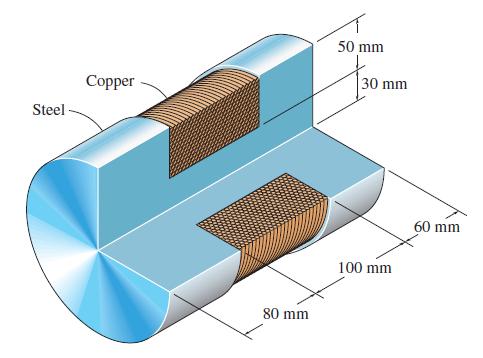
The starter for an electric motor is a full cylinder and has the cross-sectional areas shown. If copper wiring has a density of ρcu = 8.90 Mg/m³ and the steel frame has a density of ρst = 7.80 Mg/m³, estimate the total mass of the starter. Neglect the size of the copper wire. Steel Copper 80
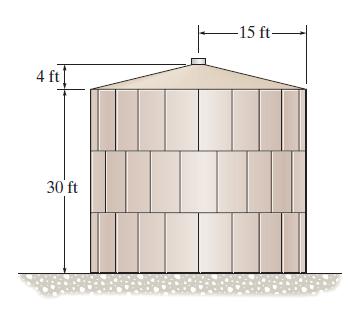
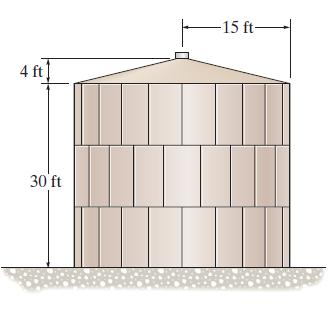
Determine the outside surface area of the storage tank. 4 ft 30 ft -15 ft
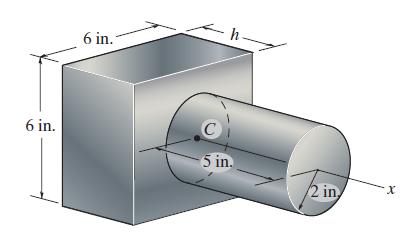
Determine the dimension h of the block so that the centroid C of the assembly lies at the base of the cylinder as shown. 6 in. 6 in. h- C 5 in. 2 in, X
Determine the volume of the storage tank. 4 ft 30 ft -15 ft-
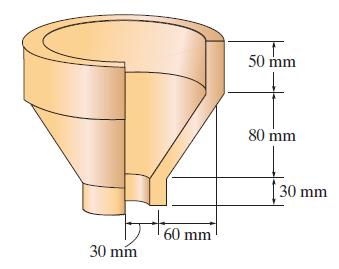
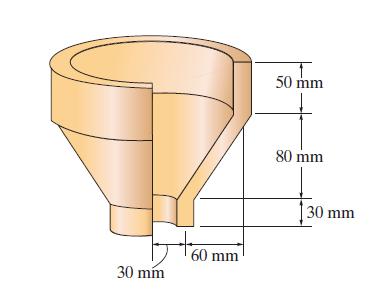
Determine the approximate amount of aluminum necessary to make the funnel. It consists of a full circular part having a thickness of 2 mm. Ho 30 mm 60 mm 50 mm 80 mm [30 mm
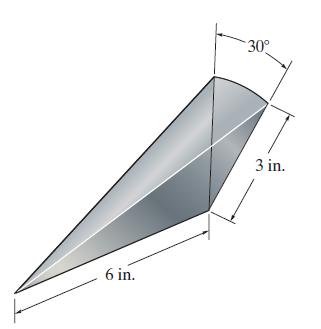
Determine the weight of the wedge which is formed by rotating a right triangle of base 6 in. and height 3 in. through an angle of 30°. The specific weight of the material is γ = 0.22 lb/in3. 6 in. 30° 3 in.
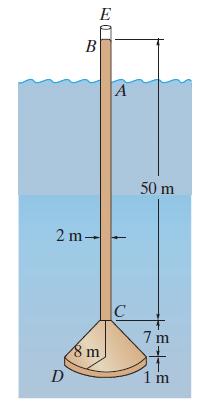
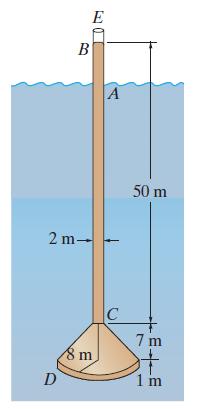
The structure is used for temporary storage of oil at sea for later loading into ships. When it is empty the water level is at A (sea level). As oil is poured into it, the water is displaced through exit ports at D. If the riser EC is filled with oil, i.e., to a depth of C, determine the height h
Determine the approximate outer surface area of the funnel. It consists of a full circular part of negligible thickness. 30 mm 60 mm 50 mm 80 mm 130 mm
If the structure in Prob. 9–129 is totally filled with oil, i.e., until it reaches a depth of 58 m below sea level, how high h will the oil level extend above sea level? E D B 2 m- 8 m A C 50 m 7m 1 m
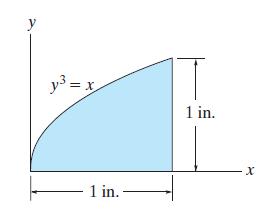
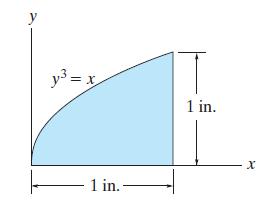
Determine the moment of inertia of the area about the x axis. y y³ = x 1 in. 1 in. X
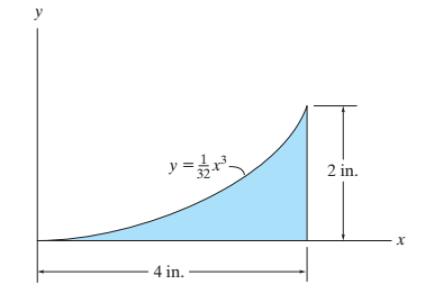
Determine the moment of inertia for the areaabout the x axis. y y=/r²_ 4 in. 2 in. X
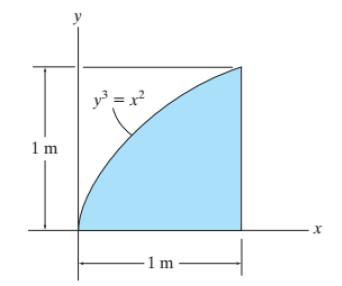
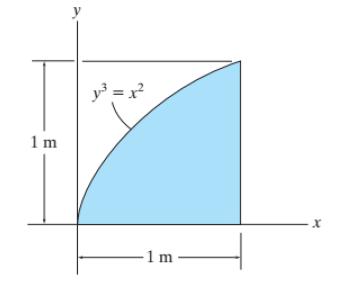
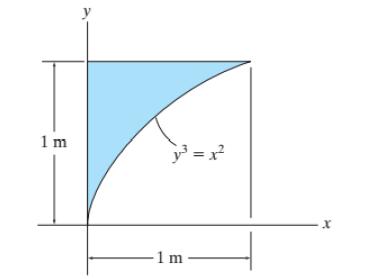
Determine the moment of inertia of the area aboutthe x axis. 1m y³ = x² -1 m
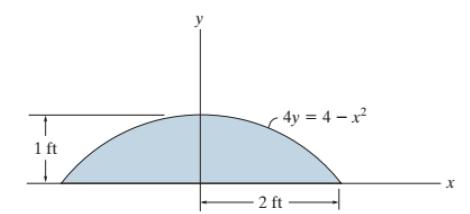
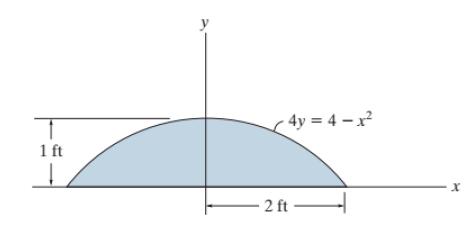
Determine the moment of inertia for the areaabout the x axis. 1 1 ft 4y=4-1² -2 ft X
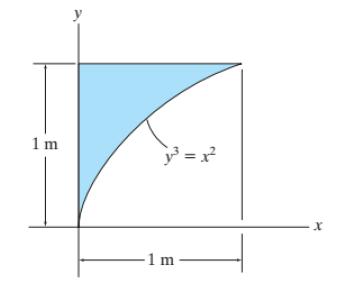
Determine the moment of inertia of the area aboutthe y axis. 1m y³ = x² 1 m X
Determine the moment of inertia of the area about the x axis. 1m y³ = x² -1 m X
Determine the moment of inertia of the area about the y axis. y y³ = x 1 in. 1 in. X
Determine the moment of inertia of the areaabout the y axis. 1 ft ↓ - 4y = 4-x² 2 ft
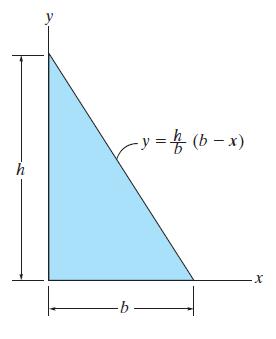
Determine the moment of inertia of the triangular area about the x axis. - y = f(b-x) -b. -X
Determine the moment of inertia of the triangular area about the y axis. h ✓y = (b − x) -b- -X
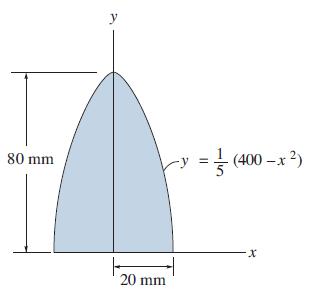
Determine the moment of inertia of the area about the x axis. 80 mm 20 mm = 1/3 (4 -(400 -x²) X
Determine the moment of inertia of the area aboutthe y axis. 1 m y³ = x² -1 m
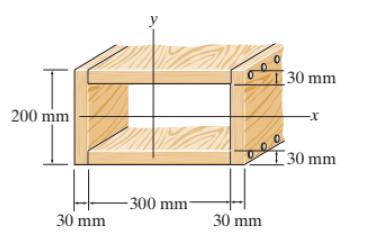
Determine the moment of inertia of the cross-sectional area of the beam about the centroidal x and y axes. 200 mm 30 mm -300 mm- 30 mm 0 [30 mm T30 mm
Determine the moment of inertia of the area about the y axis. 80 mm y 20 mm = (400-x²) -X
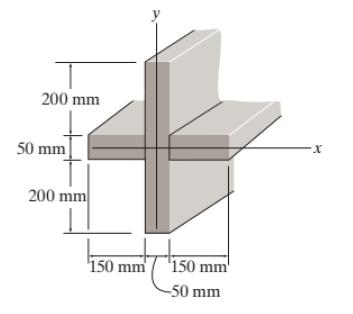
Determine the moment of inertia of the cross-sectional area of the beam about the centroidal x and y axes. 200 mm 50 mm 200 mm y 150 mm 150 mm -50 mm X
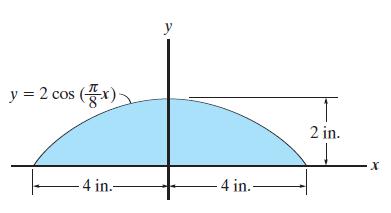
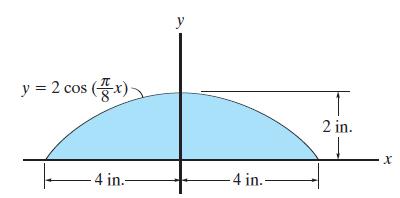
Determine the moment of inertia of the area about the x axis. y = 2 cos(x)- -4 in.- y 4 in. 2 in. X
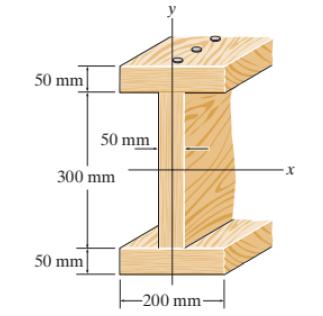
Determine the moment of inertia of the cross-sectional area of the channel with respect to the y axis. 50 mm 50 mm 300 mm 50 mm -200 mm- x
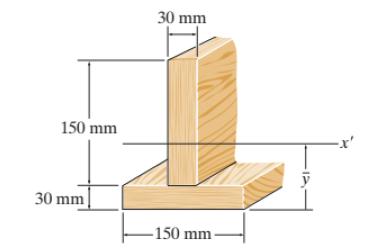
Determine the moment of inertia of the cross-sectional area of the T-beam with respect to the x' axispassing through the centroid of the cross section. 150 mm 30 mm 30 mm -150 mm-
Determine the moment of inertia of the area about the y axis. y = 2 cos(x)- 4 in.- y -4 in. 2 in. X
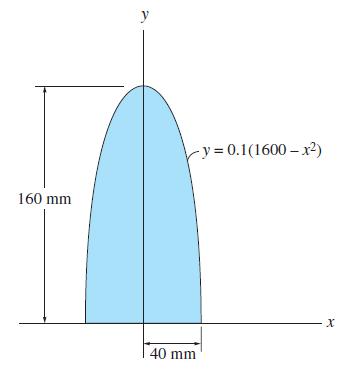
Determine the radius of gyration ky of the parabolic area. 160 mm y -y=0.1(1600-x²) 40 mm X
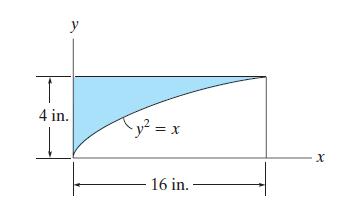
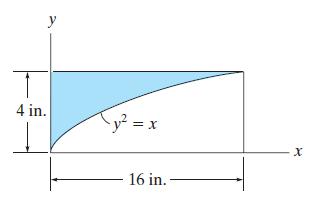
Determine the moment of inertia for the area about the x axis. y T 4 in. y² = x 16 in. X
Determine the moment of inertia for the area about the y axis. y 4 in. y² = = X 16 in. X
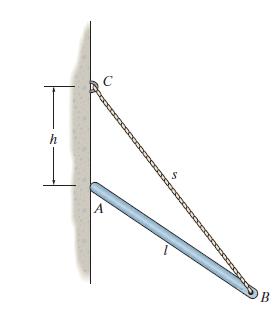
The uniform rod has a length ∫ and weight W. It is supported at one end A by a smooth wall and the other end by a cord of length s which is attached to the wall as shown. Determine the placement h for equilibrium. h C B
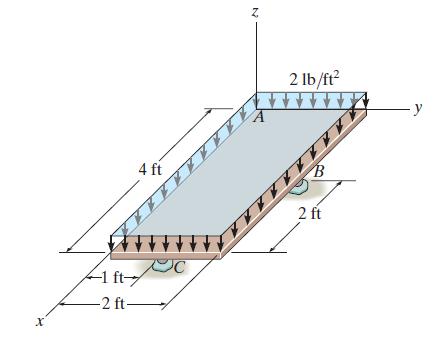
Determine the reaction at the ball supports B and C and the components of the reaction at the ball-and-socket A (notshown) for the uniformly loaded plate. X 4 ft MI▬▬▬▬ 1 ft- -2 ft- Z 2 lb/ft² B 2 ft y
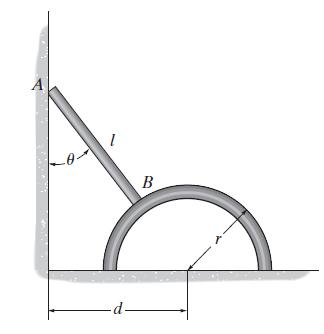
The smooth uniform rod has a mass m and is placed on the semicircular arch and against the wall. Show that for equilibrium the angle θ must satisfy sin 0 Y (V1 + 3 cos ²0) (d - I sin 0).
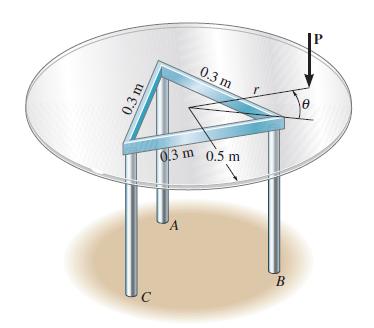
The 50-kg glass tabletop rests on the centrally located equilateral triangular frame which is supported by three legs. Determine the smallest vertical force P that, when applied to the glass, would cause it to lift or topple off the frame. Specify the force location r and the smallest angle θ, and
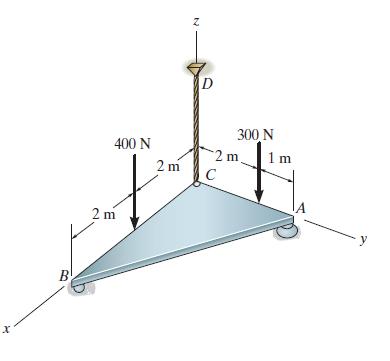
Determine the components of reaction acting at the balland- socket A, roller B, and cord CD. X B 400 N 2 m 2 m Z D 300 N 1m 2 m C y
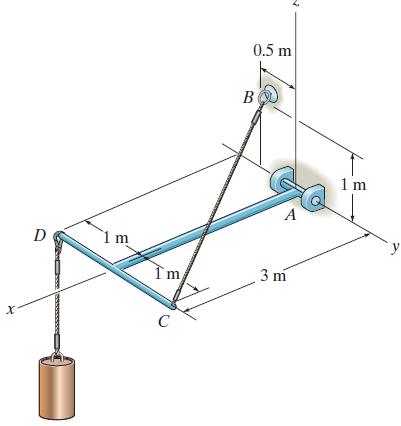
The member is supported by a pin at A and cable BC. Determine the components of reaction at these supports if the cylinder has a mass of 40 kg. X D 1 m I'm C 0.5 m B A 3 m 1m
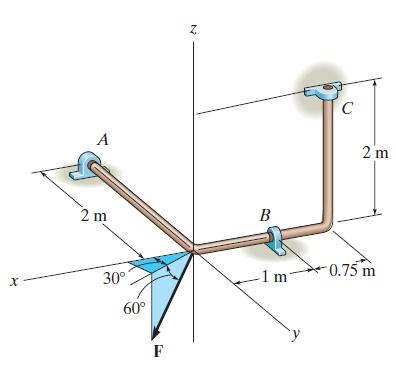
The bent rod is supported at A, B, and C by smooth journal bearings. Determine the magnitude of F which will cause the positive x component of reaction at the bearing C to be Cx = 50 N. The bearings are in proper alignment and exert only force reactions on the rod. Xx A 2 m 30° 60° F Z B -1
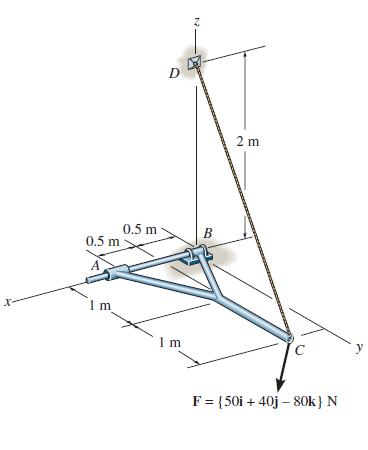
The forked rod is supported by a collar at A, a thrust bearing at B, and a cable CD. Determine the tension within cable CD and the x, y, z components of reaction at supports A and B due to the loading shown. The supports at A and B are in proper alignment and exert only force reactions on the rod.
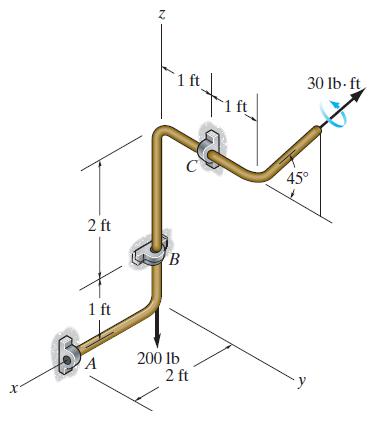
The bent rod is supported at A, B, and C by journal bearings. Determine the components of reaction at bearings if the rod is subjected to the 200-lb vertical force and the 30 lb-ft couple moment. The bearings are in proper alignment and exert only force reactions on the rod. X 2 ft 1 ft A N 1
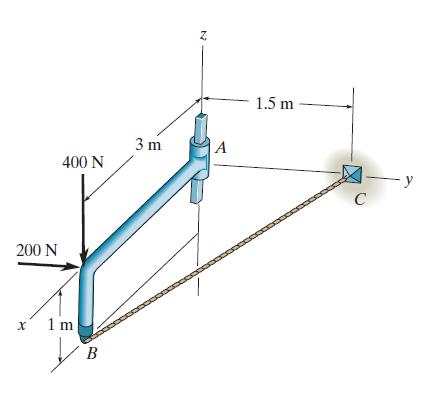
Member AB is supported by a cable BC and at A by a square rod which fits loosely through the square hole in the collar fixed to the member as shown. Determine the components of reaction at A and the tension in the cable needed to hold the rod in equilibrium. 200 N X 400 N 1 m B 3 m Z A 1.5 m C y
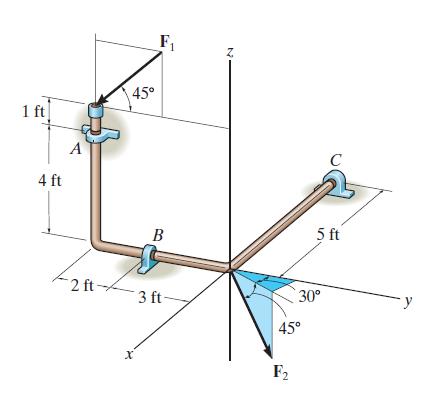
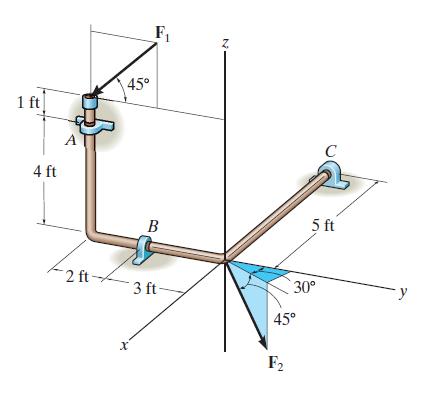
The bent rod is supported at A, B, and C by smooth journal bearings. Compute the x, y, z components of reaction at the bearings if the rod is subjected to forces F1 = 300 lb and F2 = 250 lb. F1 lies in the y-z plane. The bearings are in proper alignment and exert only force reactions on the rod. 1
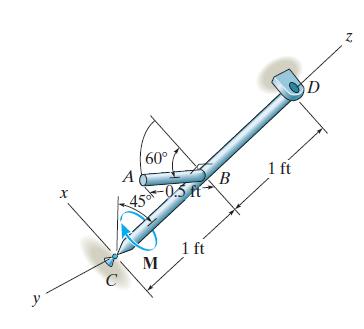
The rod has a weight of 6 lb/ft. If it is supported by a balland- socket joint at C and a journal bearing at D, determine the x, y, z components of reaction at these supports and the moment M that must be applied along the axis of the rod to hold it in the position shown. y X C 60° 45-0.5 A M 1
The bent rod is supported at A, B, and C by smooth journal bearings. Determine the magnitude of F₂ which will cause the reaction Cy at the bearing C to be equal to zero. The bearings are in proper alignment and exert only force reactions on the rod. Set F₁ = 300 lb. 1 ft 4 ft A 2
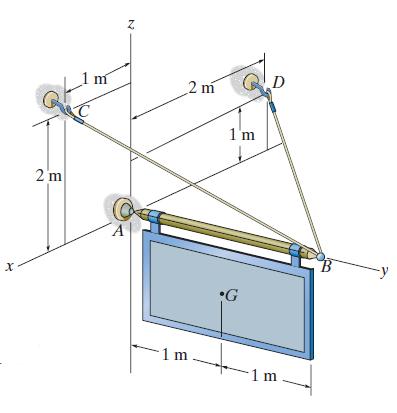
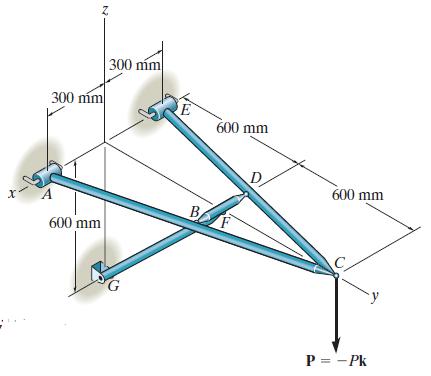
The sign has a mass of 100 kg with center of mass at G. Determine the x, y, z components of reaction at the ball-andsocket joint A and the tension in wires BC and BD. 1m GC 2 m A 2 m 1 m QD 1'm •G 1 m
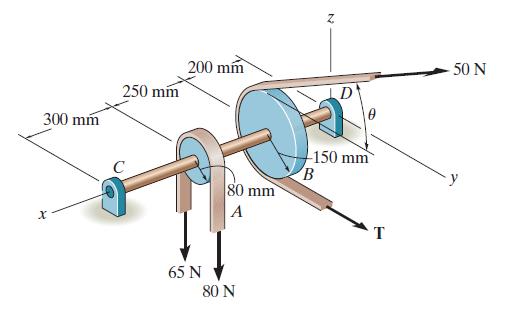
Both pulleys are fixed to the shaft and as the shaft turns with constant angular velocity, the power of pulley A is transmitted to pulley B. Determine the horizontal tension T in the belt on pulley B and the x, y, z components of reaction at the journal bearing C and thrust bearing D if θ = 0°.
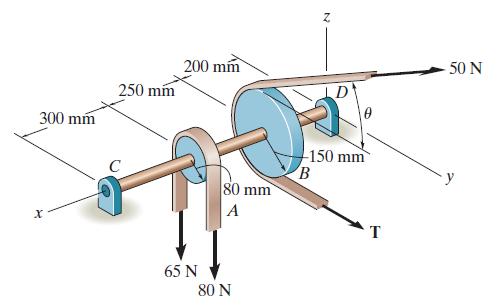
Both pulleys are fixed to the shaft and as the shaft turns with constant angular velocity, the power of pulley A is transmitted to pulley B. Determine the horizontal tension T in the belt on pulley B and the x, y, z components of reaction at the journal bearing C and thrust bearing D if θ = 45°.
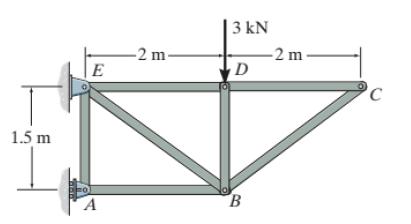
Identify the zero-force members in the truss. 1.5 m E A -2 m. 3 kN D B -2m- 'C с
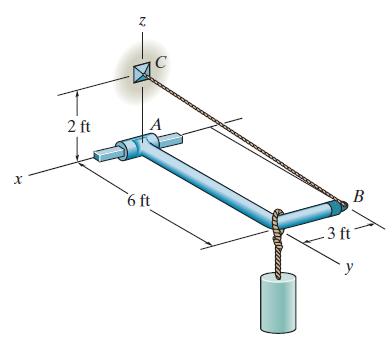
Member AB is supported by a cable BC and at A by a square rod which fits loosely through the square hole at the end joint of the member as shown. Determine the components of reaction at A and the tension in the cable needed to hold the 800-lb cylinder in equilibrium. x 2 ft Z 6 ft C -3 ft B
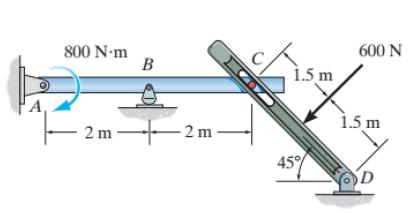
Determine the components of reaction at A and B. A, 800 N-m B · 2 m ——2 m— 1.5 m 45% 600 N 1.5 m D
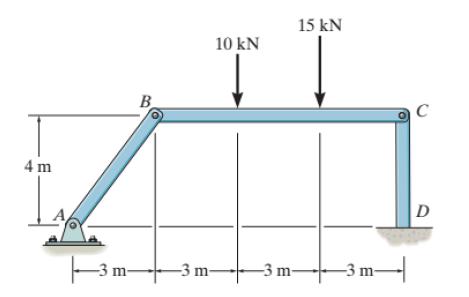
Determine the reactions at D. 4 m -3 m- B -3 m- 10 kN 15 kN -3 m- -3m-| C D
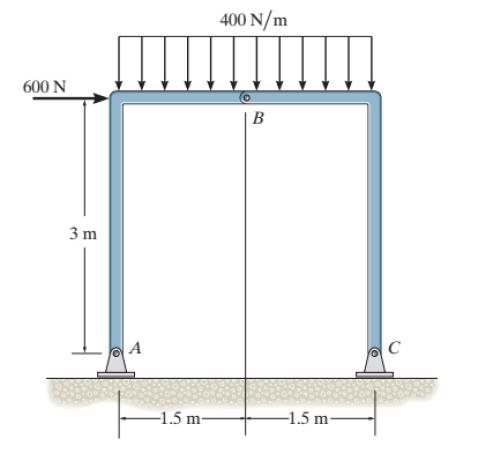
Determine the components of reaction at A and C. 600 N 3 m NA -1.5 m- 400 N/m B -1.5 m- C
Determine the components of reaction at C. 250 N B C D -1.5 m-1.5 m- -1.5 m-1.5 m- 2 m 2 m E
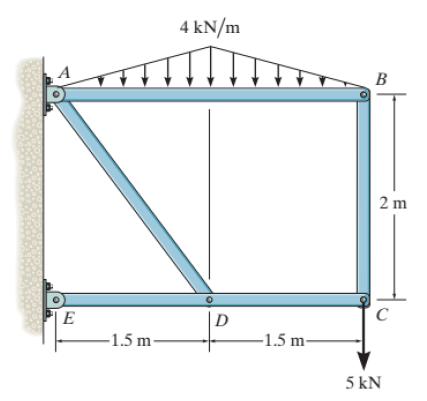
Determine the components of reaction at E. A E -1.5 m 4 kN/m D -1.5 m- B 2m C 5 kN
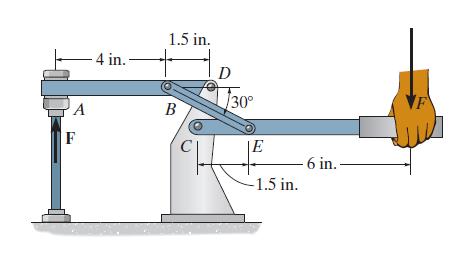
A force of 4 lb is applied to the handle of the toggle clamp. Determine the normal force F that the bolt exerts on the clamp. -4 in.- A F 1.5 in. B 다 D 30° E -1.5 in. 6 in.
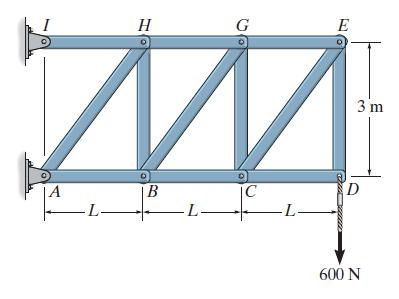
The truss supports the vertical load of 600 N. Determine the force in members BC, BG, and HG as the dimension L varies. Plot the results of F (ordinate with tension as positive) versus L (abscissa) for 0 ≤ L ≤ 3m. I H W B | A -L- G -L- C -L- E 3 m D 600 N
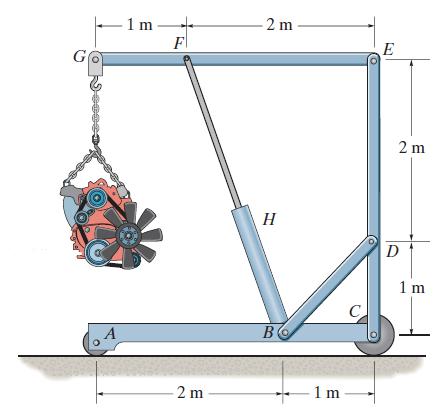
The hoist supports the 125-kg engine.Determine the force this load creates along member DB and along member FB, which contains the hydraulic cylinder H. G A 1 m. F 2 m 2 m H B 1 m C E 2 m D 1 m
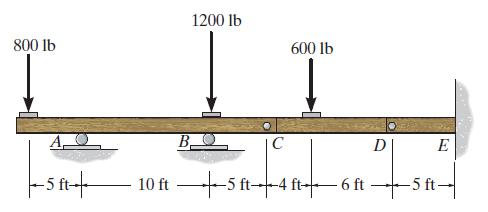
The compound beam is fixed at E and supported by rollers at A and B. Determine the reactions at these supports. There are pins at C and D. 800 lb --5ft-+ 1200 lb B. C 600 lb D 10 ft-5 ft 4 ft 6 ft- E -5 ft-
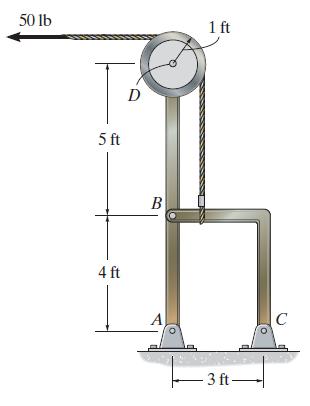
Determine the horizontal and vertical components of force that the pins exert on member ABD. 50 lb 5 ft 4 ft D B A 1 ft -3 ft- C
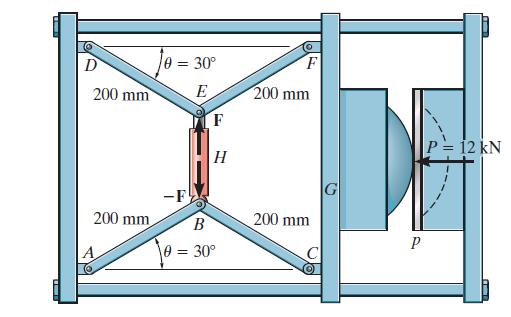
The machine shown is used for forming metal plates. It consists of two toggles ABC and DEF, which are operated by the hydraulic cylinder H.The toggles push the movable bar G forward, pressing the plate p into the cavity. If the force which the plate exerts on the head is P = 12 kN, determine the
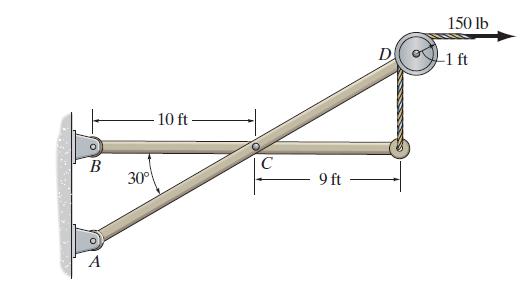
Determine the horizontal and vertical components of force acting on pins A and C. O B A 30° 10 ft- C 9 ft D 150 lb -1 ft
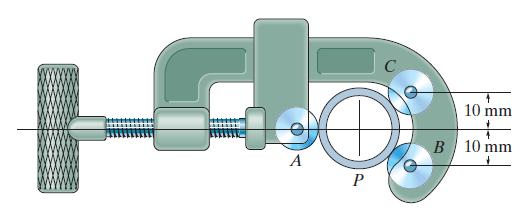
The pipe cutter is clamped around the pipe P. If the wheel at A exerts a normal force of FA = 80 N on the pipe, determine the normal forces of wheels B and C on the pipe. Also find the pin reaction on the wheel at C. The three wheels each have a radius of 7 mm and the pipe has an outer radius of 10
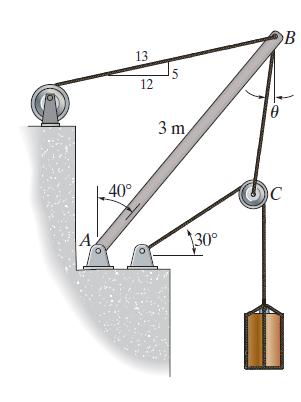
The gin-pole derrick is used to lift the 300-kg stone with constant velocity. If the derrick and the block and tackle are in the position shown, determine the horizontal and vertical components of force at the pin support A and the orientation θ and tension in the guy cable BC.
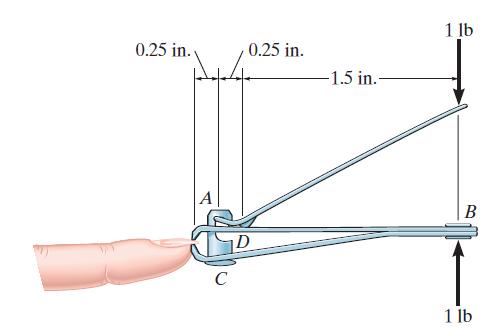
The nail cutter consists of the handle and the two cutting blades. Assuming the blades are pin connected at B and the surface at D is smooth, determine the normal force on the fingernail when a force of 1-lb is applied to the handles as shown. The pin AC slides through a smooth hole at A and is
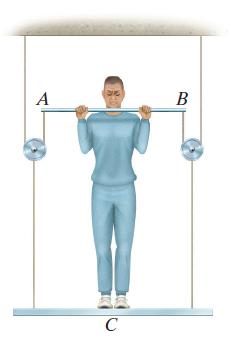
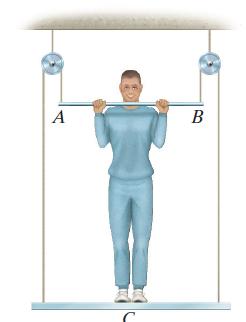
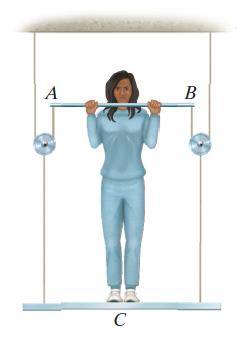
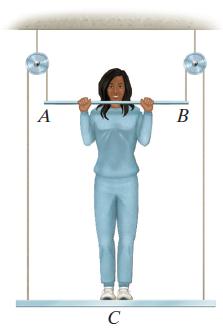
A man having a weight of 175 lb attempts to hold himself using one of the two methods shown. Determine the total force he must exert on bar AB in each case and the normal reaction he exerts on the platform at C. Neglect the weight of the platform. Do the results seem realistic?(a)(b) A C B
A woman having a weight of 175 lb attempts to hold herself using one of the two methods shown. Determine the total force she must exert on bar AB in each case and the normal reaction she exerts on the platform at C. The platform has a weight of 30 lb. Do the results seem realistic?(a)(b) A C B
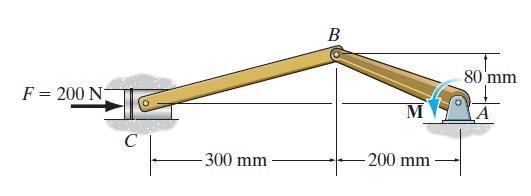
Determine the couple moment M needed to create a force of F = 200 N on the slider block at C. F= 200 N 300 mm B -200 mm 80 mm
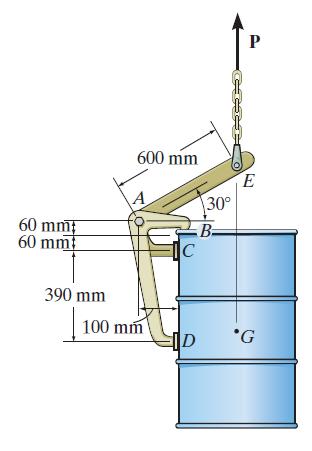
If the 300-kg drum has a center of mass at point G, determine the horizontal and vertical components of force acting at pin A and the reactions on the smooth pads C and D. The grip at B on member DAB resists both horizontal and vertical components of force at the rim of the drum. 60 mm 60 mm 390
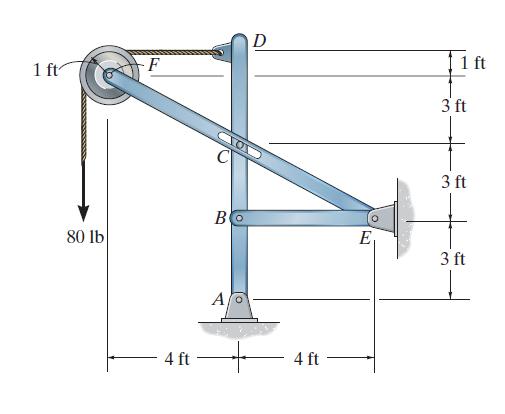
Determine the horizontal and vertical components of force that the pins exert on member ABCD. The pin at C is attached to member ABCD and passes through the smooth slot in member ECF. 1 ft 80 lb F 4 ft BO A D 4 ft E₁ 1 ft 3 ft 3 ft 3 ft
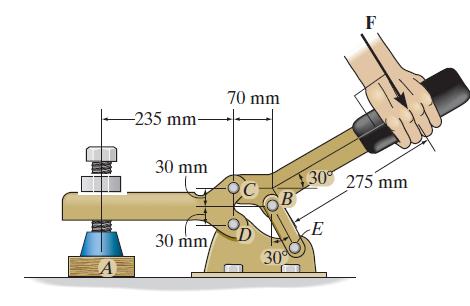
If a force F = 350 N of is applied to the handle of the toggle clamp, determine the resulting clamping force at A. A -235 mm- 30 mm 30 mm, 70 mm -OC- B 30 F 30 275 mm E
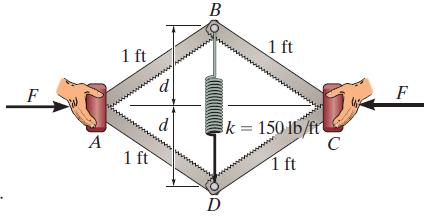
If d = 0.75 ft and the spring has an unstretched length of 1 ft, determine the force F required for equilibrium. F A 1 ft 1 ft d B D 1 ft k= 150 lb/ft 1 ft C F
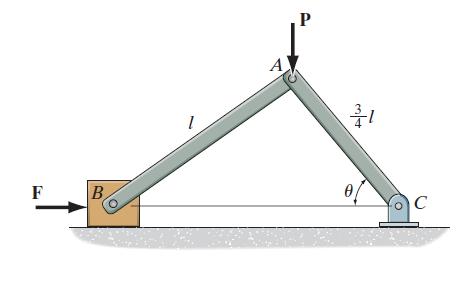
If the vertical force P is applied to the two-bar mechanism, determine the equilibrium force F on the block. Plot this magnitude as a function of u, where 0° ≤ θ ≤ 90°. F B A P 1 / C
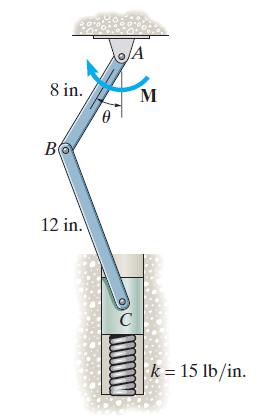
The piston C moves vertically between the two smooth walls. If the spring has a stiffness of k = 15 lb/in., and is unstretched when θ = 0°, determine the couple M that must be applied to AB to hold the mechanism in equilibrium when θ = 30°. 8 in. B Во 12 in. 0 A M k = 15 lb/in.
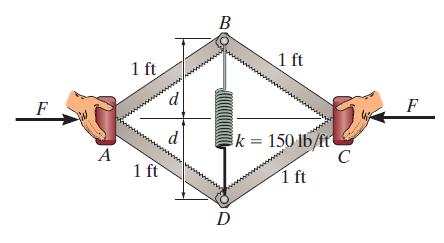
If a force of F = 50 lb is applied to the pads at A and C, determine the smallest dimension d required for equilibrium if the spring has an unstretched length of 1 ft. F A 1 ft 1 ft d B D 1 ft k= 150 lb/ft 1 ft C F
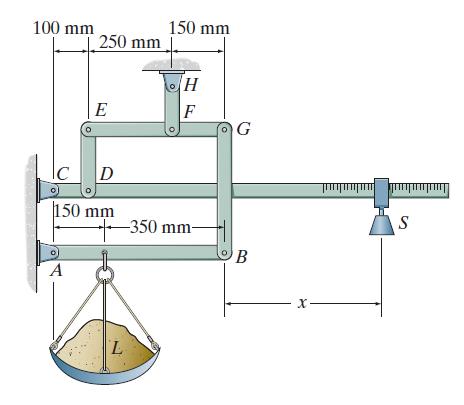
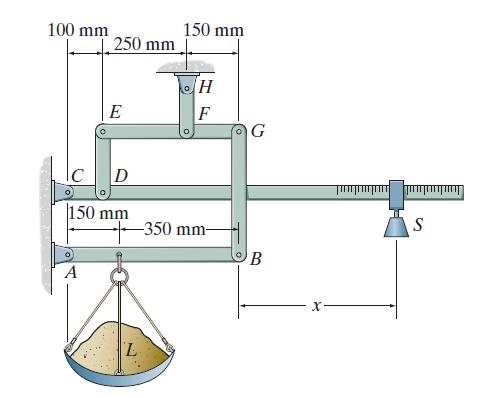
The platform scale consists of a combination of third and first class levers so that the load on one lever becomes the effort that moves the next lever. Through this arrangement, a small weight can balance a massive object. If x = 450 mm, and the mass of the counterweight S is 2 kg, determine the
The platform scale consists of a combination of third and first class levers so that the load on one lever becomes the effort that moves the next lever. Through this arrangement, a small weight can balance a heavy object. If x= 450 mm, determine the required mass of the counterweight S required to
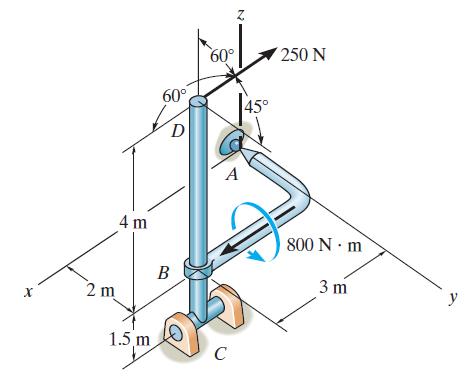
Member AB is supported by a ball-and-socket at A and smooth collar at B. Member CD is supported by a pin at C. Determine the x, y, z. components of reaction at A and C. X 2 m 4 m 1.5 m 60° D B 60° A C 45° 250 N 800 N·m 3 m
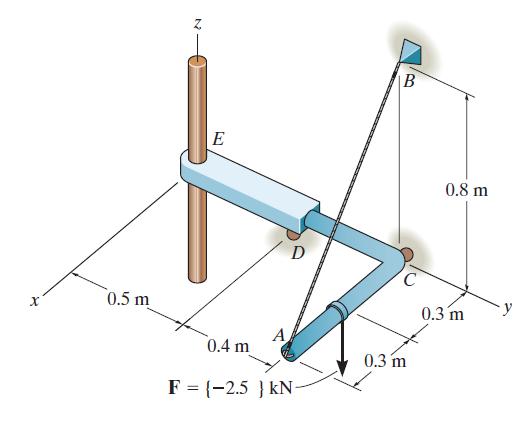
Member AD is supported by cable AB and a roller at C, and fits through a smooth circular hole at D. Member ED is supported by a roller at D and a pole that fits in a smooth snug circular hole at E. Determine the x, y, z. components of reaction at E and the tension in cable AB. X 0.5 m E A D 0.4 m F
The four-member “A” frame is supported at A and E by smooth collars and at G by a pin. All the other joints areball-and-sockets. If the pin at G will fail when the resultant force there is 800 N, determine the largest vertical force P that can be supported by the frame. Also, what are the x, y,
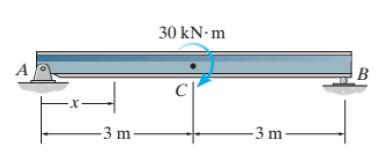
Determine the shear and moment as a function of x,where 0 ≤ x < 3m and 3m < x ≤ 6m, and then draw theshear and moment diagrams. A -3 m- 30 kN-m C -3 m- B
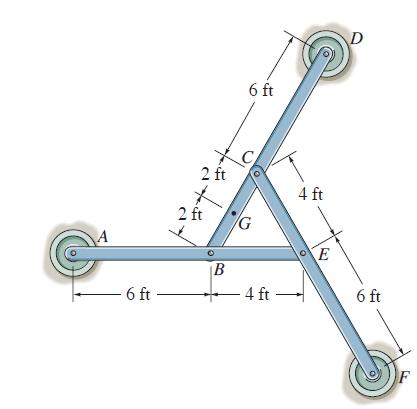
The three pin-connected members shown in the top view support a downward force of 60 lb at G. If only vertical forces are supported at the connections B,C,E and at the pad supports A, D, F, determine the reactions at each pad. A - 6 ft - 2 ft 2 ft B 6 ft C G - 4 ft 4 ft 0 E 6 ft F
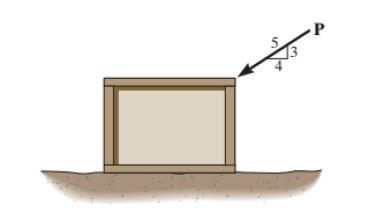
Determine the friction developed between the 50-kgcrate and the ground if(a) P = 200 N, and (b) P = 400 N.The coefficients of static and kinetic friction between thecrate and the ground are µs = 0.3 and μk = 0.2.
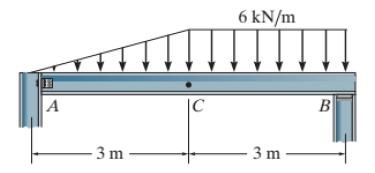
Determine the normal force, shear force, andmoment at point C. Assume A is pinned and B is a roller. A -3 m C 6 kN/m 3m B
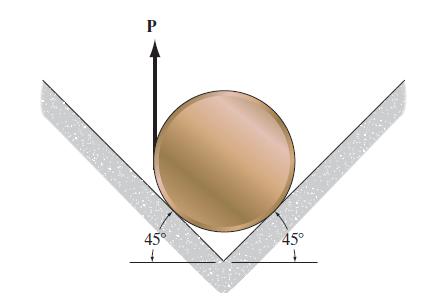
The 100-lb cylinder rests between the two inclined planes. When P = 15 lb, the cylinder is on the verge of impending motion. Determine the coefficient of static friction between the surfaces of contact and the cylinder. P 45° 45°
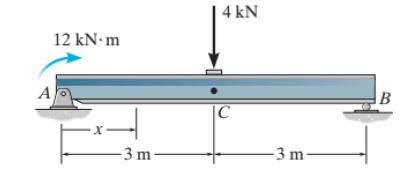
Determine the shear and moment as a function of .x,where 0 ≤ x < 3m and 3m < x ≤ 6m, and then draw theshear and moment diagrams. A 12 kN.m -3 m- 4 kN C 3 m- B
Showing 1800 - 1900
of 2426
First
11
12
13
14
15
16
17
18
19
20
21
22
23
24
25
Step by Step Answers

 Get 50% OFF
Claim Now
Get 50% OFF
Claim Now