New Semester
Started
Get
50% OFF
Study Help!
--h --m --s
Claim Now
Question Answers
Textbooks
Find textbooks, questions and answers
Oops, something went wrong!
Change your search query and then try again
S
Books
FREE
Study Help
Expert Questions
Accounting
General Management
Mathematics
Finance
Organizational Behaviour
Law
Physics
Operating System
Management Leadership
Sociology
Programming
Marketing
Database
Computer Network
Economics
Textbooks Solutions
Accounting
Managerial Accounting
Management Leadership
Cost Accounting
Statistics
Business Law
Corporate Finance
Finance
Economics
Auditing
Tutors
Online Tutors
Find a Tutor
Hire a Tutor
Become a Tutor
AI Tutor
AI Study Planner
NEW
Sell Books
Search
Search
Sign In
Register
study help
engineering
engineering mechanics statics
Engineering Mechanics Statics & Dynamics 15th Edition Russell C. Hibbeler - Solutions
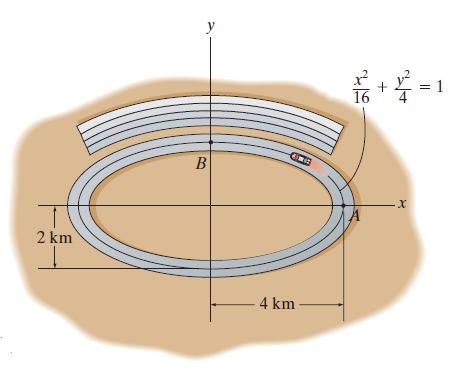
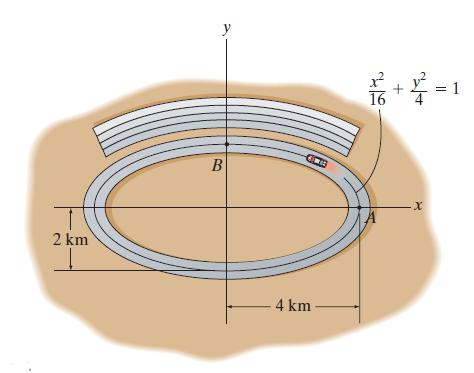
A racing car travels with a constant speed of 240 km/h around the elliptical race track. Determine the acceleration experienced by the driver at A. 2 km y B 4 km ; + 2 = 16 X
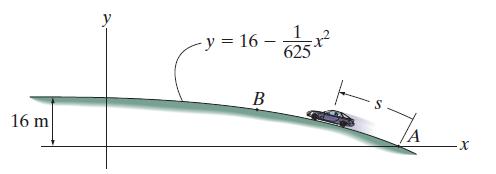
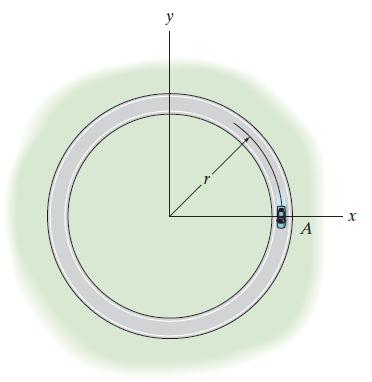
If the car passes point A with a speed of 20 m/s and begins to increase its speed at a constant rate of at = 0.5 m/s², determine the magnitude of the car's acceleration when s = 101.68 m and x = 0. 16 m - y = 16 - - B 625 A K
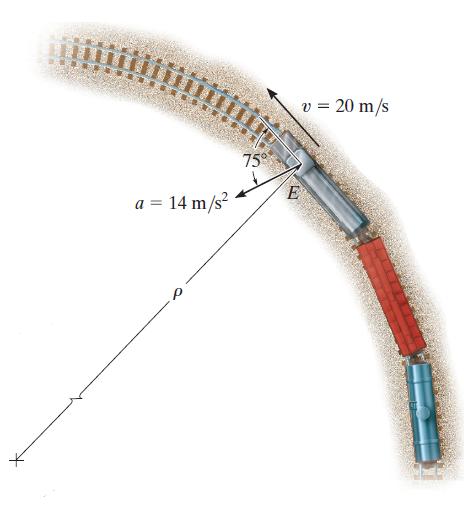
At a given instant the train engine at E has a speed of 20 m/s and an acceleration of 14 m/s² acting in the direction shown. Determine the rate of increase in the train's speed and the radius of curvature ρ of the path. = 14 m/s² a = 75% v = 20 m/s
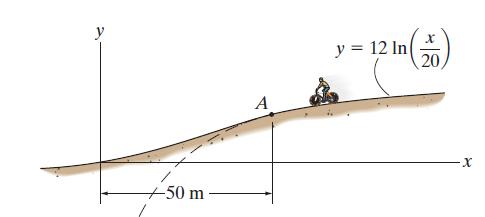
When the bicycle passes point A, it has a speed of 6 m/s, which is increasing at the rate of v̇ = (0.5) m/s². Determinethe magnitude of its acceleration when it is at point A. y +50 m y = 12 In X 20
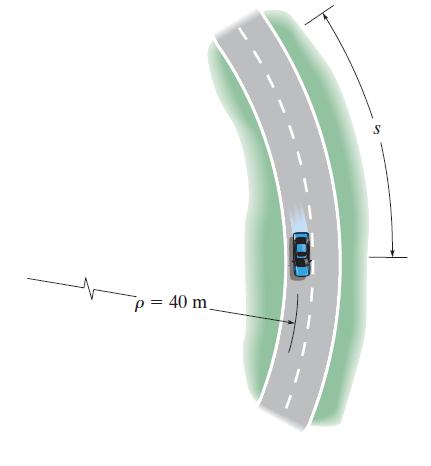
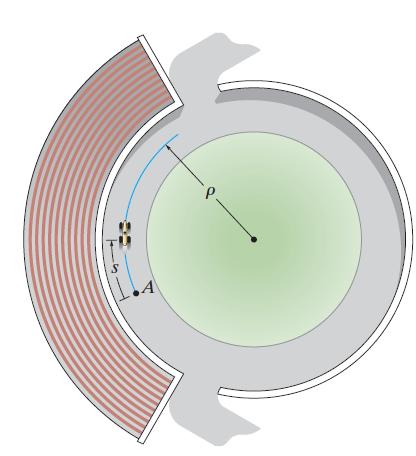
The car has an initial speed v0 = 20 m/s at s = 0. If it increases its speed along the circular track at = (0.8s) m>/s2, where s is in meters, determine the time needed for the car to travel s = 25 m. p = 40 m S
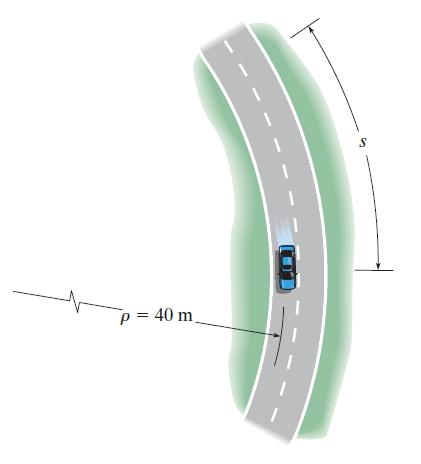
The car starts from rest at s = 0 and increases its speed at at = 4 m/s2. Determine the time when the magnitude of acceleration becomes 20 m/s2. At what position s does this occur? p= 40 m_ S
The racing car travels with a constant speed of 240 km/h around the elliptical race track. Determine the acceleration experienced by the driver at B. 2 km y B 4 km WE 16 +²=1 X
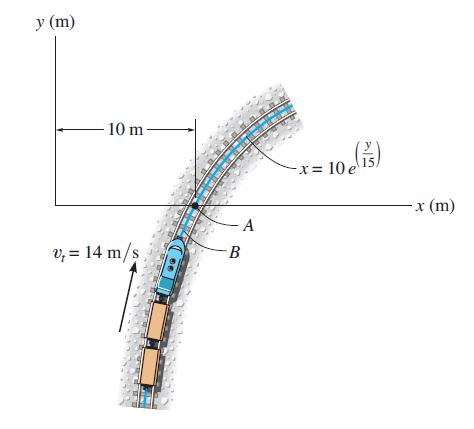
A train is traveling with a constant speed of 14 m/s along the curved path. Determine the magnitude of the acceleration of the front of the train, B, at the instant it reaches point A (y = 0). y (m) -10 m- v₁ = 14 m/s - A -B x= 10e x (m)
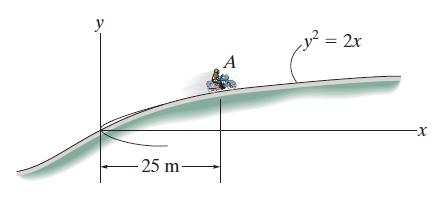
The motorcycle is traveling at a constant speed of 60 km h. Determine the magnitude of its acceleration when it is at point A. y -25 m- A y² = 2x -X
A boat is traveling along a circular curve having a radius of 100 ft. If its speed at t = 0 is 15 ft/s and is increasing at v̇ = (0.8t) ft/s², determine the magnitude of its acceleration at the instant t = 5 s.
When t = 0, the train has a speed of 8 m/s, which is increasing at 0.5 m/s2. Determine the magnitude of the acceleration of the engine when it reaches point A, at t = 20 s. Here the radius of curvature of the tracks is ρA = 400 m. v₁ = 8 m/s K A
A boat is traveling along a circular path having a radius of 20 m. Determine the magnitude of the boat's acceleration when the speed is v= 5 m/s and the rate of increase in the speed is i = 2 m/s².
Starting from rest, a bicyclist travels around a horizontal circular path, ρ = 10 m, at a speed of v = (0.09t² + 0.1t) m/s, where t is in seconds. Determine the magnitudes of her velocity and acceleration when she has traveled s = 3 m.
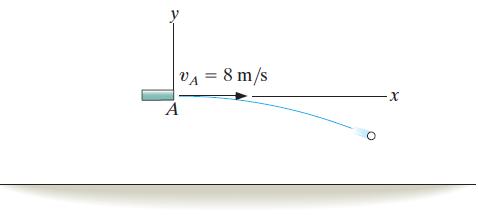
The ball is ejected horizontally from the tube with a speed of 8 m/s. Find the equation of the path, y = f(x), and then find the ball's velocity and the normal and tangential components of acceleration when t = 0.25 s. VA = 8 m/s A O X
A particle travels around a circular path having a radius of 50 m. If it is initially traveling with a speed of 10 m/s and its speed then increases at a rate of v̇ = (0.05 v) m/s²,determine the magnitude of the particle's acceleration fourseconds later.
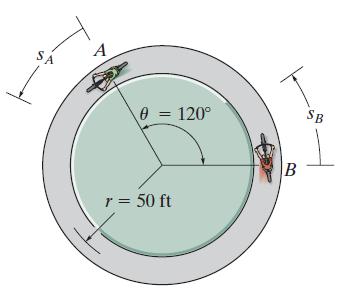
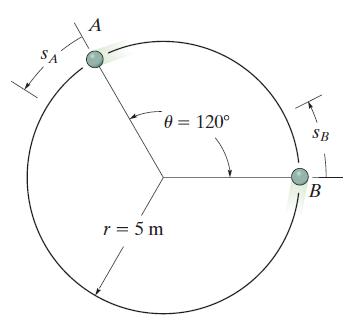
Two cyclists, A and B, are traveling counterclockwise around a circular track at a constant speed of 8 ft/s at the instant shown. If the speed of A is increased at (at)A = (sA) ft/s2, where sA is in feet, determine the distance measured counterclockwise along the track from B to A between the
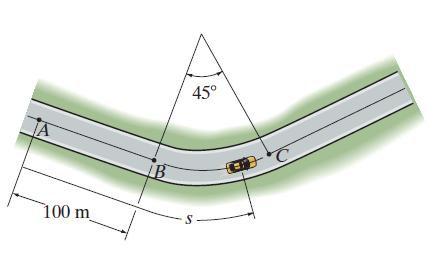
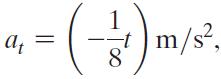
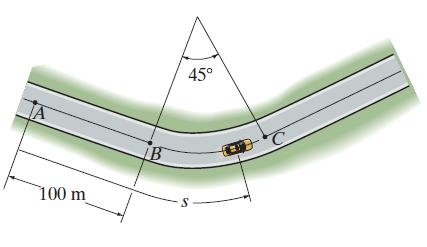
The car is traveling at a constant speed of 30 m/s. The driver then applies the brakes at A and thereby reduces the car's speed at the rate of at = (-0.08v) m/s², where v is in m/s. Determine the magnitude of the acceleration of the car just before it reaches point C on the circular curve. It
The car is traveling at a constant speed of 30 m/s. The driver then applies the brakes at A and thereby reduces the speed at the rate ofwhere t is in seconds. Determine the magnitude of the acceleration of the car just before it reaches point C on the circular curve. It takes 15 s for the car to
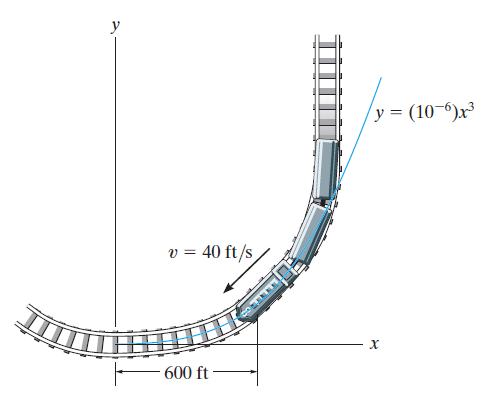
A spiral transition curve is used on railroads to connect a straight portion of the track with a curved portion. If the spiral is defined by the equation y = (10-6)x3, where x and y are in feet, determine the magnitude of the acceleration of a train engine moving with a constant speed of 40 ft/s
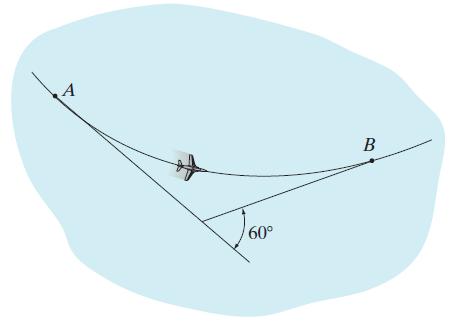
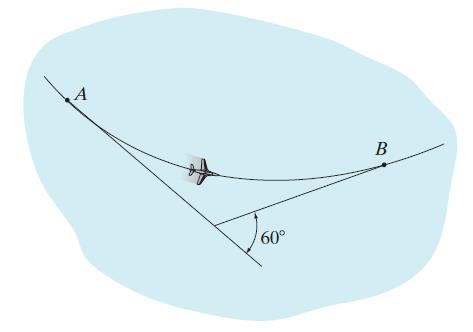
Determine the magnitude of acceleration of the airplane during the turn. It flies along the horizontal circular path AB in 40 s, while maintaining a constant speed of 300 ft/s. A 60° В
The race car has an initial speed vA = 15 m/s at A. If it increases its speed along the circular track at the rate at = (0.4s) m/s², where s is in meters, determine the time needed for the car to travel 20 m. Take ρ = 150 m. S A d
Particles A and B are traveling around a circular track at a speed of 8 m/s at the instant shown. If the speed of B is increasing by (at)B = 4 m/s2, and at the same instant A has an increase in speed of (at)A = 0.8t m/s2, where t is in seconds, determine how long it takes for a collision to occur.
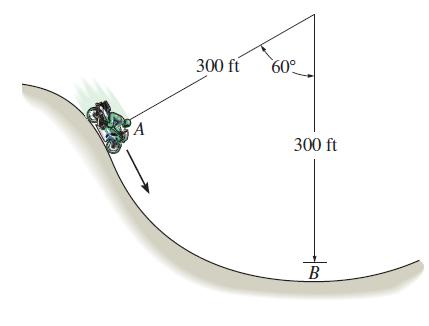
When the motorcyclist is at A, he increases his speed along the vertical circular path at the rate of v̇ = (0.3t) ft/s²,where t is in seconds and t = 0 at A. If he starts from restat A, determine the magnitudes of his velocity andacceleration when he reaches B. A 300 ft 60° 300 ft B
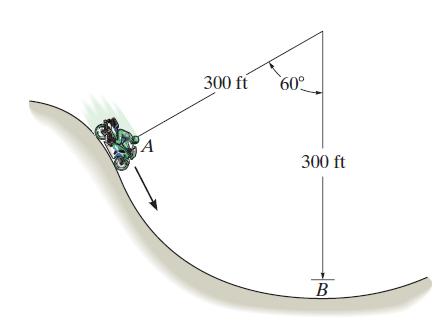
When the motorcyclist is at A, he increases his speed along the vertical circular path at the rate of v̇ = (0.04s) ft/s², where s is in ft and s = 0 at A. If he starts at vA = 2 ft/s, determine the magnitude of his velocity when he reaches B. Also, what is his initial acceleration? A 300
The airplane flies along the horizontal circular path AB in 60 s. If its speed at point A is 400 ft/s, which decreases at a rate of at = (–0.1t) ft/s2, where t is in seconds, determine the magnitude of the plane’s acceleration when it reaches point B. A 60° в
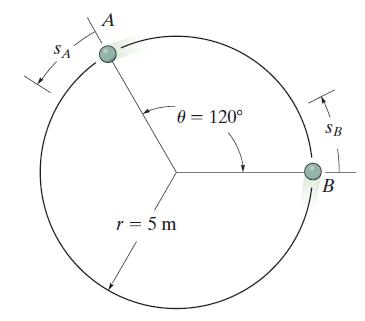
Particles A and Bare traveling counterclockwise around a circular track at a constant speed of 8 m/s. If at the instant shown the speed of A begins to increase by (at)A = (0.4SA) m/s², where sA is in meters, determine the distance measured counterclockwise along the track from B to A when t = 1 s.
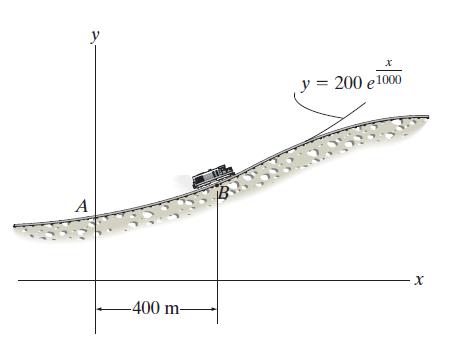
The train passes point B with a speed of 20 m/s which is decreasing at at = -0.5 m/s². Determine the magnitude of acceleration of the train at this point. A -400 m- B X y = 200 e 1000 X
A car travels around a circular track having a radius of r = 300 m such that when it is at point A it has a velocity of 5 m/s, which is increasing at the rate of v̇ = (0.06t) m/s2, where t is in seconds. Determine the magnitudes of its velocity and acceleration when it has traveled one-third the
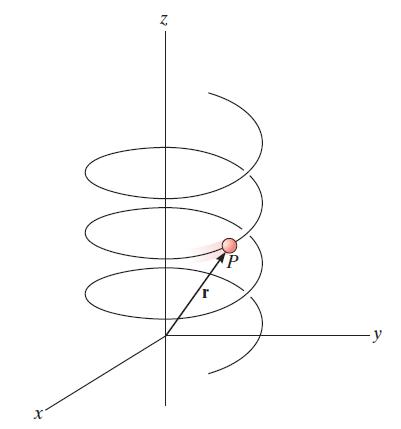
A particle P travels along an elliptical spiral path such that its position vector ris defined by {2 cos(0.1t)i + 1.5 sin(0.1t)j + (2t)k} m, where t is in seconds and the arguments for the sine and cosine are given in radians. When t = 8 s, determine the coordinate direction angles α, ß, and γ,
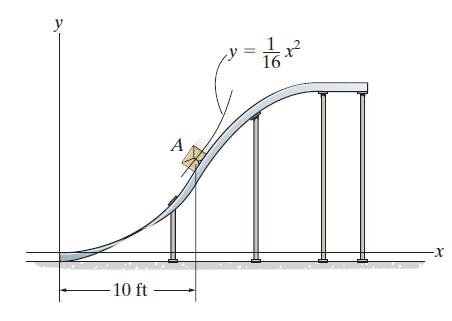
If the speed of the crate at A is 15 ft s, which is increasing at a rate v̇ = 3 ft/s2, determine the magnitude of the acceleration of the crate at this instant. y 10 ft A 16 -X
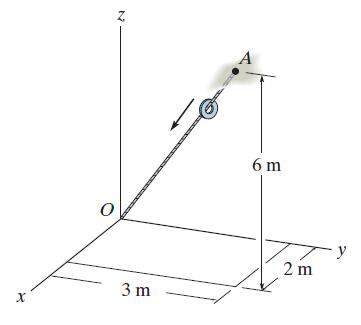
The small washer is sliding down the cord OA. When it is at the midpoint, its speed is 28 m/s and its acceleration is 7 m/s2. Express the velocity and acceleration of the washer at this point in terms of its cylindrical components. X N 3 m A 6 m 2 m -y
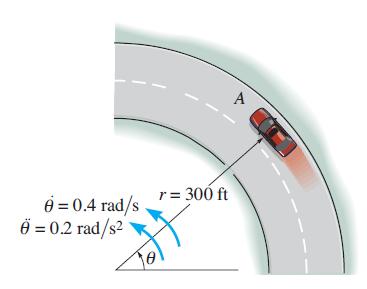
Acar is traveling along the circular curve of radius r = 300 ft. At the instant shown, its angular rate of rotation is θ̇ = 0.4 rad/s, which is increasing at the rate of θ̈ = 0.2 rad/s2. Determine the magnitudes of the car’s velocity and acceleration at this instant. 8 = 0.4
If a particle's position is described by the polar coordinates r = 4(1 + sin t) m and θ = (2e-t) rad, where t is in secondsand the argument for the sine is in radians, determine theradial and transverse components of the particle's velocityand acceleration when t = 2 s.
A particle moves along a path defined by polar coordinates r = (2et) ft and θ = (8t2) rad, where t is in seconds. Determine the components of its velocity and acceleration when t = 1 s.
A particle travels around a limaçon, defined by the equation r = b - a cos θ, where a and b are constants. Determine the particle’s radial and transverse components of velocity and acceleration as a function of θ and its time derivatives.
An airplane is flying in a straight line with a velocity of 200 mi/h and an acceleration of 3 mi/h2. If the propeller has a diameter of 6 ft and is rotating at a constant angular rate of 120 rad/s, determine the magnitudes of velocity and acceleration of a particle located on the tip of the
If a particle moves along a path such that r = (2 cost) ft and θ = (t/2) rad, where t is in seconds, plot the path r = f(θ) and determine the particle's radial and transversecomponents of velocity and acceleration.
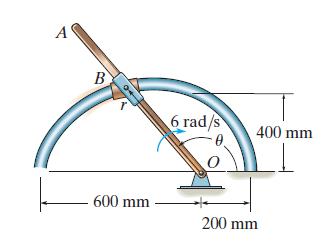
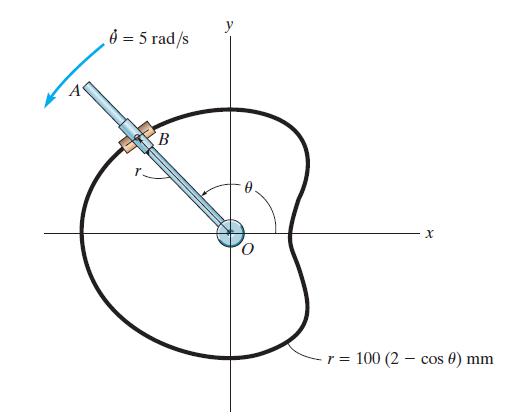
The rod OA rotates clockwise with a constant angular velocity of 6 rad/s. Two pin-connected slider blocks, located at B, move freely on OA and the curved rod whose shape is a limaçon described by the equation r = 200(2 − cos θ) mm. Determine the speed of the slider blocks at the instant θ =
Determine the magnitude of the acceleration of the slider blocks in Prob. 12–172 when θ = 150°.Prob. 12–172The rod OA rotates clockwise with a constant angular velocity of 6 rad/s. Two pin-connected slider blocks, located at B, move freely on OA and the curved rod whose shape is a limaçon
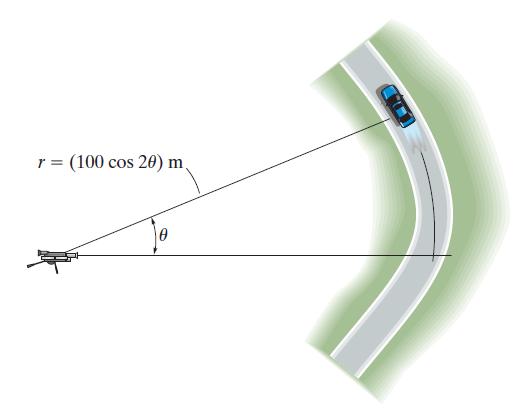
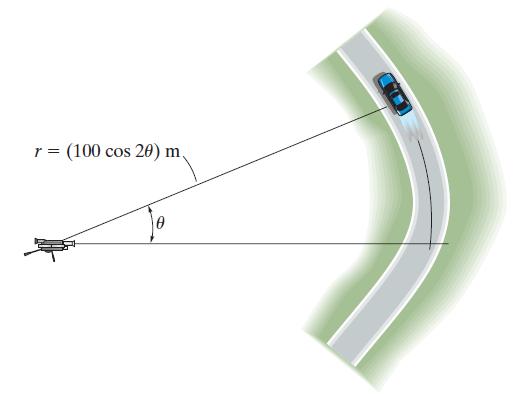
The driver of the car maintains a constant speed of 40 m/s. Determine the angular velocity of the camera tracking the car when θ = 15°. r = (100 cos 20) m, OJ
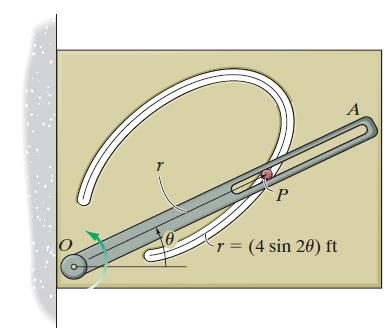
The pin P is constrained to move along the curve defined by the lemniscate r = (4 sin 2θ) ft. If the angular position of the slotted arm OA is defined by 0 = (3t3/2) rad, where t is in seconds, determine the magnitudes of the velocity and acceleration of the pin P when θ = 60°. T P r = (4 sin
When θ = 15°, the car has a speed of 50 m/s which is increasing at 6 m/s2. Determine the angular velocity of the camera tracking the car at this instant. r = (100 cos 20) m 3.
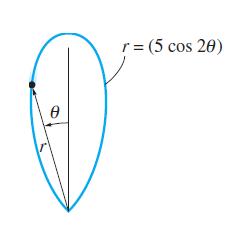
A particle travels along the portion of the "four-leaf rose" defined by the equation r = (5 cos 2θ) m. If the angular velocity of the radial coordinate line is θ = (3t²) rad/s, where t is in seconds, determine the radial and transverse components of the particle's velocity and acceleration at
The time rate of change of acceleration is referred to as the jerk, which is often used as a means of measuring passenger discomfort. Calculate this vector, ȧ in terms of its cylindrical components. using Eq. 12–32.Using Eq. 12–32. a = (i – ri?)u, + (rể + 2r0)ua + Zu- (12-32)
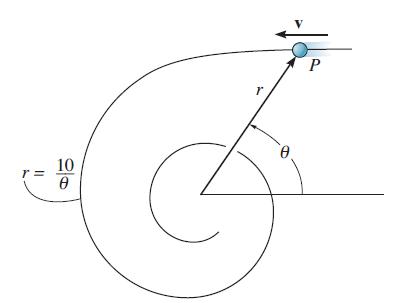
A particle P moves along the spiral path r = (10/θ) ft, where is in radians. If it maintains a constant speed of v = 20 ft/s, determine vr, and vθ as functions of θ and evaluate each at θ = 1 rad. r = 10 Ө r P
If a particle’s position is described by the polar coordinates r = (2 sin 2θ) m and θ = (4t) rad, where t is in seconds, determine the radial and transverse components of its velocity and acceleration when t = 1 s.
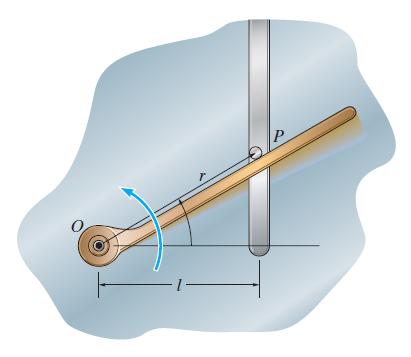
The link is pinned at O, and as a result of its rotation it drives the peg P along the vertical guide. Calculate the magnitudes of the velocity and acceleration of P if θ = ct rad, where c is a constant. P
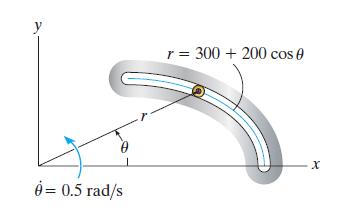
The mechanism within a machine is constructed so that the pin follows the path r= (300+200 cos θ) mm. Ifthe magnitudes of the pin'sdescribed by the equation θ̇ = 0.5 rad/s and θ̈ = 0, determine velocity and acceleration when θ = 30°. Neglect the size of the pin. Also, calculate the velocity
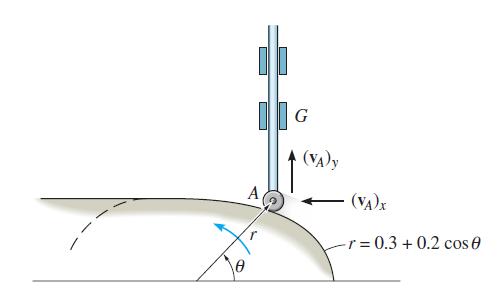
The mechanism of a machine is constructed so that the roller at A follows the surface of the cam described by the equation r = (0.3 +0.2 cos θ) m. If θ̇ = 0.5 rad/s and θ̈ = 0, determine the magnitudes of the roller's velocity and acceleration when θ = 30°. Neglect the size of the roller.
The position of a particle is described by r = (300e-0.5t) mm and θ = (0.3t2) rad, where t is in seconds. Determine the magnitudes of the particle's velocity and acceleration at the instant t = 1.5s.
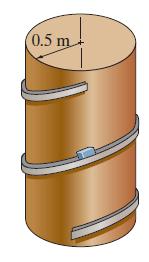
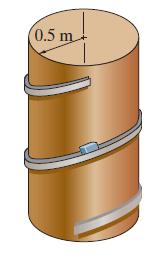
The box slides down the helical ramp with a constant speed of v = 2 m/s. Determine the magnitude of its acceleration. The ramp descends a vertical distance of 1m for every full revolution. The mean radius of the ramp is r = 0.5 m. 0.5 m
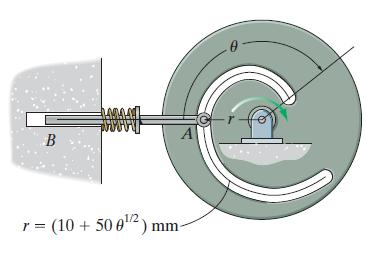
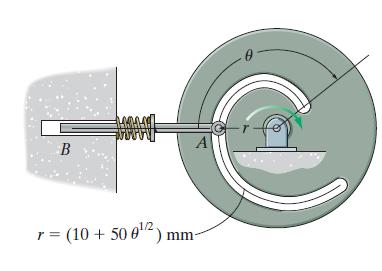
When θ = (2/3π) rad, the angular velocity and angular acceleration of the circular plate are θ = 1.5 rad/s andθ̈ = 3 rad/s², respectively. Determine the magnitudes of the velocity and acceleration of the rod AB at this instant. B hanns 0 € r = (10 + 50 0¹/2) mm-
A particle moves in the x–y plane such that its position is defined by r = {2ti + 4t2j} ft, where t is in seconds. Determine the radial and transverse components of the particle’s velocity and acceleration when t = 2 s.
The box slides down the helical ramp such that r = 0.5 m, θ = (0.5t³) rad, and z = (2-0.2t2) m, where t is in seconds. Determine the magnitudes of the velocity and acceleration of the box at the instant θ = 27π rad. (0.5 m
The motion of peg P is constrained by the lemniscate curved slot in OB and by the slotted arm OA. If OA rotates counterclockwise with an angular velocity of θ̇ = (3t³/2) rad/s, where t is in seconds, determine the magnitudes of the velocity and acceleration of peg P at θ = 30°. When t = 0, θ
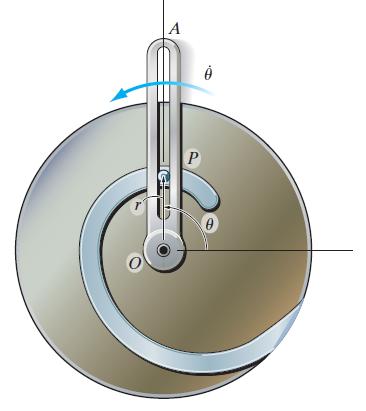
The motion of the pin P is controlled by the rotation of the grooved link OA. If the link is rotating at a constant angular rate of θ̇ = 6 rad/s, determine the magnitudes of the velocity and acceleration of P at the instant θ = π/2 rad. The spiral path is defined by the equation r = (40 θ) mm,
If the circular plate rotates clockwise with a constant angular velocity of θ̇ = 1.5 rad/s, determine the magnitudes of the velocity and acceleration of the follower rod AB when θ = (2/3π) rad. r= В A (10 + 50 0¹2) mm-
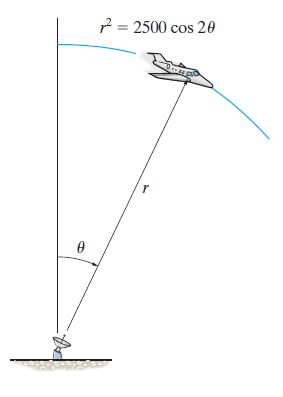
For a short time the jet plane moves along a path in the shape of a lemniscate, r² = (2500 cos 20) km². At the instant θ = 30°, the radar tracking device is rotating atθ̇ = 5(10-³) rad/s with θ̈ = 2(10-3) rad/s². Determine theradial and transverse components of velocity andacceleration of
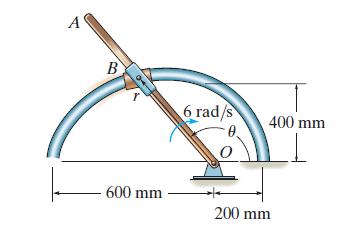
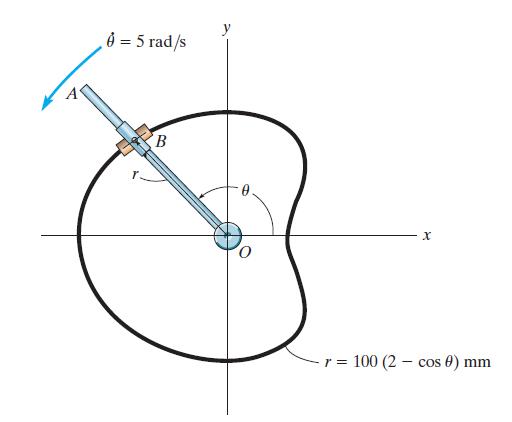
The rod OA rotates counterclockwise with a constant angular velocity of θ̇ = 5 rad/s. Two pin-connected slider blocks, located at B, move freely on OA and the curved rod whose shape is a limaçon described by the equation r = 100(2 − cos θ) mm. Determine the speed of the slider blocks at the
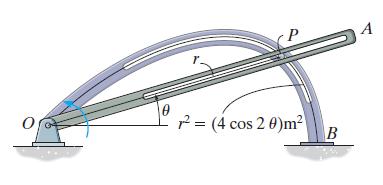
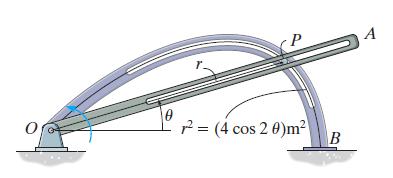
The motion of peg P is constrained by the lemniscate curved slot in OB and by the slotted arm OA. If OA rotates counterclockwise with a constant angular velocity of θ̇ = 3 rad/s, determine the magnitudes of the velocity and acceleration of peg P at θ = 30°. 0 P ²2= (4 cos 20)m² B A
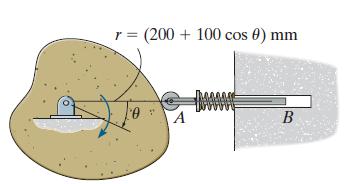
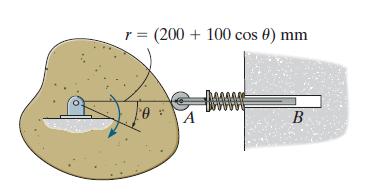
If the cam rotates clockwise with a constant angular velocity of θ̇ = 5 rad/s, determine the magnitudes of the velocity and acceleration of the follower rod AB at the instant θ = 30°. The surface of the cam has a shape of limaçon defined by r = (200 + 100 cos θ) mm. r = (200 + 100 cos 0)
At the instant θ = 30°, the cam rotates with a clockwiseangular velocity of θ̇ = 5 rad/s and angular acceleration of θ̈ = 6 rad/s². Determine the magnitudes of the velocity and acceleration of the follower rod AB at this instant. The surface of the cam has the shape of a limaçon defined by
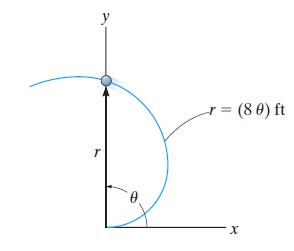
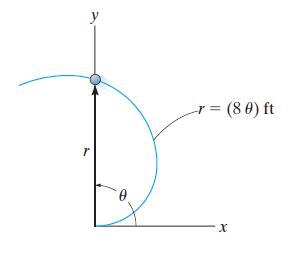
A particle moves along an Archimedean spiral r = (80) ft, where is in radians. If θ̇ = 4 rad/s (constant), determine the radial and transverse components of the particle's velocity and acceleration at the instant = π/2 rad. Sketch the curve and show the components on the curve. y r r = (80) ft X
Determine the magnitude of the acceleration of the slider blocks in Prob. 12–185 when θ = 120°.Prob. 12–185The rod OA rotates counterclockwise with a constant angular velocity of θ̇ = 5 rad/s. Two pin-connected slider blocks, located at B, move freely on OA and the curved rod whose shape is
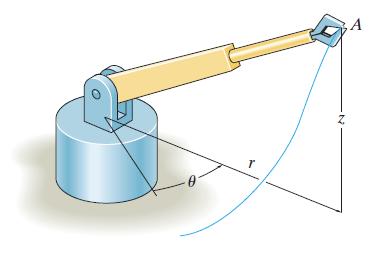
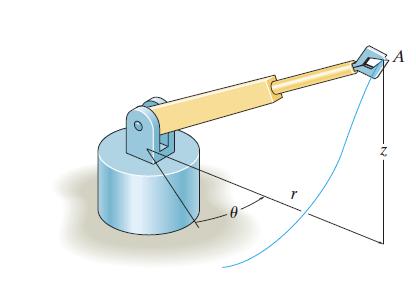
The arm of the robot move s so that r = 3 ft is constant, and its grip A moves along the path z = (3 sin 4θ) ft, where u is in radians. If θ = (0.5 t) rad, where t is in seconds, determine the magnitudes of the grip’s velocity and acceleration when t = 3 s. Z A
For a short time the arm of the robot is extending such that r= 1.5 ft/s when r = 3 ft, z = (4t²) ft, and θ = 0.5t rad, where t is in seconds. Determine the magnitudes of the velocity and acceleration of the grip A when t = 3 s. -0 T Z A
The slotted arm OA rotates counterclockwise about O such that when θ = π/4, arm OA is rotating with anangular velocity of θ̇ and an angular acceleration of 0.Determine the magnitudes of the velocity andacceleration of pin B at this instant. The motion of pin B isconstrained such that it moves
The car travels along a road, which for a short distance is defined by r = (200/θ) ft, where is in radians. If itmaintains a constant speed of v = 35 ft/s, determine theradial and transverse components of its velocity whenθ = π/3 rad.
Solve Prob. 12-189 if the particle has an angular acceleration θ̈ = 5 rad/s² when θ̇ = 4 rad/s at θ = π/2 rad.Prob. 12-189A particle moves along an Archimedean spiral r = (80) ft, where is in radians. If θ̇ = 4 rad/s (constant), determine the radial and transverse
Determine the displacement of the block at B if A is pulled down 4 ft. A C B
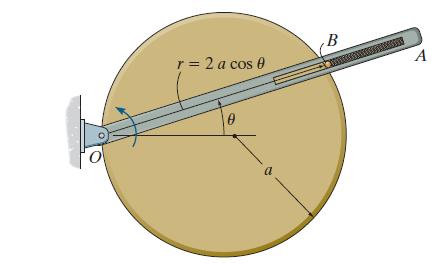
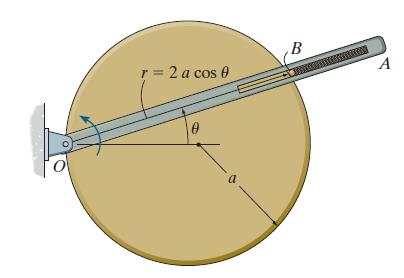
The slotted arm OA rotates counterclockwise about O with a constant angular velocity of θ̇. The motion of pin B is constrained such that it moves on the fixed circular surface and along the slot in OA. Determine the magnitudes of the velocity and acceleration of pin B as a function of θ. r = 2 a
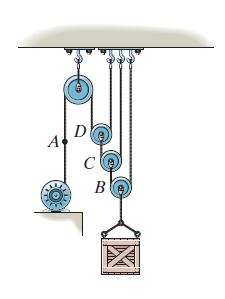
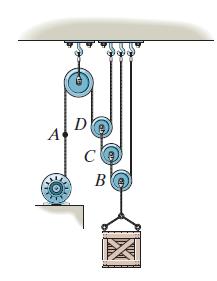
Starting from rest, the cable can be wound onto the drum of the motor at a rate of vA = (3t2) m/s, where t is in seconds. Determine the time needed to lift the load 7 m. A D C B
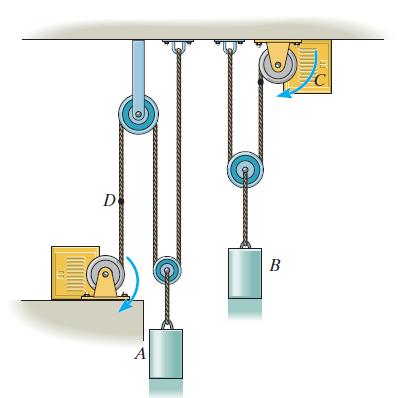
The motor draws in the cable at C with a constant velocity of vc = 4 m/s. The motor draws in the cable at D with a constant acceleration of aD = 8 m/s². If vD = 0 when t = 0, determine (a) The time needed for block A to rise3 m, and (b) The relative velocity of block A with respect
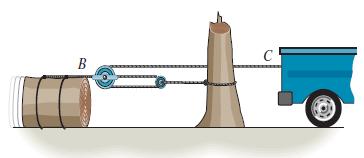
Determine the displacement of the log if the truck at C pulls the cable 4 ft to the right. B C
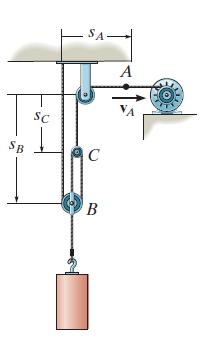
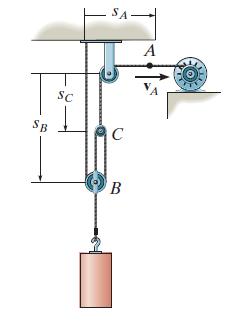
The cable at A is being drawn toward the motor at vA = 8 m/s. Determine the velocity of the block. SB SC SA- C B A VA
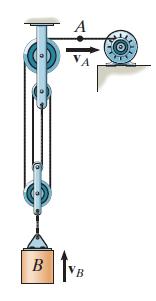
Determine the constant speed at which the cable at A must be drawn in by the motor in order to hoist the load 6 m in 1.5 s. A D C B
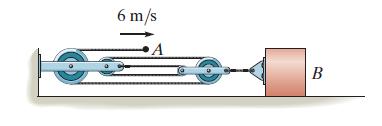
Determine the speed of the block at B. € 6 m/s A B
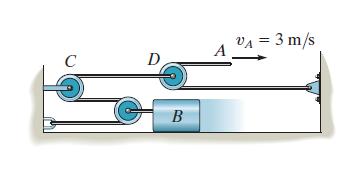
If the end A of the cable is moving at vA = 3 m/s, determine the speed of block B. D B A VA = 3 m/s
Determine the time needed for the load at B to attain a speed of 10 m/s, starting from rest, if the cable is drawn into the motor with an acceleration of 3 m/s2. SB SC -SA- C B A
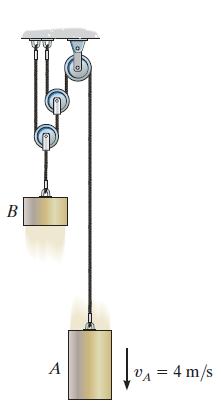
Determine the speed of B if A is moving downward with a speed of vA = 4 m/s at the instant shown. B A √e₁= = 4 m/s
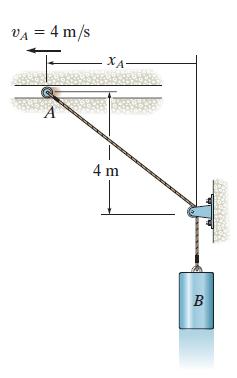
The roller at A is moving with a velocity of vA = 4 m/s and has an acceleration of aA = 2 m/s2 when xA = 3 m. Determine the velocity and acceleration of block B at this instant. VA = 4 m/s XA- 4 m B
Determine the constant speed at which the cable at A must be drawn in by the motor in order to hoist the load at B 15 ft in 5 s. B B
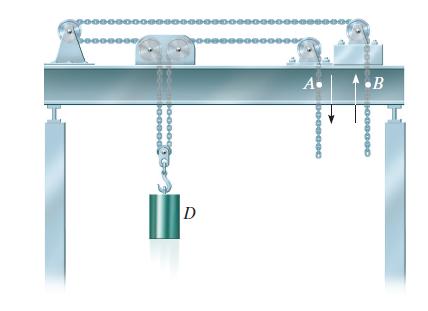
The hoist is used to lift the load at D. If the end A of the chain is traveling downward at vA = 5 ft/s and the end B is traveling upward at VB = 2 ft/s, determine the velocity of the load at D. B A. 1000000 0000000 ooooo ooood D
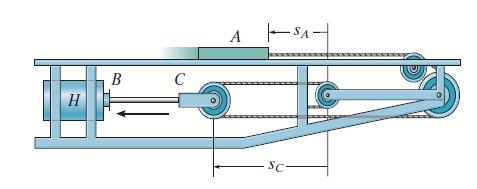
If the hydraulic cylinder H draws in rod BC at 2 ft/s, determine the speed of slider A. H B C A SC SA- C
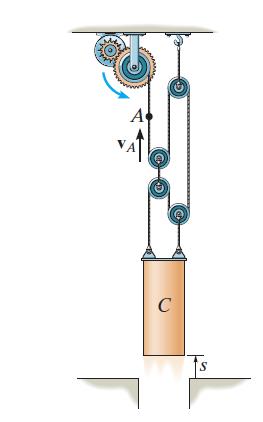
The cylinder C is being lifted using the cable and pulley system shown. If point A on the cable is being drawn toward the drum with a speed of 2 m/s, determine the speed of the cylinder. A с S
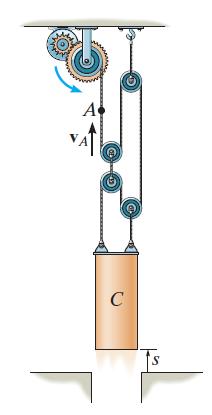
The cylinder C can be lifted with a maximum acceleration of aC = 3 m/s2 without causing the cables to fail. Determine the speed at which point A is moving toward the drum when s = 4 m if the cylinder is lifted from rest in the shortest time possible. Me A C S
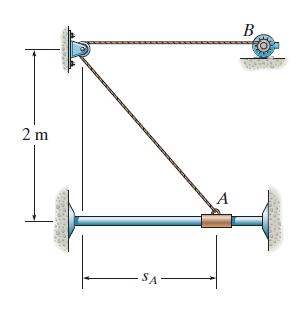
The motor draws in the cord at B with an acceleration of aB = 2 m/s2. When sA = 1.5 m, vB = 6 m/s. Determine the velocity and acceleration of the collar at this instant. 2m Nambay SA A B OF
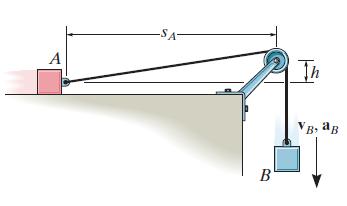
If block B is moving down with a velocity vB and has an acceleration aB, determine the velocity and acceleration of block A in terms of the parameters shown. A SA- B Th VB, aB
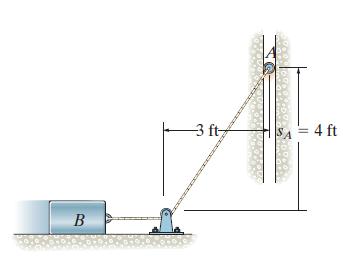
The roller at A is moving upward with a velocity of VA = 3 ft/s and has an acceleration of aA = 4 ft/s² when SA = 4 ft. Determine the velocity and acceleration of block B at this instant. B -3 ft = 4 ft
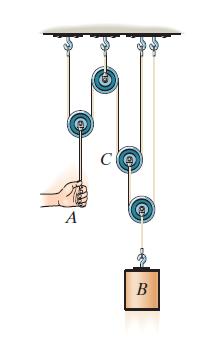
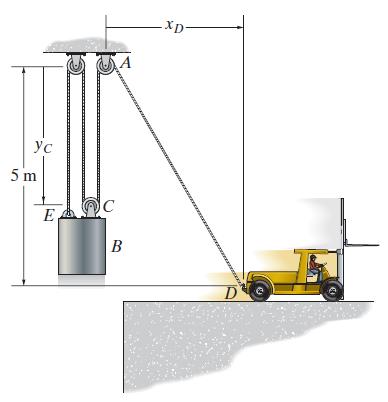
The block B is suspended from a cable that is attached to the block at E, wraps around three pulleys, and is tied to the back of a truck. If the truck starts from rest when xD is zero, and moves forward with a constant acceleration of aD = 0.5 m/s2, determine the speed of the block at the instant
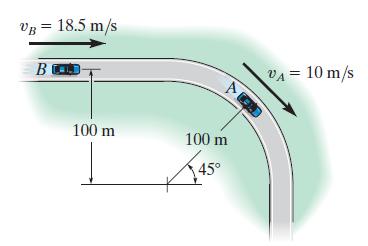
At the instant shown, the car at A is traveling at 10 m/s around the curve while increasing its speed at 5 m/s2. The car at B is traveling at 18.5 m/s along the straightaway and increasing its speed at 2 m/s2. Determine the relative velocity and relative acceleration of A with respect to B at this
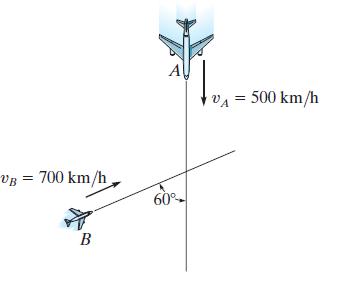
Two planes, A and B, are flying at the same altitude. If their velocities are vA = 500 km/h and vB = 700 km/h such that the angle between their straight-line courses is θ = 60°, determine the velocity of plane B with respect to plane A. VB = 700 km/h B 60% VA = 500 km/h
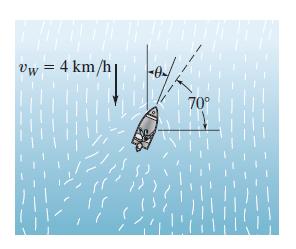
The boat can travel with a speed of 16 km/h in still water. The point of destination is located along the dashed line. If the water is moving at 4 km/h, determine the bearing angle θ at which the boat must travel to stay on course. Uw = 4 km/h Q A 70°
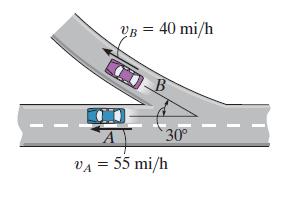
At the instant shown, cars A and B are traveling at speeds of 55 mi/h and 40 mi/h, respectively. If B is increasing its speed by 1200 mi/h2, while A maintains a constant speed, determine the velocity and acceleration of B with respect to A. Car B moves along a curve having a radius of curvature of
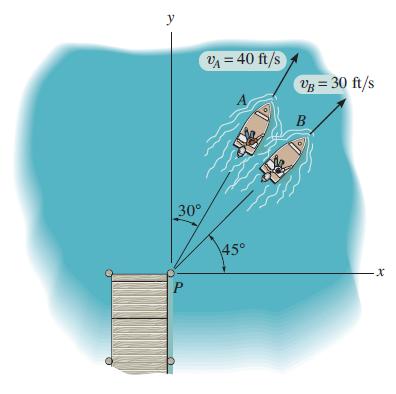
Two boats leave the pier P at the same time and travel in the directions shown. If vA = 40 ft s and vB = 30 ft/s, determine the magnitude of the velocity of boat A relative to boat B. How long after leaving the pier will the boats be 1500 ft apart? y 30° P VA = 40 ft/s 45° VB = 30 ft/s B -X
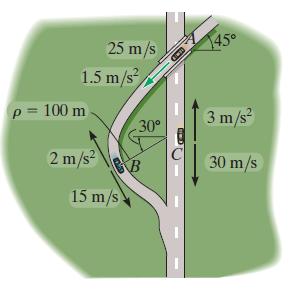
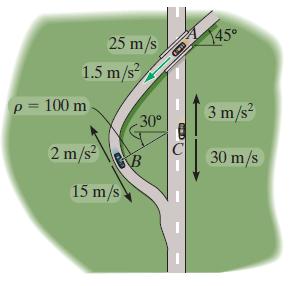
Car A travels along a straight road at a speed of 25 m/s while accelerating at 1.5 m/s². At this same instant car C is traveling along the straight road with a speed of 30 m/s while decelerating at 3 m/s². Determine the velocity and acceleration of car A relative to car C. 1.5 m/s² p= 100 m 25
Car B is traveling along the curved road with a speed of 15 m/s while decreasing its speed at 2 m/s². At this same instant car C is traveling along the straight road with a speed of 30 m/s while decelerating at 3 m/s². Determine the velocity and acceleration of car B relative to car C. 25 m/s 1.5
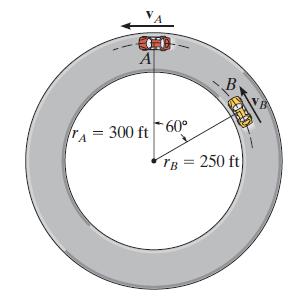
Cars A and B are traveling around the circular race track. At the instant shown, A has a speed of 90 ft/s and is increasing its speed at the rate of 15 ft/s², whereas B has a speed of 105 ft/s and is decreasing its speed at 25 ft/s². Determine the relative velocity and relative acceleration of
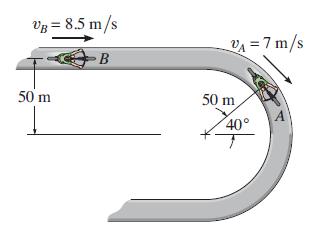
At the instant shown, the bicyclist at A is traveling at 7 m/s around the curve on the race track while increasing the bicycle’s speed at 0.5 m/s2. The bicyclist at B is traveling at 8.5 m/s along the straightaway and increasing the bicycle’s speed at 0.7 m/s2. Determine the relative velocity
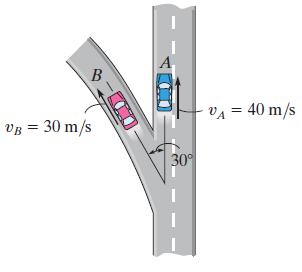
At the instant shown, cars A and B are traveling at velocities of 40 m/s and 30 m/s, respectively. If B is increasing its velocity by 2 m/s2, while A maintains a constant velocity, determine the velocity and acceleration of B with respect to A. The radius of curvature at B is ρB = 200 m. VB = 30
Showing 1600 - 1700
of 2426
First
10
11
12
13
14
15
16
17
18
19
20
21
22
23
24
Last
Step by Step Answers

 Get 50% OFF
Claim Now
Get 50% OFF
Claim Now