New Semester
Started
Get
50% OFF
Study Help!
--h --m --s
Claim Now
Question Answers
Textbooks
Find textbooks, questions and answers
Oops, something went wrong!
Change your search query and then try again
S
Books
FREE
Study Help
Expert Questions
Accounting
General Management
Mathematics
Finance
Organizational Behaviour
Law
Physics
Operating System
Management Leadership
Sociology
Programming
Marketing
Database
Computer Network
Economics
Textbooks Solutions
Accounting
Managerial Accounting
Management Leadership
Cost Accounting
Statistics
Business Law
Corporate Finance
Finance
Economics
Auditing
Tutors
Online Tutors
Find a Tutor
Hire a Tutor
Become a Tutor
AI Tutor
AI Study Planner
NEW
Sell Books
Search
Search
Sign In
Register
study help
engineering
engineering mechanics statics
Engineering Mechanics Statics & Dynamics 15th Edition Russell C. Hibbeler - Solutions
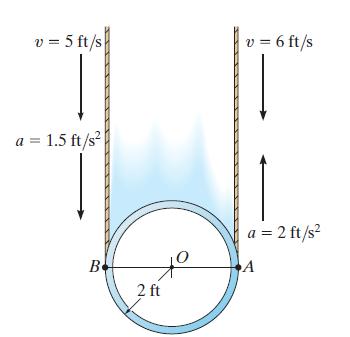
At a given instant, the cables supporting the pipe have the motions shown. Determine the angular velocity and angular acceleration of the pipe and the velocity and acceleration of point B located on the pipe. v = 5 ft/s a = 1.5 ft/s² B tº 2 ft v = 6 ft/s a = 2 ft/s² A
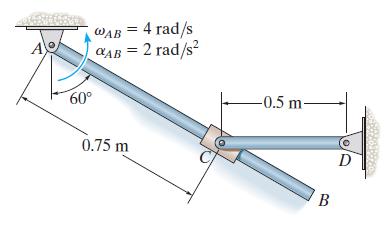
At the instant shown rod AB has an angular velocity ωAB = 4 rad/s and an angular acceleration αAB = 2 rad/s2. Determine the angular velocity and angular acceleration of rod CD at this instant.The collar at C is pin connected to CD and slides freely along AB. A 60° WAB = 4 rad/s CAB = 2
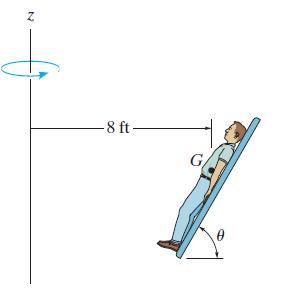
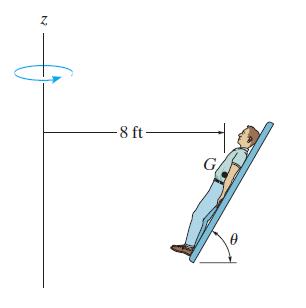
The 150-lb man lies against the cushion for which the coefficient of static friction is μs = 0.5. If he rotates about the z axis with a constant speed v = 30 ft/s, determine the smallest angle θ of the cushion at which he will begin to slip off. N -8 ft. G
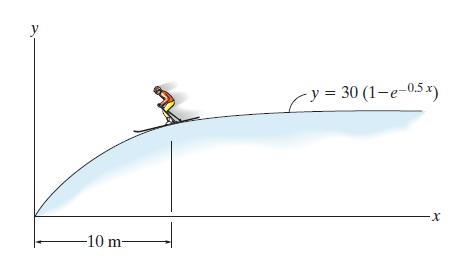
The 52-kg skier is coasting freely down the hill with a speed of 4 m/s at x = 10 m. Determine the normal reaction on the ground and the rate of increase in speed at the instant shown. Neglect friction and the size of the skier. -10 m- - y = 30 (1-e-0.5x) ·X
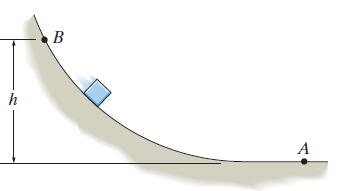
Prove that if the block is released from rest at point B on a smooth path of arbitrary shape, the speed it attains when it reaches point A is equal to the speed it attains when it falls freely through a distance h; i.e., v = √2gh. h B A
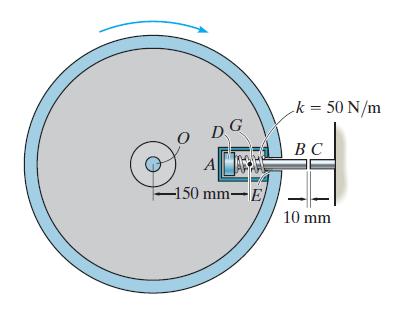
The rotational speed of the disk is controlled by a 30-g smooth contact arm AB which is spring mounted on the disk.When the disk is at rest, the center of mass G of the arm is located 150 mm from the center O, and the preset compression in the spring is 20 mm. If the initial gap between B and the
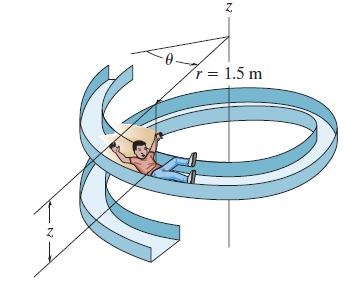
The boy of mass 40 kg is sliding down the spiral slide at a constant speed such that his position, measured from the top of the chute, has components r = 1.5 m, θ = (0.7t) rad, and z = (-0.5t) m, where t is in seconds. Determine the components of force Fr, Fθ, and Fz which the slide exerts on him
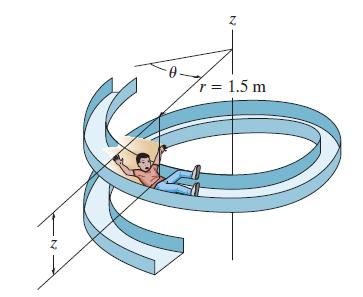
The 40-kg boy is sliding down the smooth spiral slide such that z = -2 m/s when he rotates θ = 360° and his speed is 2 m/s. Determine the r, θ, z components of force the slide exerts on him at this instant. Neglect the size of the boy. Z Z r = 1.5 m
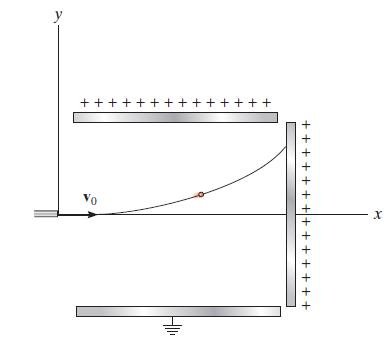
An electron of mass m is discharged with an initial horizontal velocity of v0. If it is subjected to two fields of force for which Fx = F0 and Fy = 0.3F0, where F0 is constant, determine the equation of the path, and the speed of the electron at any time t. +++ + + + +++ X ++++++++++++++
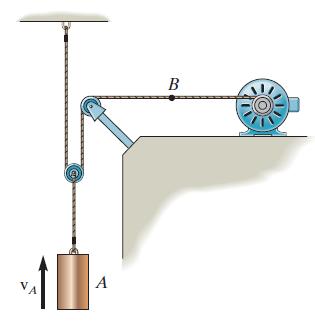
The 400-lb cylinder at A is hoisted using the motor and the pulley system shown. If the speed of point B on the cable is increased at a constant rate from zero to vB = 10 ft/s in t = 5 s, determine the tension in the cable at B to cause the motion. 10- A B
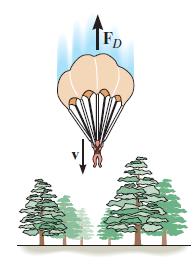
A parachutist having a mass m opens his parachute from an at-rest position at a very high altitude. If the atmospheric drag resistance is FD = kv2, where k is a constant, determine his velocity when he has fallen for a time t. What is his velocity when he lands on the ground? This velocity is
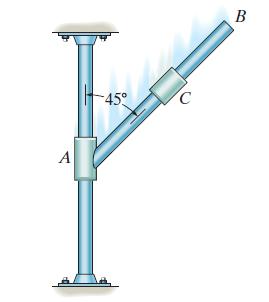
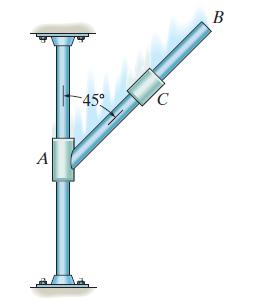
The 2-kg collar C is free to slide along the smooth shaft AB. Determine the acceleration of collar C if (a) The shaft is fixed from moving, (b) Collar A, which is fixed to shaft AB, moves downward at constant velocity along the vertical rod, and (c) Collar A is subjected to a
The 2-kg collar C is free to slide along the smooth shaft AB. Determine the acceleration of collar C if collar A is subjected to an upward acceleration of 4 m/s2. A -45 C B
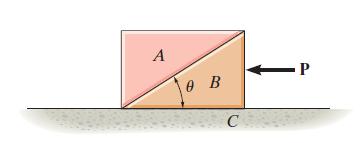
Blocks A and B each have a mass m. Determine the largest horizontal force P which can be applied to B so that A will not move relative to B. All surfaces are smooth. A А В с - р -
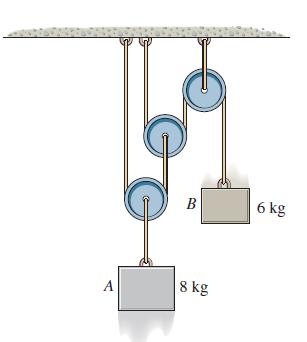
Determine the tension developed in the cords attached to each block and the accelerations of the blocks. Neglect the mass of the pulleys and cords. A G B 8 kg 6 kg
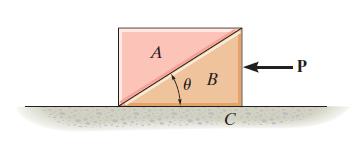
Blocks A and B each have a mass m. Determine the largest horizontal force P which can be applied to B so that A will not slip on B. The coefficient of static friction between A and B is μs.Neglect any friction between B and C. A О В C - Р
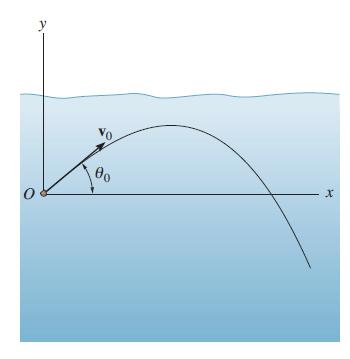
A projectile of mass m is fired into a liquid at an angle θ0 with an initial velocity v0 as shown. If the liquid develops a frictional or drag resistance on the projectile which is proportional to its velocity, i.e., F = kv, where k is a constant, determine the x and y components of its position
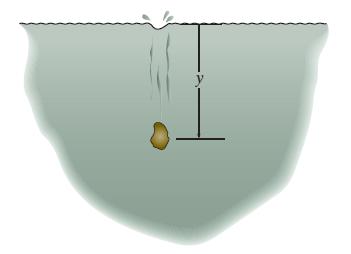
The rock is dropped from rest within the thick liquid. If the drag force acting on it is F = cv, where c is a constant, determine the velocity and position of the rock as a function of time. Plot the velocity and position time graphs.
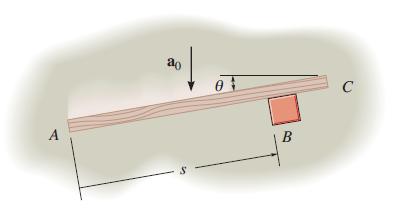
The smooth block B of negligible size has a mass m and rests on the horizontal plane. If the board AC pushes on the block at an angle θ with a constant acceleration a0, determine the velocity of the block along the board and the distance s the block moves along the board as a function of time t.
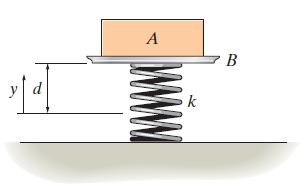
The block A has a mass mA and rests on the pan B, which has a mass mB. Both are supported by a spring having a stiffness k that is attached to the bottom of the pan and to the ground. Determine the distance d the pan should be pushed down from the equilibrium position and then released from rest so
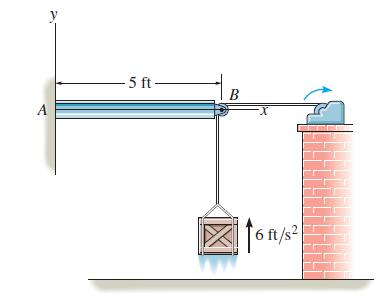
The 30-lb crate is being hoisted upward with a constant acceleration of 6 ft/s2. If the uniform beam AB has a weight of 200 lb, determine the components of reaction at A. Neglect the size and mass of the pulley at B. A 5 ft B IXI -X X6 ft/s²
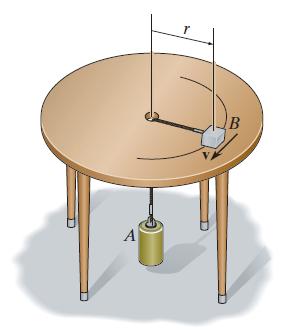
The 2-kg block B and 15-kg cylinder A are connected to a light cord that passes through a hole in the center of the smooth table. If the block is given a speed of v = 10m/s, determine the radius r of the circular path along which it travels. A r B
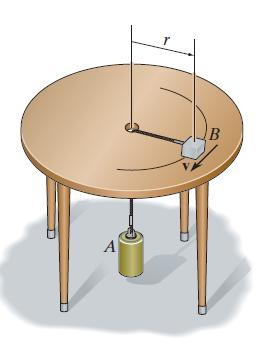
The 2-kg block B and 15-kg cylinder A are connected to a light cord that passes through a hole in the center of the smooth table. If the block travels along a circular path of radius r = 1.5m, determine the speed of the block. A в
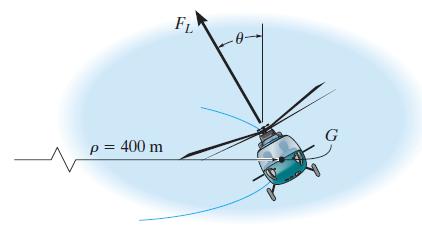
The 4-Mg helicopter maneuvers a horizontal turn having a radius of curvature ρ = 400 m. Determine the lift force FL required and the angle θ of the bank when it is flying horizontally with a constant speed of v = 40 m/s. Show that θ increases if v increases by also calculating θ when v =
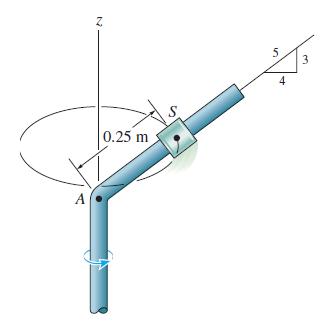
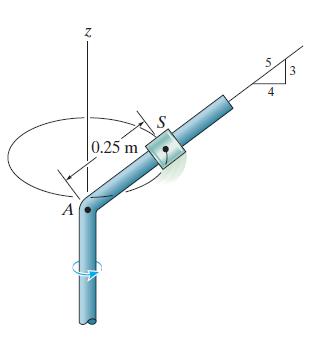
The 2-kg spool S fits loosely on the inclined rod for which the coefficient of static friction is μs = 0.2. If the spool is located 0.25 m from A, determine the maximum constant speed the spool can have so that it does not slip up the rod. Z | 0.25 m ال 4 ترا 3
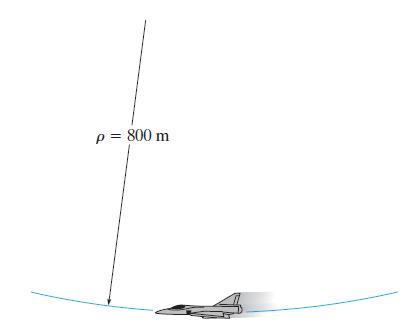
Determine the maximum constant speed at which the pilot can travel around the vertical curve having a radius of curvature ρ = 800 m, so that he experiences a maximum acceleration an = 8g = 78.5 m/s2. If he has a mass of 70 kg, determine the normal force he exerts on the seat of the airplane when
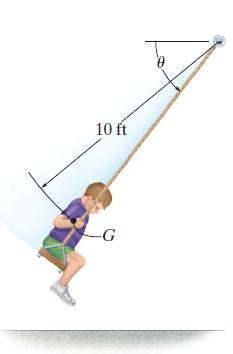
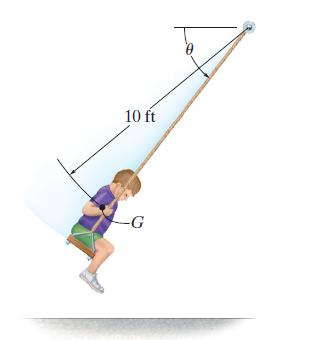
At the instant θ = 60°, the boy’s center of mass G has a downward speed vG = 15 ft/s. Determine the rate of increase in his speed and the tension in each of the two supporting cords of the swing at this instant. The boy has a weight of 60 lb. Neglect his size and the mass of the seat and cords.
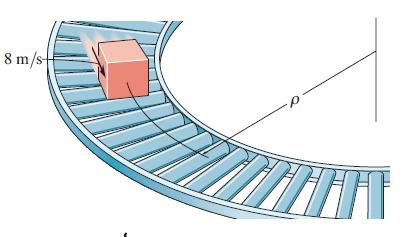
Cartons having a mass of 5 kg are required to move along the assembly line at a constant speed of 8 m/s. Determine the smallest radius of curvature for the conveyor so the cartons do not slip. The coefficients of static and kinetic friction between a carton and the conveyor are μs = 0.7 and μk =
At the instant θ = 60°, the boy’s center of mass G is momentarily at rest. Determine his speed and the tension in each of the two supporting cords of the swing when θ = 90°. The boy has a weight of 60 lb. Neglect his size and the mass of the seat and cords. 10 ft -G
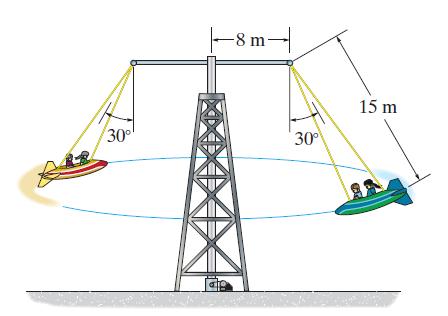
Calculate the constant speed of the cars on the amusementpark ride if it is observed that the cables are directed at 30° from the vertical. Each car, including its passengers, has a mass of 550 kg. Also, what are the components of force in the n, t, and z directions which a 60-kg passenger exerts
The 2-kg spool S fits loosely on the inclined rod for which the coefficient of static friction μs = 0.2. is If the spool is located 0.25 m from A, determine the minimum constant speed the spool can have so that it does not slip down the rod. A N 0.25 m S 5 4 3
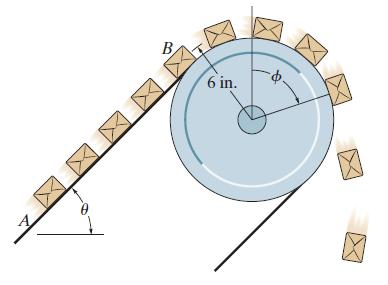
The 5-lb packages ride on the surface of the conveyor belt. If the belt starts from rest and its speed increases to 2 ft/s in 2s, determine the maximum angle θ so that none of the packages slip on the inclined surface AB of the belt. The coefficient of static friction between the belt and a
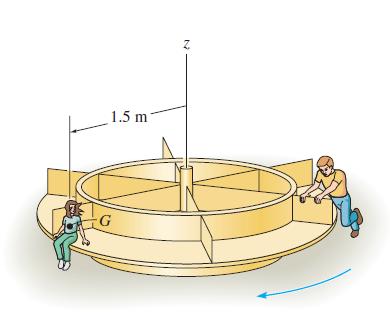
A girl having a mass of 25 kg sits at the edge of the merrygo- round so her center of mass G is at a distance of 1.5 m from the axis of rotation. If the angular motion of the platform is slowly increased so that the girl’s tangential component of acceleration can be neglected, determine the
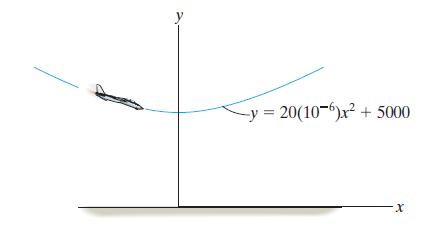
The plane is traveling at a constant speed of 800 ft/s along the curve y = 20(10-6)x2 + 5000, where x and y are in feet. If the pilot has a weight of 180 lb, determine the normal and tangential components of the force the seat exerts on the pilot when the plane is at its lowest point.
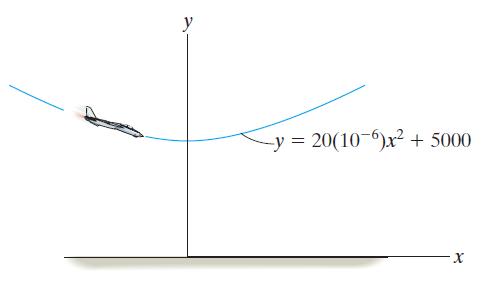
The jet plane is traveling at a constant speed of 1000 ft/s along the curve y = 20(10-6)x2 + 5000, where x and y are in feet. If the pilot has a weight of 180 lb, determine the normal and tangential components of the force the seat exerts on the pilot when y = 10 000 ft. -y=20(10-6)x² + 5000
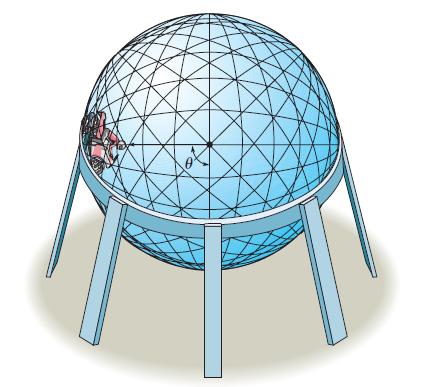
A motorcyclist in a circus rides his motorcycle within the confines of the hollow sphere. If the coefficient of static friction between the wheels of the motorcycle and the sphere is μs = 0.4, determine the minimum speed at which he must travel if he is to ride along the wall when θ = 90°. The
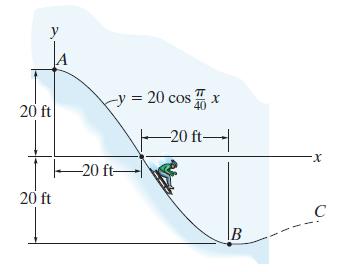
A sled and rider, weighing 30 lb and 150 lb, respectively, travel down a smooth slope that has the shape shown. If the rider does not hold on to the sides of the sled, determine the normal force which he exerts on the sled when the sled is(a) At point B, where it has a velocity of 15 ft/s,
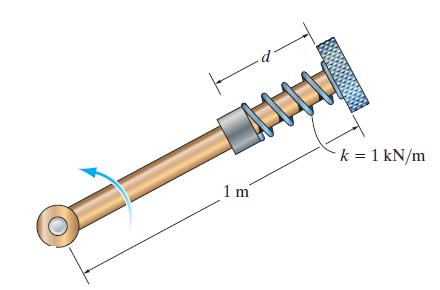
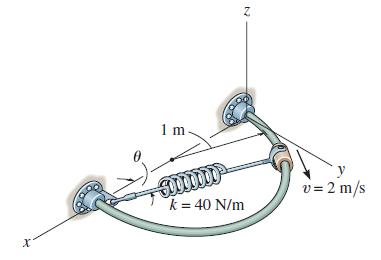
The collar has a mass of 2 kg and is free to slide along the smooth rod, which rotates in the horizontal plane. The attached spring has a stiffness k = 1 kN/m, and when no force is applied to the spring its unstretched length is d = 0.5 m. Determine the force which the spring exerts on the collar
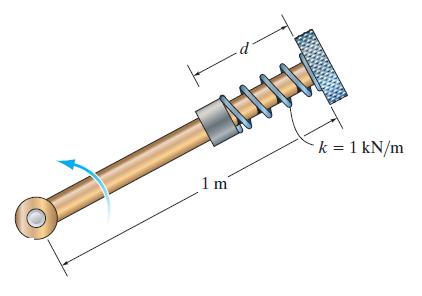
The collar has a mass of 2 kg and is free to slide along the smooth rod, which rotates in the horizontal plane. The attached spring has a stiffness k = 1 kN/m, and when no force is applied to the spring its unstretched length is d = 0.5 m. Determine the length d if the collar is at rest with
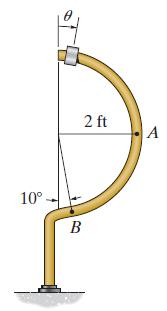
A small, 6-lb collar slides along the vertical, circular, smooth rod. If the collar is released from rest when θ = 10°, determine the normal force which it exerts on the rod when it arrives at points A and B. 10° 2 ft B A
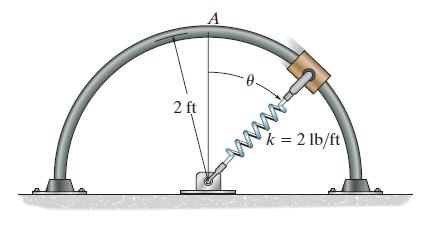
The 2-lb collar is released from rest at A and slides down along the smooth rod. If the attached spring has a stiffness k = 2 lb/ft, determine its unstretched length so that it does not allow the collar to leave contact with the top surface of the rod until θ = 60°. 2 ft A k=2 lb/ft ww
The 150-lb man lies against the cushion for which the coefficient of static friction μs = 0.5 is Determine the resultant normal and frictional forces the cushion exerts on him due to rotation about the z axis. He has a constant speed v = 20 ft/s. Neglect the size of theman.Take θ = 60°. -8
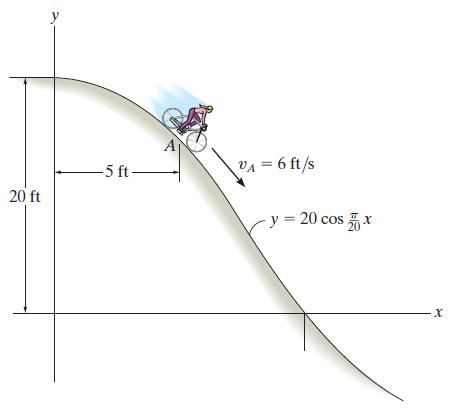
If the bicycle and rider have a total weight of 180 lb, determine the resultant normal force acting on the bicycle when it is at point A while it is freely coasting at vA = 6 ft/s. Also, calculate the increase in the bicyclist’s speed at this point. Neglect the resistance due to the wind and the
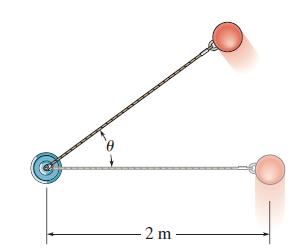
The 2-kg pendulum bob moves in the vertical plane with a velocity of 6 m/s when θ = 0°. Determine the angle θ where the tension in the cord becomes zero. -2m-
The collar has a mass of 5 kg and is confined to move along the smooth circular rod which lies in the horizontal plane. The attached spring has an unstretched length of 200 mm. If at the instant θ = 30° the collar has a speed v = 2m/s, determine the magnitudes of normal force of the rod on the
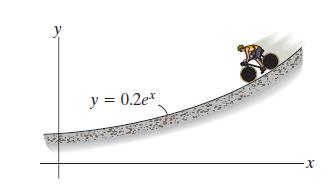
The cyclist is coasting freely down the hill with a speed of 15 m/s at y = 0.2 m. Determine the resultant normal reaction on the bicycle and the rate of increase in speed at the instant shown. The bicycle and rider have a total mass of 80 kg. Neglect friction, the mass of the wheels, and the size
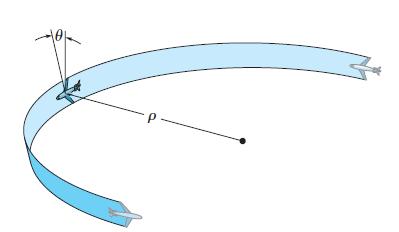
The airplane, traveling at a constant speed 50 m/s, of is executing a horizontal turn. If the plane is banked at θ = 15°, when the pilot experiences only a normal force on the seat of the plane, determine the radius of curvature of the turn. Also, what is the normal force of the seat on the pilot
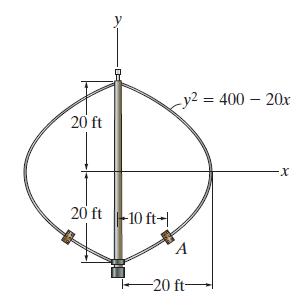
The “eggbeater” wind turbine is stopped by using spoilers which consist of 20-lb blocks that slide out along the blades when the blades are turning. As the spoilers travel along the blade, they create a drag on the blade that slows and eventually stops the blade. If it is observed that the
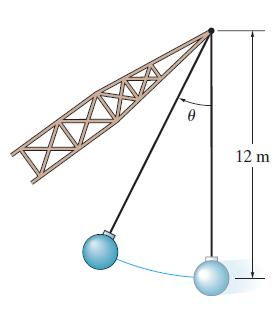
The 600-kg wrecking ball is suspended from the crane by a cable having a negligible mass. If the ball has a speed v = 8 m/s at the instant it is at its lowest point, θ = 0°, determine the tension in the cable at this instant. Also, determine the angle θ to which the ball swings before it stops.
The 2-kg pendulum bob moves in the vertical plane with a velocity of 8 m/s when θ = 0°. Determine the initial tension in the cord and also at the instant the bob reaches θ = 30°. Neglect the size of the bob. 2m
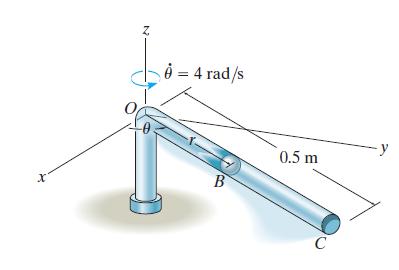
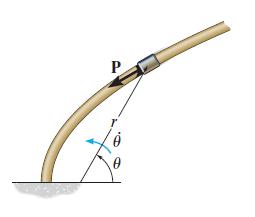
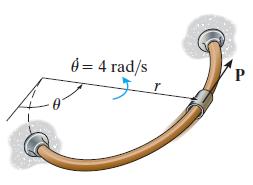
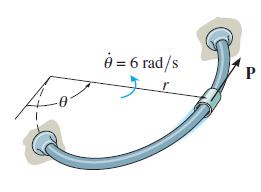
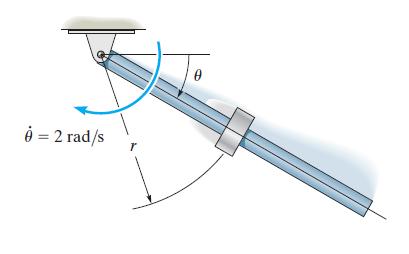
The tube rotates in the horizontal plane at a constant rate of θ̇ = 4 rad/s. If a 0.2-kg ball B starts at the origin O with an initial radial velocity of ṙ = 1.5 m/s and moves outward through the tube, determine the radial and transverse components of the ball's velocity at the instant it
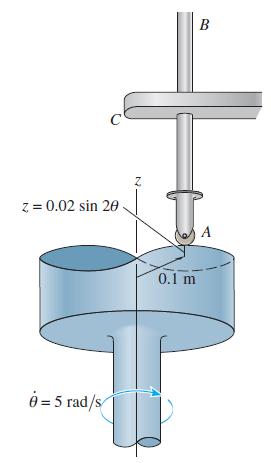
The 2-kg rod AB moves up and down as its end slides on the smooth contoured surface of the cam, where r = 0.1 m and z = (0.02 sin 2θ) m. If the cam is rotating at a constant rate of 5 rad/s, determine the maximum and minimum force the cam exerts on the rod. z = 0.02 sin 20 8=5 rad/s/ Z B T₁ 0.1 m
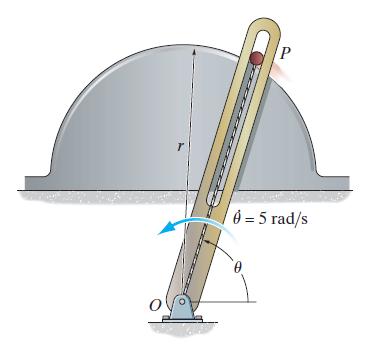
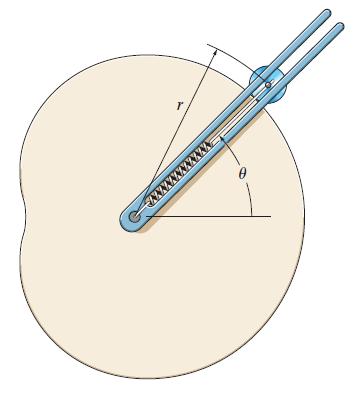
The smooth pin P has a mass of 80 g. It is attached to an elastic cord extending from O to P and, due to the slotted arm guide, moves along the horizontal circular path r = (0.8 sin θ) m. If the cord has a stiffness k = 30 kN/m and an unstretched length of 0.25 m, determine the force of the guide
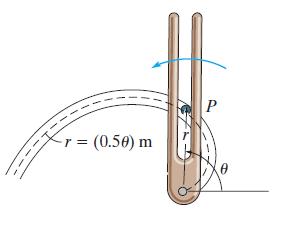
Using a forked rod, a 0.5-kg smooth peg P is forced to move along the vertical slotted path r = (0.5 θ) m, where θ is in radians. If the angular position of the arm is u = (π/8 t2) rad, where t is in seconds, determine the force of the rod on the peg and the normal force of the slot on the peg
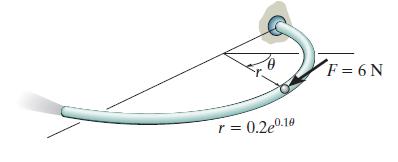
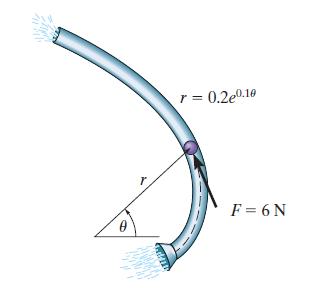
Using air pressure, the 0.5-kg ball is forced to move through the tube lying in the horizontal plane and having the shape of a logarithmic spiral. If the tangential force exerted on the ball due to air pressure is 6 N, determine the rate of increase in the ball’s speed at the instant θ = π/2.
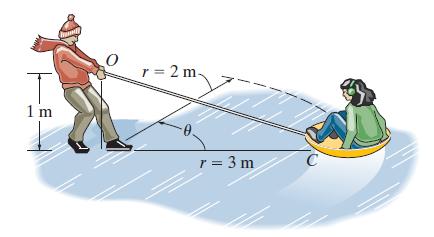
A boy standing firmly spins the girl sitting on a circular "dish" or sled in a circular path of radius r0 = 3 m such that her angular velocity is θ̇0 = 0.1 rad/s. If the attached cable OC is drawn inward such that the radial coordinate r changes with a constant speed of ṙ = -0.5 m/s, determine
Determine the magnitude of the resultant force acting on a 5-kg particle at the instant t = 2 s, if the particle is moving along a horizontal path defined by the equations r = (2t + 10) m and θ = (1.5t² - 6t) rad, where t is inseconds.
The collar, which has a weight of 3 lb, slides along the smooth rod lying in the horizontal plane and having the shape of a parabola, r = [4/(l - cosθ)] ft, where θ is in radians. If the collar’s angular rate is constant and equals θ̇ = 4 rad/s, determine the tangential force P needed to
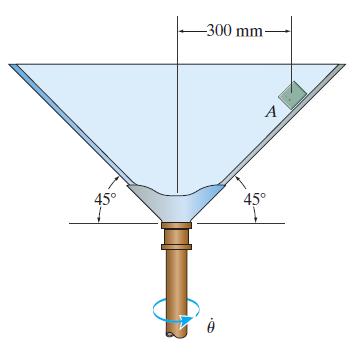
If the coefficient of static friction between the conical surface and the block is μs = 0.2, determine the maximum constant angular velocity without causing the block to slide upwards. 45° -300 mm- ģ A 45°
The path of motion of a 5-lb particle in the horizontal plane is described in terms of polar coordinates as r = (2t + 1) ft and θ = (0.5t² - t) rad, where t is in seconds. Determine the magnitude of the unbalanced force acting on the particle when t = 2 s.
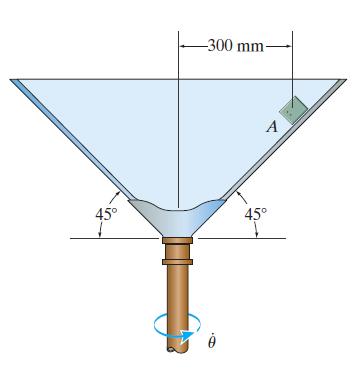
If the coefficient of static friction between the conical surface and the block of mass m is μs = 0.2, determine the minimum constant angular velocity so that the block does not slide downwards. 45° -300 mm- 0 A 45°
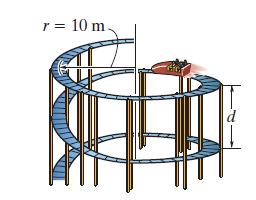
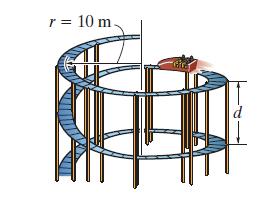
For a short time, the 250-kg roller-coaster car with passengers is traveling along the spiral track at a constant speed of v = 8 m/s. If the track descends d = 12 m for every full revolution, θ = 2π rad, determine the magnitudes of the components of force which the track exerts on the car in the
The 2-lb spool slides along the smooth horizontal spiral rod, r = (2 θ) ft, where θ is in radians. If its angular rate of rotation is constant and equals θ̇ = 4 rad/s, determine the horizontal tangential force P needed to cause the motion, and the horizontal normal force component that
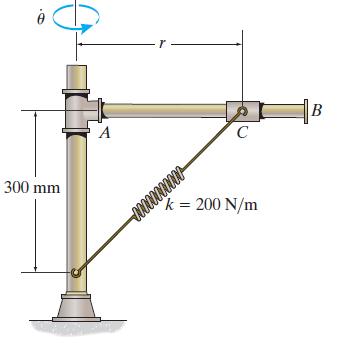
If the position of the 3-kg collar C on the smooth rod AB is held at r = 720 mm, determine the constant angular velocity θ̇ at which the mechanism is rotating about the vertical axis. The spring has an unstretched length of 400 mm. Neglect the mass of the rod and the size of the collar. 300
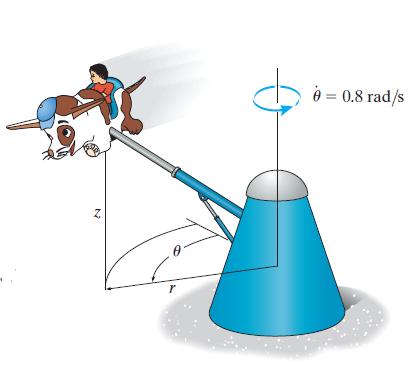
The amusement park ride rotates with a constant angular velocity of θ̇ = 0.8 rad/s. If the path of the ride is defined by r = (3 sinθ + 5)m and z = (3 cos θ)m, determine the r, θ, and z components of force exerted by the seat on the 20-kg boy when θ = 120°. N 0 0 = 0.8 rad/s
For a short time, the 250-kg roller-coaster car with passengers is traveling along the spiral track at a constant speed such that its position measured from the top of the track has components r = 10 m, θ = (0.2t) rad, and z = (-0.3t) m, where t is in seconds. Determine the magnitudes of the
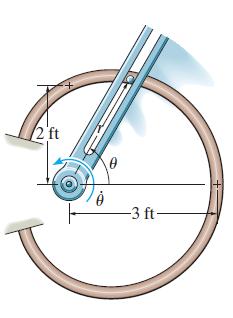
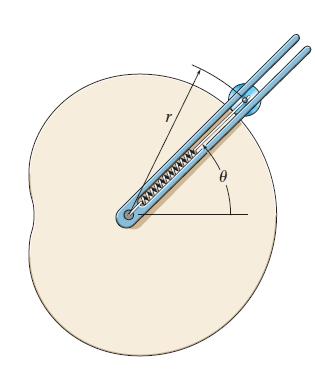
The smooth surface of the vertical cam is defined in part by the curve r = (0.2 cos θ + 0.3) m. The forked rod is rotating with an angular acceleration of θ̈ = 2 rad/s², and when θ = 45°, the angular velocity is θ̇ = 6 rad/s. Determine the force the cam and the rod exert on the 2-kg
Using air pressure, the 0.5-kg ball is forced to move through the tube lying in the horizontal plane and having the shape of a logarithmic spiral. If the tangential force exerted on the ball due to the air is 6 N, determine the rate of increase in the ball’s speed at the instant θ = π/2. What
The forked rod is used to move the smooth 2-lb particle around the horizontal path in the shape of a limaçon, r = (2 + cos θ) ft. If θ = (0.5t2) rad, where t is in seconds, determine the force which the rod exerts on the particle at the instant .The fork and path contact the particle on only one
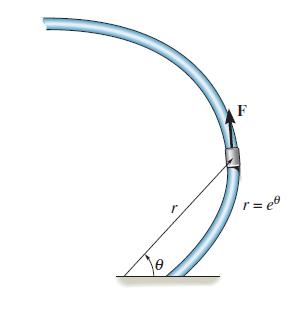
The collar has a mass of 2 kg and travels along the smooth horizontal rod defined by the equiangular spiral r = (eθ) m, where is in radians. Determine the tangential force F and the normal force N acting on the collar when θ = 45°, if the force F maintains a constant angular motion θ̇ = 2
The smooth surface of the vertical cam is defined in part by the curve r = (0.2 cos θ + 0.3) m. If the forked rod is rotating with a constant angular velocity of θ̇ = 4 rad/s, determine the force the cam and the rod exert on the 2-kg roller when θ = 30°. The attached spring has a
The spool, which has a mass of 2 kg, slides along the smooth horizontal spiral rod, r = (0.4θ) m, where θ is in radians. If its angular rate of rotation is constant and equals θ̇ = 6 rad/s, determine the horizontal tangential force P needed to cause the motion and the horizontal normal force
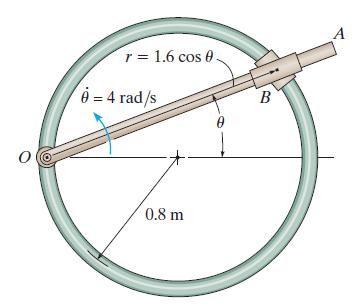
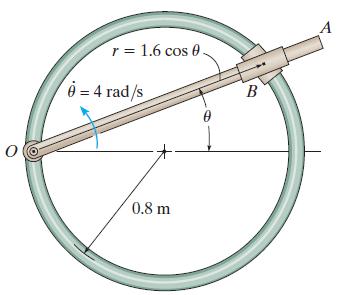
Rod OA rotates counterclockwise at a constant angular rate θ̇ = 4 rad/s. The double collar B is pin connected together such that one collar slides over the rotating rod and the other collar slides over the circular rod described by the equation r = (1.6 cos θ) m. If both collars have a
Solve Prob. 13–109 if motion is in the vertical plane.Prob. 13–109Rod OA rotates counterclockwise at a constant angular rate θ̇ = 4 rad/s. The double collar B is pin connected together such that one collar slides over the rotating rod and the other collar slides over the circular rod
A 0.2-kg spool slides down along a smooth rod. If the rod has a constant angular rate of rotation θ̇ = 2 rad/s in the vertical plane, show that the equations of motion for the spool are r̈ - 4r - 9.81 sin θ = 0 and 0.8ṙ + Ns - 1.962 cos θ = 0, where Ns is the magnitude of the normal
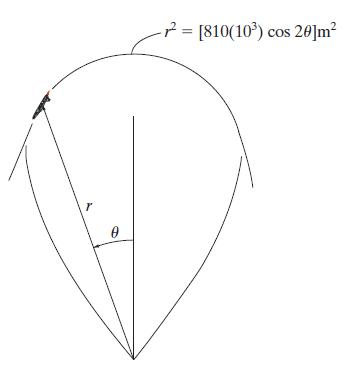
The airplane executes the vertical loop defined by r² = [810(10³) cos 2θ] m². If the pilot maintains a constant speed v= 120m/s along the path, determine the normal force the seat exerts on him at the instant θ = 0°. The pilot has a mass of 75 kg. 0 2²: = [810(10³) cos 20]m2²
The speed of a satellite launched into a circular orbit about the earth is given by Eq. 13–25. Determine the speed of a satellite launched parallel to the surface of the earth so that it travels in a circular orbit 800 km from the earth’s surface.Eq. 13–25. Vc GM ro (13-25)
The earth has an orbit with eccentricity 0.0167 around the sun. Knowing that the earth’s minimum distance from the sun is 146(106) km, find the speed at which the earth travels when it is at this distance. Determine the equation in polar coordinates which describes the earth’s orbit about the
A communications satellite is in a circular orbit above the earth such that it always remains directly over a point on the earth’s surface. As a result, the period of the satellite must equal the rotation of the earth, which is approximately 24 hours. Determine the satellite’s altitude h above
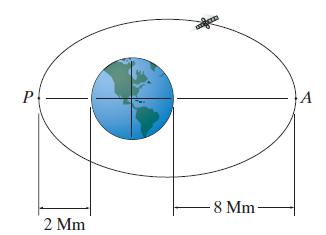
The satellite is in an elliptical orbit around the earth as shown. Determine its velocity at perigee P and apogee A, and the period of the satellite. P 2 Mm 8 Mm- A
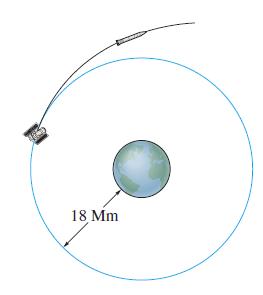
The rocket is docked next to a satellite located 18 Mm above the earth’s surface. If the satellite is traveling in a circular orbit, determine the speed tangent to the earth’s surface which must suddenly be given to the rocket, relative to the satellite, such that it travels in free flight away
Prove Kepler’s third law of motion. Use Eqs. 13–19, 13–28, 13–29, and 13–31.Eqs. 13–19 1 r C cos 0 + GM₂ h² (13-19)
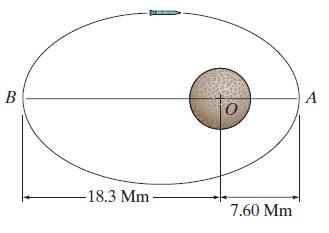
The rocket is traveling in free flight along the elliptical orbit. The planet has no atmosphere, and its mass is 0.60 times that of the earth. If the rocket has the orbit shown, determine the rocket’s speed when it is at A and at B. B -18.3 Mm- 7.60 Mm A
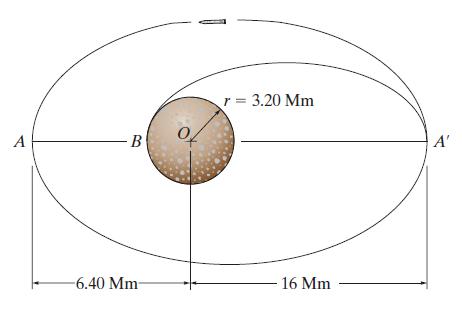
The rocket is traveling in free flight along an elliptical trajectory A'A. The planet has a mass 0.60 times that of the earth. If the rocket has an apoapsis and periapsis as shown in the figure, determine the speed of the rocket when it is at point A. A B 6.40 Mm- r = 3.20 Mm -16 Mm A'
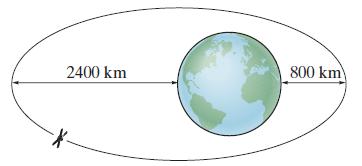
A satellite is to be placed into an elliptical orbit about the earth such that at the perigee of its orbit it has an altitude of 800 km, and at apogee its altitude is 2400 km. Determine its required launch velocity tangent to the earth’s surface at perigee and the period of its orbit. 2400 km 800
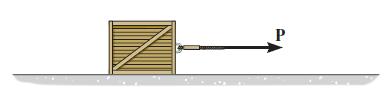
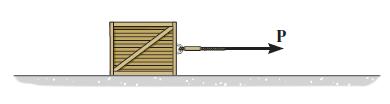
If the 50-kg crate is subjected to a force of P = 200 N, P determine its speed when it has traveled 15 m starting from rest. The coefficient of kinetic friction between the crate and the ground is μk = 0.3. P
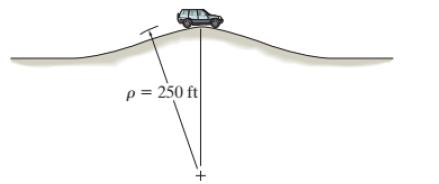
Determine the maximum speed that the jeep can travel over the crest of the hill and not lose contact with the road. p=250 ft
If the 50-kg crate starts from rest and attains a speed of P 6 m/s when it has traveled a distance of 15 m, determine the= force P acting on the crate.The coefficient of kinetic friction between the crate and the ground is μk = 0.3. P
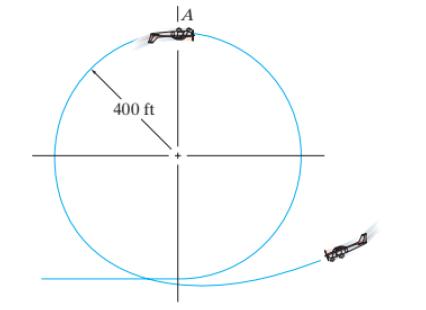
A pilot weighs 150 lb and is traveling at a constant speed of 120 ft/s. Determine the normal force he exerts on the seat of the plane when he is upside down at A. The loop has a radius of curvature of 400 ft. 400 ft |A 29
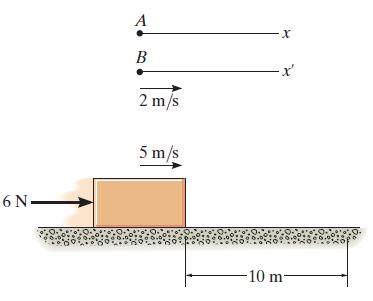
As indicated by the derivation, the principle of work and energy is valid for observers in any inertial reference frame. Show that this is so, by considering the 10-kg block which rests on the smooth surface and is subjected to a horizontal force of 6 N. If observer A is in a fixed frame x,
When the driver applies the brakes of a light truck traveling 40 km/h, it skids 30 m before stopping. How far will the truck skid if it is traveling 80 km/h when the brakes are applied?
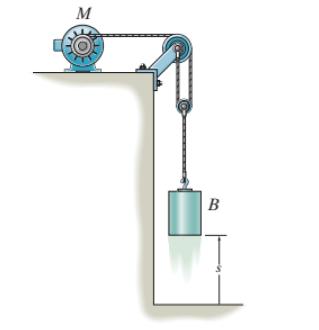
The 50-lb load is hoisted by the pulley system and motor M. If the motor exerts a constant force of 30 lb on the cable, determine the power that must be supplied to the motor if the load has been hoisted s = 10 ft starting from rest. The motor has an efficiency of ε = 0.76. M B
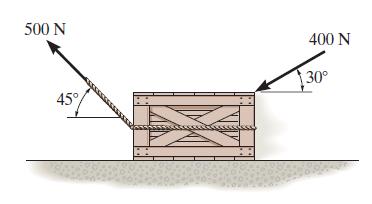
The 100-kg crate is subjected to the forces shown. If it is originally at rest, determine the distance it slides in order to attain a speed of v = 8 m/s. The coefficient of kinetic friction between the crate and the surface is μk = 0.2. 500 N 45° 400 N 30°
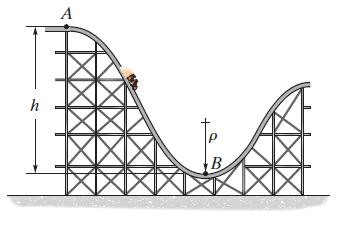
Determine the required height h of the roller coaster so that when it is essentially at rest at the crest of the hill A it will reach a speed of 100 km/h when it comes to the bottom B. Also, what should be the minimum radius of curvature ρ for the track at B so that the passengers do not
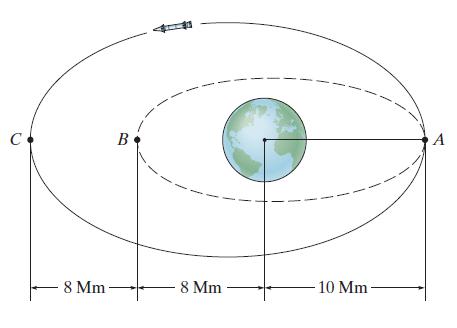
The rocket is traveling around the earth in free flight along the elliptical orbit AC. Determine its change in speed when it reaches A so that it travels along the elliptical orbit AB. C 8 Mm B W 8 Mm -10 Mm- 11 A
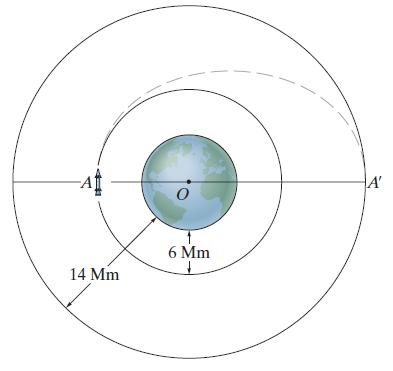
The rocket shown is originally in a circular orbit 6 Mm above the surface of the earth. It is required that it travel in another circular orbit having an altitude of 14 Mm. To do this, the rocket is given a short pulse of power at A so that it travels in free flight along the dashed elliptical path
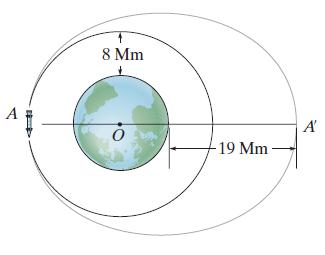
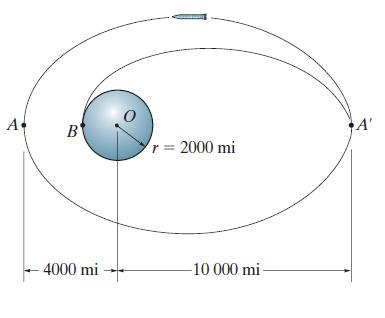
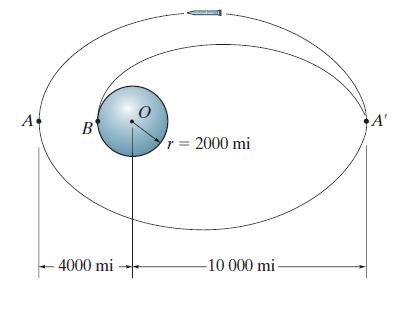
The rocket is in free-flight circular orbit around the earth. Determine the time needed for the rocket to travel from the inner orbit at A to the outer orbit at A′. 8 Mm 19 Mm Α'
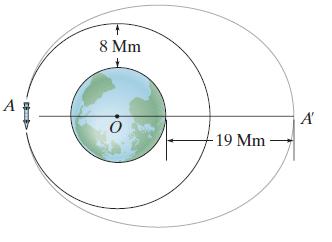
The rocket is initially in free-flight circular orbit around the earth. Determine the speed of the rocket at A. What change in the speed at A is required so that it can move in an elliptical orbit to reach point A′? A 8 Mm 0 -19 Mm A
The rocket is in free flight along an elliptical trajectory A'A. The planet has no atmosphere, and its mass is 0.60 times that of the earth. If the orbit has the apoapsis and periapsis shown, determine the rocket's velocity when it is at point A. Take G = 34.4(10-9) (lb · ft²)/slug²,Me =
If the rocket is to land on the surface of the planet, determine the required free-flight speed it must have at A' so that the landing occurs at B. How long does it take for the rocket to land, in going from A' to B? The planet has no atmosphere, and its mass is 0.6 times that of the earth. Take G
Showing 1200 - 1300
of 2426
First
6
7
8
9
10
11
12
13
14
15
16
17
18
19
20
Last
Step by Step Answers

 Get 50% OFF
Claim Now
Get 50% OFF
Claim Now