New Semester
Started
Get
50% OFF
Study Help!
--h --m --s
Claim Now
Question Answers
Textbooks
Find textbooks, questions and answers
Oops, something went wrong!
Change your search query and then try again
S
Books
FREE
Study Help
Expert Questions
Accounting
General Management
Mathematics
Finance
Organizational Behaviour
Law
Physics
Operating System
Management Leadership
Sociology
Programming
Marketing
Database
Computer Network
Economics
Textbooks Solutions
Accounting
Managerial Accounting
Management Leadership
Cost Accounting
Statistics
Business Law
Corporate Finance
Finance
Economics
Auditing
Tutors
Online Tutors
Find a Tutor
Hire a Tutor
Become a Tutor
AI Tutor
AI Study Planner
NEW
Sell Books
Search
Search
Sign In
Register
study help
engineering
engineering mechanics statics
Engineering Mechanics Statics & Dynamics 15th Edition Russell C. Hibbeler - Solutions
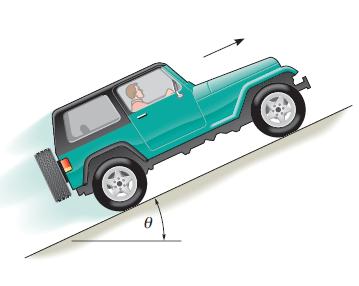
The jeep has a weight of 2500 lb and an engine which transmits a power of 100 hp to all the wheels. Assuming the wheels do not slip on the ground, determine the angle of the largest incline the jeep can climb at a constant speed v = 30 ft/s. Ө
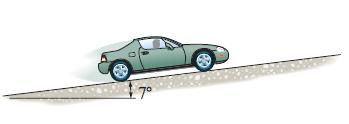
An automobile having a mass of 2 Mg travels up a 7° slope at a constant speed of v = 100 km/h If mechanical friction and wind resistance are neglected, determine the power developed by the engine if the automobile has an efficiency ε = 0.65.
Determine the power input for a motor necessary to lift 300 lb at a constant rate of 5 ft/s The efficiency of the motor is ε = 0.65.
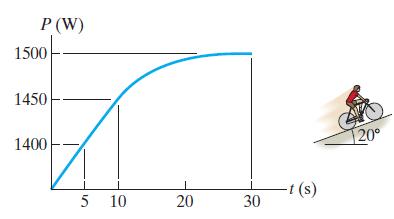
Using the biomechanical power curve shown, determine the maximum speed attained by the rider and his bicycle, which have a total mass of 92 kg, as the rider ascends the 20° slope starting from rest. P (W) 1500 1450 1400 5 10 1 20 30 -t (s) 20°
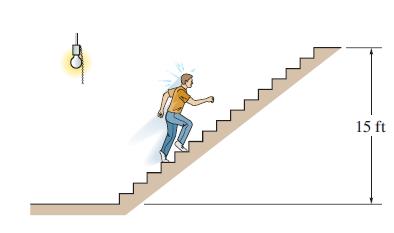
The man having a weight of 150 lb is able to run up a 15-ft-high flight of stairs in 4 s. Determine the power generated. How long would a 100-W light bulb have to burn to expend the same amount of energy? Conclusion: Please turn off the lights when they are not in use! 15 ft
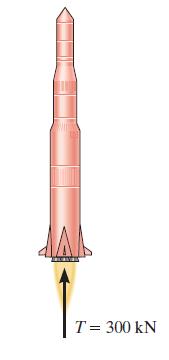
A rocket having a total mass of 8 Mg is fired vertically from rest. If the engines provide a constant thrust of T = 300 kN, determine the power output of the engines as a function of time. Neglect the effect of drag resistance and the loss of fuel mass and weight. T = 300 KN
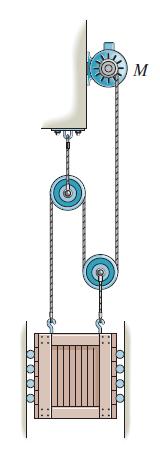
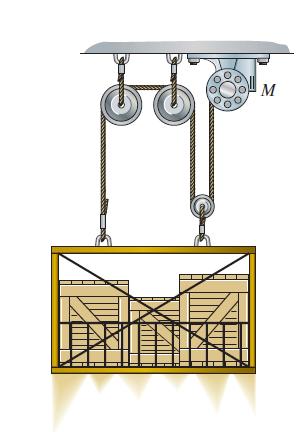
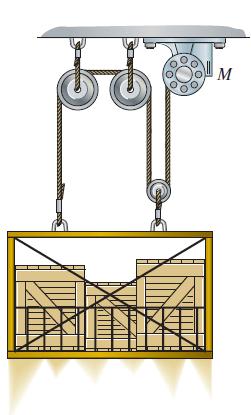
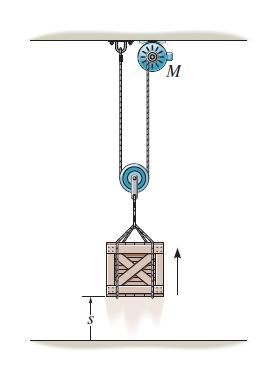
The 1000-lb elevator is hoisted by the pulley system and motor M. If the motor exerts a constant force of 500 lb on the cable, determine the power that must be supplied to the motor at the instant the load has been hoisted s = 15 ft starting from rest. The motor has an efficiency of ε = 0.65.
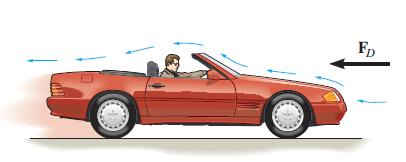
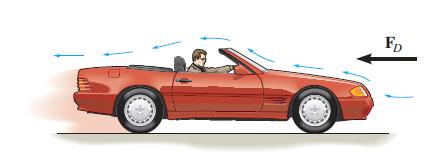
The sports car has a mass of 2.3 Mg and accelerates at 6 m/s², starting from rest. If the drag resistance on the car due to the wind is FD = (10v) N, where is the velocity in m/s, determine the power supplied to the engine when t = 5 s. The engine has a running efficiency of ε = 0.68. FD
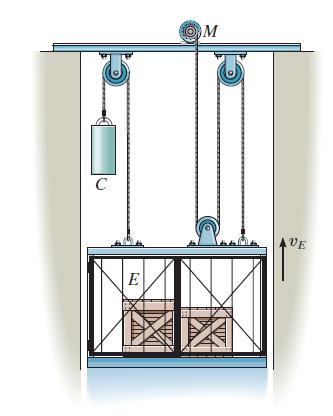
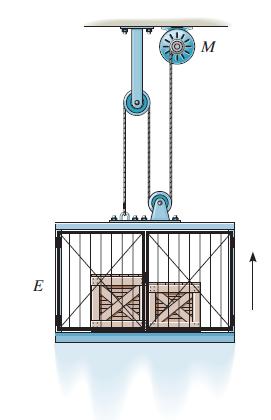
The elevator E and its freight have a total mass of 400 kg. Hoisting is provided by the motor M and the 60-kg block C. If the motor has an efficiency of ε = 0.6, determine the power that must be supplied to the motor when the elevator is hoisted upward at a constant speed of VE = 4 m/s. C E OM AVE
The motor is used to lift the loaded 500-kg elevator with a constant velocity vE = 8 m/s. If the motor draws 60 kW of electrical power, determine the motor’s efficiency. Neglect the mass of the pulleys and cable. 区 M
The Milkin Aircraft Co. manufactures a turbojet engine that is placed in a plane having a weight of 13000 lb. If the engine develops a constant thrust of 5200 lb, determine the power output of the plane when it is just ready to take off with a speed of 600 mi/h.
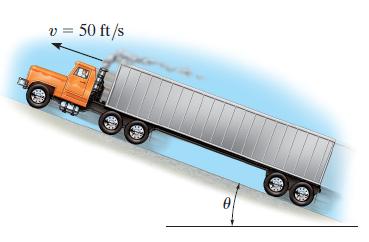
A truck has a weight of 25 000 lb and an engine which transmits a power of 350 hp to all the wheels.Assuming that the wheels do not slip on the ground, determine the angle θ of the largest incline the truck can climb at a constant speed of v = 50 ft/s. v = 50 ft/s (10)
The sports car has a mass of 2.3 Mg, and while it is traveling at 28 m/s the driver causes it to accelerate at 5 m/s2. If the drag resistance on the car due to the wind is FD = (0.3 v2)N, where v is the velocity in m/s, determine the power supplied to the engine at this instant. The engine has a
The 500-kg elevator starts from rest and moves upward with a constant acceleration ac = 2 m/s2. Determine the power output of the motor M when t = 3 s. Neglect the mass of the pulleys and cable. M
To dramatize the loss of energy in an automobile when it stops, consider a car having a weight of 5000 lb that is traveling at 35 mi/h. If the car is brought to a stop, determine how long a 100-W light bulb must burn to expend the same amount of energy. (1 mi = 5280 ft.)
An escalator is moving forward and upward with a speed of 2 ft/s. If the steps are 8 in. high and 15 in. in length, determine the required horsepower of a motor needed to lift an average load of 180 lb per step. The escalator rises to a height of 20 ft from the floor.
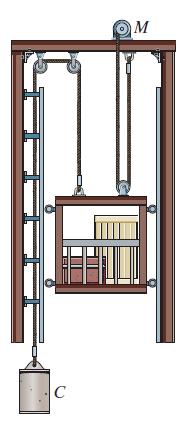
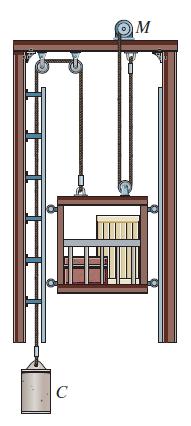
The material hoist and the load have a total mass of 800 kg and the counterweight C has a mass of 150 kg. At a given instant, the hoist has an upward velocity of 2 m/s and an acceleration of 1.5 m/s². Determine the power generated by the motor M at this instant if it operates with an efficiency of
The material hoist and the load have a total mass of 800 kg and the counterweight C has a mass of 150 kg. If the upward speed of the hoist increases uniformly from 0.5 m/s to 1.5 m/s in 1.5 s, determine the average power generated by the motor M during this time. The motor operates with an
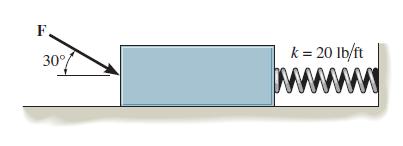
The 50-lb block rests on the rough surface for which the coeffi cient of kinetic friction is μk = 0.2. A force F = (40 + s2) lb, where s is in ft, acts on the block in the direction shown. If the spring is originally unstretched (s = 0) and the block is at rest, determine the power developed by
The material hoist and the load have a total mass of 800 kg and the counterweight C has a mass of 150 kg. At a given instant, the hoist has an upward velocity of 2 m/s and an acceleration of 1.5 m/s². Determine the power generated by the motor M at this instant if it operates with an efficiency of
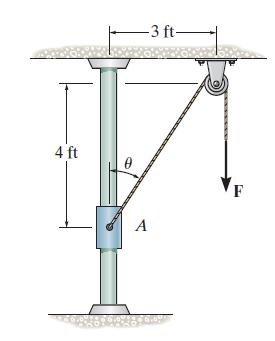
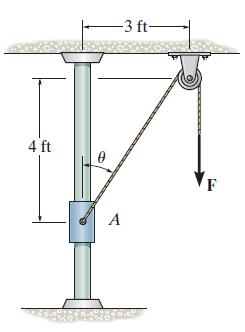
The 10-lb collar starts from rest at A and is lifted with a constant speed of 2 ft/s along the smooth rod. Determine the power developed by the force F at the instant shown. 4 ft 0 -3 ft- A
The motor M is used to hoist the 500-kg elevator upward with a constant velocity vE = 8 m/s. If the motor draws 60 kW of electrical power, determine the motor’s efficiency. Neglect the mass of the pulleys and cable. E M
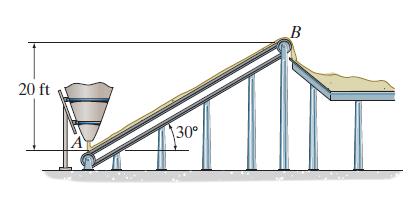
Sand is being discharged from the silo at A to the conveyor and transported to the storage deck at the rate of 360 000 lb/h. An electric motor is attached to the conveyor to maintain the speed of the belt at 3 ft/s. Determine the average power generated by the motor. 20 ft 30° B
The 10-lb collar starts from rest at A and is lifted by applying a constant vertical force of F = 25 lb to the cord. If the rod is smooth, determine the power developed by the force at the instant θ = 60°. 4 ft 0 3 ft- A F
The 50-lb crate is given a speed of 10 ft/s in t = 4 s starting from rest. If the acceleration is constant, determine the power that must be supplied to the motor when t = 2 s. The motor has an efficiency ε = 0.76. Neglect the mass of thepulley and cable. TW S M
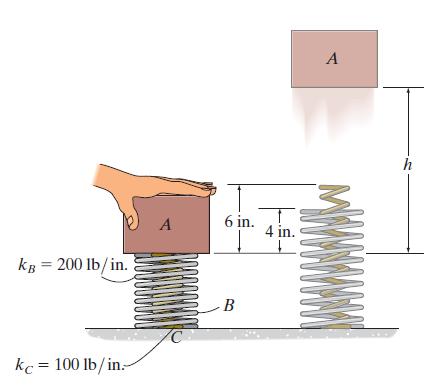
The 30-lb block A is placed on top of two nested springs B and C and then pushed down to the position shown. If it is then released, determine the maximum height h to which it will rise. KB = 200 lb/in. kc 100 lb/in. = A 6 in. B 4 in. A www h
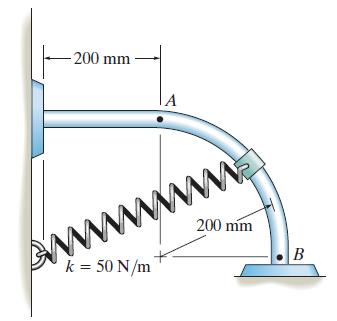
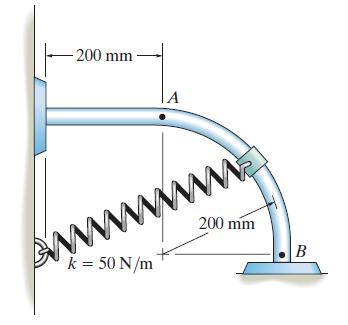
The 5-kg collar has a velocity of 5 m/s to the right when it is at A. It then travels down along the smooth guide. Determine the speed of the collar when it reaches point B, which is located just before the end of the curved portion of the rod. The spring has an unstretched length of 100 mm and B
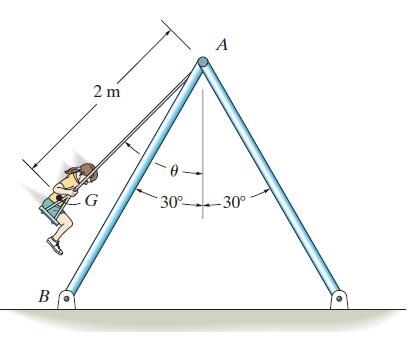
The girl has a mass of 40 kg and center of mass at G. If she is swinging to a maximum height defined by θ = 60°, determine the force developed along each of the four supporting posts such as AB at the instant θ = 0°. The swing is centrally located between the posts. B 2 m A -0- 30° -30°
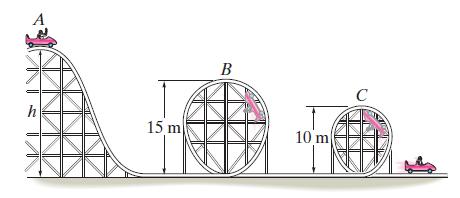
The roller coaster car has a mass of 700 kg, including its passenger. If it starts from the top of the hill A with a speed vA = 3 m/s, determine the minimum height h of the hill crest so that the car travels around the inside loops without leaving the track. Neglect friction, the mass of the
The 5-kg collar has a velocity of 5 m/s to the right when it is at A. It then travels along the smooth guide. Determine its speed when it reaches point B, which is located just before the end of the curved portion of the rod and the normal force it exerts on the rod at this point. The spring has an
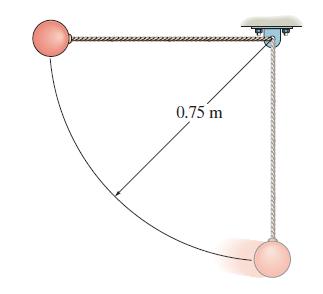
The bob of the pendulum has a mass of 0.2 kg and is released from rest when it is in the horizontal position shown. Determine its speed and the tension in the cord at the instant the bob passes through its lowest position. 0.75 m
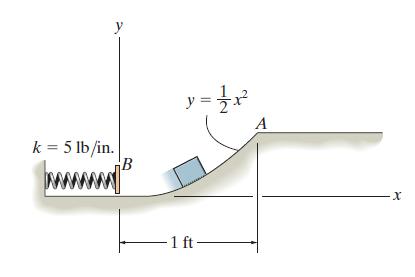
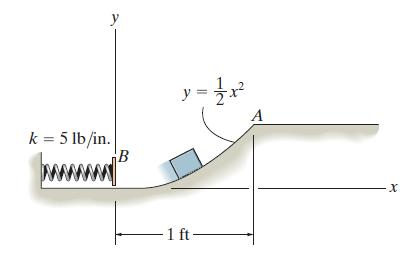
Determine the smallest amount the spring at B must be compressed against the 0.5-lb block so that when it is released from B it slides along the smooth surface and reaches point A. y k = 5 lb/in. wwwwwww B y = 1/²x² -1 ft- A
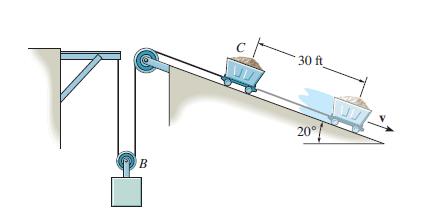
The car C and its contents have a weight of 600 lb, whereas block B has a weight of 200 lb. If the car is released from rest, determine its speed when it travels 30 ft down the 20 incline. To measure the gravitational potential energy, establish separate datums at the initial elevations of B and C.
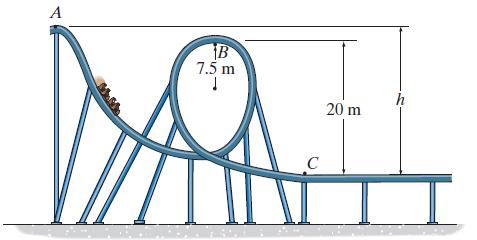
The roller coaster car having a mass m is released from rest at point A. If the track is to be designed so that the car does not leave it at B, determine the required height h. Also, find the speed of the car when it reaches point C. Neglect friction. A B 7.5 m J C 20 m h I
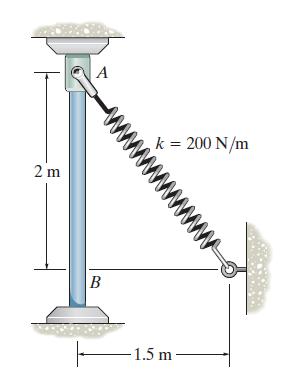
The spring has a stiffness k = 200 N/m and an unstretched length of 0.5 m. If it is attached to the 3-kg smooth collar and the collar is released from rest at A, determine the speed of the collar when it reaches B. Neglect the size of the collar. 2 m A B k = 200 N/m -1.5 m-
If the spring is compressed 3 in. against the 0.5-lb block and it is released from rest, determine the normal force of the smooth surface on the block when it reaches point x = 0.5 ft. k = 5 lb/in. www. B y = 1/² x ² -1 ft- A X
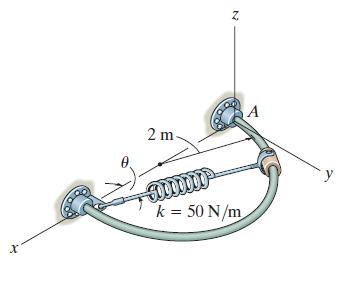
The spring has a stiffness k = 50 N/m and an unstretched length of 0.3 m. If it is attached to the 2-kg smooth collar and the collar is released from rest at A (θ = 0°), determine the speed of the collar when θ = 60°. The motion occurs in the horizontal plane. Neglect the size of the collar.
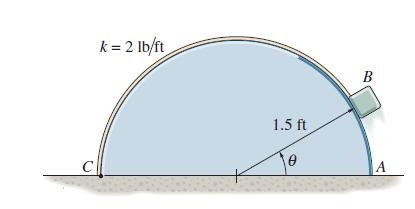
A 2-lb block rests on the smooth semicylindrical surface k at A. An elastic cord having a stiffness of k = 2 lb/ft is attached to the block at B and to the base of the semicylinder at C. If the block is released from rest at A, determine the longest unstretched length of the cord so the block
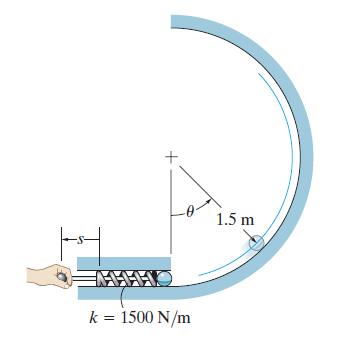
When s = 0, the spring on the firing mechanism is unstretched. If the arm is pulled back such that s = 100 mm and released, determine the speed of the 0.3-kg ball and the normal reaction of the circular track on the ball when θ = 60°. Assume all surfaces of contact to be smooth. Neglect the mass
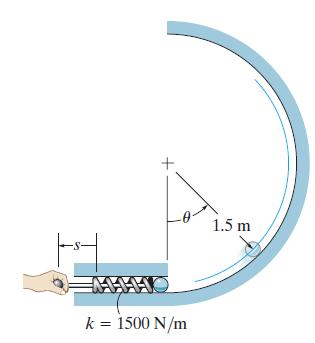
When s = 0, the spring on the firing mechanism is unstretched. If the arm is pulled back such that s = 100 mm and released, determine the maximum angle θ the 0.3-kg ball will travel without leaving the circular track. Assume all surfaces of contact to be smooth. Neglect the mass of the spring and
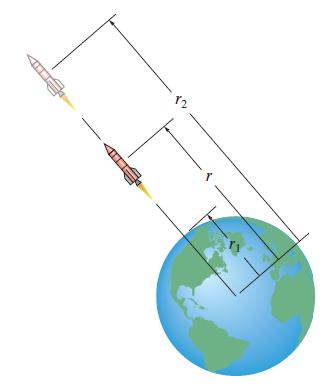
A rocket of mass m is fired vertically from the surface of the earth, i.e., at r = r1. Assuming that no mass is lost as it travels upward, determine the work it must do against gravity to reach a distance r2. The force of gravity is F = GMem/r2 (Eq. 13–1), where Me is the mass of the earth and r
If the mass of the earth is Me, show that the gravitationalpotential energy of a body of mass m located a distance rfrom the center of the earth is Vg = -GMem/r. Recall thatthe gravitational force acting between the earth and thebody is F= G(Mem/r2), Eq. 13-1. For the calculation, locatethe datum
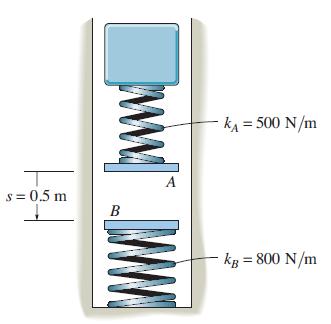
The block has a mass of 20 kg and is released from rest when s = 0.5 m. If the mass of the bumpers A and B can be neglected, determine the maximum deformation of each spring due to the collision. s = 0.5 m www. J B KA = 500 N/m kB = 800 N/m
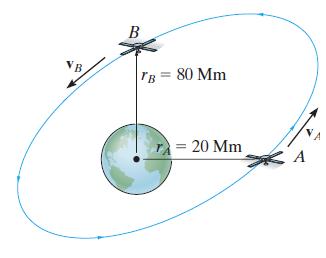
A 60-kg satellite travels in free flight along an elliptical orbit such that at A, where rA= 20 Mm, it has a speed vA = 40 Mm/h. What is the speed of the satellite when it reaches point B, where TB = 80 Mm? See Prob. 14-82, where Me = 5.976(1024) kg and G=66.73(10-¹2) m³/(kg. s²). B TB = 80 MM -
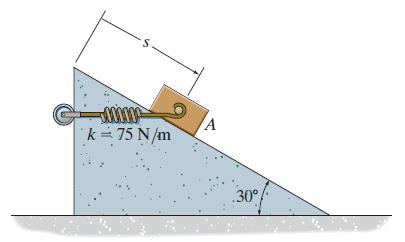
The spring is unstretched when s = 1m and the 15-kg block is released from rest at this position. Determine the speed of the block when s = 3m. The spring remains horizontal during the motion, and the contact surfaces between the block and the inclined plane are smooth. S k=75 N/m .30°
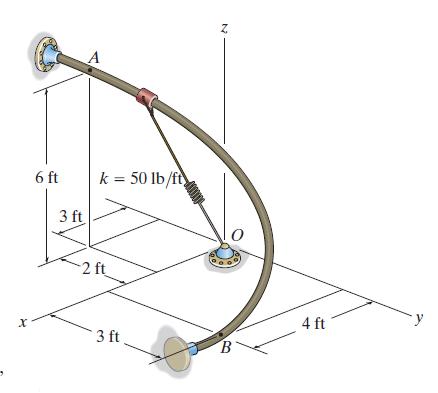
The 20-lb smooth collar is attached to the spring that has an unstretched length of 4 ft. If it is released from rest at position A, determine its speed when it reaches point B. X 6 ft 3 ft A k = 50 lb/ft 2 ft 3 ft N B 4 ft
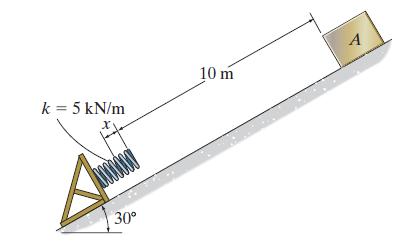
The 10-kg block A is released from rest and slides down the smooth plane. Determine the compression x of the spring when the block momentarily stops. k = 5 kN/m 000000 30° 10 m
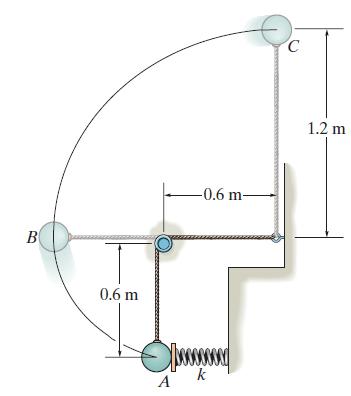
The 0.75-kg bob of a pendulum is fired from rest at position A by a spring which has a stiffness of k = 6 kN/m and is compressed 125 mm. Determine the speed of the bob and the tension in the cord when the bob is at positions B and C. Point B is located on the path where the radius of curvature is
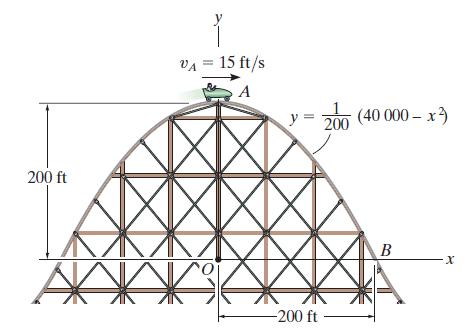
The roller coaster car has a speed of 15 ft/s when it is at the crest of a vertical parabolic track. Determine the car’s velocity and the normal force it exerts on the track when it reaches point B. Neglect friction and the mass of the wheels. The total weight of the car and the passengers is 350
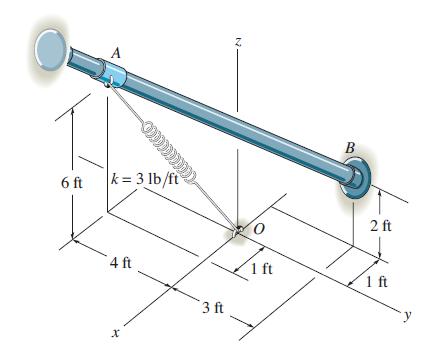
The spring has a stiffness k = 3 lb/ft and an unstretched length of 2 ft. If it is attached to the 5-lb smooth collar and the collar is released from rest at A, determine the speed of the collar just before it strikes the end of the rod at B. Neglect the size of the collar. 6 ft A k=3 lb/ft 4
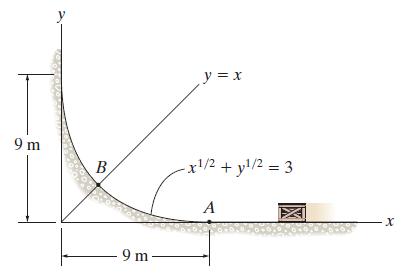
When the 5-kg box reaches point A it has a speed vA = 10 m/s. Determine the normal force the box exerts on the surface when it reaches point B. Neglect friction and the size of the box. 9 m B - 9 m y = x -x¹/2 + y²/2 = 3 A X
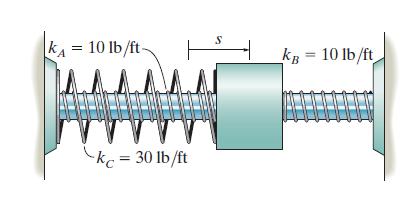
The 20-lb collar is constrained to move on the smooth rod. It is attached to the three springs which are unstretched when s = 0. If the collar is displaced s = 0.5 and released from rest, determine its speed when s = 0. KA = 10 lb/ft- -kc = 30 lb/ft KB = 10 lb/ft
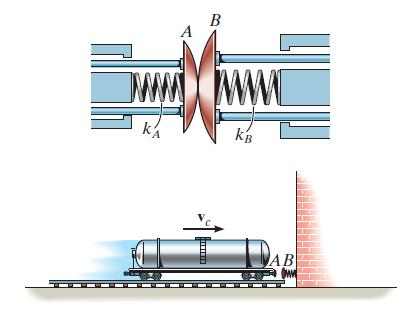
A tank car is stopped by two spring bumpers A and B, having a stiffness of KA = 15(10³) lb/ft and kB = 20(10³) lb/ft, respectively. Bumper A is attached to the car, whereas bumper B is attached to the wall. If the car has a weight of 25(10³) lb and is freely coasting at 3 ft/s, determine the
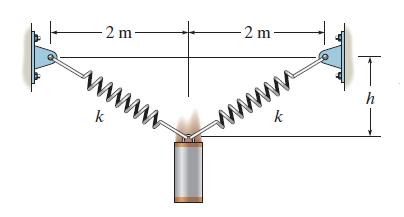
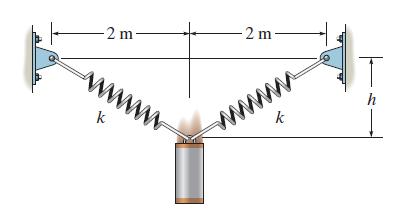
The cylinder has a mass of 20 kg and is released from rest when h = 0. Determine its speed when h = 3 m. Each spring has a stiffness k = 40 N/m and an unstretched length of 2 m. 2 m k www 2 m- k T h
If the 20-kg cylinder is released from rest at h = 0, determine the required stiffness k of each spring so that its motion is arrested or stops when h = 0.5 m. Each spring has an unstretched length of 1 m. 2 m www. k -2 m k h
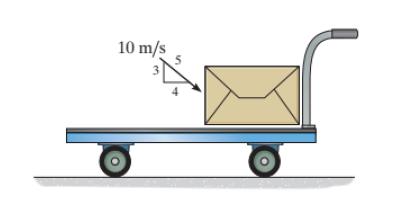
The cart and package have a mass of 20 kg and 5 kg, respectively. If the cart has a smooth surface and it is initially at rest, while the velocity of the package is as shown, determine the final common velocity of the cart and package after the impact. 10 m/s
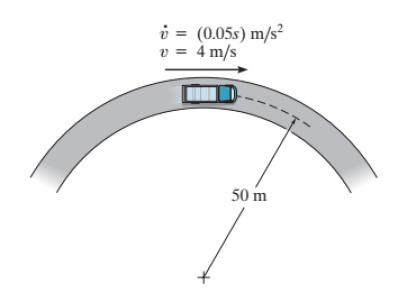
The truck travels in a circular path having a radius of 50 m at a speed of v = 4 m/s. For a short distance from s = 0, its speed is increased by v = (0.05s) m/s², where s is in meters. Determine its speed and the magnitude of its acceleration when it has moved s = 10 m. i = (0.05s) m/s² v = 4
The position of a particle along a straight line is given by s = (t³ - 9t² +15t) ft, where t is in seconds. Determine its maximum acceleration and maximum velocity during the time interval 0 ≤ t ≤ 10 s.
Car B turns such that its speed is increased by (at)B = (0.5et) m/s², where t is in seconds. If the car startsfrom rest when θ = 0°, determine the magnitudes of itsvelocity and acceleration when t = 2 s. Neglect the size ofthe car. A B 5 m
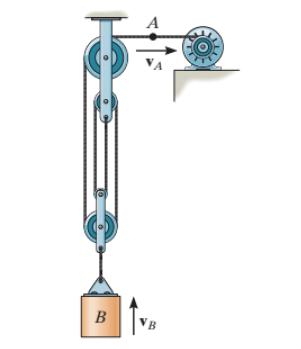
Determine the time needed for the load at B toattain a speed of 8 m/s, starting from rest, if the cable isdrawn into the motor with an acceleration of 0.2 m/s². B B
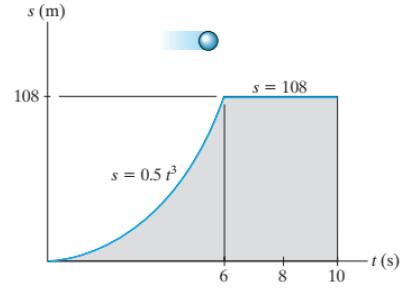
Due to an external force, the particle travels along a straight track such that its position is described by the s-t graph. Construct the v-t graph for the same time interval. Take v=0, a=0 when t=0. s (m) 108 s=0.5³ 6 s = 108 8 10 t(s)
Starting from rest, a particle moving in a straight line has an acceleration of a = (2t - 6) m/s2, where t is in seconds. What is the particle’s velocity when t = 6 s, and what is its position when t = 11 s?
If a particle has an initial velocity of v0 = 12 ft/s to the right, at s0 = 0, determine its position when t = 10 s, if a = 2 ft/s2 to the left.
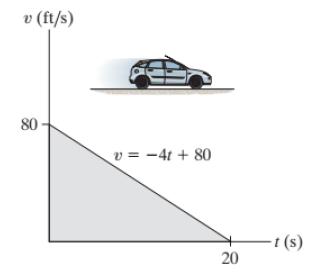
A van travels along a straight road with a velocity described by the graph. Construct the s-t and a-t graphs during the same period. Take s = 0 when t = 0. v (ft/s) 80 主 v=-4t+ 80 20 ·t(s)
A particle travels along a straight line with a velocity v = (12 - 3t2) m/s, where t is in seconds. When t = 1 s, the particle is located 10 m to the left of the origin. Determine the acceleration when t = 4 s, the displacement from t = 0 to t = 10 s, and the distance the particle travels during
A particle travels along a straight line with a constant acceleration. When s = 4 ft, v = 3 ft/s and when s = 10 ft, v = 8 ft/s. Determine the velocity as a function of position.
The velocity of a particle traveling in a straight line is given by v = (6t - 3t2) m/s, where t is in seconds. If s = 0 when t = 0, determine the particle’s deceleration and position when t = 3 s. How far has the particle traveled during the 3-s time interval, and what is its average speed?
A particle moving along a straight line is subjected to a deceleration a = (-2v³) m/s², where v is in m/s. If it has a velocity v = 8 m/s and a position s = 10m when t = 0, determine its velocity and position when t = 4 s.
A particle moves along a straight line such that its position is defined by s = (2t³ + 3t² - 12t - 10) m. Determine the velocity, average velocity, and the average speed of the particle when t = 3 s.
A particle is moving along a straight line such that its position is defined by s = (102 +20) mm, where t is in seconds. Determine (a) The displacement of the particleduring the time interval from t = 1s to t = 5s, (b) Theaverage velocity of the particle during this time
A particle moves along a straight path with an acceleration of a = (5/s) m/s2, where s is in meters. Determine the particle’s velocity when s = 2 m, if it is released from rest when s = 1 m.
A particle moves along a straight line with an acceleration of a = 5/(3s¹/3 + 5/2) m/s², where s is in meters. Determine the particle's velocity when s = 2 m, if it starts from rest when s = 1 m. Use a numerical method to evaluate the integral.
A particle travels along a straight-line path such that in 4 s it moves from an initial position sA = -8 m to a position sB = +3 m. T hen in another 5 s it moves from sB to sC = -6 m. Determine the particle’s average velocity and average speed during the 9-s time interval.
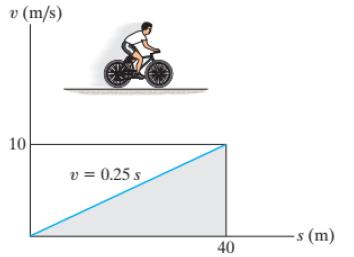
The rider begins to apply a force to the rear wheel of his bicycle, thereby initiating an acceleration. If his velocity is described by the v-s graph, construct the a-s graph for the same interval. v (m/s) 10 v = 0.25 s 40 -s (m)
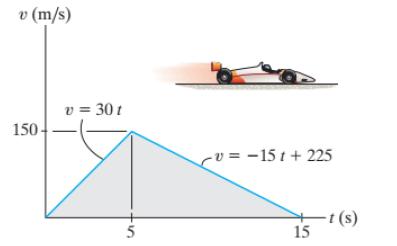
The dragster starts from rest and has a velocity described by the graph. Construct the s-t graph during the time interval 0 ≤ t ≤ 15 s. Also, determine the total distance traveled during this time interval. v (m/s) 150- v = 30 t 5 -v=-15t + 225 -t(s) 15
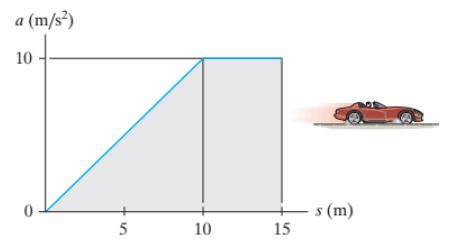
The sports car starts from rest and travels along a straight road. Its initial increasing acceleration is caused by the rear wheels of the car as shown on the graph. Construct the v-s graph. What is the velocity of the car when s=10 m and s=15m? a (m/s²) 10 5 10 15 s (m)
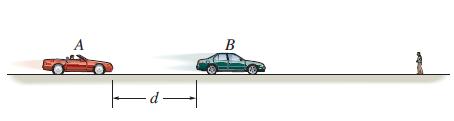
Car B is traveling a distance d ahead of car A. Both cars are traveling at 60 ft/s when the driver of B suddenly applies the brakes, causing his car to decelerate at 12 ft/s². It takes the driver of car A 0.75 s to react (this is the normal reaction time for drivers). When he applies his brakes,
The speed of a particle traveling along a straight line within a liquid is measured as a function of its position as v = (100 - s) mm/s, where s is in millimeters. Determine (a) The particle’s deceleration when it is located at point A, where sA = 75 mm, (b) The distance the particle
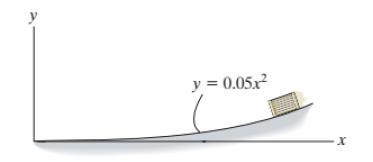
The box slides down the path described by theequation y = (0.05x²) m, where x is in meters. If the box hasx components of velocity and acceleration of vx, = -3 m/sand ax = -1.5 m/s² at x = 5 m, determine the y components of the velocity and the acceleration of the box at this instant. y =
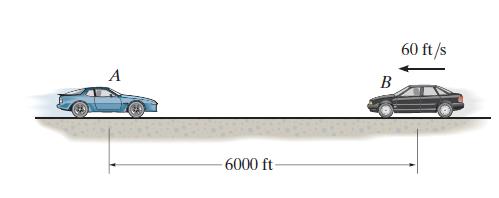
Car A starts from rest at t = 0 and travels along a straight road with a constant acceleration of 6 ft/s² until it reaches a speed of 80 ft/s. Afterwards it maintains this speed. Also, when t = 0, car B located 6000 ft down the road is traveling towards A at a constant speed of 60 ft/s. Determine
Tests reveal that a driver takes about 0.75 s before he or she can react to a situation to avoid a collision. It takes about 3 s for a driver having 0.1% alcohol in his system to do the same. If such drivers are traveling on a straight road at 30 mph (44 ft/s) and their cars can decelerate at 2
The sports car travels along the straight road such that v = 3√2100-s m/s, where s is in meters. Determine the time for the car to reach s = 60 m. How much time does it take to stop?
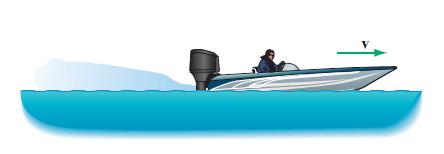
The acceleration of the boat is defined by a = (1.5 v1/2) m/s. Determine its speed when t = 4 s if it has a speed of 3 m/s when t = 0.
A ball is released from the bottom of an elevator which is traveling upward with a velocity of 6ft/s. If the ball strikes the bottom of the elevator shaft in 3 s, determine the height of the elevator from the bottom of the shaft at the instant the ball is released.Also, find the velocity of the
A particle is moving along a straight line with an initial velocity of 6 m/s when it is subjected to a deceleration of a = (-1.5v1/2) m/s2, where v is in m/s. Determine how far it travels before it stops. How much time does this take?
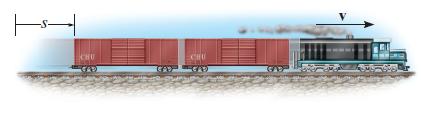
A freight train travels at v = 60(1 - e-t) ft/s, where t is the elapsed time in seconds. Determine the distance traveled in three seconds, and the acceleration at this time. sm
A particle moves along a straight path with an acceleration of a = (kt³+4) ft/s², where t is in seconds. Determine the constant k, knowing that v = 12 ft/s when t = 1 s, and that v=-2 ft/s when t = 2 s.
The velocity of a particle traveling along a straight line is v = (3t²- 6t) ft/s, where t is in seconds. If s = 4 ft when t = 0, determine the position of the particle when t = 4 s. What is the total distance traveled during the time interval t = 0 tot = 4 s? Also, what is the acceleration when t
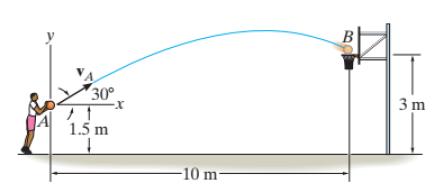
Determine the speed at which the basketball at A must be thrown at the angle of 30° so that it makes it to the basket at B. 30° -X 1.5 m -10 m- B 3m
A particle is moving along a straight line such that its acceleration is defined as a = (-2v) m/s2, where v is in meters per second. If v = 20 m/s when s = 0 and t = 0, determine the particle’s position, velocity, and accelerationas functions of time.
When a particle is projected vertically upward with an initial velocity of v0, it experiences an accelerationa = -(g + kv²), where g is the acceleration due to gravity,k is a constant, and is the velocity of the particle.Determine the maximum height reached by the particle.
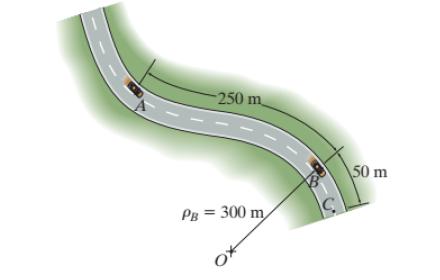
If the car decelerates uniformly along the curved road from 25 m/s at A to 15 m/s at C, determine the acceleration of the car at B. 250 m PB = 300 m 50 m
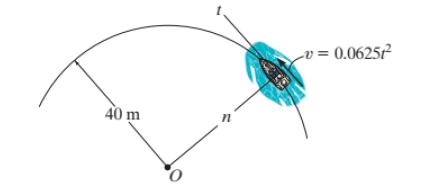
The boat is traveling along the circular path with a speed of v= (0.0625t2) m/s, where t is in seconds.Determine the magnitude of its acceleration when t = 10 s. 40 m -v = 0.0625f²
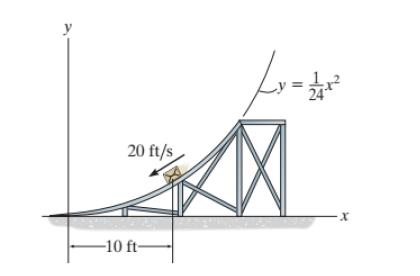
When x = 10 ft, the crate has a speed of 20 ft/s which is increasing at 6 ft/s². Determine the direction of the crate's velocity and the magnitude of its acceleration at this instant. 20 kt/s -10ft- ܀ X
When a particle falls through the air, its initial acceleration a = g diminishes until it is zero, and thereafter it falls at a constant or terminal velocity vf. If this variation of the acceleration can be expressed as a = (g/v²f) (v²f - v²), determine the time needed for the velocity to become
A train is initially traveling along a straight track at a speed of 90 km/h. For 6 s it is subjected to a constant deceleration of 0.5 m/s2, and then for the next 5 s it has a constant deceleration ac. Determine ac so that the train stops at the end of the 11-s time period.
Two cars A and B start from rest at a stop line. Car A has a constant acceleration of aA = 8 m/s2, while car B has an acceleration of aB = (2t3/2) m/s2, where t is in seconds. Determine the distance between the cars when A reaches a velocity of vA = 120 km/h.
A sphere is fired downward into a medium with an initial speed of 27 m/s. If it experiences a deceleration of a = (-6t) m/s², where t is in seconds, determine the distance traveled before it stops.
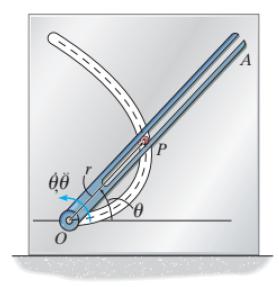
Peg P is driven by the fork link OA along the curved path described by r= (2θ) ft. At the instant 0 = π/4 rad, the angular velocity and angular acceleration of the link are θ́ = 3 rad/s and θ̈ = 1 rad/s². Determine the magnitude of the peg's acceleration at this instant. ӨӨ
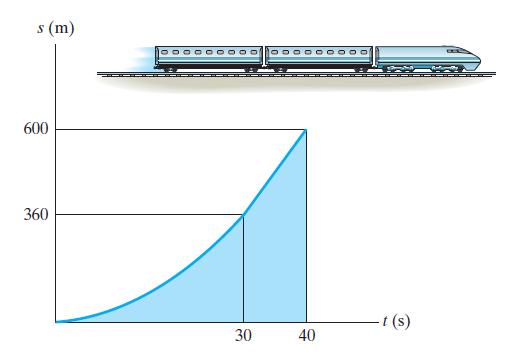
The s-t graph for a train has been experimentally determined. From the data, construct the v-t and a-t graphs for the motion; 0 ≤ t ≤ 40 s. For 0 ≤ t < 30 s, the curve is s = (0.41²) m, and then it becomes straight for t > 30 s. s (m) 600 360 30 40 -t (s) CEL H
Showing 1400 - 1500
of 2426
First
8
9
10
11
12
13
14
15
16
17
18
19
20
21
22
Last
Step by Step Answers

 Get 50% OFF
Claim Now
Get 50% OFF
Claim Now