New Semester
Started
Get
50% OFF
Study Help!
--h --m --s
Claim Now
Question Answers
Textbooks
Find textbooks, questions and answers
Oops, something went wrong!
Change your search query and then try again
S
Books
FREE
Study Help
Expert Questions
Accounting
General Management
Mathematics
Finance
Organizational Behaviour
Law
Physics
Operating System
Management Leadership
Sociology
Programming
Marketing
Database
Computer Network
Economics
Textbooks Solutions
Accounting
Managerial Accounting
Management Leadership
Cost Accounting
Statistics
Business Law
Corporate Finance
Finance
Economics
Auditing
Tutors
Online Tutors
Find a Tutor
Hire a Tutor
Become a Tutor
AI Tutor
AI Study Planner
NEW
Sell Books
Search
Search
Sign In
Register
study help
engineering
engineering mechanics statics
Engineering Mechanics Statics & Dynamics 15th Edition Russell C. Hibbeler - Solutions
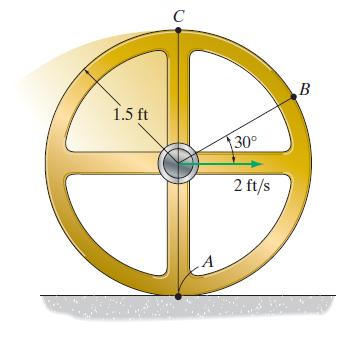
The center of the wheel is moving to the right with a speed of 2 ft/s. If no slipping occurs at the ground, A, determine the velocity of points B and C. 1.5 ft C A 30° 2 ft/s B
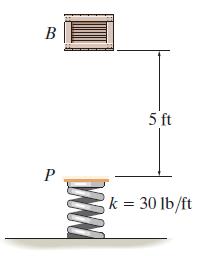
The 5-lb box B is dropped from rest 5 ft from the top of the 10-lb plate P, which is supported by the spring having a stiffness of k = 30 lb/ft. If e = 0.6 between the box and plate, determine the maximum compression imparted to the spring. Neglect the mass of the spring. B P www 5 ft k = 30 lb/ft
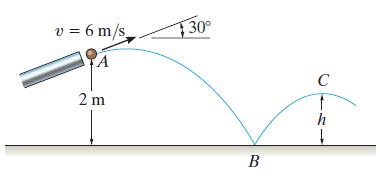
The 0.5-kg ball is fired from the tube at A with a velocity of v = 6 m/s. If the coefficient of restitution between the ball and the surface is e = 0.8, determine the height h after it bounces off the surface. v = 6 m/s 2 m 130⁰ B C 1 h ļ
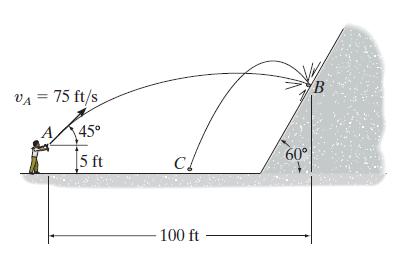
Using a slingshot, the boy fires the 0.2-lb marble at the concrete wall, striking it at B. If the coefficient of restitution between the marble and the wall is e = 0.5, determine the speed of the marble after it rebounds from the wall. VA = 75 ft/s A 45° 5 ft 100 ft 60° B
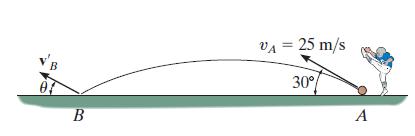
A 300-g ball is kicked with a velocity of vA = 25 m/s at point A as shown. If the coefficient of restitution between the ball and the field is e = 0.4, determine the magnitude and direction θ of the velocity of the rebounding ball at B. B B UA = 25 m/s 30° A
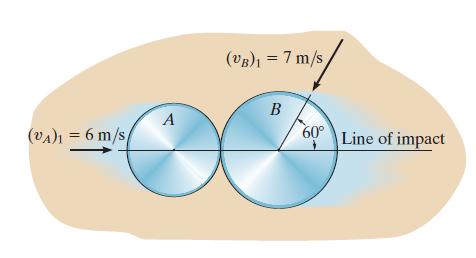
The two disks A and B have a mass of 3 kg and 5 kg, respectively. If they collide with the initial velocities shown, determine their velocities just after impact. The coefficient of restitution is e = 0.65. (VA)1 = 6 m/s/ A (VB)1 = 7 m/s/ B 60° Line of impact
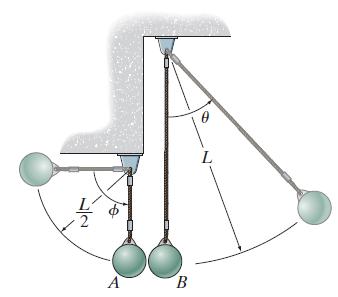
Two identical balls A and B of mass m are suspended from cords of length L/2 and L, respectively. Ball A is released from rest when ϕ = 90° and swings down to ϕ = 0°, where it strikes B. Determine the speed of each ball just after impact and the maximum angle θ through which B will swing. The
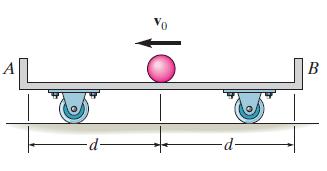
A ball of negligible size and mass m is given a velocity of v0 on the center of the cart which has a mass M and is originally at rest. If the coefficient of restitution between the ball and walls A and B is e, determine the velocity of the ball and the cart just after the ball strikes A. Also,
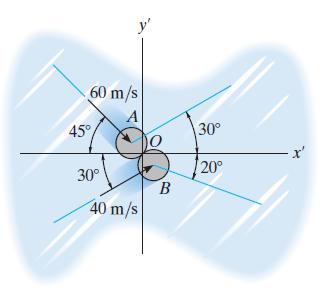
The two hockey pucks A and B each have a mass of 250 g. If they collide at O and are deflected along the colored paths, determine their speeds just after impact. Assume that the icy surface over which they slide is smooth. Since the y' axis is not along the line of impact, apply the conservation of
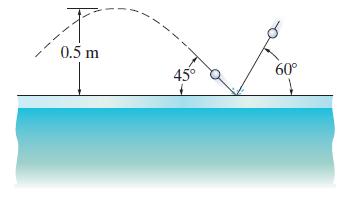
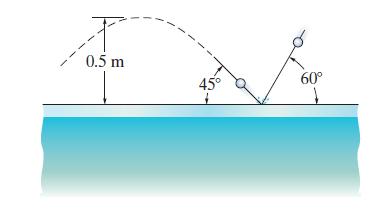
It is observed that hailstones strike the surface of a frozen lake at an angle of 60° with the horizontal and rebound at an angle of 45°. Determine the coefficient of restitution. 不 0.5 m 45° 60°
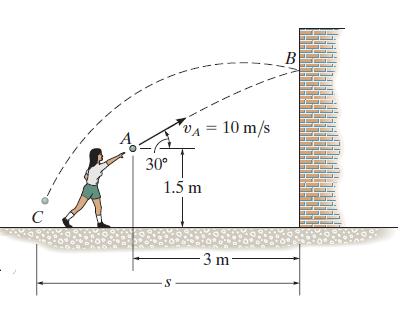
The girl throws the 0.5-kg ball toward the wall with an initial velocity vA = 10 m/s. Determine (a) The velocity at which it strikes the wall at B, (b) The velocity at which it rebounds from the wall if the coefficient of restitution e = 0.5, and (c) The distance s from the wall to
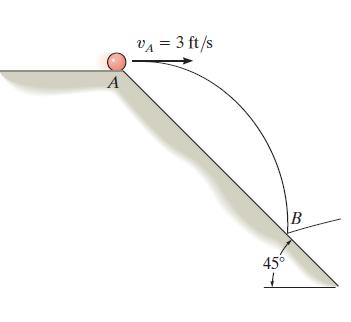
The 0.2-lb ball bearing travels over the edge A with a velocity of vA = 3 ft/s. Determine the speed at which it rebounds from the smooth inclined plane at B.Take e = 0.8. V₁ = 3 ft/s 45° B
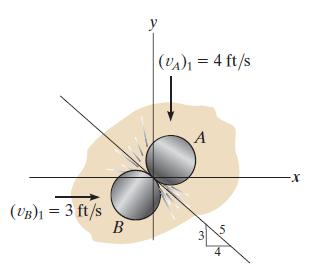
Two disks A and B each have a weight of 2 lb and the initial velocities shown just before they collide. If the coefficient of restitution is e = 0.5, determine their speeds just after impact. (UB)1 = 3 ft/s B (VA)1 = 4 ft/s A in. -X
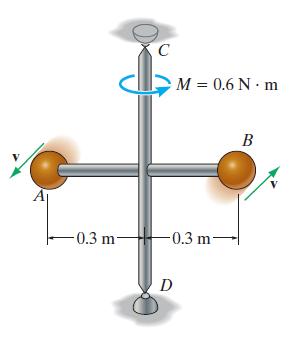
The two spheres A and B each have a mass of 400 g. The spheres are fixed to the horizontal rods and their initial velocity is 2 m/s. If a couple moment of M = 0.6 N · m is applied to the frame, determine the speed of the spheres in 3 s. The mass of the supporting frame is negligible and it is free
If the hailstones in Prob. 15–87 rise to a height of 0.5 m after rebounding, determine their velocity just before impact. Prob. 15–87It is observed that hailstones strike the surface of a frozen lake at an angle of 60° with the horizontal and rebound at an angle of 45°. Determine the
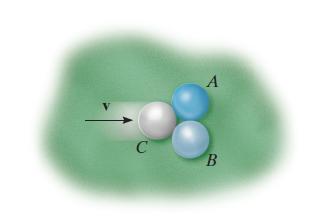
The two billiard balls A and B are originally in contact with one another when a third ball C strikes each of them at the same time as shown. If ball C remains at rest after the collision, determine the coefficient of restitution.All the balls have the same mass. Neglect the size of each ball.
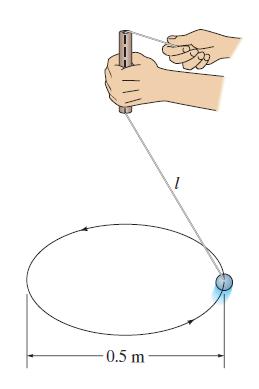
The 2-kg ball rotates around a 0.5-m-diameter circular path with a constant speed. If the cord length is shortened from 1 = 1 m to ∫' = 0.5 m, by pulling the cord through the tube, determine the new diameter of the path d'. Also, what is the tension in the cord in each case? -0.5 m 1
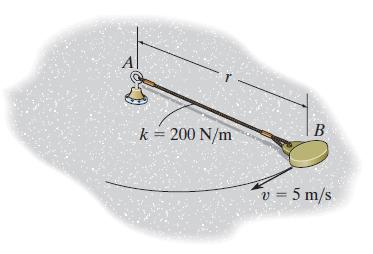
At the instant r = 1.5 m, the 5-kg disk is given a speed of v = 5 m/s, perpendicular to the elastic cord. Determine the speed of the disk and the rate of shortening of the elastic cord at the instant r = 1.2 m. The disk slides on the smooth horizontal plane. Neglect its size. The cord has an
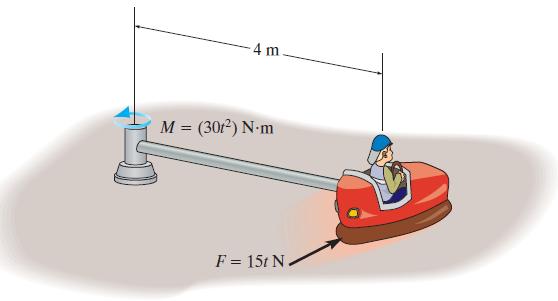
If the rod of negligible mass is subjected to a couple moment of M = (30t2) N·m and the engine of the carsupplies a traction force of F = (15t) N to the wheels,where t is in seconds, determine the speed of the car at theinstant t = 5 s. The car starts from rest. The total mass ofthe car and rider
The chute is used to divert the flow of water, Q = 0.6 m³/s. If the water has a cross-sectional area of 0.05 m², determine the force components at the pin D and roller C necessary for equilibrium. Neglect the weight of the chute and weight of the water on the chute. ρw = 1 Mg/m³. 0.12 m- 2
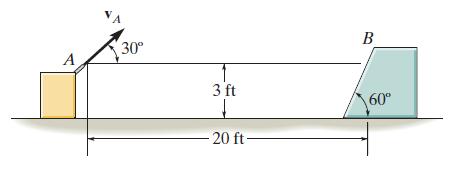
The fountain shoots water in the direction shown. If the water is discharged at 30° from the horizontal, and the cross-sectional area of the water stream is approximately 2 in2, determine the force it exerts on the concrete wall at B. γw = 62.4 lb/ft3. A VA 30º 3 ft -20 ft- B 60⁰
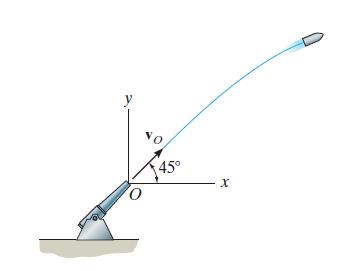
The projectile having a mass of 3 kg is fired from a cannon with a muzzle velocity of v0 = 500 m/s. Determine the projectile’s angular momentum about point O at the instant it is at the maximum height of its trajectory. 0 45⁰ X
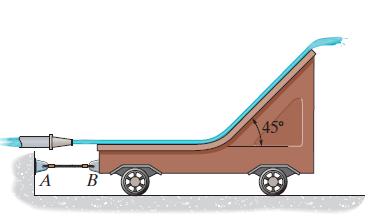
Water is discharged from a nozzle with a velocity of 12 m/s and strikes the blade mounted on the 20-kg cart. Determine the tension developed in the cord, needed to hold the cart stationary, and the normal reaction of the wheels on the cart. The nozzle has a diameter of 50 mm and the density of
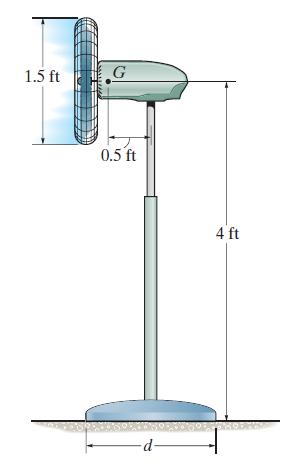
The fan blows air at 6000 ft3/min. If the fan has a weight of 30 lb and a center of gravity at G, determine the smallest diameter d of its base so that it will not tip over. The specific weight of air is γα = 0.076 lb/ft3. 1.5 ft G 0.5 ft 4 ft
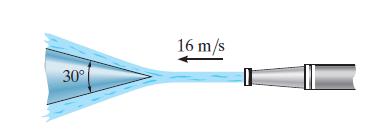
Water is discharged at 16 m/s against the fixed cone diffuser. If the opening diameter of the nozzle is 40 mm, determine the horizontal force exerted by the water on the diffuser. ρw = 1 Mg/m3. 30° 16 m/s
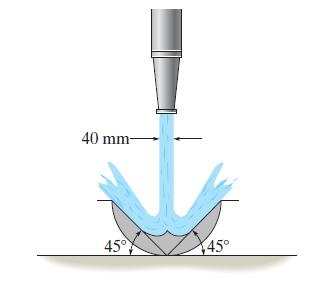
The nozzle has a diameter of 40 mm. If it discharges water uniformly with a downward velocity of 20 m/s against the fixed blade, determine the vertical force exerted by the water on the blade. ρw = 1 Mg/m3. 40 mm- 45° 45°
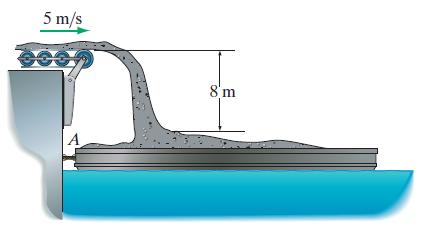
Aggregates fall off the conveyor belt at 500 kg/s and into the barge. Determine the force the rope at A exerts on the barge to hold it in place. 5 m/s A 8'm
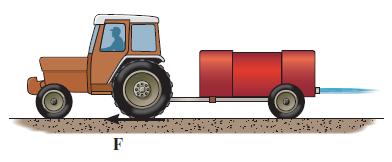
The tractor together with the empty tank has a total mass of 4 Mg. The tank is filled with 2 Mg of water. The water is discharged at a constant rate of 50 kg/s with a constant velocity of 5 m/s, measured relative to the tractor. If the tractor starts from rest, and the rear wheels provide a
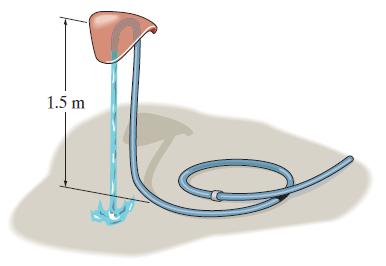
The toy sprinkler for children consists of a 0.2-kg cap and a hose that has a mass per length of 30 g/m. Determine the required rate of flow of water through the 5-mm-diameter tube so that the sprinkler will lift 1.5 m from the ground and hover from this position. Neglect the weight of the water in
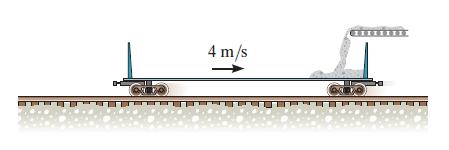
Sand drops onto the 2-Mg empty rail car at 50 kg/s from a conveyor belt. If the car is initially coasting at 4 m/s, determine the speed of the car as a function of time. 4 m/s
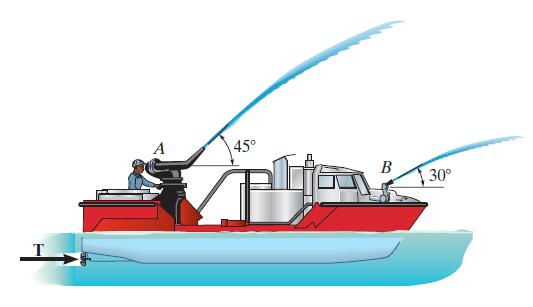
The fireboat is equipped with two water cannons. The one at A has a nozzle diameter of 6 in, and can pump 3000 gal/min, and the one at B has a nozzle diameter of 3 in. and can pump 1000 gal/min. Determine the horizontal thrust T that the propeller must exert on the boat in order to hold the boat
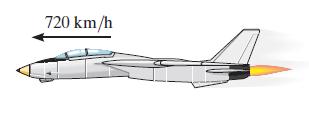
The jet is traveling at a speed of 720 km/h. If the fuel is being spent at 0.8 kg/s, and the engine takes in air at 200 kg/s, whereas the exhaust gas (air and fuel) has a relative speed of 12,000 m/s, determine the acceleration of the plane at this instant. The drag resistance of the air is FD =
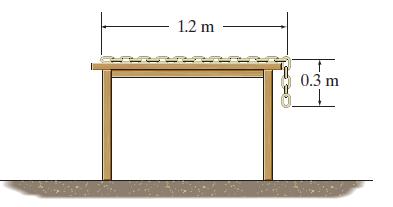
The 1.5-m-long smooth chain hangs over the edge of the table. If the chain is released from rest, determine its speed just after the last link clears the table. The chain has a mass per unit length of 6 kg/m. 1.2 m - 1 0.3 m
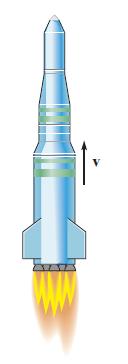
A rocket is in deep space, and on earth it has an empty weight of 500 lb and carries 300 lb of fuel. If the fuel is burned at the rate of 15 lb/s and ejected with a relative velocity of 4400 ft/s, determine the maximum speed attained by the rocket starting from rest, while it is in deep space.
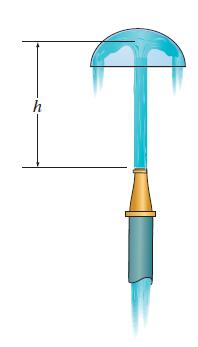
The hemispherical bowl of mass m is held in equilibrium by the vertical jet of water discharged through a nozzle of diameter d. If the discharge of the water through the nozzle is Q, determine the height h at which the bowl is suspended. The water density is ρw. Neglect the weight of the water
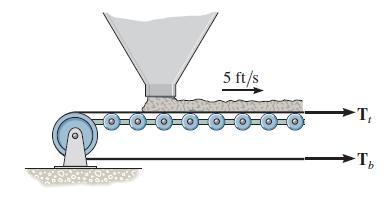
The bin deposits gravel onto the conveyor belt at the rate of 1500 lb/min. If the speed of the belt is 5 ft/s, determine how much greater the tension in the top portion of the belt must be than that in the bottom portion in order to pull the belt forward. 5 ft/s 0-0-0-0-0-0-0-0 T₁ -Tb
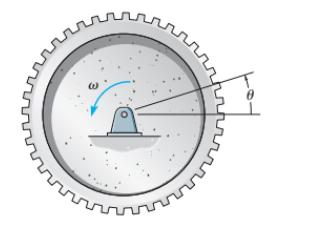
When the gear rotates 20 revolutions, it achieves an angular velocity of ε = 30 rad/s, starting from rest.Determine its constant angular acceleration and the timerequired. Մանր ստ www դդորր՝
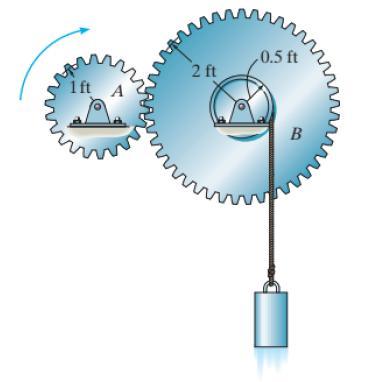
The hoisting gear A has an initial angular velocity of 60 rad/s and a constant deceleration of 1 rad/s². Determine the velocity and deceleration of the block which is being hoisted by the hub on gear B when t = 3 s. ми ift A m mm 2 ft 0.5 ft B wwwwww.
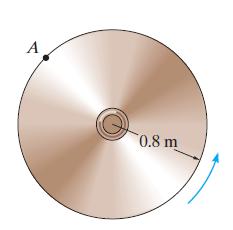
The angular velocity of the disk is defined by ω = (5t2 + 2) rad/s, where t is in seconds. Determine the magnitudes of the velocity and acceleration of point A on the disk when t = 0.5 s. A 0.8 m
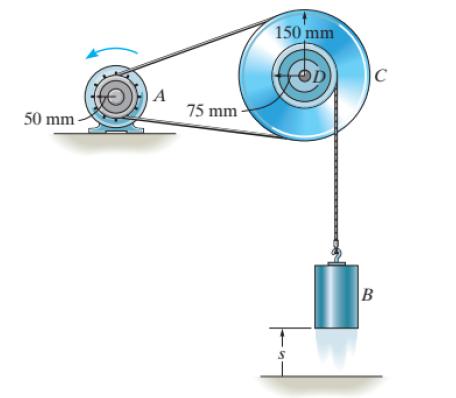
Starting at (ωA)0 = 3 rad/s, when θ = 0, s = 0, pulley A is given an angular acceleration α = (0.6θ) rad/s², where θ is in radians. Determine the speed of block B when it has risen s = 0.5 m. The pulley has an inner hub D which is fixed to C and turns with it. 50 mm- |A 75 mm- 150 mm C B
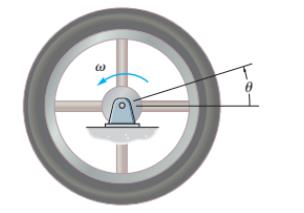
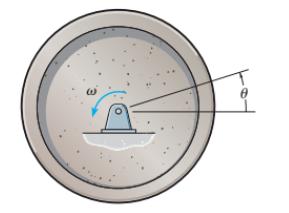
The flywheel rotates with an angular velocity of ω = (4 θ¹/2) rad/s, where θ is in radians. Determine the time it takes to achieve an angular velocity of ω = 150 rad/s. When t = 0, θ = 1 rad. W
The flywheel rotates with an angular velocity of w= (0.005θ²) rad/s, where is in radians. Determinethe angular acceleration when the wheel has rotated20 revolutions. 0
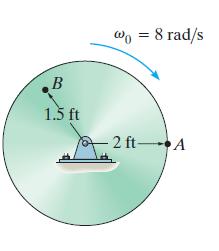
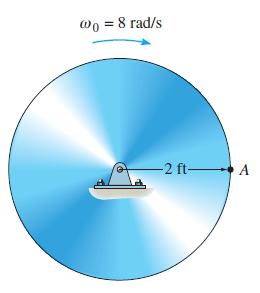
The disk is originally rotating at ω0 = 8 rad/s. If it is subjected to a constant angular acceleration of α = 20 rad/s2, determine the magnitudes of the velocity and the n and t components of acceleration of point A at the instant t = 0.5 s. B 1.5 ft wo = 8 rad/s -2 ft- A
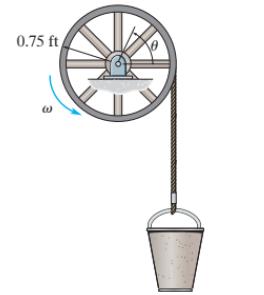
The bucket is hoisted by the rope that wraps around a drum wheel. If the angular displacement of the wheel is θ = (0.5t³ + 15t) rad, where t is in seconds, determine the velocity and acceleration of the bucket when t = 3 s. 0.75 ft W
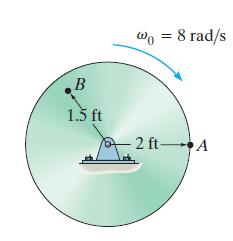
The disk is originally rotating at ω0 = 8 rad/s. If it is subjected to a constant angular acceleration of α = 6 rad/s2, determine the magnitudes of the velocity and the n and t components of acceleration of point B just after the wheel undergoes 2 revolutions. B 1.5 ft w = 8 rad/s -2 ft A
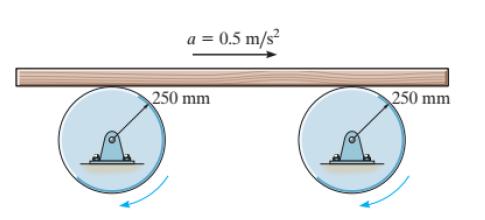
At the instant shown, the board has an accelerationof 0.5 m/s² to the right, while at the same instant pointson the outer rim of each drum have an acceleration witha magnitude of 3 m/s². If the board does not slip on thedrums, determine its speed due to the motion. a = 0.5 m/s² 250 mm 250 mm
The angular acceleration of the disk is defined by α = 3t2 + 12 rad/s, where t is in seconds. If the disk is originally rotating at ω0 = 12 rad/s, determine the magnitude of the velocity and the n and t components of acceleration of point A on the disk when t = 2 s.
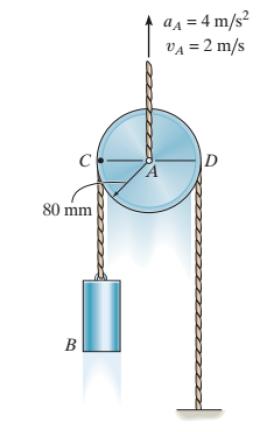
The center of the pulley is being lifted vertically with an acceleration of 4 m/s² at the instant it has a velocity of 2 m/s. If the cable does not slip on the pulley's surface, determine the accelerations of the cylinder B and point C on the pulley. C 80 mm B a₁ = 4 m/s² VA = 2 m/s D
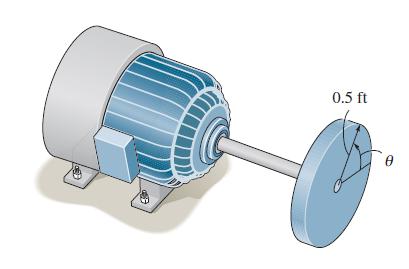
The disk is driven by a motor such that the angular position of the disk is defined by θ = (20t + 4t2) rad where t is in seconds. Determine the number of revolutions, the angular velocity, and angular acceleration of the disk when t = 90 s. 0.5 ft
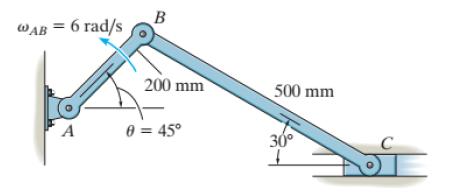
If bar AB has an angular velocity ωAB = 6 rad/s, determine the velocity of the slider block C at the instant shown. WAB = 6 rad/s A B 200 mm 0 = 45° 500 mm 30°
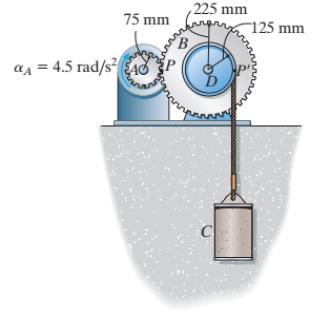
For a short period of time, the motor turns gear A with a constant angular acceleration of αΑ = 4.5 rad/s², starting from rest. Determine the velocity of the cylinder and the distance it travels in three seconds. The cord is wrapped around the drum D which is rigidly attached to gear B. α = 75
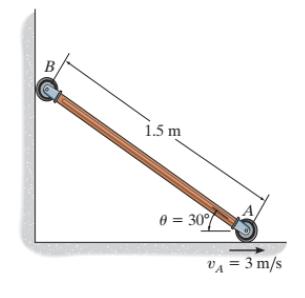
If roller A moves to the right with a constant velocity of VΑ = 3 m/s, determine the angular velocity of the link and the velocity of roller B at the instant θ = 30°. B 1.5 m 0 = 30% VA = 3 m/s
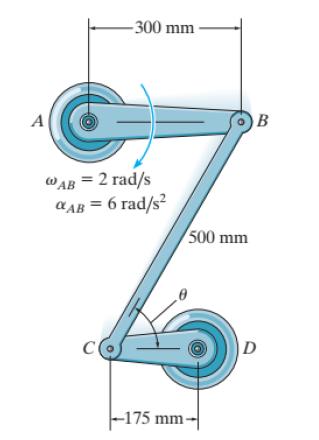
At the instant shown, link AB has an angular velocity ωAB = 2 rad/s and an angular acceleration αAB = 6 rad/s². Determine the acceleration of the pin at C and the angular acceleration of link CB at this instant, when θ = 60°. -300 mm A G @AB = 2 rad/s αAB = 6 rad/s² 500 mm --175 mm- B D
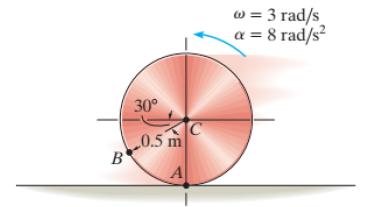
The disk is moving to the left such that it has an angular acceleration α = 8 rad/s² and angular velocity ω = 3 rad/s at the instant shown. If it does not slip at A, determine the acceleration of point B. B 30° 0.5 m A C w = 3 rad/s a = 8 rad/s²
A wheel has an angular acceleration of α = (0.5 θ) rad/s², where θ is in radians. Determine the magnitude of the velocity and acceleration of a point P located on its rim after the wheel has rotated 2 revolutions. The wheel has a radius of 0.2 m and starts when θ = 0, ω0 = 2 rad/s.
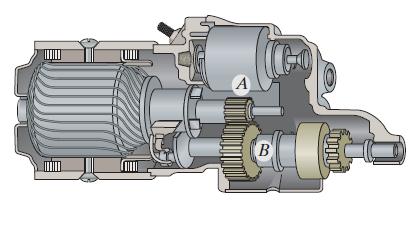
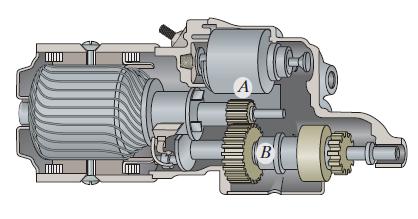
For a short time, gear A of the automobile starter rotates with an angular acceleration of αA = (450t2 + 60) rad/s2, where t is in seconds. Determine the angular velocity and angular displacement of gear B when t = 2 s, starting from rest. The radii of gears A and B are 10 mm and 25 mm,
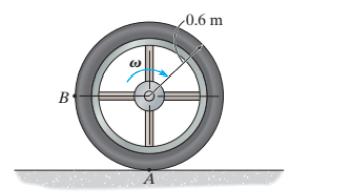
The wheel rolls without slipping with an angular velocity of ω = 10 rad/s. Determine the magnitude of the velocity of point B at the instant shown. B 0.6 m
A wheel has an initial angular velocity of 10 rev/s and a constant angular acceleration of 3 rad/s2. Determine the number of revolutions required for the wheel to have an angular velocity of 20 rev/s. What time is required?
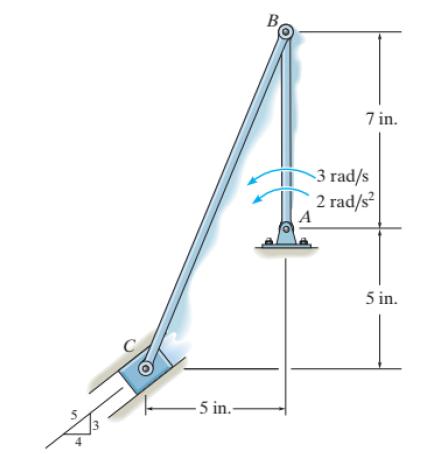
At the given instant member AB has the angular motions shown. Determine the velocity and acceleration of the slider block C at this instant. -5 in.- B 7 in. -3 rad/s 2 rad/s² A 5 in.
For a short time, gear Aof the automobile starter rotates with an angular acceleration of αA = (50ω1/2) rad/s2, where is in . Determine the angular velocity of gear B after gear A has rotated 50 rev, starting from rest. The radii of gears A and B are 10 mm and 25 mm, respectively. A В'
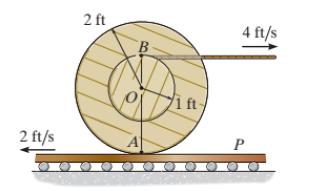
Determine the angular velocity of the spool. The cable wraps around the inner core, and the spool does not slip on the platform P. 2 ft/s 2 ft B ift- 4 ft/s P
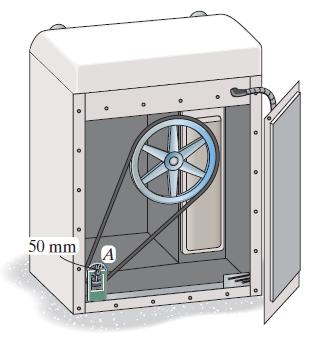
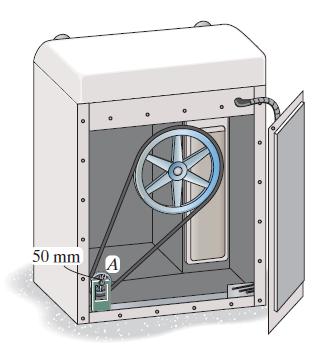
The 50-mm-radius pulley A of the clothes dryer rotates with an angular acceleration of αA = (27θ1/2A ) rad/s2, where θA is in radians. Determine its angular acceleration when t = 1 s, starting from rest. 50 mm A Pan
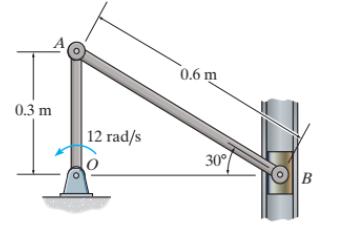
If crank OA rotates with an angular velocity of ω = 12 rad/s, determine the velocity of piston B and the angular velocity of rod AB at the instant shown. 0.3 m 12 rad/s 0.6 m 30° B
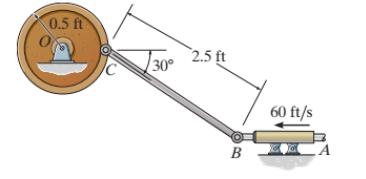
If rod AB slides along the horizontal collar with a velocity of 60 ft/s, determine the angular velocity of link BC and the velocity of point C at the instant shown. 0.5 ft 30° 2.5 ft B 60 ft/s A
If the 50-mm-radius motor pulley A of the clothes dryer rotates with an angular acceleration of αA = (10 + 50t) rad/s2, where t is in seconds, determine its angular velocity when t = 3 s, starting from rest. 50 mm A
The disk is originally rotating at ω0 = 8 rad/s. If it is subjected to a constant angular acceleration αc = 6 rad/s², determine the magnitudes of the velocity and the n and t components of acceleration of point A at the instant t = 3 s. @0 = 8 rad/s 2 ft- A
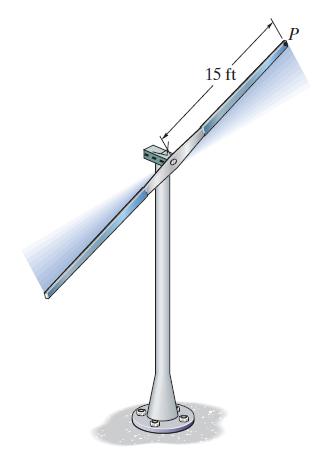
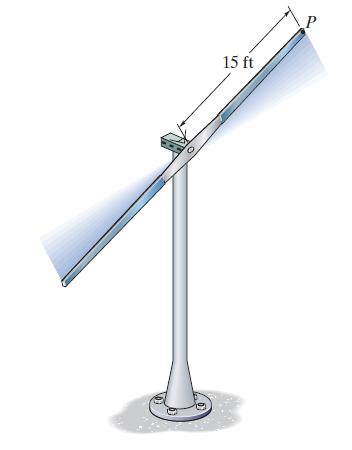
The blade on the horizontal-axis windmill is turning with an angular velocity of ω0 = 2 rad/s. Determine the distance point P on the tip of the blade has traveled if the blade attains an angular velocity of ω = 5 rad/s in 3 s. The angular acceleration is constant. Also, what is the magnitude of
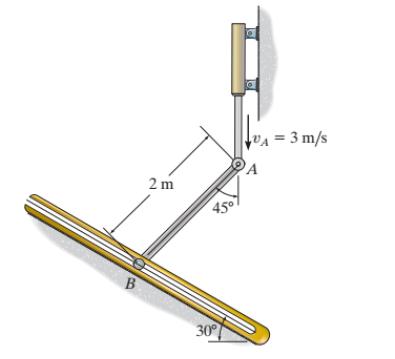
End A of the link has a velocity of vΑ = 3 m/s. Determine the velocity of the peg at B at this instant. The peg is constrained to move along the slot. B 2 m 45° 30° VA = 3 m/s A
The blade on the horizontal-axis windmill is turning with an angular velocity of ω0 = 2 rad/s. If it is given an angular acceleration of αc = 0.6 rad/s², determine the angular velocity and the magnitude of acceleration of point P on the tip of the blade when t = 3 s. 15 ft
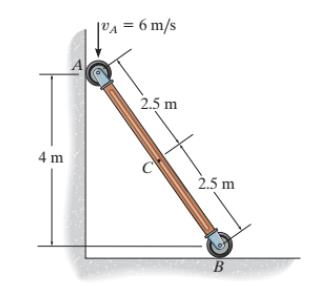
Determine the angular velocity of the rod and the velocity of point C at the instant shown. 4 m A VA = 6 m/s 2.5 m 2.5 m B
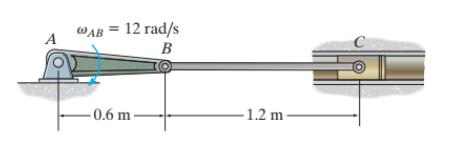
Determine the angular velocity of link BC and velocity of the piston C at the instant shown. A @AB = 12 rad/s B -0.6 m -1.2 m-
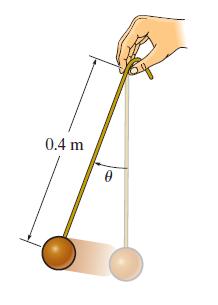
Determine the maximum angular displacement of the pendulum in Prob. 16–24.Prob. 16–24.A pendulum has a swinging motion such that θ = [ - 0.101 sin(4.95t) + 0.3 cos(4.95t) ] rad, where t is in seconds, and the arguments for the sine and cosine are in radians. Determine the magnitudes of the
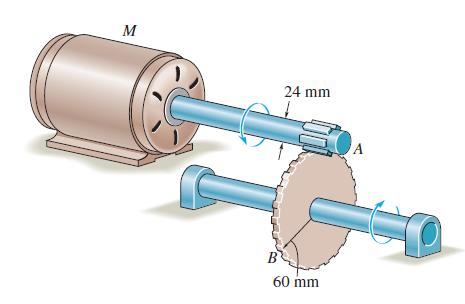
The pinion gear A on the motor shaft is given a constant angular acceleration α = 3 rad/s². If the gears A and Bhave the dimensions shown, determine the angular velocityand angular displacement of the output shaft C whent = 2 s, starting from rest. The shaft is fixed to B and turnswith it.
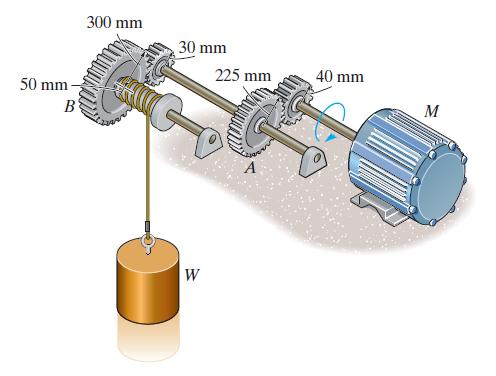
Determine the distance the load W is lifted in t = 5 s using the hoist. The shaft of the motor M turns with an angular velocity ω = 100(4 + t) rad/s, where t is in seconds. 50 mm B 300 mm 30 mm W 225 mm 40 mm M
The disk starts at ω0 = 1 rad/s when θ = 0, and is given an angular acceleration α = (0.3θ) rad/s2, where θ is in radians. Determine the magnitudes of the normal and tangential components of acceleration of a point P on the rim of the disk when θ = 1 rev. 0.4 m
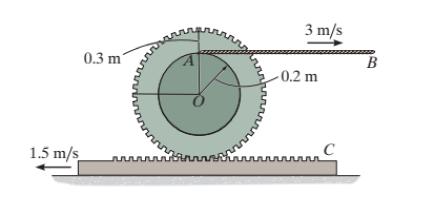
If cable AB is unwound with a speed of 3 m/s, and the gear rack C has a speed of 1.5 m/s, determine the angular velocity of the gear and the velocity of its center O. 1.5 m/s ().3 m រ -- ឧស 3 m/s - (),2 m Mung C B
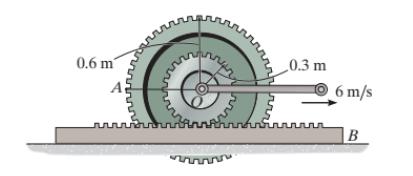
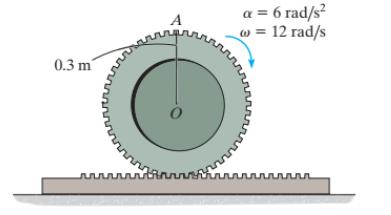
If the center O of the gear is moving with a speed of vo = 6 m/s, determine the velocity of point A on the gear. The gear rack B is fixed. 0.6 m² A w frrrrrrrrrr min gr 0.3 m 6 m/s B
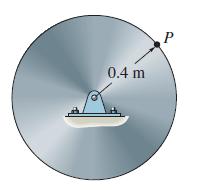
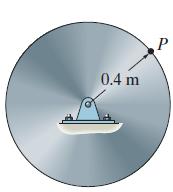
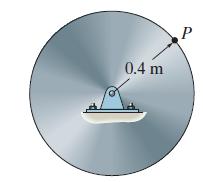
The disk starts from rest and is given an angular acceleration α = (5t1/2) rad/s2, where t is in seconds. Determine the magnitudes of the normal and tangential components of acceleration of a point P on the rim of the disk when t = 2 s. 0.4 m P
The disk starts from rest and is given an angular acceleration α = (2t²) rad/s², where t is in seconds. Determine the angular velocity of the disk and its angular displacement when t = 4 s. 0.4 m P
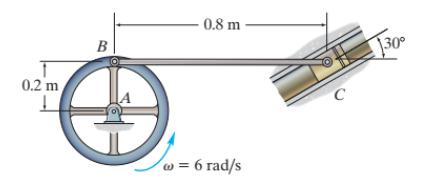
Determine the angular velocity of link BC and the velocity of the piston C at the instant shown. 0.2 m T B 0.8 m = 6 rad/s C 130⁰
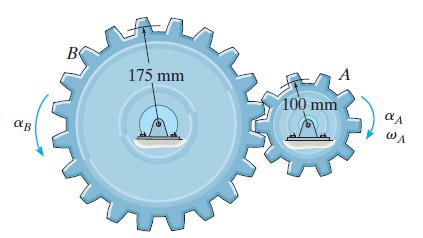
A motor gives gear A an angular acceleration of αA = (2 + 0.006 θ2) rad/s2, where θ is in radians. If this gear is initially turning at ωA = 15 rad/s, determine the angular velocity of gear B after A undergoes an angular displacement of 10 rev. aB B 175 mm A 100 mm XA ША
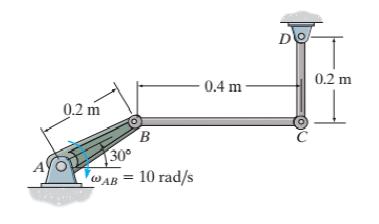
Determine the angular velocity of links BC andCD at the instant shown. 0.2 m B 130⁰ @AB = 10 rad/s 0.4 m DO 0.2 m
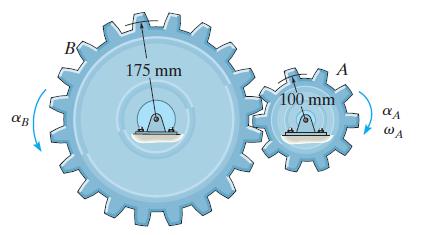
A motor gives gear A an angular acceleration of αA = (2t3) rad/s2, where t is in seconds. If this gear is initially turning at ωA = 15 rad/s, determine the angular velocity of gear B when t = 3 s. απ 175 mm A 100 mm απ WA
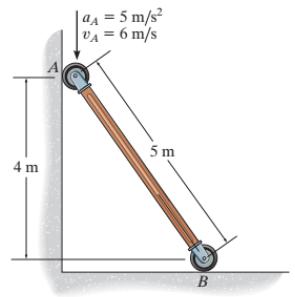
At the instant shown, end A of the rod has thevelocity and acceleration shown. Determine the angularacceleration of the rod and acceleration of end B of the rod. 4 m A |a₁ = 5 m/s² VA = 6 m/s 5m B
The gear rolls on the fixed rack with an angular velocity of ω = 12 rad/s and angular acceleration of α = 6 rad/s². Determine the horizontal and vertical components of acceleration of point A. 0.3 m² rrrrr a = 6 rad/s² w = 12 rad/s rrrrrrrr www Minnsthan A л
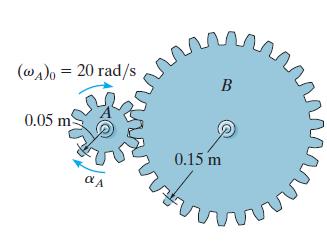
A motor gives gear A an angular acceleration of αA = (4t3) rad/s2, where t is in seconds. If this gear is initially turning at (ωA)0 = 20 rad/s, determine the angular velocity of gear B when t = 2 s. (@A)0 = 20 rad/s 0.05 m αA B 0.15 m wom
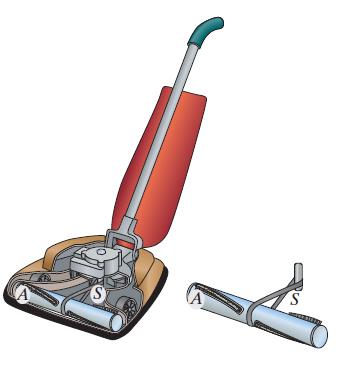
The vacuum cleaner’s armature shaft S rotates with an angular acceleration of α = 4ω3/4 rad/s2, where ω is in radωs. Determine the brush’s angular velocity when t = 4 s, starting from ω0 = 1 rad/s, at t = 0. The radii of the shaft and the brush are 0.25 in. and 1 in., respectively. Neglect
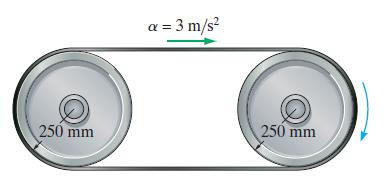
At the instant shown, the horizontal portion of the belt has an angular acceleration of 3 m/s2, while points in contact with the outer edge of the pulleys have an acceleration magnitude of 5 m/s2. If the belt does not slip on the pulleys, determine the belt’s speed due to the motion. 250 mm α =
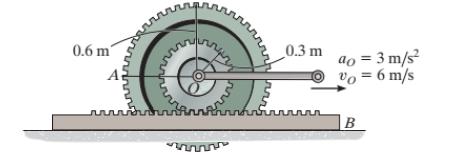
The gear rolls on the fixed rack B. At the instant shown, the center O of the gear moves with a velocity of vo = 6 m/s and acceleration of ao = 3 m/s². Determine the angular acceleration of the gear and the horizontal and vertical components of acceleration of point A at this instant. 0.6
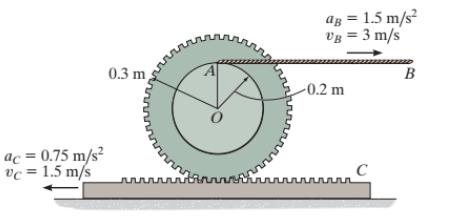
At the instant shown, cable AB has a velocity of 3 m/s and acceleration of 1.5 m/s², while the gear rack has a velocity of 1.5 m/s and acceleration of 0.75 m/s². Determine the angular acceleration of the gear at this instant. ac = 0.75 m/s vc = 1.5 m/s សបហ ().3
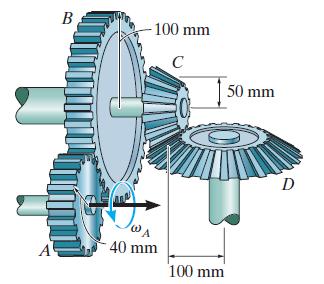
If the motor turns gear A with an angular acceleration of αA = 3 rad/s² when the angular velocity is ωA = 60 rad/s, determine the angular acceleration and angular velocity of gear D. A B -100 mm C 40 mm 50 mm 100 mm D
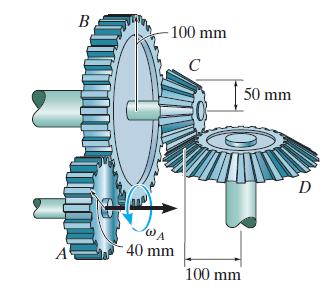
If the motor turns gear A with an angular acceleration of αA = 2 rad/s² when the angular velocity is ωA = 20 rad/s, determine the angular acceleration and angular velocity of gear D. B -100 mm C WA 40 mm 50 mm 100 mm D
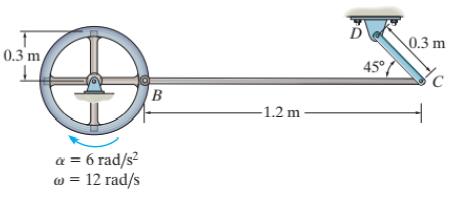
At the instant shown, the wheel rotates with an angular velocity of ω = 12 rad/s and an angularacceleration of α = 6 rad/s². Determine the angularacceleration of link BC at the instant shown. 0.3 m a = 6 rad/s² @ = 12 rad/s B -1.2 m D 45° 0.3 m C
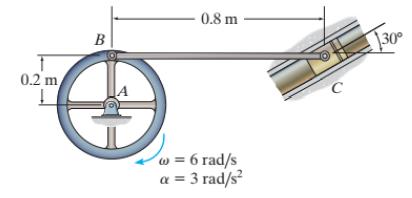
At the instant shown, wheel A rotates with an angular velocity of ω = 6 rad/s and an angular accelerationof α = 3 rad/s². Determine the angular acceleration oflink BC and the acceleration of piston C at this instant. 0.2 m, B 0.8 m w = 6 rad/s a = 3 rad/s² C 130⁰
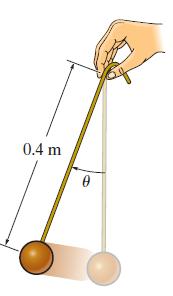
A pendulum has a swinging motion such that θ = [ - 0.101 sin(4.95t) + 0.3 cos(4.95t) ] rad, where t is in seconds, and the arguments for the sine and cosine are in radians. Determine the magnitudes of the velocity and acceleration of the bob when θ = 0°. 0.4 m 0
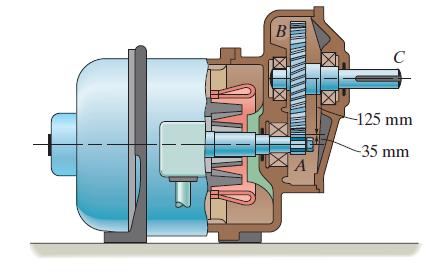
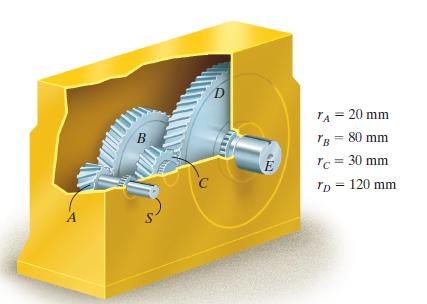
Morse Industrial manufactures the speed reducer shown. If a motor drives the gear shaft S with an angular acceleration of α = (0.4et) rad/s2, where t is in seconds, determine the angular velocity of shaft E when after starting from rest.The radius of each gear is listed in the figure. Note that
Due to an increase in power, the motor M rotates the shaft A with an angular acceleration of α = (0.060²) rad/s², where θ is in radians. If the shaft is initially turning at ω0 = 50 rad/s, determine the angular velocity of gear B after the shaft undergoes an angular displacement Δθ = 10 rev.
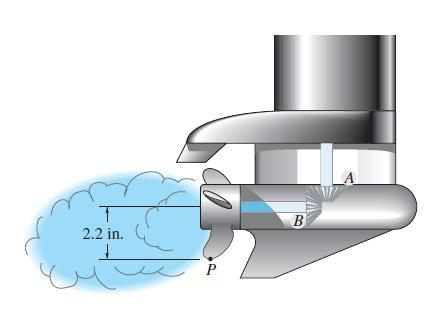
The gear A on the drive shaft of the outboard motor has a radius rA = 0.7 in. and the meshed pinion gear B on the propeller shaft has a radius rΒ = 1.4 in. Determine the angular velocity of the propeller in t = 1.3 s if the drive shaft with an angular acceleration rotates α = (300√t) rad/s²,
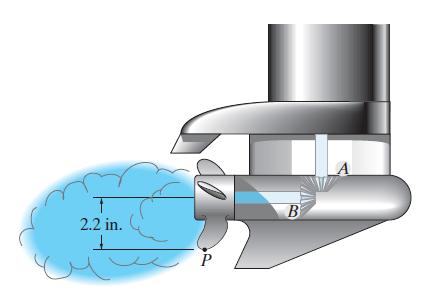
The gear A on the drive shaft of the outboard motor has a radius rA = 0.7 in. and the meshed pinion gear B on the propeller shaft has a radius rΒ = 1.4 in. Determine the magnitudes of the velocity and acceleration of a point P located on the tip of the propeller at the instant t = 0.75 s. The
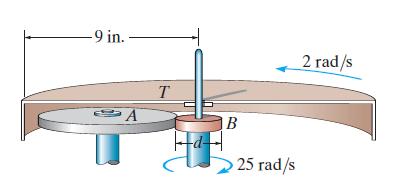
The turntable T is driven by the frictional idler wheel A, which simultaneously bears against the inner rim of the turntable and the motor-shaft spindle B. Determine the required diameter d of the spindle if the motor turns it at 25 rad/s and it is required that the turntable rotate at 2 rad/s. -9
Showing 1000 - 1100
of 2426
First
4
5
6
7
8
9
10
11
12
13
14
15
16
17
18
Last
Step by Step Answers

 Get 50% OFF
Claim Now
Get 50% OFF
Claim Now