New Semester
Started
Get
50% OFF
Study Help!
--h --m --s
Claim Now
Question Answers
Textbooks
Find textbooks, questions and answers
Oops, something went wrong!
Change your search query and then try again
S
Books
FREE
Study Help
Expert Questions
Accounting
General Management
Mathematics
Finance
Organizational Behaviour
Law
Physics
Operating System
Management Leadership
Sociology
Programming
Marketing
Database
Computer Network
Economics
Textbooks Solutions
Accounting
Managerial Accounting
Management Leadership
Cost Accounting
Statistics
Business Law
Corporate Finance
Finance
Economics
Auditing
Tutors
Online Tutors
Find a Tutor
Hire a Tutor
Become a Tutor
AI Tutor
AI Study Planner
NEW
Sell Books
Search
Search
Sign In
Register
study help
engineering
engineering mechanics statics
Vector Mechanics For Engineers Statics And Dynamics 12th Edition Phillip J Cornwell, E Russell Jr Johnston, David Mazurek, E Russell Johnston Jr, Ferdinand P Beer, Brian - Solutions
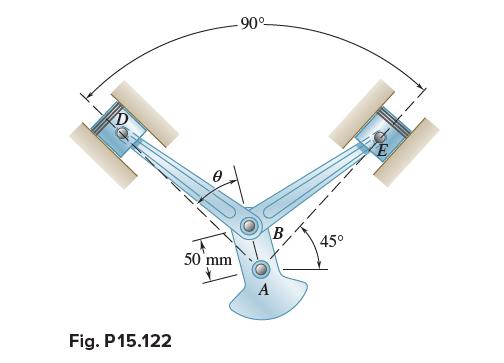
In the two-cylinder air compressor shown, the connecting rods BD and BE are each 190 mm long and crank AB rotates about the fixed point A with a constant angular velocity of 1500 rpm clockwise. Determine the acceleration of each piston when θ = 0. Fig. P15.122 50 mm -90°- 45°
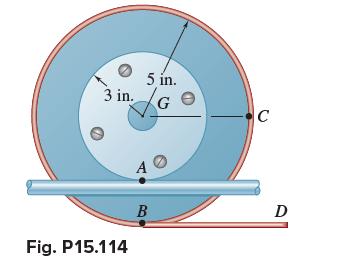
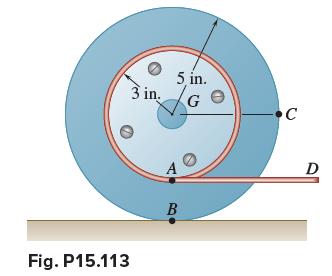
A 3-in.-radius drum is rigidly attached to a 5-in.- radius drum as shown. One of the drums rolls without sliding on the surface shown, and a cord is wound around the other drum. Knowing that at the instant shown end D of the cord has a velocity of 6 in./s and an acceleration of 20 in./s2, both
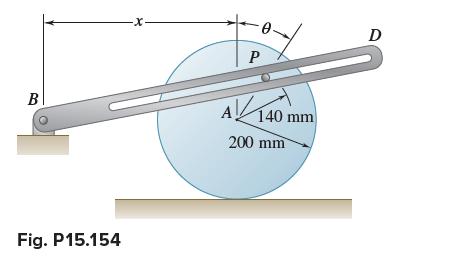
Pin P is attached to the wheel shown and slides in a slot cut in bar BD. The wheel rolls to the right without slipping with a constant angular velocity of 20 rad/s. Knowing that x = 480 mm when θ = 0, determine the angular velocity of the bar and the relative velocity of pin P with respect to the
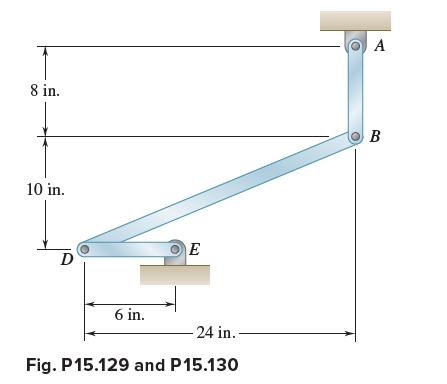
Knowing that at the instant shown bar DE has an angular velocity of 20 rad/s clockwise and an angular acceleration of 5 rad/s2 counterclockwise, determine in the position shown (a) The angular acceleration of bar BD, (b) The angular acceleration of bar AB. 8 in. 10 in. D 6 in. E -24 in.- Fig.
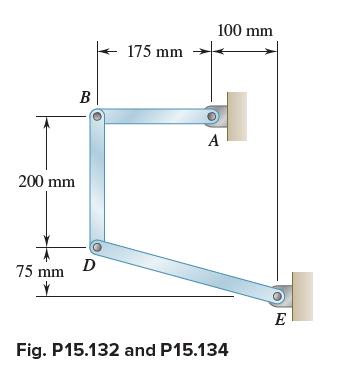
Knowing that at the instant shown bar AB has a constant angular velocity of 10 rad/s clockwise, determine the angular acceleration of (a) Bar BD, (b) Bar DE. 200 mm B 75 mm D 175 mm 100 mm A Fig. P15.132 and P15.134 E
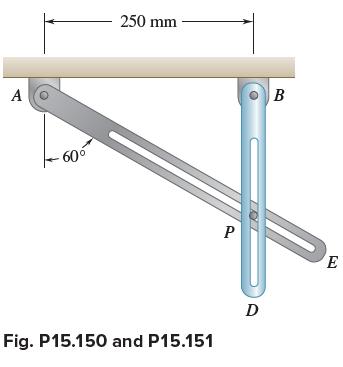
The motion of pin P is guided by slots cut in rods AE and BD. Knowing that the rods rotate with the constant angular velocities ωA = 4 rad/s clockwise and ωB = 5 rad/s counterclockwise, determine the velocity of pin P for the position shown. A -60⁰ 250 mm Fig. P15.150 and P15.151 P D B E
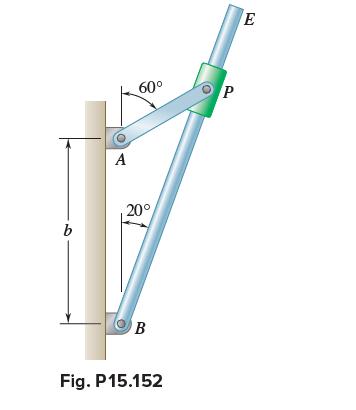
Two rotating rods are connected by slider block P. The rod attached at A rotates with a constant clockwise angular velocity ωA. For the given data, determine for the position shown (a) The angular velocity of the rod attached at B, (b) The relative velocity of slider block P with respect to the
A 3-in.-radius drum is rigidly attached to a 5-in.- radius drum as shown. One of the drums rolls without sliding on the surface shown, and a cord is wound around the other drum. Knowing that at the instant shown end D of the cord has a velocity of 6 in./s and an acceleration of 20 in./s2, both
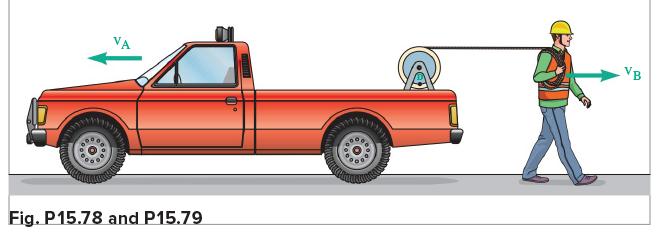
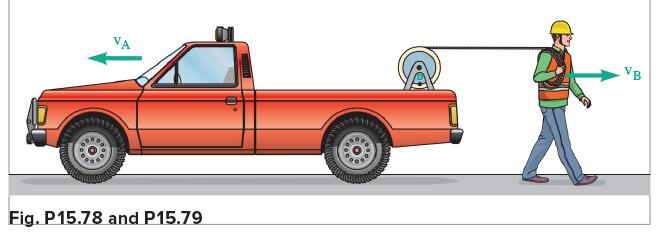
In order to uncoil electrical wire from a spool fixed to a truck, a worker drives to the left with a speed of vA = 4 m/s. At the same time, a second worker holds the cable as he walks to the right. Knowing that at the instant shown the thickness of wire on the spool is 50 mm and that the
In order to uncoil electrical wire from a 0.6-m-radius spool fixed to a truck, a worker drives to the left with a speed of vA = 5 m/s. At the same time, a second worker holds the cable as he walks to the right with a speed of vB = 3 m/s. Knowing that at the instant shown the thickness of wire on
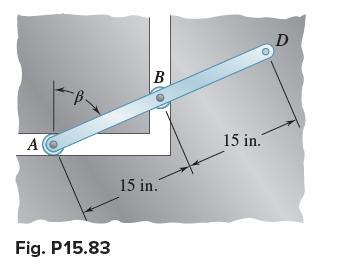
Rod ABD is guided by wheels at A and B that roll in horizontal and vertical tracks. Knowing that at the instant β = 60° and the velocity of wheel B is 40 in./s downward, determine (a) The angular velocity of the rod, (b) The velocity of point D. A Fig. P15.83 B 15 in. 15 in.
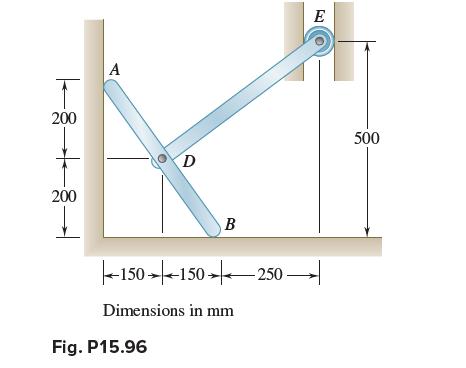
Two 500-mm rods are pin-connected at D as shown. Knowing that B moves to the left with a constant velocity of 360 mm/s, determine at the instant shown (a) The angular velocity of each rod, (b) The velocity of E. 200 200 A D B 150 150 250 Fig. P15.96 Dimensions in mm E 500
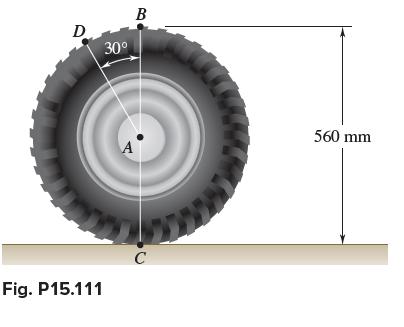
An automobile travels to the left at a constant speed of 90 km/h. Knowing that the diameter of the wheel is 650 mm, determine the acceleration of (a) Point B, (b) Point C, (c) Point D. D Fig. P15.111 30° B с 560 mm
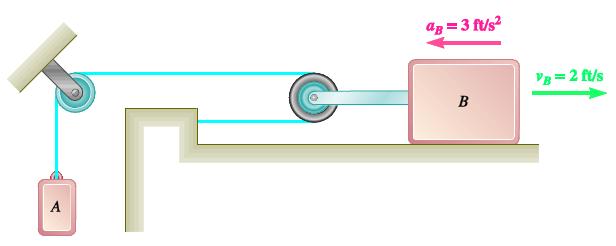
Knowing that at the instant shown block B has a velocity of 2 ft/s to the right and an acceleration of 3 ft/s2 to the left, determine (a) The velocity of block A, (b) The acceleration of block A. A aB=3 ft/s² B VB=2 ft/s
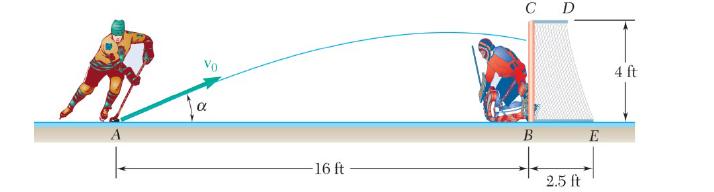
The initial velocity v0 of a hockey puck is 90 mi/h. Determine (a) The largest value (less than 45°) of the angle α for which the puck will enter the net, (b) The corresponding time required for the puck to reach the net. -16 ft C D В + 2.5 t E 4 ft
Many car companies are performing research on collision avoidance systems. A small prototype applies engine braking that decelerates the vehicle according to the relationship a = -k√t, where a and t are expressed in m/s2 and seconds, respectively. The vehicle is travelling 20 m/s when its radar
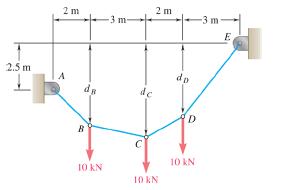
Knowing that dC = 5 m, determine (a) The distances dB and dD, (b) The maximum tension in the cable. 2.5 m 2 m da B 10 KN 3 m- C 2 m 10 KN dp D 10 KN -3 m E
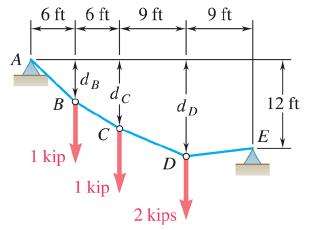
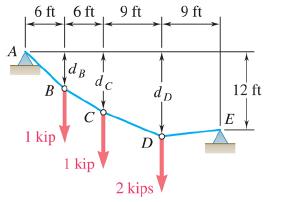
Knowing that dC = 9 ft, determine (a) The distances dB and dD, (b) The reaction at E. A 6 ft 6 ft 9 ft B 1 kip dB dc C 1 kip dp D 2 kips 9 ft 12 ft E
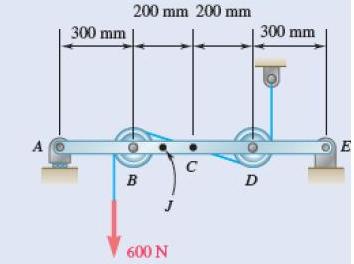
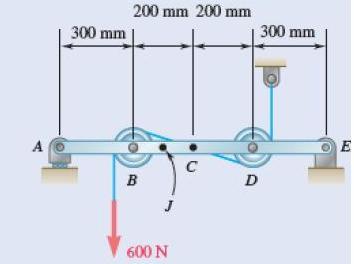
Knowing that the radius of each pulley is 120 mm and neglecting friction, determine the internal forces at (a) Point C, (b) Point J that is 100 mm to the left of C. A 300 mm 200 mm 200 mm B 600 N C D 300 mm E
Knowing that the radius of each pulley is 100 mm and neglecting friction, determine the internal forces at (a) Point C, (b) Point J that is 100 mm to the left of C. A 300 mm 200 mm 200 mm B 600 N C D 300 mm E
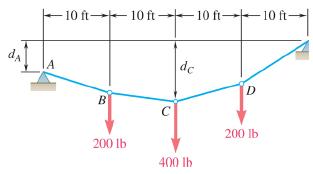
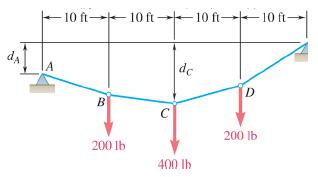
If dA = dC = 6 ft, determine (a) The components of the reaction at E, (b) The maximum tension in the cable. 10 ft- 10 ft-10 ft-10 ft- B 200 lb C de 400 lb D 200 lb
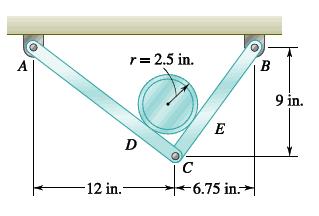
For the frame of Problem 7.17, determine the magnitude and location of the maximum bending moment in member BC.PROBLEM 7.17 A 5-in.-diameter pipe is supported every 9 ft by a small frame consisting of two members as shown. Knowing that the combined weight of the pipe and its contents is 10 lb/ft
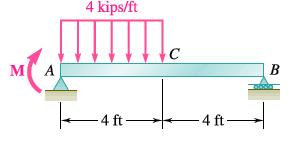
For the beam shown, draw the shear and bending-moment diagrams, and determine the magnitude and location of the maximum absolute value of the bending moment, knowing that (a) M = 0, (b) M = 24 kip · ft. MA 4 kips/ft -4 ft- C -4 ft- B
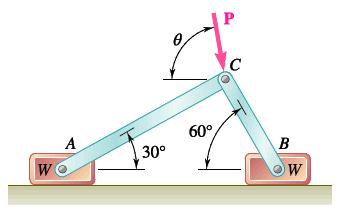
Two slender rods of negligible weight are pin-connected at C and attached to blocks A and B, each of weight W. Knowing that θ = 80° and that the coefficient of static friction between the blocks and the horizontal surface is 0.30, determine the largest value of P for which equilibrium is
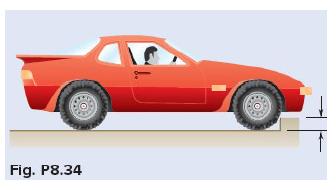
Solve Prob. 8.34, assuming that the weight of the car is equally distributed over its front and rear wheels.PROBLEM 8.34 A driver starts the engine of an automobile that is stopped with its front wheels resting against a curb and tries to drive over the curb. Knowing that the radius of the wheels
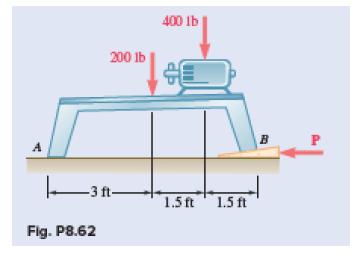
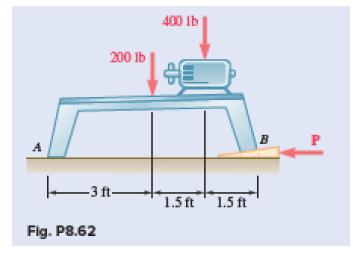
An 8° wedge is to be forced under a machine base at B. Knowing that the coefficient of static friction at all surfaces of contact is 0.15, (a) Determine the force P required to move the wedge, (b) Indicate whether the machine base will slide on the floor. 200 lb |3R Fig. P8.62 400 lb 1.5 ft 1.5
A 5-in.-diameter pipe is supported every 9 ft by a small frame consisting of two members as shown. Knowing that the combined weight of the pipe and its contents is 10 lb/ft and neglecting the effect of friction, determine the magnitude and location of the maximum bending moment in member AC. A 12
If dA = 8 ft and dC = 10 ft, determine the components of the reaction at E. -10 ft-10 ft- BO 200 lb C -10 ft-10 ft- de 400 lb D 200 lb
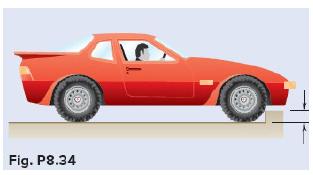
A driver starts the engine of an automobile that is stopped with its front wheels resting against a curb and tries to drive over the curb. Knowing that the radius of the wheels is 12 in., that the coefficient of static friction between the tires and the pavement is 0.90, and that 60 percent of the
Determine (a) Distance dC for which portion DE of the cable is horizontal, (b) The corresponding reactions at A and E. 6 ft 6 ft B 1 kip 9 ft ¡dB dc 1 kip dp D 2 kips 9 ft 12 ft E
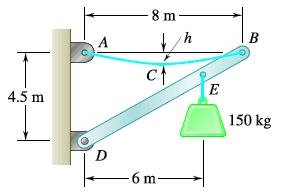
The total mass of cable ACB is 20 kg. Assuming that the mass of the cable is distributed uniformly along the horizontal, determine (a) The sag h, (b) The slope of the cable at A. 4.5 m A D -8 m- ↓ c↑ 6 m h E B 150 kg
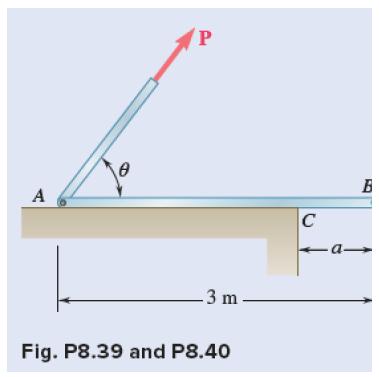
A uniform 20-kg tube resting on a loading dock will be moved by means of a cable attached at end A. Knowing that the coefficient of static friction between the tube and the dock is 0.30, determine the largest angle θ for which the tube will slide horizontally to the right and the corresponding
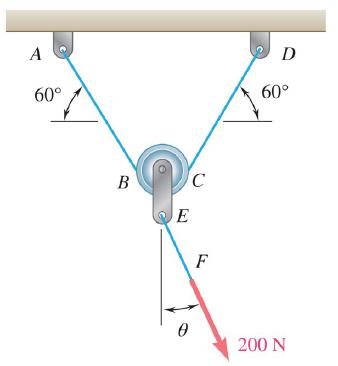
The axle of the pulley is frozen and cannot rotate with respect to the block. Knowing that the coefficient of static friction between cable ABCD and the pulley is 0.30, determine (a) The maximum allowable value of θ if the system is to remain in equilibrium, (b) The corresponding reactions at A
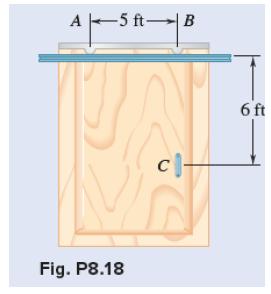
A 200-lb sliding door is mounted on a horizontal rail as shown. The coefficients of static friction between the rail and the door at A and B are 0.15 and 0.25, respectively. Determine the horizontal force that must be applied to the handle C in order to move the door to the right. A5 ft B Fig.
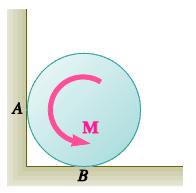
The cylinder shown is of weight W and radius r. Express in terms W and r the magnitude of the largest couple M that can be applied to the cylinder if it is not to rotate, assuming the coefficient of static friction to be (a) Zero at A and 0.30 at B, (b) 0.25 at A and 0.30 at B. A M B
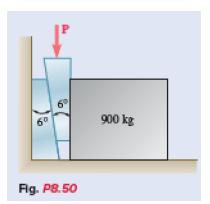
Determine the minimum value of P that must be applied to the wedge in order to move the 900-kg block. The coefficient of static friction is 0.30 at all surfaces of contact. 6⁰ P Fig. P8.50 900 kg
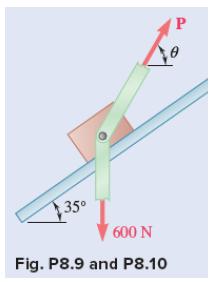
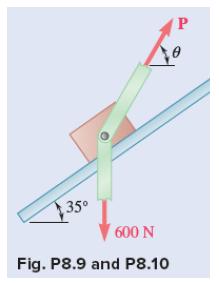
The coefficients of friction between the block and the rail are μs = 0.25 and μk = 0.20. Find the magnitude and direction of the smallest force P required (a) To start the block moving up the rail, (b) To keep the block from moving down. 35⁰ 600 N Fig. P8.9 and P8.10 P
Solve Problem 8.62 assuming that the wedge is to be forced under the machine base at A instead of B.PROBLEM 8.62An 8° wedge is to be forced under a machine base at B. Knowing that the coefficient of static friction at all surfaces of contact is 0.15, (a) Determine the force P required to move the
The coefficients of friction between the block and the rail are μs = 0.25 and μk = 0.20. Knowing that θ = 60°, determine the smallest value of P required (a) To start the block moving up the rail,(b) To keep it moving up,(c) To prevent it from moving down. 135⁰ 600 N Fig. P8.9 and P8.10 P
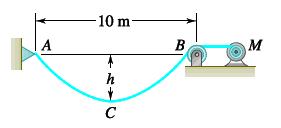
A motor M is used to slowly reel in the cable shown. Knowing that the mass per unit length of the cable is 0.4 kg/m, determine the maximum tension in the cable when h = 5 m. A -10 m- h C B M
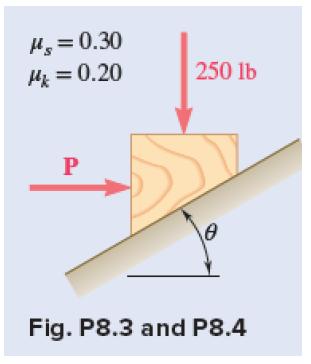
Determine whether the block shown is in equilibrium and find the magnitude and direction of the friction force when θ = 35° and P = 100 lb. M₂ = 0.30 Mk=0.20 P 250 lb 0 Fig. P8.3 and P8.4
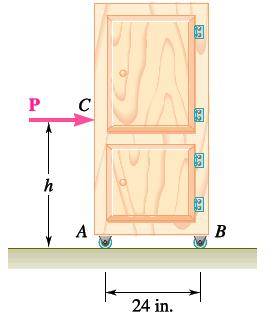
A 120-lb cabinet is mounted on casters that can be locked to prevent their rotation. The coefficient of static friction between the floor and each caster is 0.30. If h = 32 in., determine the magnitude of the force P required to move the cabinet to the right (a) If all casters are locked, (b) If
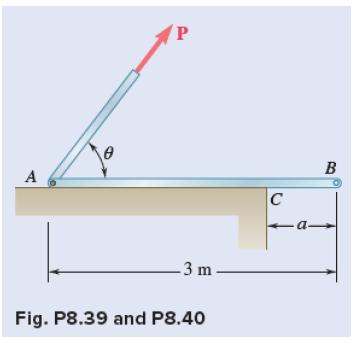
A uniform 20-kg tube rests on a loading dock with its end B located at a distance a = 0.25 m from the edge C of the dock. A cable attached at end A forming an angle θ = 60° with the tube will be used to move the tube. Knowing that the coefficient of static friction between the tube and the dock
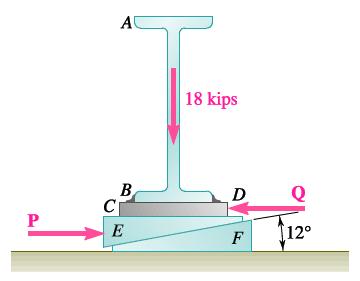
The elevation of the end of the steel beam supported by a concrete floor is adjusted by means of the steel wedges E and F. The base plate CD has been welded to the lower flange of the beam, and the end reaction of the beam is known to be 18 kips. The coefficient of static friction is 0.30 between
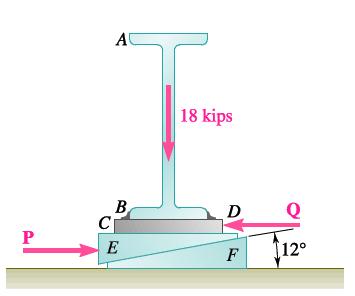
Solve Prob. 8.52 assuming that the end of the beam is to be lowered.PROBLEM 8.52The elevation of the end of the steel beam supported by a concrete floor is adjusted by means of the steel wedges E and F. The base plate CD has been welded to the lower flange of the beam, and the end reaction of the
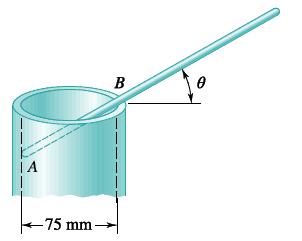
A slender steel rod of length 225 mm is placed inside a pipe as shown. Knowing that the coefficient of static friction between the rod and the pipe is 0.20, determine the largest value of θ for which the rod will not fall into the pipe. ΤΑ -75 mm- B 0
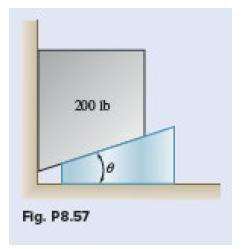
A 200-lb block rests as shown on a wedge of negligible weight. Knowing that the coefficient of static friction is 0.25 at all surfaces of contact, determine the angle θ for which sliding is impending and compute the corresponding value of the normal force exerted on the block by the vertical wall.
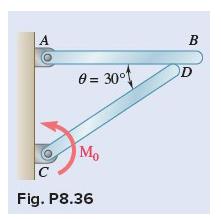
Two uniform rods each of weight W and length L are maintained in the position shown by a couple M0 applied to rod CD. Knowing that the coefficient of static friction between the rods is 0.40, determine the range of values of M0 for which equilibrium is maintained. A 0= 30° Mo C Fig. P8.36 B D
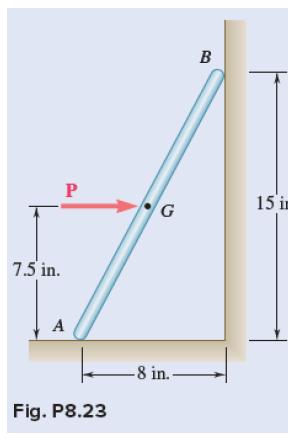
The 10-lb uniform rod AB is held in the position shown by the force P. Knowing that the coefficient of static friction is 0.20 at A and B, determine the smallest value of P for which equilibrium is maintained. 7.5 in. P A Fig. P8.23 G -8 in.- B 15 in
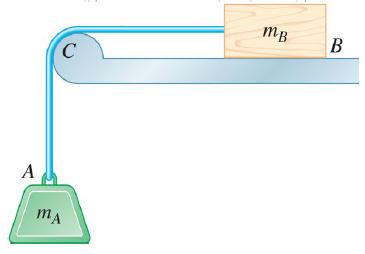
The coefficient of static friction between block B and the horizontal surface and between the rope and support C is 0.40. Knowing that mA = 12 kg, determine the smallest mass of block B for which equilibrium is maintained. A C MA MB B
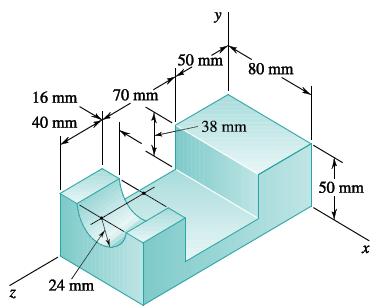
Determine the mass moment of inertia of the steel fixture shown with respect to (a) The x axis, (b) The y axis, (c) The z axis. N 16 mm 40 mm 24 mm 70 mm y 50 mm 38 mm 80 mm 50 mm X
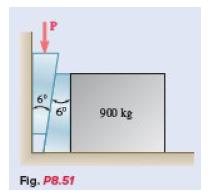
Determine the minimum value of P that must be applied to the wedge in order to move the 900-kg block. The coefficient of static friction is 0.30 at all surfaces of contact. 6⁰ 6⁰ Fig. P8.51 900 kg
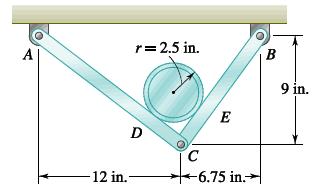
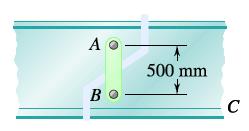
The link arrangement shown is frequently used in highway bridge construction to allow for expansion due to changes in temperature. At each of the 60-mm-diameter pins A and B the coefficient of static friction is 0.20. Knowing that the vertical component of the force exerted by BC on the link is 200
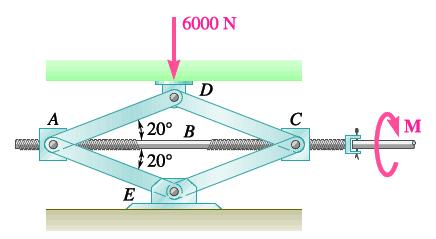
The position of the automobile jack shown is controlled by a screw ABC that is single-threaded at each end (right-handed thread at A, left-handed thread at C). Each thread has a pitch of 2.5 mm and a mean diameter of 9 mm. If the coefficient of static friction is 0.15, determine the magnitude of
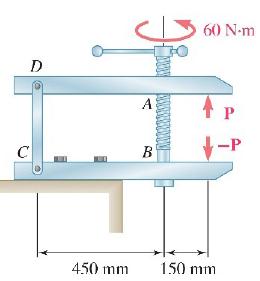
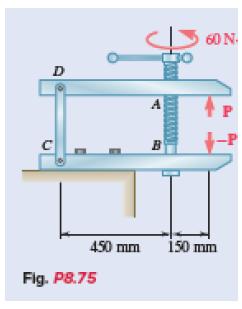
In the vise shown, the screw is single-threaded in the upper member; it passes through the lower member and is held by a frictionless washer. The pitch of the screw is 3 mm, its mean radius is 12 mm, and the coefficient of static friction is 0.15. Determine the magnitude P of the forces exerted by
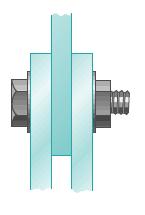
High-strength bolts are used in the construction of many steel structures. For a 1-in.-nominal-diameter bolt, the required minimum bolt tension is 51 kips. Assuming the coefficient of friction to be 0.30, determine the required couple that should be applied to the bolt and nut. The mean diameter of
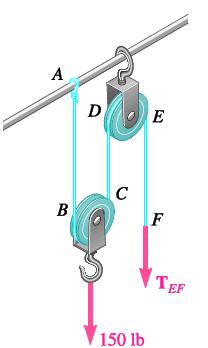
The block and tackle shown are used to raise a 150-lb load. Each of the 3-in.-diameter pulleys rotates on a 0.5-in.-diameter axle. Knowing that the coefficient of static friction is 0.20, determine the tension in each portion of the rope as the load is slowly raised. A B D C 150 lb E F TEF
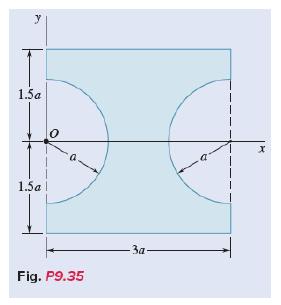
Determine the moments of inertia of the shaded area shown with respect to the x and y axes when a = 20 mm. 1.5a 1.5a | Fig. P9.35 -3a-
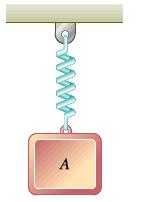
The vertical motion of mass A is defined by the relation x = cos(10t) - 0.1sin(10t), where x and t are expressed in mm and seconds, respectively. Determine (a) The position, velocity and acceleration of A when t = 0.4 s, (b) The maximum velocity and acceleration of A. GWW A
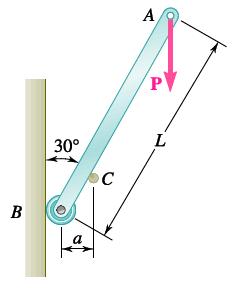
A slender rod of length L is lodged between peg C and the vertical wall and supports a load P at end A. Knowing that the coefficient of static friction between the peg and the rod is 0.15 and neglecting friction at the roller, determine the range of values of the ratio L/a for which equilibrium is
A 6-in.-radius pulley of weight 5 lb is attached to a 1.5-in.-radius shaft that fits loosely in a fixed bearing. It is observed that the pulley will just start rotating if a 0.5-lb weight is added to block A. Determine the coefficient of static friction between the shaft and the bearing. D 450
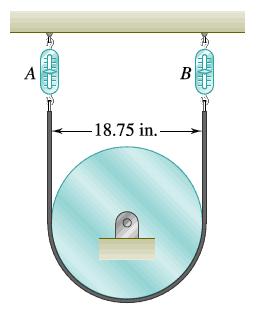
The setup shown is used to measure the output of a small turbine. The coefficient of kinetic friction is 0.20 and the reading of each spring scale is 16 lb when the flywheel is at rest. Determine (a) The reading of each scale when the flywheel is rotating clockwise at a constant speed, (b) The
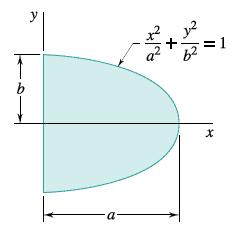
Determine the moment of inertia and the radius of gyration of the shaded area shown with respect to the y axis. || + X
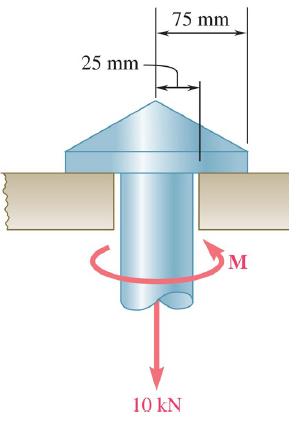
Knowing that a couple of magnitude M = 150 N∙m is required to start the vertical shaft rotating, determine the coefficient of static friction between the annular surfaces of contact. 25 mm 75 mm 10 KN M
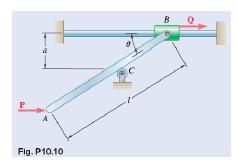
The slender rod AB is attached to a collar B and rests on a small wheel at C. Neglecting the radius of the wheel and the effect of friction, derive an expression for the magnitude of the force Q required to maintain the equilibrium of the rod. Fig. P10.10 BQ
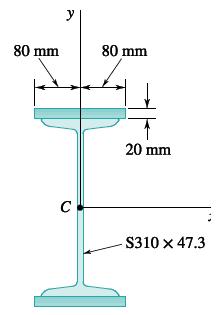
Two 20-mm steel plates are welded to a rolled S section as shown. Determine the moments of inertia and the radii of gyration of the combined section with respect to the centroidal x and y axes. 80 mm y C 80 mm 20 mm - $310 x 47.3
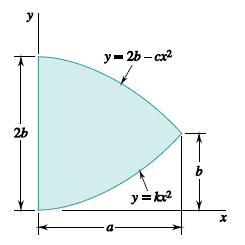
Determine the moment of inertia and the radius of gyration of the shaded area shown with respect to the x axis. У 2b у-2b-cx² у=k b x
A hawser is wrapped two full turns around a capstan head. By exerting a 160-lb force on the free end of the hawser, a sailor can resist a force of 10,000 lb on the other end of the hawser. Determine (a) The coefficient of static friction between the hawser and the capstan, (b) The number
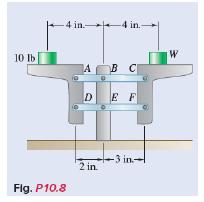
Determine the weight W that balances the 10-lb load placed on the linkage shown. 10 lb —4 in.- Fig. P10.8 A D 2 in. 4 in.- BC EF -3 in- W
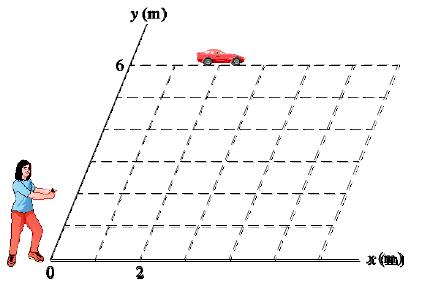
A girl operates a radio-controlled model car in a vacant parking lot. The girl’s position is at the origin of the xy coordinate axes, and the surface of the parking lot lies in the x-y plane. She drives the car in a straight line so that the x coordinate is defined by the relation x(t) = 0.5t3 -
A group of hikers uses a GPS while doing a 40 mile trek in Colorado. A curve fit to the data shows that their altitude can be approximated by the function, y(t) = 0.12t5 - 6.75t4 + 135t3 - 1120t2 + 3200t + 9070 where y and t are expressed in feet and hours, respectively. During the 18 hour hike,
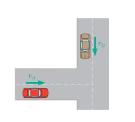
Two cars are approaching an intersection at constant speeds as shown. What velocity will car B appear to have to an observer in car A? (a) (b) (c) (d) (e)
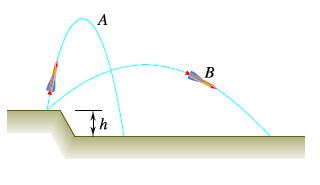
Two model rockets are fired simultaneously from a ledge and follow the trajectories shown. Neglecting air resistance, which of the rockets will hit the ground first?(a) A(b) B(c) They hit at the same time.(d) The answer depends on h. A Th B
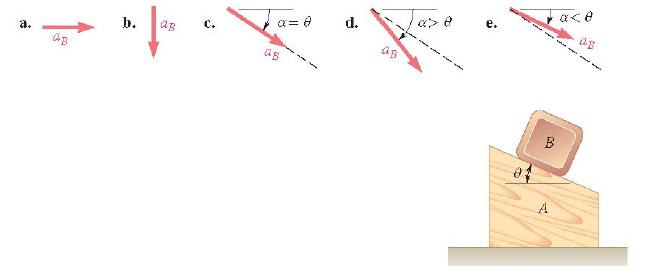
Blocks A and B are released from rest in the positions shown. Neglecting friction between all surfaces, which figure below best indicates the direction α of the acceleration of block B? a. b. ag a = 8 QB d. ♡ a> @ www e. B A a
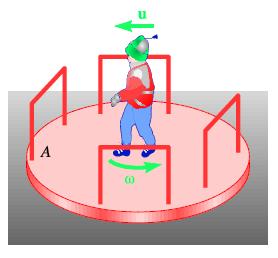
A child walks across merry-go-round A with a constant speed u relative to A. The merry-go-round undergoes fixed axis rotation about its center with a constant angular velocity ω counterclockwise.When the child is at the center of A, as shown, what is the direction of his acceleration when viewed
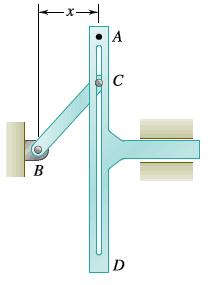
A Scotch yoke is a mechanism that transforms the circular motion of a crank into the reciprocating motion of a shaft (or vice versa). It has been used in a number of different internal combustion engines and in control valves. In the Scotch yoke shown, the acceleration of Point A is defined by the
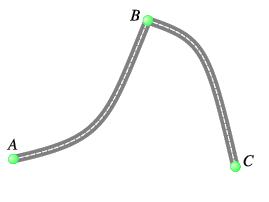
A bus travels the 100 miles between A and B at 50 mi/h and then another 100 miles between B and C at 70 mi/h. The average speed of the bus for the entire 200-mile trip is:(a) more than 60 mi/h(b) equal to 60 mi/h(c) less than 60 mi/h A B C
Ball A is thrown straight up. Which of the following statements about the ball are true at the highest point in its path?(a) The velocity and acceleration are both zero.(b) The velocity is zero, but the acceleration is not zero.(c) The velocity is not zero, but the acceleration is zero.(d) Neither
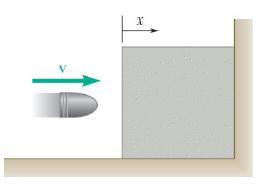
A projectile enters a resisting medium at x = 0 with an initial velocity v0 = 1000 ft/s and travels 3 in. before coming to rest. Assuming that the velocity of the projectile is defined by the relation v = v0 - kx, where v is expressed in ft/s and x is in feet, determine (a) The initial
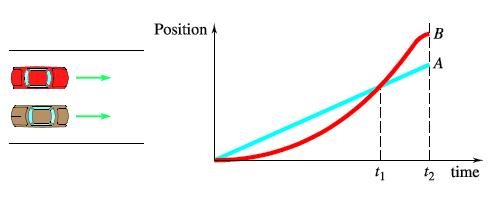
Two cars A and B race each other down a straight road. The position of each car as a function of time is shown. Which of the following statements are true (more than one answer can be correct)?(a) At time t2 both cars have traveled the same distance(b) At time t1 both cars have the same speed(c)
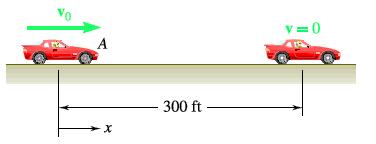
The brakes of a car are applied, causing it to slow down at a rate of 10 ft/s2. Knowing that the car stops in 300 ft, determine (a) How fast the car was traveling immediately before the brakes were applied,(b) The time required for the car to stop. x 300 ft v=0
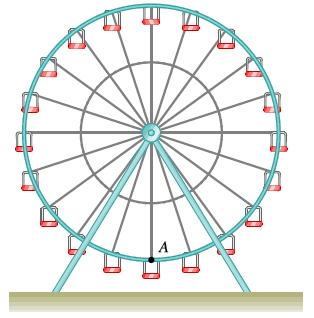
The Ferris wheel is rotating with a constant angular velocity ω. What is the direction of the acceleration of Point A?(a) →(b) ↑(c) ↓(d) ←(e) The acceleration is zero. A
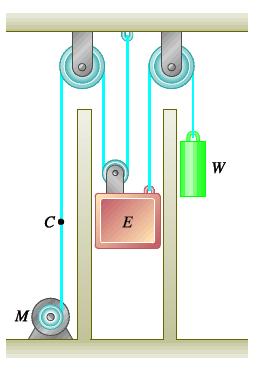
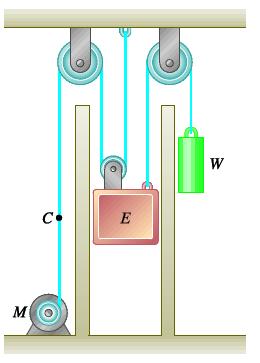
The elevator shown in the figure moves downward with a constant velocity of 4 m/s. Determine (a) the velocity of the cable C, (b) the velocity of the counterweight W, (c) the relative velocity of the cable C with respect to the elevator, (d) the relative velocity of the counterweight W with
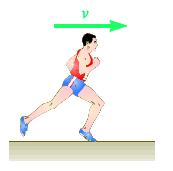
A sprinter in a 100-m race accelerates uniformly for the first 35 m and then runs with constant velocity. If the sprinter’s time for the first 35 m is 5.4 s, determine(a) His acceleration, (b) His final velocity, (c) His time for the race. ע
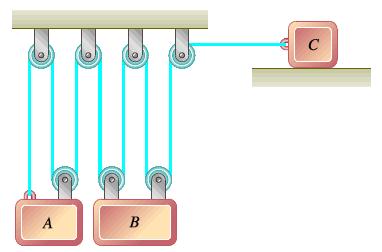
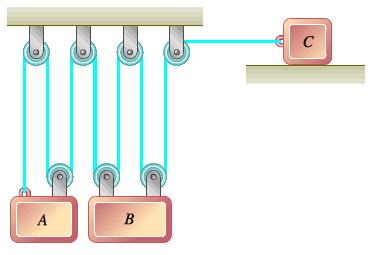
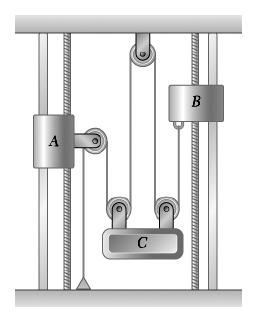
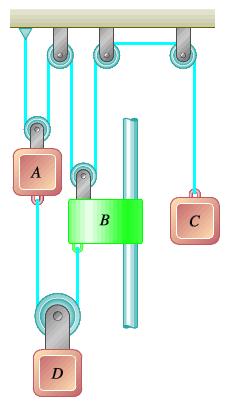
Block B moves downward with a constant velocity of 20 mm/s. At t = 0, block A is moving upward with a constant acceleration, and its velocity is 30 mm/s. Knowing that at t = 3 s slider block C has moved 57 mm to the right, determine (a) The velocity of slider block C at 0,t (b) The
The motion of a particle is defined by the relation x = t3- 61 + 9t + 5, , where x is expressed in feet and t in seconds. Determine(a) When the velocity is zero,(b) The position, acceleration, and total distance traveled when t = 5s.
Block B starts from rest, block A moves with a constant acceleration, and slider block C moves to the right with a constant acceleration of 75 mm/s2. Knowing that at 2s the velocities of B and C are 480 mm/s downward and 280 mm/s to the right, respectively, determine (a) The accelerations of A and
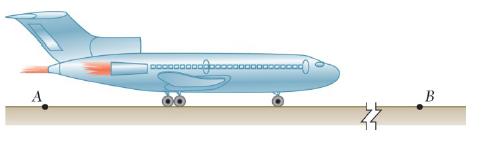
An airplane begins its take-off run at A with zero velocity and a constant acceleration a. Knowing that it becomes airborne 30 s later at B with a take-off velocity of 270 km/h, determine (a) The acceleration a, (b) Distance AB. B
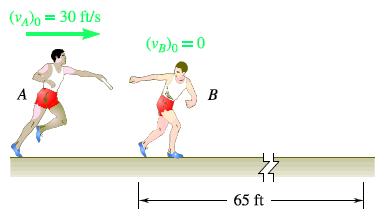
As relay runner A enters the 65-ft-long exchange zone with a speed of 30 ft/s, he begins to slow down. He hands the baton to runner B 2.5 s later as they leave the exchange zone with the same velocity. Determine(a) The uniform acceleration of each of the runners, (b) When runner B should begin to
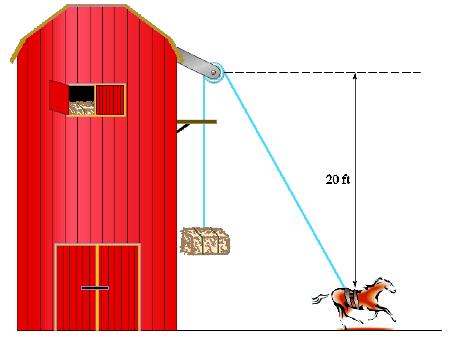
A farmer wants to get his hay bales into the top loft of his barn by walking his horse forward with a constant velocity of 1 ft/s. Determine the velocity and acceleration of the hay bale when the horse is 10 ft away from the barn. 20 ft
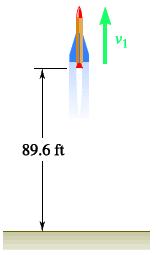
A group of students launches a model rocket in the vertical direction. Based on tracking data, they determine that the altitude of the rocket was 89.6 ft at the end of the powered portion of the flight and that the rocket landed 16 s later. Knowing that the descent parachute failed to deploy so
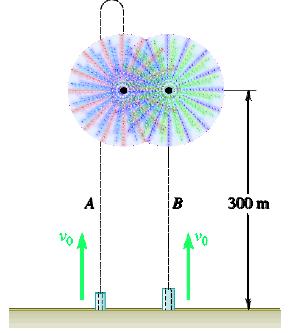
Two rockets are launched at a fireworks display. Rocket A is launched with an initial velocity v0 = 100 m/s and rocket B is launched t1 seconds later with the same initial velocity. The two rockets are timed to explode simultaneously at a height of 300 m as A is falling and B is rising. Assuming a
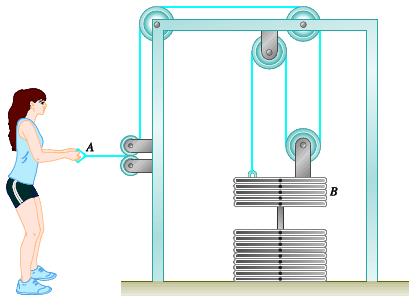
An athlete pulls handle A to the left with a constant acceleration. Knowing that after the weight B has been lifted 4 in. its velocity is 2 ft/s, determine (a) The accelerations of handle A and weight B (b) The velocity and change in position of handle A after 0.5 sec. B
Collars A and B start from rest, and collar A moves upward with an acceleration of 3t2mm/st2. Knowing that collar B moves downward with a constant acceleration and that its velocity is 150 mm/s after moving 700 mm, determine (a) The acceleration of block C, (b) The distance through which block C
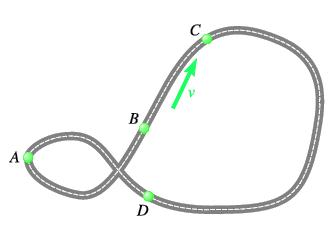
A racecar travels around the track shown at a constant speed. At which point will the racecar have the largest acceleration?(a) A(b) B(c) C(d) The acceleration will be zero at all the points. A D B D
The elevator shown starts from rest and moves upward with a constant acceleration. If the counterweight W moves through 30 ft in 5 s, determine (a) The acceleration of the elevator and the cable C, (b) The velocity of the elevator after 5 s. M C• E W
The system shown starts from rest, and each component moves with a constant acceleration. If the relative acceleration of block C with respect to collar B is 60mm/s2 upward and the relative acceleration of block D with respect to block A is 110 mm/s2 downward, determine (a) The velocity of block C
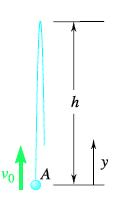
Ball A is thrown straight up with an initial speed v0 and reaches a maximum elevation h before falling back down. When A reaches its maximum elevation, a second ball is thrown straight upward with the same initial speed v0. At what height, y, will the balls cross paths?(a) y = h(b) y > h/2(c) y
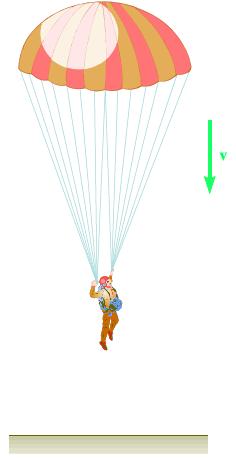
A parachutist is in free fall at a rate of 200 km/h when he opens his parachute at an altitude of 600 m. Following a rapid and constant deceleration, he then descends at a constant rate of 50 km/h from 586 m to 30 m, where he maneuvers the parachute into the wind to further slow his descent.
Based on experimental observations, the acceleration of a particle is defined by the relation a = -(0.1 + sin x/b), where a and x are expressed in m/s2 and meters, respectively. Knowing that b = 0.8m and that ν = 1 m/s when x = 0, determine (a) The velocity of the particle when x = -1 m,(b)
Showing 200 - 300
of 2426
1
2
3
4
5
6
7
8
9
10
11
12
13
14
15
Last
Step by Step Answers

 Get 50% OFF
Claim Now
Get 50% OFF
Claim Now