New Semester
Started
Get
50% OFF
Study Help!
--h --m --s
Claim Now
Question Answers
Textbooks
Find textbooks, questions and answers
Oops, something went wrong!
Change your search query and then try again
S
Books
FREE
Study Help
Expert Questions
Accounting
General Management
Mathematics
Finance
Organizational Behaviour
Law
Physics
Operating System
Management Leadership
Sociology
Programming
Marketing
Database
Computer Network
Economics
Textbooks Solutions
Accounting
Managerial Accounting
Management Leadership
Cost Accounting
Statistics
Business Law
Corporate Finance
Finance
Economics
Auditing
Tutors
Online Tutors
Find a Tutor
Hire a Tutor
Become a Tutor
AI Tutor
AI Study Planner
NEW
Sell Books
Search
Search
Sign In
Register
study help
engineering
engineering mechanics statics
Engineering Mechanics Statics & Dynamics 15th Edition Russell C. Hibbeler - Solutions
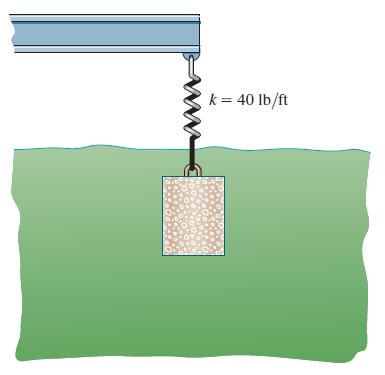
The block, having a weight of 15 lb, is immersed in a liquid such that the damping force acting on the block has a magnitude of F = (0.8 | v | ) lb, where is the velocity of the block in ft/s. If the block is pulled down 0.8 ft and released from rest, determine the position of the block as a
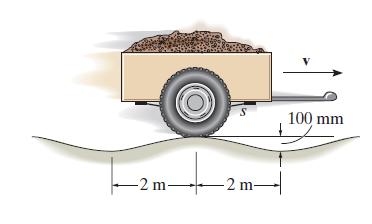
Determine the amplitude of vibration of the trailer in Prob. 22-60 if the speed v = 15 km/h.Prob. 22-60The 450-kg trailer is pulled with a constant speed over the surface of a bumpy road, which may be approximated by a cosine curve having an amplitude of 50 mm and wave length of 4 m. If the two
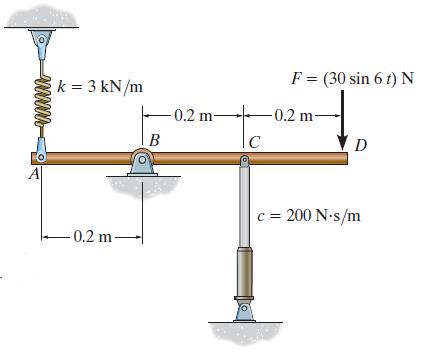
If the 12-kg rod is subjected to a periodic force of F = (30 sin 6t) N, where t is in seconds, determine the steady-state vibration amplitude θmax of the rod about the pin B. Assume θ is small. NNNN A k = 3 kN/m -0.2 m- -0.2 m- B F = (30 sin 6 t) N -0.2 m- C D c = 200 N-s/m
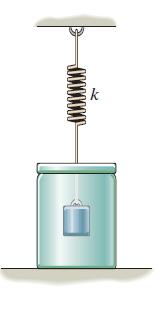
A block having a mass of 0.8 kg is suspended from a spring having a stiffness of 120 N/m. If a dashpot provides a damping force of 2.5 N when the speed of the block is 0.2 m s, determine the period of free vibration.
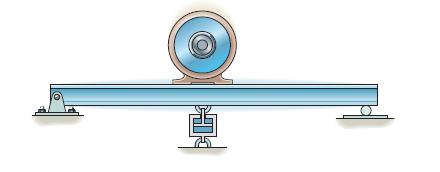
The 200-lb electric motor is fastened to the midpoint of the simply supported beam. It is found that the beam deflects 2 in. when the motor is not running. The motor turns an eccentric flywheel which is equivalent to an unbalanced weight of 1 lb located 5 in. from the axis of rotation. If the motor
The block, having a weight of 12 lb, is immersed in a liquid such that the damping force acting on the block has a magnitude of F = (0.7 | v |) lb, where v is in ft/s. If the block is pulled down 0.62 ft and released from rest, determine the position of the block as a function of time. The spring
A 7-lb block is suspended from a spring having a stiffness of k = 75 lb/ft. The support to which the spring is attached is given simple harmonic motion which may be expressed as δ = (0.15 sin 2t) ft, where t is in seconds. If the damping factor is c/cc = 0.8, determine the phase angle ϕ of
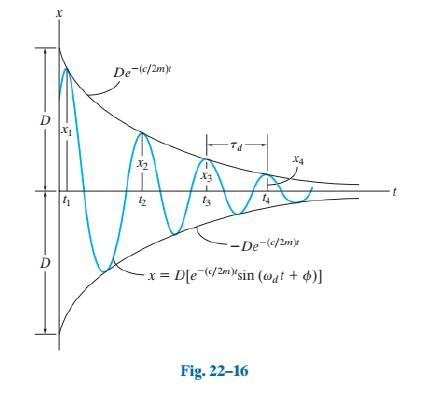
The damping factor, c/cc, may be determined experimentally by measuring the successive amplitudes of vibrating motion of a system. If two of these maximum displacements can be approximated by x₁ and x2, as shown in Fig. 22-16, show that In (x₁/x₂) = 2π(c/cc)/√1 - (c/cc)². The quantity In
Determine the magnification factor of the block, spring, and dashpot combination in Prob. 22–65.Prob. 22–65..A 7-lb block is suspended from a spring having a stiffness of k = 75 lb/ft. The support to which the spring is attached is given simple harmonic motion which may be expressed as δ =
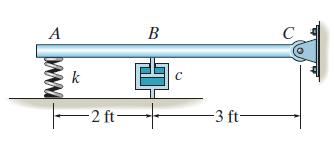
The bar has a weight of 6 lb. If the stiffness of the spring is k = 8 lb/ft and the dashpot has a damping coefficient c = 60 lb · s/ft, determine the differential equation which describes the motion in terms of the angle θ of the bar’s rotation. Also, what should be the damping coefficient of
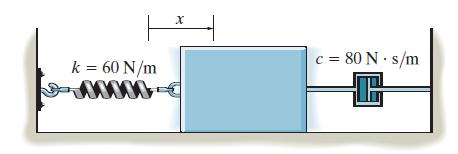
The 10-kg block-spring-damper system is continually damped. If the block is displaced to x = 50 mm and released from rest, determine the time required for it to return to the position x = 2 mm. x k = 60 N/m 0000 € c = 80 N s/m G
A block having a mass of 7 kg is suspended from a spring that has a stiffness k = 600 N/m. If the block is given an upward velocity of 0.6 m/s from its equilibrium position at t = 0, determine its position as a function of time. Assume that positive displacement of the block is downward and that
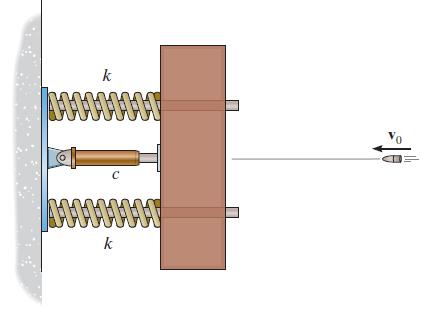
A bullet of mass m has a velocity of Vo just before it strikes the target of mass M. If the bullet embeds in the target, and the vibration is to be critically damped, determine the dashpot's damping coefficient, and the springs' maximum compression. The target is free to move along the two
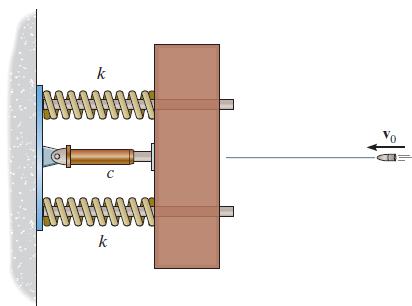
A bullet of mass m has a velocity v0 just before it strikes the target of mass M. If the bullet embeds in the target, and the dashpot’s damping coefficient is 0 < c << cc,determine the springs’ maximum compression. The target is free to move along the two horizontal guides that
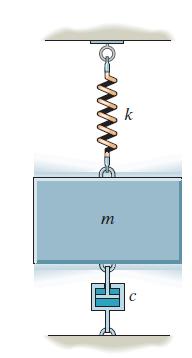
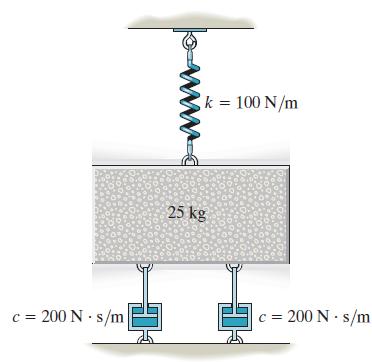
Determine the differential equation of motion for the damped vibratory system shown. What type of motion occurs? Take k = 100 N/m, c = 200 N · s/m,m = 25 kg. C et C www.c
Draw the electrical circuit that is equivalent to the mechanical system shown. Determine the differential equation which describes the charge q in the circuit. m k C
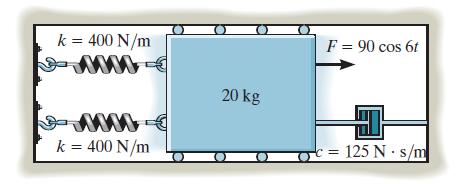
The 20-kg block is subjected to the action of the harmonic force F = (90 cos 6t) N, where t is in seconds. Write the equation which describes the steady-state motion. k = 400 N/m 50000 W k = 400 N/m 20 kg F = 90 cos 6t D c=125 N s/m
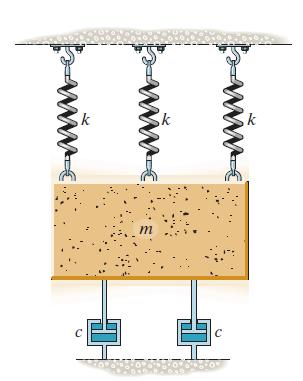
Determine the differential equation of motion for the damped vibratory system shown. What type of motion occurs? c = 200 N-s/m k = 100 N/m 25 kg = 200 N - s/m
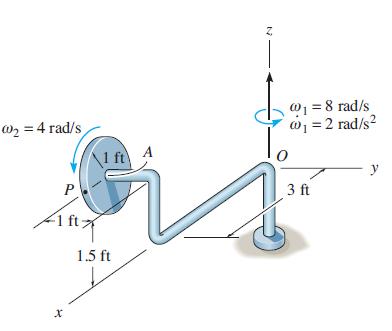
At the given instant, the rod is spinning about the z axis with an angular velocity ω1 = 8rad/s and angular acceleration ω̇1 = 2 rad/s2. At this same instant, the disk is spinning at a constant rate ω2 = 4 rad/s, measured relative to the rod. Determine the velocity and acceleration of point P
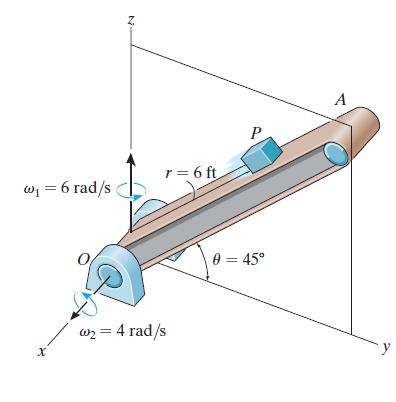
At the instant shown, the arm OA of the conveyor belt is rotating about the z axis with a constant angular velocity ω₁ = 6 rad/s, while at the same instant the arm is rotating upward at a constant rate ω₂ = 4 rad/s. If the conveyor is running at a rate ṙ = 5 ft/s, which is increasing at r̈
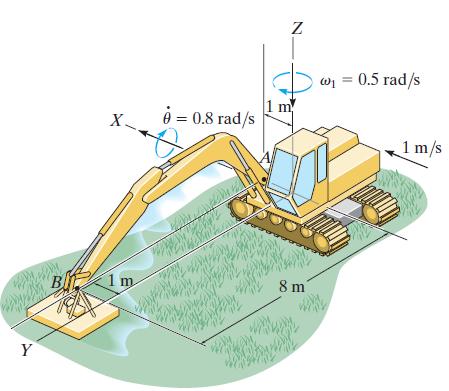
At the instant shown, the frame of the brush cutter is traveling forward in the x direction with a constant velocity of 1 m/s, and the cab is rotating about the vertical axis with a constant angular velocity of ω₁ = 0.5 rad/s. At the same instant the boom AB has an angular velocity of θ̇ = 0.8
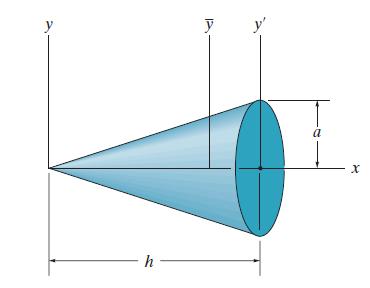
Determine the moment of inertia of the cone with respect to a vertical ȳ axis passing through the cone’s center of mass. What is the moment of inertia about a parallel axis y′ that passes through the diameter of the base of the cone? The cone has a mass m. h y y' X
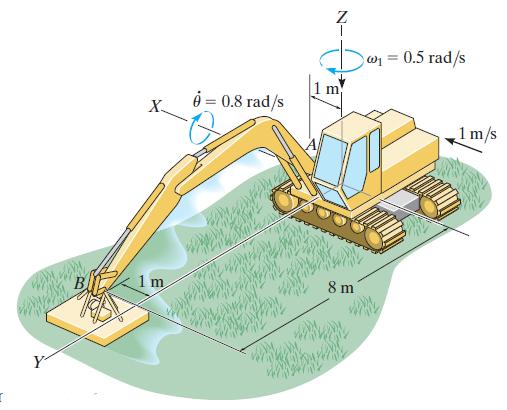
At the instant shown, the frame of the brush cutter is traveling forward in the x direction with a constant velocity of 1 m/s, and the cab is rotating about the vertical axis with an angular velocity of ω₁ = 0.5 rad/s, which is increasing at ω̇₁ = 0.4 rad/s². At the same instant the boom AB
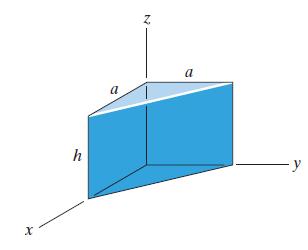
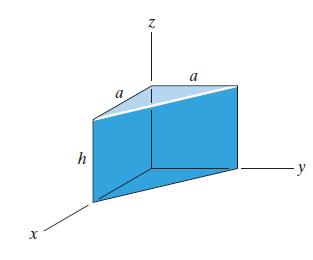
Determine by direct integration the product of inertia Iyz for the homogeneous prism. The density of the material is ρ. Express the result in terms of the total mass m of the prism. X h a Z a y
Determine by direct integration the product of inertia Ixy for the homogeneous prism. The density of the material is ρ. Express the result in terms of the total mass m of the prism. X h a N D
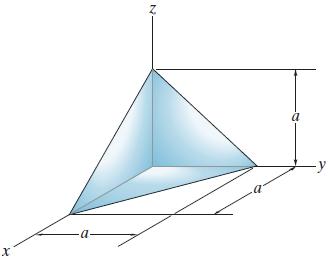
Determine the product of inertia Ixy for the homogeneous tetrahedron. The density of the material is ρ. Express the result in terms of the total mass m of the soild. Use a triangular element of thickness dz and then express dIxy in terms of the size and mass of the element using the result of
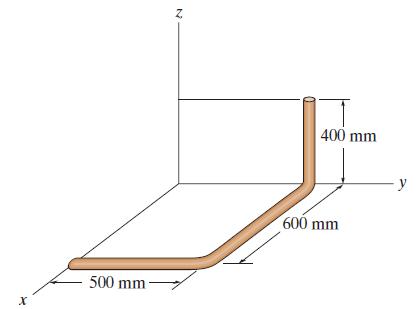
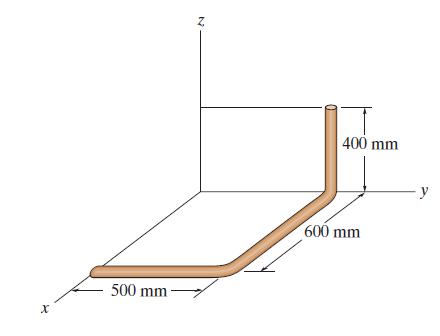
Determine the product of inertia Ixy for the bent rod. The rod has a mass per unit length of 2 kg/m. X 500 mm Z 400 mm 600 mm y
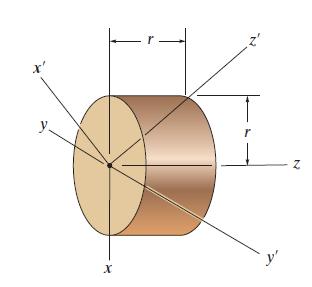
Determine the moments of inertia for the homogeneous cylinder of mass m about the x′, y′, z′ axes. y. X -r. r Z
Show that the sum of the moments of inertia of a body, Ixx + Iyy + Izz, is independent of the orientation of the x, y, z axes and thus depends only on the location of the origin.
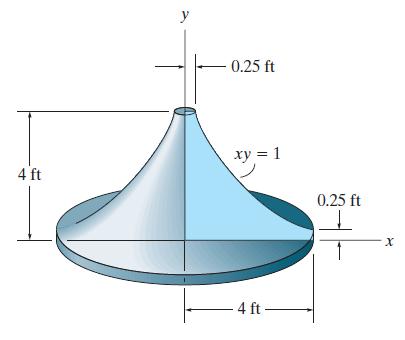
Determine the radii of gyration kx and ky for the solid formed by revolving the shaded area about the y axis. The density of the material is ρ. 4 ft y 0.25 ft xy = 1 -4 ft- 0.25 ft X
Determine the moments of inertia Ixx, Iyy, Izz for the bent rod. The rod has a mass per unit length of 2 kg/m. X 500 mm N 400 mm 600 mm y
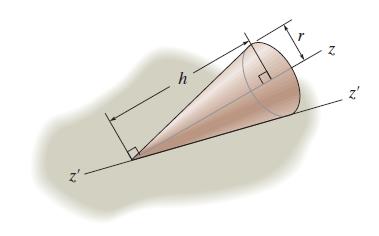
Determine the moment of inertia of the cone about the z′ axis. The weight of the cone is 15 lb, the height is h = 1.5 ft, and the radius is r = 0.5 ft. h N z'
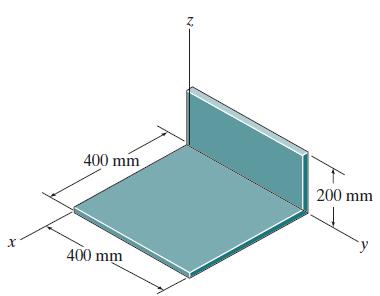
Determine the products of inertia Ixy, Lyz, and Ixz of the thin plate. The material has a density per unit area of 50 kg/m². X 400 mm 400 mm N 200 mm
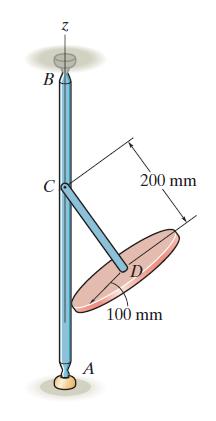
Determine the moment of inertia about the z axis of the assembly which consists of the 1.5-kg rod CD and the 7-kg disk. N e B C A 200 mm 100 mm
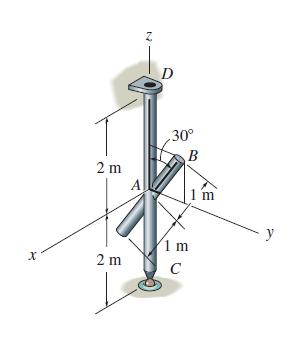
Determine the moments of inertia about the x, y, z axes of the rod assembly. The rods have a mass of 0.75 kg/m. x 2 m 2 m A N D .30° B 1 m C y
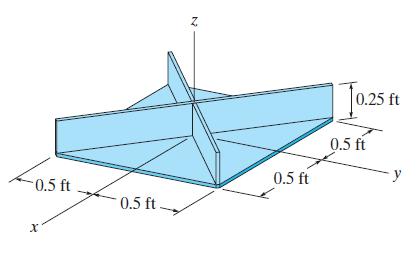
Determine the moment of inertia Ixx of the composite plate assembly. The plates have a specific weight of 6 lb/ft². -0.5 ft X 0.5 ft. Z 0.5 ft 0.25 ft 0.5 ft y
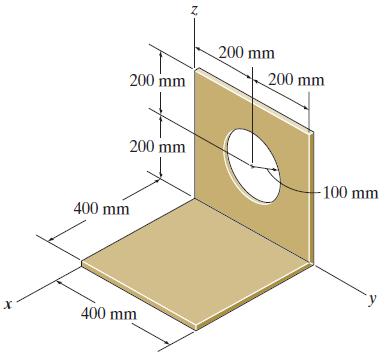
Determine the products of inertia Ixy, Iyz, and Ixz of the thin plate. The material has a mass per unit area of 50 kg/m². x 200 mm 200 mm 400 mm 400 mm 200 mm 200 mm -100 mm y
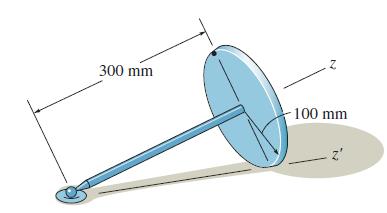
Determine the moment of inertia of both the 1.5-kg rod and 4-kg disk about the z′ axis. 300 mm -100 mm.
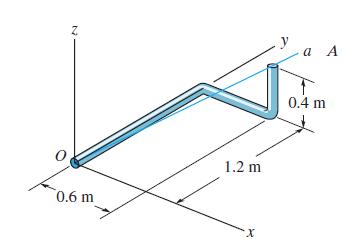
The bent rod has a mass of 4 kg m. Determine the moment of inertia of the rod about the OA axis. N 0.6 m 1.2 m X a A T 0.4 m
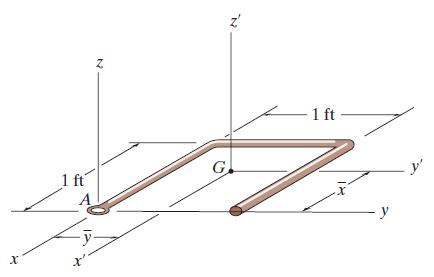
The bent rod has a weight of 1.5 lb/ft. Locate the center of gravity G(x̄, ȳ) and determine the principal moments ofinertia Ix', Iy' and Iz' of the rod with respect to the x', y', z' axes. X 1 ft X Z G 1 ft y
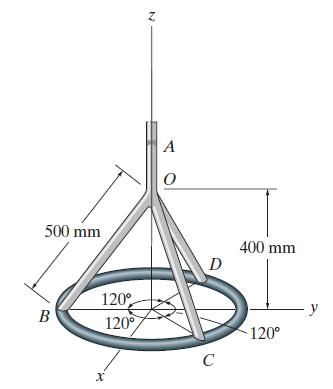
Determine the moment of inertia of the rod-and-thin-ring assembly about the z axis. The rods and ring have a mass per unit length of 2 kg/m. 500 mm B 120° 120° X N A 0 D C 400 mm 120° y
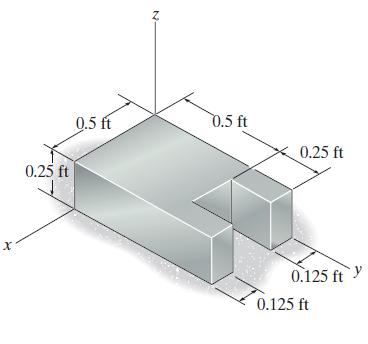
Determine the products of inertia Ixy, Iyz, and Ixz of the solid. The material is steel, which has a specific weight of 490 lb/ft3. X 0.25 ft 0.5 ft Z 0.5 ft 0.25 ft 0.125 ft 0.125 ft y
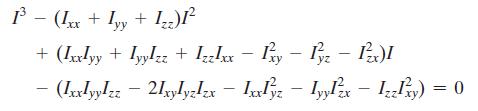
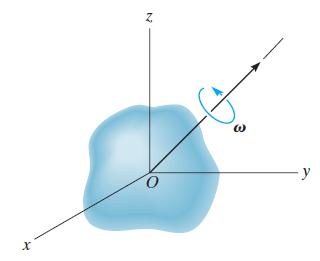
If a body contains no planes of symmetry, the principal moments of inertia can be determined mathematically. To show how this is done, consider the rigid body which is spinning with an angular velocity ω, directed along one of its principal axes of inertia. If the principal moment of inertia about
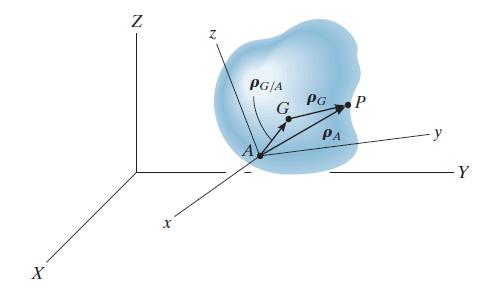
Show that if the angular momentum of a body is determined with respect to an arbitrary point A, then HA can be expressed by Eq. 21-9. This requires substituting ρA = ρG + ρG/A into Eq. 21-6 and expanding, noting that ∫ρG dm = 0 by definition of the mass center and vG = vA + ω X ρG/A.
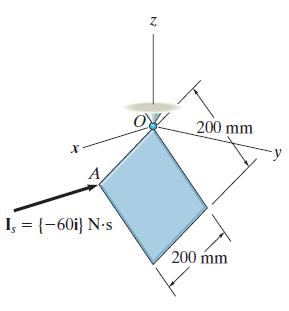
A thin plate, having a mass of 4 kg, is suspended from one of its corners by a ball-and-socket joint O. If a stone strikes the plate perpendicular to its surface at an adjacent corner A with an impulse of Is = {-60i}N · s, determine the instantaneous axis of rotation for the plate and the impulse
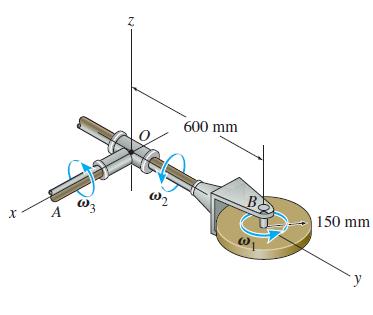
The 10-kg circular disk spins about its axle with a constant angular velocity of ω₁= 15 rad/s. Simultaneously, arm OB and shaft OA rotate about their axes with constant angular velocities of ω2 = 10 rad/s and ω3 = 6 rad/s, respectively. Determine the angular momentum of the disk about point O,
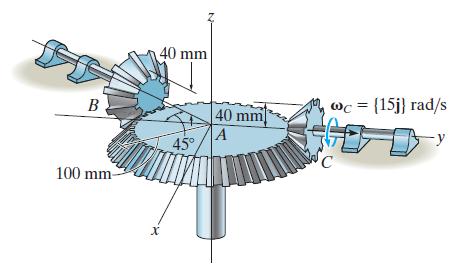
The large gear has a mass of 5 kg and a radius of gyration of kz = 75 mm. Gears B and C each have a mass of 200 g and a radius of gyration about the axis of their connecting shaft of 15 mm. If the gears are in mesh and C has an angular velocity of ωC = {15j} rad/s, determine the total angular
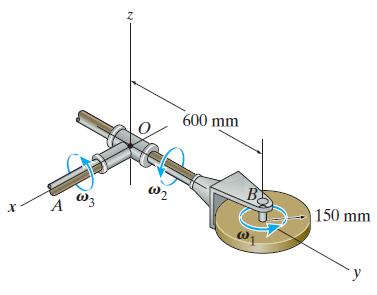
The 10-kg circular disk spins about its axle with a constant angular velocity of ω₁ = 15 rad/s. Simultaneously, arm OB and shaft OA rotate about their axes with constant angular velocities of ω₂ = 0 and ω3 = 6 rad/s, respectively. Determine the angular momentum of the disk about point O, and
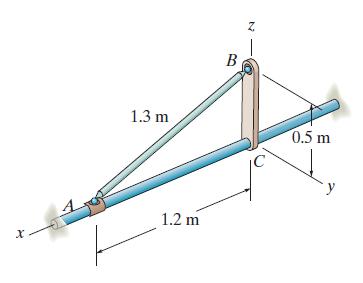
The 4-kg rod AB is attached to the 1-kg collar at A and a 2-kg link BC using ball-and-socket joints. If the rod is released from rest in the position shown, determine the angular velocity of the link after it has rotated 180°. X 1.3 m 1.2 m B Z 0.5 m
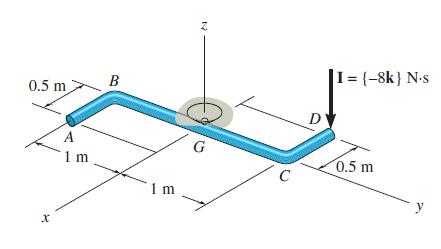
The rod assembly is supported at G by a ball-and-socket joint. Each segment has a mass of 0.5 kg/m. If the assembly is originally at rest and an impulse of I = {-8k} N · s is applied at D, determine the angular velocity of the assembly just after the impact. 0.5 m X A m B 1 m Z G C = {-8k} N-s 0.5
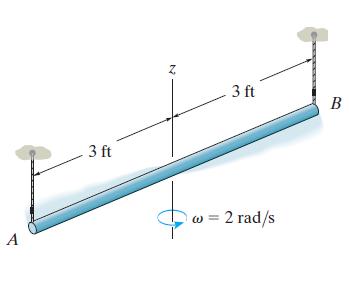
The rod weighs 3 lb/ft and is suspended from parallel cords at A and B. If the rod has an angular velocity of 2 rad/s about the z axis at the instant shown, determine how high the center of the rod rises at the instant the rod momentarily stops swinging. A 3 ft N 3 ft w = 2 rad/s B
The 25-lb thin plate is suspended from a ball-and-socket joint at O. A 0.2-lb projectile is fired with a velocity of v = {-300i - 250j + 300k} ft/s into the plate and becomes embedded in the plate at point A. Determine the angular velocity of the plate just after impact and the axis about which it
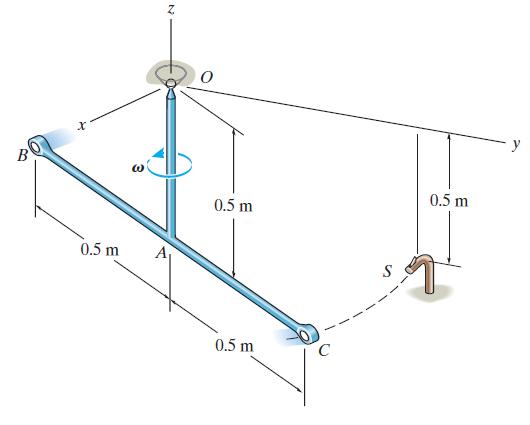
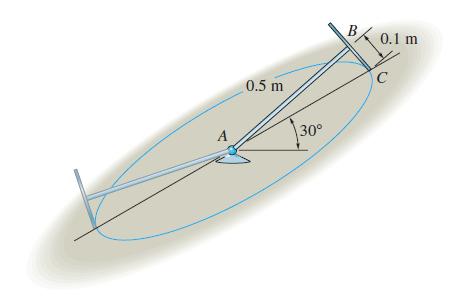
The rod assembly has a mass of 2.5 kg/m and is rotating with a constant angular velocity of ω = {2k} rad/s whenthe looped end at C encounters a hook at S, which providesa permanent connection. Determine the angular velocity ofthe assembly immediately after impact. B x 0.5 m Z A 0 0.5 m 0.5 m 0.5
The 2-kg thin disk is connected to the slender rod which is fixed to the ball-and-socket joint at A. If it is released from rest in the position shown, determine the spin of the disk about the rod when the disk reaches its lowest position. Neglect the mass of the rod. The disk rolls without
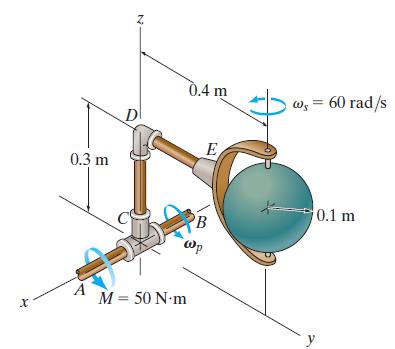
The 20-kg sphere rotates about the axle with a constant angular velocity of ωs = 60 rad/s. If shaft AB is subjected to a torque of M = 50 N · m, causing it to rotate, determine the value of ωρ after the shaft has turned 90° from the position shown. Initially, ωρ = 0. Neglect the mass of arm
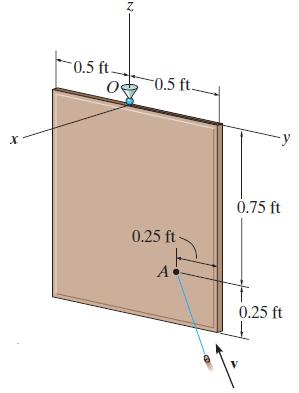
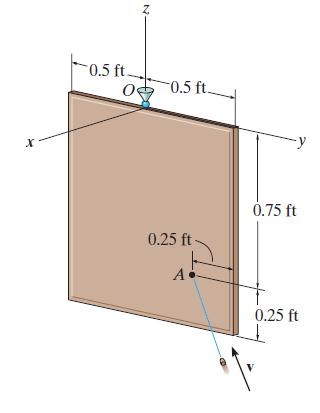
Solve Prob. 21-34 if the projectile emerges from the plate with a velocity of 275 ft/s in the same direction. X 0.5 ft. 0 N 0.5 ft. 0.25 ft A• -y 0.75 ft 0.25 ft
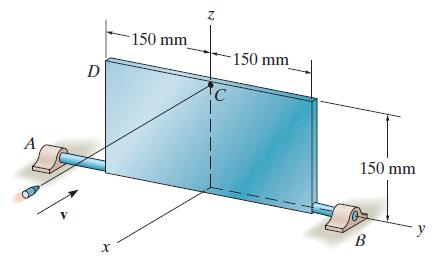
The 15-kg rectangular plate is free to rotate about the y axis because of the bearing supports at A and B. When the plate is balanced in the vertical plane, a 3-g bullet is fired into it, perpendicular to its surface, with a velocity v = {-2000i} m/s. Detemine the angular velocity of the plate at
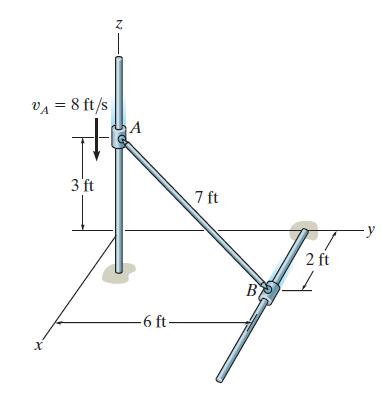
At the instant shown the collar at A on the 6-lb rod AB has a velocity of vA= 8 ft/s. Determine the kinetic energy of the rod after the collar A has descended 3 ft. Each collar is attached to the rod using a ball-and-socket joint. Neglect friction, the thickness of the rod, and the mass of the
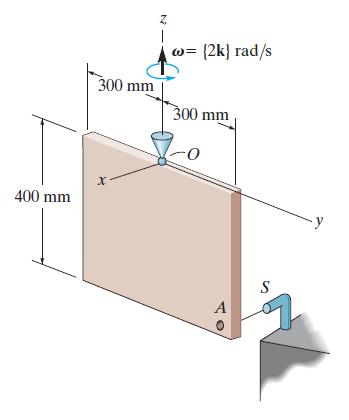
The 5-kg thin plate is suspended at O using a ball-andsocket joint. It is rotating with a constant angular velocity ω = {2k} rad/s when the corner A strikes the hook at S, which provides a permanent connection. Determine the angular velocity of the plate immediately after impact. 400 mm 300
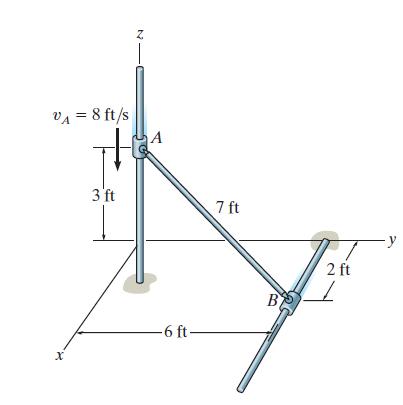
Rod AB has a weight of 6 lb and is attached to two smooth collars at its end points by ball-and-socket joints. If collar A is moving downward at a speed of 8 ft/s, determine the kinetic energy of the rod at the instant shown. VA = 8 ft/s X 3 ft Z 2. 6 ft· 7 ft B 2 ft 1
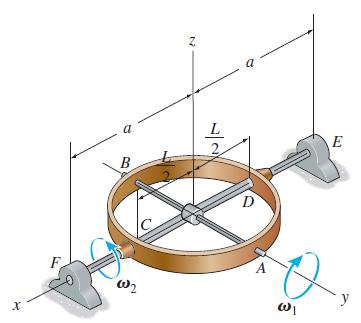
Rod CD of mass m and length L is rotating with a constant angular rate of ω1 about axle AB, while shaft EF rotates with a constant angular rate of ω2. Determine the X, Y, and Z components of reaction at thrust bearing E and journal bearing F at the instant shown. Neglect the mass of the other
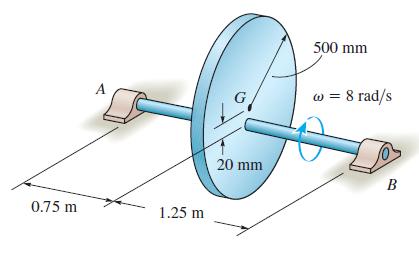
The 40-kg flywheel (disk) is mounted 20 mm off its true center at G. If the shaft is rotating at a constant speed ω = 8 rad/s, determine the maximum reactions exerted on the journal bearings at A and B. 0.75 m 1.25 m 20 mm 500 mm w = 8 rad/s B
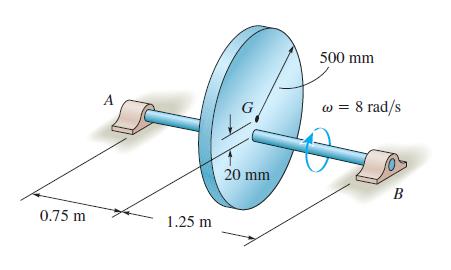
The 40-kg fly wheel (disk) is mounted 20 mm off its true center at G. If the shaft is rotating at a constant speed ω = 8 rad/s, determine the minimum reactions exerted on the journal bearings at A and B during the motion. 0.75 m A 1.25 m G 20 mm 500 mm w = 8 rad/s B
Derive the scalar form of the rotational equation of motion about the x axis if Ω ≠ ω and the moments and products of inertia of the body are not constant with respect to time.
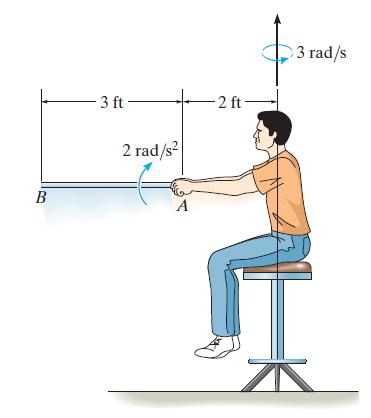
The man sits on a swivel chair which is rotating with a constant angular velocity of 3 rad/s. He holds the uniform 5-lb rod AB horizontal. He suddenly gives it an angular acceleration of 2 rad/s², measured relative to him, as shown. Determine the required force and moment components at the grip,
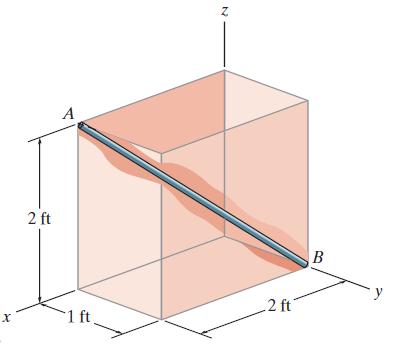
The 4-lb bar rests along the smooth corners of an open box. At the instant shown, the box has a velocity v = {5k} ft/s and an acceleration a = {2k] ft/s². Determine the x, y, z, components of force which the corners exert on the bar. X 2 ft A 1 ft. N 2 ft B
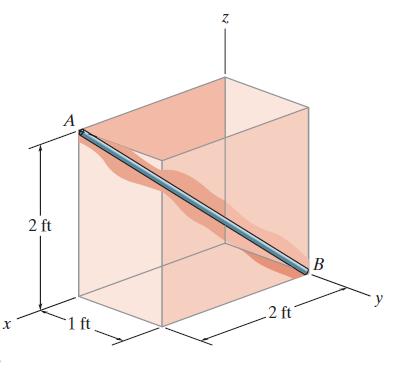
The 4-lb bar rests along the smooth corners of an open box. At the instant shown, the box has a velocity v = {3j} ft/s and an acceleration a = {-6j} ft/s². Determine the x, y, z components of force which the corners exert on the bar. X 2 ft A 1 ft Z 2 ft B
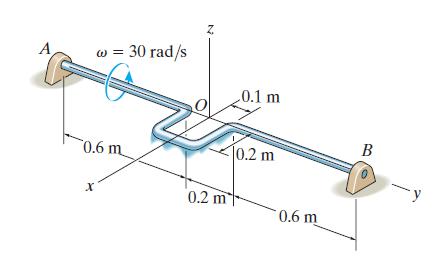
The shaft is constructed from a rod which has a mass per unit of 2 kg/m. Determine the x, y, z components of reaction at the bearings A and B if at the instant shown the shaft spins freely and has an angular velocity of ω = 30 rad/s. What is the angular acceleration of the shaft at this instant?
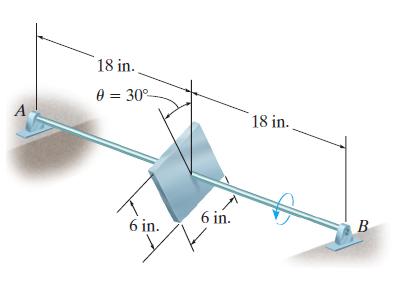
The 20-lb plate is mounted on the shaft AB so that the plane of the plate makes an angle θ = 30° with the vertical. If the shaft is turning in the direction shown with an angular velocity of 25 rad/s, determine the vertical reactions at the bearing supports A and B when the plate is in the
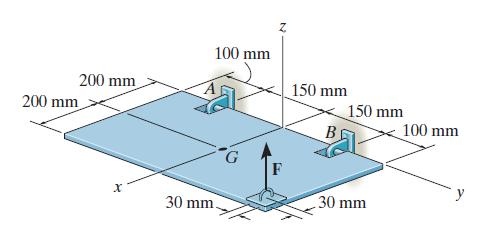
The uniform hatch door, having a mass of 15 kg and a mass center at G, is supported in the horizontal plane by bearings at A and B. If a vertical force F = 300 N is applied to the door as shown, determine the components of reaction at the bearings and the angular acceleration of the door.The
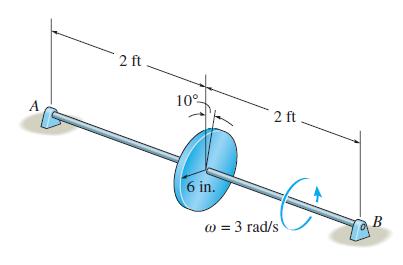
The 20-lb disk is mounted on the horizontal shaft AB such that its plane forms an angle of 10° with the vertical. If the shaft rotates with an angular velocity of 3 rad/s, determine the vertical reactions developed at the bearings when the disk is in the position shown. A 2 ft 10%- 6 in. 2 ft @ =
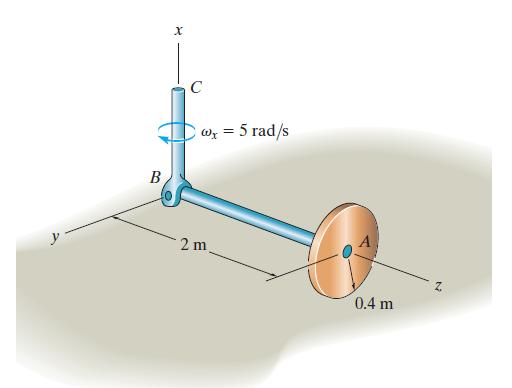
The 10-kg disk turns around the shaft AB, while the shaft rotates about BC at a constant rate of ωx = 5 rad/s. If the disk does not slip, determine the normal and frictional force it exerts on the ground. Neglect the mass of shaft AB. B X C wx = 5 rad/s 2 m 0.4 m
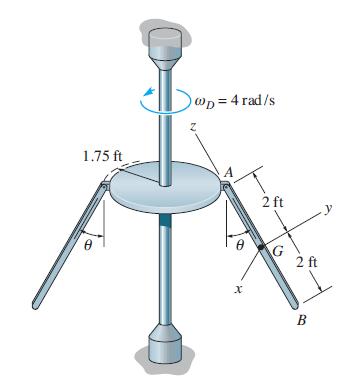
Two uniform rods, each having a weight of 10 lb, are pin connected to the edge of a rotating disk. If the disk has a constant angular velocity ωD = 4 rad/s, determine the angle θ made by each rod during the motion, and the components of the force and moment developed at the pin A. 1.75 ft @p=4
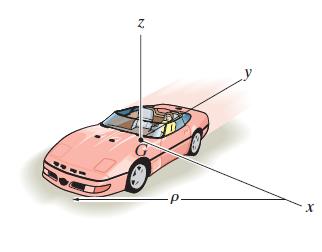
The car travels around the curved road of radius such that its mass center has a constant speed vG. Write the equations of rotational motion with respect to the x, y, z axes.Assume that the car’s six moments and products of inertia with respect to these axes are known. N -P. X
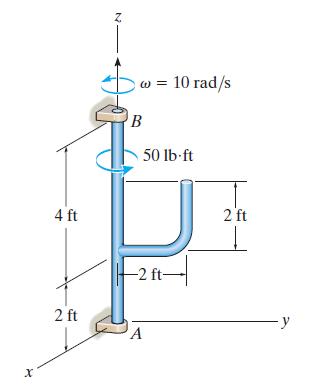
The rod assembly has a weight of 5 lb/ft. It is supported at B by a smooth journal bearing, which develops x and y force reactions, and at A by a smooth thrust bearing, which develops x, y, and z force reactions. If a 50-lb · ft torque is applied along rod AB, determine the components of reaction
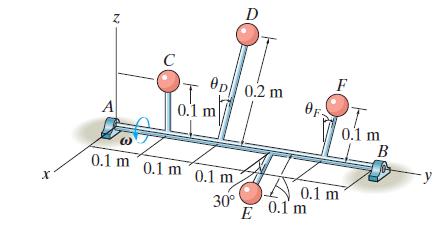
Four spheres are connected to shaft AB. If mc = 1 kg and mE = 2 kg, determine the mass of spheres D and F and the angles of the rods, θD and θF, so that the shaft is dynamicallybalanced, that is, so that the bearings at A and B exert onlyvertical reactions on the shaft as it rotates. Neglect the
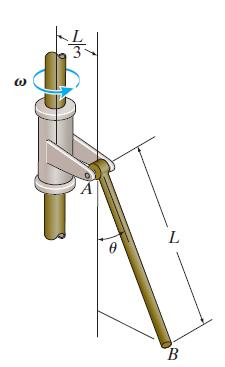
The slender rod AB has a mass m and it is connected to the bracket by a smooth pin at A. The bracket is rigidly attached to the shaft. Determine the required constant angular velocity ω of the shaft, in order for the rod to make an angleθ with the vertical. 3 0 L B
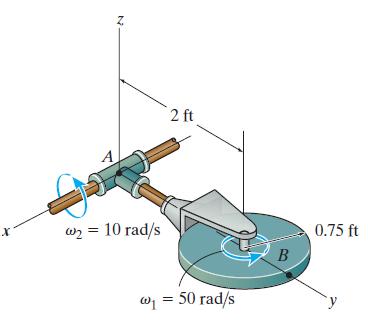
The 50-lb disk spins with a constant angular rate of ω1 = 50 rad/s about its axle. Simultaneously, the shaft rotates with a constant angular rate of ω2 = 10 rad/s. Determine the x, y, z components of the moment developed in the arm at A at the instant shown. Neglect the weight of arm AB. X N @₂
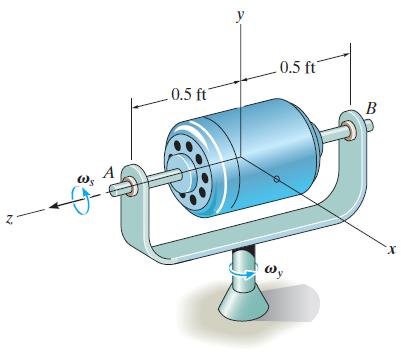
The motor weighs 50 lb and has a radius of gyration of 0.2 ft about the z axis. The shaft of the motor is supported by bearings at A and B, and spins at a constant rate of ωs = {100k} rad/s, while the frame has an angular velocity of ωy = {2j} rad/s. Determine the moment which the bearing forces
A thin rod is initially coincident with the Z axis when it is given three rotations defined by the Euler angles ϕ = 30°, θ = 45°, and ψ = 60°. If these rotations are given in the order stated, determine the coordinate direction angles α, β, γ of the axis of the rod with respect to the X,
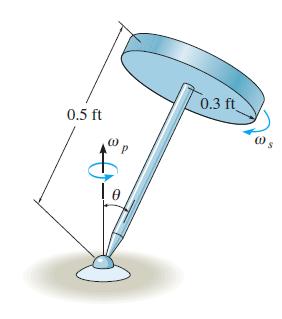
The top consists of a thin disk that has a weight of 8 lb and a radius of 0.3 ft. The rod has a negligible mass and a length of 0.5 ft. If the top is spinning with an angular velocity ωs = 300 rad/s, determine the steady-state precessional angular velocity ωp of the rod when θ = 40°. 0.5
Solve Prob. 21–64 when θ = 90°.Solve Prob. 21–64The top consists of a thin disk that has a weight of 8 lb and a radius of 0.3 ft. The rod has a negligible mass and a length of 0.5 ft. If the top is spinning with an angular velocity ωs = 300 rad/s, determine the steady-state precessional
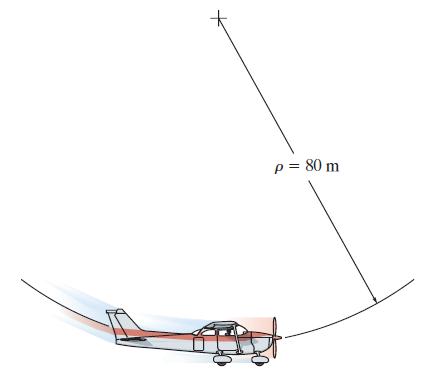
The propeller on a single-engine airplane has a mass of 15 kg and a centroidal radius of gyration of 0.3 m calculated about the axis of spin. When viewed from the front of the airplane, the propeller is turning clockwise at 350 rad/s about the spin axis. If the airplane enters a vertical curve
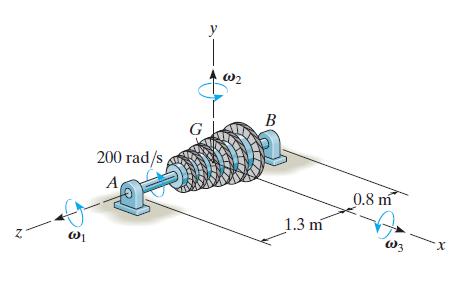
The turbine on a ship has a mass of 400 kg and is mounted on bearings A and B as shown. Its center of mass is at G, its radius of gyration is kz = 0.3 m, and kx = ky = 0.5 m. If it is spinning at 200 rad/s, determine the vertical reactions at the bearings when the ship undergoes each of the
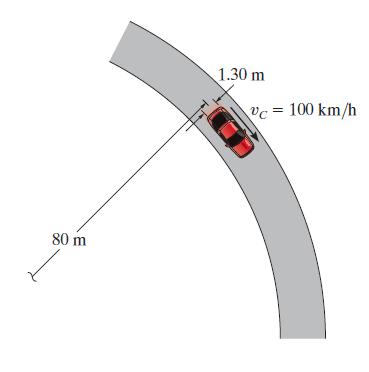
The car travels at a constant speed of vC = 100 km/h around the horizontal curve having a radius of 80 m. If each wheel has a mass of 16 kg, a radius of gyration kG = 300 mm about its spinning axis, and a radius of 400 mm, determine the difference between the normal forces of the rear wheels,
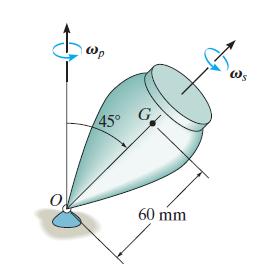
The top has a mass of 90 g, a center of mass at G, and a radius of gyration k = 18 mm about its axis of symmetry. About any transverse axis acting through point O the radius of gyration is kt = 35 mm. If the top is connected to a ball-and- socket joint at O and the precession is ωp = 0.5 rad/s,
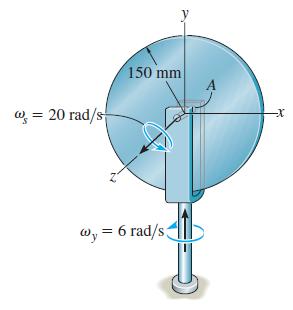
The 20-kg disk is spinning about its center at ωs = 20 rad/s while the supporting axle is rotating at ωy = 6 rad/s. Determine the gyroscopic moment caused by the force reactions which the pin A exerts on the disk due to the motion. @= 20 rad/s 150 mm wy=6 rad/s A -X
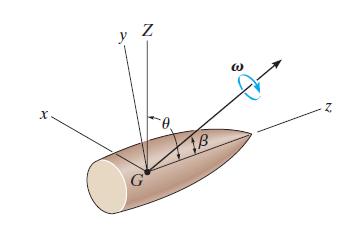
The projectile shown is subjected to torque-free motion. The transverse and axial moments of inertia are I and Iz, respectively. If θ represents the angle between the precessional axis Z and the axis of symmetry z, and β is the angle between the angular velocity ω and the z axis, show that β
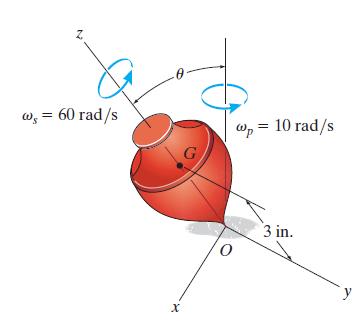
The 1-lb top has a center of gravity at point G. If it spins about its axis of symmetry and precesses about the vertical axis at constant rates of ωs = 60 rad/s and ωp = 10 rad/s, respectively, determine the steady state angle θ. The radius of gyration of the top about the z axis is kz = 1 in.,
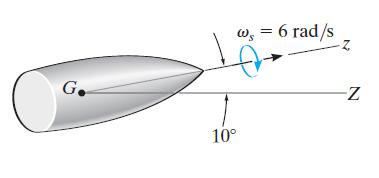
The projectile has a mass of 0.9 kg and axial and transverse radii of gyration of kz = 20 mm and kt = 25 mm, respectively. If it is spinning at ωs = 6 rad/swhen it leaves the barrel of a gun, determine its angularmomentum. Precession occurs about the Z axis. G w, = 6 rad/s 10° Z -Z
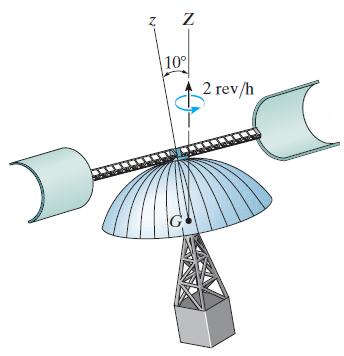
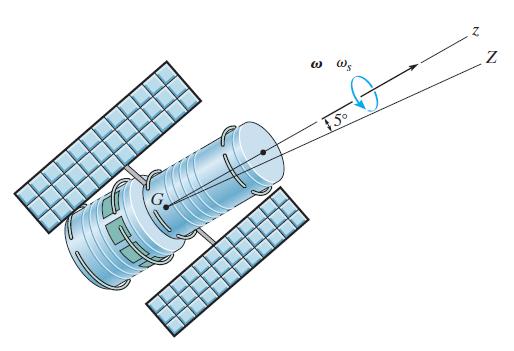
The radius of gyration about an axis passing through the axis of symmetry of the 2.5-Mg satellite is kz = 2.3 m, and about any transverse axis passing through the center of mass G, kt = 3.4 m. If the satellite has a steady-state precession of two revolutions per hour about the Z axis, determine the
The satellite has a mass of 1.8 Mg, and about axes passing through the mass center G the axial and transverse radii of gyration are kz = 0.8 m and kt = 1.2 m, respectively. If it is spinning at ωs = 6 rad/s when it is launched, determine its angular momentum. Precession occurs about the Z axis.
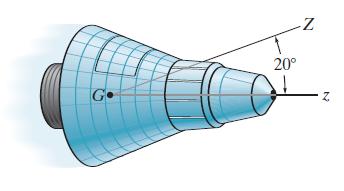
The radius of gyration about an axis passing through the axis of symmetry of the 1.6-Mg space capsule is kz = 1.2 m, and about any transverse axis passing through the center of mass G, kt = 1.8 m. If the capsule has a known steady-state precession of two revolutions per hour about the Z axis,
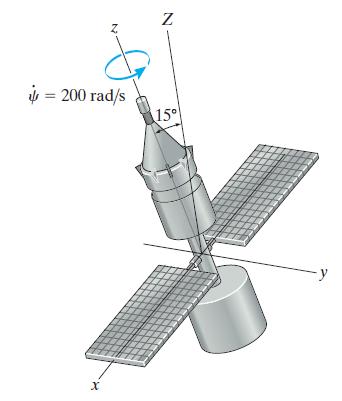
The satellite has a mass of 100 kg and radii of gyration about its axis of symmetry (z axis) and its transverse axes (x or y axis) of kz = 300 mm and kx = ky = 900 mm, respectively. If the satellite spins about the z axis at a constant rate of ψ̇ = 200 rad/s, and precesses about the Z axis,
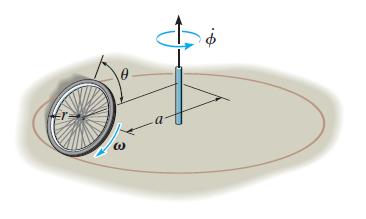
A wheel of mass m and radius r rolls with constant spin ω about a circular path having a radius a. If the angle of inclination is θ, determine the rate of precession. Treat the wheel as a thin ring. No slipping occurs. О Ө
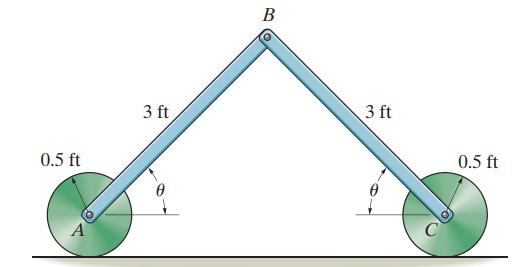
The assembly consists of two 8-lb bars which are pin connected to the two 10-lb disks. If the bars are released from rest when θ = 60°, determine their angular velocities at the instant θ = 0°. Assume the disks roll without slipping. 0.5 ft 3 ft B 6 3 ft 0 C 0.5 ft
The center O of the thin ring of mass m is given an angular velocity of ω0. If the ring rolls without slipping, determine its angular velocity after it has traveled a distance of s down the plane. Neglect its thickness. * იო
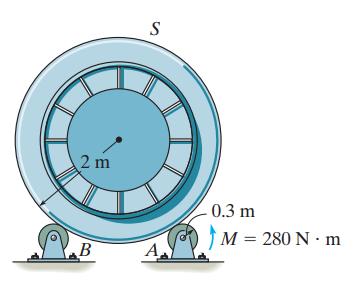
The rotary screen S is used to wash limestone. When empty it has a mass of 800 kg and a radius of gyration of kG = 1.75 m. Rotation is achieved by applying a torque of M = 280 N · m about the drive wheel at A. If no slipping occurs at A and the supporting wheel at B is free to roll, determine the
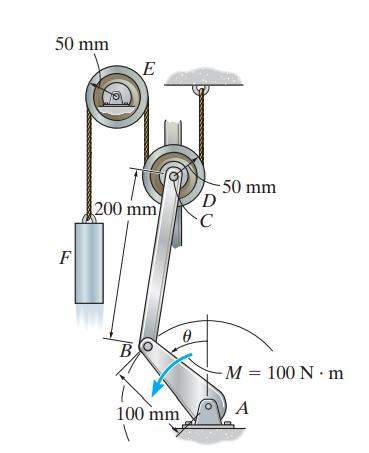
The system is released from rest at θ = 0° when a constant couple moment M = 100N · m is applied. If the mass of the cable and links AB and BC can be neglected, and each pulley can be treated as a disk having a mass of 6 kg, determine the speed of the 10-kg block at the instant link AB has
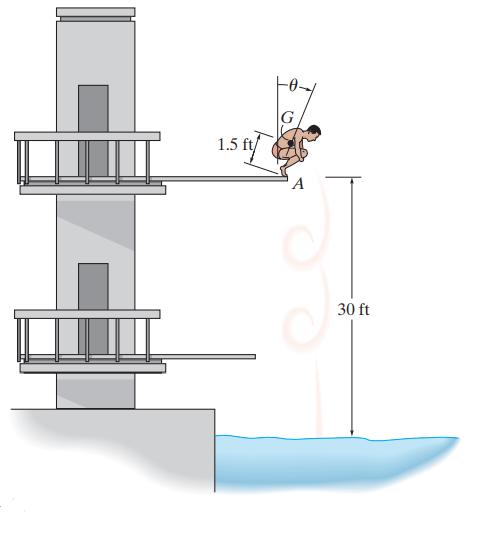
A man having a weight of 150 lb crouches down on the end of a diving board as shown. In this position the radius of gyration about his center of gravity is kG = 1.2 ft. While holding this position at θ = 0°, he rotates about his toes at A until he loses contact with the board when θ = 90°. If
Showing 600 - 700
of 2426
1
2
3
4
5
6
7
8
9
10
11
12
13
14
15
Last
Step by Step Answers

 Get 50% OFF
Claim Now
Get 50% OFF
Claim Now