New Semester
Started
Get
50% OFF
Study Help!
--h --m --s
Claim Now
Question Answers
Textbooks
Find textbooks, questions and answers
Oops, something went wrong!
Change your search query and then try again
S
Books
FREE
Study Help
Expert Questions
Accounting
General Management
Mathematics
Finance
Organizational Behaviour
Law
Physics
Operating System
Management Leadership
Sociology
Programming
Marketing
Database
Computer Network
Economics
Textbooks Solutions
Accounting
Managerial Accounting
Management Leadership
Cost Accounting
Statistics
Business Law
Corporate Finance
Finance
Economics
Auditing
Tutors
Online Tutors
Find a Tutor
Hire a Tutor
Become a Tutor
AI Tutor
AI Study Planner
NEW
Sell Books
Search
Search
Sign In
Register
study help
engineering
engineering mechanics statics
Engineering Mechanics Statics & Dynamics 15th Edition Russell C. Hibbeler - Solutions
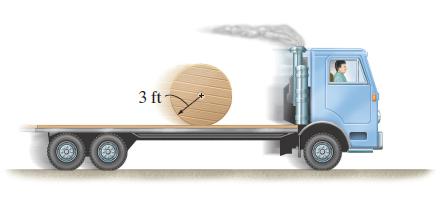
The truck carries the spool which has a weight of 500 lb and a radius of gyration of kG = 2 ft. Determine the angular acceleration of the spool if it is not tied down on the truck and the truck begins to accelerate at 3 ft/s2. Assume the spool does not slip on the bed of the truck. 3 ft
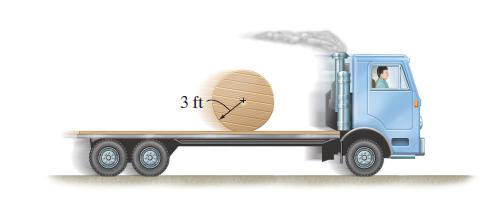
The truck carries the spool which has a weight of 200 lb and a radius of gyration of kG = 2 ft. Determine the angular acceleration of the spool if it is not tied down on the truck and the truck begins to accelerate at 5 ft/s². The coefficients of static and kinetic friction between the spool and
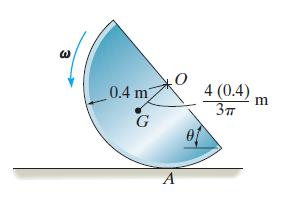
The semicircular disk having a mass of 10 kg is rotating at ω = 4 rad/s at the instant θ = 60°. If the coefficient ofstatic friction at A is μs = 0.5, determine if the disk slips at this instant. W 0.4 m G A 01 4 (0.4) Зп m
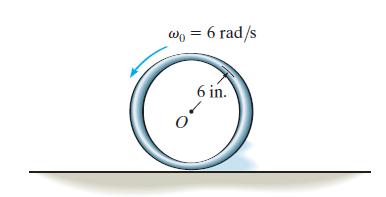
The 10-lb hoop or thin ring is given an initial angular velocity of 6 rad/s when it is placed on the surface. If the coefficient of kinetic friction between the hoop and the surface μk = 0.3, is determine the distance the hoop moves before it stops slipping. w = 6 rad/s 6 in.
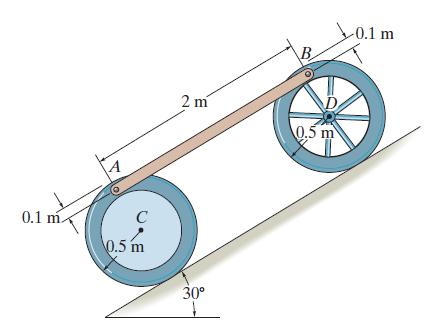
Wheel C has a mass of 60 kg and a radius of gyration of 0.4 m, whereas wheel D has a mass of 40 kg and a radius of gyration of 0.35 m. Determine the angular acceleration of each wheel at the instant shown. Neglect the mass of the link and assume that the assembly does not slip on the plane. 0.1
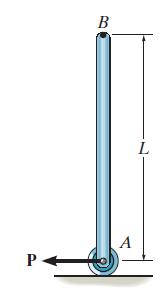
The uniform bar of mass m and length L is balanced in the vertical position when the horizontal force P is applied to the roller at A. Determine the bar’s initial angular acceleration and the acceleration of its top point B. P B L
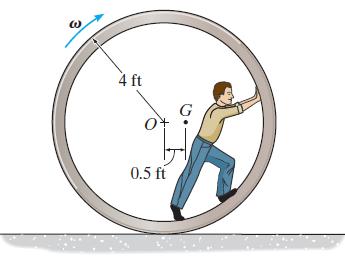
The circular concrete culvert rolls with an angular velocity of ω = 0.5 rad/s when the man is at the position shown. Atthis instant the center of gravity of the culvert and the man islocated at point G, and the radius of gyration about G iskG = 3.5 ft. Determine the angular acceleration of the
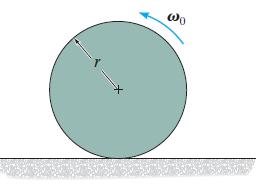
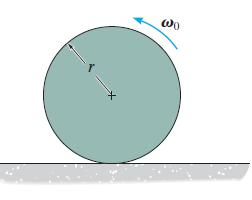
The uniform disk of mass m is rotating with an angular velocity of ω0 when it is placed on the floor. Determine the initial angular acceleration of the disk and the acceleration of its mass center.The coefficient of kinetic friction between the disk and the floor is μk.
The uniform disk of mass m is rotating with an angular velocity of ω0 when it is placed on the floor. Determine the time before it starts to roll without slipping. What is the angular velocity of the disk at this instant? The coefficient of kinetic friction between the disk and the floor is
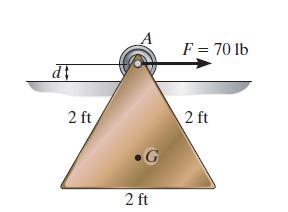
The uniform plate weighs 40lb and is supported by a roller at A. If a horizontal force of F = 70 lb is applied to the roller, determine the acceleration of the center of the roller at the instant the force is applied. The plate has a moment of inertia about its center of mass of IG = 0.414 slug ·
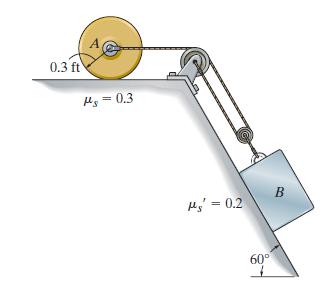
The cylinder A has a weight of 15 lb and is attached to the 20-lb block B using the cord and pulley system shown. Determine the acceleration of the block when it is released. The coefficients of static friction are indicated in the figure. 0.3 ft Hs=0.3 Hs' = 0.2 60° B
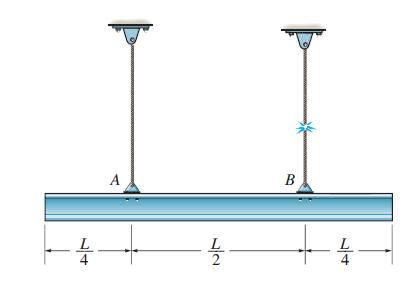
The uniform beam has a weight W. If it is originally at rest while being supported at A and B by cables, determine the tension in cable A if cable B suddenly fails. Assume the beam is a slender rod. L A A 늘 B -눈-
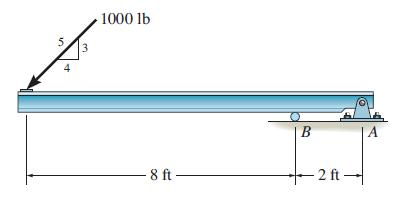
The 500-lb beam is supported at A and B when it is subjected to a force of 1000 lb as shown. If the pin support at A suddenly fails, determine the beam’s initial angular acceleration and the force of the roller support on the beam. For the calculation, assume that the beam is a slender rod so
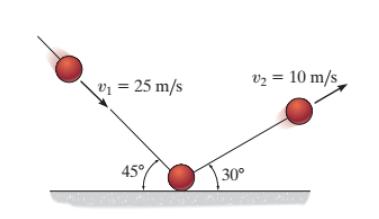
The 0.5-kg ball strikes the rough ground and rebounds with the velocities shown. Determine the magnitude of the impulse the ground exerts on the ball. Assume that the ball does not slip when it strikes the ground, and neglect the size of the ball and the impulse produced by the weight of the ball.
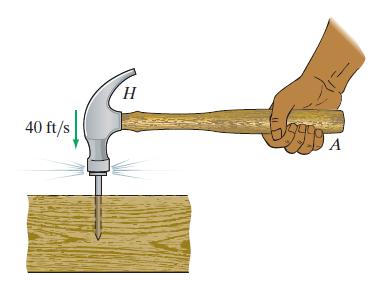
A hammer head H having a weight of 0.3 lb is moving downwards at 40 ft/s when it strikes the head of a nail of negligible mass and drives it into a block of wood. Find the impulse on the nail if it is assumed that the grip at A is loose, the handle has a negligible mass, and the hammer stays in
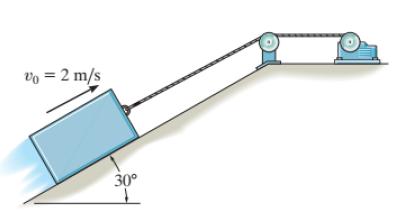
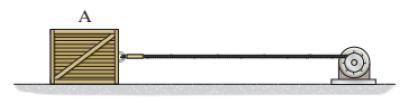
The 50-kg block is hoisted up the incline using the cable and motor arrangement shown. The coefficient of kinetic friction between the block and the surface is μk = 0.4. If the block is initially moving up the plane at v0 = 2 m/s, and at this instant (t = 0) the motor develops a tension in the
The motor exerts a force of F = (20t2) N on the cable, where t is in seconds. Determine the speed of the 25-kg crate when t = 4 s. The coefficients of static and kinetic friction between the crate and the plane are μs = 0.3 and μk = 0.25, respectively. A
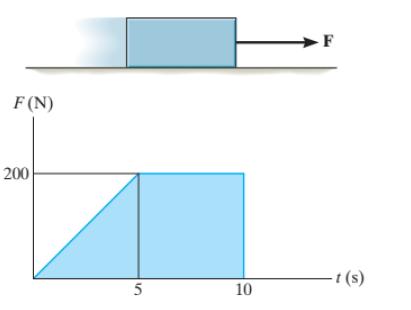
A 20-kg block is originally at rest on a horizontal surface for which the coefficient of static friction is µs = 0.6 and the coefficient of kinetic friction is µk = 0.5. If a horizontal force F is applied such that it varies with time as shown, determine the speed of the block in 10 s. F
A 20-lb block slides down a 30° inclined plane with an initial velocity of 2 ft/s. Determine the velocity of the block in 3 s if the coefficient of kinetic friction between the block and the plane is μk = 0.25.
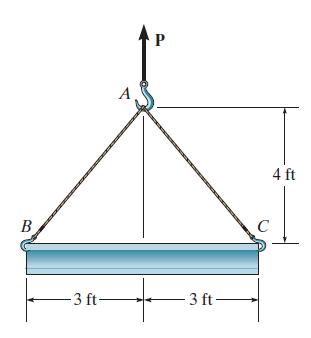
Each of the cables can sustain a maximum tension of 5000 lb. If the uniform beam has a weight of 5000 lb, determine the shortest time possible to lift the beam with a speed of 10 ft/s starting from rest. B -3 ft- P 3 ft- C 4 ft
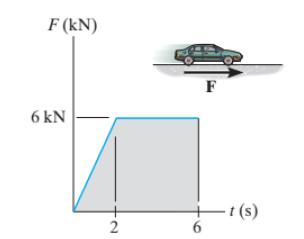
The wheels of the 1.5-Mg car generate the traction force F described by the graph. If the car starts from rest, determine its speed when t = 6 s. F (KN) 6 kN 2 6 F -t(s)
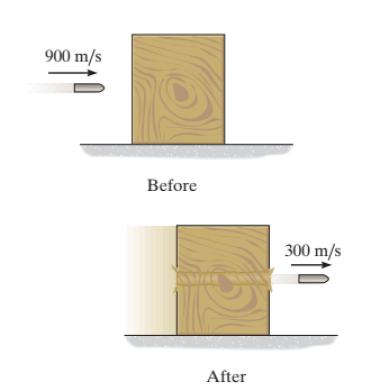
The 200-g projectile is fired with a velocity of 900 m/s towards the center of the 15-kg wooden block, which rests on a rough surface. If the projectile penetrates and emerges from the block with a velocity of 300 m/s, determine the velocity of the block just after the projectile emerges. How long
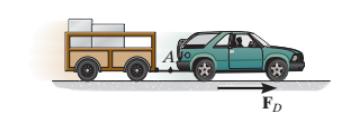
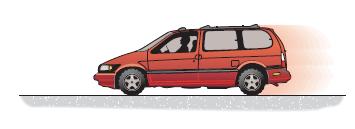
The 2.5-Mg four-wheel-drive SUV tows the 1.5-Mg trailer. The traction force developed at the wheels is FD = 9 kN. Determine the speed of the truck in 20 s, starting from rest. Also, determine the tension developed in the coupling, A, between the SUV and the trailer. Neglect the mass of the wheels.
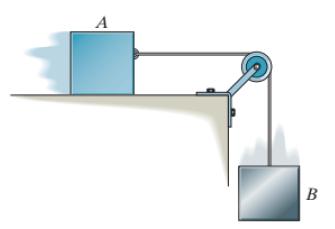
The 10-lb block A attains a velocity of 1 ft/s in 5 seconds, starting from rest. Determine the tension in the cord and the coefficient of kinetic friction between block A and the horizontal plane. Neglect the weight of the pulley. Block B has a weight of 8 lb. A B
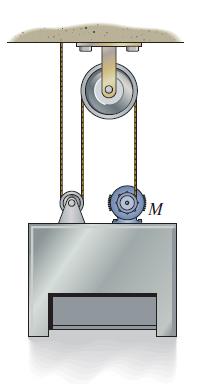
The 60-lb hoisting block is operated by a motor M. Starting from rest, the supporting cable can be wound up by the motor so that it is wound into the motor with a relative velocity of 3 ft/s in 5 s. If the cable does not slip on the pulleys, determine the average force exerted on the cables during
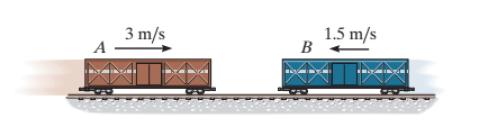
The freight cars A and B have a mass of 20 Mg and 15 Mg, respectively. Determine the velocity of A after collision if the cars collide and rebound, such that B moves to the right with a speed of 2 m/s. If A and B are in contact for 0.5 s, find the average impulsive force which acts between them.
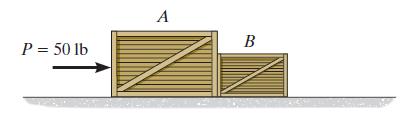
Crates A and B weigh 100 lb and 50 lb, respectively. If they start from rest, determine their speed when t = 5s . Also, find the force exerted by crate A on crate B during the motion. The coefficient of kinetic friction between the crates and the ground is μk = 0.25. P = 50 lb A B
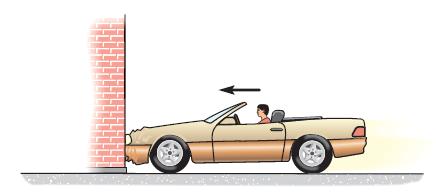
The automobile has a weight of 2700 lb and is traveling forward at 4 ft/s when it crashes into the wall. If the impact occurs in 0.06 s, determine the average impulsive force acting on the car. Assume the brakes are not applied. If the coefficient of kinetic friction between the wheels and the
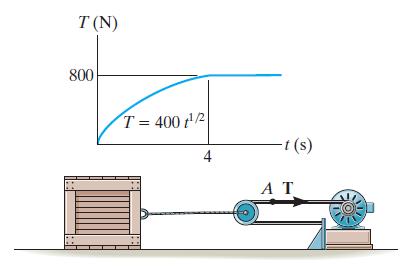
The 200-kg crate rests on the ground for which the coefficients of static and kinetic friction are μs = 0.5 and μk = 0.4, respectively. The winch delivers a horizontal towing force T to its cable at A which varies as shown in the graph. Determine the speed of the crate when t = 4 s. Originally
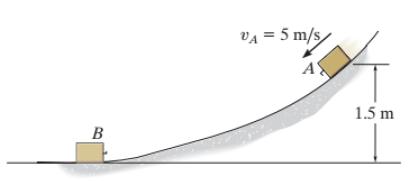
The 5-kg block A has an initial speed of 5 m/s as it slides down the smooth ramp, after which it collides with the stationary 8-kg block B. If the two blocks couple together after collision, determine their common velocity immediately after collision. B VA = 5 m/s 1.5 m
The spring is fixed to block A and block B is pressed against the spring. If the spring is compressed s = 200 mm and then the blocks are released, determine their velocity at the instant block B loses contact with the spring. The masses of blocks A and B are 10 kg and 15 kg, respectively. A k = 5
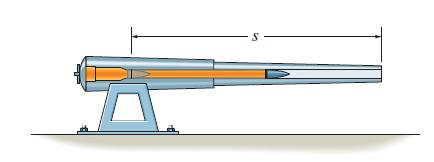
The force acting on a projectile having a mass m as it passes horizontally through the barrel of the cannon is F = C sin (πt/t′). Determine the projectile’s velocity when t = t′. If the projectile reaches the end of the barrel at this instant, determine the length s. S
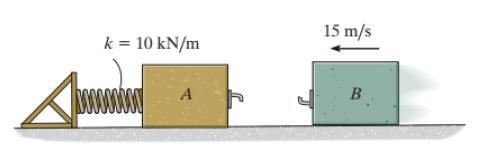
Blocks A and B have a mass of 15 kg and 10 kg, respectively. If A is stationary and B has a velocity of 15 m/s just before collision, and the blocks couple together after impact, determine the maximum compression of the spring. X k = 10 kN/m A 15 m/s B
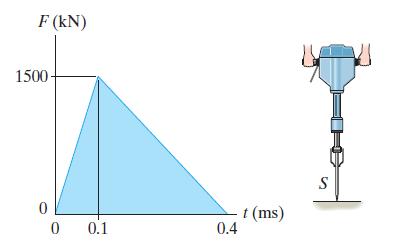
During operation the jack hammer strikes the concrete surface with a force which is indicated in the graph. To achieve this the 2-kg spike S is fired into the surface at 90 m/s. Determine the speed of the spike just after rebounding. F (KN) 1500- 0 0 0.1 0.4 t (ms) S
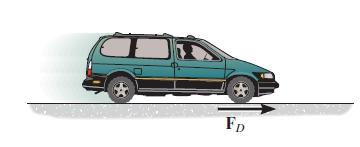
For a short period of time, the frictional driving force acting on the wheels of the 2.5-Mg van is FD = (600 t2) N, where t is in seconds. If the van has a speed of 20 km/h when , determine its speed when t = 5 s. ★ FD
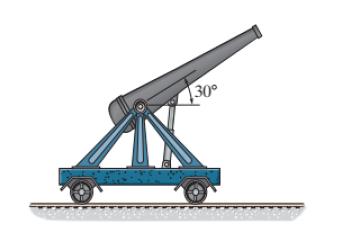
The cannon and support without a projectile have a mass of 250 kg. If a 20-kg projectile is fired from the cannon with a velocity of 400 m/s, measured relative to the cannon, determine the speed of the projectile as it leaves the cannon barrel. Neglect rolling resistance. 30°
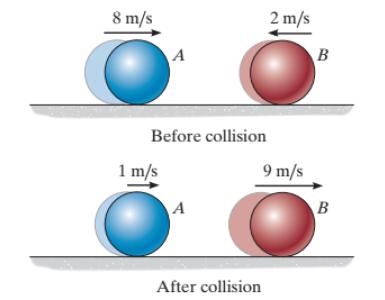
Determine the coefficient of restitution e between ball A and ball B. The velocities of A and B before and after the collision are shown. 8 m/s A Before collision 1 m/s A After collision 2 m/s 9 m/s B B
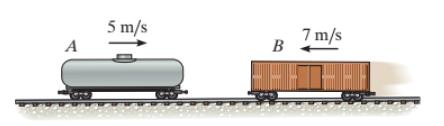
The 15-Mg tank car A and 25-Mg freight car B travel toward each other with the velocities shown. If the coefficient of restitution between the bumpers is e = 0.6, determine the velocity of each car just after the collision. A 5 m/s B 7 m/s
The 2.5-Mg van is traveling with a speed of 100 km/h when the brakes are applied and all four wheels lock. If the speed decreases to 40 km/h in 5 s, determine the coefficient of kinetic friction between the tires and the road. ex *
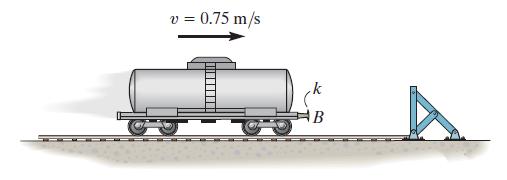
A tankcar has a mass of 20 Mg and is freely rolling to the right with a speed of 0.75 m/s. If it strikes the barrier, determine the horizontal impulse needed to stop the car if the spring in the bumper B has a stiffness (a) k→∞ (bumper is rigid), and (b) k = 15 kN/m. v = 0.75 m/s B
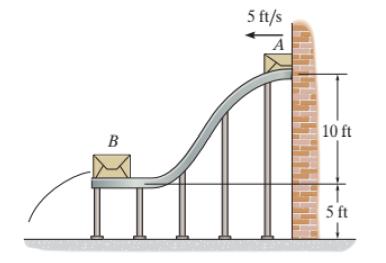
The 30-lb package A has a speed of 5 ft/s when it enters the smooth ramp. As it slides down the ramp, it strikes the 80-lb package B which is initially at rest. If the coefficient of restitution between A and B is e = 0.6, determine the velocity of B just after the impact. B 5 ft/s 10 ft 5 ft
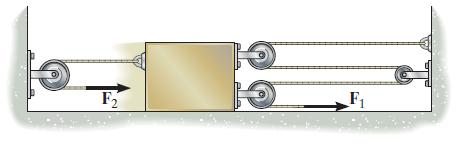
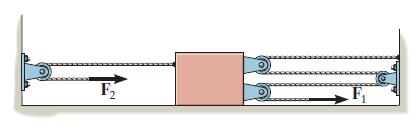
The 10-lb slider block is moving to the right with a velocity of 10 ft/s when it is acted upon by the forces F1 and F2. If the loading vary in the manner shown in the graph, determine the velocity of the block after 6 s. Neglect friction and the weight of the pulleys. F₁₂ GL F₁
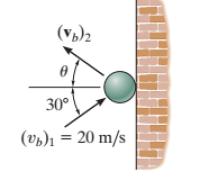
The ball strikes the smooth wall with a velocity of (vb)₁= 20 m/s. If the coefficient of restitution between the ball and the wall is e = 0.75, determine the velocity of the ball just after the impact. (Vb)₂ 0 30° (vb)₁ = 20 m/s
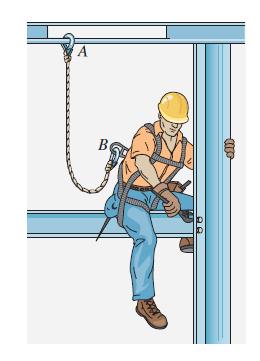
The 180-lb iron worker is secured by a fall-arrest system consisting of a harness and lanyard AB, which is fixed to the beam. If the lanyard has a slack of 4 ft, determine the average impulsive force developed in the lanyard if he happens to fall 4 feet. Neglect his size in the calculation and
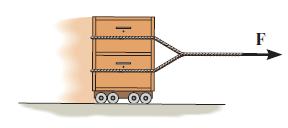
The towing force acting on the 400-kg safe varies as shown in the graph. Determine its speed, starting from rest, when t = 8 s. How far has it traveled during this time? -0.0 F
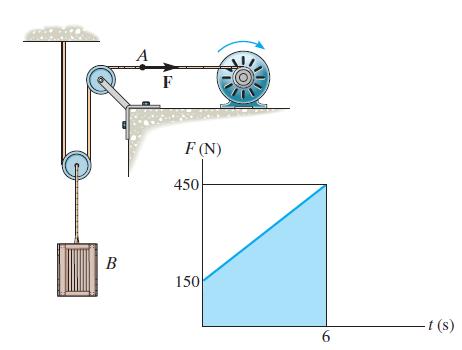
The motor exerts a force F on the 40-kg crate as shown in the graph. Determine the speed of the crate when t = 3 s and when t = 6 s. When t = 0, the crate is moving downward at 10 m/s. B F F (N) 450 150 6 -t (s)
The 30-kg slider block is moving to the left with a speed of 5 m/s when it is acted upon by the forces F1 and F2. If these loadings vary in the manner shown on the graph, determine the speed of the block at t = 6 s. Neglect friction and the mass of the pulleys and cords. F₂
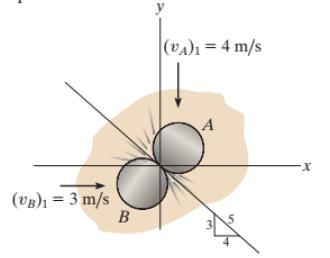
Two disks A and B each have a mass of 1 kg and the initial velocities shown just before they collide. If the coefficient of restitution is e = 0.5, determine their speeds just after impact. (VB)1 = 3 m/s B (VA)₁ = 4 m/s A -X
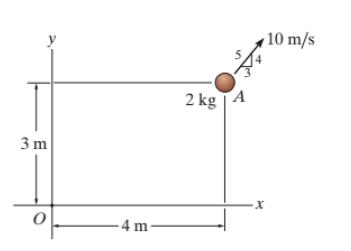
The 2-kg particle A has the velocity shown. Determine its angular momentum Ho about point O. 3 m 0 -4 m- 2 kg | A X 10 m/s
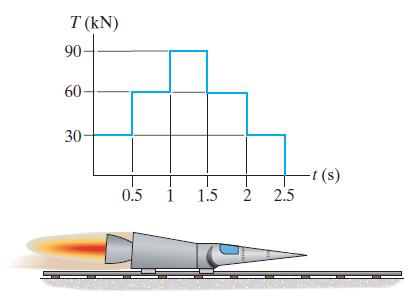
Determine the maximum speed attained by the 1.5-Mg rocket sled if the rockets provide the thrust shown in the graph. Initially, the sled is at rest. Neglect friction and the loss of mass due to fuel consumption. T (KN) 90- 60- 30- 0.5 1 1.5 2 2.5 jou -t (s)
The motor pulls on the cable at A with a force F = (30 + t2) lb, where t is in seconds. If the 34-lb crate is originally on the ground at t = 0, determine its speed in t = 4 s. Neglect the mass of the cable and pulleys. A
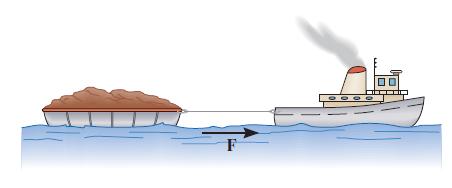
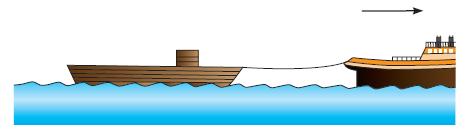
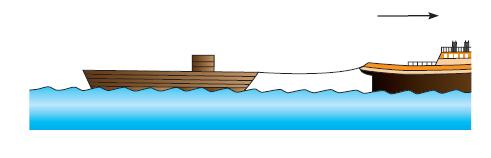
If it takes 35 s for the 50-Mg tugboat to increase its speed uniformly to 25 km/h, starting from rest, determine the force of the rope on the tugboat. The propeller provides the propulsion force F on the tugboat which gives it forward motion, whereas the barge moves freely. Also, determine the
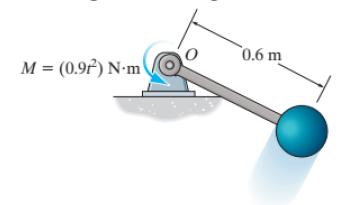
The 2-kg sphere is attached to the rod, which rotates in the horizontal plane centered at O. If the system is subjected to a couple moment M = (0.9t2) N · m, where t is in seconds, determine the speed of the sphere at the instant t = 5 s starting from rest. Neglect the mass of the rod. M =
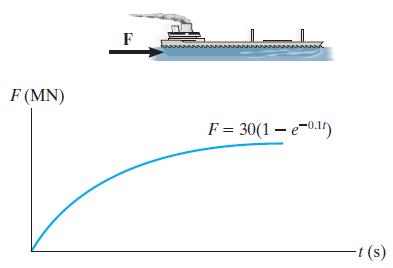
The tanker has a mass of 130 Gg. If it is originally at rest, determine its speed when t = 10 s. The horizontal thrust provided by its propeller varies with time as shown in the graph. Neglect the effect of water resistance. F (MN) F F = 30(1-e-0.11) -t (s)
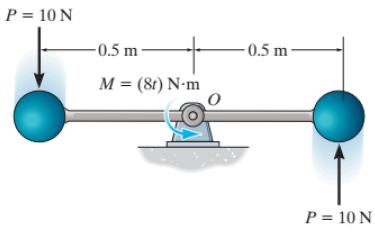
Two identical 10-kg spheres are attached to the rod, which rotates in the horizontal plane centered at pin O. If the spheres are subjected to tangential forces of P = 10 N, and the rod is subjected to a couple moment M = (8t) N m, where t is in seconds, determine the speed of the spheres at the
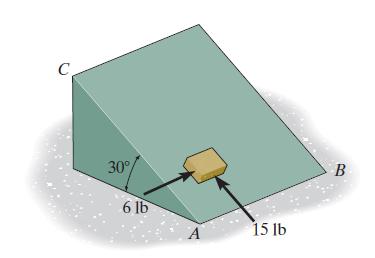
The small 20-lb block is placed on the inclined plane and subjected to 6-lb and 15-lb forces that act parallel with edges AB and AC, respectively. If the block is initially at rest, determine its speed when t = 3s. The coefficient of kinetic friction between the block and the plane is μk = 0.2.
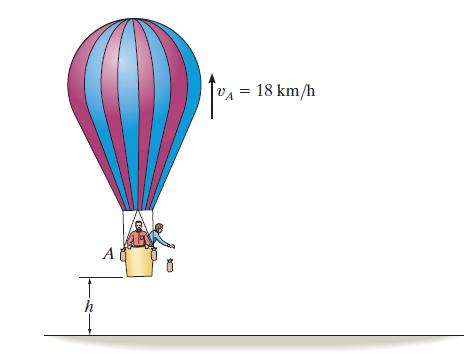
The balloon has a total mass of 400 kg including the passengers and ballast. The balloon is rising at a constant velocity of 18 km/h when h = 10 m. If the man drops the 40-kg sand bag, determine the velocity of the balloon when the bag strikes the ground. Neglect air resistance. A VA = 18 km/h
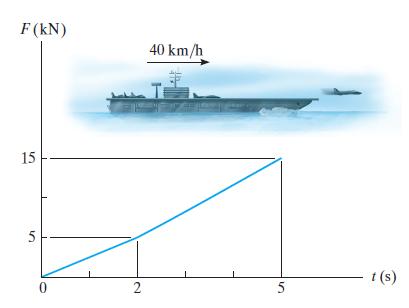
A jet plane having a mass of 7 Mg takes off from an aircraft carrier such that the engine thrust varies as shown by the graph. If the carrier is traveling forward with a speed of 40 km/h, determine the plane’s airspeed after 5 s. F (KN) 15 5 0 2 40 km/h 5 t(s)
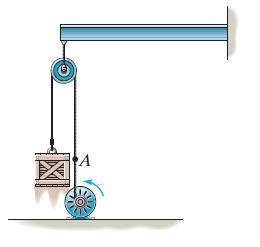
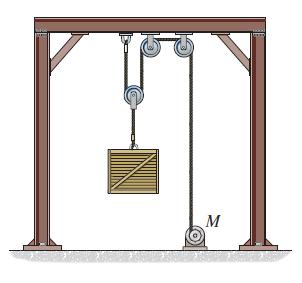
The 100-kg crate is hoisted by the motor M. If the velocity of the crate increases uniformly from 1.5m/s to 4.5m/s in 5 s, determine the tension developed in the cable during the motion. M
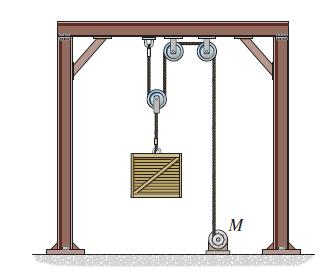
The 100-kg crate is hoisted by the motor M.The motor exerts a force on the cable of T = (200t1/2 + 150) N, where t is in seconds. If the crate starts from rest at the ground, determine the speed of the crate when t = 5 s. M
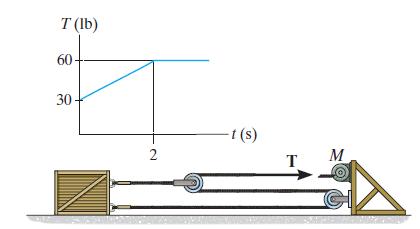
If the force T exerted on the cable by the motor M is indicated by the graph, determine the speed of the 500-lb crate when t = 4 s, starting from rest. The coefficients of static and kinetic friction are μs = 0.3 and μk = 0.25, respectively. T (lb) 60 30 2 -t (s) T M G
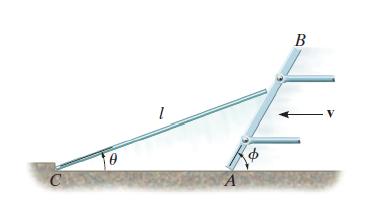
The inclined plate moves to the left with a constant velocity v. Determine the angular velocity and angular acceleration of the slender rod of length ∫.The rod pivots about the step at C as it slides on the plate C А 1 A B
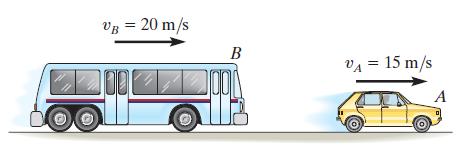
The 5-Mg bus B is traveling to the right at 20 m/s. Meanwhile a 2-Mg car A is traveling at 15 m/s to the right. If the vehicles crash and become entangled, determine their common velocity just after the collision. Assume that the vehicles are free to roll during collision. 500 VB = 20 m/s B good VA
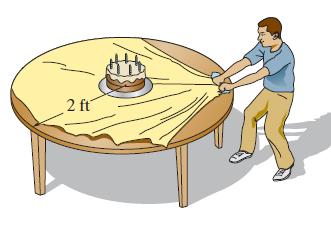
A cake and plate weighing 1.5 lb rest at the center of a circular table. Without touching the cake a boy attempts to remove the 2-ft-radius tablecloth by quickly pulling on it horizontally. If slipping between the cake plate and tablecloth occurs at all times, determine the longest time the
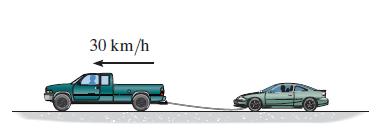
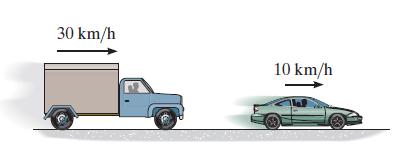
The 2.5-Mg pickup truck is towing the 1.5-Mg car using a cable as shown. If the car is initially at rest and the truck is coasting with a velocity of 30 km/h when the cable is slack, determine the common velocity of the truck and the car just after the cable becomes taut. Also, find the loss of
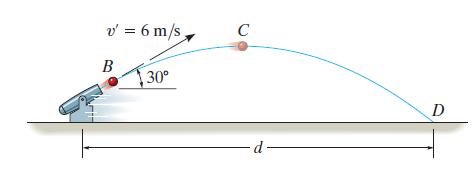
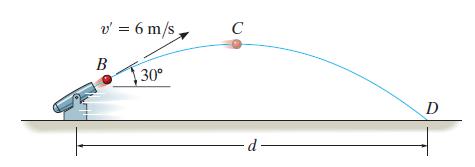
The 5-kg spring-loaded gun rests on the smooth surface. It fires a ball having a mass of 1 kg with a velocity of v' = 6 m/s relative to the gun in the direction shown. If the gun is originally at rest, determine the horizontal distance d the ball is from the gun at the instant the ball reaches its
The 5-kg spring-loaded gun rests on the smooth surface. It fires a ball having a mass of 1 kg with a velocity of v' = 6 m/s relative to the gun in the direction shown. If the gun is originally at rest, determine the distance the ball is from the initial position of the gun at the instant the ball
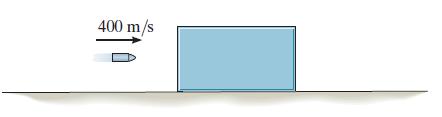
The 20-g bullet is traveling at 400 m/s when it becomes embedded in the 2-kg stationary block. Determine the distance the block will slide before it stops. The coefficient of kinetic friction between the block and the plane is μk = 0.2. 400 m/s
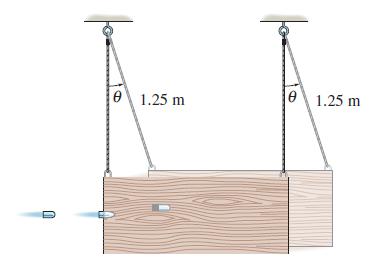
A ballistic pendulum consists of a 4-kg wooden block originally at rest, θ = 0°. When a 2-g bullet strikes and becomes embedded in it, it is observed that the block swings upward to a maximum angle of θ = 6°. Estimate the speed of the bullet. 0 e 1.25 m e Ꮎ 1.25 m
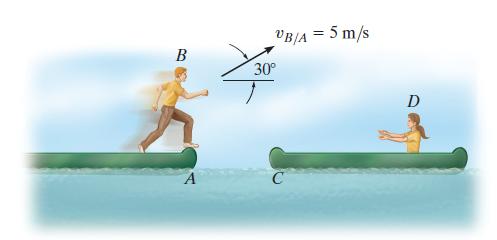
The boy B jumps off the canoe at A with a velocity of 5 m/s relative to the canoe as shown. If he lands in the second canoe C, determine the final speed of both canoes after the motion. Each canoe has a mass of 40 kg. The boy’s mass is 30 kg, and the girl D has a mass of 25 kg. Both canoes are
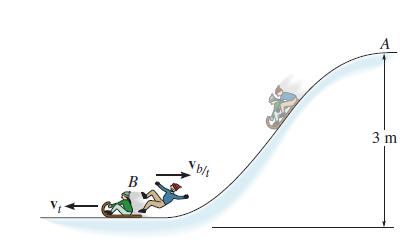
A toboggan having a mass of 10 kg starts from rest at A and carries a girl and boy having a mass of 40 kg and 45 kg, respectively.When the toboggan reaches the bottom of the slope at B, the boy is pushed off from the back with a horizontal velocity of vb/t= 2 m/s, measured relative to the toboggan.
The crate has a mass m and rests on the barge which has a mass M and is initially at rest. The coefficient of kinetic friction between the crate and barge is μ. The rope is pulled (or jerked) such that it snaps and as a result the impulse gives the barge a sudden velocity v0. Determine the time
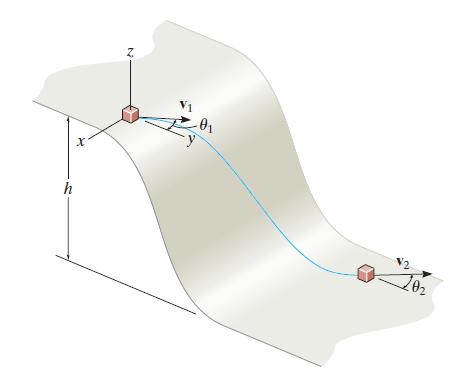
The block of mass m travels at v₁ in the direction θ₁ shown at the top of the smooth slope. Determine its speed v₂ and its direction θ2 when it reaches the bottom. h X N 20₁ 202
Using the data in Prob. 15–49, determine the distance the crate slides on the barge before coming to rest.Prob. 15–49The crate has a mass m and rests on the barge which has a mass M and is initially at rest. The coefficient of kinetic friction between the crate and barge is μ. The rope is
A railroad car weighs 30,000 lb and is traveling horizontally at 30 ft/s. At the same time another car weighing 10,000 lb is traveling 5 ft/s in the opposite direction. If the cars meet and couple together, determine the speed of both cars just after coupling. Determine the kinetic energy of both
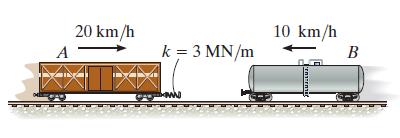
The 30-Mg freight car A and 15-Mg freight car B are moving towards each other with the velocities shown. Determine the maximum compression of the spring mounted on car A. Neglect rolling resistance. 20 km/h k = 3 MN/m KOWN 10 km/h B
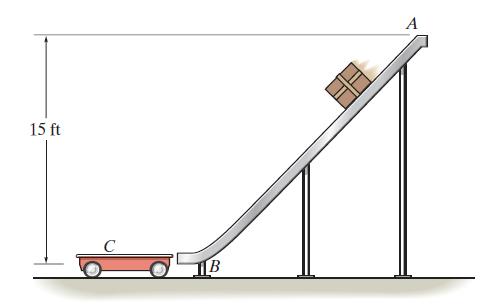
A 40-lb box slides from rest down the smooth ramp onto the surface of a 20-lb cart. Determine the speed of the box at the instant it stops sliding on the cart. If someone ties the cart to the ramp at B, determine the horizontal impulse the box will exert at C in order to stop its motion. Neglect
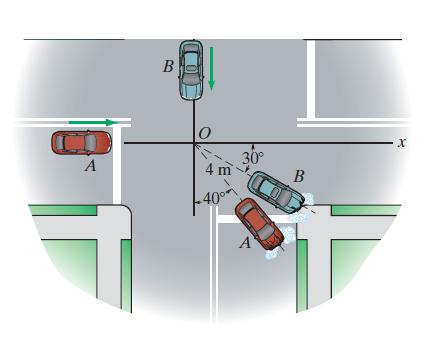
Two cars A and B, each having a mass of 1.6 Mg, collide on the icy pavement of an intersection. The direction of motion of each car after collision is measured from snow tracks as shown. If the driver in car A states that he was going 50 km/h just before collision and that after collision he
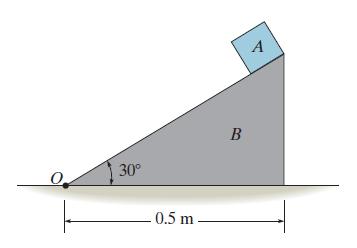
Block A has a mass of 5 kg and is placed on the smooth triangular block B having a mass of 30 kg. If the system is released from rest, determine the distance B moves from point O when A reaches the bottom. Neglect the size of block A. 0 30° .0.5 m в A
The 5-Mg truck and 2-Mg car are traveling with the freerolling velocities shown just before they collide. After the collision, the car moves with a velocity of 15km/h to the right relative to the truck. Determine the coefficient of restitution between the truck and car and the loss of energy due to
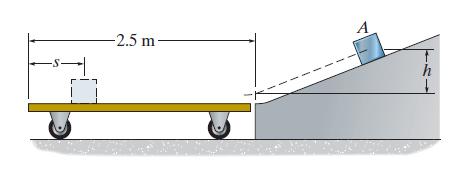
A box A, having a mass of 20 kg, is released from rest at the position shown and slides freely down the smooth inclined ramp. When it reaches the bottom of the ramp, it slides horizontally onto the surface of a 10-kg cart for which the coefficient of kinetic friction between the cart and the box is
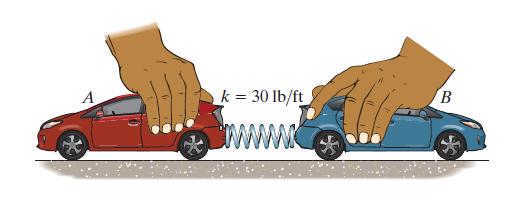
The two toy cars A and B have a weight of 0.4 lb and 0.6 lb, respectively. A spring having a stiffness of 30 lb/ft is attached to one of them and the cars are pressed together such that the spring is compressed 0.2 ft. Determine the speed of each car after they are released from rest. A k = 30
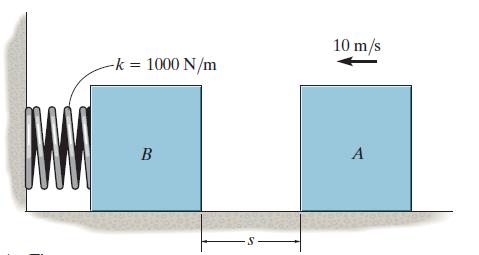
The 15-kg block A has a velocity v = 10 m/s when it is s = 4 m from the 10-kg block B. If the unstretched spring has a stiffness k = 1000 N/m, determine the maximum compression of the spring due to the collision. Take e = 0.6, and for block A, μk = 0.3. Assume block B is smooth. -k = 1000
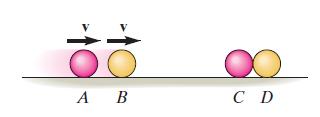
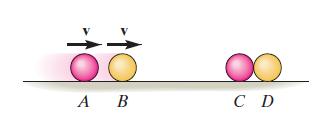
The four smooth balls each have the same mass m. If A and B are rolling forward with a velocity v and strike C, explain why after collision C and D each move off with a velocity v. Why doesn’t D move off with a velocity 2v? The collision is elastic, e = 1. Neglect the size of each ball. на A
The four balls each have the same mass m. If A and B are rolling forward with velocity v and strike C, determine the velocity of each ball after the first three collisions. Take e = 0.5 between each ball. -10 -10 А A B C D
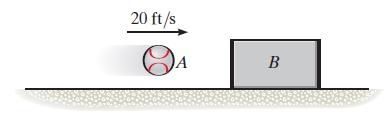
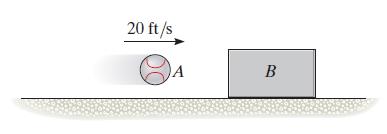
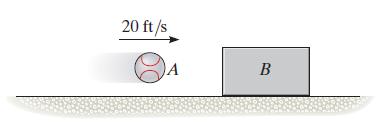
The 1-lb ball A is thrown so that when it strikes the 10-lb block B it is traveling horizontally at 20 ft/s. Determine the average normal force exerted between A and B if the impact occurs in 0.02 s. The coefficient of restitution between A and B is e = 0.6. 20 ft/s A B
The 1-lb ball A is thrown so that when it strikes the 10-lb block B it is traveling horizontally at 20 ft/s. If the coefficient of restitution between A and B is e = 0.6 and the coefficient of kinetic friction between the plane and the block is μk = 0.4, determine the time before block B stops
The 1-lb ball A is thrown so that when it strikes the 10-lb block B it is traveling horizontally at 20 ft/ s. If the coefficient of restitution between A and B is e = 0.6, and the coefficent of kinetic friction between the plane and the block is μ k = 0.4, determine the distance block B slides on
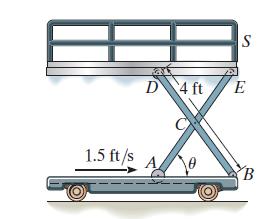
The scaffold S is raised by moving the roller at A toward the pin at B. If A is approaching B with a speed of 1.5 ft/s, determine the speed at which the platform rises as a function of θ. The 4-ft links are pin connected at their midpoint. 1.5 ft/s D 4 ft A S E B
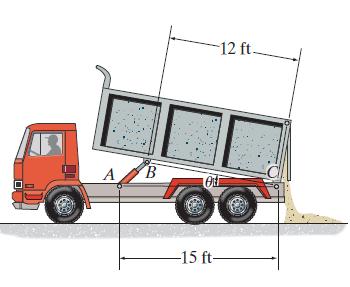
If the hydraulic cylinder AB is extending at a constant rate of 1ft/s, determine the dumpster’s angular velocity at the instant θ = 30°. A B 12 ft. Off -15 ft-
Disk A has a mass of 250 g and is sliding on a smooth horizontal surface with an initial velocity (vA)1 = 2 m/s. It makes a direct collision with disk B, which has a mass of 175 g and is originally at rest. If both disks are of the same size and the collision is perfectly elastic (e = 1), determine
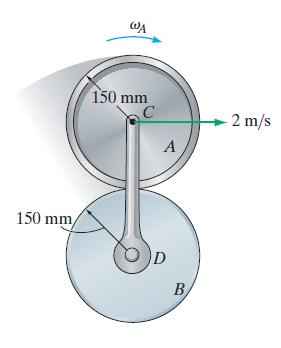
Wheel A rolls without slipping over the surface of the fixed cylinder B. Determine the angular velocity of A if its center C has a speed of 2 m/s. How many revolutions will A make about its center after link DC completes one revolution? 150 mm ФА 150 mm С А B 2 m/s
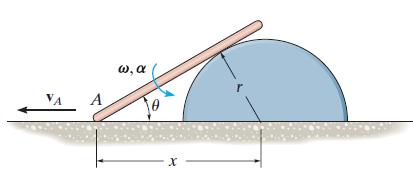
End A of the bar moves to the left with a constant velocity vA. Determine the angular velocity ω and angular acceleration α of the bar as a function of its position x. VA A ω,α X
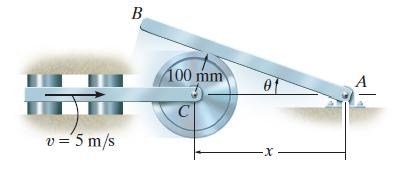
Determine the angular velocity of rod AB when θ = 30°. The shaft and the center of the roller C move forward at a constant rate v = 5 m/s. v = 5 m/s B 100 mm C of -X
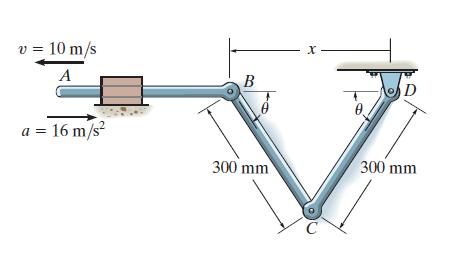
At the instant shown, θ = 60° and rod AB is subjected to a deceleration of 16 m/s2 when the velocity is 10 m/s. Determine the angular velocity and angular acceleration of link CD at this instant. v = 10 m/s A a = 16 m/s² B 300 mm X D 300 mm
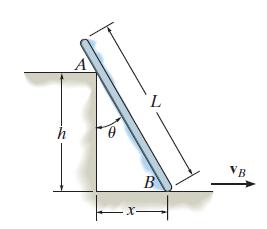
The bar remains in contact with the floor and with point A. If point B moves to the right with a constant velocity vB, determine the angular velocity and angular acceleration of the bar as a function of x. 0 7. B VB
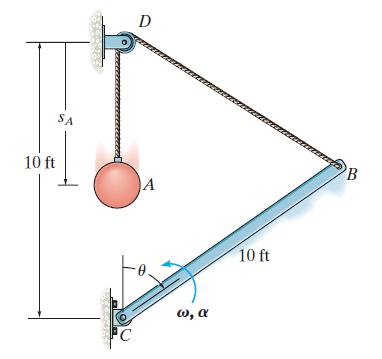
When the bar is at the angle θ, the rod is rotating clockwise with constant angular velocity ω. Determine the velocity of the weight A at this instant. The cord is 20 ft long. 10 ft SA D A w, a 10 ft B
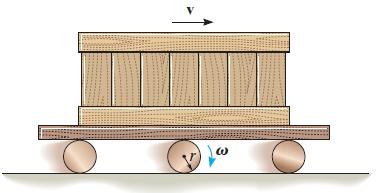
The crate is transported on a platform which rests on rollers, each having a radius r. If the rollers do not slip, determine their angular velocity if the platform moves forward with a velocity v. @
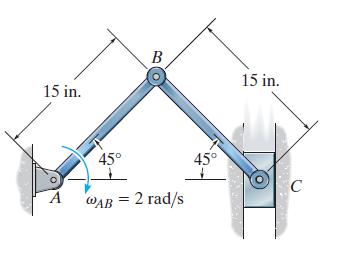
When the slider block C is in the position shown, the link AB has a clockwise angular velocity of 2 rad/s. Determine the velocity of block C at this instant. 15 in. A 45° B WAB = 2 rad/s 45° 15 in. C
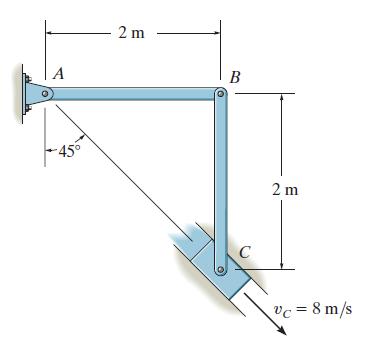
The slider block C moves at 8 m/s down the inclined groove. Determine the angular velocities of links AB and BC, at the instant shown. A -45⁰ 2 m B C 2 m Vc = 8 m/s
Showing 900 - 1000
of 2426
First
3
4
5
6
7
8
9
10
11
12
13
14
15
16
17
Last
Step by Step Answers

 Get 50% OFF
Claim Now
Get 50% OFF
Claim Now