New Semester
Started
Get
50% OFF
Study Help!
--h --m --s
Claim Now
Question Answers
Textbooks
Find textbooks, questions and answers
Oops, something went wrong!
Change your search query and then try again
S
Books
FREE
Study Help
Expert Questions
Accounting
General Management
Mathematics
Finance
Organizational Behaviour
Law
Physics
Operating System
Management Leadership
Sociology
Programming
Marketing
Database
Computer Network
Economics
Textbooks Solutions
Accounting
Managerial Accounting
Management Leadership
Cost Accounting
Statistics
Business Law
Corporate Finance
Finance
Economics
Auditing
Tutors
Online Tutors
Find a Tutor
Hire a Tutor
Become a Tutor
AI Tutor
AI Study Planner
NEW
Sell Books
Search
Search
Sign In
Register
study help
engineering
introduction to fluid mechanics
Fox And McDonald's Introduction To Fluid Mechanics 9th Edition Philip J. Pritchard, John W. Mitchell - Solutions
A velocity field in polar coordinates is given with the radial velocity as \(V_{r}=-A / r\) and the tangential velocity as \(V_{\theta}=A / r\), where \(r\) is in meters and \(A=10 \mathrm{~m}^{2}\). Plot the streamlines passing through the location \(\theta=0\) for \(r=1 \mathrm{~m}, 2
The flow of air near the Earth's surface is affected both by the wind and thermal currents. In certain circumstances the velocity field can be represented by \(\vec{V}=a \hat{i}+b\left(1-\frac{y}{h}\right) \hat{j}\) for \(yh\). Plot the streamlines for the flow for \(b / a=0.01,0.1\), and 1 .
A velocity field is given by \(\vec{V}=a y t \hat{i}-b x \hat{j}\), where \(a=1 \mathrm{~s}^{-2}\) and \(b=4 \mathrm{~s}^{-1}\). Find the equation of the streamlines at any time \(t\). Plot several streamlines at \(t=0 \mathrm{~s}, t=1 \mathrm{~s}\), and \(t=20 \mathrm{~s}\).
Air flows downward toward an infinitely wide horizontal flat plate. The velocity field is given by \(\vec{V}=(a x \hat{i}-a y \hat{j})(2+\cos \omega t)\), where \(a=5 \mathrm{~s}^{-1}, \omega=2 \pi \mathrm{s}^{-1}, x\) and \(y\) (measured in meters) are horizontal and vertically upward,
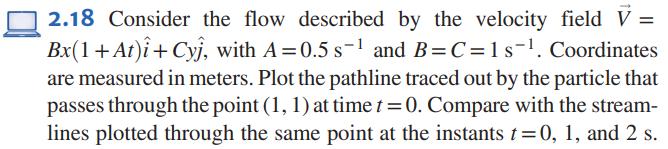
Consider the flow described by the velocity field \(\vec{V}=\) \(B x(1+A t) \hat{i}+C y \hat{j}\), with \(A=0.5 \mathrm{~s}^{-1}\) and \(B=C=1 \mathrm{~s}^{-1}\). Coordinates are measured in meters. Plot the pathline traced out by the particle that passes through the point \((1,1)\) at time
Consider the velocity field \(V=a x \hat{i}+b y(1+c t) \hat{j}\), where \(a=b=2 \mathrm{~s}^{-1}\) and \(c=0.4 \mathrm{~s}^{-1}\). Coordinates are measured in meters. For the particle that passes through the point \((x, y)=(1,1)\) at the instant \(t=0\), plot the pathline during the interval from
Consider the flow field given in Eulerian description by the expression \(\vec{V}=a x \hat{i}+b y t \hat{j}\), where \(a=0.2 \mathrm{~s}^{-1}, b=0.04 \mathrm{~s}^{-2}\), and the coordinates are measured in meters. Derive the Lagrangian position functions for the fluid particle that was located at
A velocity field is given by \(\vec{V}=a x t \hat{i}-b y \hat{j}\), where \(A=0.1 \mathrm{~s}^{-2}\) and \(b=1 \mathrm{~s}^{-1}\). For the particle that passes through the point \((x, y)=(1,1)\) at instant \(t=0 \mathrm{~s}\), plot the pathline during the interval from \(t=0\) to \(t=3
Consider the garden hose of Fig. 2.5. Suppose the velocity field is given by \(\vec{V}=u_{0} \hat{i}+v_{0} \sin \left[\omega\left(t-x / u_{0}\right)\right] \hat{j}\), where the \(x\) direction is horizontal and the origin is at the mean position of the hose, \(u_{0}=10 \mathrm{~m} / \mathrm{s}\),
Consider the velocity field of Problem 2.18. Plot the streakline formed by particles that passed through the point \((1,1)\) during the interval from \(t=0\) to \(t=3 \mathrm{~s}\). Compare with the streamlines plotted through the same point at the instants \(t=0,1\), and \(2 \mathrm{~s}\).Data
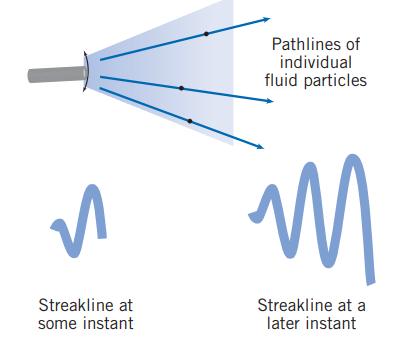
Streaklines are traced out by neutrally buoyant marker fluid injected into a flow field from a fixed point in space. A particle of the marker fluid that is at point \((x, y)\) at time \(t\) must have passed through the injection point \(\left(x_{0}, y_{0}\right)\) at some earlier instant
Consider the flow field \(\vec{V}=a x t \hat{i}+b \hat{j}\), where \(a=1 / 4 \mathrm{~s}^{-2}\) and \(b=1 / 3 \mathrm{~m} / \mathrm{s}\). Coordinates are measured in meters. For the particle that passes through the point \((x, y)=(1,2)\) at the instant \(t=0\), plot the pathline during the time
A flow is described by velocity field \(\vec{V}=a y^{2} \hat{i}+b \hat{j}\), where \(a=1 \mathrm{~m}^{-1} \mathrm{~s}^{-1}\) and \(b=2 \mathrm{~m} / \mathrm{s}\). Coordinates are measured in meters. Obtain the equation for the streamline passing through point \((6,6)\). At \(t=1 \mathrm{~s}\), what
Tiny hydrogen bubbles are being used as tracers to visualize a flow. All the bubbles are generated at the origin \((x=0, y=0)\). The velocity field is unsteady and obeys the equations:\[\begin{array}{lll} u=1 \mathrm{~m} / \mathrm{s} & v=2 \mathrm{~m} / \mathrm{s} & 0 \leq t
A flow is described by velocity field \(\vec{V}=a \hat{i}+b x \hat{j}\), where \(a=2 \mathrm{~m} / \mathrm{s}\) and \(b=1 \mathrm{~s}^{-1}\). Coordinates are measured in meters. Obtain the equation for the streamline passing through point \((2,5)\). At \(t=2 \mathrm{~s}\), what are the coordinates
A flow is described by velocity field \(\vec{V}=a y \hat{i}+b t \hat{j}\), where \(a=0.2 \mathrm{~s}^{-1}\) and \(b=0.4 \mathrm{~m} / \mathrm{s}^{2}\). At \(t=2 \mathrm{~s}\), what are the coordinates of the particle that passed through point \((1,2)\) at \(t=0\) ? At \(t=3 \mathrm{~s}\), what are
A flow is described by velocity field \(\vec{V}=a t \hat{i}+b \hat{j}\), where \(a=0.4 \mathrm{~m} / \mathrm{s}^{2}\) and \(b=2 \mathrm{~m} / \mathrm{s}\). At \(t=2 \mathrm{~s}\), what are the coordinates of the particle that passed through point \((2,1)\) at \(t=0\) ? At \(t=3 \mathrm{~s}\), what
The variation with temperature of the viscosity of air is represented well by the empirical Sutherland correlation\[\mu=\frac{b T^{1 / 2}}{1+S / T}\]Best-fit values of \(b\) and \(S\) are given in Appendix A. Develop an equation in SI units for kinematic viscosity versus temperature for air at
The variation with temperature of the viscosity of air is correlated well by the empirical Sutherland equation\[\mu=\frac{b T^{1 / 2}}{1+S / T}\]Best-fit values of \(b\) and \(S\) are given for use with SI units. Use these values to develop an equation for calculating air viscosity in British
Some experimental data for the viscosity of helium at 1 atm areUsing the approach described correlate these data to the empirical Sutherland equation\[\mu=\frac{b T^{1 / 2}}{1+S / T}\](where \(T\) is in kelvin) and obtain values for constants \(b\) and \(S\). T,C 0 100 200 300 400 ,N.s/m (x105)
The velocity distribution for laminar flow between parallel plates is given by\[\frac{u}{u_{\max }}=1-\left(\frac{2 y}{h}\right)^{2}\]where \(h\) is the distance separating the plates and the origin is placed midway between the plates. Consider a flow of water at \(15^{\circ} \mathrm{C}\), with
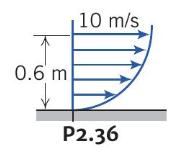
Calculate velocity gradients and shear stress for \(y=0,0.2\), 0.4 , and \(0.6 \mathrm{~m}\), if the velocity profile is a quarter-circle having its center \(0.6 \mathrm{~m}\) from the boundary. The fluid viscosity is \(7.5 \times 10^{-4} \mathrm{Ns} / \mathrm{m}^{2}\). 0.6 m 10 m/s P2.36
A very large thin plate is centered in a gap of width \(0.06 \mathrm{~m}\) with different oils of unknown viscosities above and below; one viscosity is twice the other. When the plate is pulled at a velocity of \(0.3 \mathrm{~m} / \mathrm{s}\), the resulting force on one square meter of plate due
A female freestyle ice skater, weighing \(100 \mathrm{lbf}\), glides on one skate at speed \(V=20 \mathrm{ft} / \mathrm{s}\). Her weight is supported by a thin film of liquid water melted from the ice by the pressure of the skate blade. Assume the blade is \(L=11.5\) in. long and \(w=0.125\) in.
A block of mass \(10 \mathrm{~kg}\) and measuring \(250 \mathrm{~mm}\) on each edge is pulled up an inclined surface on which there is a film of SAE \(10 \mathrm{~W}-30\) oil at \(30^{\circ} \mathrm{F}\) (the oil film is \(0.025 \mathrm{~mm}\) thick). Find the steady speed of the block if it is
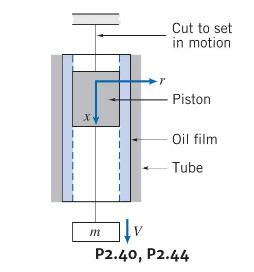
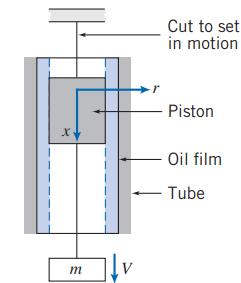
A 73-mm-diameter aluminum ( \(\mathrm{SG}=2.64)\) piston of \(100-\mathrm{mm}\) length resides in a stationary 75 -mm-inner-diameter steel tube lined with SAE \(10 \mathrm{~W}-30\) oil at \(25^{\circ} \mathrm{C}\). A mass \(m=2 \mathrm{~kg}\) is suspended from the free end of the piston. The piston
A vertical gap \(25 \mathrm{~mm}\) wide of infinite extent contains oil of specific gravity 0.95 and viscosity \(2.4 \mathrm{~Pa} \cdot \mathrm{s}\). A metal plate \(1.5 \mathrm{~m} \times 1.5 \mathrm{~m} \times 1.6 \mathrm{~mm}\) weighing \(45 \mathrm{~N}\) is to be lifted through the gap at a
A cylinder 8 in. in diameter and \(3 \mathrm{ft}\) long is concentric with a pipe of 8.25 in. i.d. Between cylinder and pipe there is an oil film. What force is required to move the cylinder along the pipe at a constant velocity of \(3 \mathrm{fps}\) ? The kinematic viscosity of the oil is \(0.006
Crude oil at \(20^{\circ} \mathrm{C}\) fills the space between two concentric cylinders \(250 \mathrm{~mm}\) high and with diameters of \(150 \mathrm{~mm}\) and \(156 \mathrm{~mm}\). What torque is required to rotate the inner cylinder at \(12 \mathrm{r} / \mathrm{min}\), the outer cylinder
The piston in Problem 2.40 is traveling at terminal speed. The mass \(m\) now disconnects from the piston. Plot the piston speed vs. time. How long does it take the piston to come within 1 percent of its new terminal speed?Data From Problem 2.40 2.40 A 73-mm-diameter aluminum (SG=2.64) piston of
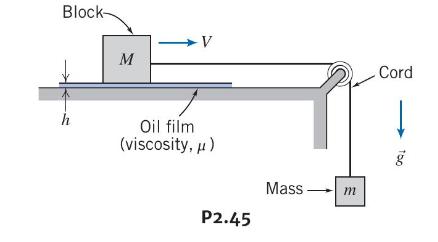
A block of mass \(M\) slides on a thin film of oil. The film thickness is \(h\) and the area of the block is \(A\). When released, mass \(m\) exerts tension on the cord, causing the block to accelerate. Neglect friction in the pulley and air resistance. Develop an algebraic expression for the
A block \(0.1 \mathrm{~m}\) square, with \(5 \mathrm{~kg}\) mass, slides down a smooth incline, \(30^{\circ}\) below the horizontal, on a film of SAE 30 oil at \(20^{\circ} \mathrm{C}\) that is \(0.20 \mathrm{~mm}\) thick. If the block is released from rest at \(t=0\), what is its initial
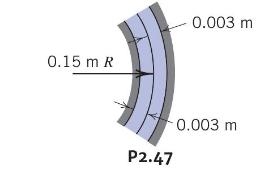
A torque of \(4 \mathrm{~N} \cdot \mathrm{m}\) is required to rotate the intermediate cylinder at \(30 \mathrm{r} / \mathrm{min}\). Calculate the viscosity of the oil. All cylinders are \(450 \mathrm{~mm}\) long. Neglect end effects. 0.15 m R 0.003 m P2.47 0.003 m.
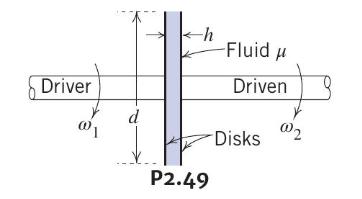
A circular disk of diameter \(d\) is slowly rotated in a liquid of large viscosity \(\mu\), at a small distance \(h\) from a fixed surface. Derive an expression for the torque \(T\) necessary to maintain an angular velocity \(\omega\). Neglect centrifugal effects.
The fluid drive shown transmits a torque \(T\) for steadystate conditions ( \(\omega_{1}\) and \(\omega_{2}\) constant). Derive an expression for the slip \(\left(\omega_{1}-\omega_{2}\right)\) in terms of \(T, \mu, d\), and \(h\). For values \(d=6\) in., \(h=0.2\) in., SAE 30 oil at \(75^{\circ}
A block that is \(a \mathrm{~mm}\) square slides across a flat plate on a thin film of oil. The oil has viscosity \(\mu\) and the film is \(h \mathrm{~mm}\) thick. The block of mass \(M\) moves at steady speed \(U\) under the influence of constant force \(F\). Indicate the magnitude and direction
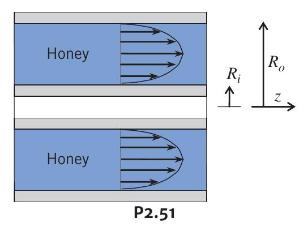
In a food-processing plant, honey is pumped through an annular tube. The tube is \(L=2 \mathrm{~m}\) long, with inner and outer radii of \(R_{i}=5 \mathrm{~mm}\) and \(R_{o}=25 \mathrm{~mm}\), respectively. The applied pressure difference is \(\Delta p=125 \mathrm{kPa}\), and the honey viscosity is
SAE \(10 \mathrm{~W}-30\) oil at \(100^{\circ} \mathrm{C}\) is pumped through a tube \(L=10 \mathrm{~m}\) long, diameter \(D=20 \mathrm{~mm}\). The applied pressure difference is \(\Delta p=5 \mathrm{kPa}\). On the centerline of the tube is a metal filament of diameter \(d=1 \mu \mathrm{m}\). The
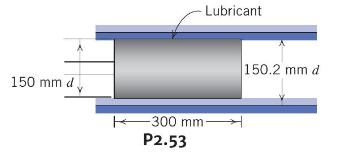
The lubricant has a kinematic viscosity of \(2.8 \times 10^{-5} \mathrm{~m}^{2} / \mathrm{s}\) and specific gravity of 0.92 . If the mean velocity of the piston is \(6 \mathrm{~m} / \mathrm{s}\), approximately what is the power dissipated in friction? 150 mm d 300 mm P2.53 Lubricant 150.2 mm d
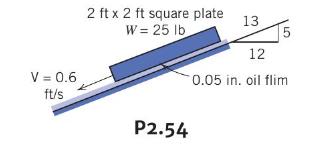
Calculate the approximate viscosity of the oil. V = 0.6 ft/s 2 ft x 2 ft square plate W= 25 lb P2.54 13 5 12 0.05 in. oil flim
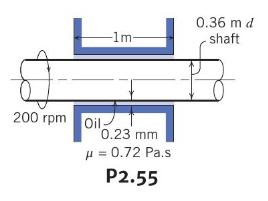
Calculate the approximate power lost in friction in this ship propeller shaft bearing. -1m- 0.36 m d shaft 200 rpm Oil- 0.23 mm = 0.72 Pa.s P2.55
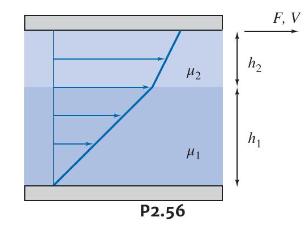
Fluids of viscosities \(\mu_{1}=0.1 \mathrm{~N} \cdot \mathrm{s} / \mathrm{m}^{2}\) and \(\mu_{2}=0.15 \mathrm{~N} \cdot \mathrm{s} / \mathrm{m}^{2}\) are contained between two plates (each plate is \(1 \mathrm{~m}^{2}\) in area). The thicknesses are \(h_{1}=0.5 \mathrm{~mm}\) and \(h_{2}=0.3
A concentric cylinder viscometer may be formed by rotating the inner member of a pair of closely fitting cylinders. The annular gap is small so that a linear velocity profile will exist in the liquid sample. Consider a viscometer with an inner cylinder of 4 in. diameter and 8 in. height, and a
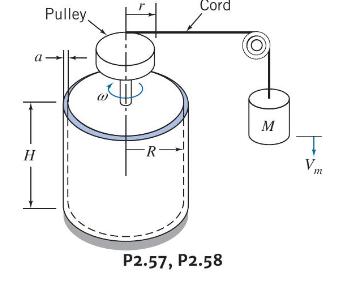
A concentric cylinder viscometer is driven by a falling mass \(M\) connected by a cord and pulley to the inner cylinder, as shown. The liquid to be tested fills the annular gap of width \(a\) and height \(H\). After a brief starting transient, the mass falls at constant speed \(V_{m}\). Develop an
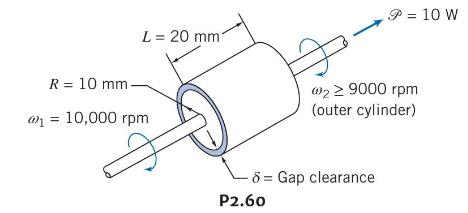
A shock-free coupling for a low-power mechanical drive is to be made from a pair of concentric cylinders. The annular space between the cylinders is to be filled with oil. The drive must transmit power, \(\mathscr{P}=10 \mathrm{~W}\). Other dimensions and properties are as shown. Neglect any
A shaft with outside diameter of \(18 \mathrm{~mm}\) turns at 20 revolutions per second inside a stationary journal bearing \(60 \mathrm{~mm}\) long. A thin film of oil \(0.2 \mathrm{~mm}\) thick fills the concentric annulus between the shaft and journal. The torque needed to turn the shaft is
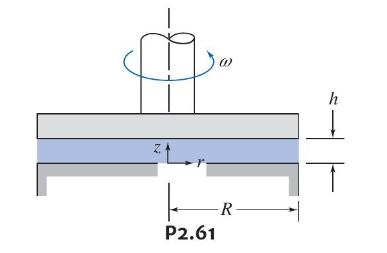
A proposal has been made to use a pair of parallel disks to measure the viscosity of a liquid sample. The upper disk rotates at height \(h\) above the lower disk. The viscosity of the liquid in the gap is to be calculated from measurements of the torque needed to turn the upper disk steadily.
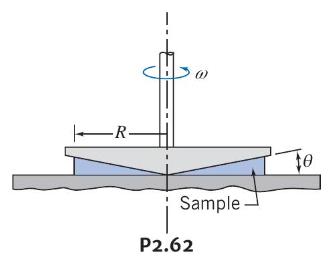
The cone and plate viscometer shown is an instrument used frequently to characterize non-Newtonian fluids. It consists of a flat plate and a rotating cone with a very obtuse angle (typically \(\theta\) is less than 0.5 degrees). The apex of the cone just touches the plate surface and the liquid to
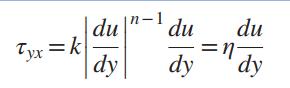
A viscometer is used to measure the viscosity of a patient's blood. The deformation rate (shear rate)-shear stress data is shown below. Plot the apparent viscosity versus deformation rate. Find the value of \(k\) and \(n\) in Eq. 2.17, and from this examine the aphorism "Blood is thicker than
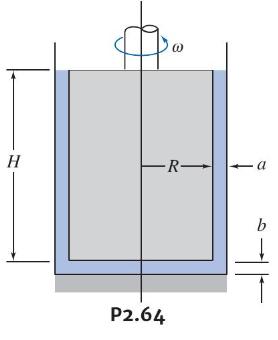
A concentric-cylinder viscometer is shown. Viscous torque is produced by the annular gap around the inner cylinder. Additional viscous torque is produced by the flat bottom of the inner cylinder as it rotates above the flat bottom of the stationary outer cylinder. Obtain an algebraic expression for
Design a concentric-cylinder viscometer to measure the viscosity of a liquid similar to water. The goal is to achieve a measurement accuracy of \(\pm 1\) percent. Specify the configuration and dimensions of the viscometer. Indicate what measured parameter will be used to infer the viscosity of the
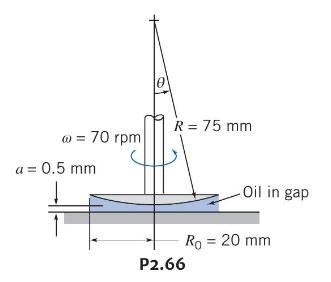
A cross section of a rotating bearing is shown. The spherical member rotates with angular speed \(\omega\), a small distance, \(a\), above the plane surface. The narrow gap is filled with viscous oil, having \(\mu=1250 \mathrm{cp}\). Obtain an algebraic expression for the shear stress acting on the
Small gas bubbles form in soda when a bottle or can is opened. The average bubble diameter is about \(0.1 \mathrm{~mm}\). Estimate the pressure difference between the inside and outside of such a bubble.
You intend to gently place several steel needles on the free surface of the water in a large tank. The needles come in two lengths: Some are \(5 \mathrm{~cm}\) long, and some are \(10 \mathrm{~cm}\) long. Needles of each length are available with diameters of \(1 \mathrm{~mm}, 2.5 \mathrm{~mm}\),
According to Folsom [6], the capillary rise \(\Delta h\) (in.) of a waterair interface in a tube is correlated by the following empirical expression:\[\Delta h=A e^{-b \cdot D}\]where \(D\) (in.) is the tube diameter, \(A=0.400\), and \(b=4.37\). You do an experiment to measure \(\Delta h\) versus
Calculate and plot the maximum capillary rise of water \(\left(20^{\circ} \mathrm{C}\right)\) to be expected in a vertical glass tube as a function of tube diameter for diameters from 0.5 to \(2.5 \mathrm{~mm}\).
Calculate the maximum capillary rise of water \(\left(20^{\circ} \mathrm{C}\right)\) to be expected between two vertical, clean glass plates spaced \(1 \mathrm{~mm}\) apart.
Calculate the maximum capillary depression of mercury to be expected in a vertical glass tube \(1 \mathrm{~mm}\) in diameter at \(15.5^{\circ} \mathrm{C}\).
Water usually is assumed to be incompressible when evaluating static pressure variations. Actually it is 100 times more compressible than steel. Assuming the bulk modulus of water is constant, compute the percentage change in density for water raised to a gage pressure of \(100 \mathrm{~atm}\).
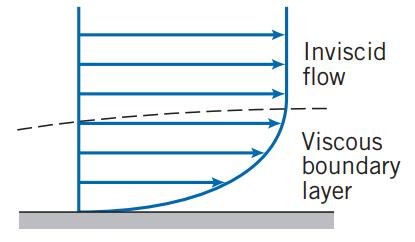
The viscous boundary layer velocity profile shown in Fig. 2.15 can be approximated by a cubic equation,\[u(y)=a+b\left(\frac{y}{\delta}\right)+c\left(\frac{y}{\delta}\right)^{3}\]The boundary condition is \(u=U\) (the free stream velocity) at the boundary edge \(\delta\) (where the viscous friction
In a food industry process, carbon tetrachloride at \(20^{\circ} \mathrm{C}\) flows through a tapered nozzle from an inlet diameter \(D_{\text {in }}=50 \mathrm{~mm}\) to an outlet diameter of \(D_{\text {out }}\). The area varies linearly with distance along the nozzle, and the exit area is
What is the Reynolds number of water at \(20^{\circ} \mathrm{C}\) flowing at \(0.25 \mathrm{~m} / \mathrm{s}\) through a \(5-\mathrm{mm}\)-diameter tube? If the pipe is now heated, at what mean water temperature will the flow transition to turbulence? Assume the velocity of the flow remains
A supersonic aircraft travels at \(2700 \mathrm{~km} / \mathrm{hr}\) at an altitude of \(27 \mathrm{~km}\). What is the Mach number of the aircraft? At what approximate distance measured from the leading edge of the aircraft's wing does the boundary layer change from laminar to turbulent?
SAE 30 oil at \(100^{\circ} \mathrm{C}\) flows through a 12 -mm-diameter stainless-steel tube. What is the specific gravity and specific weight of the oil? If the oil discharged from the tube fills a \(100-\mathrm{mL}\) graduated cylinder in 9 seconds, is the flow laminar or turbulent?
A seaplane is flying at \(100 \mathrm{mph}\) through air at \(45^{\circ} \mathrm{F}\). At what distance from the leading edge of the underside of the fuselage does the boundary layer transition to turbulence? How does this boundary layer transition change as the underside of the fuselage touches
An airliner is cruising at an altitude of \(5.5 \mathrm{~km}\) with a speed of \(700 \mathrm{~km} / \mathrm{hr}\). As the airliner increases its altitude, it adjusts its speed so that the Mach number remains constant. Provide a sketch of speed vs. altitude. What is the speed of the airliner at an
Because the pressure falls, water boils at a lower temperature with increasing altitude. Consequently, cake mixes and boiled eggs, among other foods, must be cooked different lengths of time. Determine the boiling temperature of water at 1000 and 2000 m elevation on a standard day, and compare with
Ear "popping" is an unpleasant phenomenon sometimes experienced when a change in pressure occurs, for example in a fastmoving elevator or in an airplane. If you are in a two-seater airplane at \(3000 \mathrm{~m}\) and a descent of \(100 \mathrm{~m}\) causes your ears to "pop," what is the pressure
When you are on a mountain face and boil water, you notice that the water temperature is \(195^{\circ} \mathrm{F}\). What is your approximate altitude? The next day, you are at a location where it boils at \(185^{\circ} \mathrm{F}\). How high did you climb between the two days? Assume a U.S.
Your pressure gauge indicates that the pressure in your cold tires is \(0.25 \mathrm{MPa}\) gage on a mountain at an elevation of \(3500 \mathrm{~m}\). What is the absolute pressure? After you drive down to sea level, your tires have warmed to \(25^{\circ} \mathrm{C}\). What pressure does your
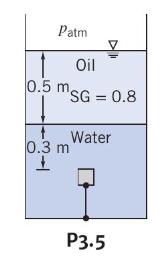
A \(125-\mathrm{mL}\) cube of solid oak is held submerged by a tether as shown. Calculate the actual force of the water on the bottom surface of the cube and the tension in the tether. Patm Oil 0.5 mSG = 0.8 0.3 m 1 Water P3.5
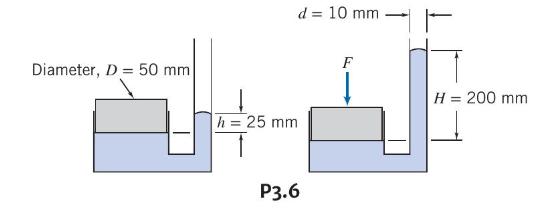
The tube shown is filled with mercury at \(20^{\circ} \mathrm{C}\). Calculate the force applied to the piston. Diameter, D 50 mm = h = 25 mm P3.6 d = 10 mm - F H = 200 mm
Calculate the absolute and gage pressure in an open tank of crude oil \(2.4 \mathrm{~m}\) below the liquid surface. If the tank is closed and pressurized to \(130 \mathrm{kPa}\), what are the absolute and gage pressures at this location?
An open vessel contains carbon tetrachloride to a depth of \(6 \mathrm{ft}\) and water on the carbon tetrachloride to a depth of \(5 \mathrm{ft}\). What is the pressure at the bottom of the vessel?
A hollow metal cube with sides \(100 \mathrm{~mm}\) floats at the interface between a layer of water and a layer of SAE \(10 \mathrm{~W}\) oil such that \(10 \%\) of the cube is exposed to the oil. What is the pressure difference between the upper and lower horizontal surfaces? What is the average
Compressed nitrogen \((140 \mathrm{lbm}\) ) is stored in a spherical tank of diameter \(D=2.5 \mathrm{ft}\) at a temperature of \(77^{\circ} \mathrm{F}\). What is the pressure inside the tank? If the maximum allowable stress in the tank is \(30 \mathrm{ksi}\), find the minimum theoretical wall
If at the surface of a liquid the specific weight is \(\gamma_{o}\), with \(z\) and \(p\) both zero, show that, if \(E=\) constant, the specific weight and pressure are given by\[\gamma=\frac{E}{\left(z+E / \gamma_{o}\right)} \quad \text { and } \quad p=-E \ln \left(1+\frac{\gamma_{o}
In the deep ocean the compressibility of seawater is significant in its effect on \(ho\) and \(p\). If \(E=2.07 \times 10^{9} \mathrm{~Pa}\), find the percentage change in the density and pressure at a depth of 10,000 metres as compared to the values obtained at the same depth under the
Assuming the bulk modulus is constant for seawater, derive an expression for the density variation with depth, \(h\), below the surface. Show that the result may be written\[ho \approx ho_{0}+b h\]where \(ho_{0}\) is the density at the surface. Evaluate the constant \(b\). Then, using the
An inverted cylindrical container is lowered slowly beneath the surface of a pool of water. Air trapped in the container is compressed isothermally as the hydrostatic pressure increases. Develop an expression for the water height, \(y\), inside the container in terms of the container height, \(H\),
A water tank filled with water to a depth of \(16 \mathrm{ft}\) has an inspection cover (1 in. \(\times 1\) in.) at its base, held in place by a plastic bracket. The bracket can hold a load of \(9 \mathrm{lbf}\). Is the bracket strong enough? If it is, what would the water depth have to be to cause
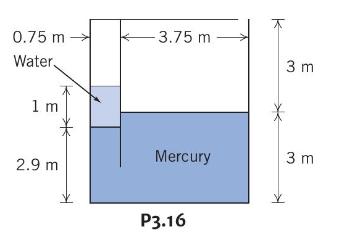
A partitioned tank as shown contains water and mercury. What is the gage pressure in the air trapped in the left chamber? What pressure would the air on the left need to be pumped to in order to bring the water and mercury free surfaces level? 0.75 m Water 3.75 m 1 m k 3 m Mercury 3 m 2.9 m P3.16
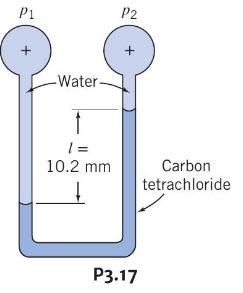
Consider the two-fluid manometer shown. Calculate the applied pressure difference. P1 -Water- | = 10.2 mm P2 P3.17 Carbon tetrachloride
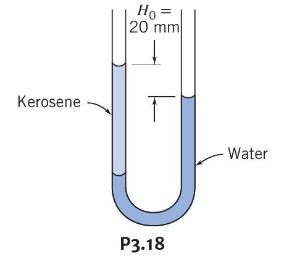
The manometer shown contains water and kerosene. With both tubes open to the atmosphere, the free-surface elevations differ by \(H_{0}=20.0 \mathrm{~mm}\). Determine the elevation difference when a pressure of \(98.0 \mathrm{~Pa}\) gage is applied to the right tube. Kerosene Ho 20 mm P3.18 - Water
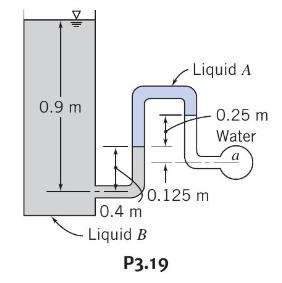
Determine the gage pressure in \(\mathrm{kPa}\) at point \(a\), if liquid \(A\) has \(\mathrm{SG}=1.20\) and liquid \(B\) has \(\mathrm{SG}=0.75\). The liquid surrounding point \(a\) is water, and the tank on the left is open to the atmosphere. 0.9 mi Liquid A 0.25 m Water 0.4 m 0.125 m Liquid B
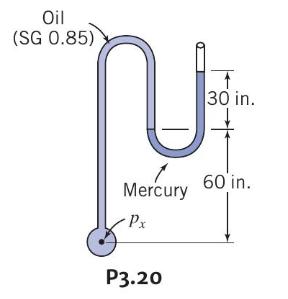
With the manometer reading as shown, calculate \(p_{x}\). Oil (SG 0.85) |30 in. 60 in. Mercury Px P3.20
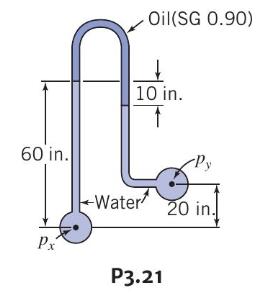
Calculate \(p_{x}-p_{y}\) for this inverted U-tube manometer. 60 in. Oil(SG 0.90) 10 in. Water 20 in. Px P3.21
An inclined gauge having a tube of 3-mm bore, laid on a slope of 1:20, and a reservoir of 25-mm-diameter contains silicon oil (SG \(0.84)\). What distance will the oil move along the tube when a pressure of \(25-\mathrm{mm}\) of water is connected to the gauge?
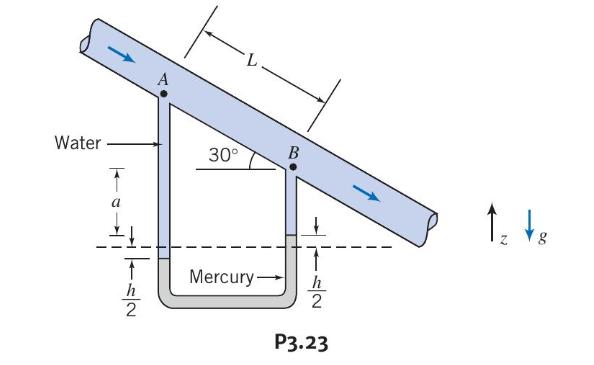
Water flows downward along a pipe that is inclined at \(30^{\circ}\) below the horizontal, as shown. Pressure difference \(p_{A}-p_{B}\) is due partly to gravity and partly to friction. Derive an algebraic expression for the pressure difference. Evaluate the pressure difference if \(L=5
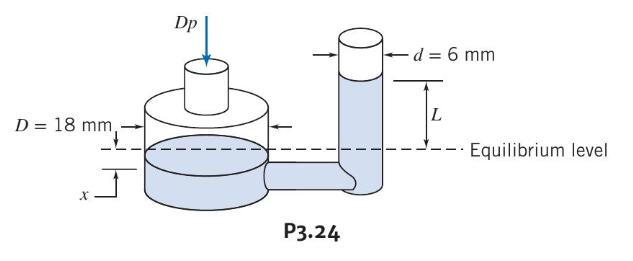
A reservoir manometer has vertical tubes of diameter \(D=18 \mathrm{~mm}\) and \(d=6 \mathrm{~mm}\). The manometer liquid is Meriam red oil. Develop an algebraic expression for liquid deflection \(L\) in the small tube when gage pressure \(\Delta p\) is applied to the reservoir. Evaluate the liquid
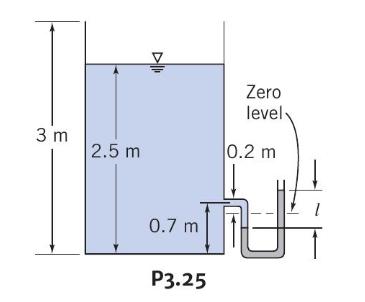
A rectangular tank, open to the atmosphere, is filled with water to a depth of \(2.5 \mathrm{~m}\) as shown. A U-tube manometer is connected to the tank at a location \(0.7 \mathrm{~m}\) above the tank bottom. If the zero level of the Meriam blue manometer fluid is \(0.2 \mathrm{~m}\) below the
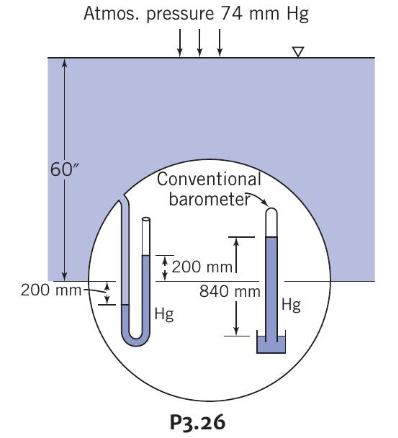
The sketch shows a sectional view through a submarine. Calculate the depth of submergence, \(y\). Assume the specific weight of seawater is \(10.0 \mathrm{kN} / \mathrm{m}^{3}\). 60" Atmos. pressure 74 mm Hg Conventional barometer 200 mm mm 200 mm- 840 mm Hg Hg P3.26
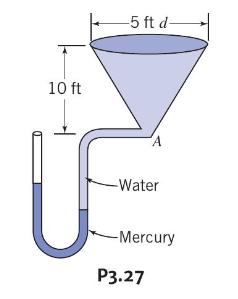
The manometer reading is 6 in. when the funnel is empty (water surface at \(A\) ). Calculate the manometer reading when the funnel is filled with water. 10 ft -5 ft d- A -Water -Mercury P3.27
A reservoir manometer is calibrated for use with a liquid of specific gravity 0.827 . The reservoir diameter is 5 / 8 in. and the vertical tube diameter is 3/16 in. Calculate the required distance between marks on the vertical scale for \(1 \mathrm{in}\). of water pressure difference.
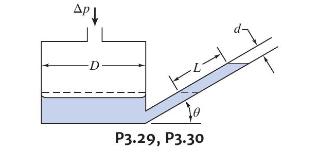
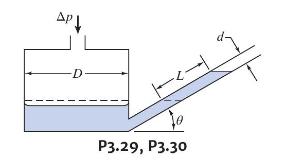
The inclined-tube manometer shown has \(D=96 \mathrm{~mm}\) and \(d=8 \mathrm{~mm}\). Determine the angle, \(\theta\), required to provide a 5:1 increase in liquid deflection, \(L\), compared with the total deflection in a regular U-tube manometer. Evaluate the sensitivity of this inclined-tube
The inclined-tube manometer shown has \(D=76 \mathrm{~mm}\) and \(d=8 \mathrm{~mm}\), and is filled with Meriam red oil. Compute the angle, \(\theta\), that will give a \(15-\mathrm{cm}\) oil deflection along the inclined tube for an applied pressure of \(25 \mathrm{~mm}\) of water gage. Determine
A barometer accidentally contains 6.5 inches of water on top of the mercury column (so there is also water vapor instead of a vacuum at the top of the barometer). On a day when the temperature is \(70^{\circ} \mathrm{F}\), the mercury column height is 28.35 inches (corrected for thermal expansion).
A water column stands \(50 \mathrm{~mm}\) high in a \(2.5-\mathrm{mm}\) diameter glass tube. What would be the column height if the surface tension were zero? What would be the column height in a \(1.0-\mathrm{mm}\) diameter tube?
Consider a small-diameter open-ended tube inserted at the interface between two immiscible fluids of different densities. Derive an expression for the height difference \(\Delta h\) between the interface level inside and outside the tube in terms of tube diameter \(D\), the two fluid densities
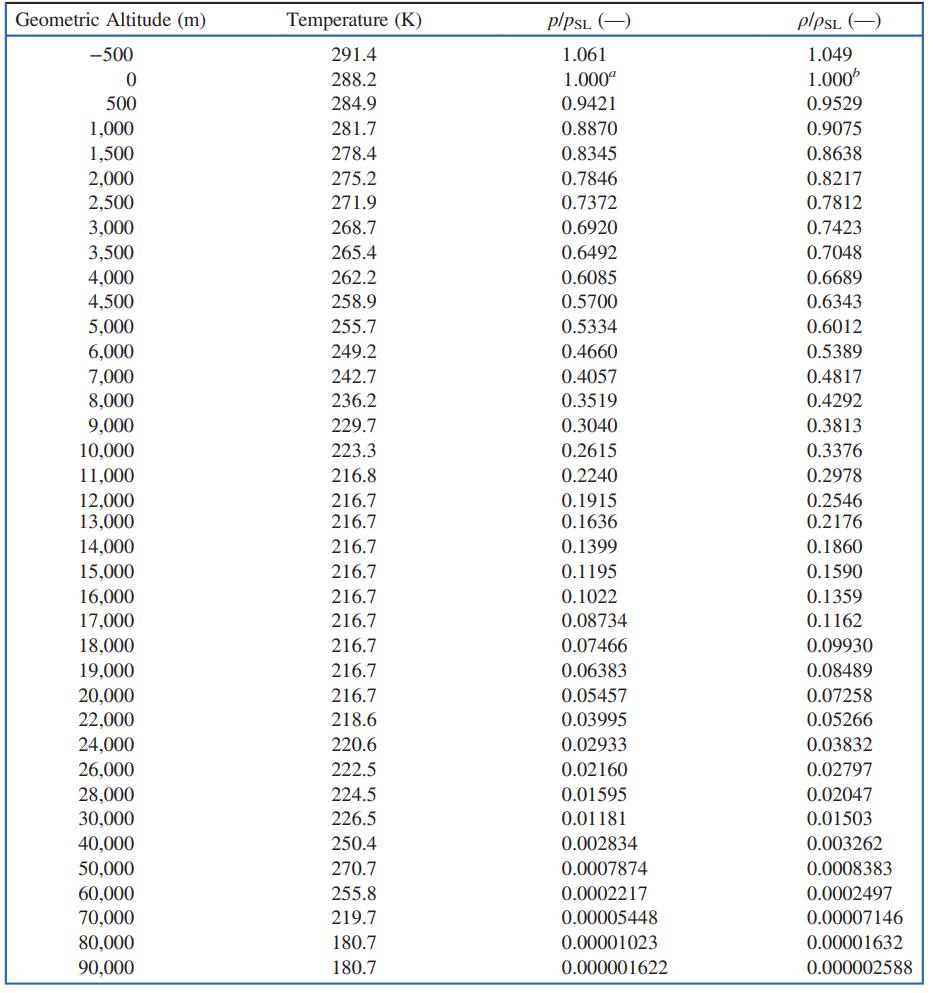
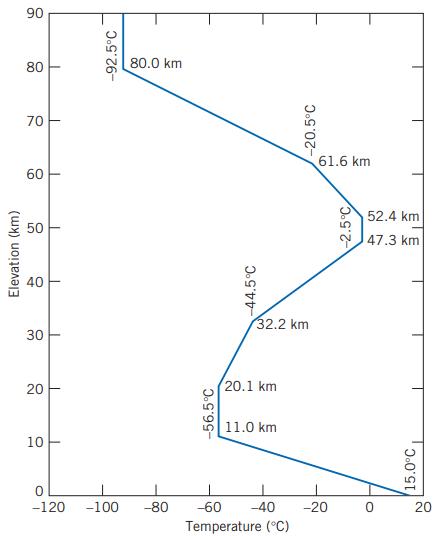
Based on the atmospheric temperature data of the U.S. Standard Atmosphere of Fig. 3.3, compute and plot the pressure variation with altitude, and compare with the pressure data of Table A.3.Data From Table A.3Data From Figure 3.3 Geometric Altitude (m) -500 Temperature (K) P/PSL (-) plPSL (-) 291.4
Showing 900 - 1000
of 1127
1
2
3
4
5
6
7
8
9
10
11
12
Step by Step Answers

 Get 50% OFF
Claim Now
Get 50% OFF
Claim Now