New Semester
Started
Get
50% OFF
Study Help!
--h --m --s
Claim Now
Question Answers
Textbooks
Find textbooks, questions and answers
Oops, something went wrong!
Change your search query and then try again
S
Books
FREE
Study Help
Expert Questions
Accounting
General Management
Mathematics
Finance
Organizational Behaviour
Law
Physics
Operating System
Management Leadership
Sociology
Programming
Marketing
Database
Computer Network
Economics
Textbooks Solutions
Accounting
Managerial Accounting
Management Leadership
Cost Accounting
Statistics
Business Law
Corporate Finance
Finance
Economics
Auditing
Tutors
Online Tutors
Find a Tutor
Hire a Tutor
Become a Tutor
AI Tutor
AI Study Planner
NEW
Sell Books
Search
Search
Sign In
Register
study help
engineering
introduction to fluid mechanics
Fox And McDonald's Introduction To Fluid Mechanics 9th Edition Philip J. Pritchard, John W. Mitchell - Solutions
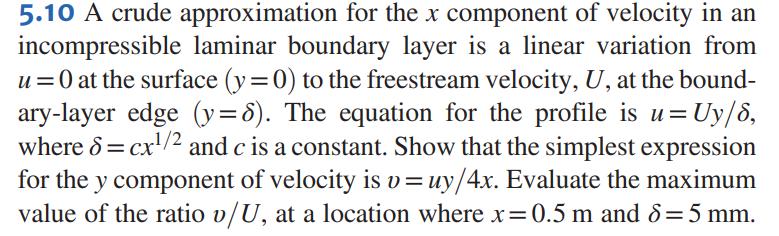
A crude approximation for the \(x\) component of velocity in an incompressible laminar boundary layer is a linear variation from \(u=0\) at the surface \((y=0)\) to the freestream velocity, \(U\), at the boundary-layer edge \((y=\delta)\). The equation for the profile is \(u=U y / \delta\), where
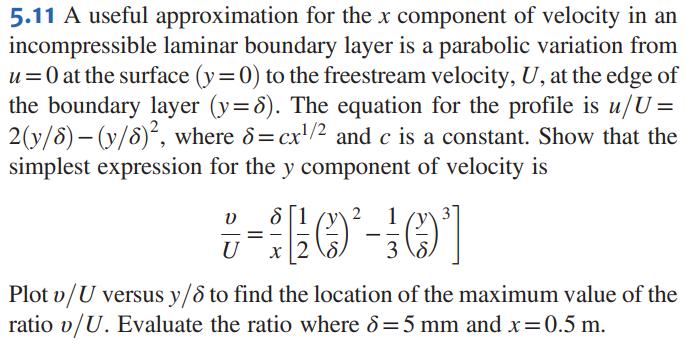
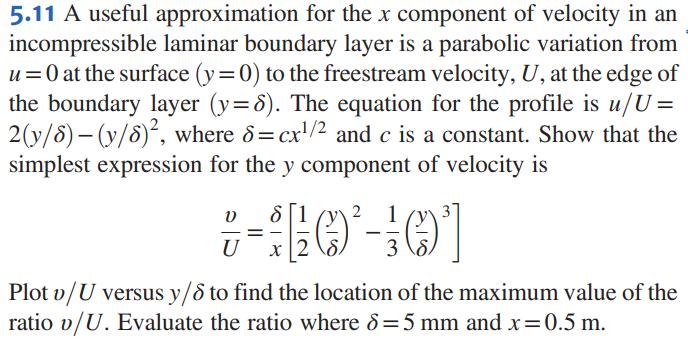
A useful approximation for the \(x\) component of velocity in an incompressible laminar boundary layer is a parabolic variation from \(u=0\) at the surface \((y=0)\) to the freestream velocity, \(U\), at the edge of the boundary layer \((y=\delta)\). The equation for the profile is \(u / U=\) \(2(y
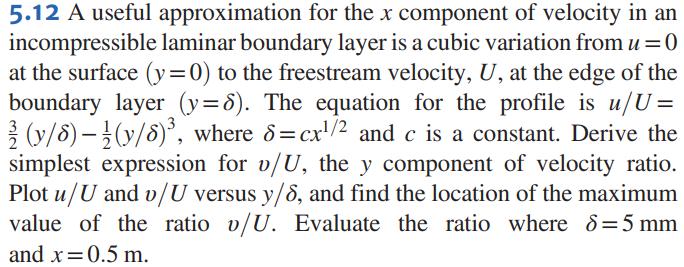
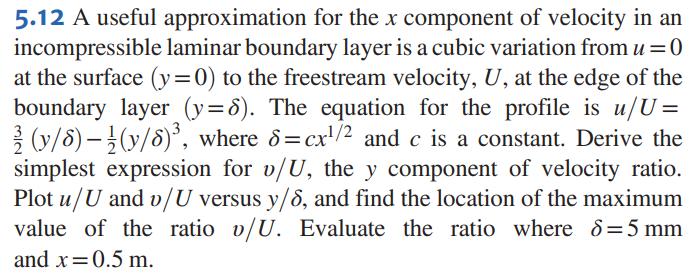
A useful approximation for the \(x\) component of velocity in an incompressible laminar boundary layer is a cubic variation from \(u=0\) at the surface \((y=0)\) to the freestream velocity, \(U\), at the edge of the boundary layer \((y=\delta)\). The equation for the profile is \(u / U=\)
For a flow in the \(x y\) plane, the \(x\) component of velocity is given by \(u=A x^{2} y^{2}\), where \(A=0.3 \mathrm{~m}^{-3} \cdot \mathrm{s}^{-1}\), and \(x\) and \(y\) are measured in meters. Find a possible \(y\) component for steady, incompressible flow.Is it also valid for unsteady,
Consider a water stream from a jet of an oscillating lawn sprinkler. Describe the corresponding pathline and streakline.
Which of the following sets of equations represent possible incompressible flow cases?(a) \(V_{r}=U \cos \theta ; V_{\theta}=-U \sin \theta\)(b) \(V_{r}=-q / 2 \pi r ; V_{\theta}=K / 2 \pi r\)(c) \(V_{r}=U \cos \theta\left[1-(a / r)^{2}\right] ; V_{\theta}=-U \sin \theta\left[1+(a / r)^{2}\right]\)
For an incompressible flow in the \(r \theta\) plane, the \(r\) component of velocity is given as \(V_{r}=U \cos \theta\).(a) Determine a possible \(\theta\) component of velocity.(b) How many possible \(\theta\) components are there?
A viscous liquid is sheared between two parallel disks of radius \(R\), one of which rotates while the other is fixed. The velocity field is purely tangential, and the velocity varies linearly with \(z\) from \(V_{\theta}=0\) at \(z=0\) (the fixed disk) to the velocity of the rotating disk at its
A velocity field in cylindrical coordinates is given as \(\vec{V}=\hat{\mathrm{e}}_{r} A / r+\hat{\mathrm{e}}_{\theta} B / r\), where \(A\) and \(B\) are constants with dimensions of \(\mathrm{m}^{2} / \mathrm{s}\). Does this represent a possible incompressible flow? Sketch the streamline that
Determine the family of stream functions \(\psi\) that will yield the velocity field \(\vec{V}=2 y(2 x+1) \hat{i}+\left[x(x+1)-2 y^{2}\right] \hat{j}\).
The stream function for a certain incompressible flow field is given by the expression \(\psi=-U r \sin \theta+q \theta / 2 \pi\). Obtain an expression for the velocity field. Find the stagnation point(s) where \(|\vec{V}|=0\), and show that \(\psi=0\) there.
Determine the stream functions for the following flow fields. For the value of \(\psi=2\), plot the streamline in the region between \(x=-1\) and \(x=1\).(a) \(u=4 ; v=3\)(b) \(u=4 y ; v=0\)(c) \(u=4 y ; v=4 x\)(d) \(u=4 y ; v=-4 x\)
Determine the stream function for the steady incompressible flow between parallel plates. The velocity profile is parabolic and given by \(u=u_{c}+a y^{2}\), where \(u_{c}\) is the centerline velocity and \(y\) is the distance measured from the centerline. The plate spacing is \(2 b\) and the
An incompressible frictionless flow field is specified by the stream function \(\psi=-5 A x-2 A y\), where \(A=2 \mathrm{~m} / \mathrm{s}\), and \(x\) and \(y\) are coordinates in meters.(a) Sketch the streamlines \(\psi=0\) and \(\psi=5\), and indicate the direction of the velocity vector at the
A parabolic velocity profile was used to model flow in a laminar incompressible boundary layer in Problem 5.11. Derive the stream function for this flow field. Locate streamlines at one-quarter and one-half the total volume flow rate in the boundary layer.Data From Problem 5.11 5.11 A useful
A flow field is characterized by the stream function \(\psi=3 x^{2} y-y^{3}\). Demonstrate that the flow field represents a twodimensional incompressible flow. Show that the magnitude of the velocity depends only on the distance from the origin of the coordinates. Plot the stream line \(\psi=2\).
A flow field is characterized by the stream function \(\psi=x y\). Plot sufficient streamlines to represent the flow field. Determine the location of any stagnation points. Give at least two possible physical interpretations of this flow.
A cubic velocity profile was used to model flow in a laminar incompressible boundary layer in Problem 5.12. Derive the stream function for this flow field. Locate streamlines at one-quarter and one-half the total volume flow rate in the boundary layer.Data From Problem 5.12 5.12 A useful
A flow field is characterized by the stream function\[\psi=\frac{1}{2 \pi}\left(\tan ^{-1} \frac{y-a}{x}-\tan ^{-1} \frac{y+a}{x}\right)-\frac{1}{2 \pi} \ln \sqrt{x^{2}+y^{2}}\]Locate the stagnation points and sketch the flow field. Derive an expression for the velocity at (a, 0).
In a parallel one-dimensional flow in the positive \(x\) direction, the velocity varies linearly from zero at \(y=0\) to \(30 \mathrm{~m} / \mathrm{s}\) at \(y=1.5 \mathrm{~m}\). Determine an expression for the stream function, \(\psi\). Also determine the \(y\) coordinate above which the volume
Consider the flow field given by \(\vec{V}=x y^{2} \hat{i}-\frac{1}{3} y^{3} \hat{j}+x y \hat{k}\). Determine (a) the number of dimensions of the flow, (b) if it is a possible incompressible flow, and (c) the acceleration of a fluid particle at point \((x, y, z)=(1,2,3)\).
Consider the flow field given by \(\vec{V}=a x^{2} y \hat{i}-b y \hat{j}+c z^{2} \hat{k}\), where \(a=2 \mathrm{~m}^{-2} \cdot \mathrm{s}^{-1}, b=2 \mathrm{~s}^{-1}\), and \(c=1 \mathrm{~m}^{-1} \cdot \mathrm{s}^{-1}\). Determine (a) the number of dimensions of the flow, (b) if it is a possible
The velocity field within a laminar boundary layer is approximated by the expression\[\vec{V}=\frac{A U y}{x^{1 / 2}} \hat{i}+\frac{A U y^{2}}{4 x^{3 / 2}} \hat{j}\]In this expression, \(A=141 \mathrm{~m}^{-1 / 2}\), and \(U=0.240 \mathrm{~m} / \mathrm{s}\) is the freestream velocity. Show that
A velocity field is given by \(\vec{V}=10 t \hat{i}-\frac{10}{t^{3}} \hat{j}\). Show that the flow field is a two-dimensional flow and determine the acceleration as a function of time.
The \(y\) component of velocity in a two-dimensional, incompressible flow field is given by \(v=-A x y\), where \(v\) is in \(\mathrm{m} / \mathrm{s}, x\) and \(y\) are in meters, and \(A\) is a dimensional constant. There is no velocity component or variation in the \(z\) direction. Determine the
A \(4 \mathrm{~m}\) diameter tank is filled with water and then rotated at a rate of \(\omega=2 \pi\left(1-\mathrm{e}^{-t}\right) \mathrm{rad} / \mathrm{s}\). At the tank walls, viscosity prevents relative motion between the fluid and the wall. Determine the speed and acceleration of the fluid
An incompressible liquid with negligible viscosity flows steadily through a horizontal pipe of constant diameter. In a porous section of length \(L=0.3 \mathrm{~m}\), liquid is removed at a constant rate per unit length, so the uniform axial velocity in the pipe is \(u(x)=U(1-x / 2 L)\), where
Sketch the following flow fields and derive general expressions for the acceleration:(a) \(u=2 x y ; v=-x^{2} y\)(b) \(u=y-x+x^{2} ; v=x+y-2 x y\)(c) \(u=x^{2} t+2 y ; v=2 x-y t^{2}\)(d) \(u=-x^{2}-y^{2}-x y t ; v=x^{2}+y^{2}+x y t\)
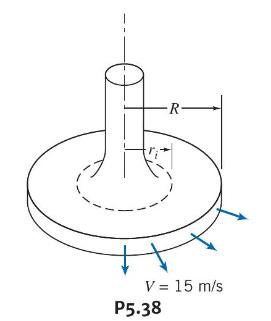
Consider the low-speed flow of air between parallel disks as shown. Assume that the flow is incompressible and inviscid, and that the velocity is purely radial and uniform at any section. The flow speed is \(V=15 \mathrm{~m} / \mathrm{s}\) at \(R=75 \mathrm{~mm}\). Simplify the continuity equation
As part of a pollution study, a model concentration \(c\) as a function of position \(x\) has been developed,\[c(x)=A\left(e^{-x / 2 a}-e^{-x / a}\right)\]where \(A=3 \times 10^{-5} \mathrm{ppm}\) (parts per million) and \(a=3 \mathrm{ft}\). Plot this concentration from \(x=0\) to \(x=30
As an aircraft flies through a cold front, an onboard instrument indicates that ambient temperature drops at the rate of \(0.7^{\circ} \mathrm{F} / \mathrm{min}\).Other instruments show an air speed of 400 knots and a \(2500 \mathrm{ft} / \mathrm{min}\) rate of climb. The front is stationary and
Wave flow of an incompressible fluid into a solid surface follows a sinusoidal pattern. Flow is axisymmetric about the \(z\) axis, which is normal to the surface. The \(z\) component of the flow follows the pattern\[V_{z}=A z \sin \left(\frac{2 \pi t}{T}\right)\]Determine (a) the radial component
A steady, two-dimensional velocity field is given by \(\vec{V}=A x \hat{i}-A y \hat{j}\), where \(A=1 \mathrm{~s}^{-1}\). Show that the streamlines for this flow are rectangular hyperbolas, \(x y=C\). Obtain a general expression for the acceleration of a fluid particle in this velocity field.
A velocity field is represented by the expression \(\vec{V}=(A x-B)\) \(\hat{i}+C y \hat{j}+D t \hat{k}\) where \(A=0.2 \mathrm{~s}^{-1}, B=0.6 \mathrm{~m} \cdot \mathrm{s}^{-1}, D=5 \mathrm{~m} \cdot \mathrm{s}^{-2}\) and the coordinates are measured in meters. Determine the proper value for \(C\)
A parabolic approximate velocity profile was used in Problem 5.11 to model flow in a laminar incompressible boundary layer on a flat plate. For this profile, find the \(x\) component of acceleration, \(a_{x}\), of a fluid particle within the boundary layer. Plot \(a_{x}\) at location \(x=0.8
A cubic approximate velocity profile was used in Problem 5.12 to model flow in a laminar incompressible boundary layer on a flat plate. For this profile, obtain an expression for the \(x\) and \(y\) components of acceleration of a fluid particle in the boundary layer. Plot \(a_{x}\) and \(a_{y}\)
The velocity field for steady inviscid flow from left to right over a circular cylinder, of radius \(R\) is given by\[\vec{V}=U \cos \theta\left[1-\left(\frac{R}{r}\right)^{2}\right] \hat{e}_{r}-U \sin \theta\left[1+\left(\frac{R}{r}\right)^{2}\right] \hat{e}_{\theta}\]Obtain expressions for the
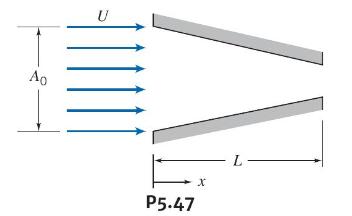
Consider the incompressible flow of a fluid through a nozzle as shown. The area of the nozzle is given by \(A=A_{0}(1-b x)\) and the inlet velocity varies according to \(U=U_{0}(0.5+0.5 \cos \omega t)\) where \(A_{0}=5 \mathrm{ft}^{2}, L=20 \mathrm{ft}, b=0.02 \mathrm{ft}^{-1}, \omega=0.16
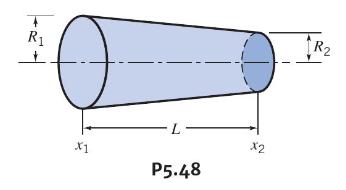
Consider the one-dimensional, incompressible flow through the circular channel shown. The velocity at section (1) is given by \(U=U_{0}+U_{1} \sin \omega t\), where \(U_{0}=20 \mathrm{~m} / \mathrm{s}, U_{1}=2 \mathrm{~m} / \mathrm{s}\), and \(\omega=0.3 \mathrm{rad} / \mathrm{s}\). The channel
Expand \((\vec{V} \cdot abla) \vec{V}\) in cylindrical coordinates by direct substitution of the velocity vector to obtain the convective acceleration of a fluid particle. Verify the results given in Eq. 5.12a.Data From Equation 5.12A Ve OV, V arp =Vr- + dr r de r av, avr r +V + dt
Determine the velocity potential for(a) a flow field characterized by the stream function \(\psi=3 x^{2} y-y^{3}\).(b) a flow field characterized by the stream function \(\psi=x y\).
Determine whether the following flow fields are irrotational.(a) \(u=2 x y ; v=-x^{2} y\)(b) \(u=y-x+x^{2} ; v=x+y-2 x y\)(c) \(u=x^{2} t+2 y ; v=2 x-y t^{2}\)(d) \(u=-x^{2}-y^{2}-x y t ; v=x^{2}+y^{2}+x y t\)
The velocity profile for steady flow between parallel is parabolic and given by \(u=u_{c}+a y^{2}\), where \(u_{c}\) is the centerline velocity and \(y\) is the distance measured from the centerline. The plate spacing is \(2 b\) and the velocity is zero at each plate. Demonstrate that the flow is
Consider the velocity field for flow in a rectangular "corner," \(\vec{V}=A x \hat{i}-A y \hat{i}\), with \(A=0.3 \mathrm{~s}^{-1}\), as in Example 5.8. Evaluate the circulation about the unit square of Example 5.8.
Consider the two-dimensional flow field in which \(u=A x^{2}\) and \(v=B x y\), where \(A=1 / 2 \mathrm{ft}^{-1} \cdot \mathrm{s}^{-1}, B=-1 \mathrm{ft}^{-1} \cdot \mathrm{s}^{-1}\), and the coordinates are measured in feet. Show that the velocity field represents a possible incompressible flow.
Consider a flow field represented by the stream function \(\psi=3 x^{5} y-10 x^{3} y^{3}+3 x y^{5}\). Is this a possible two-dimensional incompressible flow? Is the flow irrotational?
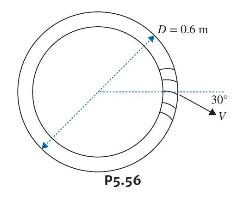
Fluid passes through the set of thin, closely space blades at a velocity of \(3 \mathrm{~m} / \mathrm{s}\). Determine the circulation for the flow. P5.56 D= 0.6 m 30 V
A two-dimensional flow field is characterized as \(u=A x^{2}\) and \(u=B x y\) where \(A=\frac{1}{2} \mathrm{~m}^{-1} \mathrm{~s}^{-1}\) and \(B=-1 \mathrm{~m}^{-1} \mathrm{~s}^{-1}\), and \(x\) and \(y\) are in meters. Demonstrate that the velocity field represents a possible incompressible flow
A flow field is represented by the stream function \(\psi=x^{4}-2 x^{3} y+2 x y^{3}-y^{4}\). Is this a possible two-dimensional flow? Is the flow irrotational?
Consider a velocity field for motion parallel to the \(x\) axis with constant shear. The shear rate is \(d u / d y=A\), where \(A=0.1 \mathrm{~s}^{-1}\). Obtain an expression for the velocity field, \(\vec{V}\). Calculate the rate of rotation. Evaluate the stream function for this flow field.
Consider the flow field represented by the stream function \(\psi=A x y+A y^{2}\), where \(A=1 \mathrm{~s}^{-1}\). Show that this represents a possible incompressible flow field. Evaluate the rotation of the flow. Plot a few streamlines in the upper half plane.
Consider the velocity field given by \(\vec{V}=A x^{2} \hat{i}+B x y \hat{j}\), where \(A=1 \mathrm{ft}^{-1} \cdot \mathrm{s}^{-1}, B=-2 \mathrm{ft}^{-1} \cdot \mathrm{s}^{-1}\), and the coordinates are measured in feet.(a) Determine the fluid rotation.(b) Evaluate the circulation about the "curve"
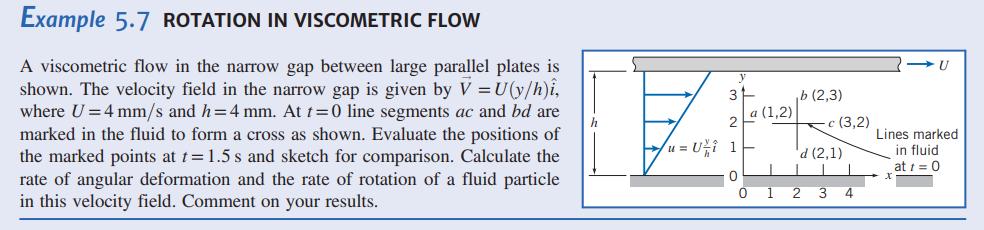
Consider again the viscometric flow of Example 5.7. Evaluate the average rate of rotation of a pair of perpendicular line segments oriented at \(\pm 45^{\circ}\) from the \(x\) axis. Show that this is the same as in the example.Data From Example 5.7 Example 5.7 ROTATION IN VISCOMETRIC FLOW A
The velocity field near the core of a tornado can be approximated as\[\vec{V}=-\frac{q}{2 \pi r} \hat{e}_{r}+\frac{K}{2 \pi r} \hat{e}_{\theta}\]Is this an irrotational flow field? Obtain the stream function for this flow.
A velocity field is given by \(\vec{V}=2 \hat{i}-4 x \hat{j} \mathrm{~m} / \mathrm{s}\). Determine an equation for the streamline. Calculate the vorticity of the flow.
Consider the pressure-driven flow between stationary parallel plates separated by distance \(2 b\). Coordinate \(y\) is measured from the channel centerline. The velocity field is given by \(u=\) \(u_{\max }\left[1-(y / b)^{2}\right]\). Evaluate the rates of linear and angular deformation. Obtain
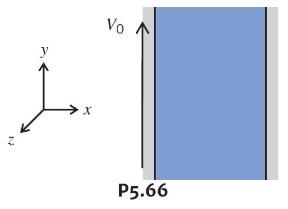
Consider a steady, laminar, fully developed, incompressible flow between two infinite plates, as shown. The flow is due to the motion of the left plate as well a pressure gradient that is applied in the \(y\) direction. Given the conditions that \(\vec{V} eq \vec{V}(z), w=0\), and that gravity
Assume the liquid film in Example 5.9 is not isothermal, but instead has the following distribution:\[T(y)=T_{0}+\left(T_{w}-T_{0}\right)\left(1-\frac{y}{h}\right)\]where \(T_{0}\) and \(T_{w}\) are, respectively, the ambient temperature and the wall temperature. The fluid viscosity decreases with
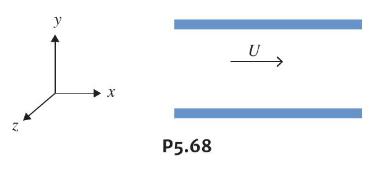
Consider a steady, laminar, fully developed incompressible flow between two infinite parallel plates as shown. The flow is due to a pressure gradient applied in the \(x\) direction. Given that \(\vec{V}_{1} \vec{V}(z), w=0\) and that gravity points in the negative \(y\) direction, prove that
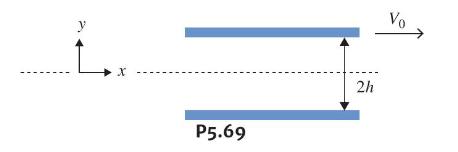
Consider a steady, laminar, fully developed incompressible flow between two infinite parallel plates separated by a distance \(2 h\) as shown. The top plate moves with a velocity \(V_{0}\). Derive an expression for the velocity profile. Determine the pressure gradient for which the flow rate is
A linear velocity profile was used to model flow in a laminar incompressible boundary layer in Problem 5.10. Express the rotation of a fluid particle. Locate the maximum rate of rotation. Express the rate of angular deformation for a fluid particle. Locate the maximum rate of angular deformation.
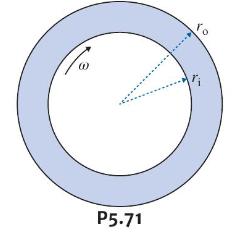
A cylinder of radius \(r_{\mathrm{i}}\) rotates at a speed \(\omega\) coaxially inside a fixed cylinder of radius \(r_{0}\). A viscous fluid fills the space between the two cylinders. Determine the velocity profile in the space between the cylinders and the shear stress on the surface of each
The velocity profile for fully developed laminar flow in a circular tube is \(u=u_{\max }\left[1-(r / R)^{2}\right]\). Obtain an expression for the shear force per unit volume in the \(x\) direction for this flow. Evaluate its maximum value for a pipe radius of \(75 \mathrm{~mm}\) and a maximum
Assume the liquid film in Example 5.9 is horizontal (i.e., \(\theta=0^{\circ}\) ) and that the flow is driven by a constant shear stress on the top surface \((y=h), \tau_{y x}=C\). Assume that the liquid film is thin enough and flat and that the flow is fully developed with zero net flow rate (flow
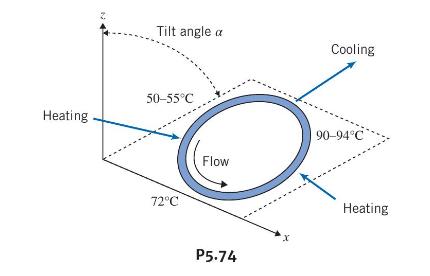
The common thermal polymerase chain reaction (PCR) process requires the cycling of reagents through three distinct temperatures for denaturation \(\left(90-94^{\circ} \mathrm{C}\right)\), annealing \(\left(50-55^{\circ} \mathrm{C}\right)\), and extension \(\left(72^{\circ} \mathrm{C}\right)\). In
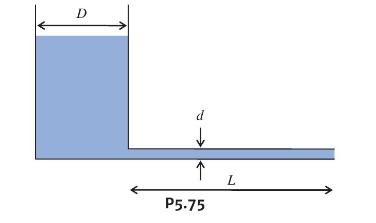
A tank contains water \(\left(20^{\circ} \mathrm{C}\right)\) at an initial depth \(y_{0}=1 \mathrm{~m}\). The tank diameter is \(D=250 \mathrm{~mm}\) and a tube of diameter \(d=3 \mathrm{~mm}\) and length \(L=4 \mathrm{~m}\) is attached to the bottom of the tank. For laminar flow a reasonable model
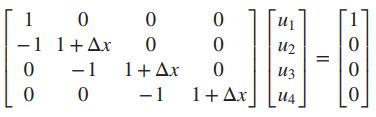
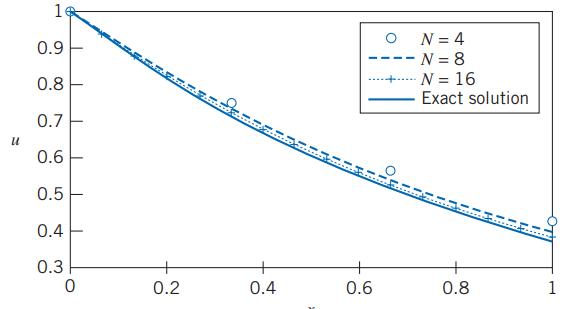
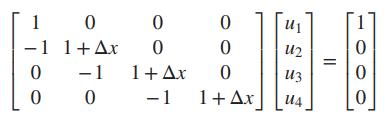
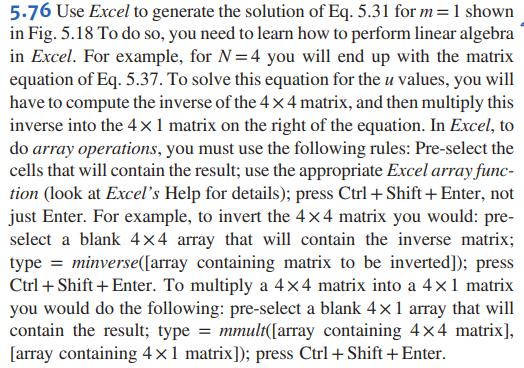
Use Excel to generate the solution of Eq. 5.31 for \(m=1\) shown in Fig. 5.18 To do so, you need to learn how to perform linear algebra in Excel. For example, for \(N=4\) you will end up with the matrix equation of Eq. 5.37. To solve this equation for the \(u\) values, you will have to compute the
For a small spherical particle of styrofoam (density \(=16 \mathrm{~kg} / \mathrm{m}^{3}\) ) with a diameter of \(5 \mathrm{~mm}\) falling in air, the drag is given by \(F_{\mathrm{D}}=3 \pi \mu V d\), where \(\mu\) is the air viscosity and \(V\) is the sphere velocity. Derive the differential
Following the steps to convert the differential equation Eq. 5.31 (for \(m=1\) ) into a difference equation (for example, Eq. 5.37 for \(N=4\) ), solve\[\frac{d u}{d x}+u=2 x^{2}+x \quad 0 \leq x \leq 1 \quad u(0)=3\]for \(N=4,8\), and 16 and compare to the exact solution\[u_{\text {exact }}=2
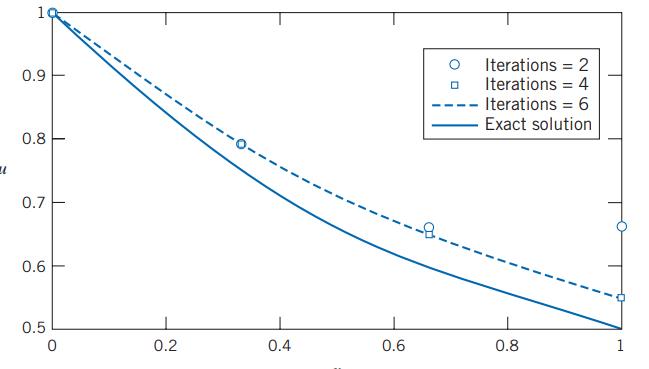
Use Excel to generate the progression to an iterative solution Eq. 5.31 for \(m=2\), as illustrated in Fig. 5.21Data From Equation 5.31Data From Fig. 5.21 du +um=0; 0x1; u(0)=1 dx
Use Excel to generate the solutions of Eq. 5.31 for \(m=-1\), with \(u(0)=3\), using 4 and 16 points over the interval from \(x=0\) to \(x=3\), with sufficient iterations, and compare to the exact solution\[u_{\text {exact }}=\sqrt{9-2 x}\]To do so, follow the steps described in the "Dealing with
An incompressible frictionless flow field is given by \(\vec{V}=(A x+B y) \hat{i}+(B x-A y) \hat{j}\), where \(A=2 \mathrm{~s}^{-1}\) and \(B=2 s^{-1}\), and the coordinates are measured in meters. Find the magnitude and direction of the acceleration of a fluid particle at point \((x, y)=(2,2)\).
A velocity field in a fluid with density of \(1000 \mathrm{~kg} / \mathrm{m}^{3}\) is given by \(\vec{V}=(-A x+B y) t \hat{i}+(A y+B x) t \hat{j}\), where \(A=2 \mathrm{~s}^{-2}\) and \(B=1 \mathrm{~s}^{-2}\), \(x\) and \(y\) are in meters, and \(t\) is in seconds. Body forces are negligible.
The \(x\) component of velocity in an incompressible flow field is given by \(u=A x\), where \(A=2 \mathrm{~s}^{-1}\) and the coordinates are measured in meters. The pressure at point \((x, y)=(0,0)\) is \(p_{0}=190 \mathrm{kPa}\) gage. The density is \(ho=1.50 \mathrm{~kg} / \mathrm{m}^{3}\) and
Consider the flow field with the velocity given by \(\vec{V}=3 \hat{i}+5 t \hat{j}+\) \(8 t^{2} \hat{k}\), where the velocity is in \(\mathrm{m} / \mathrm{s}\) and \(t\) is in seconds. The fluid density is \(800 \mathrm{~kg} / \mathrm{m}^{3}\) and gravity acts in the negative \(z\) direction.
Consider the flow field with the velocity given by \(\vec{V}=4 y \hat{i}+3 x \hat{j}\), where the velocity is in \(\mathrm{ft} / \mathrm{s}\) and the coordinates are in feet. The fluid density is \(1.5 \mathrm{slug} / \mathrm{ft}^{3}\) and gravity acts in the negative \(y\) direction. Determine
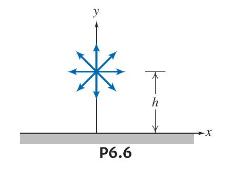
The velocity field for a plane source located distance \(h=1 \mathrm{~m}\) above an infinite wall aligned along the \(x\) axis is given by\[\begin{aligned} \vec{V}= & \frac{q}{2 \pi\left[x^{2}+(y-h)^{2}\right]}[x \hat{i}+(y-h) \hat{j}] \\ & +\frac{q}{2 \pi\left[x^{2}+(y+h)^{2}\right]}[x
In a two-dimensional frictionless, incompressible \(\left(ho=1500 \mathrm{~kg} / \mathrm{m}^{3}\right)\) flow, the velocity field in meters per second is given by \(\vec{V}=(A x+B y) \hat{i}+(B x-A y) \hat{j}\); the coordinates are measured in meters, and \(A=4 \mathrm{~s}^{-1}\) and \(B=2
Consider a two-dimensional incompressible flow flowing downward against a plate. The velocity is given by \(\vec{V}=A x \hat{i}-A y \hat{j}\), where \(A=2 \mathrm{~s}^{-1}\) and \(x\) and \(y\) are in meters. Determine general expressions for the acceleration and pressure gradients in the \(x\) and
An incompressible liquid with a density of \(900 \mathrm{~kg} / \mathrm{m}^{3}\) and negligible viscosity flows steadily through a horizontal pipe of constant diameter. In a porous section of length \(L=2 \mathrm{~m}\), liquid is removed at a variable rate along the length so that the uniform axial
Consider a flow of water in pipe. What is the pressure gradient required to accelerate the water at \(20 \mathrm{ft} / \mathrm{s}^{2}\) if the pipe is(a) horizontal,(b) vertical with the water flowing upward, and(c) vertical with the water flowing downward. Explain why the pressure gradient depends
The velocity field for a plane vortex sink is given by \(\vec{V}=(-q / 2 \pi r) \hat{e}_{r}+(K / 2 \pi r) \hat{e}_{\theta}\), where \(q=2 \mathrm{~m}^{3} / \mathrm{s} / \mathrm{m}\) and \(K=1\) \(\mathrm{m}^{3} / \mathrm{s} / \mathrm{m}\). The fluid density is \(1000 \mathrm{~kg} /
An incompressible liquid with negligible viscosity and density \(ho=1.75 \mathrm{slug} / \mathrm{ft}^{3}\) flows steadily through a horizontal pipe. The pipe cross-section area linearly varies from \(15 \mathrm{in}^{2}{ }^{2}\) to \(2.5 \mathrm{in.}^{2}\) over a length of 10 feet. Develop an
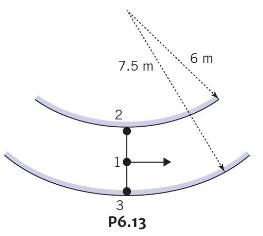
Consider water flowing in a circular section of a twodimensional channel. Assume the velocity is uniform across the channel at \(12 \mathrm{~m} / \mathrm{s}\). The pressure is \(120 \mathrm{kPa}\) at centerline (point 1). Determine the pressures at point 2 and 3 for the case of (a) flow in the
Consider a tornado as air moving in a circular pattern in the horizontal plane. If the wind speed is \(200 \mathrm{mph}\) and the diameter of the tornado is \(200 \mathrm{ft}\), determine the radial pressure gradient. If it is desired to model the tornado using water in a 6 in. diameter tube, what
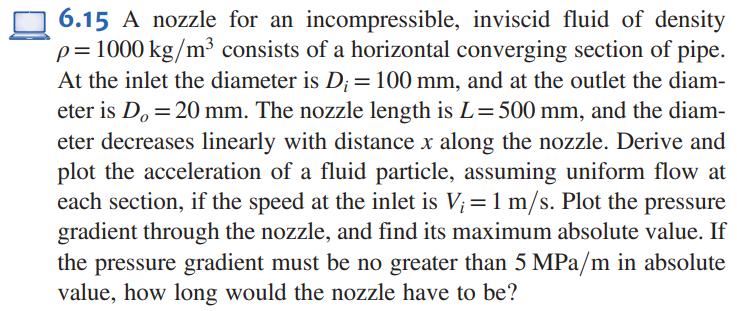
A nozzle for an incompressible, inviscid fluid of density \(ho=1000 \mathrm{~kg} / \mathrm{m}^{3}\) consists of a horizontal converging section of pipe. At the inlet the diameter is \(D_{i}=100 \mathrm{~mm}\), and at the outlet the diameter is \(D_{o}=20 \mathrm{~mm}\). The nozzle length is \(L=500
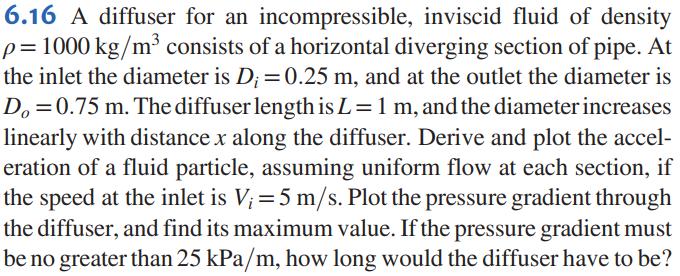
A diffuser for an incompressible, inviscid fluid of density \(ho=1000 \mathrm{~kg} / \mathrm{m}^{3}\) consists of a horizontal diverging section of pipe. At the inlet the diameter is \(D_{i}=0.25 \mathrm{~m}\), and at the outlet the diameter is \(D_{o}=0.75 \mathrm{~m}\). The diffuser length is
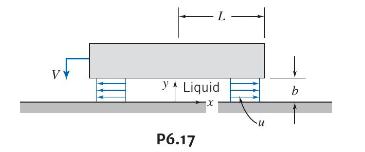
A liquid layer separates two plane surfaces as shown. The lower surface is stationary; the upper surface moves downward at constant speed \(V\). The moving surface has width \(w\), perpendicular to the plane of the diagram, and \(w \gg L\). The incompressible liquid layer, of density \(ho\), is
Consider Problem 6.15 with the nozzle directed upward. Assuming that the flow is uniform at each section, derive and plot the acceleration of a fluid particle for an inlet speed of \(V_{i}=2 \mathrm{~m} / \mathrm{s}\). Plot the pressure gradient through the nozzle and find its maximum absolute
Consider Problem 6.16 with the diffuser directed upward. Assuming that the flow is uniform at each section, derive and plot the acceleration of a fluid particle for an inlet speed of \(V_{i}=12 \mathrm{~m} / \mathrm{s}\). Plot the pressure gradient through the diffuser, and find its maximum value.
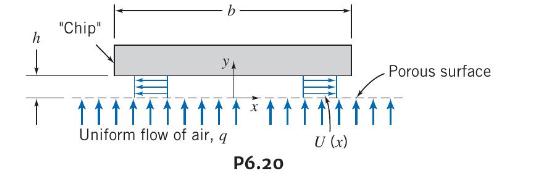
A rectangular computer chip floats on a thin layer of air, \(h=0.5 \mathrm{~mm}\) thick, above a porous surface. The chip width is \(b=40 \mathrm{~mm}\), as shown. Its length, \(L\), is very long in the direction perpendicular to the diagram. There is no flow in the \(z\) direction. Assume flow in
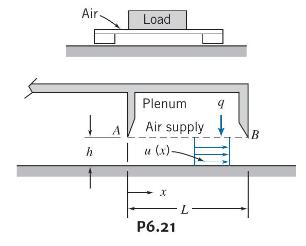
Heavy weights can be moved with relative ease on air cushions by using a load pallet as shown. Air is supplied from the plenum through porous surface \(A B\). It enters the gap vertically at uniform speed, \(q\). Once in the gap, all air flows in the positive \(x\) direction (there is no flow
The \(y\) component of velocity in a two-dimensional incompressible flow field is given by \(v=-A x y\), where \(v\) is in \(\mathrm{m} / \mathrm{s}\), the coordinates are measured in meters, and \(A=1 \mathrm{~m}^{-1} \cdot \mathrm{s}^{-1}\). There is no velocity component or variation in the
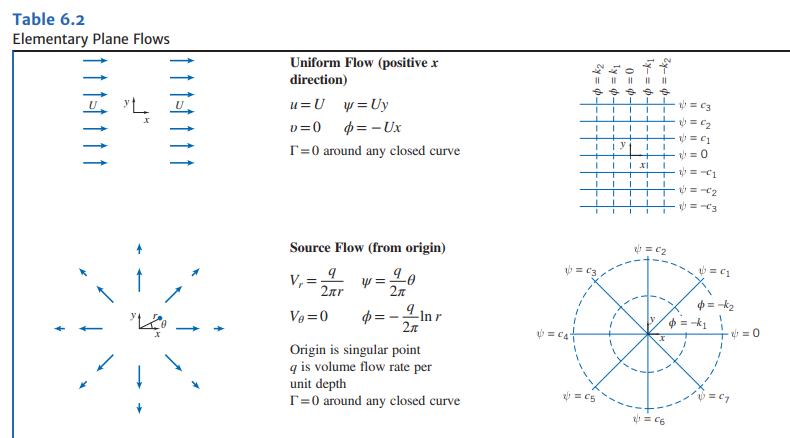
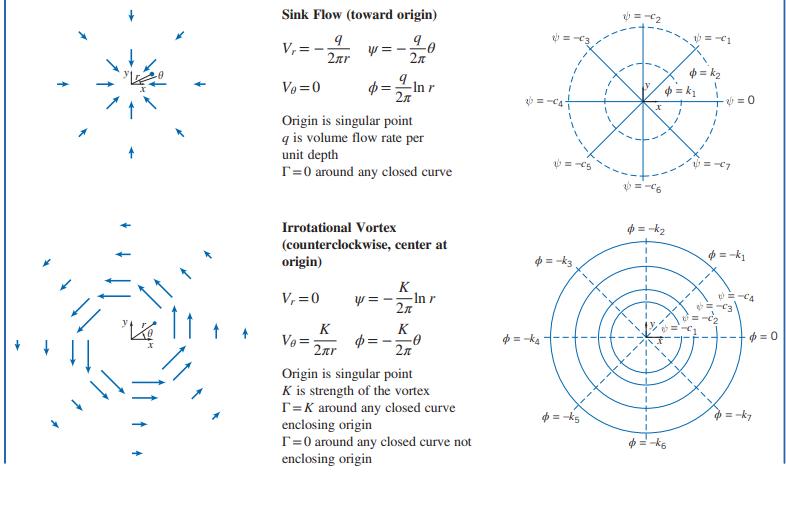
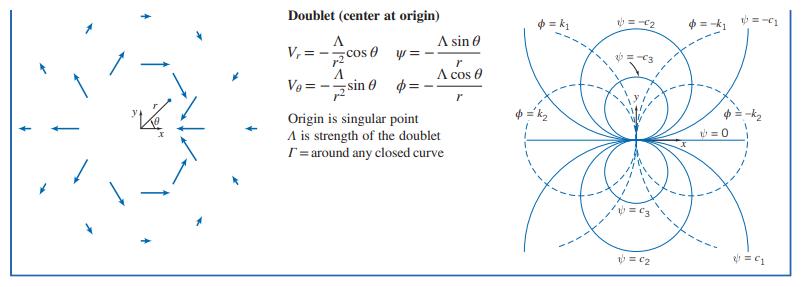
The velocity field for a plane doublet is given in Table 6.2. Find an expression for the pressure gradient at any point \((r, \theta)\).Data From Table 6.2 Table 6.2 Elementary Plane Flows Uniform Flow (positive x direction) u=U_w=Uy v=0 = -Ux I=0 around any closed curve Source Flow (from origin) q
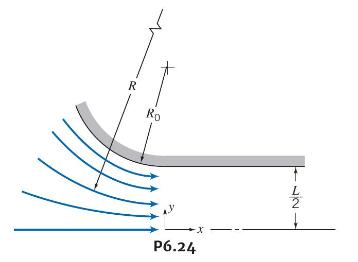
To model the velocity distribution in the curved inlet section of a water channel, the radius of curvature of the streamlines is expressed as \(R=L R_{0} / 2 y\). As an approximation, assume the water speed along each streamline is \(V=10 \mathrm{~m} / \mathrm{s}\). Find an expression for and plot
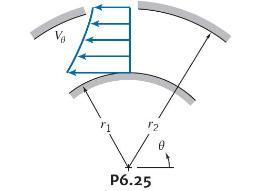
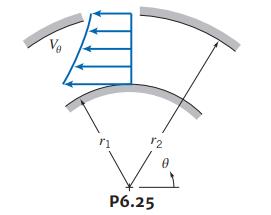
Repeat Example 6.1, but with the somewhat more realistic assumption that the flow is similar to a free vortex (irrotational) profile, \(V_{\theta}=c / r\) (where \(c\) is a constant), as shown in Fig. P6.25. In doing so, prove that the flow rate is given by \(Q=k \sqrt{\Delta p}\), where \(k\)
Using the analyses of Example 6.1 and Problem 6.25, plot the discrepancy (percent) between the flow rates obtained from assuming uniform flow and the free vortex (irrotational) profile as a function of \(r_{2} / r_{1}\).Data From Example 6.1Data From Problem 6.25 Example 6.1 FLOW IN A BEND The flow
The \(x\) component of velocity in a two-dimensional incompressible flow field is given by \(u=-\Lambda\left(x^{2}-y^{2}\right) /\left(x^{2}+y^{2}\right)^{2}\), where \(u\) is in \(\mathrm{m} / \mathrm{s}\), the coordinates are measured in meters, and \(\Lambda=2 \mathrm{~m}^{3} \cdot
Water flows at a speed of \(25 \mathrm{ft} / \mathrm{s}\). Calculate the dynamic pressure of this flow. Express your answer in inches of mercury.
Plot the speed of air versus the dynamic pressure (in millimeters of mercury), up to a dynamic pressure of \(250 \mathrm{~mm} \mathrm{Hg}\).
Showing 600 - 700
of 1127
1
2
3
4
5
6
7
8
9
10
11
12
Step by Step Answers

 Get 50% OFF
Claim Now
Get 50% OFF
Claim Now