New Semester
Started
Get
50% OFF
Study Help!
--h --m --s
Claim Now
Question Answers
Textbooks
Find textbooks, questions and answers
Oops, something went wrong!
Change your search query and then try again
S
Books
FREE
Study Help
Expert Questions
Accounting
General Management
Mathematics
Finance
Organizational Behaviour
Law
Physics
Operating System
Management Leadership
Sociology
Programming
Marketing
Database
Computer Network
Economics
Textbooks Solutions
Accounting
Managerial Accounting
Management Leadership
Cost Accounting
Statistics
Business Law
Corporate Finance
Finance
Economics
Auditing
Tutors
Online Tutors
Find a Tutor
Hire a Tutor
Become a Tutor
AI Tutor
AI Study Planner
NEW
Sell Books
Search
Search
Sign In
Register
study help
engineering
introduction to fluid mechanics
Fox And McDonald's Introduction To Fluid Mechanics 9th Edition Philip J. Pritchard, John W. Mitchell - Solutions
Compare the height due to capillary action of water exposed to air in a circular tube of diameter \(D=0.5 \mathrm{~mm}\), and between two infinite vertical parallel plates of gap \(a=0.5 \mathrm{~mm}\).
At ground level in Denver, Colorado, the atmospheric pressure and temperature are \(83.2 \mathrm{kPa}\) and \(25^{\circ} \mathrm{C}\). Calculate the pressure on Pike's Peak at an elevation of \(2690 \mathrm{~m}\) above the city assuming(a) an incompressible and(b) an adiabatic atmosphere. Plot the
If atmospheric pressure at the ground is \(101.3 \mathrm{kPa}\) and temperature is \(15^{\circ} \mathrm{C}\), calculate the pressure \(7.62 \mathrm{~km}\) above the ground, assuming(a) no density variation,(b) isothermal variation of density with pressure, and(c) adiabatic variation of density with
If the temperature in the atmosphere is assumed to vary linearly with altitude so \(T=T_{o}-\alpha z\) where \(T_{o}\) is the sea level temperature and \(\alpha=-d T / d z\) is the temperature lapse rate, find \(p(z)\) when air is taken to be a perfect gas. Give the answer in terms of \(p_{o},
A door \(1 \mathrm{~m}\) wide and \(1.5 \mathrm{~m}\) high is located in a plane vertical wall of a water tank. The door is hinged along its upper edge, which is \(1 \mathrm{~m}\) below the water surface. Atmospheric pressure acts on the outer surface of the door and at the water surface.(a)
A hydropneumatic elevator consists of a piston-cylinder assembly to lift the elevator cab. Hydraulic oil, stored in an accumulator tank pressurized by air, is valved to the piston as needed to lift the elevator. When the elevator descends, oil is returned to the accumulator. Design the least
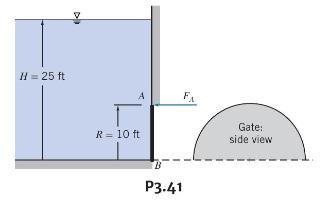
Semicircular plane gate \(A B\) is hinged along \(B\) and held by horizontal force \(F_{A}\) applied at \(A\). The liquid to the left of the gate is water. Calculate the force \(F_{A}\) required for equilibrium. H=25 ft R = 10 ft P3.41 FA Gate: side view
A circular gate \(3 \mathrm{~m}\) in diameter has its center \(2.5 \mathrm{~m}\) below a water surface and lies in a plane sloping at \(60^{\circ}\). Calculate magnitude, direction, and location of total force on the gate.
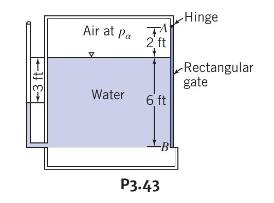
For the situation shown, find the air pressure in the tank in psi. Calculate the force exerted on the gate at the support \(B\) if the gate is \(10 \mathrm{ft}\) wide. Show a free body diagram of the gate with all the forces drawn in and their points of application located. -3 ft- Air at pa 2 ft
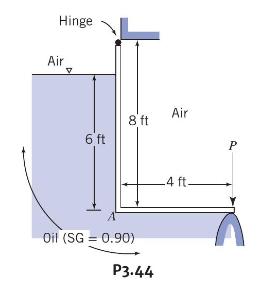
What is the pressure at \(A\) ? Draw a free body diagram of the 10 -ft wide gate showing all forces and the locations of their lines of action. Calculate the minimum force \(P\) necessary to keep the gate closed. Hinge Air 6 ft 8 ft Oil (SG = 0.90) P3.44 Air P -4 ft.
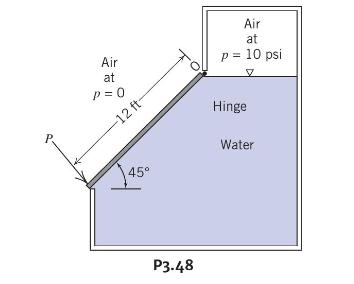
Calculate the minimum force \(P\) necessary to hold a uniform \(12 \mathrm{ft}\) square gate weighing \(500 \mathrm{lb}\) closed on a tank of water under a pressure of \(10 \mathrm{psi}\). Draw a free body of the gate as part of your solution. Air at Air at p = 10 psi p = 0 -12 ft- Hinge P. Water
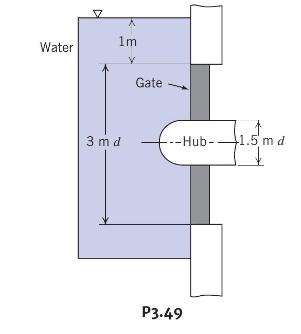
Calculate magnitude and location of the resultant force of water on this annular gate. 1m Water Gate 3 md --Hub-- 1.5m d P3.49
A vertical rectangular gate \(2.4 \mathrm{~m}\) wide and \(2.7 \mathrm{~m}\) high is subjected to water pressure on one side, the water surface being at the top of the gate. The gate is hinged at the bottom and is held by a horizontal chain at the top. What is the tension in the chain?
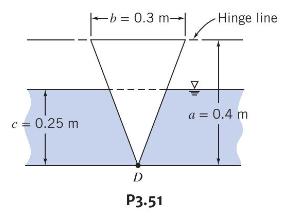
A window in the shape of an isosceles triangle and hinged at the top is placed in the vertical wall of a form that contains liquid concrete. Determine the minimum force that must be applied at point \(D\) to keep the window closed for the configuration of form and concrete shown. Plot the results
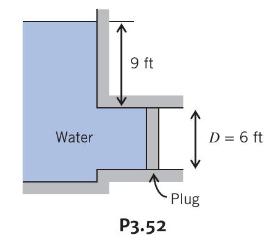
A large open tank contains water and is connected to a 6 -ftdiameter conduit as shown. A circular plug is used to seal the conduit. Determine the magnitude, direction, and location of the force of the water on the plug. Water 9 ft P3.52 Plug D= 6 ft
The circular access port in the side of a water standpipe has a diameter of \(0.6 \mathrm{~m}\) and is held in place by eight bolts evenly spaced around the circumference. If the standpipe diameter is \(7 \mathrm{~m}\) and the center of the port is located \(12 \mathrm{~m}\) below the free surface
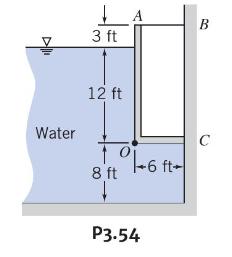
The gate \(A O C\) shown is \(6 \mathrm{ft}\) wide and is hinged along \(O\). Neglecting the weight of the gate, determine the force in bar \(A B\). The gate is sealed at \(C\). 3 ft A Water 12 ft 1401-61 8 ft ft- P3.54 B C
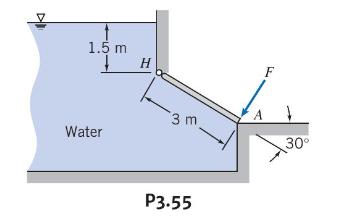
The gate shown is hinged at \(H\). The gate is \(3 \mathrm{~m}\) wide normal to the plane of the diagram. Calculate the force required at \(A\) to hold the gate closed. 1.5 m H Water 3 m P3.55 30
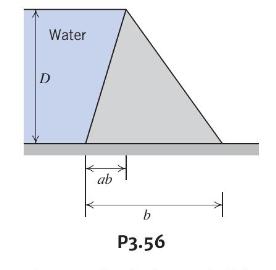
A solid concrete dam is to be built to hold back a depth \(D\) of water. For ease of construction the walls of the dam must be planar. Your supervisor asks you to consider the following dam cross-sections: a rectangle, a right triangle with the hypotenuse in contact with the water, and a right
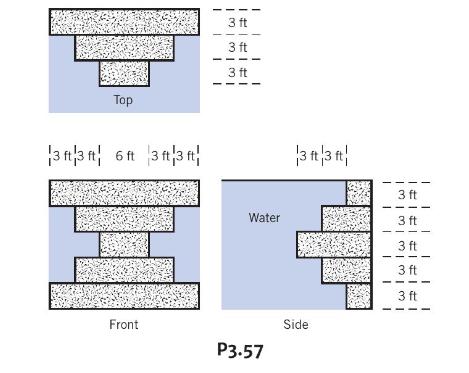
For the dam shown, what is the vertical force of the water on the dam? 3 ft Top 3 ft 3 ft 3f3ft 6ft 3ft 3ft 3 ft 3 ft Front Water P3.57 Side wwwlwlwl 3 ft 3 ft -f-f-f-f-f 3 ft 3 ft 3 ft 1 I
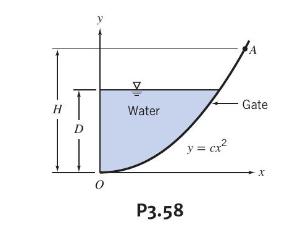
The parabolic gate shown is \(2 \mathrm{~m}\) wide and pivoted at \(O\); \(c=0.25 \mathrm{~m}^{-1}, D=2 \mathrm{~m}\), and \(H=3 \mathrm{~m}\). Determine(a) the magnitude and line of action of the vertical force on the gate due to the water,(b) the horizontal force applied at \(A\) required to
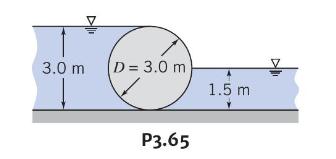
A cylindrical weir has a diameter of \(3 \mathrm{~m}\) and a length of \(6 \mathrm{~m}\). Find the magnitude and direction of the resultant force acting on the weir from the water. 3.0 m D= 3.0 m) 1.5 m P3.65
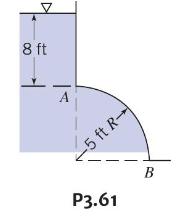
The quarter cylinder \(A B\) is \(10 \mathrm{ft}\) long. Calculate magnitude, direction, and location of the resultant force of the water on \(A B\). 8 ft A -5 ft R- P3.61 B
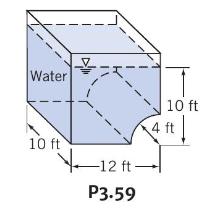
An open tank is filled with water to the depth indicated. Atmospheric pressure acts on all outer surfaces of the tank. Determine the magnitude and line of action of the vertical component of the force of the water on the curved part of the tank bottom. Water H 10 ft 4 ft 10 ft -12 ft- P3.59
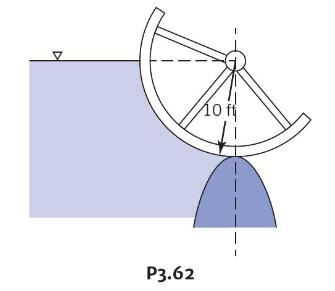
Calculate the magnitude, direction (horizontal and vertical components are acceptable), and line of action of the resultant force exerted by the water on the cylindrical gate \(30 \mathrm{ft}\) long. P3.62 10 ft
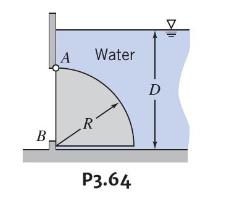
A gate, in the shape of a quarter-cylinder, hinged at \(A\) and sealed at \(B\), is \(3 \mathrm{~m}\) wide. The bottom of the gate is \(4.5 \mathrm{~m}\) below the water surface. Determine the force on the stop at \(B\) if the gate is made of concrete; \(R=3 \mathrm{~m}\). B A R Water D P3.64
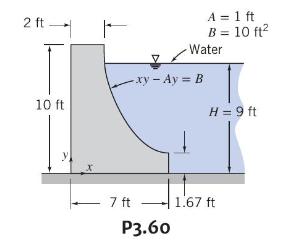
A dam is to be constructed using the cross-section shown. Assume the dam width is \(w=160 \mathrm{ft}\). For water height \(H=9 \mathrm{ft}\), calculate the magnitude and line of action of the vertical force of water on the dam face. Is it possible for water forces to overturn this dam? Under what
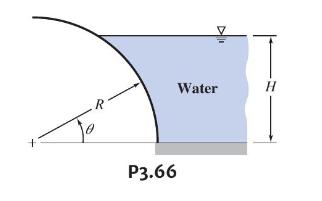
A curved surface is formed as a quarter of a circular cylinder with \(R=0.750 \mathrm{~m}\) as shown. The surface is \(w=3.55 \mathrm{~m}\) wide. Water stands to the right of the curved surface to depth \(H=0.650 \mathrm{~m}\). Calculate the vertical hydrostatic force on the curved surface.
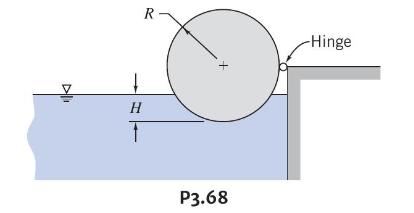
The cylinder shown is supported by an incompressible liquid of density \(ho\), and is hinged along its length. The cylinder, of mass \(M\), length \(L\), and radius \(R\), is immersed in liquid to depth \(H\). Obtain a general expression for the cylinder specific gravity versus the ratio of liquid
A hemispherical shell \(1.2 \mathrm{~m}\) in diameter is connected to the vertical wall of a tank containing water. If the center of the shell is \(1.8 \mathrm{~m}\) below the water surface, what are the vertical and horizontal force components on the shell? On the top half of the shell?
If you throw an anchor out of your canoe but the rope is too short for the anchor to rest on the bottom of the pond, will your canoe float higher, lower, or stay the same? Prove your answer.
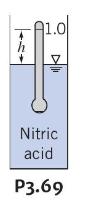
A hydrometer is a specific gravity indicator, the value being indicated by the level at which the free surface intersects the stem when floating in a liquid. The 1.0 mark is the level when in distilled water. For the unit shown, the immersed volume in distilled water is \(15 \mathrm{~cm}^{3}\). The
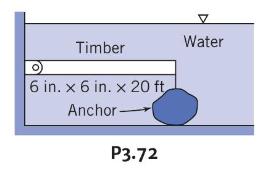
The timber weighs \(40 \mathrm{lb} / \mathrm{ft}^{3}\) and is held in a horizontal position by the concrete \(\left(150 \mathrm{lb} / \mathrm{ft}^{3}\right)\) anchor. Calculate the minimum total weight which the anchor may have. Timber 6 in. x 6 in. x 20 ft Anchor- P3.72 Water
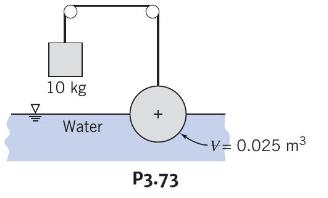
Find the specific weight of the sphere shown if its volume is \(0.025 \mathrm{~m}^{3}\). State all assumptions. What is the equilibrium position of the sphere if the weight is removed? 10 kg Water P3.73 -V= 0.025 m
The fat-to-muscle ratio of a person may be determined from a specific gravity measurement. The measurement is made by immersing the body in a tank of water and measuring the net weight. Develop an expression for the specific gravity of a person in terms of their weight in air, net weight in water,
An open tank is filled to the top with water. A steel cylindrical container, wall thickness \(\delta=1 \mathrm{~mm}\), outside diameter \(D=100 \mathrm{~mm}\), and height \(H=1 \mathrm{~m}\), with an open top, is gently placed in the water. What is the volume of water that overflows from the tank?
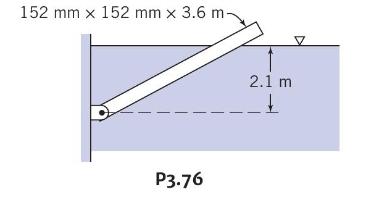
If the timber weighs \(670 \mathrm{~N}\), calculate its angle of inclination when the water surface is \(2.1 \mathrm{~m}\) above the pivot. Above what depth will the timber stand vertically? 152 mm x 152 mm x 3.6 m- P3.76 2.1 m
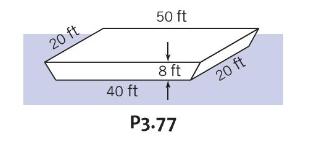
The barge shown weighs 40 tons and carries a cargo of 40 tons. Calculate its draft in freshwater. 20 ft 40 ft 50 ft 8 ft P3.77 20 ft
Quantify the experiment performed by Archimedes to identify the material content of King Hiero's crown. Assume you can measure the weight of the king's crown in air, \(W_{a}\), and the weight in water, \(W_{w}\). Express the specific gravity of the crown as a function of these measured values.
Hot-air ballooning is a popular sport. According to a recent article, "hot-air volumes must be large because air heated to \(150^{\circ} \mathrm{F}\) over ambient lifts only \(0.018 \mathrm{lbf} / \mathrm{ft}^{3}\) compared to 0.066 and 0.071 for helium and hydrogen, respectively." Check these
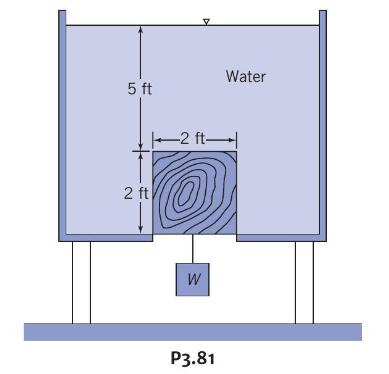
The opening in the bottom of the tank is square and slightly less than \(2 \mathrm{ft}\) on each side. The opening is to be plugged with a wooden cube \(2 \mathrm{ft}\) on a side.(a) What weight \(W\) should be attached to the wooden cube to insure successful plugging of the hole? The wood weighs
It is desired to use a hot air balloon with a volume of \(320,000 \mathrm{ft}^{3}\) for rides planned in summer morning hours when the air temperature is about \(48^{\circ} \mathrm{F}\). The torch will warm the air inside the balloon to a temperature of \(160^{\circ} \mathrm{F}\). Both inside and
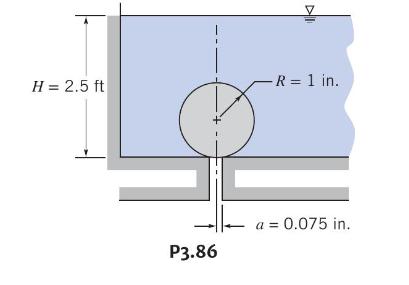
A sphere of 1-in.-radius made from material of specific gravity of \(S G=0.95\), is submerged in a tank of water. The sphere is placed over a hole of 0.075 -in.-radius in the tank bottom. When the sphere is released, will it stay on the bottom of the tank or float to the surface? H = 2.5 ft P3.86 -
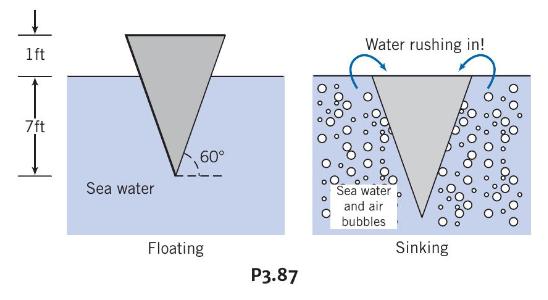
You are in the Bermuda Triangle when you see a bubble plume eruption (a large mass of air bubbles, similar to foam) off to the side of the boat. Do you want to head toward it and be part of the action? What is the effective density of the water and air bubbles in the drawing on the right that will
A balloon has a weight (including crew but not gas) of \(2.2 \mathrm{kN}\) and a gas-bag capacity of \(566 \mathrm{~m}^{3}\). At the ground it is partially inflated with \(445 \mathrm{~N}\) of helium. How high can this balloon rise in the U.S. Standard Atmosphere (Appendix A) if the helium always
A helium balloon is to lift a payload to an altitude of \(40 \mathrm{~km}\), where the atmospheric pressure and temperature are \(3.0 \mathrm{mbar}\) and \(-25^{\circ} \mathrm{C}\), respectively. The balloon skin is polyester with specific gravity of 1.28 and thickness of \(0.015 \mathrm{~mm}\). To
A sphere of radius \(R\) is partially immersed to depth \(d\) in a liquid of specific gravity SG. Obtain an algebraic expression for the buoyancy force acting on the sphere as a function of submersion depth \(d\). Plot the results over the range of water depth \(0 \leq d \leq 2 R\).
A hot air balloon with an initial volume of \(2600 \mathrm{~m}^{3}\) rises from sea level to \(1000 \mathrm{~m}\) elevation. The temperature of the air inside the balloon is \(100^{\circ} \mathrm{C}\) at the start and drops to \(90^{\circ} \mathrm{C}\) at \(1000 \mathrm{~m}\). What are the net
The stem of a glass hydrometer used to measure specific gravity is \(5 \mathrm{~mm}\) in diameter. The distance between marks on the stem is \(2 \mathrm{~mm}\) per 0.1 increment of specific gravity. Calculate the magnitude and direction of the error introduced by surface tension if the hydrometer
On the Milford Trek in New Zealand, there is a pass with a cliff known as the " 12 second drop" for the time it takes a rock to hit the ground below from the pass. Estimate the height of the pass assuming that you throw a \(5 \mathrm{~cm}\) diameter rock that weighs \(200 \mathrm{~g}\) over the
A fully loaded Boeing 777-200 jet transport aircraft has a mass of \(325,000 \mathrm{~kg}\). The pilot brings the 2 engines to full takeoff thrust of \(450 \mathrm{kN}\) each before releasing the brakes. Neglecting aerodynamic and rolling resistance, estimate the minimum runway length and time
An ice-cube tray containing \(250 \mathrm{~mL}\) of freshwater at \(15^{\circ} \mathrm{C}\) is placed in a freezer at \(-5^{\circ} \mathrm{C}\). Determine the change in internal energy \((\mathrm{kJ})\) and entropy \((\mathrm{kJ} / \mathrm{K})\) of the water when it has frozen.
Three steel balls (each about half an inch in diameter) lie at the bottom of a plastic shell floating on the water surface in a partially filled bucket. Someone removes the steel balls from the shell and carefully lets them fall to the bottom of the bucket, leaving the plastic shell to float empty.
A proposed ocean salvage scheme involves pumping air into "bags" placed within and around a wrecked vessel on the sea bottom. Comment on the practicality of this plan, supporting your conclusions with analyses.
A high school experiment consists of a block of mass \(2 \mathrm{~kg}\) sliding across a surface (coefficient of friction \(\mu=0\).6). If it is given an initial velocity of \(5 \mathrm{~m} / \mathrm{s}\), how far will it slide, and how long will it take to come to rest? The surface is now
For a small particle of styrofoam (density \(=19.2 \mathrm{~kg} / \mathrm{m}^{3}\) ) that is spherical with a diameter \(d=1.0 \mathrm{~mm}\) falling in standard air at speed \(V\), the drag is given by \(F_{D}=3 \pi \mu V d\) where \(\mu\) is the air viscosity. Find(a) the maximum speed of the
Air at \(20^{\circ} \mathrm{C}\) and an absolute pressure of \(101.3 \mathrm{kpa}\) is compressed adiabatically in a piston-cylinder device, without friction, to an absolute pressure of \(905.3 \mathrm{kpa}\) in a piston-cylinder device. Find the work done (MJ).
A block of copper of mass \(5 \mathrm{~kg}\) is heated to \(90^{\circ} \mathrm{C}\) and then plunged into an insulated container containing \(4 \mathrm{~L}\) of water at \(10^{\circ} \mathrm{C}\). Find the final temperature of the system. For copper, the specific heat is \(385 \mathrm{~J} /
The average rate of heat loss from a person to the surroundings when not actively working is about \(85 \mathrm{~W}\). Suppose that in an auditorium with volume of approximately \(3.5 \times 10^{5} \mathrm{~m}^{3}\), containing 6000 people, the ventilation system fails. How much does the internal
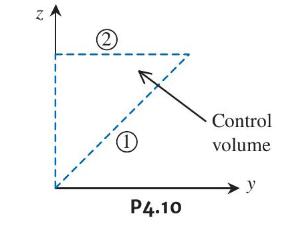
The velocity field in the region shown is given by \(\vec{V}=(a \hat{j}+b y \hat{k})\) where \(a=10 \mathrm{~m} / \mathrm{s}\) and \(b=5 \mathrm{~s}^{-1}\). For the \(1 \mathrm{~m} \times 1 \mathrm{~m}\) triangular control volume (depth \(w=1 \mathrm{~m}\) perpendicular to the diagram), an element
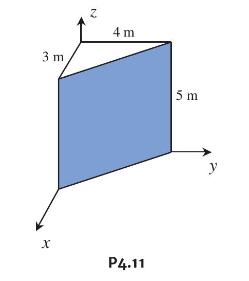
The area shown shaded is in a flow where the velocity field is given by \(\vec{V}=a x \hat{i}+b y \hat{j}+c \hat{k} ; a=b=2 \mathrm{~s}^{-1}\) and \(c=1 \mathrm{~m} / \mathrm{s}\). Write a vector expression for an element of the shaded area. Evaluate the integrals \(\int_{A} \vec{V} \cdot d A\) and
A \(0.3 \mathrm{~m}\) by \(0.5 \mathrm{~m}\) rectangular air duct carries a flow of \(0.45 \mathrm{~m}^{3} / \mathrm{s}\) at a density of \(2 \mathrm{~kg} / \mathrm{m}^{3}\). Calculate the mean velocity in the duct. If the duct tapers to \(0.15 \mathrm{~m}\) by \(0.5 \mathrm{~m}\) size, what is the
Across a shock wave in a gas flow there is a great change in gas density \(ho\). If a shock wave occurs in a duct such that \(V=660 \mathrm{~m} / \mathrm{s}\) and \(ho=1.0 \mathrm{~kg} / \mathrm{m}^{3}\) before the shock and \(V=250 \mathrm{~m} / \mathrm{s}\) after the shock, what is \(ho\) after
Water flows in a pipeline composed of \(75-\mathrm{mm}\) and \(150-\mathrm{mm}\) pipe. Calculate the mean velocity in the \(75-\mathrm{mm}\) pipe when that in the \(150-\mathrm{mm}\) pipe is \(2.5 \mathrm{~m} / \mathrm{s}\). What is its ratio to the mean velocity in the \(150-\mathrm{mm}\) pipe?
A farmer is spraying a liquid through 10 nozzles, 3-mm-ID, at an average exit velocity of \(3 \mathrm{~m} / \mathrm{s}\). What is the average velocity in the 25-mm-ID head feeder? What is the system flow rate, in \(\mathrm{L} / \mathrm{m}\) ?
A university laboratory that generates \(15 \mathrm{~m}^{3} / \mathrm{s}\) of air flow at design condition wishes to build a wind tunnel with variable speeds. It is proposed to build the tunnel with a sequence of three circular test sections: section 1 will have a diameter of \(1.5 \mathrm{~m}\),
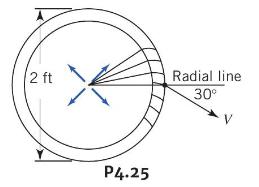
Fluid passes through this set of thin closely spaced blades. What flow rate \(q\) is required for the velocity \(V\) to be \(10 \mathrm{ft} / \mathrm{s}\) ? 2 ft Radial line 30 P4.25
A manifold pipe of 3 in. diameter has four openings in its walls spaced equally along the pipe and is closed at the downstream end. If the discharge from each opening is \(0.50 \mathrm{cfs}\), what are the mean velocities in the pipe between the openings?
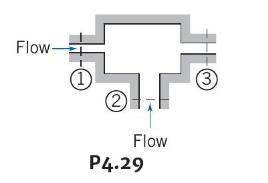
In the incompressible flow through the device shown, velocities may be considered uniform over the inlet and outlet sections. The following conditions are known: \(A_{1}=0.1 \mathrm{~m}^{2}, A_{2}=0.2 \mathrm{~m}^{2}\), \(A_{3}=0.6 \mathrm{~m}^{2}, \quad V_{1}=10 e^{-t / 2} \mathrm{~m} /
You are trying to pump storm water out of your basement during a storm. The pump can extract \(27.5 \mathrm{gpm}\). The water level in the basement is now sinking by about \(4 \mathrm{in} . / \mathrm{hr}\). What is the flow rate (gpm) from the storm into the basement? The basement is \(20
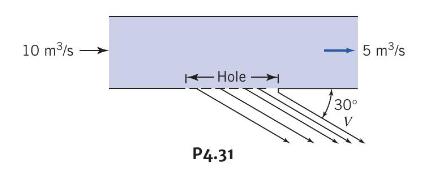
Find the average efflux velocity \(V\) if the flow exits from a hole of area \(1 \mathrm{~m}^{2}\) in the side of the duct as shown. 10 m/s Hole- 30 V P4.31 5 m/s
Water enters a wide, flat channel of height \(2 h\) with a uniform velocity of \(2.5 \mathrm{~m} / \mathrm{s}\). At the channel outlet the velocity distribution is given by\[\frac{u}{u_{\max }}=1-\left(\frac{y}{h}\right)^{2}\]where \(y\) is measured from the centerline of the channel. Determine the
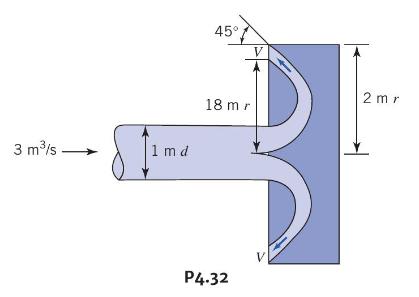
Find \(V\) for this mushroom cap on a pipeline. 3 m/s- 1 m d 45 V 18 m r P4.32 2 m r
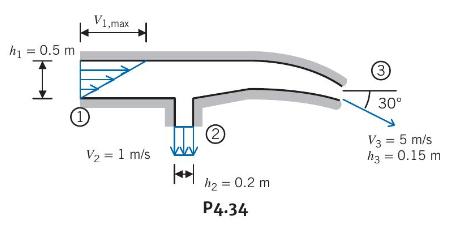
A two-dimensional reducing bend has a linear velocity profile at section (1). The flow is uniform at sections (2) and (3). The fluid is incompressible and the flow is steady. Find the maximum velocity, \(V_{1, \text { max }}\), at section (1). h = 0.5 m V1,max 1 V = 1 m/s 30 h3 V3 = 5 m/s 0.15 m h
Incompressible fluid flows steadily through a plane diverging channel. At the inlet, of height \(H\), the flow is uniform with magnitude \(V_{1}\). At the outlet, of height \(2 H\), the velocity profile is\[V_{2}=V_{\mathrm{m}} \cos \left(\frac{\pi y}{2 H}\right)\]where \(y\) is measured from the
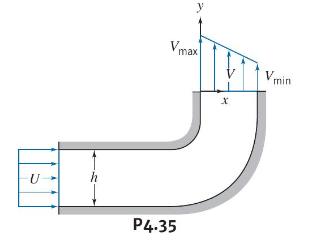
Water enters a two-dimensional, square channel of constant width, \(h=75.5 \mathrm{~mm}\), with uniform velocity, \(U\). The channel makes a \(90^{\circ}\) bend that distorts the flow to produce the linear velocity profile shown at the exit, with \(V_{\max }=2 V_{\min }\). Evaluate \(V_{\min }\),
Viscous liquid from a circular tank, \(D=300 \mathrm{~mm}\) in diameter, drains through a long circular tube of radius \(R=50 \mathrm{~mm}\). The velocity profile at the tube discharge is\[u=u_{\max }\left[1-\left(\frac{r}{R}\right)^{2}\right]\]Show that the average speed of flow in the drain tube
A rectangular tank used to supply water for a Reynolds flow experiment is \(230 \mathrm{~mm}\) deep. Its width and length are \(W=150 \mathrm{~mm}\) and \(L=230 \mathrm{~mm}\). Water flows from the outlet tube (inside diameter \(D=6.35 \mathrm{~mm}\) ) at Reynolds number \(R e=2000\), when the tank
A cylindrical tank, \(0.3 \mathrm{~m}\) in diameter, drains through a hole in its bottom. At the instant when the water depth is \(0.6 \mathrm{~m}\), the flow rate from the tank is observed to be \(4 \mathrm{~kg} / \mathrm{s}\). Determine the rate of change of water level at this instant.
Air enters a tank through an area of \(0.018 \mathrm{~m}^{2}\) with a velocity of \(4.6 \mathrm{~m} / \mathrm{s}\) and a density of \(15.5 \mathrm{~kg} / \mathrm{m}^{3}\). Air leaves with a velocity of \(1.5 \mathrm{~m} / \mathrm{s}\) and a density equal to that in the tank. The initial density of
A cylindrical tank, of diameter \(D=50 \mathrm{~mm}\), drains through an opening, \(d=5 \mathrm{~mm}\)., in the bottom of the tank. The speed of the liquid leaving the tank is approximately \(V=\sqrt{2 g y}\) where \(y\) is the height from the tank bottom to the free surface. If the tank is
A conical flask contains water to height \(H=36.8 \mathrm{~mm}\), where the flask diameter is \(D=29.4 \mathrm{~mm}\). Water drains out through a smoothly rounded hole of diameter \(d=7.35 \mathrm{~mm}\) at the apex of the cone. The flow speed at the exit is \(V=\sqrt{2 g y}\), where \(y\) is the
A smooth flat plate \(2.4 \mathrm{~m}\) long and \(0.6 \mathrm{~m}\) wide is placed in an airstream at \(101.3 \mathrm{kPa}, 15^{\circ} \mathrm{C}\), and velocity \(9 \mathrm{~m} / \mathrm{s}\). Calculate the total drag force on this plate ( 2 sides) if the boundary layer at the trailing edge is(a)
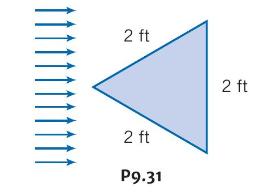
Assume laminar boundary-layer flow to estimate the drag on the flat plate shown when it is placed parallel to a \(15 \mathrm{ft} / \mathrm{s}\) air flow. The air is at \(70^{\circ} \mathrm{F}\) and \(1 \mathrm{~atm}\). 2 ft 2 ft P9.31 2 ft
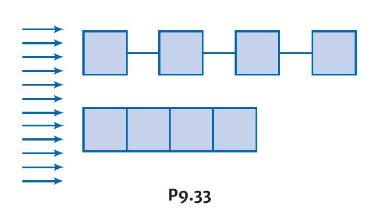
Assume laminar boundary-layer flow to estimate the drag on four square plates (each 3 in. \(\times 3\) in.) placed parallel to a \(3 \mathrm{ft} / \mathrm{s}\) water flow, for the two configurations shown. Before calculating, which configuration do you expect to experience the lower drag? Assume
Water at \(10^{\circ} \mathrm{C}\) flows over a flat plate at a speed of \(0.8 \mathrm{~m} / \mathrm{s}\). The plate is \(0.35 \mathrm{~m}\) long and \(1 \mathrm{~m}\) wide. The boundary layer on each surface of the plate is laminar. Assume that the velocity profile may be approximated as linear.
A smooth flat plate \(1.6 \mathrm{ft}\) long is immersed in \(68^{\circ} \mathrm{F}\) water flowing at \(1.2 \mathrm{ft} / \mathrm{s}\). In the center of the plate is a small 1-in.-square sensor. What is the friction force on this sensor?
A developing boundary layer of standard air on a flat plate. The freestream flow outside the boundary layer is undisturbed with \(U=50 \mathrm{~m} / \mathrm{s}\). The plate is \(3 \mathrm{~m}\) wide perpendicular to the diagram. Assume flow in the boundary layer is turbulent, with a
A flat-bottomed barge having a \(150 \mathrm{ft} \times 20 \mathrm{ft}\) bottom is towed through still water \(\left(60^{\circ} \mathrm{F}\right)\) at \(10 \mathrm{mph}\). What is the frictional drag force exerted by the water on the bottom of the barge? How long could the laminar portion of the
Grumman Corp. has proposed to build a magnetic levitation train to operate at a top speed of \(300 \mathrm{mph}\). The vehicle is \(114 \mathrm{ft}\) long. Assuming that the sides and top can be treated approximately as a smooth flat plate of \(30 \mathrm{ft}\) width with a turbulent boundary
The velocity profile in a turbulent boundary-layer flow at zero pressure gradient is approximated by the \(\frac{1}{6}\)-power profile expression,\[\frac{u}{U}=\eta^{1 / 6}, \quad \text { where } \quad \eta=\frac{y}{\delta}\]Use the momentum integral equation with this profile to obtain expressions
Air at standard conditions flows over a flat plate. The freestream speed is \(30 \mathrm{ft} / \mathrm{s}\). Find \(\delta\) and \(\tau_{w}\) at \(x=3 \mathrm{ft}\) from the leading edge assuming (a) completely laminar flow (assume a parabolic velocity profile) and (b) completely turbulent flow
A laboratory wind tunnel has a flexible upper wall that can be adjusted to compensate for boundary-layer growth, giving zero pressure gradient along the test section. The wall boundary layers are well represented by the \(\frac{1}{7}\)-power-velocity profile. At the inlet the tunnel cross section
Perform a cost-effectiveness analysis on a typical large tanker used for transporting petroleum. Determine, as a percentage of the petroleum cargo, the amount of petroleum that is consumed in traveling a distance of 2000 miles. Use data from Example 9.4, and the following: Assume the petroleum
Resistance of a barge is to be determined from model test data. The model is constructed to a scale ratio of 1:13.5 and has length, beam, and draft of \(7.00 \mathrm{~m}, 1.4 \mathrm{~m}\), and \(0.2 \mathrm{~m}\), respectively. The test is to simulate performance of the prototype at 10 knots. What
You are asked by your college crew to estimate the skin friction drag on their eight-seat racing shell. The hull of the shell may be approximated as half a circular cylinder with \(457 \mathrm{~mm}\) diameter and \(7.32 \mathrm{~m}\) length. The speed of the shell through the water is \(6.71
A steel sphere of \(0.25 \mathrm{in}\). diameter has a velocity of \(200 \mathrm{ft} / \mathrm{s}\) at an altitude of 30,000 ft in the U.S. Standard Atmosphere. Calculate the drag force on this sphere.
A sheet of plastic material \(0.5 \mathrm{in}\). thick, with specific gravity \(\mathrm{SG}=1.7\), is dropped into a large tank containing water. The sheet is \(2 \mathrm{ft} \times 4 \mathrm{ft}\). Estimate the terminal speed of the sheet as it falls with(a) the short side vertical(b) the long
As part of the 1976 bicentennial celebration, an enterprising group hung a giant American flag \(194 \mathrm{ft}\) high and \(367 \mathrm{ft}\) wide from the suspension cables of the Verrazano Narrows Bridge. They apparently were reluctant to make holes in the flag to alleviate the wind force, and
Assuming a critical Reynolds number of 0.1 , calculate the approximate diameter of the largest air bubble that will obey Stokes' law while rising through a large tank of oil of viscosity \(0.19 \mathrm{~Pa} \cdot \mathrm{s}\) and SG 0.90 .
Showing 1000 - 1100
of 1127
1
2
3
4
5
6
7
8
9
10
11
12
Step by Step Answers

 Get 50% OFF
Claim Now
Get 50% OFF
Claim Now