New Semester
Started
Get
50% OFF
Study Help!
--h --m --s
Claim Now
Question Answers
Textbooks
Find textbooks, questions and answers
Oops, something went wrong!
Change your search query and then try again
S
Books
FREE
Study Help
Expert Questions
Accounting
General Management
Mathematics
Finance
Organizational Behaviour
Law
Physics
Operating System
Management Leadership
Sociology
Programming
Marketing
Database
Computer Network
Economics
Textbooks Solutions
Accounting
Managerial Accounting
Management Leadership
Cost Accounting
Statistics
Business Law
Corporate Finance
Finance
Economics
Auditing
Tutors
Online Tutors
Find a Tutor
Hire a Tutor
Become a Tutor
AI Tutor
AI Study Planner
NEW
Sell Books
Search
Search
Sign In
Register
study help
engineering
introduction to fluid mechanics
Fox And McDonald's Introduction To Fluid Mechanics 9th Edition Philip J. Pritchard, John W. Mitchell - Solutions
A simple but effective anemometer to measure wind speed can be made from a thin plate hinged to deflect in the wind. Consider a thin plate made from brass that is \(20 \mathrm{~mm}\) high and \(10 \mathrm{~mm}\) wide. Derive a relationship for wind speed as a function of deflection angle,
It is proposed to build a pyramidal building with a square base with sides of \(160 \mathrm{ft}\), which has the same volume as the Willis Tower. Calculate the maximum drag force on this building. Do you expect the drag force to be greater, the same, or less than that for the Willis Tower? Why? and
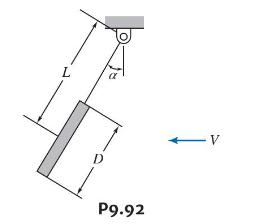
A circular disk is hung in an air stream from a pivoted strut as shown. In a wind-tunnel experiment, performed in air at \(15 \mathrm{~m} / \mathrm{s}\) with a \(25-\mathrm{mm}\) diameter disk, \(\alpha\) was measured at \(10^{\circ}\). For these conditions determine the mass of the disk. Assume
An F-4 aircraft is slowed after landing by dual parachutes deployed from the rear. Each parachute is \(12 \mathrm{ft}\) in diameter. The F-4 weighs 32,000 lbf and lands at 160 knots. Estimate the time and distance required to decelerate the aircraft to 100 knots, assuming that the brakes are not
A 180-hp sports car of frontal area \(1.72 \mathrm{~m}^{2}\), with a drag coefficient of 0.31 , requires \(17 \mathrm{hp}\) to cruise at \(100 \mathrm{~km} / \mathrm{h}\). At what speed does aerodynamic drag first exceed rolling resistance? The rolling resistance is 1.2 percent of the car weight,
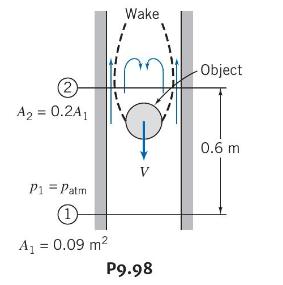
An object falls in air down a long vertical chute. The speed of the object is constant at \(3 \mathrm{~m} / \mathrm{s}\). The flow pattern around the object is shown. The static pressure is uniform across sections (1) and (2); pressure is atmospheric at section (1). The effective flow area at
An object of mass \(m\), with cross-sectional area equal to half the size of the chute, falls down a mail chute. The motion is steady. The wake area is \(\frac{3}{4}\) the size of the chute at its maximum area. Use the assumption of constant pressure in the wake. Apply the continuity, Bernoulli,
A light plane tows an advertising banner over a football stadium on a Saturday afternoon. The banner is \(4 \mathrm{ft}\) tall and \(45 \mathrm{ft}\) long. According to Hoerner [16], the drag coefficient based on area ( \(L h\) ) for such a banner is approximated by \(C_{D}=0.05 L / h\), where
Consider small oil droplets \((\mathrm{SG}=0.85)\) rising in water. Develop a relation for calculating terminal speed of a droplet (in \(\mathrm{m} / \mathrm{s}\) ) as a function of droplet diameter (in \(\mathrm{mm}\) ) assuming Stokes flow. For what range of droplet diameter is Stokes flow a
Compute the terminal speed of a 3-mm-diameter spherical raindrop in standard air.
A tennis ball with a mass of \(57 \mathrm{~g}\) and diameter of \(64 \mathrm{~mm}\) is dropped in standard sea level air. Calculate the terminal velocity of the ball. Assuming as an approximation that the drag coefficient remains constant at its terminal-velocity value, estimate the time and
A cast-iron "12-pounder" cannonball rolls off the deck of a ship and falls into the ocean at a location where the depth is \(1000 \mathrm{~m}\). Estimate the time that elapses before the cannonball hits the sea bottom.
A rectangular airfoil of \(40 \mathrm{ft}\) span and \(6 \mathrm{ft}\) chord has lift and drag coefficients of 0.5 and 0.04 , respectively, at an angle of attack of \(6^{\circ}\). Calculate the drag and horsepower necessary to drive this airfoil at 50,100, and \(150 \mathrm{mph}\) horizontally
An air bubble, \(0.3 \mathrm{in}\). in diameter, is released from the regulator of a scuba diver swimming \(100 \mathrm{ft}\) below the sea surface where the water temperature is \(86^{\circ} \mathrm{F}\). The air bubble expands as it rises in water. Find the time it takes for the bubble to reach
Why is it possible to kick a football farther in a spiral motion than in an end-over-end tumbling motion?
If \(C_{L}=1.0\) and \(C_{D}=0.05\) for an airfoil, then find the span needed for a rectangular wing of \(10 \mathrm{~m}\) chord to lift \(3560 \mathrm{kN}\) at a take-off speed of \(282 \mathrm{~km} / \mathrm{h}\). What is the wing drag at take-off?
A barge weighing \(8820 \mathrm{kN}\) that is \(10 \mathrm{~m}\) wide, \(30 \mathrm{~m}\) long, and \(7 \mathrm{~m}\) tall has come free from its tug boat in the Mississippi River. It is in a section of river which has a current of \(1 \mathrm{~m} / \mathrm{s}\), and there is a wind blowing
While walking across campus one windy day, an engineering student speculates about using an umbrella as a "sail" to propel a bicycle along the sidewalk. Develop an algebraic expression for the speed a bike could reach on level ground with the umbrella "propulsion system." The frontal area of bike
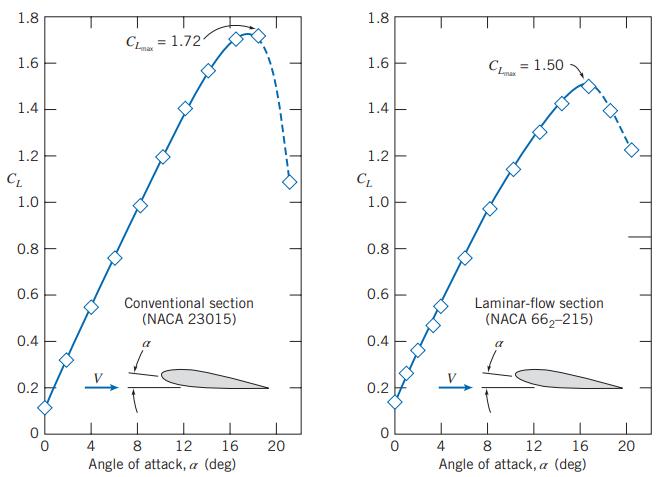
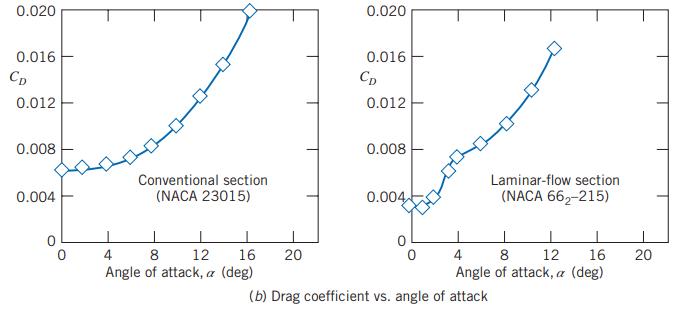
The NACA 23015 airfoil is to move at \(180 \mathrm{mph}\) through standard sea level air. Determine the minimum drag, drag at optimum \(L / D\) and drag at point of maximum lift. Calculate the lift at these points and the power that must be expended to obtain these lifts.
Wiffle \(^{\mathrm{TM}}\) balls made from light plastic with numerous holes are used to practice baseball and golf. Explain the purpose of the holes and why they work. Explain how you could test your hypothesis experimentally.
The "shot tower," used to produce spherical lead shot, has been recognized as a mechanical engineering landmark. In a shot tower, molten lead is dropped from a high tower; as the lead solidifies, surface tension pulls each shot into a spherical shape. Discuss the possibility of increasing the "hang
A model airfoil of chord 6 in. and span 30 in. is placed in a wind tunnel with an air flow of \(100 \mathrm{ft} / \mathrm{s}\) at \(70^{\circ} \mathrm{F}\). It is mounted on a cylindrical support rod \(1 \mathrm{in}\). in diameter and \(10 \mathrm{in}\). tall. Instruments at the base of the rod
How do cab-mounted wind deflectors for tractor-trailer trucks work? Explain using diagrams of the flow pattern around the truck and pressure distribution on the surface of the truck.
The U.S. Air Force F-16 fighter aircraft has wing planform area \(A=300 \mathrm{ft}^{2}\); it can achieve a maximum lift coefficient of \(C_{L}=1.6\). When fully loaded, its weight is \(26,000 \mathrm{lbf}\). The airframe is capable of maneuvers that produce \(9 g\) vertical accelerations. However,
A light airplane has 35 -ft effective wingspan and 5.5 - \(\mathrm{ft}\) chord. It was originally designed to use a conventional (NACA 23015) airfoil section. With this airfoil, its cruising speed on a standard day near sea level is \(150 \mathrm{mph}\). A redesign is proposed in which the current
Jim Hall's Chaparral \(2 \mathrm{~F}\) sports-racing cars in the 1960s pioneered use of airfoils mounted above the rear suspension to enhance stability and improve braking performance. The airfoil was effectively \(6 \mathrm{ft}\) wide (span) and had a 1-ft chord. Its angle of attack was variable
Some cars come with a "spoiler," a wing section mounted on the rear of the vehicle that salespeople sometimes claim significantly increases traction of the tires at highway speeds. Investigate the validity of this claim. Are these devices really just cosmetic?
Roadside signs tend to oscillate in a twisting motion when a strong wind blows. Discuss the phenomena that must occur to cause this behavior.
A class demonstration showed that lift is present when a cylinder rotates in an air stream. A string wrapped around a paper cylinder and pulled causes the cylinder to spin and move forward simultaneously. Assume a cylinder of \(5 \mathrm{~cm}\) diameter and \(30 \mathrm{~cm}\) length is given a
A baseball pitcher throws a ball at \(80 \mathrm{mph}\). Home plate is \(60 \mathrm{ft}\) away from the pitcher's mound. What spin should be placed on the ball for maximum horizontal deviation from a straight path? A baseball has a mass of \(5 \mathrm{oz}\) and a circumference of \(9 \mathrm{in}\).
Consider incompressible flow in a circular channel. Derive general expressions for Reynolds number in terms of (a) volume flow rate and tube diameter and (b) mass flow rate and tube diameter. The Reynolds number is 1800 in a section where the tube diameter is \(10 \mathrm{~mm}\). Find the Reynolds
What is the maximum flow rate of air that may occur at laminar condition in a 4-in.-diameter pipe at an absolute pressure of \(30 \mathrm{psia}\) and \(100^{\circ} \mathrm{F}\) ? If the pressure is raised to \(60 \mathrm{psia}\), what is the maximum flow rate? If the temperature is raised to
For flow in circular tubes, transition to turbulence usually occurs around \(R e \approx 2300\). Investigate the circumstances under which the flows of (a) standard air and (b) water at \(15^{\circ} \mathrm{C}\) become turbulent. On \(\log -\log\) graphs, plot: the average velocity, the volume flow
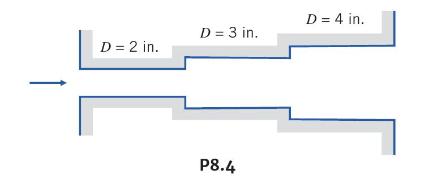
Air flows at \(100^{\circ} \mathrm{F}\) in a pipe system in which the diameter increases in two stages from 2 in. to 3 in. to 4 in. Each section is \(6 \mathrm{ft}\) long. The initial flow rate is high enough so that the flow is turbulent in all sections. As the flow rate is decreased, which
An incompressible fluid flows between two infinite stationary parallel plates. The velocity profile is given by \(u=u_{\max }\left(A y^{2}+\right.\) \(B y+C)\), where \(A, B\), and \(C\) are constants and \(y\) is measured upward from the lower plate. The total gap width is \(h\) units. Use
Oil is confined in a 4-in.-diameter cylinder by a piston having a radial clearance of \(0.001 \mathrm{in}\). and a length of \(2 \mathrm{in}\). A steady force of \(4500 \mathrm{lbf}\) is applied to the piston. Assume the properties of SAE 30 oil at \(120^{\circ} \mathrm{F}\). Estimate the rate at
Viscous oil flows steadily between parallel plates. The flow is fully developed and laminar. The pressure gradient is \(1.25 \mathrm{kPa} / \mathrm{m}\) and the channel half-width is \(h=1.5 \mathrm{~mm}\). Calculate the magnitude and direction of the wall shear stress at the upper plate surface.
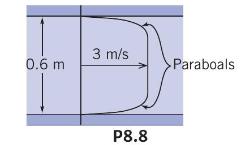
Calculate \(\alpha\) for the flow in this two-dimensional passage if \(q\) is \(1.5 \mathrm{~m}^{3} / \mathrm{s} \cdot \mathrm{m}\). 3 m/s 0.6 m >Paraboals P8.8
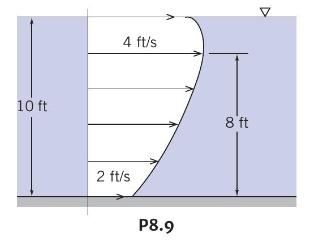
The velocity profile in a two-dimensional open channel may be approximated by the parabola shown. Calculate the flow rate and the kinetic energy coefficient \(\alpha\). 10 ft 4 ft/s 2 ft/s P8.9 A 8 ft
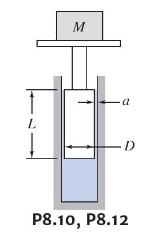
A large mass is supported by a piston of diameter \(D=4 \mathrm{in}\). and length \(L=4\) in. The piston sits in a cylinder closed at the bottom, and the gap \(a=0.001 \mathrm{in}\). between the cylinder wall and piston is filled with SAE 10 oil at \(68^{\circ} \mathrm{F}\). The piston slowly sinks
A hydraulic jack supports a load of \(9000 \mathrm{~kg}\). The following data are given:Estimate the rate of leakage of hydraulic fluid past the piston, assuming the fluid is SAE 30 oil at \(30^{\circ} \mathrm{C}\). Diameter of piston 100 mm Radial clearance between piston and cylinder Length of
The basic component of a pressure gage tester consists of a piston-cylinder apparatus as shown. The piston, \(6 \mathrm{~mm}\) in diameter, is loaded to develop a pressure of known magnitude. The piston length is \(25 \mathrm{~mm}\). Calculate the mass, \(M\), required to produce 1.5 MPa gage in
When a horizontal laminar flow occurs between two parallel plates of infinite extent \(0.3 \mathrm{~m}\) apart, the velocity at the midpoint between the plates is \(2.7 \mathrm{~m} / \mathrm{s}\). Calculate (a) the flow rate through a cross section \(0.9 \mathrm{~m}\) wide, (b) the velocity
In a laminar flow of water of \(0.007 \mathrm{~m}^{3} / \mathrm{s}\) between parallel plates spaced \(75 \mathrm{~mm}\) apart, the measured shearing stress at the pipe wall is \(47.9 \mathrm{~Pa}\). What is the viscosity of the fluid? Is the flow laminar?
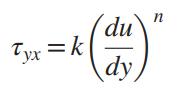
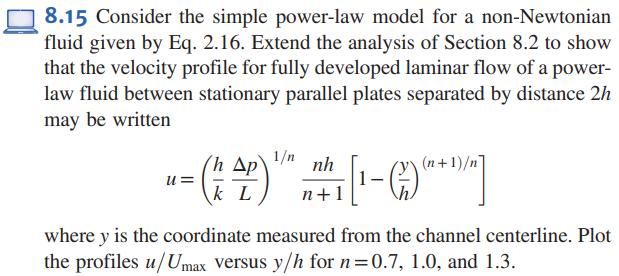
Consider the simple power-law model for a non-Newtonian fluid given by Eq. 2.16. Extend the analysis of Section 8.2 to show that the velocity profile for fully developed laminar flow of a powerlaw fluid between stationary parallel plates separated by distance \(2 h\) may be
A sealed journal bearing is formed from concentric cylinders. The inner and outer radii are 25 and \(26 \mathrm{~mm}\), the journal length is \(100 \mathrm{~mm}\), and it turns at \(2800 \mathrm{rpm}\). The gap is filled with oil in laminar motion. The velocity profile is linear across the gap. The
Using the profile of Problem 8.15, show that the flow rate for fully developed laminar flow of a power-law fluid between stationary parallel plates may be written as\[Q=\left(\frac{h}{k} \frac{\Delta p}{L}\right)^{1 / n} \frac{2 n w h^{2}}{2 n+1}\]Here \(w\) is the plate width. In such an
In a laminar flow between parallel plates spaced 12 in. apart, the shear stress at the wall is \(1.0 \mathrm{psf}\) and the fluid viscosity \(0.002 \mathrm{lb} \mathrm{s} / \mathrm{ft}^{2}\). What is the centerline velocity and the velocity gradient 1 in. from the centerline?
A fluid of specific gravity 0.90 flows at a Reynolds number of 1500 between parallel plates spaced \(0.3 \mathrm{~m}\) apart. The velocity \(50 \mathrm{~mm}\) from the wall is \(3 \mathrm{~m} / \mathrm{s}\). Calculate the flow rate and the velocity gradient at the wall.
Two immiscible fluids are contained between infinite parallel plates. The plates are separated by distance \(2 h\), and the two fluid layers are of equal thickness \(h\); the dynamic viscosity of the upper fluid is three times that of the lower fluid. If the lower plate is stationary and the upper
The record-read head for a computer disk-drive memory storage system rides above the spinning disk on a very thin film of air (the film thickness is \(0.25 \mu \mathrm{m}\) ). The head location is \(25 \mathrm{~mm}\) from the disk centerline; the disk spins at \(8500 \mathrm{rpm}\). The record-read
Consider steady, incompressible, and fully developed laminar flow of a viscous liquid down an incline with no pressure gradient. The velocity profile was derived in Example 5.9. Plot the velocity profile. Calculate the kinematic viscosity of the liquid if the film thickness on a \(30^{\circ}\)
In a flow of air between parallel plates spaced \(0.03 \mathrm{~m}\) apart, the centerline velocity is \(1.2 \mathrm{~m} / \mathrm{s}\) and that \(5 \mathrm{~mm}\) from the pipe wall is \(0.8 \mathrm{~m} / \mathrm{s}\). Assuming laminar flow, determine the wall shear stress using each of the
Two immiscible fluids of equal density are flowing down a surface inclined at a \(60^{\circ}\) angle. The two fluid layers are of equal thickness \(h=10 \mathrm{~mm}\); the kinematic viscosity of the upper fluid is \(1 / 5\) th that of the lower fluid, which is \(u_{\text {lower }}=0.01
Consider fully developed flow between parallel plates with the upper plate moving at \(U=5 \mathrm{ft} / \mathrm{s}\). The spacing between the plates is \(a=0.1 \mathrm{in}\). Determine the flow rate per unit depth for the case of zero pressure gradient. If the fluid is air, evaluate the shear
The velocity profile for fully developed flow of castor oil at \(20^{\circ} \mathrm{C}\) between parallel plates with the upper plate moving is given by Eq. 8.8. Assume \(U=1.5 \mathrm{~m} / \mathrm{s}\) and \(a=5 \mathrm{~mm}\). Find the pressure gradient for which there is no net flow in the
Free-surface waves begin to form on a laminar liquid film flowing down an inclined surface whenever the Reynolds number, based on mass flow per unit width of film, is larger than about 33. Estimate the maximum thickness of a laminar film of water that remains free from waves while flowing down a
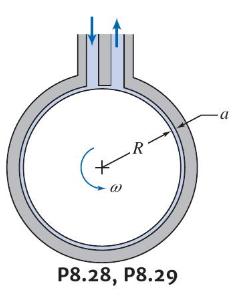
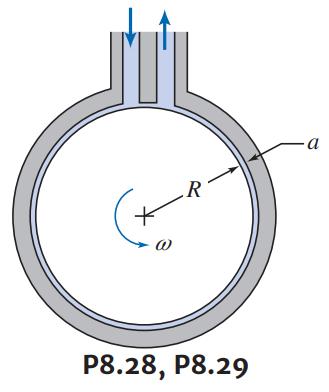
A viscous-shear pump is made from a stationary housing with a close-fitting rotating drum inside. The clearance is small compared with the diameter of the drum, so flow in the annular space may be treated as flow between parallel plates. Fluid is dragged around the annulus by viscous forces.
The efficiency of the viscous-shear pump of Fig. P8.29 is given by\[\eta=6 q \frac{(1-2 q)}{(4-6 q)}\]where \(q=Q / a b R \omega\) is a dimensionless flow rate, \(Q\) is the flow rate at pressure differential \(\Delta p\), and \(b\) is the depth normal to the diagram. Plot the efficiency versus
An inventor proposes to make a "viscous timer" by placing a weighted cylinder inside a slightly larger cylinder containing viscous liquid, creating a narrow annular gap close to the wall. Analyze the flow field created when the apparatus is inverted and the mass begins to fall under gravity. Would
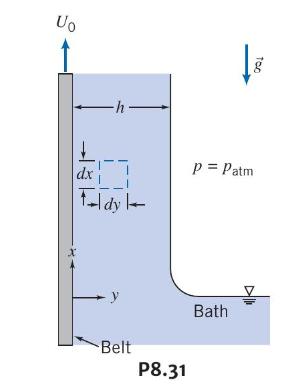
A continuous belt, passing upward through a chemical bath at speed \(U_{0}\), picks up a liquid film of thickness \(h\), density \(ho\), and viscosity \(\mu\). Gravity tends to make the liquid drain down, but the movement of the belt keeps the liquid from running off completely. Assume that the
A wet paint film of uniform thickness, \(\delta\), is painted on a vertical wall. The wet paint can be approximated as a Bingham fluid with a yield stress, \(\tau_{y}\), and density, \(ho\). Derive an expression for the maximum value of \(\delta\) that can be sustained without having the paint flow
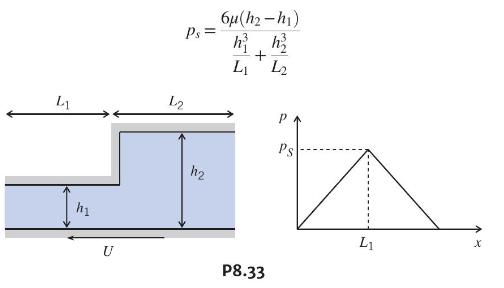
When dealing with the lubrication of bearings, the governing equation describing pressure is the Reynolds equation, generally written in one dimension as\[\frac{d}{d x}\left(\frac{h^{3}}{\mu} \frac{d p}{d x}\right)+6 U \frac{d h}{d x}=0\]where \(h\) is the step height and \(U\) is the velocity of
Consider first water and then SAE 10W lubricating oil flowing at \(40^{\circ} \mathrm{C}\) in a 6-mm-diameter tube. Determine the maximum flow rate and the corresponding pressure gradient, \(\partial p / \partial x\) for each fluid at which laminar flow would be expected.
Using for the viscosity of water, find the viscosity at \(-20^{\circ} \mathrm{C}\) and \(120^{\circ} \mathrm{C}\). Plot the viscosity over this range. Find the maximum laminar flow rate \((\mathrm{L} / \mathrm{hr})\) in a 7.5- \(\mathrm{mm}\)-diameter tube at these temperatures. Plot the maximum
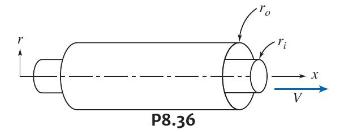
Consider fully developed laminar flow in the annulus between two concentric pipes. The outer pipe is stationary, and the inner pipe moves in the \(x\) direction with speed \(V\). Assume the axial pressure gradient is zero \((\partial p / \partial x=0)\). Obtain a general expression for the shear
Carbon dioxide flows in a 50-mm-diameter pipe at a velocity of \(1.5 \mathrm{~m} / \mathrm{s}\), temperature \(66^{\circ} \mathrm{C}\), and absolute pressure \(50 \mathrm{kPa}\). Is the flow laminar or turbulent? If the temperature is lowered to \(30^{\circ} \mathrm{C}\), what is the flow regime?
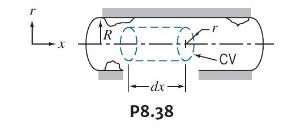
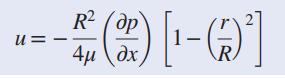
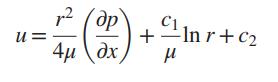
Consider fully developed laminar flow in a circular pipe. Use a cylindrical control volume as shown. Indicate the forces acting on the control volume. Using the momentum equation, develop an expression for the velocity distribution. r Lx -dx- P8.38 -CV
What is the largest diameter of pipeline that may be used to carry \(100 \mathrm{gpm}\) of jet fuel (JP-4) at \(59^{\circ} \mathrm{F}\) if the flow is to be laminar?
Consider fully developed laminar flow in the annular space formed by the two concentric cylinders shown in the diagram for Problem 8.36, but with pressure gradient, \(\partial p / \partial x\), and the inner cylinder stationary. Let \(r_{0}=R\) and \(r_{i}=k R\). Show that the velocity profile is
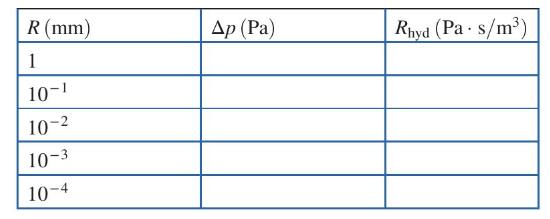
Consider fully developed pressure-driven flow in a cylindrical tube of radius, \(R\), and length, \(L=10 \mathrm{~mm}\), with flow generated by an applied pressure gradient, \(\Delta p\). Tests are performed with room temperature water for various values of \(R\), with a fixed flow rate of \(Q=10
In the laminar flow of an oil of viscosity \(1 \mathrm{~Pa} \cdot \mathrm{s}\), the velocity at the center of a \(0.3 \mathrm{~m}\) pipe is \(4.5 \mathrm{~m} / \mathrm{s}\) and the velocity distribution is parabolic. Calculate the shear stress at the pipe wall and within the fluid \(75
In a laminar flow of \(0.007 \mathrm{~m}^{3} / \mathrm{s}\) in a 75 -mm-diameter pipeline the shearing stress at the pipe wall is known to be \(47.9 \mathrm{~Pa}\). Calculate the viscosity of the fluid.
Consider blood flow in an artery. Blood is non-Newtonian; the shear stress versus shear rate is described by the Casson relationship:\[\begin{cases}\sqrt{\tau}=\sqrt{\tau_{c}}+\sqrt{\mu \frac{d u}{d r}}, & \text { for } \tau \geq \tau_{c} \\ \tau=0 & \text { for } \tau
The classic Poiseuille flow (Eq. 8.12), is for no-slip conditions at the walls. If the fluid is a gas, and when the mean free path, \(l\) (the average distance a molecule travels before collision with another molecule), is comparable to the length-scale \(L\) of the flow, slip will occur at the
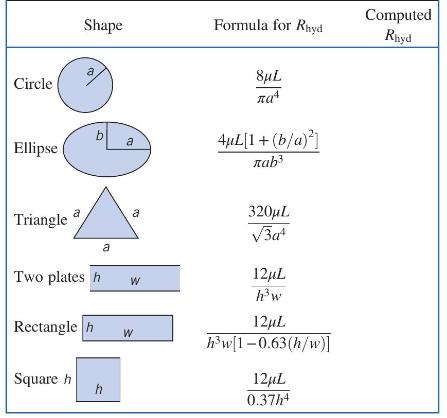
For pressure-driven, steady, fully developed laminar flow of an incompressible fluid through a straight channel of length \(L\), we can define the hydraulic resistance as \(R_{\text {hyd }}=\Delta p / Q\), where \(\Delta p\) is the pressure drop and \(Q\) is the flow rate (analogous to the
In a laminar flow in a 12-in.-diameter pipe the shear stress at the wall is \(1.0 \mathrm{psf}\) and the fluid viscosity \(0.002 \mathrm{lb} \cdot \mathrm{s} / \mathrm{ft}^{2}\). Calculate the velocity gradient \(1 \mathrm{in}\). from the centerline.
A fluid of specific gravity 0.90 flows at a Reynolds number of 1500 in a 0.3-m-diameter pipeline. The velocity \(50 \mathrm{~mm}\) from the wall is \(3 \mathrm{~m} / \mathrm{s}\). Calculate the flow rate and the velocity gradient at the wall.
In a food industry plant, two immiscible fluids are pumped through a tube such that fluid \(1\left(\mu_{1}=0.5 \mathrm{~N} \cdot \mathrm{s} / \mathrm{m}^{2}\right)\) forms an inner core \(\mathrm{r}=D / 4\) and fluid \(2\left(\mu_{2}=5 \mathrm{~N} \cdot \mathrm{s} / \mathrm{m}^{2}\right)\) forms an
A horizontal pipe carries fluid in fully developed turbulent flow. The static pressure difference measured between two sections is \(750 \mathrm{psi}\). The distance between the sections is \(15 \mathrm{ft}\), and the pipe diameter is 3 in. Calculate the shear stress, \(\tau_{w}\), that acts on the
Kerosene is pumped through a smooth tube with inside diameter \(D=30 \mathrm{~mm}\) at close to the critical Reynolds number. The flow is unstable and fluctuates between laminar and turbulent states, causing the pressure gradient to intermittently change from approximately \(-4.5 \mathrm{kPa} /
In a flow of water in a 0.3-m-diameter pipe, the centerline velocity is \(6 \mathrm{~m} / \mathrm{s}\) and that \(50 \mathrm{~mm}\) from the pipe wall is \(5.2 \mathrm{~m} / \mathrm{s}\). Assuming laminar flow, determine the wall shear stress using each of the measurements. Explain whether the flow
A liquid drug, with the viscosity and density of water, is to be administered through a hypodermic needle. The inside diameter of the needle is \(0.25 \mathrm{~mm}\) and its length is \(50 \mathrm{~mm}\). Determine (a) the maximum volume flow rate for which the flow will be laminar, (b) the
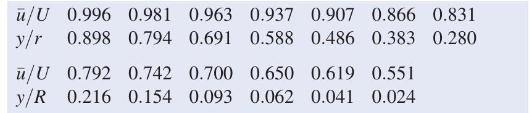
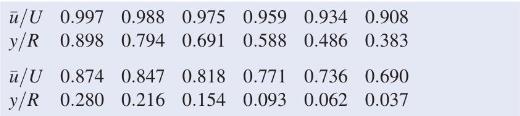
Laufer [5] measured the following data for mean velocity in fully developed turbulent pipe flow at \(R e_{U}=50,000\) :In addition, Laufer measured the following data for mean velocity in fully developed turbulent pipe flow at \(R e_{U}=500,000\) :Fit each set of data to the "power-law" profile for
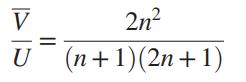
Equation 8.23 gives the power-law velocity profile exponent, \(n\), as a function of centerline Reynolds number, \(R e_{U}\), for fully developed turbulent flow in smooth pipes. Equation 8.24 relates mean velocity, \(\bar{V}\), to centerline velocity, \(U\), for various values of \(n\). Prepare a
Consider fully developed laminar flow of water between stationary parallel plates. The maximum flow speed, plate spacing, and width are \(20 \mathrm{ft} / \mathrm{s}, 0.075\mathrm{in}\). and \(1.25 \mathrm{in}\)., respectively. Find the kinetic energy coefficient, \(\alpha\).
Consider fully developed laminar flow in a circular tube. Evaluate the kinetic energy coefficient for this flow.
Show that the kinetic energy coefficient, \(\alpha\), for the "power law" turbulent velocity profile of Eq. 8.22 is given by Eq. 8.27. Plot \(\alpha\) as a function of \(R e_{\bar{V}}\), for \(R e_{\bar{V}}=1 \times 10^{4}\) to \(1 \times 10^{7}\). When analyzing pipe flow problems it is common
If the turbulent velocity profile in a pipe \(0.6 \mathrm{~m}\) in diameter may be approximated by \(v=3.56 y^{1 / 7}\), where \(v\) is in \(\mathrm{m} / \mathrm{s}\) and \(y\) is in \(\mathrm{m}\), and the shearing stress in the fluid \(0.15 \mathrm{~m}\) from the pipe wall is \(23.0
Water flows in a horizontal constant-area pipe; the pipe diameter is \(75 \mathrm{~mm}\) and the average flow speed is \(5 \mathrm{~m} / \mathrm{s}\). At the pipe inlet, the gage pressure is \(275 \mathrm{kPa}\), and the outlet is at atmospheric pressure. Determine the head loss in the pipe. If the
For a given volume flow rate and piping system, will the pressure loss be greater for hot water or cold water? Explain.
Consider the pipe flow from the water tower of Example 8.7. To increase delivery, the pipe length is reduced from \(600 \mathrm{ft}\) to \(450 \mathrm{ft}\) (the flow is still fully turbulent and \(f=0.035\) ). What is the flow rate?
At the inlet to a constant-diameter section of the Alaskan pipeline, the pressure is \(8.5 \mathrm{MPa}\) and the elevation is \(45 \mathrm{~m}\); at the outlet the elevation is \(115 \mathrm{~m}\). The head loss in this section of pipeline is \(6.9 \mathrm{~kJ} / \mathrm{kg}\). Calculate the
When oil (kinematic viscosity \(1 \times 10^{-4} \mathrm{~m}^{2} / \mathrm{s}\), specific gravity 0.92) flows at a mean velocity of \(1.5 \mathrm{~m} / \mathrm{s}\) through a 50 -mm-diameter pipeline, the head lost in \(30 \mathrm{~m}\) of pipe is \(5.4 \mathrm{~m}\). What will be the head loss
When fluid of specific weight \(50 \mathrm{lb} / \mathrm{ft}^{3}\) flows in a 6-in.diameter pipeline, the frictional stress between fluid and pipe is \(0.5 \mathrm{psf}\). Calculate the head lost per foot of pipe. If the flow rate is \(2.0 \mathrm{cfs}\), how much power is lost per foot of pipe?
If the head lost in 30 -m-diameter of \(75-\mathrm{mm}\)-diameter pipe is \(7.6 \mathrm{~m}\) for a given flow rate of water, what is the total drag force exerted by the water on this length of pipe?
Water flows at \(10 \mathrm{~L} / \mathrm{min}\) through a horizontal \(15-\mathrm{mm}\) diameter tube. The pressure drop along a \(20-\mathrm{m}\) length of tube is \(85 \mathrm{kPa}\). Calculate the head loss.
Laufer [5] measured the following data for mean velocity near the wall in fully developed turbulent pipe flow at \(R e_{U}=50,000(U=9.8 \mathrm{ft} / \mathrm{s}\) and \(R=4.86\) in. \()\) in air:Plot the data and obtain the best-fit slope, \(d \bar{u} / d y\). Use this to estimate the wall shear
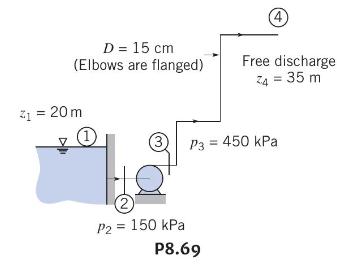
Water is pumped at the rate of \(0.075 \mathrm{~m}^{3} / \mathrm{s}\) from a reservoir \(20 \mathrm{~m}\) above a pump to a free discharge \(35 \mathrm{~m}\) above the pump. The pressure on the intake side of the pump is \(150 \mathrm{kPa}\) and the pressure on the discharge side is \(450
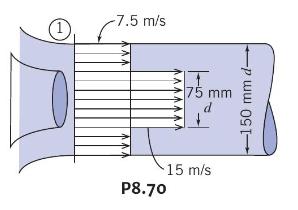
Just downstream from the nozzle tip the velocity distribution is as shown. Calculate the flow rate past section 1, the kinetic energy coefficient \(\alpha\), and the momentum flux. Assume water is flowing. -7.5 m/s 75 mm d P8.70 15 m/s. 150 mm d-
Showing 300 - 400
of 1127
1
2
3
4
5
6
7
8
9
10
11
12
Step by Step Answers

 Get 50% OFF
Claim Now
Get 50% OFF
Claim Now