New Semester
Started
Get
50% OFF
Study Help!
--h --m --s
Claim Now
Question Answers
Textbooks
Find textbooks, questions and answers
Oops, something went wrong!
Change your search query and then try again
S
Books
FREE
Study Help
Expert Questions
Accounting
General Management
Mathematics
Finance
Organizational Behaviour
Law
Physics
Operating System
Management Leadership
Sociology
Programming
Marketing
Database
Computer Network
Economics
Textbooks Solutions
Accounting
Managerial Accounting
Management Leadership
Cost Accounting
Statistics
Business Law
Corporate Finance
Finance
Economics
Auditing
Tutors
Online Tutors
Find a Tutor
Hire a Tutor
Become a Tutor
AI Tutor
AI Study Planner
NEW
Sell Books
Search
Search
Sign In
Register
study help
engineering
introduction to fluid mechanics
Fox And McDonald's Introduction To Fluid Mechanics 9th Edition Philip J. Pritchard, John W. Mitchell - Solutions
Water flows in a rectangular channel at a depth of \(750 \mathrm{~mm}\). If the flow speed is(a) \(1 \mathrm{~m} / \mathrm{s}\) (b) \(4 \mathrm{~m} / \mathrm{s}\), compute the corresponding Froude numbers.
A partially open sluice gate in a 5 -m-wide rectangular channel carries water at \(10 \mathrm{~m}^{3} / \mathrm{s}\). The upstream depth is \(2.5 \mathrm{~m}\). Find the downstream depth and Froude number.
Find the critical depth for flow at \(3 \mathrm{~m}^{3} / \mathrm{s}\) in a rectangular channel of width \(2.5 \mathrm{~m}\).
Flow occurs in a rectangular channel of \(6 \mathrm{~m}\) width and has a specific energy of \(3 \mathrm{~m}\). Plot accurately the relation between depth and specific energy. Determine from the curve(a) the critical depth,(b) the maximum flow rate,(c) the flow rate at a depth of \(2.4
What is the maximum flow rate that may occur in a rectangular channel \(2.4 \mathrm{~m}\) wide for a specific energy of \(1.5 \mathrm{~m}\) ?
A rectangular channel carries a discharge of \(10 \mathrm{ft}^{3} / \mathrm{s}\) per foot of width. Determine the minimum specific energy possible for this flow. Compute the corresponding flow depth and speed.
Flow in the channel of Problem 11.15 has a specific energy of \(4.5 \mathrm{ft}\). Compute the alternate depths for this specific energy.Data From Problem 11.15 11.15 A rectangular channel carries a discharge of 10 ft/s per foot of width. Determine the minimum specific energy possible for this
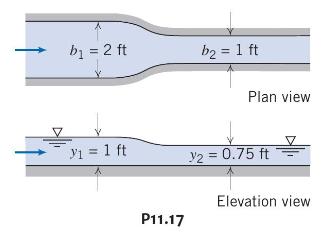
Consider the Venturi flume shown. The bed is horizontal, and flow may be considered frictionless. The upstream depth is \(1 \mathrm{ft}\), and the downstream depth is \(0.75 \mathrm{ft}\). The upstream breadth is \(2 \mathrm{ft}\), and the breadth of the throat is \(1 \mathrm{ft}\). Estimate the
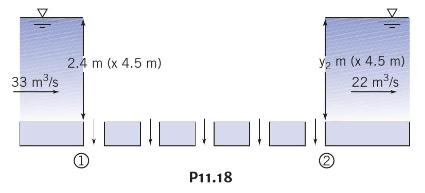
Eleven cubic meters per second of water are diverted through ports in the bottom of the channel between sections (1) and (2). Neglecting head losses and assuming a horizontal channel, what depth of water is to be expected at section (2)? What channel width at section (2) would be required to
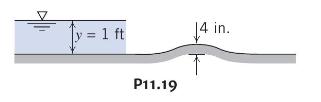
A rectangular channel \(10 \mathrm{ft}\) wide carries \(100 \mathrm{cfs}\) on a horizontal bed at \(1.0 \mathrm{ft}\) depth. A smooth bump across the channel rises \(4 \mathrm{in}\). above the channel bottom. Find the elevation of the liquid free surface above the bump. = 1 ft 14 in. P11.19
At what depths can \(800 \mathrm{cfs}\) flow in a trapezoidal channel of base width \(12 \mathrm{ft}\) and side slopes 1 (vert.) on 3 (horiz.) if the specific energy is \(7 \mathrm{ft}\) ?
At a section of a 10 -ft-wide rectangular channel, the depth is \(0.3 \mathrm{ft}\) for a discharge of \(20 \mathrm{ft}^{3} / \mathrm{s}\). A smooth bump \(0.1 \mathrm{ft}\) high is placed on the floor of the channel. Determine the local change in flow depth caused by the bump.
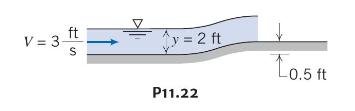
Water, at \(3 \mathrm{ft} / \mathrm{s}\) and \(2 \mathrm{ft}\) depth, approaches a smooth rise in a wide channel. Estimate the stream depth after the \(0.5 \mathrm{ft}\) rise. V = 3 ft S y=2 ft P11.22 L0.5 ft
A horizontal rectangular channel \(3 \mathrm{ft}\) wide contains a sluice gate. Upstream of the gate the depth is \(6 \mathrm{ft}\) and the depth downstream is \(0.9 \mathrm{ft}\). Estimate the volume flow rate in the channel.
A hydraulic jump occurs in a rectangular channel \(4.0 \mathrm{~m}\) wide. The water depth before the jump is \(0.4 \mathrm{~m}\) and after the jump is \(1.7 \mathrm{~m}\). Compute the flow rate in the channel, the critical depth, and the head loss in the jump.
A hydraulic jump occurs in a wide horizontal channel. The discharge is \(2 \mathrm{~m}^{3} / \mathrm{s}\) per meter of width. The upstream depth is \(500 \mathrm{~mm}\). Determine the depth of the jump.
A hydraulic jump occurs in a rectangular channel. The flow rate is \(200 \mathrm{ft}^{3} / \mathrm{s}\), and the depth before the jump is \(1.2 \mathrm{ft}\). Determine the depth behind the jump and the head loss. The channel is \(10 \mathrm{ft}\) wide.
The depths of water upstream and downstream from a hydraulic jump on the horizontal "apron" downstream from a spillway structure are observed to be approximately \(3 \mathrm{ft}\) and \(8 \mathrm{ft}\). If the structure is \(200 \mathrm{ft}\) long (perpendicular to the direction of flow), about how
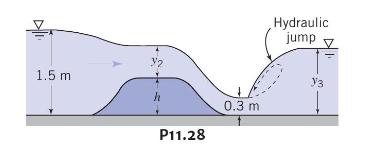
Calculate \(y_{2}, h\), and \(y_{3}\) for this two-dimensional flow picture. State any assumptions clearly. Hydraulic jump $2 1.5 m 0.3 m P11.28
The hydraulic jump may be used as a crude flow meter. Suppose that in a horizontal rectangular channel \(5 \mathrm{ft}\) wide the observed depths before and after a hydraulic jump are \(0.66 \mathrm{ft}\) and \(3.0 \mathrm{ft}\). Find the rate of flow and the head loss.
A hydraulic jump occurs on a horizontal apron downstream from a wide spillway at a location where depth is \(0.9 \mathrm{~m}\) and speed is \(25 \mathrm{~m} / \mathrm{s}\). Estimate the depth and speed downstream from the jump. Compare the specific energy downstream of the jump to that upstream.
A hydraulic jump occurs in a rectangular channel. The flow rate is \(50 \mathrm{~m}^{3} / \mathrm{s}\) and the depth before the jump is \(2 \mathrm{~m}\). Determine the depth after the jump and the head loss if the channel is \(1 \mathrm{~m}\) wide.
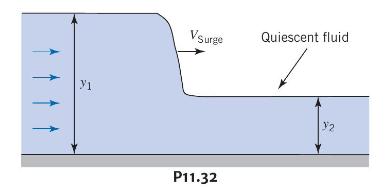
A positive surge wave, or moving hydraulic jump, can be produced in the laboratory by suddenly opening a sluice gate. Consider a surge of depth \(y_{2}\) advancing into a quiescent channel of depth \(y_{1}\). Obtain an expression for surge speed in terms of \(y_{1}\) and \(y_{2}\) y1 Vsurge
A 2-m-wide rectangular channel with a bed slope of 0.0005 has a depth of flow of \(1.5 \mathrm{~m}\). Manning's roughness coefficient is 0.015 . Determine the steady uniform discharge in the channel.
Determine the uniform flow depth in a rectangular channel \(2.5 \mathrm{~m}\) wide with a discharge of \(3 \mathrm{~m}^{3} / \mathrm{s}\). The slope is 0.0004 and Manning's roughness factor is 0.015 .
Determine the uniform flow depth in a trapezoidal channel with a bottom width of \(8 \mathrm{ft}\) and side slopes of 1 vertical to 2 horizontal. The discharge is \(100 \mathrm{ft}^{3} / \mathrm{s}\). Manning's roughness factor is 0.015 and the channel bottom slope is 0.0004 .
Water flows uniformly at a depth of \(1.2 \mathrm{~m}\) in a rectangular canal \(3 \mathrm{~m}\) wide laid on a slope of \(1 \mathrm{~m}\) per \(1000 \mathrm{~m}\). What is the mean shear stress on the sides and bottom of the canal?
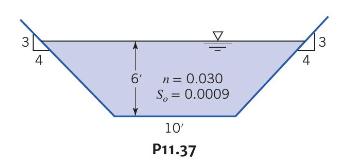
This large uniform open channel flow is to be modeled without geometric distortion in the hydraulic laboratory at a scale of 1:9. What flow rate, bottom slope, and Manning \(n\) will be required in the model? 3 4 6' = 0.030 S = 0.0009 10' P11.37 3
A rectangular flume built of timber is \(3 \mathrm{ft}\) wide. The flume is to handle a flow of \(90 \mathrm{ft}^{3} / \mathrm{s}\) at a normal depth of \(6 \mathrm{ft}\). Determine the slope required.
A channel with square cross section is to carry \(20 \mathrm{~m}^{3} / \mathrm{s}\) of water at normal depth on a slope of 0.003 . Compare the dimensions of the channel required for(a) concrete (b) masonry.
A triangular channel with side angles of \(45^{\circ}\) is to carry \(10 \mathrm{~m}^{3} / \mathrm{s}\) at a slope of 0.001 . The channel is concrete. Find the required dimensions.
A flume of timber has as its cross section an isosceles triangle (apex down) of \(2.4 \mathrm{~m}\) base and \(1.8 \mathrm{~m}\) altitude. At what depth will \(5 \mathrm{~m}^{3} / \mathrm{s}\) flow uniformly in this flume if it is laid on a slope of 0.01 ?
At what depth will \(4.25 \mathrm{~m}^{3} / \mathrm{s}\) flow uniformly in a rectangular channel \(3.6 \mathrm{~m}\) wide lined with rubble masonry and laid on a slope of \(1: 4000\) ?
A semicircular trough of corrugated steel, with diameter \(D=1 \mathrm{~m}\), carries water at depth \(y=0.25 \mathrm{~m}\). The slope is 0.01 . Find the discharge.
A rectangular flume built of concrete with \(1 \mathrm{ft}\) per \(1000 \mathrm{ft}\) slope is \(6 \mathrm{ft}\) wide. Water flows at a normal depth of \(3 \mathrm{ft}\). The flume is fitted with a new plastic film liner. Find the new depth of flow if the discharge remains constant.
Water flows in a trapezoidal channel at a flow rate of \(10 \mathrm{~m}^{3} / \mathrm{s}\). The bottom width is \(2.4 \mathrm{~m}\), the sides slope at \(1: 1\), and the bed slope is 0.00193 . The channel is excavated from bare soil. Find the depth of the flow.
What slope is necessary to carry \(11 \mathrm{~m}^{3} / \mathrm{s}\) uniformly at a depth of \(1.5 \mathrm{~m}\) in a rectangular channel \(3.6 \mathrm{~m}\) wide having \(n=0.017\) ?
Find the normal depth for the channel of Problem 11.45 after a new plastic liner is installed.Data From Problem 11.45 11.45 Water flows in a trapezoidal channel at a flow rate of 10 m/s. The bottom width is 2.4 m, the sides slope at 1:1, and the bed slope is 0.00193. The channel is excavated from
For a trapezoidal shaped channel with \(n=0.014\) and slope \(S_{b}=0.0002\) with a 20 -ft bottom width and side slopes of 1 vertical to 1.5 horizontal, determine the normal depth for a discharge of \(1000 \mathrm{cfs}\).
Compute the critical depth for the channel in Problem 11.33.Data From Problem 11.33 11.33 A 2-m-wide rectangular channel with a bed slope of 0.0005 has a depth of flow of 1.5 m. Manning's roughness coefficient is 0.015. Determine the steady uniform discharge in the channel.
A trapezoidal canal lined with brick has side slopes of \(2: 1\) and bottom width of \(10 \mathrm{ft}\). It carries \(600 \mathrm{ft}^{3} / \mathrm{s}\) at critical speed. Determine the critical slope (the slope at which the depth is critical).
An optimum rectangular storm sewer channel made of unfinished concrete is to be designed to carry a maximum flow rate of \(100 \mathrm{ft}^{3} / \mathrm{s}\) at the critical flow rate (the rate at which the depth is the critical depth.) Determine the channel width and slope.
For a sharp-crested suppressed weir of length \(B=8.0 \mathrm{ft}\), \(P=2.0 \mathrm{ft}\), and \(H=1.0 \mathrm{ft}\), determine the discharge over the weir. Neglect the velocity of approach head.
A rectangular sharp-crested weir with end contractions is \(1.5 \mathrm{~m}\) long. How high should the weir crest be placed in a channel to maintain an upstream depth of \(2.5 \mathrm{~m}\) for \(0.5 \mathrm{~m}^{3} / \mathrm{s}\) flow rate?
What is the depth of water behind a rectangular sharp-crested weir \(1.5 \mathrm{~m}\) wide and \(1.2 \mathrm{~m}\) high when a flow of \(0.28 \mathrm{~m}^{3} / \mathrm{s}\) passes over it? What is the velocity of approach?
A broad-crested weir \(0.9 \mathrm{~m}\) high has a flat crest and a coefficient of 1.6. If this weir is \(6 \mathrm{~m}\) long and the head on it is \(0.46 \mathrm{~m}\), what is the flow rate?
The head on \(\mathrm{a} 90^{\circ} \mathrm{V}\)-notch weir is \(1.5 \mathrm{ft}\). Determine the discharge.
The geometry of a centrifugal water pump is \(r_{1}=10 \mathrm{~cm}\), \(r_{2}=20 \mathrm{~cm}, b_{1}=b_{2}=4 \mathrm{~cm}, \beta_{1}=30^{\circ}, \beta_{2}=15^{\circ}\), and it runs at speed \(1600 \mathrm{rpm}\). Estimate the discharge required for axial entry, the power generated in the water in
Find the resulting \(\Pi\)-groups when (a) \(D, ho\), and \(Q\) or (b) \(H, ho\), and \(Q\) are the repeating variables in the analysis of a turbomachine where the relevant variables are \(P, D, N, Q, H, \mu, ho\), and \(E\) (see Chapter 7). Discuss how to interpret each II obtained.
Consider the centrifugal pump impeller dimensions given in Example 10.1. Estimate the ideal head rise and mechanical power input if the outlet blade angle is changed to \(60^{\circ}, 70^{\circ}, 80^{\circ}\), or \(85^{\circ}\).Data From Example 10.1 Example 10.1 IDEALIZED CENTRIFUGAL PUMP A
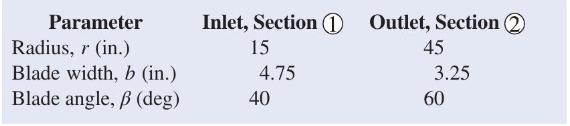
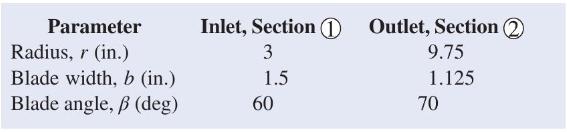
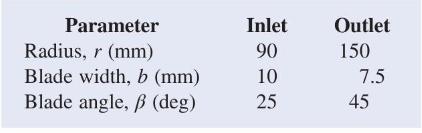
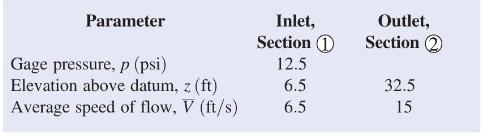
Dimensions of a centrifugal pump impeller areThe pump is driven at \(575 \mathrm{rpm}\) and the fluid is water. Calculate the theoretical head and mechanical power if the flow rate is \(80,000 \mathrm{gpm}\). Parameter Radius, r (in.) Blade width, b (in.) Blade angle, (deg) Inlet, Section Outlet,
Dimensions of a centrifugal pump impeller areThe pump is driven at \(1250 \mathrm{rpm}\) while pumping water. Calculate the theoretical head and mechanical power input if the flow rate is \(1500 \mathrm{gpm}\). Parameter Radius, r (in.) Blade width, b (in.) Blade angle, (deg) Inlet, Section 1
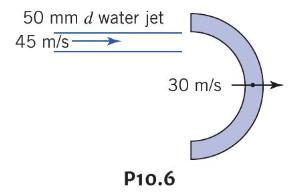
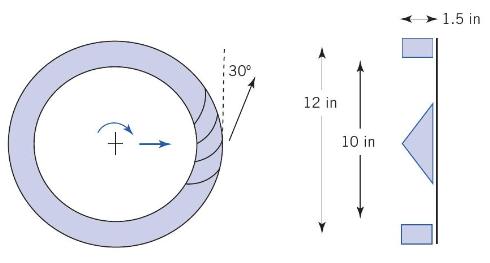
The blade is one of a series. Calculate the force exerted by the jet on the blade system. 50 mm d water jet 45 m/s 30 m/s P10.6
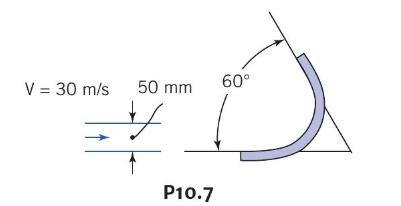
This blade is one of a series. What force is required to move the series horizontally against the direction of the jet of water at a velocity of \(15 \mathrm{~m} / \mathrm{s}\) ? What power is required to accomplish this motion? 60 V = 30 m/s 50 mm P10.7
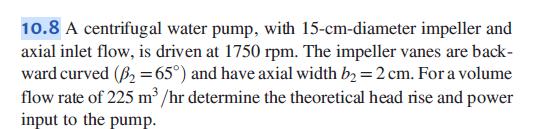
A centrifugal water pump, with 15 -cm-diameter impeller and axial inlet flow, is driven at \(1750 \mathrm{rpm}\). The impeller vanes are backward curved \(\left(\beta_{2}=65^{\circ}\right)\) and have axial width \(b_{2}=2 \mathrm{~cm}\). For a volume flow rate of \(225 \mathrm{~m}^{3} /
Consider the centrifugal pump impeller dimensions given in Example 10.1. Construct the velocity diagram for shockless flow at the impeller inlet, if \(b=\) constant. Calculate the effective flow angle with respect to the radial impeller blades for the case of no inlet swirl. Investigate the effects
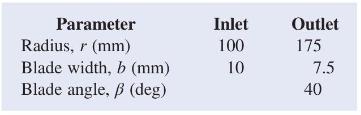
A centrifugal water pump designed to operate at \(1300 \mathrm{rpm}\) has dimensionsDraw the inlet velocity diagram for a volume flow rate of \(35 \mathrm{~L} / \mathrm{s}\). Determine the inlet blade angle for which the entering velocity has no tangential component. Draw the outlet velocity
A series of blades, such as in Example 10.13, moving in the same direction as a water jet of \(25 \mathrm{~mm}\) diameter and of velocity \(46 \mathrm{~m} / \mathrm{s}\), deflects the jet \(75^{\circ}\) from its original direction. What relation between blade velocity and blade angle must exist to
In passing through this blade system, the absolute jet velocity decreases from 41.5 to \(22.5 \mathrm{~m} / \mathrm{s}\). If the flow rate is \(57 \mathrm{~L} / \mathrm{s}\) of water, calculate the power transferred to the blade system and the vertical force component exerted on the blade system.
A centrifugal pump runs at \(1750 \mathrm{rpm}\) while pumping water at a rate of \(50 \mathrm{~L} / \mathrm{s}\). The water enters axially, and leaves tangential to the impeller blades. The impeller exit diameter and width are \(300 \mathrm{~mm}\) and \(10 \mathrm{~mm}\), respectively. If the pump
A centrifugal water pump designed to operate at \(1200 \mathrm{rpm}\) has dimensionsDetermine the flow rate at which the entering velocity has no tangential component. Draw the outlet velocity diagram, and determine the outlet absolute flow angle measured relative to the normal direction at this
Kerosene is pumped by a centrifugal pump. When the flow rate is \(350 \mathrm{gpm}\), the pump requires \(18 \mathrm{hp}\) input and its efficiency is 82 percent. Calculate the pressure rise produced by the pump. Express this result as(a) feet of water(b) feet of kerosene.
In the water pump of Problem 10.8, the pump casing acts as a diffuser, which converts 60 percent of the absolute velocity head at the impeller outlet to static pressure rise. The head loss through the pump suction and discharge channels is 0.75 times the radial component of velocity head leaving
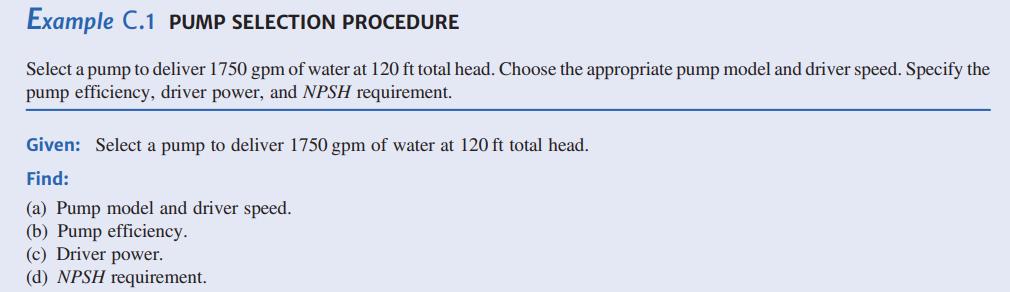
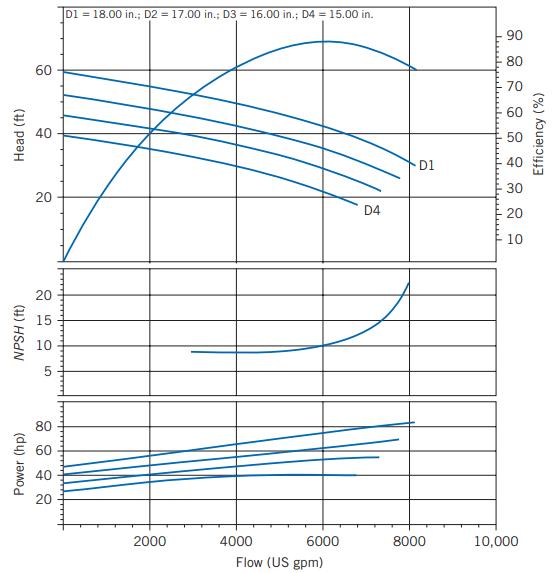
Use data from Appendix \(C\) to choose points from the performance curves for a Peerless horizontal split case Type 16A18B pump at 705 and 880 nominal rpm. Obtain and plot curve-fits of total head versus delivery for this pump, with an 18.0-in.-diameter impeller.Data From Appendix C Example C.1
Data from tests of a water suction pump operated at \(2000 \mathrm{rpm}\) with a 12 -in.-diameter impeller arePlot the performance curves for this pump; include a curve of efficiency versus volume flow rate. Locate the best efficiency point and specify the pump rating at this point. Flow rate, Q
A centrifugal pump impeller having \(r_{1}=50 \mathrm{~mm}\), \(r_{2}=150 \mathrm{~mm}\), and width \(b=3.75 \mathrm{~mm}\) is to pump \(225 \mathrm{~L} / \mathrm{s}\) of water and supply \(12.2 \mathrm{~J}\) of energy to each newton of fluid. The impeller rotates at \(1000 \mathrm{rpm}\). What
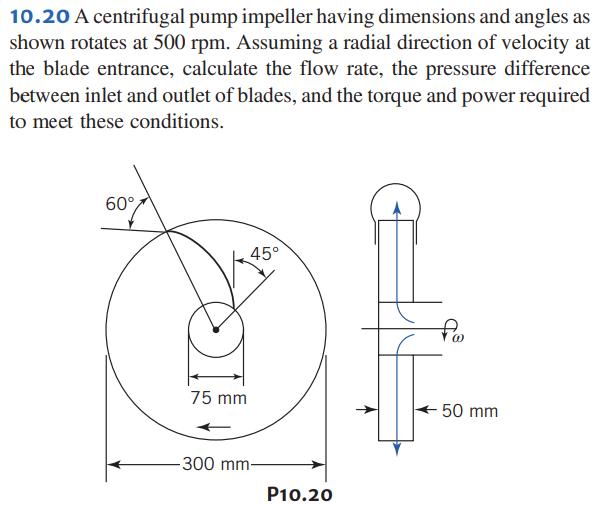
A centrifugal pump impeller having dimensions and angles as shown rotates at \(500 \mathrm{rpm}\). Assuming a radial direction of velocity at the blade entrance, calculate the flow rate, the pressure difference between inlet and outlet of blades, and the torque and power required to meet these
An axial-flow fan operates in sea-level air at \(1350 \mathrm{rpm}\) and has a blade tip diameter of \(3 \mathrm{ft}\) and a root diameter of \(2.5 \mathrm{ft}\). The inlet angles are \(\alpha_{1}=55^{\circ}, \beta_{1}=30^{\circ}\), and at the exit \(\beta_{2}=60^{\circ}\). Estimate the volumetric
Data measured during tests of a centrifugal pump driven at \(3000 \mathrm{rpm}\) areThe flow rate is \(65 \mathrm{gpm}\) and the torque applied to the pump shaft is \(4.75 \mathrm{lbf} \cdot \mathrm{ft}\). The pump efficiency is 75 percent, and the electric motor efficiency is 85 percent. Find(a)
A small centrifugal pump, when tested at \(N=2875 \mathrm{rpm}\) with water, delivered \(Q=0.016 \mathrm{~m}^{3} / \mathrm{s}\) and \(H=40 \mathrm{~m}\) at its best efficiency point \((\eta=0.70)\). Determine the specific speed of the pump at this test condition. Sketch the impeller shape you
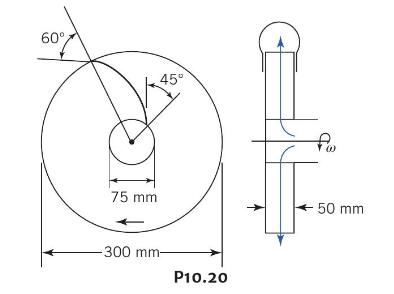
If the impeller of Problem 10.20 rotates between horizontal planes of infinite extent and the flow rate is \(25 \mathrm{~L} / \mathrm{s}\), what rise of pressure may be expected between one point having \(r=150 \mathrm{~mm}\) and another having \(r=225 \mathrm{~mm}\) ?Data From Problems 10.20 10.20
At the outlet of a pump impeller of diameter \(0.6 \mathrm{~m}\) and width \(150 \mathrm{~mm}\), the absolute velocity is observed to be \(30 \mathrm{~m} / \mathrm{s}\) at an angle of \(60^{\circ}\) with a radial line. Calculate the torque exerted on the impelier.
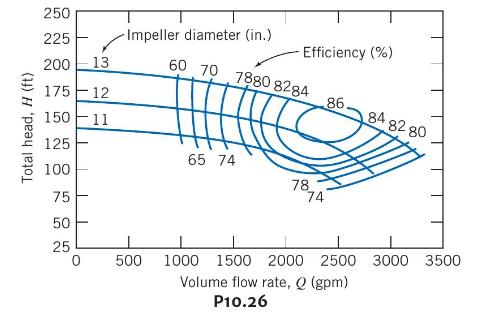
Typical performance curves for a centrifugal pump, tested with three different impeller diameters in a single casing, are shown. Specify the flow rate and head produced by the pump at its best efficiency point with a 12-in.-diameter impeller. Scale these data to predict the performance of this pump
A pump with \(D=500 \mathrm{~mm}\) delivers \(Q=0.725 \mathrm{~m}^{3} / \mathrm{s}\) of water at \(H=10 \mathrm{~m}\) at its best efficiency point. If the specific speed of the pump is 1.74 , and the required input power is \(90 \mathrm{~kW}\), determine the shutoff head, \(H_{0}\), and best
At its best efficiency point \((\eta=0.87)\), a mixed-flow pump, with \(D=16\) in., delivers \(Q=2500 \mathrm{cfm}\) of water at \(H=140 \mathrm{ft}\) when operating at \(N=1350 \mathrm{rpm}\). Calculate the specific speed of this pump. Estimate the required power input. Determine the curve-fit
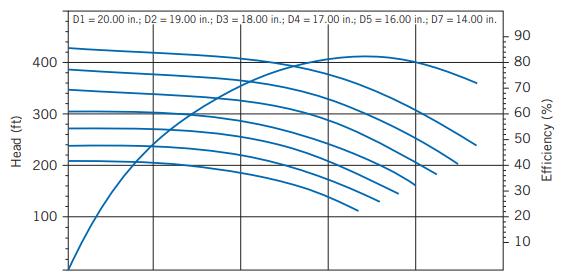
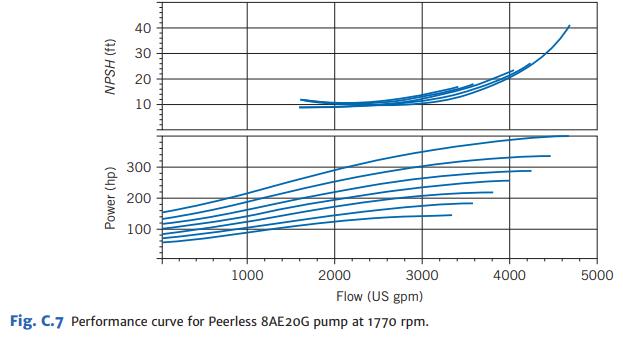
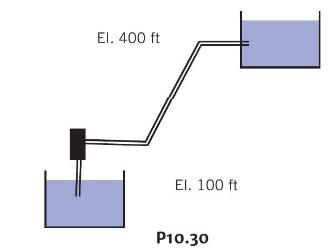
Using the performance curves in Appendix C, select the smallest diameter Peerless 8AE20G pump operating at \(1770 \mathrm{rpm}\) that will deliver a flow of at least \(2000 \mathrm{gpm}\) for the pipeline shown. Determine the actual flow rate and the pump electrical power requirement.Data From
A pump (Peerless 8AE20G, Appendix C) operates at 1775 rpm and has the 20 -in. inch impeller. It supplies the pipe-line below while operating at maximum efficiency. Find the pipeline loss coefficient \(K\) in the equation \(h_{L}=K Q^{2}\), with \(Q\) in gpm, for this condition. Neglect local
A pumping system must be specified for a lift station at a wastewater treatment facility. The average flow rate is 110 million liters per day and the required lift is \(10 \mathrm{~m}\). Non-clogging impellers must be used; about 65 percent efficiency is expected. For convenient installation,
A centrifugal water pump operates at \(1750 \mathrm{rpm}\); the impeller has backward-curved vanes with \(\beta_{2}=60^{\circ}\) and \(b_{2}=1.25 \mathrm{~cm}\). At a flow rate of \(0.025 \mathrm{~m}^{3} / \mathrm{s}\), the radial outlet velocity is \(V_{n_{2}}=3.5 \mathrm{~m} / \mathrm{s}\).
A set of eight \(30-\mathrm{kW}\) motor-pump units is used to deliver water through an elevation of \(30 \mathrm{~m}\). The efficiency of the pumps is specified to be 65 percent. Estimate the delivery in liters per day and select an appropriate operating speed.
A blower has a rotor with 12-in. outside diameter and 10-in. inside diameter with 1.5 -in high rotor blades. The flow rate through the blower is \(500 \mathrm{ft}^{3} / \mathrm{min}\) at a rotor speed of \(1800 \mathrm{rpm}\). The air at blade inlet is in the radial direction and the discharge
A centrifugal water pump has an impeller with an outer diameter of \(14 \mathrm{in}\). and a blade height of \(1 \mathrm{in}\). It rotates at 1200 \(\mathrm{rpm}\). The flow enters parallel to the axis of rotation and leaves at an angle of \(35^{\circ}\) with an absolute exit velocity of \(75
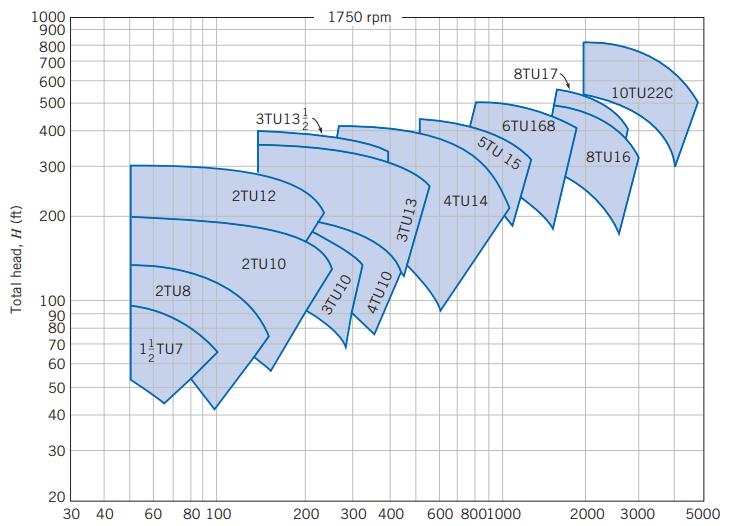
Appendix C contains area bound curves for pump model selection and performance curves for individual pump models. Use these data to verify the similarity rules for a Peerless Type 4AE12 pump, with impeller diameter \(D=11.0\) in., operated at 1750 and 3550 nominal rpm.Data From Appendix C Total
Consider the Peerless Type 16A18B horizontal split case centrifugal pump (Appendix C). Use these performance data to verify the similarity rules for(a) impeller diameter change (b) operating speeds of 705 and \(880 \mathrm{rpm}\) (The scale change between speeds).Data From Appendix C 60 60 Head
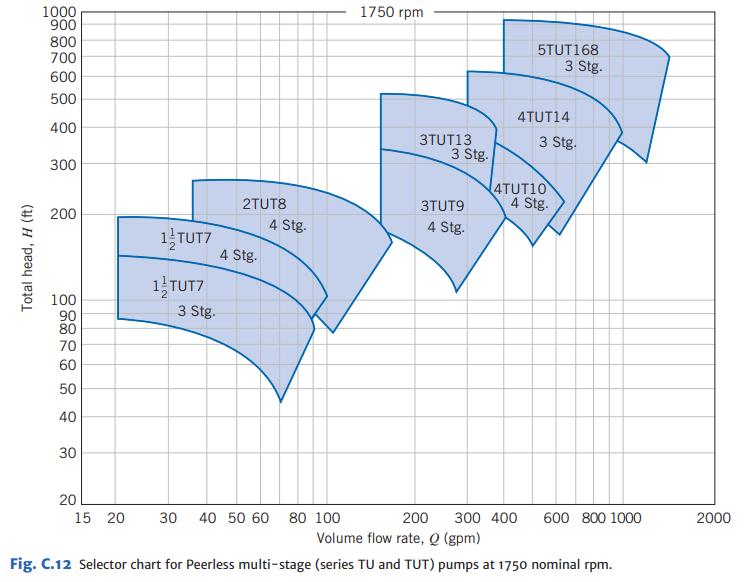
Use data from Appendix \(C\) to verify the similarity rules for the effect of changing the impeller diameter of a Peerless Type 4AE12 pump operated at 1750 and 3550 nominal rpm.Data From Appendix C Total head, H (ft) 1000 1750 rpm 900 800 700 5TUT168 3 Stg. 600 500 400 300 2TUT8 200 1TUT7 1TUT7 4
A centrifugal water pump has an impeller with backwardcurved vanes and an inner diameter of \(0.1 \mathrm{~m}\), an outer diameter of \(0.25 \mathrm{~m}\), and a blade height of \(4 \mathrm{~cm}\). It operates at \(1200 \mathrm{rpm}\). Water enters the impeller at the blade angle of \(50^{\circ}\)
Catalog data for a centrifugal water pump at design conditions are \(Q=250 \mathrm{gpm}\) and \(\Delta p=18.6 \mathrm{psi}\) at \(1750 \mathrm{rpm}\). A laboratory flume requires \(200 \mathrm{gpm}\) at \(32 \mathrm{ft}\) of head. The only motor available develops \(3 \mathrm{hp}\) at \(1750
\( \mathrm{~A} 1 / 3\) scale model of a centrifugal water pump running at \(N_{m}=5100 \mathrm{rpm}\) produces a flow rate of \(Q_{m}=1 \mathrm{~m}^{3} / \mathrm{s}\) with a head of \(H_{m}=5.4 \mathrm{~m}\). Assuming the model and prototype efficiencies are comparable, estimate the flow rate,
Sometimes the variation of water viscosity with temperature can be used to achieve dynamic similarity. A model pump delivers \(0.10 \mathrm{~m}^{3} / \mathrm{s}\) of water at \(15^{\circ} \mathrm{C}\) against a head of \(27 \mathrm{~m}\), when operating at \(3600 \mathrm{rpm}\). Determine the water
A large deep fryer at a snack-food plant contains hot oil that is circulated through a heat exchanger by pumps. Solid particles and water droplets coming from the food product are observed in the flowing oil. What special factors must be considered in specifying the operating conditions for the
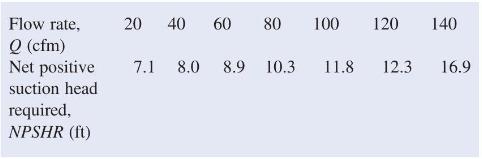
Data from tests of a pump, with a 12.3-in.-diameter impeller operated at \(1450 \mathrm{rpm}\) areDevelop and plot a curve-fit equation for NPSHR versus volume flow rate in the form NPSHR \(=a+b Q^{2}\), where \(a\) and \(b\) are constants. If the \(N P S H A=20 \mathrm{ft}\), estimate the maximum
A four-stage boiler feed pump has suction and discharge lines of \(10 \mathrm{~cm}\) and \(7.5 \mathrm{~cm}\) inside diameter. At \(3500 \mathrm{rpm}\), the pump is rated at \(0.025 \mathrm{~m}^{3} / \mathrm{s}\) against a head of \(125 \mathrm{~m}\) while handling water at \(115^{\circ}
A centrifugal pump operating at \(N=2265 \mathrm{rpm}\) lifts water between two reservoirs connected by \(300 \mathrm{ft}\) of 6 -in.-diameter and \(100 \mathrm{ft}\) of 3-in.-diameter cast-iron pipe in series. The gravity lift is \(25 \mathrm{ft}\). Estimate the head requirement, power needed, and
A centrifugal pump is installed in a piping system with \(L=300 \mathrm{~m}\) of \(D=40 \mathrm{~cm}\) cast-iron pipe. The downstream reservoir surface is \(15 \mathrm{~m}\) lower than the upstream reservoir. Determine and plot the system head curve. Find the volume flow rate (magnitude and
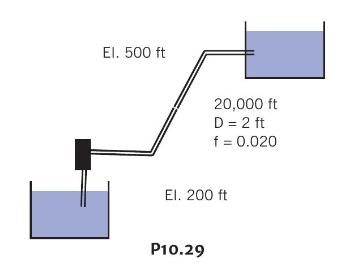
Part of the water supply for the South Rim of Grand Canyon National Park is taken from the Colorado River [54]. A flow rate of \(600 \mathrm{gpm}\) taken from the river at elevation \(3734 \mathrm{ft}\) is pumped to a storage tank atop the South Rim at \(7022 \mathrm{ft}\) elevation. Part of the
A pump transfers water from one reservoir to another through two cast-iron pipes in series. The first is \(3000 \mathrm{ft}\) of 9-in.-diameter pipe and the second is \(1000 \mathrm{ft}\) of 6-in.-diameter pipe. A constant flow rate of \(75 \mathrm{gpm}\) is tapped off at the junction between the
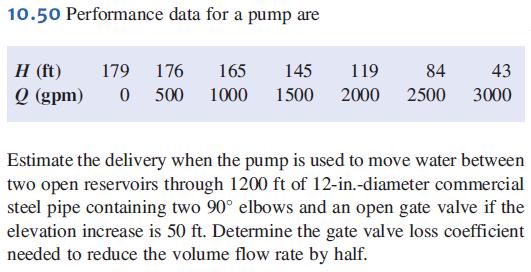
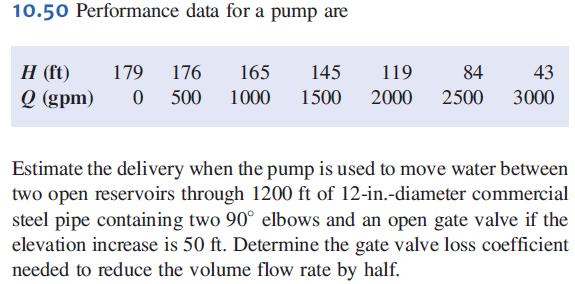
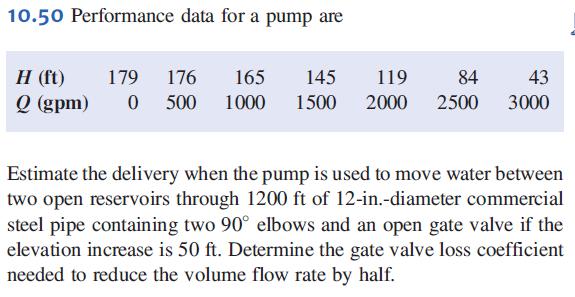
Performance data for a pump areEstimate the delivery when the pump is used to move water between two open reservoirs through \(1200 \mathrm{ft}\) of 12-in.-diameter commercial steel pipe containing two \(90^{\circ}\) elbows and an open gate valve if the elevation increase is \(50 \mathrm{ft}\).
Consider the pump and piping system of Problem 10.50. Determine the volume flow rate and gate valve loss coefficient for the case of two identical pumps installed in parallel.Data From Problem 10.50 10.50 Performance data for a pump are H (ft) Q (gpm) 179 176 165 0 500 1000 1500 145 119 84 43 2000
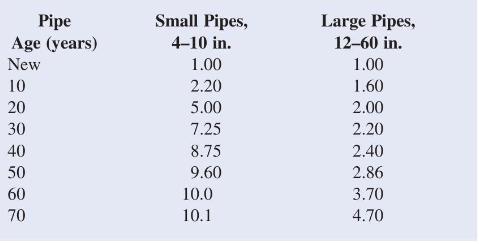
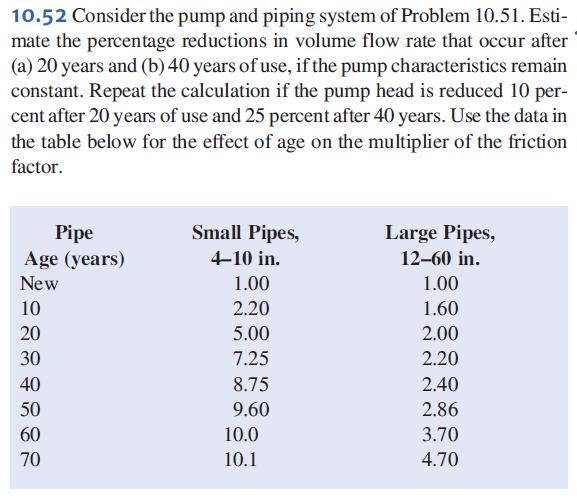
Consider the pump and piping system of Problem 10.51. Estimate the percentage reductions in volume flow rate that occur after(a) 20 years (b) 40 years of use, if the pump characteristics remain constant. Repeat the calculation if the pump head is reduced 10 percent after 20 years of use and 25
Consider the flow system shown in Problem 8.94. Assume the minimum NPSHR at the pump inlet is \(15 \mathrm{ft}\) of water. Select a pump appropriate for this application. Use the data for increase in friction factor with pipe age given in Problem 10.52 to determine and compare the system flow rate
Showing 100 - 200
of 1127
1
2
3
4
5
6
7
8
9
10
11
12
Step by Step Answers

 Get 50% OFF
Claim Now
Get 50% OFF
Claim Now