New Semester
Started
Get
50% OFF
Study Help!
--h --m --s
Claim Now
Question Answers
Textbooks
Find textbooks, questions and answers
Oops, something went wrong!
Change your search query and then try again
S
Books
FREE
Study Help
Expert Questions
Accounting
General Management
Mathematics
Finance
Organizational Behaviour
Law
Physics
Operating System
Management Leadership
Sociology
Programming
Marketing
Database
Computer Network
Economics
Textbooks Solutions
Accounting
Managerial Accounting
Management Leadership
Cost Accounting
Statistics
Business Law
Corporate Finance
Finance
Economics
Auditing
Tutors
Online Tutors
Find a Tutor
Hire a Tutor
Become a Tutor
AI Tutor
AI Study Planner
NEW
Sell Books
Search
Search
Sign In
Register
study help
engineering
introduction to fluid mechanics
Fox And McDonald's Introduction To Fluid Mechanics 9th Edition Philip J. Pritchard, John W. Mitchell - Solutions
In a laboratory experiment, the water flow rate is to be measured catching the water as it vertically exits a pipe into an empty open tank that is on a zeroed balance. The tank is \(10 \mathrm{~m}\) directly below the pipe exit, and the pipe diameter is \(50 \mathrm{~mm}\). One student obtains a
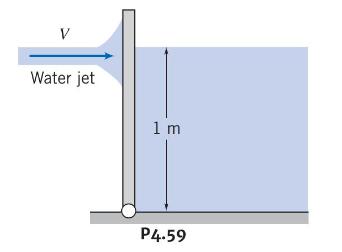
A gate is \(1 \mathrm{~m}\) wide and \(1.2 \mathrm{~m}\) tall and hinged at the bottom. On one side the gate holds back a 1-m-deep body of water. On the other side, a \(5-\mathrm{cm}\) diameter water jet hits the gate at a height of \(1 \mathrm{~m}\). What jet speed \(V\) is required to hold the
Water flows steadily through a fire hose and nozzle. The hose is \(75-\mathrm{mm}-\mathrm{ID}\), and the nozzle tip is \(35-\mathrm{mm}-\mathrm{ID}\); water gage pressure in the hose is \(510 \mathrm{kPa}\), and the stream leaving the nozzle is uniform. The exit speed and pressure are \(32
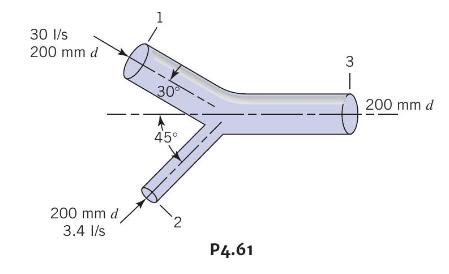
Two types of gasoline are blended by passing them through a horrzontal "wye" as shown. Calculate the magnitude and direction of the force exerted on the "wye" by the gasoline. The gage pressure \(p_{3}=145 \mathrm{kPa}\). 30 l/s 200 mm d 1 30 200 mm d 3.4 l/s 45 P4.61 3 200 mm d
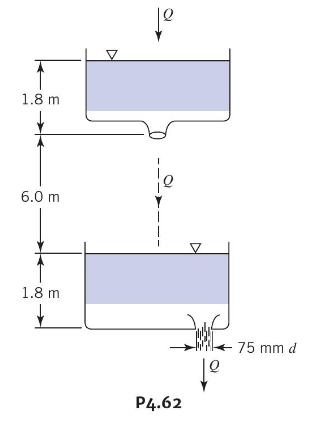
The lower tank weighs \(224 \mathrm{~N}\), and the water in it weighs 897 N. If this tank is on a platform scale, what weight will register on the scale beam? 1.8 m 6.0 m 1.8 m P4.62 - 75 mm d
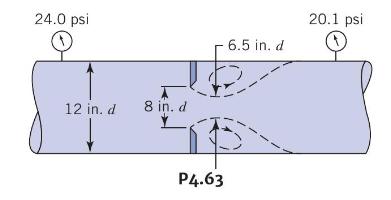
The pressure difference results from head loss caused by eddies downstream from the orifice plate. Wall friction is negligible. Calculate the force exerted by the water on the orifice plate. The flow rate is 7.86 cfs. 24.0 psi 12 in. d 8 in. d P4.63 6.5 in. d 20.1 psi
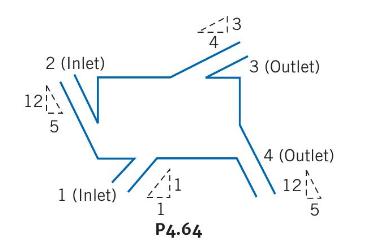
Obtain expressions for the rate of change in mass of the control volume shown, as well as the horizontal and vertical forces required to hold it in place, in terms of \(p_{1}, A_{1}, V_{1}, p_{2}, A_{2}, V_{2}, p_{3}\), \(A_{3}, V_{3}, p_{4}, A_{4}, V_{4}\), and the constant density \(ho\). 12 4 2
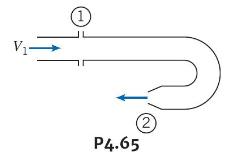
Water is flowing steadily through the \(180^{\circ}\) elbow shown. At the inlet to the elbow the gage pressure is 103 psi. The water discharges to atmospheric pressure. Assume properties are uniform over the inlet and outlet areas: \(A_{1}=2500 \mathrm{~mm}^{2}, A_{2}=650 \mathrm{~mm}^{2}\), and
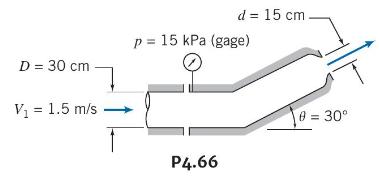
Water flows steadily through the nozzle shown, discharging to atmosphere. Calculate the horizontal component of force in the flanged joint. Indicate whether the joint is in tension or compression. D = 30 cm V = 1.5 m/s d = 15 cm. p = 15 kPa (gage) 0 = 30 P4.66
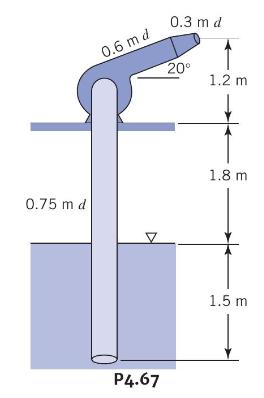
The pump, suction pipe, discharge pipe, and nozzle are all welded together as a single unit. Calculate the horizontal component of force (magnitude and direction) exerted by the water on the unit when the pump is developing a head of \(22.5 \mathrm{~m}\). 0.6 m d 0.3 m d 20 1.2 m 0.75 m d 1.8 m
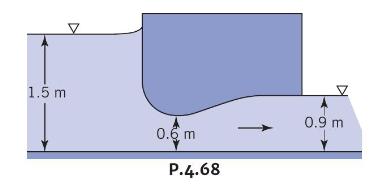
The passage is \(1.2 \mathrm{~m}\) wide normal to the paper. What will be the horizontal component of force exerted by the water on the structure? 1.5 m 0.6 m P.4.68 0.9 m
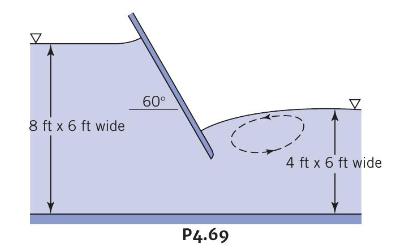
If the two-dimensional flow rate through this sluice gate is \(50 \mathrm{cfs} / \mathrm{ft}\), calculate the horizontal and vertical components of force on the gate, neglecting wall friction. 8 ft x 6 ft wide 60 P4.69 4 ft x 6 ft wide
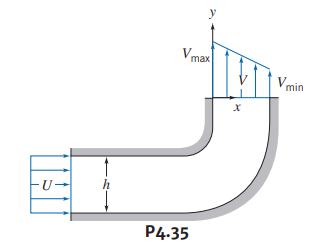
Assume the bend of Problem 4.35 is a segment of a larger channel and lies in a horizontal plane. The inlet pressure is 170 \(\mathrm{kPa}\) absolute, and the outlet pressure is \(130 \mathrm{kPa}\) absolute. Find the force required to hold the bend in place.Data From Problem 4.35 4.35 Water enters
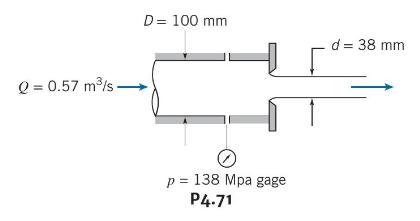
A flat plate orifice of \(50 \mathrm{~mm}\) diameter is located at the end of a 100-mm-diameter pipe. Water flows through the pipe and orifice at \(57 \mathrm{~m}^{3} / \mathrm{s}\). The diameter of the water jet downstream from the orifice is \(38 \mathrm{~mm}\). Calculate the external force
At rated thrust, a liquid-fueled rocket motor consumes \(80 \mathrm{~kg} / \mathrm{s}\) of nitric acid as oxidizer and \(32 \mathrm{~kg} / \mathrm{s}\) of aniline as fuel. Flow leaves axially at \(180 \mathrm{~m} / \mathrm{s}\) relative to the nozzle and at \(110 \mathrm{kPa}\) absolute. The nozzle
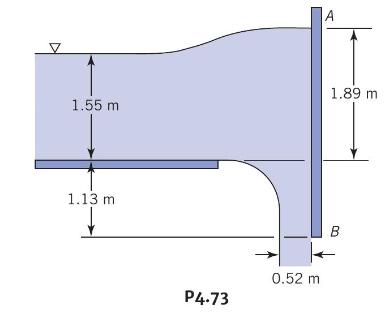
Flow from the end of a two-dimensional open channel is deflected vertically downward by the gate \(A B\). Calculate the force exerted by the water on the gate. At and downstream from \(B\) the flow may be considered a free jet. A 1.55 m 1.89 m 1.13 m 0.52 m P4.73 B
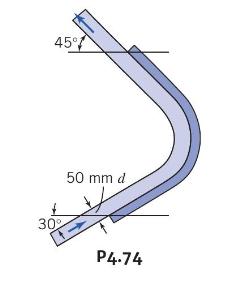
Calculate the magnitude and direction of the vertical and horizontal components and the total force exerted on this stationary blade by a \(50 \mathrm{~mm}\) jet of water moving at \(15 \mathrm{~m} / \mathrm{s}\). 45 50 mm d 30% P4.74
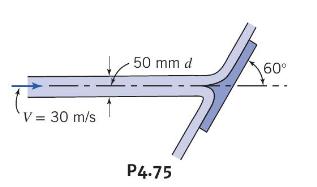
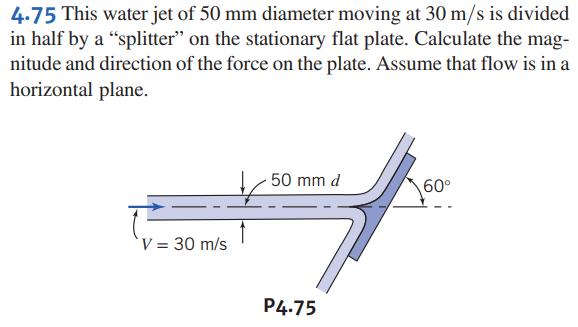
This water jet of \(50 \mathrm{~mm}\) diameter moving at \(30 \mathrm{~m} / \mathrm{s}\) is divided in half by a "splitter" on the stationary flat plate. Calculate the magnitude and direction of the force on the plate. Assume that flow is in a horizontal plane. V = 30 m/s 50 mm d P4.75 60
If the splitter is removed from the plate of Problem 4.75 problem and sidewalls are provided on the plate to keep the flow two dimensional, how will the jet divide after striking the plate?Data From Problem 4.75 4.75 This water jet of 50 mm diameter moving at 30 m/s is divided in half by a
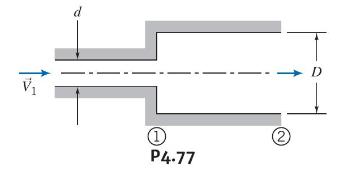
Consider flow through the sudden expansion shown. If the flow is incompressible and friction is neglected, show that the pressure rise, \(\Delta p=p_{2}-p_{1}\), is given by\[\frac{\Delta p}{\frac{1}{2} ho
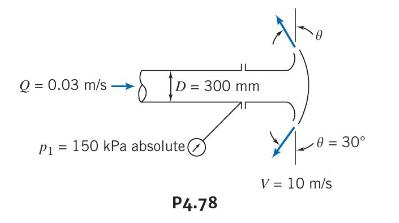
A conical spray head is shown. The fluid is water and the exit stream is uniform. Evaluate (a) the thickness of the spray sheet at a radius of \(400 \mathrm{~mm}\) and (b) the axial force exerted by the spray head on the supply pipe. Q = 0.03 m/s D = 300 mm P1 150 kPa absoluted = 0=30' = 30 P4.78 V
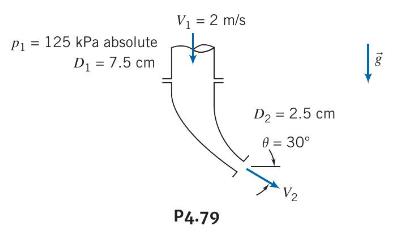
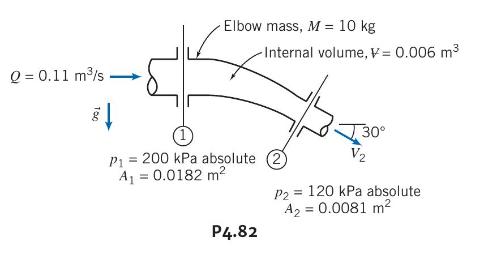
A curved nozzle assembly that discharges to the atmosphere is shown. The nozzle mass is \(4.5 \mathrm{~kg}\) and its internal volume is \(0.002 \mathrm{~m}^{3}\). The fluid is water. Determine the reaction force exerted by the nozzle on the coupling to the inlet pipe. 100 P1 125 kPa absolute D =
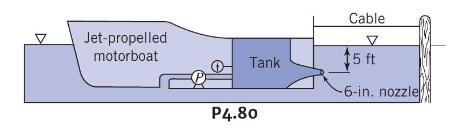
The pump maintains a pressure of \(10 \mathrm{psi}\) at the gauge. The velocity leaving the nozzle is \(34 \mathrm{ft} / \mathrm{s}\). Calculate the tension force in the cable. Jet-propelled motorboat Tank P4.80 Cable 15 ft 6-in. nozzle
A motorboat moves up a river at a speed of \(9 \mathrm{~m} / \mathrm{s}\) relative to the land. The river flows at a velocity of \(1.5 \mathrm{~m} / \mathrm{s}\). The boat is powered by a jet-propulsion unit which takes in water at the bow and discharges it beneath the surface at the stern.
reducing elbow is shown. The fluid is water. Evaluate the components of force that must be provided by the adjacent pipes to keep the elbow from moving. A 30
A monotube boiler consists of a \(6 \mathrm{~m}\) length of tubing with 9.5-mm-ID. Water enters at the rate of \(0.135 \mathrm{~kg} / \mathrm{s}\) at \(3.45 \mathrm{MPa}\) absolute. Steam leaves at \(2.76 \mathrm{MPa}\) gage with \(12.4 \mathrm{~kg} / \mathrm{m}^{3}\) density. Find the magnitude
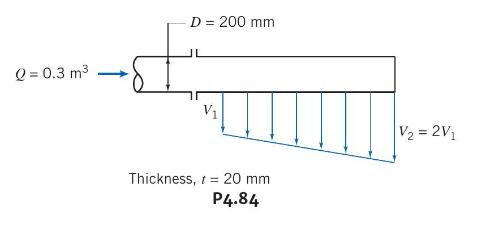
Water is discharged at a flow rate of \(0.3 \mathrm{~m}^{3} / \mathrm{s}\) from a narrow slot in a \(200-\mathrm{mm}\)-diameter pipe. The resulting horizontal twodimensional jet is \(1 \mathrm{~m}\) long and \(20 \mathrm{~mm}\) thick, but of nonuniform velocity; the velocity at location (2) is
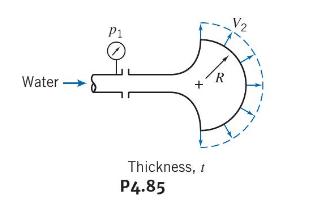
A nozzle for a spray system is designed to produce a flat radial sheet of water. The sheet leaves the nozzle at \(V_{2}=10 \mathrm{~m} / \mathrm{s}\), covers \(180^{\circ}\) of arc, and has thickness \(t=1.5 \mathrm{~mm}\). The nozzle discharge radius is \(R=50 \mathrm{~mm}\). The water supply pipe
The horizontal velocity in the wake behind an object in an air stream of velocity \(U\) is given by\[\begin{array}{ll} u(r)=U\left[1-\cos ^{2}\left(\frac{\pi r}{2}\right)\right] & |r| \leq 1 \\ u(r)=U & |r|>1 \end{array}\]where \(r\) is the nondimensional radial coordinate, measured
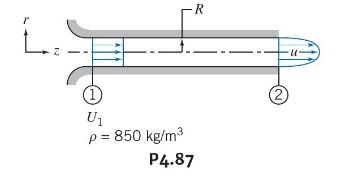
An incompressible fluid flows steadily in the entrance region of a circular tube of radius \(R=75 \mathrm{~mm}\). The flow rate is \(Q=0.1 \mathrm{~m}^{3} / \mathrm{s}\). Find the uniform velocity \(U_{1}\) at the entrance. The velocity distribution at a section downstream is\[\frac{u}{u_{\max
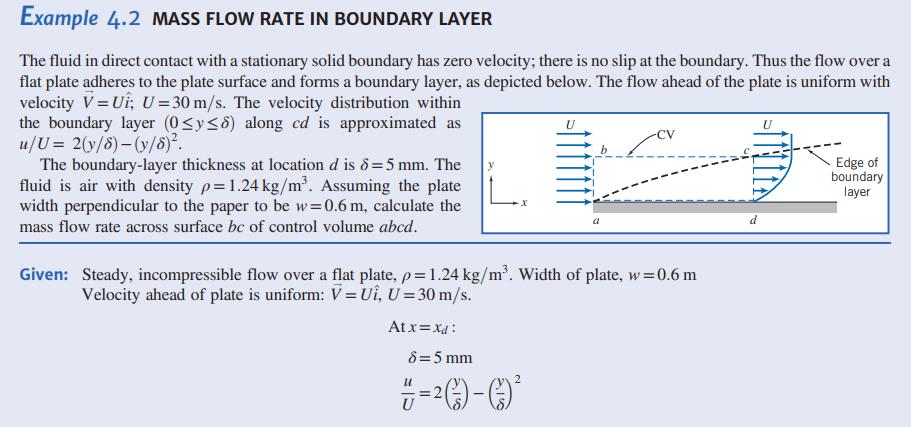
Consider the incompressible flow of fluid in a boundary layer as depicted in Example 4.2. Show that the friction drag force of the fluid on the surface is given by\[F_{f}=\int_{0}^{\delta} ho u(U-u) w d y\]Evaluate the drag force for the conditions of Example 4.2.Data From Example 4.2 Example 4.2
Air at standard conditions flows along a flat plate. The undisturbed freestream speed is \(U_{0}=20 \mathrm{~m} / \mathrm{s}\). At \(L=0.4 \mathrm{~m}\) downstream from the leading edge of the plate, the boundary-layer thickness is \(\delta=2 \mathrm{~mm}\). The velocity profile at this location is
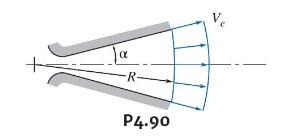
Gases leaving the propulsion nozzle of a rocket are modeled as flowing radially outward from a point upstream from the nozzle throat. Assume the speed of the exit flow, \(V_{e}\), has constant magnitude. Develop an expression for the axial thrust, \(T_{a}\), developed by flow leaving the nozzle
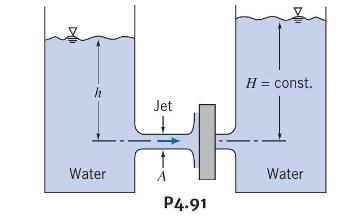
Two large tanks containing water have small smoothly contoured orifices of equal area. A jet of liquid issues from the left tank. Assume the flow is uniform and unaffected by friction. The jet impinges on a vertical flat plate covering the opening of the right tank. Determine the minimum value for
Students are playing around with a water hose. When they point it straight up, the water jet just reaches one of the windows of an office, \(10 \mathrm{~m}\) above. If the hose diameter is \(1 \mathrm{~cm}\), estimate the water flow rate \((\mathrm{L} / \mathrm{min})\). A student places his hand
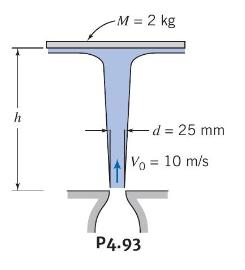
A 2-kg disk is constrained horizontally but is free to move vertically. The disk is struck from below by a vertical jet of water. The speed and diameter of the water jet are \(10 \mathrm{~m} / \mathrm{s}\) and \(25 \mathrm{~mm}\) at the nozzle exit. Obtain a general expression for the speed of the
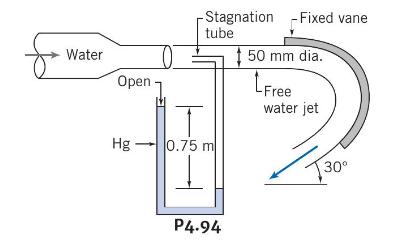
A stream of water from a 50-mm-diameter nozzle strikes a curved vane, as shown. A stagnation tube connected to a mercuryfilled U-tube manometer is located in the nozzle exit plane. Calculate the speed of the water leaving the nozzle. Estimate the horizontal component of force exerted on the vane by
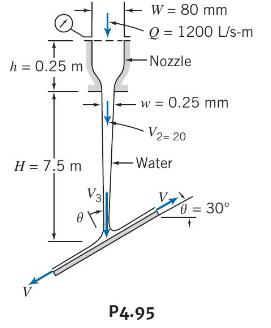
A plane nozzle discharges vertically \(1200 \mathrm{~L} / \mathrm{s}\) per unit width downward to atmosphere. The nozzle is supplied with a steady flow of water. A stationary, inclined, flat plate, located beneath the nozzle, is struck by the water stream. The water stream divides and flows along
In ancient Egypt, circular vessels filled with water sometimes were used as crude clocks. The vessels were shaped in such a way that, as water drained from the bottom, the surface level dropped at constant rate, \(s\). Assume that water drains from a small hole of area \(A\). Find an expression for
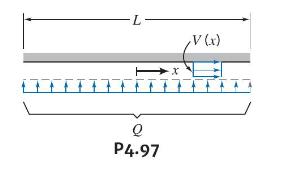
Incompressible fluid of negligible viscosity is pumped at total volume flow rate \(Q\) through a porous surface into the small gap between closely spaced parallel plates as shown. The fluid has only horizontal motion in the gap. Assume uniform flow across any vertical section. Obtain an expression
The narrow gap between two closely spaced circular plates initially is filled with incompressible liquid. At \(t=0\) the upper plate, initially \(h_{0}\) above the lower plate, begins to move downward toward the lower plate with constant speed, \(V_{0}\), causing the liquid to be squeezed from the
Design a clepsydra (Egyptian water clock), which is a vessel from which water drains by gravity through a hole in the bottom and that indicates time by the level of the remaining water. Specify the dimensions of the vessel and the size of the drain hole; indicate the amount of water needed to fill
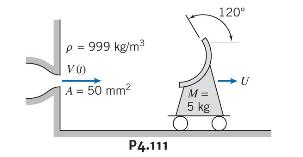
Water from a stationary nozzle impinges on a moving vane with turning angle \(\theta=120^{\circ}\). The vane moves away from the nozzle with constant speed, \(U=10 \mathrm{~m} / \mathrm{s}\), and receives a jet that leaves the nozzle with speed \(V=30 \mathrm{~m} / \mathrm{s}\). The nozzle has an
A freshwater jet boat takes in water through side vents and ejects it through a nozzle of diameter \(D=75 \mathrm{~mm}\); the jet speed is \(V_{j}\). The drag on the boat is given by \(F_{\text {drag }}=k V^{2}\), where \(V\) is the boat speed. Find an expression for the steady speed, \(V\), in
The Canadair CL-215T amphibious aircraft is specially designed to fight fires. It is the only production aircraft that can scoop water, at up to 6120 gallons in 12 seconds, from any lake, river, or ocean. Determine the added thrust required during water scooping, as a function of aircraft speed,
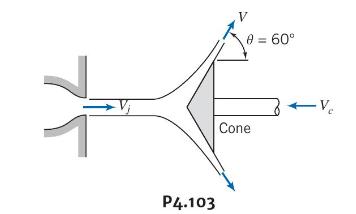
Water, in a \(100-\mathrm{mm}\)-diameter jet with speed of \(30 \mathrm{~m} / \mathrm{s}\) to the right, is deflected by a cone that moves to the left at \(14 \mathrm{~m} / \mathrm{s}\). Determine (a) the thickness of the jet sheet at a radius of \(230 \mathrm{~mm}\). and (b) the external
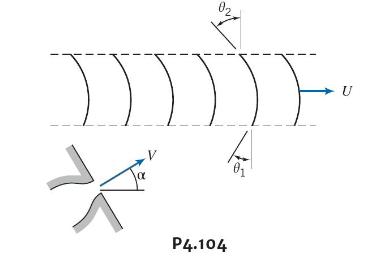
Consider a series of turning vanes struck by a continuous jet of water that leaves a 50-mm-diameter nozzle at constant speed,\(V=86.6 \mathrm{~m} / \mathrm{s}\). The vanes move with constant speed, \(U=50 \mathrm{~m} / \mathrm{s}\). Note that all the mass flow leaving the jet crosses the vanes. The
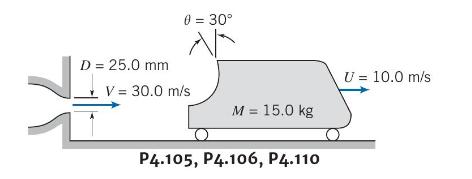
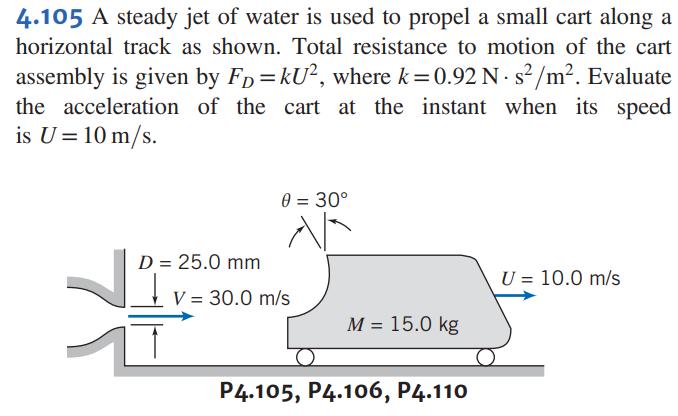
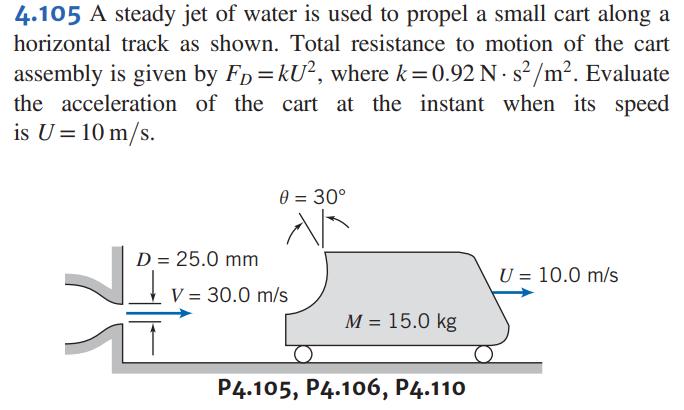
A steady jet of water is used to propel a small cart along a horizontal track as shown. Total resistance to motion of the cart assembly is given by \(F_{D}=k U^{2}\), where \(k=0.92 \mathrm{~N} \cdot \mathrm{s}^{2} / \mathrm{m}^{2}\). Evaluate the acceleration of the cart at the instant when its
The cart of Problem 4.105 is accelerated by a jet of water that strikes the curved vane. The cart moves along a level track with negligible resistance. At any time its speed is \(U\). Calculate the time required to accelerate the cart from rest to \(U=V / 2\).Data From Problem 4.105 4.105 A steady
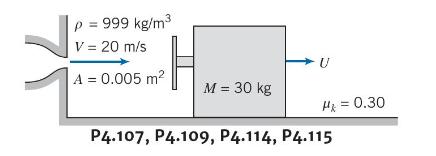
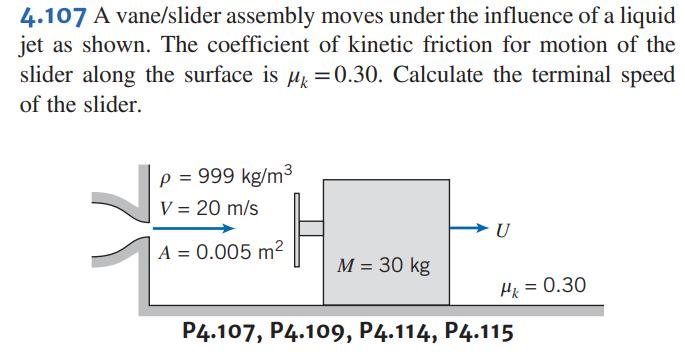
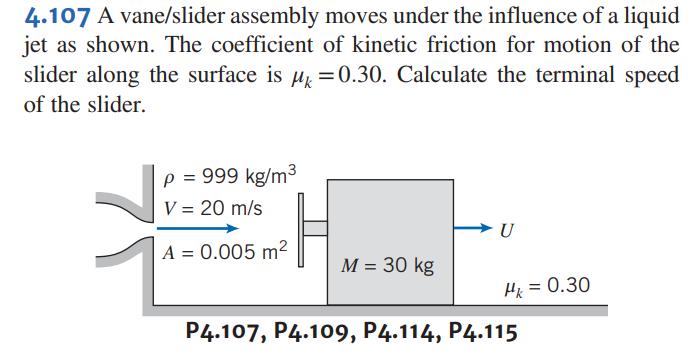
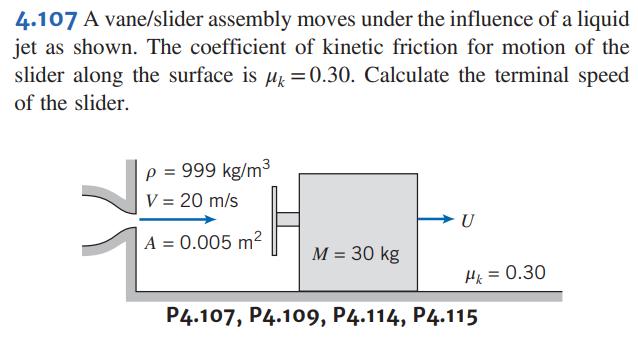
A vane/slider assembly moves under the influence of a liquid jet as shown. The coefficient of kinetic friction for motion of the slider along the surface is \(\mu_{k}=0.30\). Calculate the terminal speed of the slider. p = 999 kg/m V = 20 m/s 7' A = 0.005 m U M = 30 kg P = 0.30 P4.107, P4.109,
A cart is propelled by a liquid jet issuing horizontally from a tank as shown. The track is horizontal; resistance to motion may be neglected. The tank is pressurized so that the jet speed may be considered constant. Obtain a general expression for the speed of the cart as it accelerates from rest.
For the vane/slider problem of Problem 4.107, find and plot expressions for the acceleration and speed of the slider as a function of time.Data From Problem 4.107 4.107 A vane/slider assembly moves under the influence of a liquid jet as shown. The coefficient of kinetic friction for motion of the
If the cart of Problem 4.105 is released at \(t=0\), when would you expect the acceleration to be maximum? Sketch what you would expect for the curve of acceleration versus time. What value of \(\theta\) would maximize the acceleration at any time? Why? Will the cart speed ever equal the jet speed?
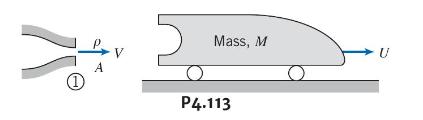
The wheeled cart shown rolls with negligible resistance. The cart is to accelerate to the right at a constant rate of \(2.5 \mathrm{~m} / \mathrm{s}^{2}\). This is to be accomplished by "programming" the water jet speed, \(V(t)\), that hits the cart. The jet area remains constant at \(50
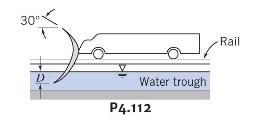
A rocket sled is to be slowed from an initial speed of \(300 \mathrm{~m} / \mathrm{s}\) by lowering a scoop into a water trough. The scoop is \(0.3 \mathrm{~m}\) wide; it deflects the water through \(150^{\circ}\). The trough is \(800 \mathrm{~m}\) long. The mass of the sled is \(8000
Starting from rest, the cart shown is propelled by a hydraulic catapult (liquid jet). The jet strikes the curved surface and makes a \(180^{\circ}\) turn, leaving horizontally. The mass of the cart is \(100 \mathrm{~kg}\) and the jet of water leaves the nozzle (of area \(0.001 \mathrm{~m}^{2}\) )
Solve Problem 4.107 if the vane and slider ride on a film of oil instead of sliding in contact with the surface. Assume motion resistance is proportional to speed, \(F_{R}=k U\), with \(k=7.5 \mathrm{~N} \cdot \mathrm{s} / \mathrm{m}\).Data From Problem 4.107 4.107 A vane/slider assembly moves
For the vane/slider problem of Problem 4.114, plot the acceleration, speed, and position of the slider as functions of time.Data From Problem 4.114 4.114 Solve Problem 4.107 if the vane and slider ride on a film of oil instead of sliding in contact with the surface. Assume motion resistance is
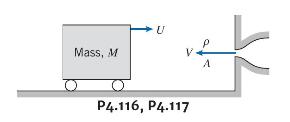
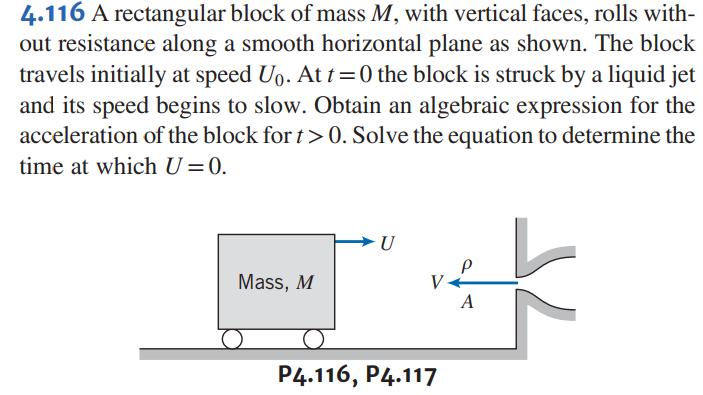
A rectangular block of mass \(M\), with vertical faces, rolls without resistance along a smooth horizontal plane as shown. The block travels initially at speed \(U_{0}\). At \(t=0\) the block is struck by a liquid jet and its speed begins to slow. Obtain an algebraic expression for the acceleration
In Problem 4.116, if \(M=100 \mathrm{~kg}, ho=999 \mathrm{~kg} / \mathrm{m}^{3}\), and \(A=0.01 \mathrm{~m}^{2}\), find the jet speed \(V\) required for the cart to be brought to rest after one second if the initial speed of the cart is \(U_{0}=5 \mathrm{~m} / \mathrm{s}\). For this condition, plot
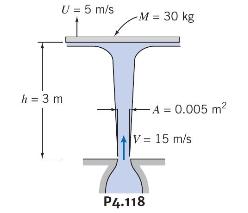
A vertical jet of water impinges on a horizontal disk as shown. The disk assembly mass is \(30 \mathrm{~kg}\). When the disk is \(3 \mathrm{~m}\) above the nozzle exit, it is moving upward at \(U=5 \mathrm{~m} / \mathrm{s}\). Compute the vertical acceleration of the disk at this instant. h = 3 m U
A rocket sled traveling on a horizontal track is slowed by a retro-rocket fired in the direction of travel. The initial speed of the sled is \(U_{0}=500 \mathrm{~m} / \mathrm{s}\). The initial mass of the sled is \(M_{0}=1500 \mathrm{~kg}\). The retro-rocket consumes fuel at the rate of \(7.75
A rocket sled accelerates from rest on a level track with negligible air and rolling resistances. The initial mass of the sled is \(M_{0}=600 \mathrm{~kg}\). The rocket initially contains \(150 \mathrm{~kg}\) of fuel. The rocket motor burns fuel at constant rate \(\dot{m}=15 \mathrm{~kg} /
A rocket sled with initial mass of \(900 \mathrm{~kg}\) is to be accelerated on a level track. The rocket motor burns fuel at constant rate \(\dot{m}=13.5 \mathrm{~kg} / \mathrm{s}\). The rocket exhaust flow is uniform and axial. Gases leave the nozzle at \(2750 \mathrm{~m} / \mathrm{s}\) relative
A rocket sled with initial mass of 3 metric tons, including 1 ton of fuel, rests on a level section of track. At \(t=0\), the solid fuel of the rocket is ignited and the rocket burns fuel at the rate of \(75 \mathrm{~kg} / \mathrm{s}\). The exit speed of the exhaust gas relative to the rocket is
A "home-made" solid propellant rocket has an initial mass of \(9 \mathrm{~kg}\); \(6.8 \mathrm{~kg}\) of this is fuel. The rocket is directed vertically upward from rest, burns fuel at a constant rate of \(0.225 \mathrm{~kg} / \mathrm{s}\), and ejects exhaust gas at a speed of \(1980 \mathrm{~m} /
Neglecting air resistance, what speed would a vertically directed rocket attain in \(5 \mathrm{~s}\) if it starts from rest, has initial mass of \(350 \mathrm{~kg}\), burns \(10 \mathrm{~kg} / \mathrm{s}\), and ejects gas at atmospheric pressure with a speed of \(2500 \mathrm{~m} / \mathrm{s}\)
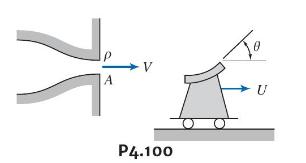
The vane/cart assembly of mass \(M=30 \mathrm{~kg}\), shown in Problem 4.100, is driven by a water jet. The water leaves the stationary nozzle of area \(A=0.02 \mathrm{~m}^{2}\), with a speed of \(20 \mathrm{~m} / \mathrm{s}\). The coefficient of kinetic friction between the assembly and the
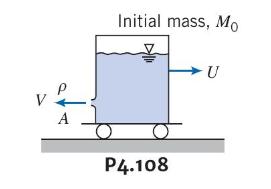
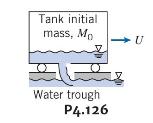
The moving tank shown is to be slowed by lowering a scoop to pick up water from a trough. The initial mass and speed of the tank and its contents are \(M_{0}\) and \(U_{0}\), respectively. Neglect external forces due to pressure or friction and assume that the track is horizontal. Apply the
A model solid propellant rocket has a mass of \(69.6 \mathrm{~g}\), of which \(12.5 \mathrm{~g}\) is fuel. The rocket produces \(5.75 \mathrm{~N}\) of thrust for a duration of \(1.7 \mathrm{~s}\). For these conditions, calculate the maximum speed and height attainable in the absence of air
The \(90^{\circ}\) reducing elbow of Example 4.6 discharges to atmosphere. Section (2) is located \(0.3 \mathrm{~m}\) to the right of Section (1). Estimate the moment exerted by the flange on the elbow.Data From Example 4.6 Example 4.6 FLOW THROUGH ELBOW: USE OF GAGE PRESSURES Water flows steadily
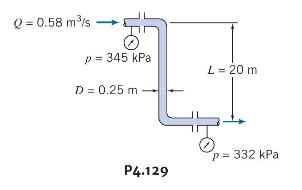
Crude oil ( \(\mathrm{SG}=0.95)\) from a tanker dock flows through a pipe of \(0.25 \mathrm{~m}\) diameter in the configuration shown. The flow rate is \(0.58 \mathrm{~m}^{3} / \mathrm{s}\), and the gage pressures are shown in the diagram. Determine the force and torque that are exerted by the pipe
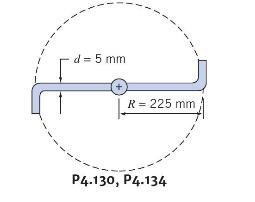
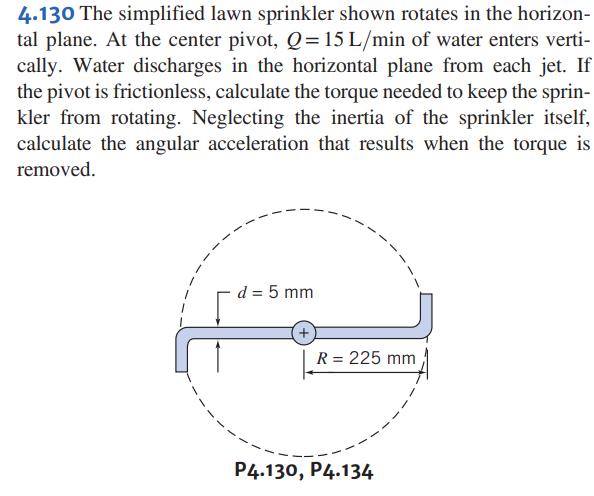
The simplified lawn sprinkler shown rotates in the horizontal plane. At the center pivot, \(Q=15 \mathrm{~L} / \mathrm{min}\) of water enters vertically. Water discharges in the horizontal plane from each jet. If the pivot is frictionless, calculate the torque needed to keep the sprinkler from
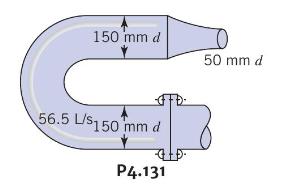
Calculate the torque about the pipe's centerline in the plane of the bolted flange that is caused by the flow through the nozzle. The nozzle centerline is \(0.3 \mathrm{~m}\) above the flange centerline. What is the effect of this torque on the force on the bolts? Neglect the effects of the weights
A fire truck is equipped with a \(66 \mathrm{ft}\) long extension ladder which is attached at a pivot and raised to an angle of \(45^{\circ}\). A 4-in.diameter fire hose is laid up the ladder and a 2-in.-diameter nozzle is attached to the top of the ladder so that the nozzle directs the stream
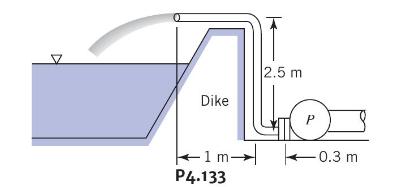
Calculate the torque exerted on the flange joint by the fluid flow as a function of the pump flow rate. Neglect the weight of the \(100 \mathrm{~mm}\) diameter pipe and the fluid in the pipe. Dike 2.5 m 1 m -0.3 m P4.133
Consider the sprinkler of Problem 4.130 again. Derive a differential equation for the angular speed of the sprinkler as a function of time. Evaluate its steady-state speed of rotation if there is no friction in the pivot.Data From Problem 4.130 4.130 The simplified lawn sprinkler shown rotates in
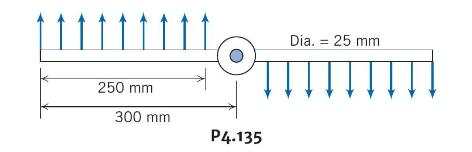
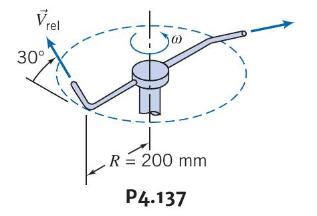
Water flows out of the \(2.5-\mathrm{mm}\) slots of the rotating spray system, as shown. The velocity varies linearly from a maximum at the outer radius to zero at the inner radius. The flow rate is \(3 \mathrm{~L} / \mathrm{s}\). Find (a) the torque required to hold the system stationary and (b)
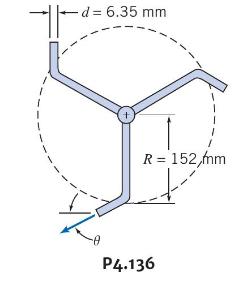
The lawn sprinkler shown is supplied with water at a rate of \(68 \mathrm{~L} / \mathrm{min}\). Neglecting friction in the pivot, determine the steady-state angular speed for \(\theta=30^{\circ}\). Plot the steady-state angular speed of the sprinkler for \(0 \leq \theta \leq 90^{\circ}\). -d=6.35mm
A small lawn sprinkler is shown. The sprinkler operates at a gage pressure of \(140 \mathrm{kPa}\). The total flow rate of water through the sprinkler is \(4 \mathrm{~L} / \mathrm{min}\). Each jet discharges at \(17 \mathrm{~m} / \mathrm{s}\) (relative to the sprinkler arm) in a direction inclined
When a garden hose is used to fill a bucket, water in the bucket may develop a swirling motion. Why does this happen? How could the amount of swirl be calculated approximately?
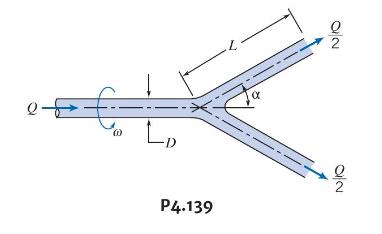
A pipe branches symmetrically into two legs of length \(L\), and the whole system rotates with angular speed \(\omega\) around its axis of symmetry. Each branch is inclined at angle \(\alpha\) to the axis of rotation. Liquid enters the pipe steadily, with zero angular momentum, at volume flow rate
For the rotating sprinkler of Example 4.13, what value of \(\alpha\) will produce the maximum rotational speed? What angle will provide the maximum area of coverage by the spray? Draw a velocity diagram (using an \(r, \theta, z\) coordinate system) to indicate the absolute velocity of the water jet
Compressed air is stored in a pressure bottle with a volume of \(100 \mathrm{~L}\), at \(500 \mathrm{kPa}\) absolute and \(20^{\circ} \mathrm{C}\). At a certain instant, a valve is opened and mass flows from the bottle at \(\dot{m}=0.01 \mathrm{~kg} / \mathrm{s}\). Find the rate of change of
A turbine is supplied with \(0.6 \mathrm{~m}^{3} / \mathrm{s}\) of water from a \(0.3 \mathrm{~m}\) diameter pipe; the discharge pipe has a \(0.4 \mathrm{~m}\) diameter. Determine the pressure drop across the turbine if it delivers \(60 \mathrm{~kW}\).
Air is drawn from the atmosphere into a turbomachine. At the exit, conditions are \(500 \mathrm{kPa}\) gage and \(130^{\circ} \mathrm{C}\). The exit speed is \(100 \mathrm{~m} / \mathrm{s}\) and the mass flow rate is \(0.8 \mathrm{~kg} / \mathrm{s}\). Flow is steady and there is no heat transfer.
At high speeds the compressor and turbine of the jet engine may be eliminated entirely. The result is called a ramjet (a subsonic configuration is shown). Here the incoming air is slowed and the pressure increases; the air is heated in the widest part by the burning of injected fuel. The heated air
Transverse thrusters are used to make large ships fully maneuverable at low speeds without tugboat assistance. A transverse thruster consists of a propeller mounted in a duct; the unit is then mounted below the waterline in the bow or stern of the ship. The duct runs completely across the ship.
All major harbors are equipped with fire boats for extinguishing ship fires. A 75-mm-diameter hose is attached to the discharge of a \(11 \mathrm{~kW}\) pump on such a boat. The nozzle attached to the end of the hose has a diameter of \(25 \mathrm{~mm}\). If the nozzle discharge is held \(3
A pump draws water from a reservoir through a \(150-\mathrm{mm}-\) diameter suction pipe and delivers it to a \(75-\mathrm{mm}\)-diameter discharge pipe. The end of the suction pipe is \(2 \mathrm{~m}\) below the free surface of the reservoir. The pressure gage on the discharge pipe \((2
Liquid flowing at high speed in a wide, horizontal open channel under some conditions can undergo a hydraulic jump, as shown. For a suitably chosen control volume, the flows entering and leaving the jump may be considered uniform with hydrostatic pressure distributions (see Example 4.7). Consider a
Which of the following sets of equations represent possible three dimensional incompressible flow cases?(a) \(u=2 y^{2}+2 x z ; v=-2 x y+6 x^{2} y z ; w=3 x^{2} z^{2}+x^{3} y^{4}\)(b) \(u=x y z t ; v=-x y z z^{2} ; w=z^{2}\left(x t^{2}-y t\right)\)(c) \(u=x^{2}+2 y+z^{2} ; v=x-2 y+z ; w=-2 x
Which of the following sets of equations represent possible two dimensional incompressible flow cases?(a) \(u=2 x y ; v=-x^{2} y\)(b) \(u=y-x+x^{2} ; v=x+y-2 x y\)(c) \(u=x^{2} t+2 y ; v=2 x-y t^{2}\)(d) \(u=-x^{2}-y^{2}-x y t ; v=x^{2}+y^{2}+x y t\)
In an incompressible three-dimensional flow field, the velocity components are given by \(u=a x+b y z ; v=c y+d x z\). Determine the form of the \(z\) component of velocity. If the \(z\) component were not a function of \(x\) or \(y\) what would be the form be?
In a two-dimensional incompressible flow field, the \(x\) component of velocity is given by \(u=2 x\). Determine the equation for the \(y\) component of velocity if \(v=0\) along the \(x\) axis.
The three components of velocity in a velocity field are given by \(u=A x+B y+C z, v=D x+E y+F z\), and \(w=G x+H y+J z\). Determine the relationship among the coefficients \(A\) through \(J\) that is necessary if this is to be a possible incompressible flow field.
The \(x\) component of velocity in a steady, incompressible flow field in the \(x y\) plane is \(u=A / x\), where \(A=2 \mathrm{~m}^{2} / \mathrm{s}\), and \(x\) is measured in meters. Find the simplest \(y\) component of velocity for this flow field.
The \(y\) component of velocity in a steady incompressible flow field in the \(x y\) plane is\[v=\frac{2 x y}{\left(x^{2}+y^{2}\right)^{2}}\]Show that the simplest expression for the \(x\) component of velocity is\[u=\frac{1}{\left(x^{2}+y^{2}\right)}-\frac{2 y^{2}}{\left(x^{2}+y^{2}\right)^{2}}\]
The velocity components for an incompressible steady flow field are \(u=a\left(x^{2}+z^{2}\right)\) and \(v=b(x y+y z)\). Determine the general expression for the \(z\) component of velocity. If the flow were unsteady, what would be the expression for the \(z\) component?
The radial component of velocity in an incompressible two-dimensional flow is given by \(V_{r}=3 r-2 r^{2} \cos (\theta)\). Determine the general expression for the \(\theta\) component of velocity. If the flow were unsteady, what would be the expression for the \(\theta\) component?
Showing 500 - 600
of 1127
1
2
3
4
5
6
7
8
9
10
11
12
Step by Step Answers

 Get 50% OFF
Claim Now
Get 50% OFF
Claim Now