New Semester
Started
Get
50% OFF
Study Help!
--h --m --s
Claim Now
Question Answers
Textbooks
Find textbooks, questions and answers
Oops, something went wrong!
Change your search query and then try again
S
Books
FREE
Study Help
Expert Questions
Accounting
General Management
Mathematics
Finance
Organizational Behaviour
Law
Physics
Operating System
Management Leadership
Sociology
Programming
Marketing
Database
Computer Network
Economics
Textbooks Solutions
Accounting
Managerial Accounting
Management Leadership
Cost Accounting
Statistics
Business Law
Corporate Finance
Finance
Economics
Auditing
Tutors
Online Tutors
Find a Tutor
Hire a Tutor
Become a Tutor
AI Tutor
AI Study Planner
NEW
Sell Books
Search
Search
Sign In
Register
study help
engineering
the science and engineering of materials
The Science And Engineering Of Materials 7th Edition Donald R. Askeland, Wendelin J. Wright - Solutions
A sheet of copper is exposed to oxygen at 1000°C. After 100 h, 0.246 g of copper are lost per cm2 of surface area; after 250 h, 0.388 g/cm2 are lost; and after 500 h, 0.550 g/cm2 are lost. Determine whether the oxidation is parabolic, linear, or logarithmic, then determine the time required for a
At 800°C, iron oxidizes at a rate of 0.014 g/cm2 per hour; at 1000°C, iron oxidizes at a rate of 0.0656 g/cm2 per hour. Assuming a parabolic oxidation rate, determine the maximum temperature at which iron can be held if the oxidation rate is to be less than 0.005 g/cm2 per hour.
The drilling platforms for offshore oil rigs are supported on large steel columns resting on the bottom of the ocean. Design an approach to ensure that corrosion of the supporting steel columns does not occur.
A storage building is to be produced using steel sheet for the siding and roof. Design a corrosion protection system for the steel.
Design the materials for the scraper blade for a piece of earthmoving equipment.
Write a computer program that will calculate the thickness of a coating using different inputs provided by the user (e.g., density and valence of the metal, area or dimensions of the part being plated, desired time of plating, and current).
A 2-m-long soda-lime glass sheet is produced at 1400°C. Determine its length after it cools to 25°C.
A lead pipe in the basement of an old house travels 15 feet from the water heater outlet elbow to the riser up to a sink. The basement is cool and dank at 20°C, and thewater that is suddenly flowing through the pipe is 53°C. How much linear expansion does the pipe undergo?
State any two applications for which a high thermal conductivity is desirable.
1. The molar heat capacity is the energy required to increase the temperature of one mole of a material by one degree. How much heat is required to bring 50 moles of ethanol stored at 25°C to a boil?2. The thermal expansion coefficient is the change of length of a material per unit length per
State any two applications for which a low thermal conductivity of a material is desirable.
If the gas constant was exactly 1.987 caly(mol·K), what is the percent error in assuming 3R is 6 caly(mol · K)?
In older references in the English language, you may find the specific heat in units of BTUy(lbm · °R), where BTU is the British thermal unit, lbm is pounds, and °R is degrees Rankine. Look up the conversion factors for these units and determine what the specific heat of water is in these units.
Calculate the increase in temperature for 1 kg samples of the following metals when 20,000 joules of heat is supplied to the metal at 25°C:(a) Al;(b) Cu;(c) Fe; and(d) Ni.
Calculate the heat (in calories and joules) required to raise the temperature of 1 kg of the following materials by 50°C:(a) Lead;(b) Nickel;(c) Si3N4; and(d) 6,6-nylon.
Calculate the temperature of a 100 g sample of the following materials (originally at 25°C) when 3000 calories are introduced:(a) Tungsten;(b) Titanium;(c) Al2O3; and(d) Low-density polyethylene.
An alumina insulator for an electrical device is also to serve as a heat sink. A 10°C temperature rise in an alumina insulator 1 cm x 1 cm x 0.02 cm is observed during use. Determine the thickness of a high-density polyethylene insulator that would be needed to provide the same performance as a
A 200 g sample of aluminum is heated to 400°C and then quenched into 2000 cm3 of water at 20°C. Calculate the temperature of the water after the aluminum and water reach equilibrium. Assume no heat loss from the system.
A copper casting requires the final dimensions to be 2.5 cm x 50 cm x 10 cm. Determine the size of the pattern that must be used to make the mold into which the liquid copper is poured during the manufacturing process.
A copper casting requires the final dimensions to be 1 in. x 12 in. x 24 in. Determine the size of the pattern that must be used to make the mold into which the liquid copper is poured during the manufacturing process.
An aluminum casting is made using the permanent mold process. In this process, the liquid aluminum is poured into a gray cast iron mold that is heated to 350°C. We wish to produce an aluminum casting that is 15 in. long at 25°C. Calculate the length of the cavity that must be machined into the
We coat a 100-cm-long, 2-mm-diameter copper wire with a 0.5-mm-thick epoxy insulation coating. Determine the length of the copper and the coating when their temperature increases from 25°C to 250°C. What is likely to happen to the epoxy coating as a result of this heating?
A Ti-alloy strip and stainless steel strip are roll bonded at 760°C. If the total length of the bimetallic strip is 1 m long when hot rolled, calculate the length of each metal at 25°C. What is the nature of the stress (compressive or tensile) just below the surface on the Ti-alloy side and on
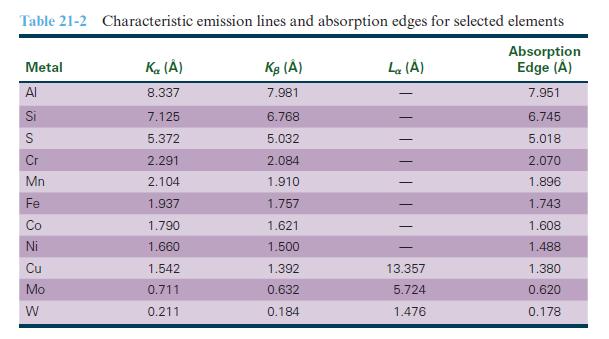
Plot Ka as a function of the absorption edge and see if there is any likely trend. (Table 21-2.) Try and explain the trend(s) if you find any. Table 21-2 Characteristic emission lines and absorption edges for selected elements La (A) Absorption Edge
How are colored glasses produced?
What is a photochromic glass?
A material has a linear absorption coefficient of 591 cm–1 for a particular wavelength. Determine the thickness of the material required to absorb 99.9% of the photons.
If a 10-cm-thick prism reduces the intensity of a light by 25%, what is its linear absorption coefficient?
A beam of light in water reflects off of a polished germanium sphere. What is its reflectivity?
A glass fiber (n = 1.5) is coated with Teflon. Calculate the maximum angle that a beam of light can deviate from the axis of the fiber without escaping from the inner portion of the fiber.
A beam of photons in air strikes a composite material consisting of a 1-cm-thick sheet of polyethylene and a 2-cm-thick sheet of soda-lime glass. The incident beam is 10° from the normal of the composite.Determine the angle of the beam with respect to the normal of the composite as it(a) Passes
We find that 20% of the original intensity of a beam of photons is transmitted from air through a 1-cm-thick material having a dielectric constant of 2.3 and back into air. Determine the fraction of the beam that is (a) Reflected at the front surface;(b) Absorbed in the material; and(c)
A beam of photons passes through air and strikes a soda-lime glass that is part of an aquarium containing water. What fraction of the beam is reflected by the front face of the glass? What fraction of the remaining beam is reflected by the back face of the glass?
A block of glass 10-cm-thick with n = 1.5 transmits 90% of light incident on it. Determine the linear absorption coefficient (α) for this material. If this block is placed in water, what fraction of the incident light will be transmitted through it?
A length of 6000 km of fiber-optic cable is laid to connect New York to London. If the core of the cable has a refractive index of 1.48 and the cladding has a refractive index of 1.45, what is the time needed for a beam of photons introduced at 0° in New York to reach London? Assume that
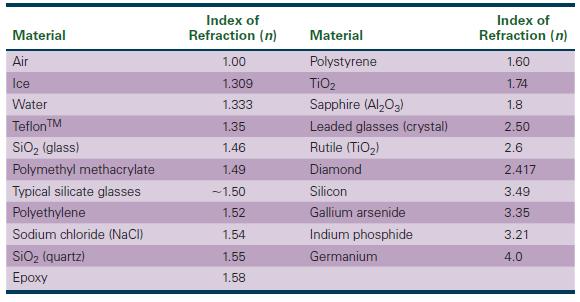
A beam of photons strikes a material at an angle of 25° to the normal of the surface. Which, if any, of the materials listed in Table 21-1 could cause the beam of photons to continue at an angle of 18 to 20° from the normal of the material’s surface? Material Air Ice Water Teflon ™M SiO₂
A laser beam passing through air strikes a 5-cm-thick polystyrene block at a 20° angle to the normal of the block. By what distance is the beam displaced from its original path when the beam reaches the opposite side of the block?
Find the speed of light through quartz. If the light has a wavelength of 5890 Å in a vacuum, what wavelength does it have in the quartz?
What material has a wavelength of about 0.5 mm? 0.88 mm? What is the band gap energy of lead sulfate?
Write the formula for wavelength as a function of frequency, and find the frequency of a 560-nm photon.
What is the principle by which LEDs and solar cells work?
What factors limit the transmission of light through dielectric materials?
What is dispersion? What is the importance of dispersion in fiber-optic systems?
Why is the refractive index of ice smaller than that of water?
What polarization mechanism affects the refractive index?
What is “lead crystal”? What makes the refractive index of this material so much higher than that of ordinary silicate glass?
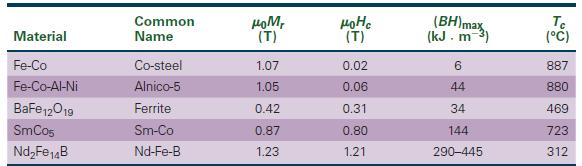
Design a permanent magnet to lift a 1000 kg maximum load under operating temperatures as high as 750°C. Which material(s) listed in Table 20-6 will meet the above requirement? Material Fe-Co Fe-Co-Al-Ni BaFe
Upon what does the index of refraction of a material depend?
The coercive field for pure iron is related to the grain size of the iron by the relationship Hc = 1.83 + 4.14/√A, where A is the area of the grain in two dimensions (mm2) and Hc has units of Aym. If only the grain size influences the 99.95% iron (coercivity 0.9 oersted), estimate the size of the
What is Snell’s law? Illustrate using a diagram.
State the definitions of refractive index and absorption coefficient. Compare these with the definitions of dielectric constant, loss factor, Young’s modulus, and viscous deformation.
1. A beam of light passes through benzene to glass (silicon dioxide). The angle of incidence of the light is 30°. What is the angle of the refracted light?2. Calculate the reflectivity of mercury in air from the index of refraction n.
Converting Magnetic Units. Write a computer program that will convert magnetic units from the cgs or Gaussian system to the SI system. For example, if the user provides a value of flux density in gauss, the program should provide a value in Wb/m2 or tesla.
Design a spinel-structure ferrite that will produce a total magnetic moment per cubic meter of 4.1 x 10⁵ Aym.
Design a permanent magnet that will have a remanance of at least 5000 gauss, that will not be demagnetized if exposed to a temperature of 400°C or to a magnetic field of 1000 oersted, and that has good magnetic power.
Design a solenoid no longer than 1 cm that will produce an inductance of 3000 gauss.
What is spintronics? Give an example of a spintronics-based device used in personal and laptop computers.
State examples of materials that show the magnetostriction effect.
What is magnetostriction? How is this similar to electrostriction? How is it different from the piezoelectric effect?
Suppose that the total magnetic moment per cubic meter in a spinel structure in which Ni2+ ions have replaced a portion of the Fe2+ ions is 4.6 x 10⁵ Aym. Calculate the fraction of the Fe2+ ions that have been replaced and the wt% Ni present in the spinel.
Suppose we replace 10% of the Fe2+ ions in magnetite with Cu2+ ions. Determine the total magnetic moment per cubic centimeter.
Calculate the attractive force per square meter from a permanent magnet with a saturation magnetization of 1.0 tesla.
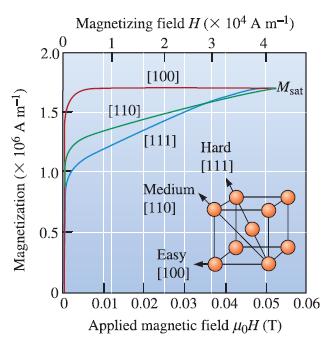
Refer to Figure 20-13. What are the coordinates of Msat? Use the units of Aym for both values. Magnetization (X 106 A m-¹) 0 2.0 1.5 1.0 0.5 0 0 Magnetizing field H (X 104 A m-¹) 2 3 4 [100] [110] [111] Medium [110] Easy [100] Hard [111] Msat 0.01 0.02 0.03 0.04 0.05 0.06 Applied magnetic field
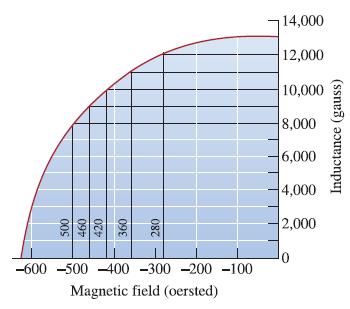
Take the maximum power from the problem in Example 20-3 and convert it to SI units.Example 20-3Determine the power, or BH product, for the magnetic material with the properties shown in Figure 20-11. 500 460 420 -600-500-400-300-200 -100 Magnetic field
What advantages does the Fe-3% Si material have compared with permalloy for use in electric motors?
A force of 20 lb is applied to the face of a 0.5 cm x 0.5 cm x 0.1 cm thickness of quartz crystal. Determine the voltage produced by the force. The modulus of elasticity of quartz is 10.4 x 10⁶ psi.
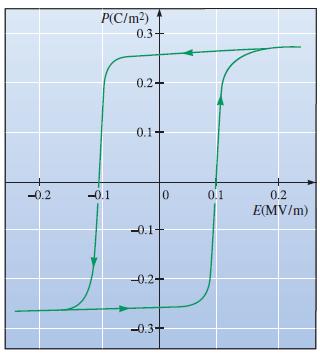
For the example hysteresis loop in Figure 19-24, what is the polarization (Cym2 if the electric field starts at 0.2 MV⁄m and drops to zero? -0.2 P(C/m²) -0.1 0.3- 0.2+ 0.1+ 0 -0.1+ -0.2+ -0.3+ 0.1 0.2 E(MV/m)
We would like to produce a 100-ohm resistor using a thin wire of a material. Design such a device.
Design a capacitor that is capable of storing 1 μF when 100 V is applied.
Design an epoxy-matrix composite that has a modulus of elasticity of at least 35 x 106 psi and an electrical conductivity of at least 1 x 10⁵ ohm-1 · cm-1.
State any four real-world applications of different magnetic materials.
Explain the following statement: “Strictly speaking, there is no such thing as a nonmagnetic material.”
Normally, we disregard the magnetic moment of the nucleus. In what application does the nuclear magnetic moment become important?
What two motions of electrons are important in determining the magnetic properties of materials?
Explain why only a handful of solids exhibit ferromagnetic or ferrimagnetic behavior.
Calculate and compare the maximum magnetization we would expect in iron, nickel, cobalt, and gadolinium. There are seven electrons in the 4f level of gadolinium. Compare the calculated values with the experimentally observed values.Calculate and compare the maximum magnetization we would expect in
Calculate the mass of an electron by using the mass of the Bohr magneton and Planck’s constant.
Define the following terms: magnetic induction, magnetic field, magnetic susceptibility, and magnetic permeability.
Define the following terms: ferromagnetic, ferrimagnetic, diamagnetic, paramagnetic, superparamagnetic, and antiferromagnetic materials.
What is a ferromagnetic material? What is a ferrimagnetic material? Explain and provide examples of each type of material.
How does the permeability of ferromagnetic and ferrimagnetic materials change with temperature when the temperature is greater than the Curie temperature?
Derive the equation μr = 1 + xm using Equations 20-4 through 20-7. B = μH (20-4)
A 4-79 permalloy solenoid coil needs to produce a minimum inductance of 1.5 Wbym2. If the maximum allowed current is 5 mA, how many turns are required in a wire 1 m long?
An alloy of nickel and cobalt is to be produced to give a magnetization of 2 x 10⁶ Aym. The crystal structure of the alloy is FCC with a lattice parameter of 0.3544 nm. Determine the atomic percent cobalt required, assuming no interaction between the nickel and cobalt.
Estimate the magnetization that might be produced in an alloy containing nickel and 70 at% copper, assuming that no interaction occurs.
An Fe-80% Ni alloy has a maximum permeability of 300,000 when an inductance of 3500 gauss is obtained. The alloy is placed in a 20-turn coil that is 2 cm in length. What current must flow through the conductor coil to obtain this field?
An Fe-49% Ni alloy has a maximum permeability of 64,000 when a magnetic field of 0.125 oersted is applied. What inductance is obtained and what current is needed to obtain this inductance in a 200-turn, 3-cm-long coil?
Draw a schematic of the B-H and M-H loops for a typical ferromagnetic material. What is the difference between these two loops?
Is the magnetic permeability of ferromagnetic or ferrimagnetic materials constant? Explain.
From a phenomenological viewpoint, what are the similarities between elastomers, ferromagnetic and ferrimagnetic materials, and ferroelectrics?
What are the major differences between ferromagnetic and ferrimagnetic materials?
Compare the electrical resistivities of ferromagnetic metals and ferrimagnetic ceramics.
Why are eddy current losses important design factors in ferromagnetic materials but less important in ferrimagnetic materials?
Which element has the highest saturation magnetization? What alloys have the highest saturation magnetization of all materials?
What material has the highest energy product of all magnetic materials?
Is coercivity of a material a microstructuresensitive property? Is remanance a microstructure- sensitive property? Explain.
Is saturation magnetization of a material a microstructure-sensitive property? Explain.
Can the same material have different hysteresis loops? Explain.
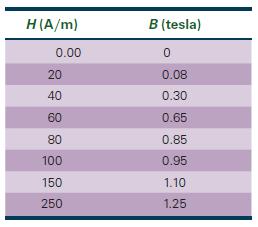
The following data describe the effect of the magnetic field on the inductance in a silicon steel. Calculate the initial permeability and the maximum permeability for the material. H (A/m) 0.00 20 40 60 80 100 150 250 B (tesla) 0 0.08 0.30 0.65 0.85 0.95 1.10 1.25
Using Figure 20-16, determine the following properties of the magnetic material: remanance, saturation magnetization, coercive field, initial permeability, maximum permeability, and power (maximum BH product). B (gauss) 14,000 r 10,000 6,000 2,000 -1200-600
Showing 500 - 600
of 2309
1
2
3
4
5
6
7
8
9
10
11
12
13
14
15
Last
Step by Step Answers

 Get 50% OFF
Claim Now
Get 50% OFF
Claim Now