New Semester
Started
Get
50% OFF
Study Help!
--h --m --s
Claim Now
Question Answers
Textbooks
Find textbooks, questions and answers
Oops, something went wrong!
Change your search query and then try again
S
Books
FREE
Study Help
Expert Questions
Accounting
General Management
Mathematics
Finance
Organizational Behaviour
Law
Physics
Operating System
Management Leadership
Sociology
Programming
Marketing
Database
Computer Network
Economics
Textbooks Solutions
Accounting
Managerial Accounting
Management Leadership
Cost Accounting
Statistics
Business Law
Corporate Finance
Finance
Economics
Auditing
Tutors
Online Tutors
Find a Tutor
Hire a Tutor
Become a Tutor
AI Tutor
AI Study Planner
NEW
Sell Books
Search
Search
Sign In
Register
study help
engineering
the science and engineering of materials
The Science And Engineering Of Materials 7th Edition Donald R. Askeland, Wendelin J. Wright - Solutions
A magnetic material has a coercive field of 167 Aym, a saturation magnetization of 0.616 tesla, and a residual inductance of 0.3 tesla. Sketch the hysteresis loop for the material.
A magnetic material has a coercive field of 10.74 A/m, a saturation magnetization of 2.158 tesla, and a remanance induction of 1.183 tesla. Sketch the hysteresis loop for the material.
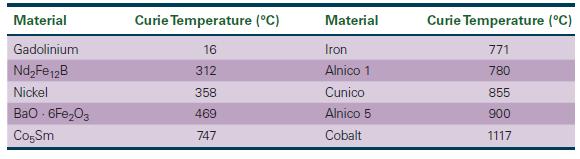
Give the electron configuration of the pure elements in Table 20-3. Material Gadolinium Nd₂Fe₁2B Nickel BaO 6Fe₂O3 Co-Sm . Curie Temperature (°C) 16 312 358 469 747 Material Iron Alnico 1 Cunico Alnico 5 Cobalt Curie Temperature (°C) 771 780 855 900 1117
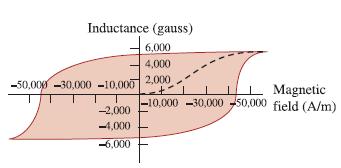
Using Figure 20-17, determine the following properties of the magnetic material: remanance, saturation magnetization, coercive field, initial permeability, maximum permeability, and power (maximum BH product). Inductance (gauss) 6,000 4,000 -50,000-30,000 -10,000
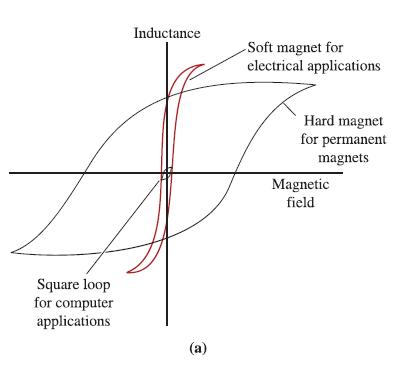
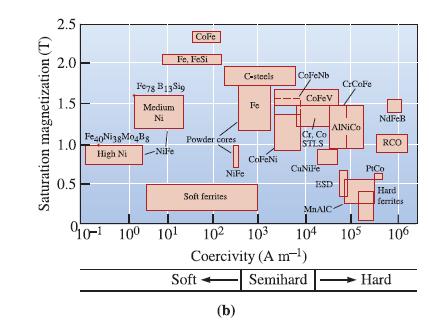
In Figure 20-9(b), what materials have the highest and lowest saturation magnetizations and coercivities? Square loop for computer applications Inductance (a) Soft magnet for electrical applications Hard magnet for permanent magnets Magnetic field
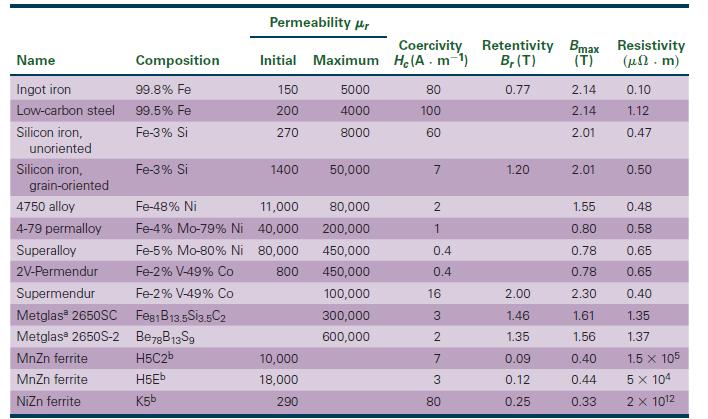
Use the data in Table 20-4 to correlate maximum permeability with coercivity. Is there a potential trend? Name Ingot iron Low-carbon steel Silicon iron, unoriented Silicon iron, grain-oriented 4750 alloy 4-79 permalloy Superalloy 2V-Permendur Supermendur Metglas 2650SC Metglasª 2650S-2 MnZn
Sketch the M-H loop for Fe at 300 K, 500 K, and 1000 K.
Define the terms soft and hard magnetic materials. Draw a typical M-H loop for each material.
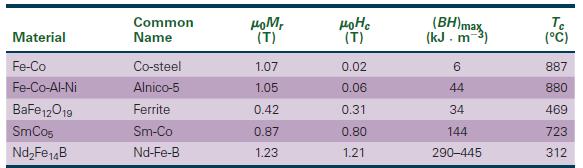
Use the data in Table 20-6 to see if there is a possible relationship between BHmax and the Curie temperature. Material Fe-Co Fe-Co-Al-Ni BaFe 12019 SmCo5 Nd₂Fe₁4B Common Name Co-steel Alnico-5 Ferrite Sm-Co Nd-Fe-B ном, (T) 1.07 1.05 0.42 0.87 1.23 HoHe (T) 0.02 0.06 0.31 0.80 1.21 (kJ.
What important characteristics are associated with soft magnetic materials?
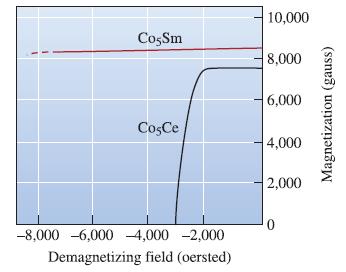
Estimate the power of the Co5Ce material shown in Figure 20-14. Co-Sm Cosce -8,000 -6,000 -4,000 -2,000 Demagnetizing field (oersted) 10,000 8,000 6,000 4,000 2,000 Magnetization (gauss)
Are materials used for magnetic data storage magnetically hard or soft? Explain.
Give examples of materials used in magnetic recording.
What are the advantages of using Fe- Nd-B magnets? What are some of their disadvantages?
What is the maximum magnetic power for Co-γ-Fe2O3?
A multi-layer capacitor is to be designed using a relaxor ferroelectric formulation based on lead magnesium niobate (PMN). The apparent dielectric constant of the material is 20,000. Calculate the capacitance of a multilayer capacitor consisting of ten layers connected in parallel using Ni
Calculate the capacitance of a parallelplate capacitor containing five layers of mica for which each mica sheet is 1 cm x 2 cm x 0.005cm. The layers are connected in parallel.
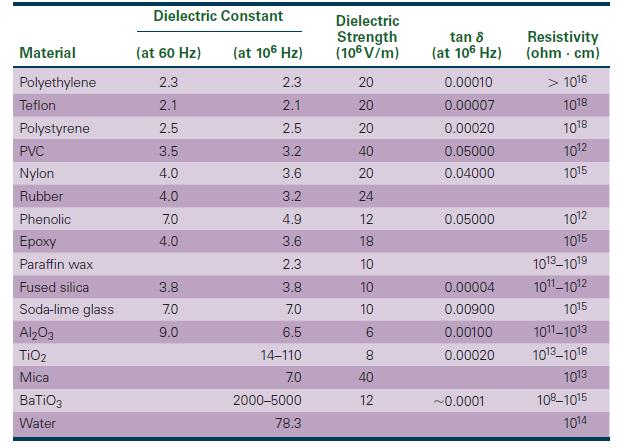
For the 14 materials with both a dielectric strength and resistivity listed in Table 19-7, plot the dielectric strength as a function of resistivity. Assume log average values for the resistivity ranges. Material Polyethylene Teflon Polystyrene PVC Nylon Rubber Phenolic Epoxy Paraffin wax Fused
Define the following terms: electrostriction, piezoelectricity (define both its direct and converse effects), and ferroelectricity.
Suppose we are able to produce a polarization of 5 x 10⁻⁸ C/m2 in a cube (5 mm side) of barium titanate. Assume a dielectric constant of 3000. What voltage is produced?
A 2-mm-thick alumina dielectric is used in a 60 Hz circuit. Calculate the voltage required to produce a polarization of 5 x 10⁻⁷ Cym2.
Calculate the displacement of the electrons or ions for the following conditions: (a) Electronic polarization in nickel of 2 x 10⁻⁷ C/m2;(b) Electronic polarization in aluminum of 2 x 10⁻⁸ Cym2;(c) Ionic polarization in NaCl of 4.3 x 10⁻⁸ Cym2; and(d) Ionic polarization in ZnS
With respect to mechanical behavior, we have seen that stress (a cause) produces strain (an effect). What is the electrical analog of this?
Can polymers be semiconducting? What would be the advantages in using these instead of silicon?
How do the touch screen displays on some computers work?
What are ionic conductors? What are their applications?
Calculate the electrical conductivity of a fiber-reinforced polyethylene part that is reinforced with 20 vol % of continuous, aligned nickel fibers.
If we want the resistivity of a nylon to be 104 ohm · cm, what weight percent carbon fibers should be added?
Silicon is the material of choice for the substrate for integrated circuits. Explain why silicon is preferred over germanium, even though the electron and hole mobilities are much higher and the bandgap is much smaller for germanium than for silicon. Provide a list of the references or websites
Investigate the scaling relationship known as Moore’s Law. Is it expected that this trend will continue to be followed in the future using established microelectronics fabrication techniques? If not, what are some of the alternatives currently being considered? Provide a list of the references or
How can we make LEDs that emit white light (i.e., light that looks like sunlight)?
Design a light-emitting diode that will emit at 1.12 micrometers. Is this wavelength in the visible range? What is a potential application for this type of LED?
When a voltage of 5 mV is applied to the emitter of a transistor, a current of 2 mA is produced. When the voltage is increased to 8 mV, the current through the collector rises to 6 mA. By what percentage will the collector current increase when the emitter voltage is doubled from 9 mV to 18 mV?
At room temperature, will the conductivity of silicon doped with 1017 cm-3 of arsenic be greater than, about equal to, or less than the conductivity of silicon doped with 1017 cm-3 of phosphorus?
Determine the electrical conductivity of silicon when 0.0001 at% antimony is added as a dopant and compare it to the electrical conductivity when 0.0001 at% indium is added.
Calculate the electrical conductivity of silicon doped with 1018 cm-3 boron at room temperature. Compare the intrinsic carrier concentration to the dopant concentration.
Calculate the intrinsic carrier concentration for GaAs at room temperature. Given that the effective mass of electrons in GaAs is 0.067me, where me is the mass of the electron, calculate the effective mass of the holes.
Determine the amount of arsenic that must be combined with 1 kg of gallium to produce a p-type semiconductor with an electrical conductivity of 500 ohm-1 · cm-1 at 25°C. The lattice parameter of GaAs is about 5.65 Å, and GaAs has the zincblende structure.
Estimate the electrical conductivity of silicon doped with 0.0002 at% arsenic at 600°C, which is above the plateau in the conductivity-temperature curve.
We would like to produce an extrinsic germanium semiconductor having an electrical conductivity of 2000 ohm-1 · cm-1. Determine the amount of phosphorus and the amount of gallium required to make n- and p-type semiconductors, respectively.
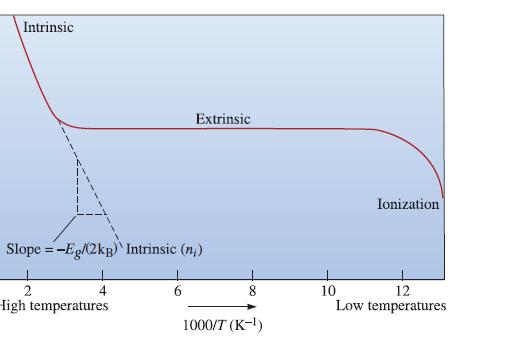
Report the temperature range (in°C) for which the sample in Figure 19-15 behaves as an extrinsic semiconductor. Intrinsic 1 Extrinsic Slope =-Eg/2kB) Intrinsic (n;) 2 High temperatures 1000/T (K-¹) Ionization 10 12 Low temperatures
For germanium and silicon, compare the temperatures required to double the electrical conductivities from the room temperature values.
For germanium and silicon, compare, at 25°C, the number of charge carriers per cubic centimeter, the fraction of the total electrons in the valence band that are excited into the conduction band, and the constant n0.
What is radiative and nonradiative recombination? What types of materials are used to make LEDs?
Explain the following terms: semiconductor, intrinsic semiconductor, extrinsic semiconductor, elemental semiconductor, compound semiconductor, direct bandgap semiconductor, and indirect bandgap semiconductor.
The electrical resistivity of a beryllium alloy containing 5 at% of an alloying element is found to be 50 x 10-6 ohm · cm at 400° C. Determine the contributions to resistivity due to temperature and due to impurities by finding the expected resistivity of pure beryllium at 400°C, the
(a) Copper and nickel form a complete solid solution. Draw a schematic diagram illustrating the resistivity of a copper and nickel alloy as a function of the atomic percent nickel. Comment on why the curve has the shape that it does.(b) Copper and gold do not form a complete solid solution. At the
Find the resistivity of palladium at 443°C if it has a defect contribution of 1.02 x 10⁻⁷ ohm · cm.
After finding the electrical conductivity of cobalt at 0°C, we decide we would like to double that conductivity. To what temperature must we cool the metal?
The electrical resistivity of pure chromium is found to be 18 x 10-6 ohm . cm. Estimate the temperature at which the resistivity measurement was made.
Calculate the electrical conductivity of nickel at 250°C and at 1500°C.
Calculate the electrical conductivity of platinum at 2200°C.
Calculate the resistivities of cobalt and beryllium at 505 K.
A typical thickness for a copper conductor (known as an interconnect) in an integrated circuit is 250 nm. The mean free path of electrons in pure, annealed copper is about 40 nm. As the thickness of copper interconnects approaches the mean free path, how do you expect conduction in the interconnect
Draw a schematic of the band structures of an insulator, a semiconductor, and a metal. Use this to explain why the conductivity of pure metals decreases with increasing temperature, while the opposite is true for semiconductors and insulators.
In a welding process, a current of 400 A flows through the arc when the voltage is 35 V. The length of the arc is about 0.1 in., and the average diameter of the arc is about 0.18 in. Calculate the current density in the arc, the electric field across the arc, and the electrical conductivity of the
We apply 10 V to an aluminum wire 2 mm in diameter and 20 m long. If 10% of the valence electrons carry the electrical charge, calculate the average drift velocity of the electrons in km⁄h and miles⁄h.
A current density of 5000 A⁄cm2 flows through a magnesium wire. If half of the valence electrons serve as charge carriers, calculate the average drift velocity of the electrons.
If the current density is 1.25 A⁄cm2 and the drift velocity is 107 cm⁄s, how many charge carriers are present?
Ag has an electrical conductivity of 6.80 x 10⁵ Ω–1 · cm-1. Au has an electrical conductivity of 4.26 x 10⁵ Ω-1 · cm-1. Calculate the number of charge carriers per unit volume and the electron mobility in each in order to account for this difference in electrical conductivity.
We would like to produce a 5000-ohm resistor from boron-carbide fiber having a diameter of 0.1 mm. What is the required length of the fiber?
A current density of 100,000 A⁄cm2 flows through a gold wire 50 m in length. The resistance of the wire is found to be 2 ohm. Calculate the diameter of the wire and the voltage applied to the wire.
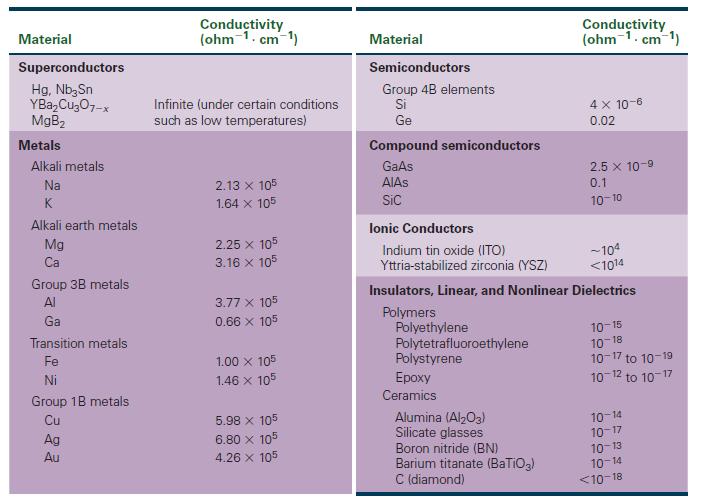
Of the metals listed in Table 19-1, which are the most and least conductive? Material Superconductors Hg, Nb3Sn YBa₂Cu3O7-x MgB₂ Metals Alkali metals Na K Alkali earth metals Mg Ca Group 3B metals Al Ga Transition metals Fe Ni Group 1B metals Cu Ag Au Conductivity (ohm 1. cm ¹) Infinite (under
The power lost in a 2-mm-diameter copper wire is to be less than 250 W when a 5 A current is flowing in the circuit. What is the maximum length of the wire?
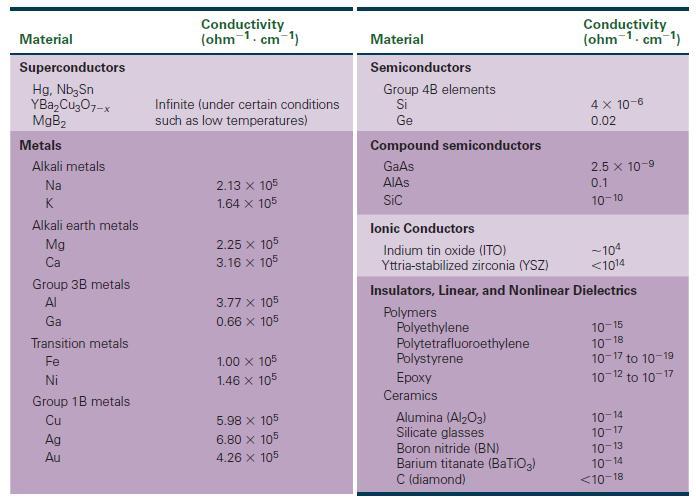
A 0.5-mm-diameter fiber, 1 cm in length, made from boron nitride is placed in a 120-Ω circuit. Using Table 19-1, calculate(a) The current flowing in the circuit; and(b) The number of electrons passing through the boron nitride fiber per second.(c) What would the current and number of electrons be
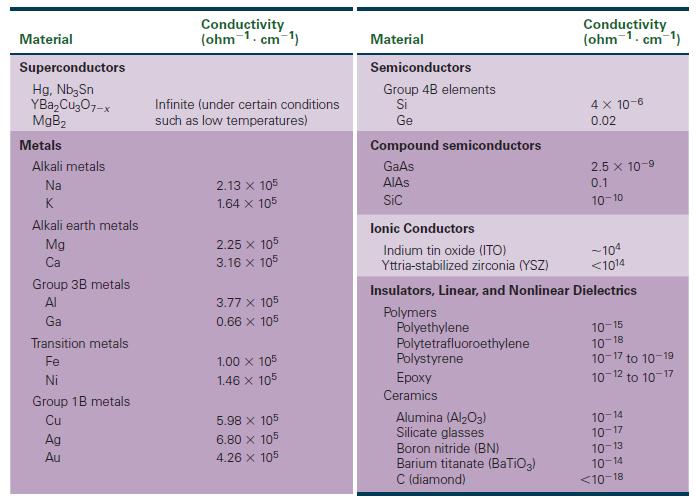
A current of 10 A passes through a 1-mmdiameter wire 1000 m long. Calculate the power loss if the wire is made from(a) Aluminum and(b) Silicon Material Superconductors Hg, Nb3Sn YBa₂Cu3O7-x MgB₂ Metals Alkali metals Na K Alkali earth metals Mg Ca Group 3B metals Al Ga Transition
A wire two microns in diameter is made from 10 cm silver, 0.1 cm gallium, and 10 cm silver all joined end to end (i.e., in series). Assume the joints are perfect and have no additional resistance. What is the total resistance of the wire?
Find the resistance of a fiber with a crosssectional area of 1.34 mm2 and length of 10 cm that is subjected to a voltage of 225 V for which the current density is 1.25 A⁄cm2. Assume the resistor is uniform in material and properties.
1. Calculate the resistivity of pure iridium at 673 K using its temperature resistivity coefficient.2. Electrical conductivity is sometimes given in the units of %IACS. What does IACS stand for? Define the unit using the information found.3. Can organic materials such as polymers and carbon
Concrete Canoe Design. Describe what novel materials can be used to make a concrete canoe.
The binder used in producing asphalt has a density of about 1.3 g/cm3. Design an asphalt, including the weight and volumes of each constituent, that might be suitable for use as pavement. Assume that the sands and aggregates are the same as those for a normal concrete.
We would like to produce a concrete sculpture. The sculpture will be as thin as 3 in. in some areas and should be light in weight, but it must have a 28-day compressive strength of at least 2000 psi. Our available aggregate contains 1% moisture, and our sands contain 5% moisture. Design a concrete
We would like to produce a concrete that is suitable for use in building a large structure in a sulfate environment. For these situations, the maximum water-cement ratio should be 0.45 (by weight). The compressive strength of the concrete after 28 days should be at least 4000 psi. We have an
Design a wood floor that will be 50 ft by 50 ft and will be in an environment in which humidity changes will cause a fluctuation of plus or minus 5% water in the wood. We want to minimize any buckling or gap formation in the floor.
A wooden structure is functioning in an environment controlled at 65% humidity. Design a wood support column that is to hold a compressive load of 20,000 lb. The distance from the top to the bottom of the column should be 96 ± 0.25 in. when the load is applied.
We plan to prepare 10 yd3 of concrete using a 1:2.5:4.5 weight ratio of cement–sand–coarse aggregate. The water–cement ratio (by weight) is 0.45. The sand contains 3 wt% water; the coarse aggregate contains 2 wt% water; and 5% entrained air is expected. Determine the number of sacks of
We have been asked to prepare 100 yd3 of normal concrete using a volume ratio of cement–sand–coarse aggregate of 1:2:4. The water–cement ratio (by weight) is to be 0.5. The sand contains 6 wt% water, and the coarse aggregate contains 3 wt% water. No entrained air is expected.(a) Determine the
Calculate the amount of cement, sand, aggregate, and water needed to create a concrete mix with a 28-day compressive strength of 34 MPa for a 10 m x 10 m x 0.25 m structure given the following conditions: allowed slump = 10 cm and only 3.8 cm (1.5 in.) aggregate with 2% moisture and coarse sand
Determine the amounts of water, cement, and sand in 10 m3 of concrete if the cement–sand–aggregate ratio is 1:2.5:4.5 and the water–cement ratio is 0.4. Assume that no air is entrained into the concrete. The sand used for this mixture contains 4 wt% water, and the aggregate contains 2
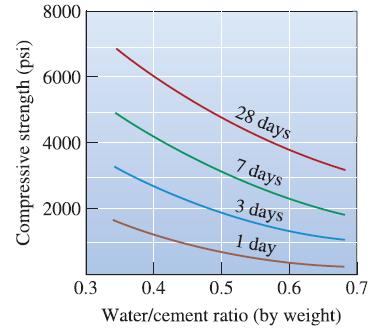
What is the maximum water to cement ratio acceptable for a structure that must have a final compressive strength of at least 5 ksi? Compressive strength (psi) 8000 6000 4000 2000 0.3 28 days 7 days 3 days 1 day 0.4 0.5 0.6 Water/cement ratio (by weight) 0.7
A wall 30 feet long is built using radial longitudinal cuts of 5-in. wide pine with the boards arranged in a vertical fashion. The wood contains a moisture content of 55% when the wall is built; however, the humidity level in the room is maintained to give 45% moisture in the wood. Determine the
Boards of maple 1 in. thick, 6 in. wide, and 16 ft long are used as the flooring for a 60 ft x 60 ft hall. The boards were cut from logs with a tangential-longitudinal cut. The floor is laid when the boards have a moisture content of 12%. After some particularly humid days, the moisture content in
Boards of oak 0.5 cm thick, 1 m long, and 0.25 m wide are used as flooring for a 10 m x 10 m area. If the floor was laid at a moisture content of 25% and the expected moisture could be as high as 45%, determine the dimensional change in the floor parallel to and perpendicular to the length of the
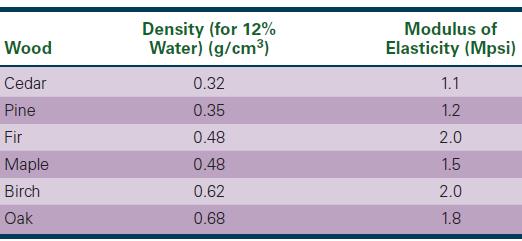
Use Table 18-1 to determine if there is a relationship between density and the elastic modulus of the woods listed. Wood Cedar Pine Fir Maple Birch Oak Density (for 12% Water) (g/cm³) 0.32 0.35 0.48 0.48 0.62 0.68 Modulus of Elasticity (Mpsi) 1.1 1.2 2.0 1.5 2.0 1.8
Determine the expansion in the radial direction of cedar when it changes from 12% to 27% water content. The initial dimension is 1 ft.
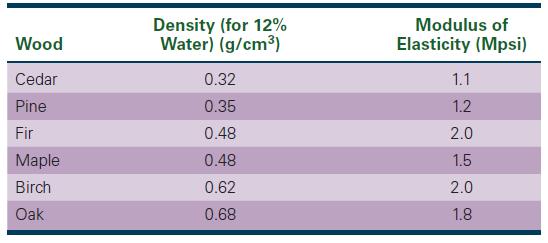
Table 18-1 lists the densities for typical woods. Calculate the densities of the woods after they are completely dried and at 100% water content. Wood Cedar Pine Fir Maple Birch Oak Density (for 12% Water) (g/cm³) 0.32 0.35 0.48 0.48 0.62 0.68 Modulus of Elasticity (Mpsi) 1.1 1.2 2.0 1.5 2.0 1.8
A green wood with a density of 0.82 g/cm3 contains 150% water. The compressive strength of this wood is 27 MPa. After several days of drying, the compressive strength increases to 41 MPa. What is the water content and density of the dried wood?
The density of a sample of oak is 0.90 g/cm3. Calculate(a) The density of completely dry oak and(b) The percent water in the original sample.
A sample of wood with the dimensions 3 in. x 4 in. x 12 in. has a dry density of 0.35 g/cm3.(a) Calculate the number of gallons of water that must be absorbed by the sample to contain 120% water.(b) Calculate the density after the wood absorbs this amount of water.
1. What is the difference in lignin content between hardwood and softwood species? What is the chemical structure of lignin?2. The equilibrium moisture content of wood is the moisture content at which the wood is neither gaining nor losing moisture. What is the moisture content of wood at 70°F
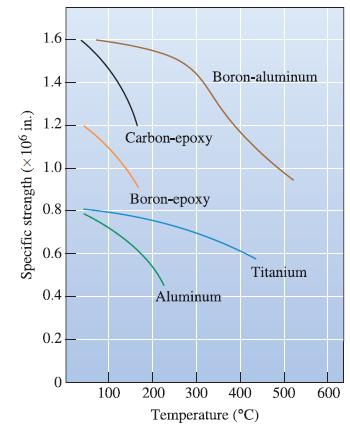
Calculate the steepest and the shallowest apparent (i.e., linear) slopes of the lines in Figure 17-26 and identify the materials to which they belong. Specific strength (x 106 in.) 1.6 1.4- 1.2 1.0 0.8 0.6 0.4 0.2 0 100 Boron-aluminum Carbon-epoxy Boron-epoxy Aluminum Titanium 200 300 400 500
Properties of a Laminar Composite. Write a computer program (or use spreadsheet software) to calculate the properties of a laminar composite. For example, if the user provides the value of the thermal conductivity of each phase and the corresponding volume fraction, the program should provide the
What factors will have to be considered in designing a bicycle frame using an aluminum frame and a frame made using C-C composite?
Design an electrical-contact material and a method for producing the material that will result in a density of no more than 6 g/cm3, yet at least 50 vol% of the material will be conductive.
Design the materials and processing required to produce a discontinuous, but aligned, fiber-reinforced fiberglass composite that will form the hood of a sports car. The composite should provide a density of less than 1.6 g/cm3 and a strength of 20,000 psi. Be sure to list all of the assumptions you
What is a laminar composite?
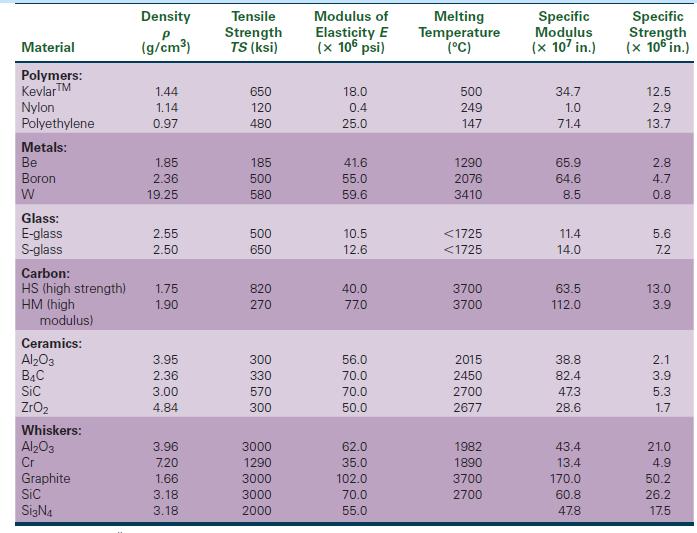
Find the materials with the highest numerical values for each of the following six properties in Table 17-2: (a) Density; (b) Tensile strength;(c) Elastic modulus; (d) Melting temperature;(e) Specific modulus; and (f) Specific strength.For example, tungsten has the highest
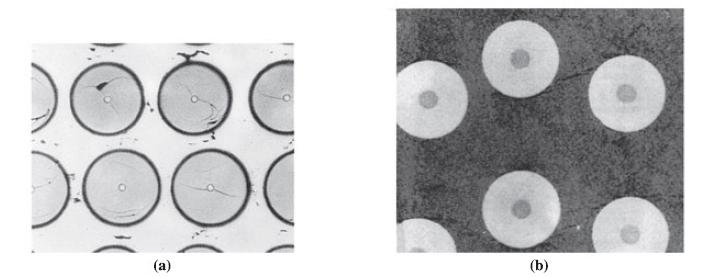
Determine the ratio of the cross-sectional area of fiber to filament in both images in Figure 17-18. DOO( (a) (b)
What are the advantages of using ceramicmatrix composites?
Plot seven equally spaced points from the curve in Figure 17-11 and find a non-polynomial equation to fit the line that has an R2 value of at least 0.900. Tensile strength (MPa) 0° 400 300 200 100 0 30° 45° 60⁰ 90° 30 60 Angle between fibers and stress 90
Showing 600 - 700
of 2309
1
2
3
4
5
6
7
8
9
10
11
12
13
14
15
Last
Step by Step Answers

 Get 50% OFF
Claim Now
Get 50% OFF
Claim Now