New Semester
Started
Get
50% OFF
Study Help!
--h --m --s
Claim Now
Question Answers
Textbooks
Find textbooks, questions and answers
Oops, something went wrong!
Change your search query and then try again
S
Books
FREE
Study Help
Expert Questions
Accounting
General Management
Mathematics
Finance
Organizational Behaviour
Law
Physics
Operating System
Management Leadership
Sociology
Programming
Marketing
Database
Computer Network
Economics
Textbooks Solutions
Accounting
Managerial Accounting
Management Leadership
Cost Accounting
Statistics
Business Law
Corporate Finance
Finance
Economics
Auditing
Tutors
Online Tutors
Find a Tutor
Hire a Tutor
Become a Tutor
AI Tutor
AI Study Planner
NEW
Sell Books
Search
Search
Sign In
Register
study help
engineering
the science and engineering of materials
The Science And Engineering Of Materials 7th Edition Donald R. Askeland, Wendelin J. Wright - Solutions
Calculation of Phases and Microconstituents in Plain Carbon Steels. Write a computer program that will calculate the amounts of phases in plain carbon steels in compositions that range from 0 to 1.5% carbon. Assume room temperature for your calculations. The program should ask the user to provide a
What are some of the steps that follow the continuous casting process?
Why has continuous casting of steels and other alloys assumed increased importance?
What is an ingot?
Explain how scrap is used for making alloys.
Explain briefly how steel is made, starting with iron ore, coke, and limestone.
What is an ore?
Why is pressure a key ingredient in the pressure die casting process?
What is investment casting? What are the advantages of investment casting? Explain why this process is often used to cast turbine blades.
An alloy is cast into a shape using a sand mold and a metallic mold. Which casting is expected to be stronger and why?
Why is it that castings made from pressure die casting are likely to be stronger than those made using the sand casting process?
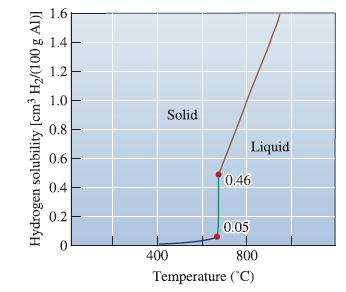
From Figure 9-14, find the solubility of hydrogen in liquid aluminum just before solidification begins when the partial pressure of hydrogen is 1 atm. Determine the solubility of hydrogen (in cm3/100 g Al) at the same temperature if the partial pressure were reduced to 0.01 atm. Hydrogen solubility
Explain the green sand molding process.
Review Example 9-7. The usual method of measuring a vacuum in the United States vacuum pump industry is in inches of mercury. For example, atmospheric pressure is 29.92 inches of mercury. Convert the pressure found in the example to in. Hg.Data From Example 9-7After melting at atmospheric pressure,
The solubility of hydrogen in liquid aluminum at 715°C is found to be 1 cm3/ (100 g Al). If all of this hydrogen precipitated as gas bubbles during solidification and remained trapped in the casting, calculate the volume percent gas in the solid aluminum.
A liquid cast iron has a density of 7.65 g/ cm3. Immediately after solidification, the density of the solid cast iron is found to be 7.71 g/cm3. Determine the percent volume change that occurs during solidification. Does the cast iron expand or contract during solidification?
Liquid magnesium is poured into a 2 cm x 2 cm x 24 cm mold and, as a result of directional solidification, all of the solidification shrinkage occurs along the 24-cm length of the casting. Determine the length of the casting immediately after solidification is complete.
In the context of stainless steel making, what is argon oxygen decarburization?
What is Sievert’s Law? How can gas porosity in molten alloys be removed or minimized?
Give examples of materials that expand upon solidification.
If you cool an open vessel of liquid gallium until a thin solid “cake” forms, will the cake form on the top or the bottom? Assume that the air above the liquid gallium is stagnant and does not cool the surface at all.
A 2 in. x 8 in. x 10 in. iron casting is produced and, after cooling to room temperature, is found to weigh 43.9 lb.Determine(a) The percent of shrinkage that must have occurred during solidification and (b) The number of shrinkage pores in the casting if all of the shrinkage occurs as pores
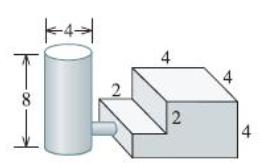
Figure 9-30 shows a cylindrical riser attached to a casting. Compare the solidification times for each casting section and the riser and determine whether the riser will be effective. 8 k41 4 2 4
A 2 cm x 4 cm x 6 cm magnesium casting is produced. After cooling to room temperature, the casting is found to weigh 80 g. Determine(a) The volume of the shrinkage cavity at the center of the casting and(b) The percent shrinkage that must have occurred during solidification.
A 4-in. cube of a liquid metal is allowed to solidify. A spherical shrinkage cavity with a diameter of 1.49 in. is observed in the solid casting. Determine the percent volume change that must have occurred during solidification.
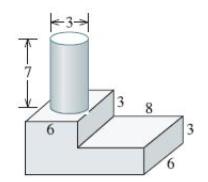
Figure 9-29 shows a cylindrical riser attached to a casting. Compare the solidification times for each casting section and the riser and determine whether the riser will be effective. K31 6 3 8 6 3
A hollow cylindrical mold for casting aluminum ingots has a 300 mm inside diameter and is 2 m high. If the mold is filled with liquid aluminum at 935 K, what is the largest spherical cavity that may form in the ingot?
Calculate the volume, diameter, and height of the cylindrical riser required to prevent shrinkage in a 4 in. x 10 in. x 20 in. casting if the H/D of the riser is 1.5.
Calculate the volume, diameter, and height of the cylindrical riser required to prevent shrinkage in a 1 in. x 6 in. x 6 in. casting if the H/D of the riser is 1.0.
What is a riser? Why should it be designed so as to freeze after the casting?
In general, compared to components prepared using forging, rolling, extrusion, etc., cast products tend to have lower fracture toughness. Explain why this may be the case.
What type of defect in a casting can cause catastrophic failure of cast components such as turbine blades? What precautions are taken to prevent porosity in castings?
Why is it that forged components do not show a cast ingot structure?
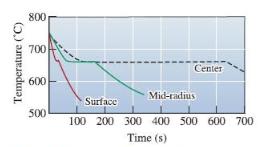
Figure 9-28 shows the cooling curves obtained from several locations within a cylindrical aluminum casting. Determine the local solidification times and the SDAS at each location, then plot the tensile strength versus distance from the casting surface. Would you recommend that the casting be
What are the features expected in the macrostructure of a cast component? Explain using a sketch.
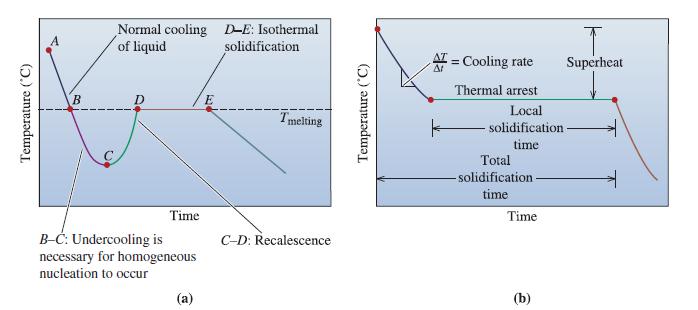
In Figure 9-8, what do the slopes of the lines A-B and E-onward represent?Do these quantities represent physical properties? Temperature (°C) B Normal cooling of liquid D Time B-C: Undercooling is necessary for homogeneous nucleation to occur (a) E D-E: Isothermal solidification Tmelting C-D:
What are the features expected in the macrostructure of a cast component? Explain using a sketch.
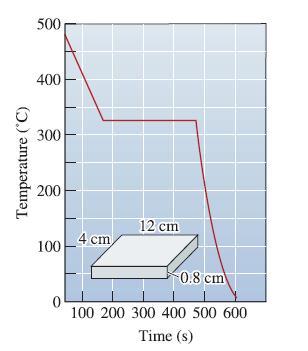
A cooling curve is shown Figure 9-26.Determine(a) The pouring temperature;(b) The solidification temperature;(c) The superheat;(d) The cooling rate, just before solidification begins;(e) The total solidification time;(f) The local solidification time; and(g) The probable identity of the metal.(h)
What is meant by the terms “local” and “total” solidification times?
What is thermal arrest?
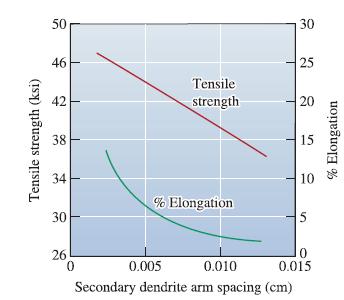
In Figure 9-7, what is the equation (slope intercept form) of the tensile strength line, and what SDAS would appear to give a tensile strength of zero if the line is extrapolated? Does extrapolating the trend like this make sense? Tensile strength (ksi) 50 46 42 38 34 30 26 Tensile strength 0 %
What is meant by the term recalescence?
Sketch a cooling curve for a pure metal and label the different regions carefully.
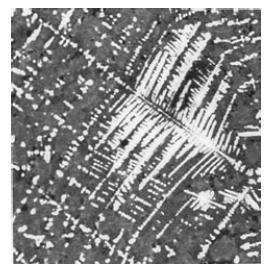
Figure 9-25 shows dendrites in a titanium powder particle that has been rapidly solidified. Assuming that the size of the titanium dendrites is related to solidification time by the same relationship as in aluminum, estimate the solidification time of the powder particle. नफ 483465 IM
A zinc alloy has a SDAS of 0.01 cm and m = 0.40. What is the solidification time?
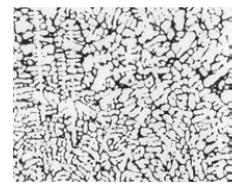
Figure 9-5(b) shows a micrograph of an aluminum alloy. Estimate(a) The secondary dendrite arm spacing and(b) The local solidification time for that area of the casting.
The secondary dendrite arm spacing in an electron-beam weld of copper is 9.5 x 10⁻⁴ cm. Estimate the solidification time of the weld.
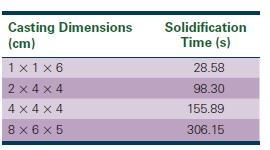
Find the constants B and n in Chvorinov’s rule by plotting the following data on a log–log plot: Casting Dimensions (cm) 1x1x6 2 x 4x4 4X4 XA 8 X6 X5 Solidification Time (s) 28.58 98.30 155.89 306.15
What solidification time is required for a casting of 9.5 cm3 and a mold contact area of 10.0 cm2? The mold constant is 838 s/cm2.
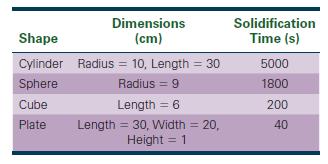
Find the mold constant B and exponent n in Chvorinov’s rule using the following data and a log–log plot: Dimensions (cm) Shape Cylinder Radius = 10, Length = 30 Sphere Radius = 9 Cube Plate Length = 6 Length = 30, Width = 20, Height = 1 Solidification Time (s) 5000 1800 200 40
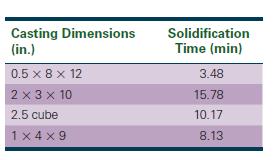
Find the constants B and n in Chvorinov’s rule by plotting the following data on a log–log plot: Casting Dimensions (in.) 0.5 x 8 x 12 2 x 3 x 10 2.5 cube 1x4x9 Solidification Time (min) 3.48 15.78 10.17 8.13
Write down Chvorinov’s rule and explain the meaning of each term.
It is desired to increase the dendritic fraction from 0.012 to 0.025. Assuming that the specific heat of the metal being solidified is constant, determine the increase in the amount of undercooling required.
Calculate the fraction of solidification that occurs dendritically when silver nucleates(a) At 10°C undercooling;(b) At 100°C undercooling; and(c) Homogeneously.The specific heat of silver is 3.25 J/(cm3 • °C).
What is a dendrite and why do dendrites form during solidification?
Describe under what conditions we expect molten metals to undergo dendritic solidification.
During solidification, the specific heat of the material and the latent heat of fusion need to be removed. Define each of these terms.
What are the two steps encountered in the solidification of molten metals? As a function of time, can they overlap with one another?
How do machines in ski resorts make snow?
What is a metallic glass?
What is photochromic glass?
What is a glass-ceramic? How are glass ceramics made?
Why is it that many inorganic melts solidify into amorphous materials more easily compared to metallic materials?
What is second-phase strengthening?
Compare and contrast grain size strengthening and strain hardening mechanisms.
Explain how aluminum alloys can be strengthened using small amounts of titanium and boron.
Write a computer program to assist you in solving problems such as those illustrated in Examples 11-2 or 11-3. The input will be, for example, the bulk composition of the alloy, the mass of the alloy, and the atomic masses of the elements (or compounds) forming the binary system. The program should
Design an Al-Si brazing alloy and process that will be successful in joining an Al-Mn alloy that has a liquidus temperature of 659°C and a solidus temperature of 656°C. Brazing, like soldering, involves introducing a liquid filler metal into a joint without melting the metals that are to be
Design a eutectic diffusion bonding process to join aluminum to silicon. Describe the changes in microstructure at the interface during the bonding process.
Design a processing method that permits a Pb-15% Sn alloy solidified under nonequilibrium conditions to be hot worked.
Explain the vapor-liquid-solid mechanism of nanowire growth.
What is hot shortness? How does it affect the temperature at which eutectic alloys can be used?
The Fe-Fe3C phase diagram exhibits a eutectic near the composition used for cast irons. Explain why it is beneficial for ferrous alloys used for casting to have a eutectic point.
Refractories used in steel making include silica brick that contain very small levels of alumina (Al2O3). The eutectic temperature in this system is about 1587°C. Silica melts at about 1725°C. Explain what will happen to the load bearing capacity of the bricks if a small amount of alumina gets
Explain why Pb-Sn alloys are used for soldering.
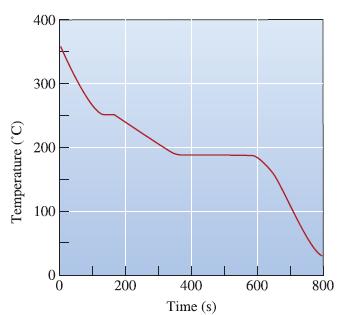
Figure 11-31 shows a cooling curve for a Pb-Sn alloy. Determine(a) The pouring temperature;(b) The superheat;(c) The liquidus temperature;(d) The eutectic temperature;(e) The freezing range;(f ) The local solidification time;(g) The total solidification time; (h) The composition of the alloy.
Does the shape of the proeutectic phase have an effect on the strength of eutectic alloys? Explain.
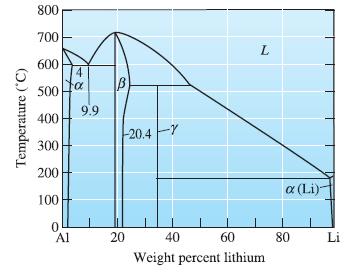
Observation of a microstructure shows that there is 28% eutectic and 72% primary b in an Al-Li alloy (Figure 11-28). Determine the composition of the alloy and whether it is hypoeutectic or hypereutectic. Temperature (C 800 700 600 500 400 300 200 100 0 4 ta Al 9.9 B 20 20.4-7 L 40 60 Weight
For the Pb-Sn system, explain why the tensile strength is a maximum at the eutectic composition.
In regards to eutectic alloys, what does the term “modification” mean? How does it help properties of the alloy?
An Al-Si alloy contains 15% primary b and 85% eutectic microconstituent immediately after the eutectic reaction has been completed. Determine the composition of the alloy.
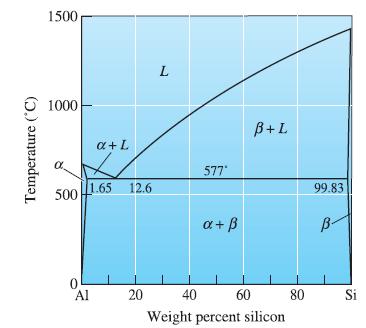
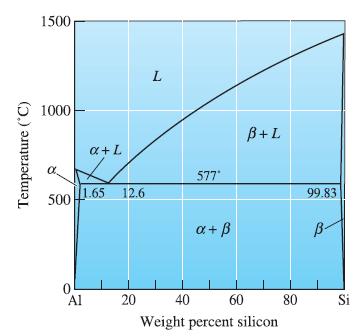
An Al-Si alloy contains 85% α and 15% β at 500°C. Determine the composition of the alloy. Is the alloy hypoeutectic or hypereutectic? Temperature (°C) 1500 1000 α 500 1.65 12.6 0 a+L Al 20 L 577" a + ß B+L 40 60 Weight percent silicon 80 99.83 B- Si
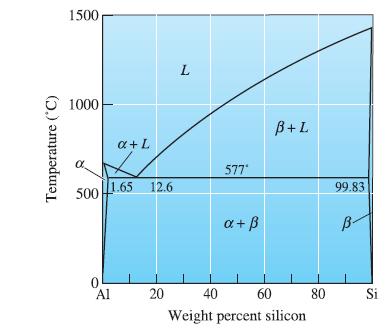
At the eutectic in the Al-Si phase diagram, what phase(s) is (are) present? Give a chemical analysis of the phase(s). Temperature (°C) 1500 1000 500 1.65 0 a + L Al 12.6 20 L 577* a + ß B+L 40 60 Weight percent silicon 80 99.83 B- Si
Consider an Al-4% Si alloy.Determine(a) If the alloy is hypoeutectic or hypereutectic;(b) The composition of the first solid to form during solidification;(c) The amounts and compositions of each phase at 578°C;(d) The amounts and compositions of each phase at 576°C, the amounts and compositions
A Pb-Sn alloy contains 23% primary a and 77% eutectic microconstituent immediately after the eutectic reaction has been completed. Determine the composition of the alloy.
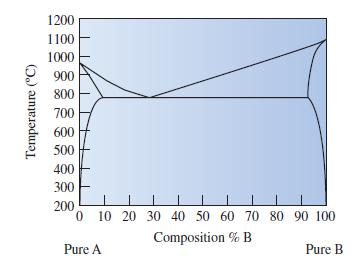
Determine the phases that are present and the compositions for each phase in Cu-85 wt% Ag at 800°C. Temperature (°C) 1200 1100 1000 900 800 700 600 500 400 300 200 0 10 20 30 40 50 60 70 80 90 100 Composition % B Pure A Pure B
A Pb-Sn alloy contains 45% α and 55% β at 100°C. Determine the composition of the alloy. Is the alloy hypoeutectic or hypereutectic?
We discussed the primary phase or primary constituent. Why would we be interested in the percentage of the primary phase in the Al-Si alloy system?
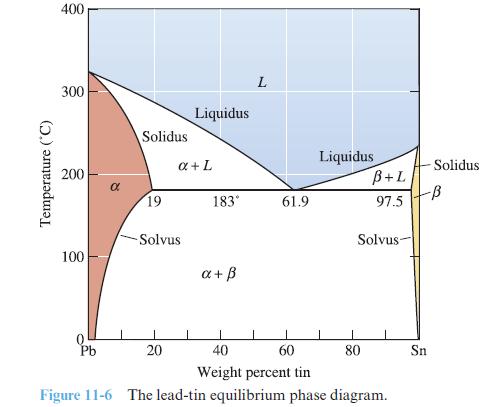
Use the Gibbs phase rule to determine the number of degrees of freedom in each region of the phase diagram in Figure 11-6. Temperature (°C) 400 300 200 100 Pb Solidus 19 -Solvus 20 Liquidus a + L 183° a+ ß L 61.9 Liquidus B+L 97.5 Solvus 80 60 40 Weight percent tin Figure 11-6 The lead-tin
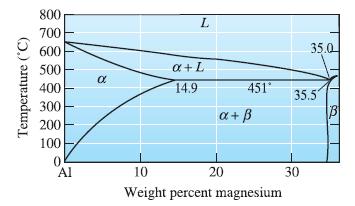
Consider an Al-12% Mg alloy (Figure 11-29). During solidification, determine(a) The composition of the first solid to form;(b) The liquidus temperature, solidus temperature, solvus temperature, and freezing range of the alloy;(c) The amounts and compositions of each phase at 525°C;(d) The amounts
Consider the Al-Si phase diagram. What are the percentages of the a-phase and liquid for an Al-5 wt% Si alloy at 620, 600, and 578°C? What are the percentages of α and β phases in this alloy for an Al-5 wt% Si alloy at 576 and 550°C?
Determine the phases that are present and the compositions for each phase in Cu-55 wt% Ag at 600°C.Data Form Problem 11-23Consider a Pb-70% Sn alloy. Determine(a) If the alloy is hypoeutectic or hypereutectic;(b) The composition of the first solid to form during solidification;(c) The amounts and
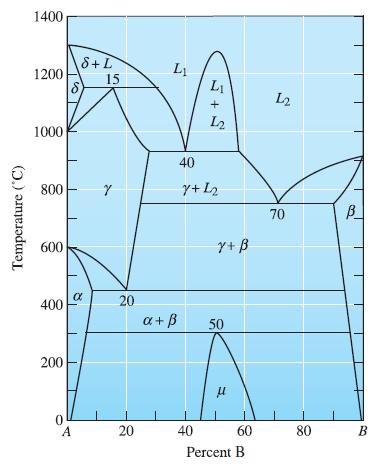
Consider Figure 11-5. For an equal component alloy of A and B starting at 1400°C, write each reaction as the crucible is cooled to room temperature (25°C). Temperature (°C) 1400 1200 1000 800 600 400 200 0 S A S+L α 15 Y 20 20 Li a + ß L₁ + 12 40 7+12 40 Y+ B 50 μ 60 Percent B L2 70 80 B
Consider a Pb-70% Sn alloy. Determine(a) If the alloy is hypoeutectic or hypereutectic;(b) The composition of the first solid to form during solidification;(c) The amounts and compositions of each phase at 184°C;(d) The amounts and compositions of each phase at 182°C;(e) The amounts and
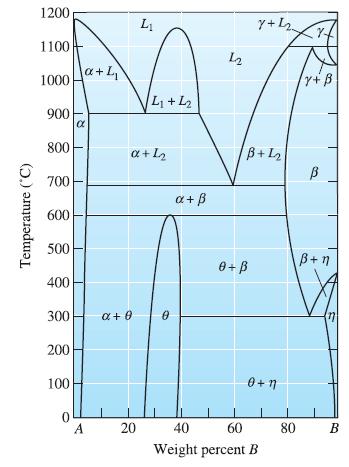
A hypothetical phase diagram is shown in Figure 11-26.(a) Are any intermetallic compounds present? If so, identify them and determine whether they are stoichiometric or nonstoichiometric.(b) Identify the solid solutions present in the system. Is either material A or B allotropic? Explain.(c)
An intermetallic compound is found for 10 wt% Si in the Cu-Si phase diagram. Determine the formula for the compound.
An intermetallic compound is found for 38 wt% Sn in the Cu-Sn phase diagram. Determine the formula for the compound.
In Figure 11-2, what weight percent of rhodium allows the highest temperature pure γ phase? Crack Soft Good Good Good Good Hard VS. (a) VS. (b) VS. (c) VS. (d) Hard Poor Poor Poor Poor Crack Soft
Why is it common practice to only label one-phase regions in a binary phase diagram?
Under what circumstances is the total composition the same as the phase composition or compositions? Under what circumstances is it different?
Showing 1300 - 1400
of 2309
First
7
8
9
10
11
12
13
14
15
16
17
18
19
20
21
Last
Step by Step Answers

 Get 50% OFF
Claim Now
Get 50% OFF
Claim Now