New Semester
Started
Get
50% OFF
Study Help!
--h --m --s
Claim Now
Question Answers
Textbooks
Find textbooks, questions and answers
Oops, something went wrong!
Change your search query and then try again
S
Books
FREE
Study Help
Expert Questions
Accounting
General Management
Mathematics
Finance
Organizational Behaviour
Law
Physics
Operating System
Management Leadership
Sociology
Programming
Marketing
Database
Computer Network
Economics
Textbooks Solutions
Accounting
Managerial Accounting
Management Leadership
Cost Accounting
Statistics
Business Law
Corporate Finance
Finance
Economics
Auditing
Tutors
Online Tutors
Find a Tutor
Hire a Tutor
Become a Tutor
AI Tutor
AI Study Planner
NEW
Sell Books
Search
Search
Sign In
Register
study help
engineering
thermodynamics fundamentals
Thermodynamics Fundamentals And Engineering Applications 1st Edition William C. Reynolds, Piero Colonna - Solutions
In analogy with the way the Gibbs and Helmholtz energy are obtained by considering processes occurring in a closed system, obtain the thermodynamic function that most simply allows for the calculation of the energy transfer as work in an isobaric and isentropic process.
Work out the differential relation between specific entropy of a simple compressible fluid and its temperature and pressure, such that it can be evaluated with the help of cP and an equation of state in the form P = P - (T, v).
How can the residual part of cP of a simple compressible fluid be evaluated from an an equation of state in the form P = P - (T, v)?
Obtain the expression for the isothermal compressibility κ from the Helmholtz energy a = a - (T,v).
Assume that the equation of state for a certain fluid is given as g = g - (T,P) (for example, this is the case for the IF97 equation of state, but it has also been applied for mixture equations of state like ammonia/water and LiBr/water). Show that all primary properties can be obtained by
Suppose we want to store 100 kg of carbon dioxide in a 0.5 m3 tank at 320 K and we want to calculate the required pressure using different thermodynamic models. Given that the critical temperature and pressure of carbon dioxide are 304.2 K and 7.382 MPa, respectively, calculate the pressure
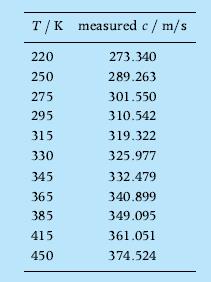
Given the speed of sound values for ethane from A. F. Estrada-Alexanders and J. P. M. Trusler, ?The speed of sound and derived thermodynamic properties of ethane at temperatures between 220 K and 450 K and pressures to 10.5 MPa,? J. Chem. Thermodynamics, 29, (9), 991?1015, 1997, measured at low
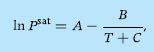
The vapor pressure of refrigerant R134a can be approximated with the Antoine equation ?with P in kPa and T in K, A = 14.41 kPa, B = 2094 kPa ? K, and C = ?33.06 K. The critical temperature is Tc?= 374.21 K. Calculate the acentric factor. Is this molecule more or less acentric than that of water if
Propane is to be stored at 4 MPa, 100°C. The critical temperature and pressure of propane are equal to 369.8 K and 4.23 MPa, respectively. Estimate the specific volume at these conditions. How large is the tank needed to store 1150 kg of propane?
Compare the specific volume of steam at 40 MPa, 800 K as obtained with the ideal gas equation of state, the generalized compressibility chart, and the IF97 model. The critical temperature and pressure of water are equal to 647.096 K and 22.064 MPa, respectively.
Calculate the vapor pressure of water at 150°C using the van der Waals equation of state. Repeat the calculation at 370°C. How do these values compare with values obtained with the IF97 model?
What is the relation between the isothermal compressibility and the speed of sound for a simple compressible fluid?
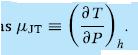
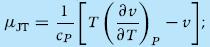
The Joule?Thomson (or Joule?Kelvin) coefficient for a simple compressible substance is defined as (a) Prove that (b) Discuss how this equation might be used;(c) Show that the Joule?Thomson coefficient for a perfect gas is zero. IS JAJT = ат Әр h
Obtain equations for the speed of sound and isothermal, isobaric, and isentropic compressibility a valid for the van der Waals equation of state.
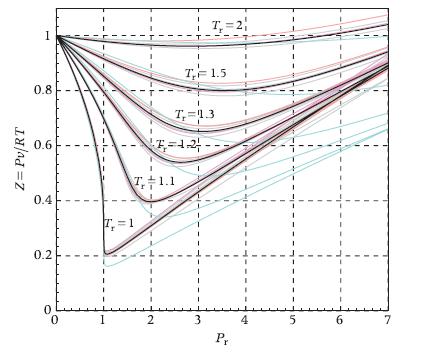
Evaluate the specific volume of heptane for Tr = 1.1 and Pr = 3.5 using(a) The van der Waals equation of state (Tc = 540.13 K, Pc?= 27.36 bar);(b) The generalized compressibility chart of Figure 6.6;(c) TPSI. Which is more accurate among the values obtained with (a) and (b)? Consider the flow of 5
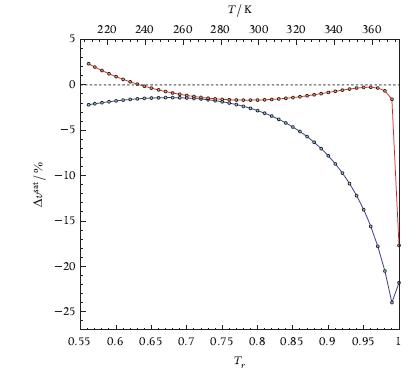
Obtain charts like those of Figure 6.23 in order to compare values for propane calculated with STANMIX and TPSI. What can you infer from these charts about the accuracy of the cubic equation of state model if compared to a multi-parameter thermodynamic model? Ausat
Estimate the limiting metastable state for the liquid and the vapor of water at 100°C using the van der Waals equation of state.
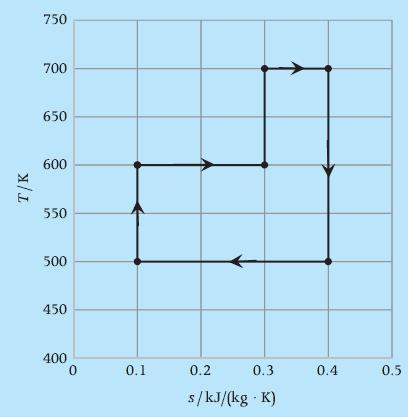
What is the value of the efficiency of the adjacent reversible cycle displayed here in the T?s diagram of its working fluid? T/K 750 700 650 600 550 500 450 400 0 0.1 0.2 0.3 s/kJ/(kg. K) 0.4 0.5
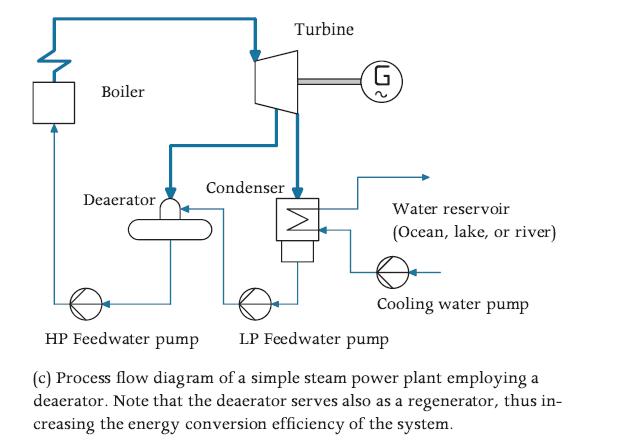
Calculate the increase in thermal efficiency due to the introduction of a regenerating dearator in the Rankine-cycle power plant of Exercise 7.5. The plant operates at the optimal pressure (the extraction pressure that makes the thermal efficiency maximum). Figure 7.9c shows the process flow
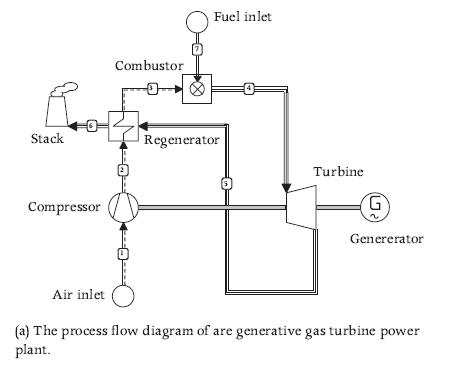
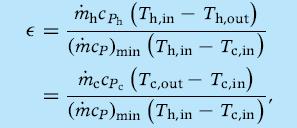
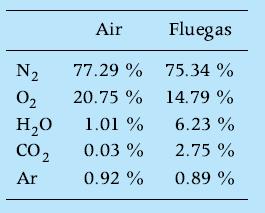
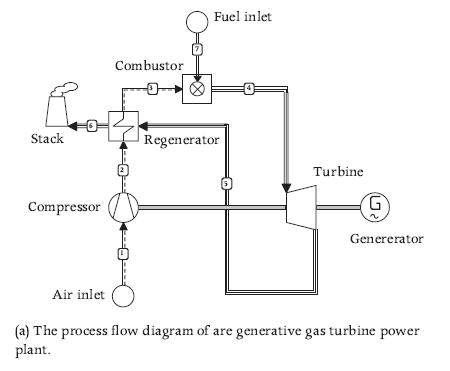
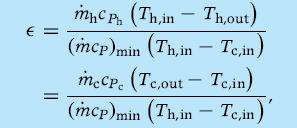
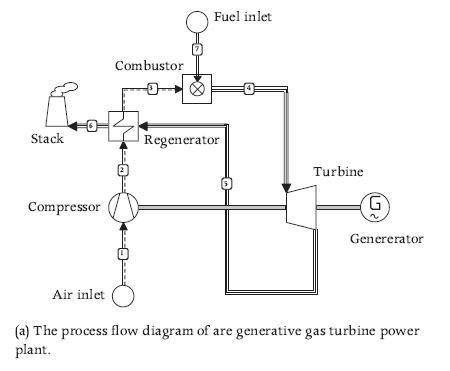
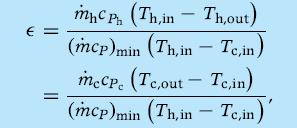
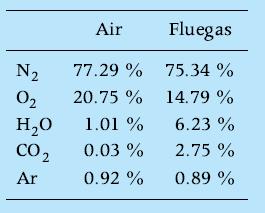
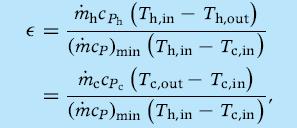
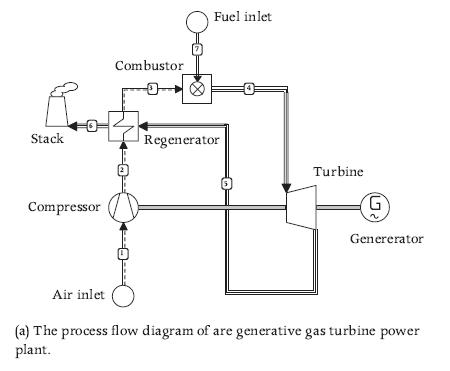
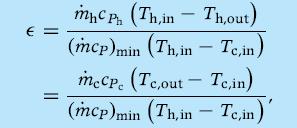
In the regenerative gas turbine power plant whose process flow diagram is shown in Figure 7.27a, the mass flow of air entering the compressor at 1 bar and 25?C is 17.9 kg/s. The pressure ratio of the compressor is 9.9. The regenerator effectiveness is 0.9. The effectiveness of a counter flow heat
Compare the COP of the ammonia refrigeration system of Figure 7.21 to that of the single-stage system of Figure 7.20, operating with the same working fluid between the same minimum and maximum cycle pressures, and given that the temperature at the outlet of the direct contact heat exchanger equals
Consider a closed recuperative Brayton cycle turbine power plant employing supercritical CO2?as the working fluid. The working fluid at the compressor inlet is at T = 32?C and P = 7.7 MPa. CO2 pressure in the heater is 20 MPa and the turbine inlet temperature is 550?C. The regenerator effectiveness
Steam flows through a condenser at 2 × 10⁶ kg/hr, entering as saturated vapor at 40°C, and leaving at the same pressure as subcooled liquid at 30°C. Cooling water enters the condenser pipes at 18°C and 1.5 bar. Assume no pressure loss occurs in the pipes. Environmental regulations require that
The fuel efficiency of reciprocating engines could be greatly increased (and thus pollution decreased) if the thermal energy that is wasted with the exhaust gases and by cooling the engine jacket and the lube oil were converted into additional work. As a first step in this direction, the heat
The booster pump of a large steam power plant raises the pressure from 3 × 10⁶ Pa at 313 K to 6 × 10⁶ Pa. If the flow rate is 20 000 kg/min, and the isentropic efficiency is 0.75, calculate the required power in kW.
A renewable energy system for the (co)generation of electricity and cooling in sunny areas of the world consists of a solar Organic Rankine Cycle (ORC) power system, whose discharged thermal power is used to power an absorption refrigerator. The thermal power collected by the solar troughs and
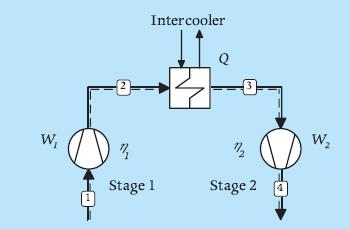
Consider a two-stage gas compressor with inter-cooling.Assume the gas can be treated as ideal with constant specific heat. Derive an expression for the specific work input in terms of P1 ,P2 ,P4 ,?1 ,?2 ,T1 and T3. Then, for all the other parameters fixed, find the value of P2?which minimizes the
Calculate the thermal efficiency of a simple steam power plant implementing the superheated cycle configuration. Superheated steam enters the turbine at 10 MPa and 680 K. The pressure in the condenser is kept at 0.1 MPa, as the discharged thermal energy is used for district heating. Assume that the
A Rankine-cycle power plant has one stage of reheat. The steam at the turbine inlet is at 500°C and 3 × 10⁶ Pa. After expansion to 0.5 × 10⁶ Pa, the steam is reheated to 500°C, and expanded in a second turbine to a condenser pressure of 0.007 × 10⁶ Pa. The steam leaves the
Consider an externally heated air gas turbine implementing the thermodynamic cycle described in Section 7.5. Using a compressor isentropic efficiency 0.85, determine the conversion efficiency of the system as a function of the pressure ratio, keeping the turbine inlet temperature fixed. What
Determine the energy conversion efficiency of a supercritical steam power plant whose steam condenses at 310 K, and reaches 30 MPa in the primary heater. Assume that the inlet pump state is saturated for simplicity, that the maximum system temperature is 923 K and that the overall isentropic
Determine the efficiency and the net mechanical power output of the system of Exercise 7.15 in the case where the compressor includes one inter-cooling stage, the isentropic efficiency of the compressors is the same as in Exercise 7.15, and the pressure ratio of the two stages is optimal. Assume an
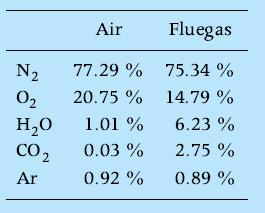
Combustion gas with the composition of Exercise 7.15 at the inlet of the reheated stages of a gas turbine is at 1400 K and 40 bar. The gas expands to atmospheric pressure. Between the high pressure and low pressure turbines, the gas is reheated at a constant pressure of 10 bar up to 1400 K. Assume
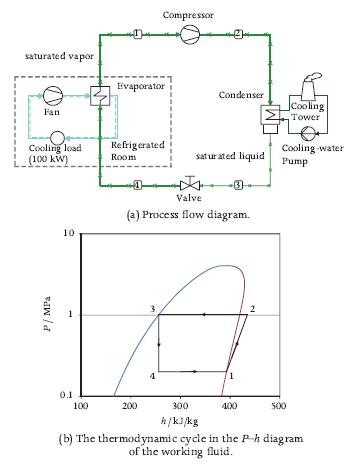
Determine the COP of a vapor-compression refrigerator implementing the simple inverse Rankine cycle, employing R134a as refrigerant, with saturated vapor leaving the evaporator at 278 K and saturated liquid leaving the condenser at 300 K. The compressor has an isentropic efficiency of 0.87. Derive
A power system for space applications is based on a Rankine cycle using potassium as the working fluid. The working fluid at the turbine inlet is at 1200 K and 2.0 bar, and is fixed. The pump inlet is saturated liquid and the pump work is negligible. The turbine efficiency is 0.7. In space the
The compression ratio of an ideal Otto cycle using air as the working fluid is 8. The energy input is idealized as a transfer of energy as heat to the working fluid of 1650 kJ/kg. The inlet conditions are 20°C and 1 bar. Calculate the temperature and pressure of all remaining states in the cycle,
An ideal diesel cycle using air as the working fluid has a compression ratio of 15. The energy input is idealized as a transfer of energy as heat to the working fluid of 1650 kJ/kg. The inlet conditions are 20°C and 1 bar. Calculate the temperature and pressure of all remaining states in the
An idealized recip engine implementing the ideal Otto cycle operates with a compression ratio of 9:1 at intake conditions of 100 kPa and 298 K. The cylinder volume is initially 2000 cm3. If 4 kJ of energy is transferred as heat to the working fluid during an isochoric process, calculate the cycle
The compression ratio of an idealized recip engine implementing the ideal diesel cycle is 15:1. The air intake conditions are 100 kPa and 298 K. The cylinder volume is initially 2000 cm3. If 4 kJ of energy is transferred as heat to the working fluid during an isobaric process, calculate the cycle
A converging nozzle used in the stator of a high pressure steam turbine expands a steam mass flow rate of 1.0 kg/s. The nozzle inlet conditions of the steam are T = 500°C and P = 150 bar. The steam at the outlet of the nozzle is at a pressure of 100 bar. Note that for this expansion ratio the
Discuss why the idealized cycles of Exercises 7.20 and 7.21 are inadequate for the analysis of real engines. Which idealizations are likely to be the weakest? What effects will they have on the predicted performance?Data From in Exercise 7.20An ideal diesel cycle using air as the working fluid has
Obtain the relation between the molar entropy change of an ideal gas vapor mixture and the molar entropy of each constituent.
Calculate the maximum power output of an adiabatic steam turbine in kW, whereby the mass flow rate of steam is 10 kg/s, the inlet is at 20 MPa and 400°C and the discharge pressure is 1 atm.
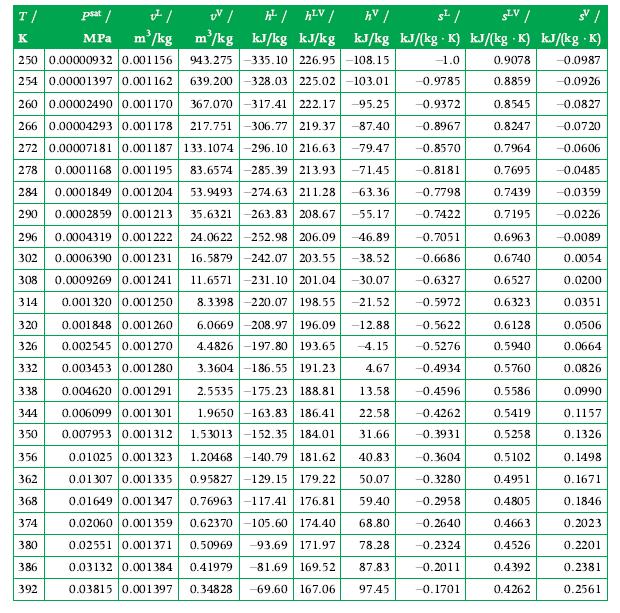
Potassium enters a turbine as saturated vapor at 1400 K and is discharged at 90 kPa. Calculate the minimum possible quality at the turbine outlet.
A solar-powered heat pump receives energy as heat from a solar collector at TH, rejects energy as heat to the atmosphere at TA, and pumps energy as heat from a cold space at TC. Derive an expression for the minimum ratio Q̇H/Q̇C, in terms of the three temperatures. If TH = 350 K, TA = 290 K,
Compute the maximum percent liquefaction (by mass) of O2 that can be achieved by expanding it adiabatically in a piston–cylinder system from the saturated vapor state at 10 atm to twice the initial volume.
Consider the recuperator of the supercritical CO2 cycle power plant of Exercise 7.19 Assume that the energy rejected to the environment from the surface of the insulating material covering the recuperator is negligible, and that the environment is at T0 = 308 K and P0 = 1 atm. Calculate the change
Nitrogen is contained in a closed pressurized vessel. The vessel and its contents are in thermal equilibrium with the environment at temperature T0 = 300 K. The environment pressure is P0 = 1.013 bar. The vessel does not move and is at zero elevation. Assume that the nitrogen in the vessel
Derive the reference I-law cycle efficiency for the evaluation of the II-law efficiency of refrigeration systems.
Compute the standardized enthalpy and entropy of a mixture formed by an equal mass amount of CO2?and H2O at 2 atm and 311 K. If liquid is present for these conditions, assume that the vapor phase can be approximated as an ideal gas mixture, and the liquid phase is pure water. Use:?a) Values
Obtain the expression for the specific flow exergy (9.5) from its definition.
Calculate the exergy associated with the drum of an industrial steam boiler that is shutting down. Assume all the mass flow rates of water in and out of the drum are negligible. The environment is at T0 = 293 K and 1 atm. The drum is at 15 m height, and its water at 12.4 MPa in saturated
The ammonia mass flow rate of the compressor of a refrigeration plant is 1 kg/s, and its inlet is at 266 K and 3 bar. The compressor outlet pressure is 16 bar while the outlet temperature is kept at 333 K thanks to a water cooling jacket. 5000 kg/hr of liquid water enters the cooling jacket at 288
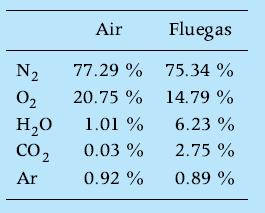
Perform the exergy analysis of the recuperated gas turbine of Exercise 7.15 knowing that i) The exergy input of the system is 14.26 MW, ii) The chemical exergy of the flue gas is 11 kJ/kg, and iii) the environment is at 15°C and 1 bar. Draw the Grassman diagram of the system. If you were
In a chemical process butane vapor is needed at some point. At that time 3 kg of butane are stored in a closed wellinsulated vessel in saturated conditions at 15.4 bar (100°C) and an electric heater is turned on in order to completely vaporize the fluid. Assuming that the environment is at 293 K
Determine the chemical equation for the reaction of octane (C8H18) with: a) 100 % excess air, and b) 250 % theoretical air.
Ammonia (NH3) and hydrogen (H2) have been proposed as automotive fuels as a way of reducing related pollution. Calculate a) The stoichiometric air/fuel ratio for these two fuels and compare it to that for hydrocarbons, b) For ammonia, the HHV and LHV at standard conditions. Obtain
Write out the chemical equation for the stoichiometric reaction of octane (C8H18) with air. Determine the theoretical air/fuel ratio for this reaction on both a volumetric (mole) and mass basis.
An oil-based fuel contains 84 % C and 16 % H2 by mass. Calculate the stoichiometric amount of air for complete combustion of 0.5 kg of fuel. Determine the air/fuel ratio.
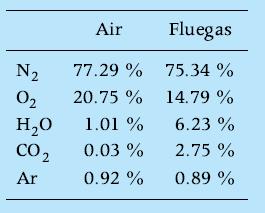
Compute the air/fuel ratio by mass for the combustion of methane, if the exhaust gas dry analysis in percent by volume is: χCO2 = 0.01537, χO2 = 0.4917, χH2O = 0.03073. The presence of minor species like CO and H2 can be neglected.
Determine the dew point of the products of combustion of octane with 400 % theoretical dry air if the pressure is 0.1013 MPa.
Consider n-butane (C4H10) reacting stoichiometrically with dry air at a pressure of 125 kPa: determine the dew point. What is the effect of excess air if this reaction occurs with 100 % excess air?
A hydrocarbon whose composition is unknown undergoes combustion such that an Orsat apparatus measures the following composition: χCO2 = 0.09, χO2 = 0.088, χCO = 0.011, χN2 = 0.811. Determine the reaction equation, air/fuel ratio, and the percent of theoretical air on a mass basis.
Determine the adiabatic flame temperature for the combustion of propane in air if: (a) The air/fuel ratio is stoichiometric, (b) The air is twice the stoichiometric amount, and (c) The air is four times the stoichiometric amount. Assume complete combustion in each case.
If methane is burned in air and the excess air is 15 %, calculate the volume percent of oxygen in the flue gas, both on a wet basis (including water vapor) and on a dry basis (neglecting water vapor).
How much energy is released when 1 mole of propane (C3H8) reacts with 80 % theoretical air and both the inlet and the outlet of the combustor are kept at the standard reference state? How much energy is released if this reaction is stoichiometric?
Make a table of the enthalpy of combustion at the standard reference state for hydrogen (H2), carbon monoxide (CO), methane (CH4), ethane(C2H6), and propane (C3H8), assuming that the water in the products is liquid.
Calculate the enthalpy of combustion for the so called water-gas shift reaction at standard reference conditions and at 300 ?C. CO(g) + H₂O(g)CO₂(g) + H₂(g),
Compare the energy released as heat by burning stoichiometrically 1 mole of CH4 with air and that released by burning 1 mole of C and 2 moles of H2. Assume that combustion occurs at the standard reference state. Why is the energy change different?
Propane (C3H8) and oxygen in stoichiometric proportions react in a steady flow water-cooled burner. The reactants enter the burner at 305 K and leave the burner at 2 atm and emerge at 730 K. The flow rate of the products is 115 kg/hr. What is the rate of energy transfer as heat to the cooling
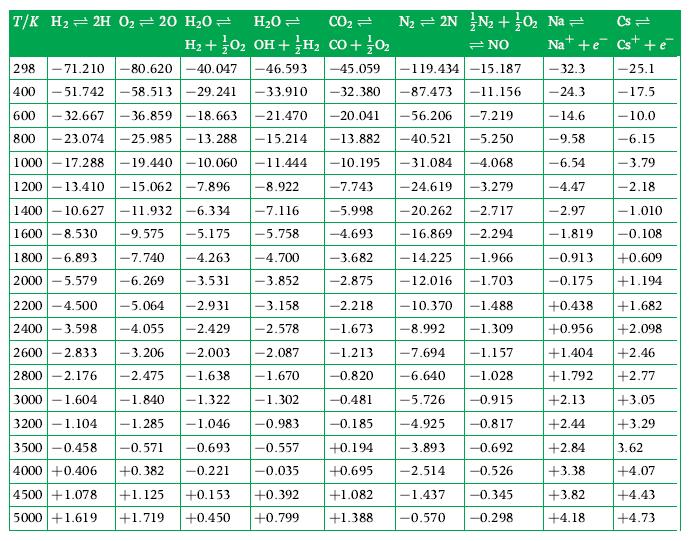
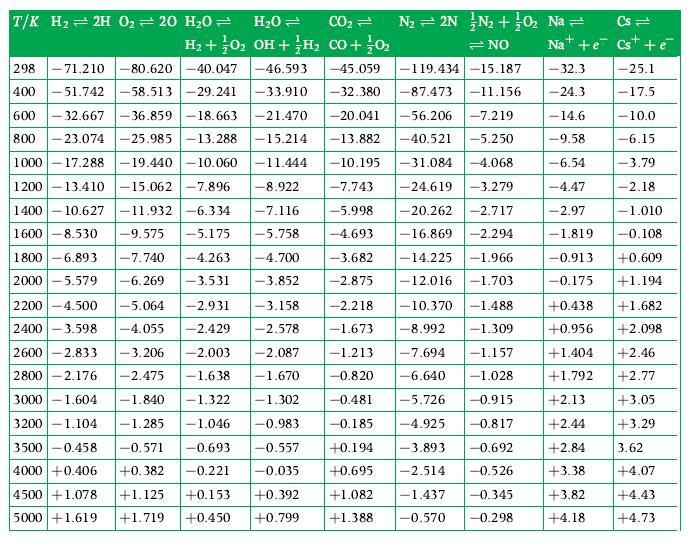
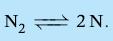
A laboratory analysis shows that CO2 becomes 10 % dissociated into CO and O2 at 2390 K if the total pressure is 1 atm. Obtain the equilibrium constant from this information and compare it to the value given in Table D.1. T/K H₂2H 0₂ = 20 H₂0 = H₂O = CO₂ = N₂ = 2N N₂ + 0₂ Na
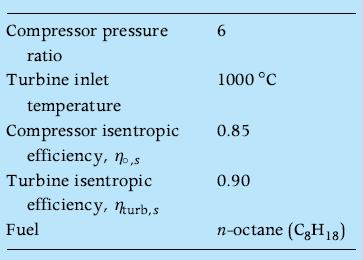
A turboprop engine has the following characteristics:The engine propels an airplane at 640 km/hr at an altitude of 7600 m (?35 ?C, 38 kPa). Analyze the thermodynamic cycle on a per kg basis, making suitable assumptions. Calculate the state points of the cycle, and the engine specific consumption in
A gas turbine uses liquid n-butane (C4H10) as fuel. Calculate the required excess air such that the turbine inlet temperature does not exceed 1000 K. Assume for simplicity that the combustor inlet is at the standard reference condition.
Find the mole fractions of O present in equilibrium O2 at 1000 K and at 5000 K. Assume P = 1 atm. Repeat the calculation for N2 and the same conditions.
Using data for standardized enthalpy and absolute entropy obtained from GASMIX calculate the equilibrium constant for the gaseous reaction ?298 K. Derive an expression which would let you obtain this, as an alternative to using Table D.1 in terms of the equilibrium constants for simpler reactions.
The burner of a power station must provide thermal power to the boiler at a rate of 88 MW. The maximum flame temperature is to be 1100 K, and the products of combustion can leave the boiler at no less than 920 K. Design a burner system, specifying the fuel, flow rates, and any other datum deemed
The water-gas shift reaction is ?Processes based on this reaction have been studied as a means of providing H2 as an automotive fuel. Assume that 1 mole of CO reacts with one mole of H2O at1800 K and 1 atm. Determine the equilibrium composition. Will lowering the temperature increase or decrease
Hydrogen is to be burned with oxygen to produce a 1922 K flame. Neglecting dissociation, determine the composition of the product gases and specify the ratios of oxygen- and hydrogen-flow rates. The burner is adiabatic and atmospheric.
Assuming that air is composed of O2 , O, N2, N, and NO, and that only O2 and N2 are present in significant amounts at room temperature in the ratio of 3.76 moles of N2 per mole of O2, determine the composition of equilibrium air at 1000 K and 1 atm.
Calculate the equilibrium composition of the water-gas shift reaction of Exercise 10.25 with the element potential method. Compare the accuracy of the results with those obtained with the equilibrium constant method and with STANJAN, commenting on the difference and on the differences between the
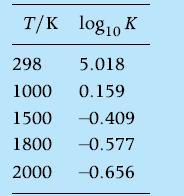
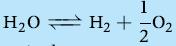
For the reaction?the equilibrium constant is log10?K = ?3.531 at 2000 K. Estimate the constant at T = 2225 K using the van t?Hoff equation. 1 H₂O = H₂+ = 0₂ 2
Consider the reaction (a) At the peak combustion temperature in a car (2500 to 2800 K), and neglecting the effect of pressure, will this reaction affect the production of NO??(b) If the peak pressure is about 35 bar in the cylinder of a car engine, does this high pressure increase or decrease the
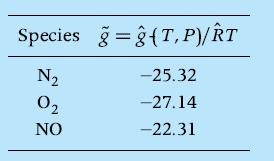
Consider the reaction of air to form a gaseous mixture containing N2, O2 , and NO and assume that the perfect gas law is applicable. Calculate the mole fractions of the species at equilibrium at T = 2000 K and P = 5 atm using the element potentials method. The nondimensional Gibbs function values
One of the production processes of gallium-arsenide used in the semiconductor industry involves the equilibrium reaction of a gas mixture of As2 , As4, and Ga at 800 K and 0.1 atm, thus the perfect gas approximation ais valid. If there are the same number of atoms of As and Ga, and 1 mole of
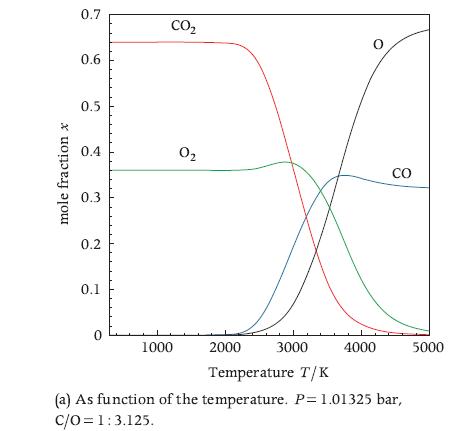
One mole of CO reacts with one mole of O2 in a steady flow process. Both reactants at the inlet are at 298 K and 1 atm. The final products of the reaction are a mixture of CO, CO2, and O2 at 1 atm. Determine the equilibrium composition at 3000 K and 2800 K. Determine also the energy
Determine the maximum energy output per gmole of CO2 for a fuel cell operating on CO and O2 at 298 K and 1 atm. Assume that the products at the outlet of the fuel cell contain only CO2.
Obtain the relation between the isochoric specific heat of an ideal gas mixture and those of its constituents.
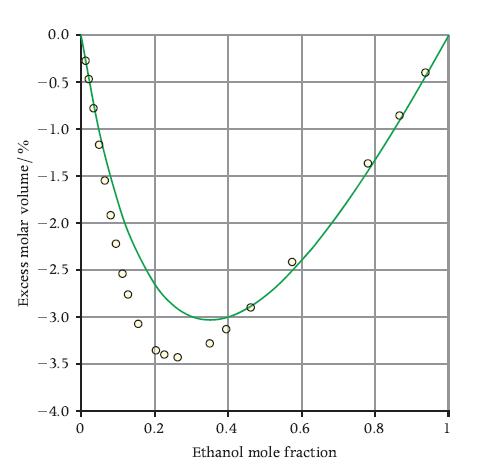
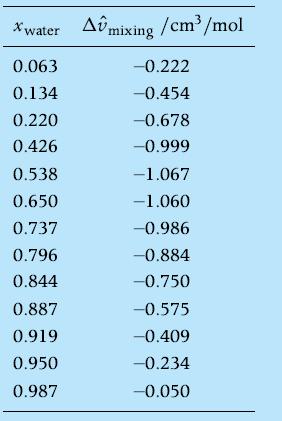
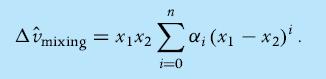
The following table reports the measurements of excess molar volume for the water– ethanol mixture at T = 298 K of Figure 8.4.Data on excess molar properties are often correlated with a polynomial of the so-called Redlich–Kister formCorrelate the given data with a Redlich–Kister polynomial of
A gas having an ideal gas specific-heat ratio γ of 1.5 is required for a certain gas dynamics experiment. Specify a mixture that could be used.
The analysis of a gas mixture shows that the composition by weight is 15 % He, 60 % N2, and 25 % O2. Calculate the mole fractions and molecular weight of the mixture.
A mixture of gases used for a special heat transfer application consists of 25 % Ar, 50 % He, 25 % H2 by weight. The operating temperature is such that the mixture behaves like an ideal gas at the operating pressure of 10 bar. Determine the partial pressure of the constituents, the cP of the
A mixture of 40 % argon and 60 % nitrogen by weight is compressed from 1 atm, 20°C, to 4 atm. Assuming that the fluid complies with the ideal gas model, calculate the mixture temperature at the final pressure, the work required and the entropy change of the mixture and of the constituents.
The flue gas of a gas turbine contains water vapor and yH2O = 0.05. The temperature after the gas turbine outlet, downstream in the process, is 350 K. The flue gas contains minute quantities of sulfur which is present in the fuel. Sulfur can combine with liquid water forming sulfuric acid which is
The excess enthalpy of a non-ideal liquid mixture is also often called heat of mixing or enthalpy of mixing, as it is the energy that gets transferred as heat to or from a mixture at constant temperature and pressure when the constituents are mixed. The result depends on the interaction of
How many variables can be fixed independently in order to fix the state of a binary mixture in vapor–liquid equilibrium if, as is most often the case, the two phases contain both components in different amounts? Which variables would you decide to control in an actual experiment? How many degrees
Assume that a binary mixture and its components can be modeled using the van der Waals equation of state, both for the liquid and the vapor phase. Assume also that the mixture equation of state parameters can be calculated using so-called van der Waals one-fluid mixture rules,(a) Derive the
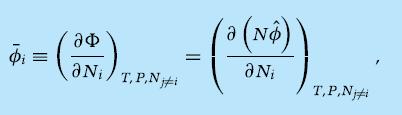
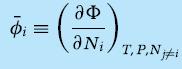
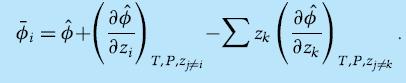
A generic partial molar property is defined aswhere ϕ can be v, h, s,u, g, . . . ; if you are hasty, you might wrongly conclude that Ф = аф (а), a Ni T.P.N = а (Nф) a Ni T,P.Ng
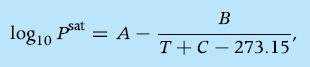
A fluid formed by pentane and hexane obeys Raoult’s law quite well. Such a mixture can be used for example as the working fluid of an organic Rankine cycle power plant. The vapor pressure of pure pentane can be computed rather accurately with the Antoine equationwith P in bar and T in K, A =
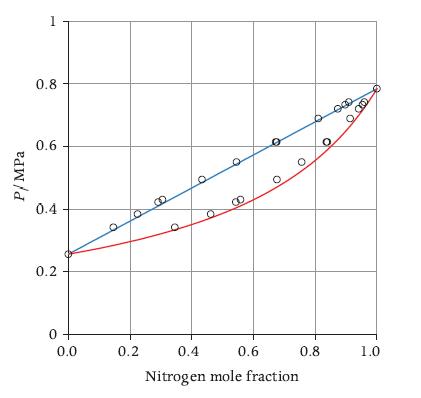
Use STANMIX to make a P–xy chart similar to that in Figure 8.20 for the equimolar methanol/water mixture. Plot the bubble and dew lines for T = 350 K, 375 K, and 400 K. P/MPa 1 0.8 0.6 0.4 0.2 0 0.0 0.2 CD CO 0.4 0.6 Nitrogen mole fraction 0.8 900 om O 0 mm 1.0
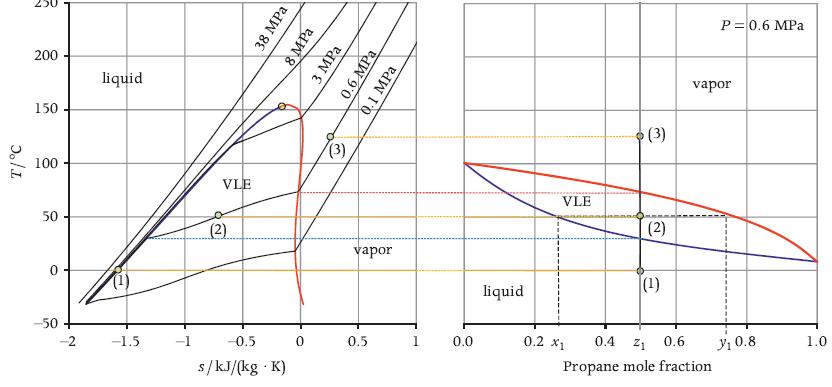
Use STANMIX to make a T–s chart similar to that in Figure 8.1 for the equimolar methanol/water mixture. Plot two iso-lines for each type, that is, isobar, isochore, isenthalp, iso-quality. T/°C 200 150 100 50 0 -50 -2 liquid -1.5 VLE (2) 38 MPa 8 MPa 3 MPa 0.6 MPa 0.1 MPa -0.5 s/kJ/(kg
Showing 200 - 300
of 321
1
2
3
4
Step by Step Answers

 Get 50% OFF
Claim Now
Get 50% OFF
Claim Now