New Semester
Started
Get
50% OFF
Study Help!
--h --m --s
Claim Now
Question Answers
Textbooks
Find textbooks, questions and answers
Oops, something went wrong!
Change your search query and then try again
S
Books
FREE
Study Help
Expert Questions
Accounting
General Management
Mathematics
Finance
Organizational Behaviour
Law
Physics
Operating System
Management Leadership
Sociology
Programming
Marketing
Database
Computer Network
Economics
Textbooks Solutions
Accounting
Managerial Accounting
Management Leadership
Cost Accounting
Statistics
Business Law
Corporate Finance
Finance
Economics
Auditing
Tutors
Online Tutors
Find a Tutor
Hire a Tutor
Become a Tutor
AI Tutor
AI Study Planner
NEW
Sell Books
Search
Search
Sign In
Register
study help
mathematics
a first course in abstract algebra
A First Course In Abstract Algebra 7th Edition John Fraleigh - Solutions
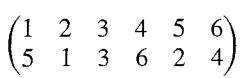
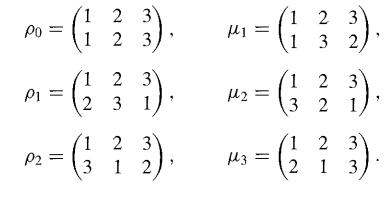
Let A be a set and let σ ∈ SA· For a fixed a ∈ A, the set Oa.σ- = {σn(a) |n ∈ Z}is the orbit of a under σ. Find the orbit of 1 under the permutation defined prior to Exercise 1.Data Prior to Exercise 1. 1 3 2 3 4 5 6 4 5 6 2 14 1 τ = 1 2 3 4 5 6 2 4 1 3 6 5 2 με 1 5 2 3 4 5
Find the maximum possible order for some element of Z8 x Z10 x Z24 .
Do the translations, together with the identity map, form a subgroup of the group of plane isometries? Why or why not?
Are the groups Z8 x Z10 x Z24 and Z4 x Z12 x Z40 isomorphic? Why or why not?
Do the rotations about one particular point P, together with the identity map, form a subgroup of the group of plane isometries? Why or why not?
Let H be the subset of M2(R) consisting of all matrices of the form for a, b ∈ R. Is H closed undera. Matrix addition? b. Matrix multiplication? 19- 別
Let H be the subset of M2(R) consisting of all matrices of the formfor a, b ∈ R Exercise 23 of Section 2 shows that H is closed under both matrix addition and matrix multiplication.a. Show that (C,+) is isomorphic to (H, +).b. Show that (C,•) is isomorphic to (H, •).(We say that H is a matrix
Find all solutions in C of the given equation.Z4 = -1
List the elements of Z2 x Z4. Find the order of each of the elements. Is this group cyclic?
Find all orbits of the given permutation. 1 5 2 3 4 5 6 6 2 4, 1 13
Compute the indicated product involving the following permutations in S6: τσ 1 2 3 4 5 6 3 1 4 5 6 2) 1 2 2 3 4 4 1 3 5 6 65 u= '1 5 2 34 5 24 3 1
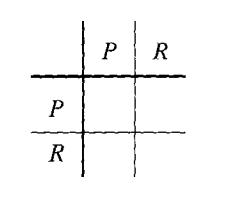
Let P stand for an orientation preserving plane isometry and R for an orientation reversing one. Fill in the table with P or R to denote the orientation preserving or reversing property of a product. P R P R
This exercise shows that the group of symmetries of a certain type of geometric figure may depend on the dimension of the space in which we consider the figure to lie. a. Describe all symmetries of a point in the real line R; that is, describe all isometries of R that leave one point
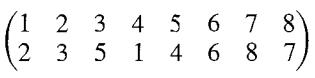
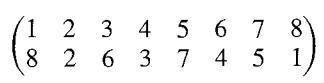
Find all orbits of the given permutation. 1 2 3 4 5 6 7 8 562 4 8 3 3 1 1 7)
Compute the indicated product involving the following permutations in S6:τ2σ 1 2 3 4 5 6 3 1 4 5 6 2) 1 2 2 3 4 4 1 3 5 6 65 u= '1 5 2 34 5 24 3 1
Find all cosets of the subgroup 4Z of Z.
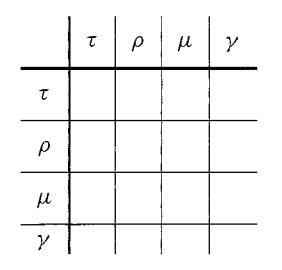
Flll in the table to give all possible types of plane isometries given by a product of two types. For example, a product of two rotations may be a rotation, or it may be another type. Fill in the box corresponding to pp with both letters. Use your answer to Exercise 2 to eliminate some types.
Repeat Exercise 1 for the group Z3 x Z4.Data from exercise 1List the elements of Z2 x Z4 . Find the order of each of the elements. Is this group cyclic?
Find all orbits of the given permutation. 1 2 3 4 5 23 3 6 7 8 8 8 7 5 1 4 6
Find all cosets of the subgroup 4Z of 2Z.
Find the order of the given element of the direct product. (2, 6) in Z4 x Z12
Compute the indicated product involving the following permutations in S6:σ-2τ 1 2 3 4 5 6 3 1 4 5 6 2) 1 2 2 3 4 4 1 3 5 6 65 u= '1 5 2 34 5 24 3 1
Compute the expressions shown for the permutations a, r andµ defined prior to Exercise 1.|(σ)|Data from Exercise 1In Exercises, compute the indicated product involving the following permutations in S6: 0= 1 3 23 4 5 6 2 14 5 6 2 T= 1 2 3 4 5 6 3 6 2 4 1 5 23 «= (1 ² 3 4 5 6). 5 24 3
Find all cosets of the subgroup (2) of Z12.
Find the order of the given element of the direct product.(2, 3) in Z6 x Z15
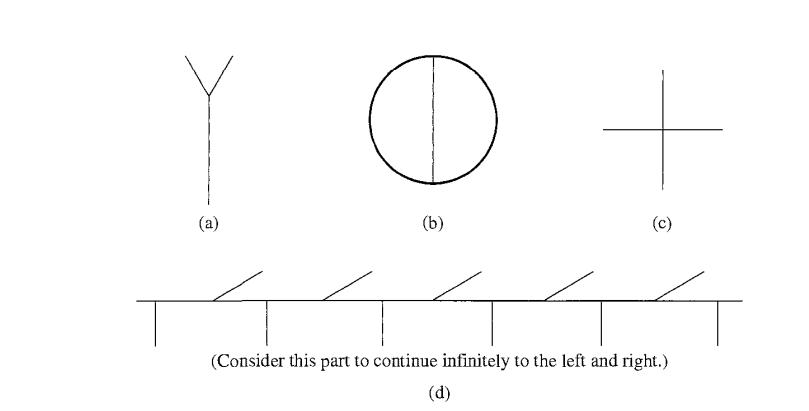
Draw a plane figure that has a one-element group as its group of symmetries in R2.
Find all orbits of the given permutation.σ : Z → Z where σ(n) = n + 1
Compute the expressions shown for the permutations a, r andµ defined prior to Exercise 1.|(τ2)Data from Exercise 1In Exercises, compute the indicated product involving the following permutations in S6: 0= 1 3 23 4 5 6 2 14 5 6 2 T= 1 2 3 4 5 6 3 6 2 4 1 5 23 «= (1 ² 3 4 5 6). 5 24 3
Find all cosets of the subgroup (4) of Z12.
Draw a plane figure that has a two-element group as its group of symmetries in R2 •
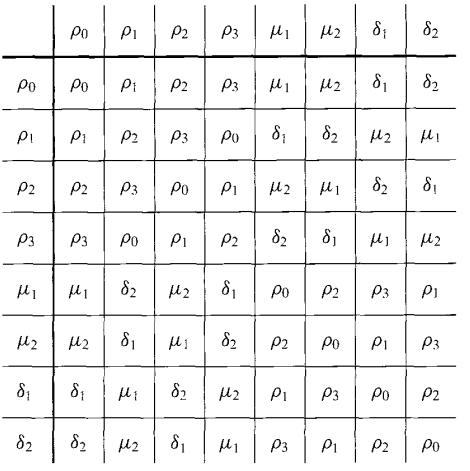
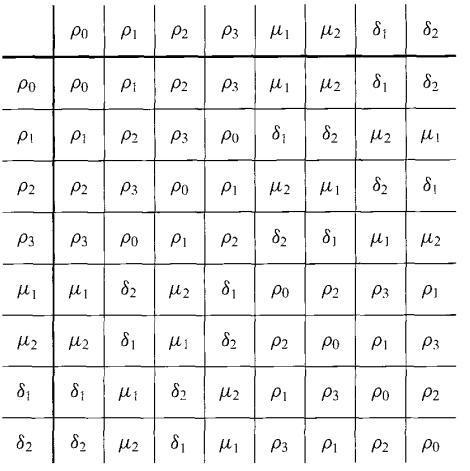
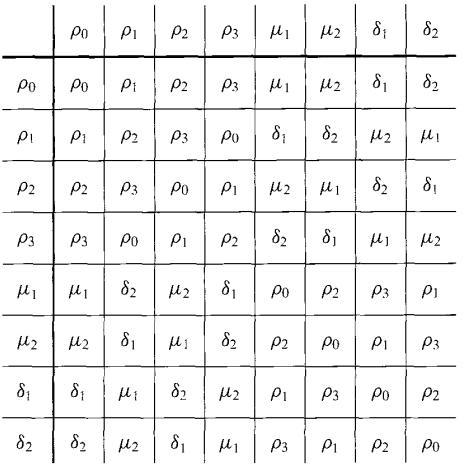
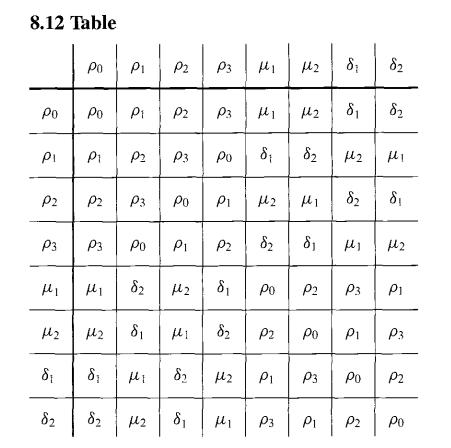
Find all left cosets of the subgroup {p0 , µ2} of the group D4 given by Table 8.12.Table 8.12. Po PI P2 P3 μ₁ 12 8₁ Po Po P1 fly 12 Pi 8₁ 82 8₂ P₂ P1 0₁P2 P₂ P3 P2 P3 Po PI μ2 P3 Po PI P2 82 82 8₁ 3 P3 flj μ м, м Po 8₁ 82 8₂ P3 12 8₁ 12 8₁ 8₂ M₂ 12 fl ळ 8₁ 12
Find all orbits of the given permutation.σ : Z → Z where σ(n) = n +2
Find all cosets of the subgroup (18) of Z36.
Find the order of the given element of the direct product.(3, 10, 9) in Z4 x Z12 x Z15
Draw a plane figure that has a three-element group as its group of symmetries in R2.
Find all orbits of the given permutation.σ : Z → Z where σ(n) = n - 3
Find the order of the given element of the direct product.( 3, 6, 12, 16) in Z4 x Z12 x Z20 x Z24
Draw a plane figure that has a four-element group isomorphic to Z4 as its group of symmetries in R2.
Compute the indicated product of cycles that are permutations of { 1, 2, 3, 4, 5, 6, 7, 8}.(1, 4, 5)(7, 8)(2, 5, 7)
Compute the expressions shown for the permutations a, r andµ defined prior to Exercise 1.σl00 Data from Exercise 1In Exercises, compute the indicated product involving the following permutations in S6: 0= 1 3 23 4 5 6 2 14 5 6 2 T= 1 2 3 4 5 6 3 6 2 4 1 5 23 «= (1 ² 3 4 5 6). 5 24 3
Repeat the preceding exercise, but find the right cosets this time. Are they the same as the left coset?Data from exercise 9Repeat Exercise 6 for the subgroup {Po, p2} of D4.Data from Exercise 6Find all left cosets of the subgroup {p0 , µ2} of the group D4 given by Table 8.12.
What is the largest order among the orders of all the cyclic subgroups of Z6 x Z8 ? of Z12 x Z15?
In Exercises, compute the expressions shown for the permutations σ, τ and µ defined prior to Exercise 1.μ100Data from Exercise 1In Exercises, compute the indicated product involving the following permutations in S6: 1 2 3 4 5 3 1 4 5 6 6 2). Na T= /1 23 4 5 2 4 1 3 6 6 5, μl == 43 51 2 3
Draw a plane figure that has a four-element group isomorphic to the Klein 4-group V as its group of symmetries in R2.
Let A be a set and let σ ∈ SA· For a fixed a ∈ A, the set Oa.σ- = {σn(a) |n ∈ Z}is the orbit of a under σ. Find the orbit of 1 under the permutation defined prior to Exercise 1.σData Prior to Exercise 1. 1 3 2 3 4 5 6 4 5 6 2 14 1 τ = 1 2 3 4 5 6 2 4 1 3 6 5 2 με 1 5 2 3 4
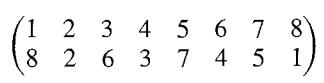
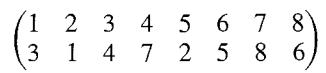
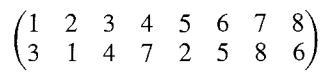
Express the permutation of { 1, 2, 3, 4, 5, 6, 7, 8} as a product of disjoint cycles, and then as a product of transpositions. 1 2 3 4 5 6 7 8 8 26 374 5 1
Rewrite Table 8.12 in the order exhibited by the left cosets in Exercise 9. Do you seem to get a coset group of order 4? If so, is it isomorphic to Z4 or to the Klein 4-group V?Data from exercise 9 Repeat Exercise 6 for the subgroup {Po, p2} of D4.Table 8.12
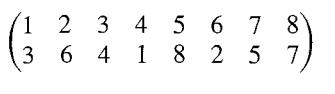
Express the permutation of { 1, 2, 3, 4, 5, 6, 7, 8} as a product of disjoint cycles, and then as a product of transpositions. 1 3 1 4 2 3 3 4 7 5 6 7 258 8 6
Find all proper nontrivial subgroups of Z2 x Z2 x Z2 .
A plane isometry ∅ has a fixed point if there exists a point P in the plane such that ∅( P) = P. Which of the four types of plane isometries (other than the identity) can have a fixed point?
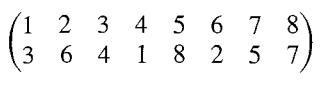
Express the permutation of { 1, 2, 3, 4, 5, 6, 7, 8} as a product of disjoint cycles, and then as a product of transpositions. 1 3 2 3 6 64 3 4 4 4 18 5 6 7 8 2 5 7
Let A be a set and let σ ∈ SA· For a fixed a ∈ A, the set Oa.σ- = {σn(a) |n ∈ Z}is the orbit of a under σ. Find the orbit of 1 under the permutation defined prior to Exercise 1.τData Prior to Exercise 1. 1 3 2 3 4 5 6 4 5 6 2 14 1 τ = 1 2 3 4 5 6 2 4 1 3 6 5 2 με 1 5 2 3 4 5
Find all subgroups of Z2 x Z4 of order 4.
Referring to Exercise 10, which types of plane isometries, if any, have exactly one fixed point? Data from Exercise 10.A plane isometry ∅ has a fixed point if there exists a point P in the plane such that ∅( P) = P. Which of the four types of plane isometries (other than the identity) can
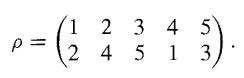
Recall that element a of a group G with identity element e has order r > 0 if ar = e and no smaller positive power of a is the identity. Consider the group S8. a. What is the order of the cycle ( 1, 4, 5, 7)? b. State a theorem suggested by part (a). c. What is the order of a =
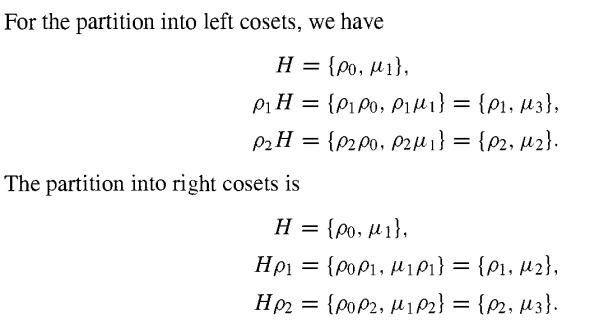
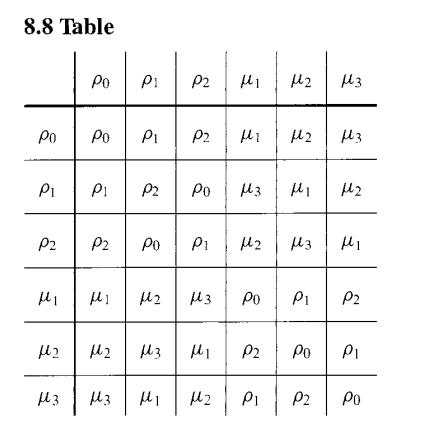
Find the index of (µ1) in the group S3, using the notation of Example 10.7Data from 10.7 ExampleTable 10.8 again shows Table 8.8 for the symmetric group S3 on three letters. Let H be the sub group (µ 1) = { p0 , µ i} of S3 . Find the partitions of S3 into left co sets of H, and the
Find the index of (3) in the group Z24.
Find all subgroups of Z2 x Z2 x Z4 that are isomorphic to the Klein 4-group.
In Table 8.8, we used po, p1, p2, µ1, µ2 , µ3 as the names of the 6 elements of S3. Some authors use the notations ∈, p, p2, ∅, p∅, p2∅ for these elements, where their ∈ is our identity p0, their p is our p1, and their ∅ is our µ1. Verify geometrically that their six
Referring to Exercise 10, which types of plane isometries, if any, have exactly two fixed points? Data from Exercise 10.A plane isometry ∅ has a fixed point if there exists a point P in the plane such that ∅( P) = P. Which of the four types of plane isometries (other than the identity) can
Find the index of (µ2) in the group D4 given in Table 8.12 Table 8.12 Po PI P2 P3 12 8₁ Po 8₂ Po μ₁ fly P1 Pi P2 P3 M₂ 8₁ 12 P2 P3 Po 8₁ 82 μ2 fl Po PI μ2 82 8₁ P3 Po PI P2 82 P2 P3 P₁ P2 82 12 8₁ 8₁ fly μls P3 8₂ μ₂ 8₂ 3 12 8₁ P2 fl 8₂ 12 8₁ Po P2 P3
Disregarding the order of the factors, write direct products of two or more groups of the form Zn so that the resulting product is isomorphic to Z60 in as many ways as possible.
Referring to Exercise 10, which types of plane isometries, if any, have an infinite number of fixed points? Data from Exercise 10.A plane isometry ∅ has a fixed point if there exists a point P in the plane such that ∅( P) = P. Which of the four types of plane isometries (other than the
Find the maximum possible order for an element of Sn for the given value of n.n = 5
With reference to Exercise 14, give a similar alternative labeling for the 8 elements of D4 in Table 8.12. Data from Exercise 14In Table 8.8, we used po, p1 , p2 , µ1, µ2 , µ3 as the names of the 6 elements of S3 . Some authors use the notations ∈, p, p2 , ∅, p∅, p2∅ for these
Fill in the blanks. a. The cyclic subgroup of Z24 generated by 18 has order______. b. Z3 x Z4 is of order_________.c. The element (4, 2) of Z12 x Z8 has order_______. d. The Klein 4-group is isomorphic to Z ______ x Z______. e. Z2 x Z x Z4 has ________ elements of finite order.
Argue geometrically that a plane isometry that leaves three noncolinear points fixed must be the identity map.
Find the maximum possible order for an element of Sn for the given value of n.n = 6
Let σ = (1, 2, 5, 4)(2, 3) in S5 . Find the index of (σ) in S5.
Find the maximum possible order for some element of Z4 x Z6 •
Using Exercise 14, show algebraically that if two plane isometries ∅ and ψ agree on three noncolinear points, that is, if ∅(Pi) = ψ(Pi) for noncolinear points P1, P2 , and P3 , then∅ and ψ are the same map.Data from exercise 14.Argue geometrically that a plane isometry that leaves
Find the maximum possible order for an element of Sn for the given value of n.n = 7
Let µ= (1, 2, 4, 5)(3, 6) in S6. Find the index of (µ) in S6.
Are the groups Z2 x Z12 and Z4 x Z6 isomorphic? Why or why not?
Do the rotations, together with the identity map, form a subgroup of the group of plane isometries? Why or why not?
Consider the group S3 of Example 8.7 a. Find the cyclic subgroups (p1), (p2), and (µ1) of S3. b. Find all subgroups, proper and improper, of S3 and give the subgroup diagram for them.Data from Example 8.7An interesting example fo rus is the group S3 of 3! = 6 elements. Let the set A be {
Find the number of elements in the set {σ ∈ S4 | σ(3) = 3}
Find the maximum possible order for an element of Sn for the given value of n.n = 10
Find the number of elements in the set {σ ∈ S5 | σ(2) = 5}.
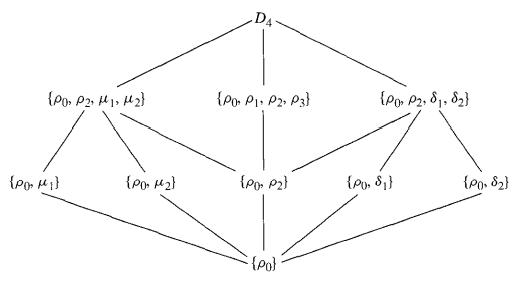
Verify that the subgroup diagram for D4 shown in Fig. 8.13 is correct by finding all ( cyclic) subgroups generated by one element, then all subgroups generated by two elements, etc.Fig. 8.13 {PO, P2, M₁, M₂} {PO, M₁} {PO, M^₂} DA {PO₂ P₁, P2, P3} {PO, P₂} {Pol {PO, P₂,
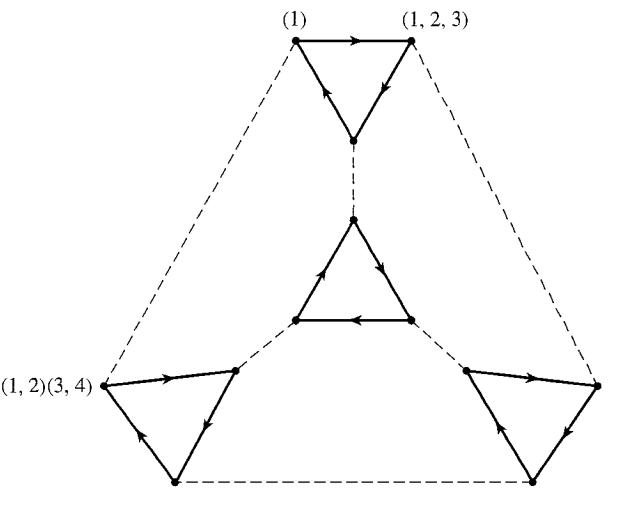
Figure 9.22 shows a Cayley digraph for the alternating group A4 using the generating set S = {(1, 2, 3), (1, 2)(3, 4)}. Continue labeling the other nine vertices with the elements of A4 , expressed as a product of disjoint cycles.Figure 9.22 (1, 2) (3, 4) (1) I I i T T (1, 2, 3) 1 1 1 1 1
Correct the definition of the italicized term without reference to the text, if correction is needed, so that it is in a form acceptable for publication. Let G be a group and let H ⊆ G. The left coset of H containing a is aH = {ah | h ∈ H}.
Find the maximum possible order for an element of Sn for the given value of n.n = 15
Correct the definition of the italicized term without reference to the text, if correction is needed, so that it is in a form acceptable for publication.Let G be a group and let H ≤ G. The index of H in G is the number of right cosets of H in G.
Give the multiplication table for the cyclic subgroup of S5 generated by There will be six elements. Let them be p, p2, p 3 , p4, p5, and p0 = p6 . Is this group isomorphic to S3 ? 1 2 3 2 4 3 4 5 5 1 3,
Find the maximum possible order for some element of Z4 x Z18 x Z15 •
Does the reflection across one particular line L, together with the identity map, form a subgroup of the group of plane isometries? Why or why not?
Mark each of the following true or false. ___ a. Every subgroup of every group has left cosets. ___ b. The number of left cosets of a subgroup of a finite group divides the order of the group. ___ c. Every group of prime order is abelian. ___ d. One cannot have left cosets of a
Are the groups Z4 x Z18 x Z15 and Z3 x Z36 x Z10 isomorphic? Why or why not?
Do the glide reflections, together with the identity map, form a subgroup of the group of plane isometries? Why or why not?
Completing a detail in the proof of Theorem 12.5, let G be a finite group consisting of the identity isometry and rotations about one point P in the plane. Show that G is cyclic, generated by the rotation in G that turns the plane counterclockwise about P through the smallest angle θ > 0.Data
Give an example of the desired subgroup and group if possible. If impossible, say why it is impossible.A subgroup of an abelian group G whose left cosets and right cosets give different partitions of G.
Correct the definition of the italicized term without reference to the text, if correction is needed, so that it is in a form acceptable for publication.A cycle is a permutation having only one orbit.
Proceed as in Example 11.13 to find all abelian groups, up to isomorphism, of the given order.Order 8Data from example 11.13Find all abelian groups, up to isomorphism, of order 360. The phrase up to isomorphism signifies that any abelian group of order 360 should be structurally identical
Which of the four types of plane isometries can be elements of a finite subgroup of the group of plane isometries?
a. Verify that the six matrices form a group under matrix multiplication. b. What group discussed in this section is isomorphic to this group of six matrices? 1 0 0 0 1 0 00 1 3 0 1 0 0 0 1 1 0 0 0 0 1 0 0 1 1 0 0 0 0 0 0 1 0 1 0 1 0 0 1 0 1 0 1 0 0 0 1 0 1 0 0 0 0 1
Give an example of the desired subgroup and group if possible. If impossible, say why it is impossible. A subgroup of a group G whose left cosets give a partition of G into just one cell.
Proceed as in Example 11.13 to find all abelian groups, up to isomorphism, of the given order.Order 16Data from example 11.13Find all abelian groups, up to isomorphism, of order 360. The phrase up to isomorphism signifies that any abelian group of order 360 should be structurally identical
Correct the definition of the italicized term without reference to the text, if correction is needed, so that it is in a form acceptable for publication.The alternating group is the group of all even permutations.
Completing a detail of the proof of Theorem 12.5, let G be a finite group of plane isometries. Show that the rotations in G, together with the identity isometry, form a subgroup H of G, and that either H = G or |G| = 2|H|. Data from Theorem 12.5Every finite group G of isometries of the plane
Showing 1100 - 1200
of 1629
First
3
4
5
6
7
8
9
10
11
12
13
14
15
16
17
Step by Step Answers

 Get 50% OFF
Claim Now
Get 50% OFF
Claim Now