New Semester
Started
Get
50% OFF
Study Help!
--h --m --s
Claim Now
Question Answers
Textbooks
Find textbooks, questions and answers
Oops, something went wrong!
Change your search query and then try again
S
Books
FREE
Study Help
Expert Questions
Accounting
General Management
Mathematics
Finance
Organizational Behaviour
Law
Physics
Operating System
Management Leadership
Sociology
Programming
Marketing
Database
Computer Network
Economics
Textbooks Solutions
Accounting
Managerial Accounting
Management Leadership
Cost Accounting
Statistics
Business Law
Corporate Finance
Finance
Economics
Auditing
Tutors
Online Tutors
Find a Tutor
Hire a Tutor
Become a Tutor
AI Tutor
AI Study Planner
NEW
Sell Books
Search
Search
Sign In
Register
study help
mathematics
a first course in abstract algebra
A First Course In Abstract Algebra 7th Edition John Fraleigh - Solutions
Factor the Gaussian integer into a product of irreducibles in Z[i].7
State whether the given function ν is a Euclidean norm for the given integral domain.The function ν for Z[x] given by ν(f(x)) = (the absolute value of the coefficient of the highest degree nonzero term of f(x)) for nonzero f(x) ∈ Z[x]
Determine whether the element is an irreducible of the indicated domain.14 in Z
Factor the Gaussian integer into a product of irreducibles in Z[i].4 + 3i
State whether the given function ν is a Euclidean norm for the given integral domain.The function v for Q given by ν(a) = a2 for nonzero a ∈ Q
Determine whether the element is an irreducible of the indicated domain.2x - 3 in Z[x]
Factor the Gaussian integer into a product of irreducibles in Z[i].6 - 7i
State whether the given function ν is a Euclidean norm for the given integral domain.The function ν for Q given by ν(a) = 50 for nonzero a ∈ Q
Determine whether the element is an irreducible of the indicated domain.2x - 10 in Z[x]
Show that 6 does not factor uniquely (up to associates) into irreducibles in Z[√-5]. Exhibit two different factorizations.
Determine whether the element is an irreducible of the indicated domain.2x - 3 in Q[x]
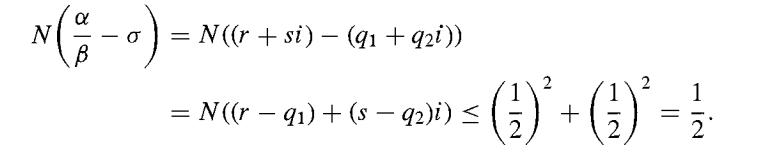
Consider α = 7 + 2i and β = 3 - 4i in Z[i]. Find σ and ρ in Z[i] such that α = βσ + ρ with N(ρ) < N(β).
Find a gcd of 49,349 and 15,555 in Z.
Determine whether the element is an irreducible of the indicated domain.2x - 10 in Q[x]
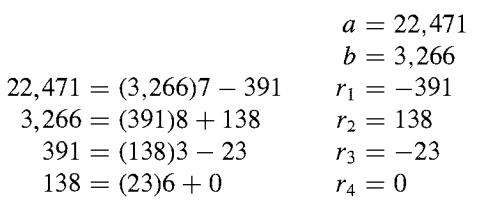
Following the idea of Exercise 6 and referring to Exercise 7, express the positive gcd of 49,349 and 15,555 in Z in the form λ(49,349) + µ,(15,555) for λ, µ, ∈ Z.Data from Exercise 6By referring to Example 46.11, actually express the gcd 23 in the form λ(22,471) + µ,(3,266) for λ,µ, ∈
Determine whether the element is an irreducible of the indicated domain.2x - 10 in Z11[x]
Mark each of the following true or false. ___ a. Z[i] is a PID. ___ b. Z[i] is a Euclidean domain. ___ c. Every integer in Z is a Gaussian integer. ___ d. Every complex number is a Gaussian integer. ___ e. A Euclidean algorithm holds in Z[i]. ___ f. A multiplicative
Use a Euclidean algorithm in Z[i] to find a gcd of 8 + 6i and 5 - 15i in Z[i].
If possible, give four different associates of 2x - 7 viewed as an element of Z[x]; of Q[x]; of Z11[x].
Let D be an integral domain with a multiplicative norm N such that |N(α)| = 1 for α ∈ D if and only if α is a unit of D. Let π be such that |N(π)| is minimal among all |N(β)| > 1 for β ∈ D. Show that π is an irreducible of D.
Describe how the Euclidean Algorithm can be used to find the gcd of n members a1, a2 , · · · , an of a Euclidean domain.
Factor the polynomial 4x2 - 4x + 8 into a product of irreducibles viewing it as an element of the integral domain Z[x]; of the integral domain Q[x]; of the integral domain Z11[x].
a. Show that 2 is equal to the product of a unit and the square of an irreducible in Z[i]. b. Show that an odd prime p in Z is irreducible in Z[i] if and only if p ≡ 3 (mod 4). (Use Theorem 47.10.)Data from Theorem 47.10Let p be an odd prime in Z. Then p = a2 + b2 for integers a and b in Z
Using your method devised in Exercise 10, find the gcd of 2178, 396, 792, and 726. Data from Exercise 10Describe how the Euclidean Algorithm can be used to find the gcd of n members a1, a2 , · · · , an of a Euclidean domain.
Find all gcd's of the given elements of Z.234, 3250, 1690
Prove Lemma 47.2.Data from Lemma 47.2In Z[i], the following properties of the norm function N hold for all α, β ∈ Z[i]:N(α) ≥ 0. N(α) = 0 if and only if α = 0. N(αβ) = N(α)N(β). Proof If we let α = a1 + a2i and β = b1 + b2i, these results are all straightforward
Let us consider Z[x]. a. Is Z[x] a UFD? Why? b. Show that {a + xf(x)|a ∈ 2Z, f(x) ∈ Z[x]} is an ideal in Z[x]. c. Is Z[x] a PID? (Consider part (b).) d. Is Z[x] a Euclidean domain? Why?
Find all gcd's of the given elements of Z.784, -1960, 448
Prove that N of Example 47.9 is multiplicative, that is, that N(αβ) = N(α)N(β) for α,β ∈ Z[√-5].Data from Example 47.9Let Z[√-5] = {a + ib √5 | a, b ∈ Z}. As a subset of the complex numbers closed under addition, subtraction, and multiplication, and containing 0 and 1, Z[√-5] is
Mark each of the following true or false. __ a. Every Euclidean domain is a PID. __ b. Every PID is a Euclidean domain. __ c. Every Euclidean domain is a UFD. __ d. Every UFD is a Euclidean domain. __ e. A gcd of 2 and 3 in Q is ½__ f. The Euclidean algorithm gives a
Find all gcd's of the given elements of Z.2178,396, 792,594
Let D be an integral domain with a multiplicative norm N such that |N(α)| = 1 for α ∈ D if and only if α is a unit of D. Show that every nonzero nonunit of D has a factorization into irreducibles in D.
Does the choice of a particular Euclidean norm v on a Euclidean domain D influence the arithmetic structure of D in any way? Explain.
Express the given polynomial as the product of its content with a primitive polynomial in the indicated UFD.18x2 - 12x + 48 in Z[x]
Use a Euclidean algorithm in Z[i] to find a gcd of 16 + 7i and 10 - 5i in Z[i].
Show by a construction analogous to that given in the proof of Theorem 47.4 that the division algorithm holds in the integral domain Z[√-2] for v(α) = N(α) for nonzero α in this domain (see Exercise 16). (Thus this domain is Euclidean. See Hardy and Wright [29] for a discussion of which
Let D be a Euclidean domain and let v be a Euclidean norm on D. Show that if a and b are associates in D, then v(a) = v(b).
Express the given polynomial as the product of its content with a primitive polynomial in the indicated UFD.18x2 - 12x + 48 in Q[x]
Let (α) be a nonzero principal ideal in Z[i]. a. Show that Z[i]/(α) is a finite ring.b. Show that if π is an irreducible of Z[i], then Z[i]/(π) is a field. c. Referring to part (b), find the order and characteristic of each of the following fields. i. Z[i]/(3) ii. Z[i]/(1 +
Let D be a Euclidean domain and let v be a Euclidean norm on D. Show that for nonzero a, b ∈ D, one has v(a) < v(ab) if and only if b is not a unit of D.
Express the given polynomial as the product of its content with a primitive polynomial in the indicated UFD.2x2 - 3x + 6 in Z[x]
Let n ∈ Z+ be square free, that is, not divisible by the square of any prime integer. Let Z[√-n] = {a+ ib√n | a, b ∈ Z}. a. Show that the norm N, defined by N(α) = a2 + nb2 for α = a + ib√n, is a multiplicative norm on Z[√-n]. b. Show that N(α) = 1 for α ∈ Z[√-n] if
Repeat Exercise 16 for Z [√-n] ={a+ b√n|a, b ∈ Z}, with N defined by N(α) = a2 - nb2 for α = a+ b√n in Z[√n].Data from Exercise 16Let n ∈ Z+ be square free, that is, not divisible by the square of any prime integer. Let Z[√-n] = {a+ ib√n | a, b ∈ Z}. a. Show that the norm
Prove or disprove the following statement: If v is a Euclidean norm on Euclidean domain D, then {a ∈ D|v(a) > v(1)} U {0} is an ideal of D.
Express the given polynomial as the product of its content with a primitive polynomial in the indicated UFD.2x2 - 3x + 6 in Z7[x]
Show that every field is a Euclidean domain.
Correct the definition of the italicized term without reference to the text, if correction is needed, so that it is in a form acceptable for publication.Two elements a and b in an integral domain D are associates in D if and only if their quotient a/b in D is a unit.
Let v be a Euclidean norm on a Euclidean domain D. a. Show that if s ∈ Z such that s + v(1) > 0, then η : D* → Z defined by η(a) = v(a) + s for nonzero a ∈ D is a Euclidean norm on D. As usual, D* is the set of nonzero elements of D. b. Show that for t ∈ Z+, λ : D* → Z
Correct the definition of the italicized term without reference to the text, if correction is needed, so that it is in a form acceptable for publication.An element of an integral domain D is an irreducible of D if and only if it cannot be factored into a product of two elements of D.
Let D be a UFD. An element c in D is a least common multiple (abbreviated Icm) of two elements a and bin D if a | c, b|c and if c divides every element of D that is divisible by both a and b. Show that every two nonzero elements a and b of a Euclidean domain D have an Icm in D.
Correct the definition of the italicized term without reference to the text, if correction is needed, so that it is in a form acceptable for publication.An element of an integral domain D is a prime of D if and only if it cannot be factored into a product of two smaller elements of D.
Use the last statement in Theorem 46.9 to show that two nonzero elements r, s ∈ Z generate the group (Z, +) if and only if r and s, viewed as integers in the domain Z, are relatively prime, that is, have a gcd of 1.Data from Theorem 46.9Let D be a Euclidean domain with a Euclidean norm v, and let
Mark each of the following true or false. ____a. Every field is a UFD. ____ b. Every field is a PID. ____ c. Every PID is a UFD. ____ d. Every UFD is a PID. ____ e. Z[x] is a UFD. ____ f. Any two irreducibles in any UFD are associates. ____ g. If Dis a PID, then
Using the last statement in Theorem 46.9, show that for nonzero a, b, n ∈ Z, the congruence ax ≡ b (mod n) has a solution in Z if a and n are relatively prime.Data from Theorem 46.9Let D be a Euclidean domain with a Euclidean norm v, and let G and b be nonzero elements of D. Let r1 be as in
Let D be a UFD. Describe the irreducibles in D[x] in terms of the irreducibles in D and the irreducibles in F[x], where F is a field of quotients of D.
Generalize Exercise 22 by showing that for nonzero a, b, n ∈ Z, the congruence ax ≡ b (mod n) has a solution in Z if and only if the positive gcd of a and n in Z divides b. Interpret this result in the ring Zn.Data from Exercise 22Using the last statement in Theorem 46.9, show that for nonzero
Lemma 45.26 states that if D is a UFD with a field of quotients F, then a nonconstant irreducible f(x) of D[x] is also an irreducible of F[x ]. Show by an example that a g(x) ∈ D[x] that is an irreducible of F[x] need not be an irreducible of D[x].Data from Lemma 45.26If D is a UFD, then a finite
Following the idea of Exercises 6 and 23, outline a constructive method for finding a solution in Z of the congruence ax ≡ b (mod n) for nonzero a, b, n ∈ Z, if the congruence does have a solution. Use this method to find a solution of the congruence 22x ≡ 18 (mod 42).Data from Exercise
All our work in this section was restricted to integral domains. Taking the same definition in this section but for a commutative ring with unity, consider factorizations into irreducibles in Z x Z. What can happen? Consider in particular (1, 0).
Prove that if p is a prime in an integral domain D, then pis an irreducible.
Prove that if p is an irreducible in a UFD, then p is a prime.
For a commutative ring R with unity show that the relation a ~ b if a is an associate of b (that is, if a = bu for u a unit in R is an equivalence relation on R.
Let D be an integral domain. Exercise 37, Section 18 showed that (U, ·) is a group where U is the set of units of D. Show that the set D* - U of non units of D excluding 0 is closed under multiplication. Is this set a group under the multiplication of D?Data from Exercises 37 Section 18Show that
Let D be a UFD. Show that a nonconstant divisor of a primitive polynomial in D[x] is again a primitive polynomial.
Show that in a PID, every ideal is contained in a maximal ideal.
Factor x3 - y3 into irreducibles in Q[x, y] and prove that each of the factors is irreducible.
Let R be any ring. The ascending chain condition (ACC) for ideals holds in R if every strictly increasing sequence N1 ⊂ N2 ⊂ N3 ⊂ · · · of ideals in R is of finite length. The maximum condition (MC) for ideals holds in R if every nonempty set S of ideals in R contains an ideal not properly
Let R be any ring. The descending chain condition (DCC) for ideals holds in R if every strictly decreasing sequence N1 ⊃ N2 ⊃ N3 ⊃ · · · of ideals in R is of finite length. The minimum condition (mC) for ideals holds in R if given any set S of ideals of R, there is an ideal of S that
Give an example of a ring in which ACC holds but DCC does not hold.
Let R be an ordered ring with set P of positive elements, and let < be the relation on R defined in Theorem 25.5. Prove the given statement. (All the proofs have to be in terms of Definition 25.1 and Theorem 25.5. For example, you must not say, "We know that negative times positive is negative,
Let R be an ordered ring with set P of positive elements, and let < be the relation on R defined in Theorem 25.5. Prove the given statement. (All the proofs have to be in terms of Definition 25.1 and Theorem 25.5. For example, you must not say, "We know that negative times positive is negative,
Let R be an ordered ring with set P of positive elements, and let < be the relation on R defined in Theorem 25.5. Prove the given statement. (All the proofs have to be in terms of Definition 25.1 and Theorem 25.5. For example, you must not say, "We know that negative times positive is negative,
Let R be an ordered ring with set P of positive elements, and let < be the relation on R defined in Theorem 25.5. Prove the given statement. (All the proofs have to be in terms of Definition 25.1 and Theorem 25.5. For example, you must not say, "We know that negative times positive is negative,
Let R be an ordered ring with set P of positive elements, and let < be the relation on R defined in Theorem 25.5. Prove the given statement. (All the proofs have to be in terms of Definition 25.1 and Theorem 25.5. For example, you must not say, "We know that negative times positive is negative,
Let R be an ordered ring with set P of positive elements, and let < be the relation on R defined in Theorem 25.5. Prove the given statement. (All the proofs have to be in terms of Definition 25.1 and Theorem 25.5. For example, you must not say, "We know that negative times positive is negative,
For a set S, let P(S) be the collection of all subsets of S. Let binary operations + and · on P(S) be defined by A+ B = (A U B) - (A ∩ B) = {x | x ∈ A or x ∈ B but x ∉ (A ∩ B)} and A . B=A ∩ B for A, B ∈ P(S). a. Give the tables for + and • for P(S), where S = {a, b}.b.
Find all prime ideals and all maximal ideals of Z12.
Show that the given number α ∈ C is algebraic over Q by finding f(x) ∈ Q[x] such that f(α) = 0.√2 + √3
Mark each of the following true or false. ___ a. It is impossible to double any cube of constructible edge by compass and straightedge constructions. ___ b. It is impossible to double every cube of constructible edge by compass and straightedge constructions. ___ c. It is impossible
Show that the given number α ∈ C is algebraic over Q by finding f(x) ∈ Q[x] such that f(α) = 0.1 + i
Give a basis for the indicated vector space over the field.Q(i) over Q
Show that if E is a finite extension of a field F and [E : F] is a prime number, then E is a simple extension of F and, indeed, E = F(α) for every a ∈ E not in F.
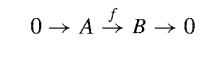
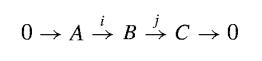
Let A and B be additive groups, and suppose that the sequence is exact. Show that A ≈ B. 0 A → $ B 0 →
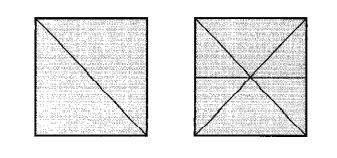
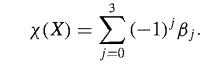
Verify by direct calculation that both triangulations of the square region X in Fig. 42.1 give the same value for the Euler characteristic χ(X).
Compute the homology groups of the space consisting of two tangent I-spheres, i.e., a figure eight.
Assume that c = 2P1P3P4 - 4P3P4P6 + 3P3P2P4 + P1P6P4 is a 2-chain of a certain simplicial complex X. a. Compute ∂2(c). b. Is c a 2-cycle? c. Is ∂2(c) a 1-cycle?
Let A, B, and C be additive groups and suppose that the sequence is exact. Show that a. j maps B onto C b. i is an isomorphism of A into B c. C is isomorphic to B/i[A] 0 → A B C → 0
Compute the homology groups of the space consisting of two tangent 2-spheres.
Illustrate Theorem 43.7, as we did in Example 43.8, for each of the following spaces. a. The annular region of Example 42.10 b. The torus of Example 42.12 c. The Klein bottle of Example 43.1Data from Theorem 43.7Let X be a finite simplicial complex (or triangulated space) of
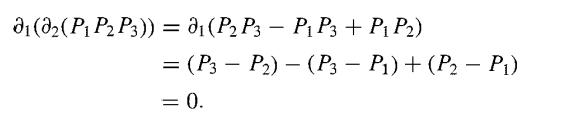
Compute ∂2(∂2(P1P2P3P4)) and show that it is 0, completing the proof of Theorem 41.9.Data from Theorem 41.9Let X be a simplicial complex, and let Cn(X) be then-chains of X for n = 0, 1, 2, 3. Then the composite homomorphism ∂n-1∂n mapping Cn(X) into Cn-2(X) maps everything into 0 for n = 1,
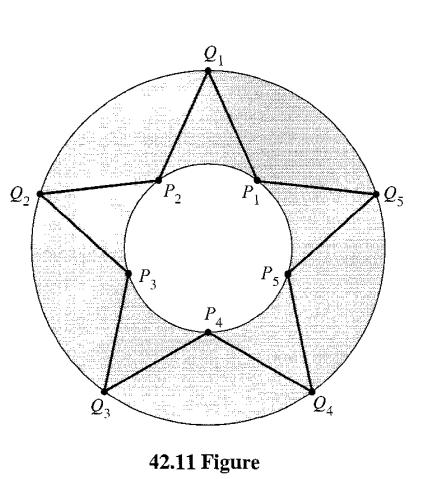
Compute the homology groups of the space consisting of a 2-sphere with an annular ring ( as in Fig. 42.11) that does not touch the 2-sphere. 2₂ 23 dy P3 Alon P2 2₁ PA P₁ Ps 42.11 Figure 25
Will every continuous map of a square region into itself have a fixed point? Why or why not? Will every continuous map of a space consisting of two disjoint 2-cells into itself have a fixed point? Why or why not?
Describe Ci(P), Zi(P), Bi(P), and Hi(P) for the space consisting of just the 0-simplex P.
Compute the homology groups of the space consisting of a 2-sphere with an annular ring whose inner circle is a great circle of the 2-sphere.
Compute the homology groups of the space consisting of a 2-sphere touching a Klein bottle at one point.
Describe Ci(X), Zi(X), Bi(X), and Hi(X) for the space X consisting of two distinct 0-simplexes, P and P'.
Compute the homology groups of the space consisting of a circle touching a 2-sphere at one point.
Theorem 44.4 and Theorem 44.7 are closely connected with Exercise 39 of Section 14. Show the connection. Data from Theorem 44.7If A' is a subcomplex of the chain complex A, then the collection A/A' of factor groups Ak/A'k, together with the collection ∂̅ of homomorphisms ∂̅k defined by
Compute the homology groups of the space consisting of two Klein bottles with no points in common.
Compute the homology groups of the surface consisting of a 2-sphere with a handle (see Fig. 42.17). Figure 42.17
Showing 200 - 300
of 1629
1
2
3
4
5
6
7
8
9
10
11
12
13
14
15
Last
Step by Step Answers

 Get 50% OFF
Claim Now
Get 50% OFF
Claim Now