New Semester
Started
Get
50% OFF
Study Help!
--h --m --s
Claim Now
Question Answers
Textbooks
Find textbooks, questions and answers
Oops, something went wrong!
Change your search query and then try again
S
Books
FREE
Study Help
Expert Questions
Accounting
General Management
Mathematics
Finance
Organizational Behaviour
Law
Physics
Operating System
Management Leadership
Sociology
Programming
Marketing
Database
Computer Network
Economics
Textbooks Solutions
Accounting
Managerial Accounting
Management Leadership
Cost Accounting
Statistics
Business Law
Corporate Finance
Finance
Economics
Auditing
Tutors
Online Tutors
Find a Tutor
Hire a Tutor
Become a Tutor
AI Tutor
AI Study Planner
NEW
Sell Books
Search
Search
Sign In
Register
study help
mathematics
a first course in abstract algebra
A First Course In Abstract Algebra 7th Edition John Fraleigh - Solutions
Describe all solutions of the given congruence. 2x ≡ 6 (mod 4)
Mark each of the following true or false. ___ a. Mn(F) has no divisors of 0 for any n and any field F. ___ b. Every nonzero element of M2(Z2) is a unit. ___ c. End(A) is always a ring with unity ≠ 0 for every abelian group A. ___ d. End(A) is never a ring with unity ≠ 0 for
Let R be a nonzero commutative ring, and let T be a nonempty subset of R closed under multiplication and containing neither 0 nor divisors of 0. Starting with R x T and otherwise exactly following the construction in this section, we can show that the ring R can be enlarged to a partial ring of
Let R be a commutative ring with unity of characteristic 3. Compute and simplify (a + b )9 for a, b ∈ R.
Decide whether the indicated operations of addition and multiplication are defined (closed) on the set, and give a ring structure. If a ring is not formed, tell why this is the case. If a ring is formed, state whether the ring is commutative, whether it has unity, and whether it is a field.{a + b
Find all zeros in the indicated finite field of the given polynomial with coefficients in that field.x2 + 1 in Z2
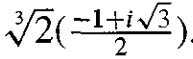
It can be shown that the smallest subfield of R containing 3√2 is isomorphic to the smallest subfield of C containing Explain why this shows that, although there is no ordering for C, there may be an ordering of a subfield of C that contains some elements that are not real numbers.
Describe all solutions of the given congruence.36x ≡ 15 (mod 24)
Show that M2(F) has at least six units for every field F. Exhibit these units.
Describe all units in the given ring.Z
Show that f(x) = x2 + 8x - 2 is irreducible over Q. Is f(x) irreducible over R? Over C?
Find all zeros in the indicated finite field of the given polynomial with coefficients in that field.x5 + 3x3 + x2 + 2x in Z5
Describe all solutions of the given congruence.45x ≡ 15 (mod 24)
Show that End ((Z, +)) is naturally isomorphic to (Z, +,•)and that End((Zn, +)) is naturally isomorphic to (Zn,+,·).
Correct the definition of the italicized term without reference to the text, if correction is needed, so that it is in a form acceptable for publication. If ab = 0, then a and b are divisors of zero.
Describe all units in the given ring.Z x Z
Repeat Exercise 14 with g(x) = x2 + 6x + 12 in place of f(x). Data from Exercise14Show that f(x) = x2 + 8x - 2 is irreducible over Q. Is f(x) irreducible over R? Over C?
Find all zeros in the indicated finite field of the given polynomial with coefficients in that field.f(x)g(x) where f(x) = x3 + 2x2 + 5 and g(x) = 3x2 + 2x in Z7
Mark each of the following true or false. ___ a. There is only one ordering possible for the ring Z. ___ b. The field R can be ordered in only one way. ___ c. Any subfield of R can be ordered in only one way. ___ d. The field Q can be ordered in only one way. ___ e. If R is
Describe all solutions of the given congruence.39x ≡ 125 (mod 9)
Show that End((Z2 x Z2 , +)) is not isomorphic to (Z2 x Z2, +, ·).
With reference to Exercise 12, describe the ring Q(3Z, {6n |n ∈ Z+}) by describing a subring of R to which it is isomorphic. Data from Exercise 12Let R be a nonzero commutative ring, and let T be a nonempty subset of R closed under multiplication and containing neither 0 nor divisors of 0.
Correct the definition of the italicized term without reference to the text, if correction is needed, so that it is in a form acceptable for publication.If n, a = 0 for all elements a in a ring R, then n is the characteristic of R.
Describe all units in the given ring.Z5
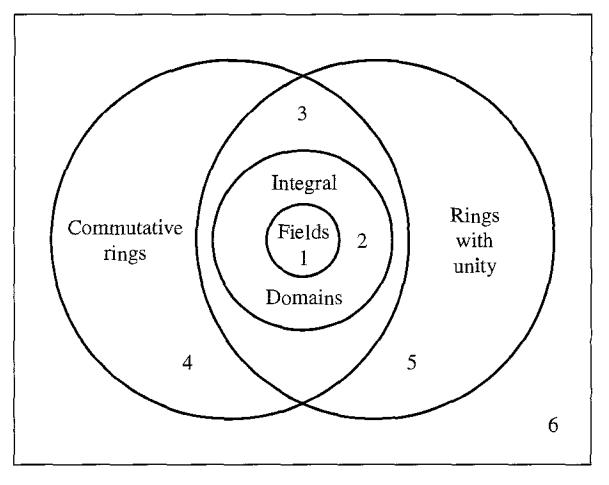
Each of the six numbered regions in Fig. 19.10 corresponds to a certain type of a ring. Give an example of a ring in each of the six cells. For example, a ring in the region numbered 3 must be commutative (it is inside the commutative circle), have unity, but not be an integral domain.Data from
Describe an ordering of the ring Q[π], discussed in Example 25.11, in which π is greater than any rational number.Data from in Example 25.11Example 22.9 stated that the evaluation homomorphism ∅π : Q[x]→ R where ∅(a0 + a1x + · · · + anxn) = a0 + a1π + · · · + anπn is one
Correct the definition of the italicized term without reference to the text, if correction is needed, so that it is in a form acceptable for publication. A polynomial with coefficients in a ring R is an infinite formal sum where ai ∈ R for i = 0, 1, 2, · · •. Σαχί = a +
Describe all solutions of the given congruence.41x ≡ 125 (mod 9)
With reference to Exercise 12, suppose we drop the condition that T have no divisors of zero and just require that nonempty T not containing 0 be closed under multiplication. The attempt to enlarge R to a commutative ring with unity in which every nonzero element of T is a unit must fail if T
Mark each of the following true or false. ___ a. nZ has zero divisors if n is not prime. ___ b. Every field is an integral domain. ___ c. The characteristic of nZ is n.___ d. As a ring, Z is isomorphic to nZ for all n ≥1. ___ e. The cancellation law holds in any ring that is
Describe all units in the given ring.Q
Use Fermat's theorem to find all zeros in Z5 of 2x219 + 3x74 + 2x57 + 3x44 .
Describe all solutions of the given congruence.155x ≡ 75 (mod 65)
If G = {e}, the group of one element, show that RG is isomorphic to R for any ring R.
There exists a matrix K ∈M2(C) such that ∅ : H → M2(C) defined byfor all a, b, c, d ∈ R, gives an isomorphism of H with ∅[H] a. Find the matrix K. b. What other thing should you check to show that ∅ gives an isomorphism of H with ∅ [H]? 0 = a[bi] + b[_id]+c[i b]+dk, p(a +
Describe all units in the given ring.Z x Q x Z
Determine whether the polynomial in Z[x] satisfies an Eisenstein criterion for irreducibility over Q. x2 - 12
Describe all solutions of the given congruence39x ≡ 52 (mod 130)
Describe all units in the given ring.Z4
Determine whether the polynomial in Z[x] satisfies an Eisenstein criterion for irreducibility over Q.8x3 + 6x2 - 9x + 24
Let p be a prime ≥ 3. Use Exercise 28 below to find the remainder of (p - 2)! modulo p.Data from Exercise 28Using Exercise 27, deduce the half of Wilson's theorem that states that if pis a prime, then (p - 1)! ≡ -1 (mod p ). [The other half states that if n is an integer > 1 such that (n - 1
Consider the matrix ring M2(Z2). a. Find the order of the ring, that is, the number of elements in it. b. List all units in the ring.
Determine whether the polynomial in Z[x] satisfies an Eisenstein criterion for irreducibility over Q.4x10 - 9x3 + 24x - 18
Consider the element f(x, y) = (3x3 + 2x)y3 + (x2 - 6x + 1)y2 + (x4 - 2x)y + (x4 - 3x2 + 2) of (Q[x])[y]. Write f (x, y) as it would appear if viewed as an element of (Q[y])[x ].
Using Exercise 28 below, find the remainder of 34! modulo 37. Data from Exercise 28Using Exercise 27, deduce the half of Wilson's theorem that states that if pis a prime, then (p - 1)! ≡ -1 (mod p ). [The other half states that if n is an integer > 1 such that (n - 1 )! ≡ -1 (mod n ),
Give a one-sentence synopsis of the proof of the "if" part of Theorem 19.5. Data from 19.5 Theorem The cancellation laws hold in a ring R if and only if R has no divisors of 0. Proof: Let R be a ring in which the cancellation laws hold, and suppose ab = 0 for some a, b ∈ R.
If possible, give an example of a homomorphism∅ : R → R' where R and R' are rings with unity 1 ≠ 0 and 1' ≠ 0', and where ∅(1) ≠ 0' and ∅(1) ≠ 1'.
Determine whether the polynomial in Z[x] satisfies an Eisenstein criterion for irreducibility over Q.2x10 - 25x3 + 10x2 - 30
Let R be an ordered ring with set P of positive elements, and let < be the relation on R defined in Theorem 25.5. Prove the given statement. (All the proofs have to be in terms of Definition 25.1 and Theorem 25.5. For example, you must not say, "We know that negative times positive is negative,
Consider the evaluation homomorphism ∅5 : (Q[x] → R Find six elements in the kernel of the homomorphism ∅5
Using Exercise 28 below, find the remainder of 49! modulo 53.Data from Exercise 28Using Exercise 27, deduce the half of Wilson's theorem that states that if pis a prime, then (p - 1)! ≡ -1 (mod p ). [The other half states that if n is an integer > 1 such that (n - 1 )! ≡ -1 (mod n ), then n
Using Exercise 28 below, find the remainder of 24! modulo 29. Data from Exercise 28Using Exercise 27, deduce the half of Wilson's theorem that states that if pis a prime, then (p - 1)! ≡ -1 (mod p ). [The other half states that if n is an integer > 1 such that (n - 1 )! ≡ -1 (mod n ),
Consider the map det of Mn(R) into R where det(A) is the determinant of the matrix A for A ∈ Mn (R). Is det a ring homomorphism? Why or why not?
Find all zeros of 6x4 + 17x3 + 7x2 + x - 10 in (Q. (This is a tedious high school algebra problem. You might use a bit of analytic geometry and calculus and make a graph, or use Newton's method to see which are the best candidates for zeros.)
Find a polynomial of degree >0 in Z4 [x] that is a unit.
Mark each of the following true or false. ___ a. aP- 1 ≡ 1 (mod p) for all integers a and primes p. ___ b. ap-1 ≡ 1 (mod p) for all integers a such that a ≠ 0 (mod p) for a prime p. ___ c. φ(n) ≤ n for all n ∈ Z+. ___ d. φ(n) ≤ n - 1 for all n ∈ Z+. ___ e.
Describe all ring homomorphisms of Z into Z.
An element a of a ring R is idempotent if a2 = a. Show that a division ring contains exactly two idempotent elements.
Correct the definition of the italicized term without reference to the text, if correction is needed, so that it is in a form acceptable for publication. A polynomial f(x) ∈ F[x] is irreducible over the field F if and only if f(x) ≠ g(x)h(x) for any polynomials g(x), h(x) ∈ F[x].
Mark each of the following true or false. ___ a. The polynomial (anxn + · · · + a1x + a0) ∈ R[x] is 0 if and only if ai = 0, for i = 0, 1, · · ·, n. ___ b. If R is a commutative ring, then R[x] is commutative. ___ c. If D is an integral domain, then D[x] is an integral
Give the group multiplication table for the multiplicative group of units in Z12 . To which group of order 4 is it isomorphic?
Describe all ring homomorphisms of Z into Z x Z.
Show that an intersection of subdomains of an integral domain D is again a subdomain of D.
Correct the definition of the italicized term without reference to the text, if correction is needed, so that it is in a form acceptable for publication.A nonconstant polynomial f(x) ∈ F[x] is irreducible over the field F if and only if in any factorization of it in F[x], one of the factors is in
Give a one-sentence synopsis of the proof of Theorem 20.1.Data from 20.1 Theorem If a ∈ Z and p is a prime not dividing a, then p divides aP-1 - 1, that is, aP-1 = 1 (mod p) for a ≠ 0 (mod p).
Describe all ring homomorphisms of Z x Z into Z.
Show that a finite ring R with unity 1 ≠ 0 and no divisors of 0 is a division ring. (It is actually a field, although commutativity is not easy to prove. See Theorem 24.10.) In your proof, to show that a ≠ 0 is a unit, you must show that a "left multiplicative inverse" of a ≠0 in R is also a
Prove Theorem 25.10 of the text.Data from Theorem 25.10Let R be an ordered ring with set P of positive elements and let ∅ : R → R' be a ring isomorphism. The subset P' = ∅[P] satisfies the requirements of Definition 25.1 for a set of positive elements of R'. Furthermore, in the ordering of R'
Mark each of the following true or false. ___ a. x - 2 is irreducible over Q. ___ b. 3x - 6 is irreducible over Q. ___ c. x2 - 3 is irreducible over Q. ___ d. x2 + 3 is irreducible over Z7. ___ e. If F is a field, the units of F[x] are precisely the nonzero elements of
Let D be an integral domain and x an indeterminate. a. Describe the units in D[x]. b. Find the units in Z[x]. c. Find the units in Z7[x].
How many homomorphisms are there of Z x Z x Z into Z?
Let R be a ring that contains at least two elements. Suppose for each nonzero a ∈ R, there exists a unique b ∈ R such that aba = a. a. Show that R has no divisors of 0. b. Show that bab = b. c. Show that R has unity. d. Show that R is a division ring.
Show that if R is an ordered ring with set P of positive elements and Sis a subring of R, then P ∩ S satisfies the requirements for a set of positive elements in the ring S, and thus gives an ordering of S.
Find all prime numbers p such that x + 2 is a factor of x4 + x3 + x2 - x + 1 in Zp[x].
Prove the left distributive law for R [x], where R is a ring and x is an indeterminate.
Show that 1 and p - 1 are the only elements of the field ZP that are their own multiplicative inverse.
Consider this solution of the equation X2 = I3 in the ring M3(R).X2 = I3 implies X2 -I3 = 0. the zero matrix, so factoring, we have (X - I3)(X + I3) = 0 Whence either X = I3 or X = -I3 Is this reasoning correct? If not, point out the error, and if possible, give a counterexample to the
Show that the characteristic of a subdomain of an integral domain D is equal to the characteristic of D.
Show that if < is a relation on a ring R satisfying the properties of trichotomy, transitivity, and isotonicity stated in Theorem 25.5, then there exists a subset P of R satisfying the conditions for a set of positive elements in Definition 25.1, and such that the relation < p defined by a
Find all irreducible polynomials of the indicated degree in the given ring.Degree 2 in Z2[x]
Let F be a field of characteristic zero and let D be the formal polynomial differentiation map, so that D(a0 + a1x + a2x 2 + · · · + anxn) = a1 + 2 · a2x + · · · + n · anxn-1.a. Show that D : F[x] → F[x] is a group homomorphism of (F[x], +) into itself. Is D a ring homomorphism?b.
Using Exercise 27, deduce the half of Wilson's theorem that states that if p is a prime, then (p - 1)! ≡ -1 (mod p ). [The other half states that if n is an integer > 1 such that (n - 1 )! ≡ -1 (mod n ), then n is a prime. Just think what the remainder of (n - l)! would be modulo n if n is
Find all solutions of the equation x2 + x - 6 = 0 in the ring Z14 by factoring the quadratic polynomial. Compare with Exercise 27.Data from exercise 27 Consider this solution of the equation X2 = I3 in the ring M3(R).X2 = I3 implies X2 -I3 = 0. the zero matrix, so factoring, we have (X - I3)(X
Show that if D is an integral domain, then {n · 1 |n ∈ Z} is a subdomain of D contained in every subdomain of D.
Let R be an ordered integral domain. Show that if a2n+1 = b2n+ 1 where a, b ∈ R and n is a positive integer, then a= b.
Find all irreducible polynomials of the indicated degree in the given ring.Degree 3 in Z2[x]
Let F be a subfield of a field E. a. Define an evaluation homomorphism ∅α1 ,···,αn : F[x1, · · ·, Xn] → E for αi ∈ E stating the analog of Theorem 22.4. b. With E = F = (Q), compute ∅-3,2(x12x23 + 3x14 x2). c. Define the concept of a zero of a polynomial
Let R be a ring, and let RR be the set of all functions mapping R into R. For∅, ψ ∈ RR, define the sum∅ + ψ by (∅ + ψ)(r) = ∅(r) + ψ(r) and the product ∅ . ψ by (∅ · ψ)(r) = ∅(r)ψ(r) for r ∈ R. Note that · is not function composition. Show that (RR,+,·) is a
Use Fermat's theorem to show that for any positive integer n, the integer n37 - n is divisible by 383838.
Show that the characteristic of an integral domain D must be either 0 or a prime p.
Correct the definition of the italicized term without reference to the text, if correction is needed, so that it is in a from acceptable for publication.A field F is a ring with nonzero unity such that the set of nonzero elements of F is a group under multiplication.
Let R be an ordered ring and consider the ring R[x, y] of polynomials in two variables with coefficients in R. Example 25.2 describes two ways in which we can order R[x], and for each of these, we can continue on and order (R[x])[y] in the analogous two ways, giving four ways of arriving at an
Find all irreducible polynomials of the indicated degree in the given ring.Degree 2 in Z3[x]
Referring to Exercise 29, let F be a field. An element ∅ of FF is a polynomial function on F, if there exists f(x) ∈ F[x] such that ∅(a)= f(a) for all a ∈ F. a. Show that the set PF of all polynomial functions on F forms a subring of FF. b. Show that the ring PF is not necessarily
Referring to Exercise 29, find a number larger than 383838 that divides n37 - n for all positive integers n.Data from Exercise 29Use Fermat's theorem to show that for any positive integer n, the integer n37 - n is divisible by 383838.
Correct the definition of the italicized term without reference to the text, if correction is needed, so that it is in a from acceptable for publication.A unit in a ring is an element of magnitude 1.
This exercise shows that every ring R can be enlarged (if necessary) to a ring S with unity, having the same characteristic as R. Let S = R x Z if R has characteristic 0, and R x Zn if R has characteristic n. Let addition in S be the usual addition by components, and let multiplication be defined
Find all irreducible polynomials of the indicated degree in the given ring.Degree 3 in Z3[x]
Refer to Exercises 29 and 30 for the following questions. a. How many elements are there in Z2Z2 ? in Z3Z3 b. Classify (Z2z2 , +) and (Z3z3 , +) by Theorem 11.12, the Fundamental Theorem of finitely generated abelian groups. c. Show that if F is a finite field, then FF= PF.Data from
Give an example of a ring having two elements a and b such that ab = 0 but neither a nor b is zero.
Showing 800 - 900
of 1629
First
2
3
4
5
6
7
8
9
10
11
12
13
14
15
16
Last
Step by Step Answers

 Get 50% OFF
Claim Now
Get 50% OFF
Claim Now