New Semester
Started
Get
50% OFF
Study Help!
--h --m --s
Claim Now
Question Answers
Textbooks
Find textbooks, questions and answers
Oops, something went wrong!
Change your search query and then try again
S
Books
FREE
Study Help
Expert Questions
Accounting
General Management
Mathematics
Finance
Organizational Behaviour
Law
Physics
Operating System
Management Leadership
Sociology
Programming
Marketing
Database
Computer Network
Economics
Textbooks Solutions
Accounting
Managerial Accounting
Management Leadership
Cost Accounting
Statistics
Business Law
Corporate Finance
Finance
Economics
Auditing
Tutors
Online Tutors
Find a Tutor
Hire a Tutor
Become a Tutor
AI Tutor
AI Study Planner
NEW
Sell Books
Search
Search
Sign In
Register
study help
mathematics
a first course in abstract algebra
A First Course In Abstract Algebra 7th Edition John Fraleigh - Solutions
Give an example of the desired subgroup and group if possible. If impossible, say why it is impossible.A subgroup of a group of order 6 whose left cosets give a partition of the group into 6 cells.
Proceed as in Example 11.13 to find all abelian groups, up to isomorphism, of the given order.Order 32Data from example 11.13Find all abelian groups, up to isomorphism, of order 360. The phrase up to isomorphism signifies that any abelian group of order 360 should be structurally identical
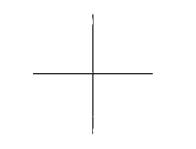
In this section we discussed the group of symmetries of an equilateral triangle and of a square. Give a group that we have discussed in the text that is isomorphic to the group of symmetries of the indicated figure. You may want to label some special points on the figure, write some permutations
Give an example of the desired subgroup and group if possible. If impossible, say why it is impossible.A subgroup of a group of order 6 whose left cosets give a partition of the group into 12 cells.
Proceed as in Example 11.13 to find all abelian groups, up to isomorphism, of the given order.Order 720Data from example 11.13Find all abelian groups, up to isomorphism, of order 360. The phrase up to isomorphism signifies that any abelian group of order 360 should be structurally identical
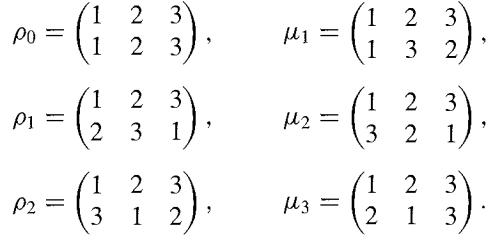
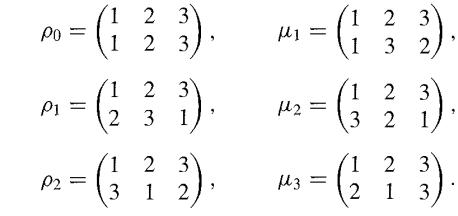
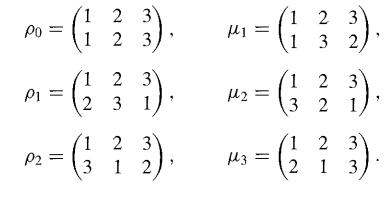
Which of the permutations in S3 of Example 8. 7 are even permutations? Give the table for the alternating group A3.Data from example 8.7 An interesting example for us is the group S3 of3! = 6 elements. Let the set A be { 1, 2, 3}. We list the permutations of A and assign to each a subscripted
In this section we discussed the group of symmetries of an equilateral triangle and of a square. Give a group that we have discussed in the text that is isomorphic to the group of symmetries of the indicated figure. You may want to label some special points on the figure, write some permutations
Give an example of the desired subgroup and group if possible. If impossible, say why it is impossible.A subgroup of a group of order 6 whose left cosets give a partition of the group into 4 cells.
Proceed as in Example 11.13 to find all abelian groups, up to isomorphism, of the given order.Order 1089Data from example 11.13Find all abelian groups, up to isomorphism, of order 360. The phrase up to isomorphism signifies that any abelian group of order 360 should be structurally identical
Give a one-sentence synopsis of Proof 1 of Theorem 9.15.Data from 9.15 TheoremNo permutation in Sn can be expressed both as a product of an even number of transpositions and as a product of an odd number of transposition.Proof 1 of 9.15 TheoremWe remarked in Section 8 that SA ≈ SB if A and B have
In this section we discussed the group of symmetries of an equilateral triangle and of a square. Give a group that we have discussed in the text that is isomorphic to the group of symmetries of the indicated figure. You may want to label some special points on the figure, write some permutations
Give a one-sentence synopsis of the proof of Theorem 10 .10. Data from Theorem 10.10Let H be a subgroup of a finite group G. Then the order of H is a divisor of the order of G. ProofLet n be the order of G, and let H have order m. The preceding boxed statement shows that every coset of H
How many abelian groups (up to isomorphism) are there of order 24? of order 25? of order (24)(25)?
Give a two-sentence synopsis of Proof 2 of Theorem 9.15.Data from 9.15 TheoremNo permutation in Sn can be expressed both as a product of an even number of transpositions and as a product of an odd number of transposition.Proof 2 of 9.15 TheoremLet a ∈ Sn and let r = (i, j) be a transposition in
In this section we discussed the group of symmetries of an equilateral triangle and of a square. Give a group that we have discussed in the text that is isomorphic to the group of symmetries of the indicated figure. You may want to label some special points on the figure, write some permutations
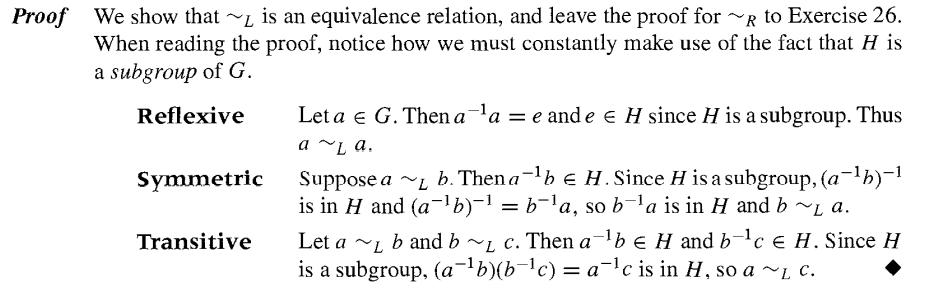
Prove that the relation~ R of Theorem 10.1 is an equivalence relation. Data from Theorem 10.1Let H be a subgroup of G. Let the relation ~L be defined on G by a ~ L b if and only if a-1 b ∈ H Let ~ R be defined by a ~ R b if and only if ab-1 ∈ HThen ~ L and ~ R are both
Following the idea suggested in Exercise 26, let m and n be relatively prime positive integers. Show that if there are (up to isomorphism) r abelian groups of order m ands of order n, then there are (up to isomorphism) rs abelian groups of order mn. Data from exercise 26How many abelian groups
Prove the following about Sn if n ≥ 3. a. Every permutation in Sn can be written as a product of at most n - I transpositions. b. Every permutation in Sn that is not a cycle can be written as a product of at most n - 2 transpositions. c. Every odd permutation in Sn can be written
Compute the left regular representation of Z4 . Compute the right regular representation of S3 using the notation of Example 8.7.Data from Example 8.7.An interesting example for us is the group S3 of 3! = 6 elements. Let the set A be { 1, 2, 3}. We list the permutations of A and assign to each a
Let H be a subgroup of a group G and let g ∈ G. Define a one-to-one map of H onto Hg. Prove that your map is one to one and is onto Hg.
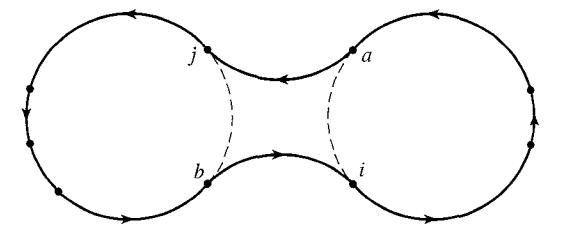
a. Draw a figure like Fig. 9 .16 to illustrate that if i and j are in different orbits of σ and σ (i) = i, then the number of orbits of ( i, j)σ is one less than the number of orbits of σ. b. Repeat part (a) if σ(j) = j alsoFigure 9.16 C
Let H be a subgroup of a group G such that g-1 hg ∈ H for all g ∈ G and all h ∈ H. Show that every left coset gH is the same as the right coset Hg.
a. Let p be a prime number. Fill in the second row of the table to give the number of abelian groups of order pn, up to isomorphism.b. Let p, q, and r be distinct prime numbers. Use the table you created to find the number of abelian groups, up to isomorphism, of the given order.i. p3q4r7 ii.
Show that for every subgroup H of Sn for n ≥ 2, either all the permutations in Hare even or exactly half of them are even.
Correct the definition of the italicized term without reference to the text, if correction is needed, so that it is in a form acceptable for publication.The left regular representation of a group G is the map of G into SG whose value at g ∈ G is the permutation of G that carries each x ∈ G into
Let H be a subgroup of a group G. Prove that if the partition of G into left cosets of H is the same as the partition into right cosets of H, then g-1 hg ∈ H for all g ∈ G and all h ∈ H.
Indicate schematically a Cayley digraph for Zm x Zn for the generating set S = {(l, 0), (0, l)}.
Let σ be a permutation of a set A. We shall say "σ moves a ∈ A" if σ(a) ≠ a. If A is a finite set, how many elements are moved by a cycle σ ∈ SA of length n?
Determine whether the given function is a permutation of R.f1 : R → R defined by f1(x) = x + 1
Let H be a subgroup of a group G and let a, b ∈ G. Prove the statement or give a counterexample.If aH = bH, then Ha= Hb.
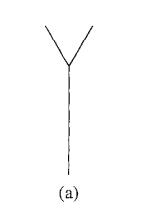
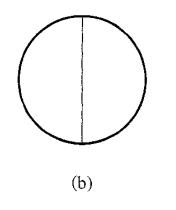
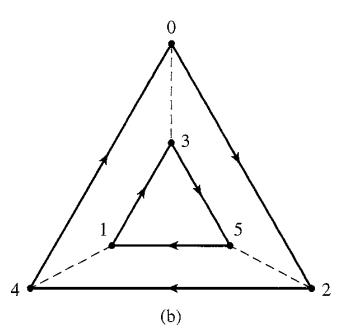
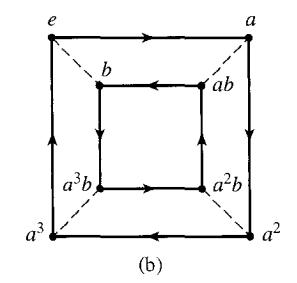
Consider Cayley digraphs with two arc types, a solid one with an arrow and a dashed one with no arrow, and consisting of two regular n-gons, for n ≥ 3, with solid arc sides, one inside the other, with dashed arcs joining the vertices of the outer n-gon to the inner one. Figure 7 .9(b) shows such
Let A be an infinite set. Let H be the set of all σ ∈ SA such that the number of elements moved by a (see Exercise 30) is finite. Show that H is a subgroup of Sn.Data from exercise 30Let σ be a permutation of a set A. We shall say "σ moves a ∈ A" if σ(a) ≠ a. If A is a finite set, how
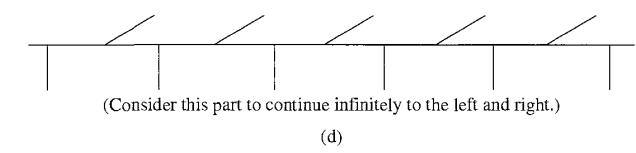
A square with horizontal and vertical edges using translation directions given by vectors (1, 0) and (0, 1). Describe a pattern to be used to fill the plane by translation in the two directions given by the specified vectors. Answer these questions in each case. a. Does the symmetry group
Determine whether the given function is a permutation of R.f2 : R → R defined by f2(x) = x2
Let H be a subgroup of a group G and let a, b ∈ G. Prove the statement or give a counterexample.If Ha= Hb, then b ∈ Ha.
Mark each of the following true or false. ___ a. If G1 and G2 are any groups, then G1 x G2 is always isomorphic to G2 x G1• ___ b. Computation in an external direct product of groups is easy if you know how to compute in each component group. ___ c. Groups of finite order must be
Let A be an infinite set. Let K be the set of all σ ∈SA that move (see Exercise 30) at most 50 elements of A. Is K a subgroup of SA? Why?Data from exercise 30Let σ be a permutation of a set A. We shall say "σ moves a ∈ A" if σ(a) ≠ a. If A is a finite set, how many elements are moved by a
Determine whether the given function is a permutation of R.f3 : R → R defined by f3(x) = -x3
A square as in Exercise 31 using translation directions given by vectors (1, 1/2) and (0, 1).Describe a pattern to be used to fill the plane by translation in the two directions given by the specified vectors. Answer these questions in each case. a. Does the symmetry group contain any
Let H be a subgroup of a group G and let a, b ∈ G. Prove the statement or give a counterexample.If aH = bH, then Ha-1 = Hb- 1 .
Give an example illustrating that not every nontrivial abelian group is the internal direct product of two proper nontrivial subgroups.
Consider Sn for a fixed n ≥ 2 and let σ be a fixed odd permutation. Show that every odd permutation in Sn is a product of σ and some permutation in An.
A square as in Exercise 31 with the letter L at its center using translation directions given by vectors ( 1, 0) and (0, 1).Describe a pattern to be used to fill the plane by translation in the two directions given by the specified vectors. Answer these questions in each case. a. Does the
Determine whether the given function is a permutation of R.f4 : R → R defined by f4(x) = ex
Let H be a subgroup of a group G and let a, b ∈ G. Prove the statement or give a counterexample.If aH = bH, then a2H = b2H.
a. How many subgroups of Z5 x Z6 are isomorphic to Z5 x Z6 ? b. How many subgroups of Z x Z are isomorphic to Z x Z?
Show that if σ is a cycle of odd length, then σ2 is a cycle.
Determine whether the given function is a permutation of R.f5 : R → R defined by f5(x) = x3 - x2 - 2x
A square as in Exercise 31 with the letter E at its center using translation directions given by vectors ( 1, 0) and (0, 1). Describe a pattern to be used to fill the plane by translation in the two directions given by the specified vectors. Answer these questions in each case. a. Does
Let G be a group of order pq, where p and q are prime numbers. Show that every proper subgroup of G is cyclic.
Give an example of a nontrivial group that is not of prime order and is not the internal direct product of two nontrivial subgroups.
Following the line of thought opened by Exercise 34, complete the following with a condition involving n and r so that the resulting statement is a theorem: If σ is a cycle of length n, then σ' is also a cycle if and only if. ..Data from Exercise 34Show that if σ is a cycle of odd length, then
Mark each of the following true or false.___ a. Every permutation is a one-to-one function. ___ b. Every function is a permutation if and only if it is one to one. ___ c. Every function from a finite set onto itself must be one to one. ___ d. Every group G is isomorphic to a subgroup
A square as in Exercise 31 with the letter Hat its center using translation directions given by vectors (1, 0) and (0, 1).Describe a pattern to be used to fill the plane by translation in the two directions given by the specified vectors. Answer these questions in each case. a. Does the
Show that there are the same number of left as right cosets of a subgroup H of a group G; that is, exhibit a one-to-one map of the collection of left cosets onto the collection of right cosets.
Mark each of the following true or false. ___ a. Every abelian group of prime order is cyclic. ___ b. Every abelian group of prime power order is cyclic. __ c. Z8 is generated by {4, 6}. __ d. Z8 is generated by { 4, 5, 6}. ___ e. All finite abelian groups are classified up
Let G be a group and let a be a fixed element of G. Show that the map γa : G → G, given by γa (g) = ag for g ∈ G, is a permutation of the set G.
A regular hexagon with a vertex at the top using translation directions given by vectors (1, 0) and (1, √3).Describe a pattern to be used to fill the plane by translation in the two directions given by the specified vectors. Answer these questions in each case. a. Does the symmetry group
Show by an example that every proper subgroup of a nonabelian group may be abelian.
Exercise 29 of Section 4 showed that every finite group of even order 2n contains an element of order 2. Using the theorem of Lagrange, show that if n is odd, then an abelian group of order2n contains precisely one element of order 2.Data from exercise 29 of section 4Show that if G is a finite
Let p and q be distinct prime numbers. How does the number (up to isomorphism) of abelian groups of order pr compare with the number (up to isomorphism) of abelian groups of order qr?
Referring to Exercise 36, show that H ={ γa | a ∈ G} is a subgroup of SG, the group of all permutations of G. Data from Exercise 36Let G be a group and let a be a fixed element of G. Show that the map γa : G → G, given by γa (g) = ag for g ∈ G, is a permutation of the set G.
A regular hexagon with a vertex at the top containing an equilateral triangle with vertex at the top and centroid at the center of the hexagon, using translation directions given by vectors (1, 0) and (1, √3).Describe a pattern to be used to fill the plane by translation in the two directions
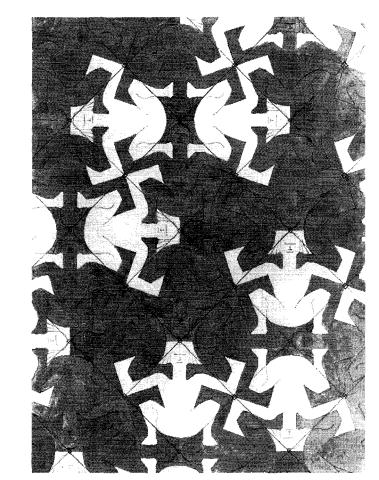
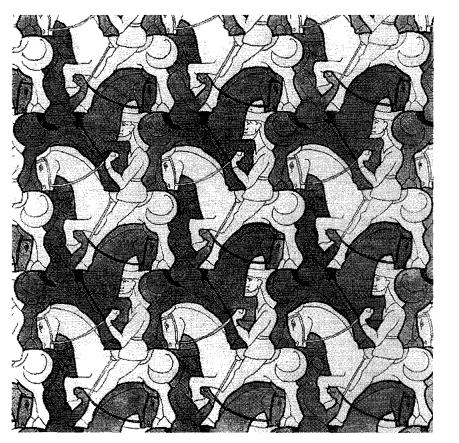
The Study of Regular Division of the Plane with Horsemen in Fig. 12.8. This exercise is concerned with art works of M. C. Escher. Neglect the shading in the figures and assume the markings in each human figure, reptile, or horseman are the same, even though they may be invisible due to
Let A be a nonempty set. What type of algebraic structure mentioned previously in the text is given by the set of all functions mapping A into itself under function composition?
Show that a group with at least two elements but with no proper nontrivial subgroups must be finite and of prime order.
Let G be an abelian group of order 72. a. Can you say how many subgroups of order 8 G has? Why, or why not? b. Can you say how many subgroups of order 4 G has? Why, or why not?
Referring to Exercise 49 of Section 8, show that H of Exercise 37 is transitive on the set G.Data from Exercise 37Show that H ={ γa | a ∈ G} is a subgroup of SG, the group of all permutations of G. Data from Exercise 49 of Section 8If A is a set, then a subgroup H of SA is transitive on A
Indicate schematically a Cayley digraph for D,, using a generating set consisting of a rotation through 2rr / n radians and a reflection (mirror image). See Exercise 44.Data from Exercise 44.In analogy with Examples 8.7 and 8.10, consider a regular plane n-gon for n ≥ 3. Each way that two copies
Prove Theorem 10.14.Data from Theorem 10.14Suppose H and K are subgroups of a group G such that K ≤ H ≤ G, and suppose (H : K) and (G : H) are both finite. Then (G : K) is finite, and (G : K) = (G : H)(H : K).
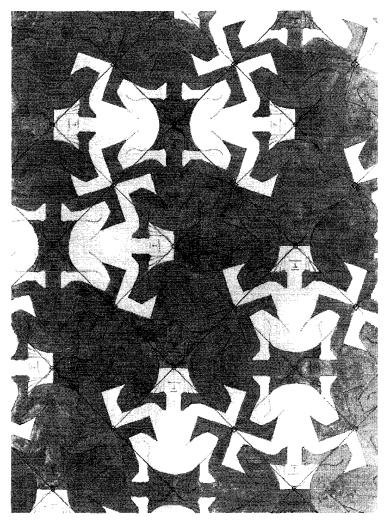
The Study of Regular Division of the Plane with Imaginary Human Figures in Fig. 12.9.This exercise is concerned with art works of M. C. Escher. Neglect the shading in the figures and assume the markings in each human figure, reptile, or horseman are the same, even though they may be invisible due
Let G be an abelian group. Show that the elements of finite order in G form a subgroup. This subgroup is called the torsion subgroup of G.
Show that Sn is generated by {(1, 2), (1, 2, 3, • • •, n)}.
Give a two-sentence synopsis of the proof of Cayley's theorem.
Show that if His a subgroup of index 2 in a finite group G, then every left coset of His also a right coset of H.
Deal with the concept of the torsion subgroup just defined.Find the order of the torsion subgroup of Z4 x Z x Z3; of Z12 x Z x Z12.
Let A be a set, B a subset of A, and let b be one particular element of B. Determine whether the given set is sure to be a subgroup of SA under the induced operation. Here σ[B] = {σ(x) |x ∈ B}.{σ ∈ SA |σ(b) = b}
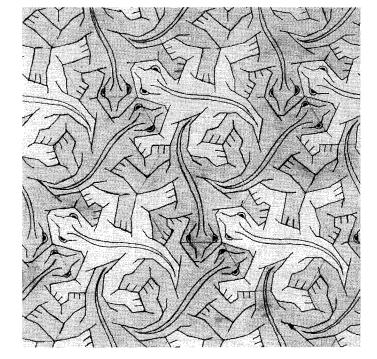
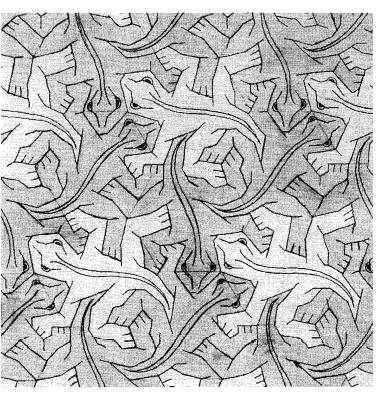
The Study of Regular Division of the Plane with Reptiles in Fig. 12.10.Figure 12.10 This exercise is concerned with art works of M. C. Escher. Neglect the shading in the figures and assume the markings in each human figure, reptile, or horseman are the same, even though they may be invisible
Show that if a group G with identity e has finite order n, then an = e for all a ∈ G.
Deal with the concept of the torsion subgroup just defined.Find the torsion subgroup of the multiplicative group R* of nonzero real numbers.
Let A be a set, B a subset of A, and let b be one particular element of B. Determine whether the given set is sure to be a subgroup of SA under the induced operation. Here σ[B] = {σ(x) |x ∈ B}.{σ ∈ SA |σ(b) ∈ B}
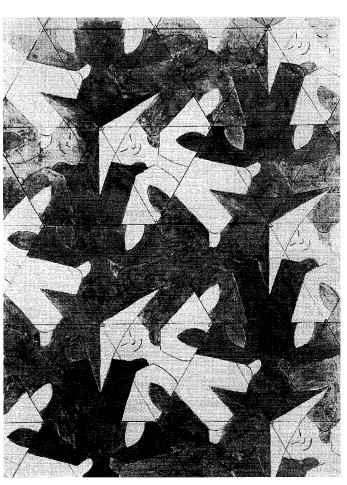
The Study of Regular Division of the Plane with Human Figures in Fig. 12.11. Figure 12.11. This exercise is concerned with art works of M. C. Escher. Neglect the shading in the figures and assume the markings in each human figure, reptile, or horseman are the same, even though they may be
Show that every left coset of the subgroup Z of the additive group of real numbers contains exactly one element x such that O ≤ x < 1.
Deal with the concept of the torsion subgroup just defined.Find the torsion subgroup T of the multiplicative group C* of nonzero complex numbers.
Show that the rotations of a cube in space form a group isomorphic to S4.
Let A be a set, B a subset of A, and let b be one particular element of B. Determine whether the given set is sure to be a subgroup of SA under the induced operation. Here σ[B] = {σ(x) |x ∈ B}.{σ ∈ SA |σ[B] ⊆ B}
Show that the function sine assigns the same value to each element of any fixed left coset of the subgroup (2π) of the additive group R of real numbers. (Thus sine induces a well-defined function on the set of cosets; the value of the function on a coset is obtained when we choose an element x of
Let A be a set, B a subset of A, and let b be one particular element of B. Determine whether the given set is sure to be a subgroup of SA under the induced operation. Here σ[B] = {σ(x) |x ∈ B}.{σ ∈ SA | σ[B] = B}
Let H and K be subgroups of a group G. Define ~ on G by a ~ b if and only if a = hbk for some h ∈ H and some k ∈ K. a. Prove that ~ is an equivalence relation on G. b. Describe the elements in the equivalence class containing a ∈ G. (These equivalence classes are called double
In analogy with Examples 8.7 and 8.10, consider a regular plane n-gon for n ≥ 3. Each way that two copies of such an n-gon can be placed, with one covering the other, corresponds to a certain permutation of the vertices. The set of these permutations in a group, the nth dihedral group Dn• under
Let SA be the group of all permutations of the set A, and let c be one particular element of A. a. Show that {σ ∈ SA | σ (c) = c} is a subgroup Sc.c of SA. b. Let d ≠ c be another particular element of A. Is Sc.d = {σ ∈ SA | σ(c) = d} a subgroup of SA? Why or why not? c.
Consider a cube that exactly fills a certain cubical box. As in Examples 8.7 and 8.10, the ways in which the cube can be placed into the box correspond to a certain group of permutations of the vertices of the cube. This group is the group of rigid motions ( or rotations) of the cube. (It should
Give a two-sentence synopsis of the proof of Theorem 11.5. Data from Theorem 11.5.The finite indecomposable abelian groups are exactly the cyclic groups with order a power of a prime. Proof: Let G be a finite indecomposable abelian group. Then by Theorem 11.12, G is isomorphic to a direct
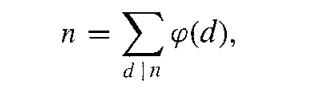
The Euler phi-function is defined for positive integers n by φ(n) = s, where s is the number of positive integers less than or equal ton that are relatively prime ton. Use Exercise 45 to show thatthe sum being taken over all positive integers d dividing n. Data from Exercise 45Show that a
Show that a finite cyclic group of order n has exactly one subgroup of each order d dividing n, and that these are all the subgroups it has.
Prove that a direct product of abelian groups is abelian.
Show that Sn is a nonabelian group for n ≥ 3.
Strengthening Exercise 46, show that if n ≥ 3, then the only element of σ of Sn satisfying σ γ = γ a for all y ∈ Sn is σ = ι, the identity permutation.Data from in exercise 46Show that Sn is a nonabelian group for n ≥ 3.
Let G be a finite group. Show that if for each positive integer m the number of solutions x of the equation xm = e in G is at most m, then G is cyclic.
Orbits were defined before Exercise 11. Leta, b ∈ A and a ∈ SA- Show that if Oa.σ and Ob.σ have an element in common then Oa.σ and Ob.σ.Orbits definedLet A be a set and let σ ∈ SA· For a fixed a ∈ A, the set Oa.σ- = {σn(a) |n ∈ Z}is the orbit of a under σ.
Showing 1200 - 1300
of 1629
First
3
4
5
6
7
8
9
10
11
12
13
14
15
16
17
Step by Step Answers

 Get 50% OFF
Claim Now
Get 50% OFF
Claim Now