New Semester
Started
Get
50% OFF
Study Help!
--h --m --s
Claim Now
Question Answers
Textbooks
Find textbooks, questions and answers
Oops, something went wrong!
Change your search query and then try again
S
Books
FREE
Study Help
Expert Questions
Accounting
General Management
Mathematics
Finance
Organizational Behaviour
Law
Physics
Operating System
Management Leadership
Sociology
Programming
Marketing
Database
Computer Network
Economics
Textbooks Solutions
Accounting
Managerial Accounting
Management Leadership
Cost Accounting
Statistics
Business Law
Corporate Finance
Finance
Economics
Auditing
Tutors
Online Tutors
Find a Tutor
Hire a Tutor
Become a Tutor
AI Tutor
AI Study Planner
NEW
Sell Books
Search
Search
Sign In
Register
study help
mathematics
a first course in abstract algebra
A First Course In Abstract Algebra 7th Edition John Fraleigh - Solutions
Following up the idea of Exercise 47 determine whether H will always be a subgroup for every abelian group G if H consists of the identity e together with all elements of G of order 3; of order 4. For what positive integers n will H always be a subgroup for every abelian group G, if H consists of
Find a counterexample of Exercise 47 with the hypothesis that G is abelian omitted. Data from Exercise 47Let G be an abelian group. Let H be the subset of G consisting of the identity e together with all elements of G of order 2. Show that H is a subgroup of G.
Let H and K be subgroups of a group G. Ask you to establish necessary and sufficient criteria for G to appear as the internal direct product of H and K. Let H and K be groups and let G = H x K. Recall that both H and K appear as subgroups of G in a natural way. Show that these subgroups H (actually
Referring to the definition before Exercise 11 and to Exercise 49, show that for σ ∈ SA, (σ) iData before Exercise 11Let A be a set and let σ ∈ SA· For a fixed a ∈ A, the set Oa.σ- = {σn(a) |n ∈ Z}
Let H and K be subgroups of a group G satisfying the three properties listed in the preceding exercise. Show that for each g ∈ G, the expression g = hk for h ∈ H and k E K is unique. Then let each g be renamed (h, k). Show that, under this renaming, G becomes structurally identical (isomorphic)
Let G be a group. Prove that the permutations pa: G → G, where pa(x) = xa for a ∈ G and x ∈ G, do form a group isomorphic to G.
Let G be an abelian group. Let H be the subset of G consisting of the identity e together with all elements of G of order 2. Show that H is a subgroup of G.
If A is a set, then a subgroup H of SA is transitive on A if for each a, b ∈ A there exists σ ∈ H such that σ(a) = b. Show that if A is a nonempty finite set, then there exists a finite cyclic subgroup H of SA with |H|= |A| that is transitive on A.
Let G be a group with binary operation *· Let G' be the same set as G, and define a binary operation *' on G' by x *' y = y *X for all x, y ∈ G'. a. (Intuitive argument that G' under*' is a group.) Suppose the front wall of your class room were made of transparent glass, and that all
Prove that if a finite abelian group has order a power of a prime p, then the order of every element in the group is a power of p. Can the hypothesis of commutativity be dropped? Why, or why not?
An identity element for a binary operation * as described by Definition 3.12 is sometimes referred to as "a two-sided identity element." Using complete sentences, give analogous definitions fora. A left identity element el for*, b. A right identity element eR for*·Theorem 3.13 shows that if a
Determine whether the binary operation * gives a group structure on the given set. If no group results, give the first axiom in the order G1, G2, G3 from Definition 4.1 that does not hold.Let* be defined on Q by letting a* b = ab.Data from Definition 4.1.A group (G, *) is a set G, closed under a
Which of the sets in Exercises 1 through 6 are subgroups of the group C* of nonzero complex numbers under multiplication?Data from Exercises 1-61. R2. Q+3. 7Z4. The set iR of pure imaginary numbers including 0 5. The set πQ of rational multiples of π 6. The set {πn | n ∈ Z}
The map ∅: Z → Z defined by ∅(n) = n + 1 for n ∈ Z is one to one and onto Z. Give the definition of a binary operation * on Z such that ∅ is an isomorphism mappinga. (Z, +) onto (Z, *),b. (Z, *) onto (Z, +).In each case, give the identity element for * on Z.
A relation on a set S of generators of a group G is an equation that equates some product of generators and their inverses to the identity e of G. For example, if S = {a, b} and G is commutative so that ab= ba, then one relation is aba-1 b-1 = e. If, moreover, b is its own inverse, then another
The map ∅: Z → Z defined by ∅(n) = n + 1 for n ∈ Z is one to one and onto Z. Give the definition of a binary operation * on Z such that ∅ is an isomorphism mappinga. (Z, •) onto (Z, *), b. (Z, *) onto (Z, ·).In each case, give the identity element for * on Z.
Find all solutions in CC of the given equation.z3 = -8
Find all solutions in CC of the given equation.Z3 = -27i
Find all solutions in CC of the given equation.Z6 = 1
The displayed homomorphism condition for an isomorphism ∅ in Definition 3. 7 is sometimes summarized by saying,"∅ must commute with the binary operation(s)." Explain how that condition can be viewed in this mannerData from Definition 3.7Let (S, *) and (S', *') be binary algebraic structures. An
Find all solutions in CC of the given equation.Z6 = -64
The following "definitions" of a group are taken verbatim, including spelling and punctuation, from papers of students who wrote a bit too quickly and carelessly. Criticize them.a. A group G is a set of elements together with a binary operation * such that the following conditions are satisfied *
Proof synopsis We give an example of a proof synopsis. Here is a one-sentence synopsis of the proof that the inverse of an element a in a group (G, *) is unique. Assuming that a * a' = e and a * a" = e, apply the left cancellation law to the equation a * a' = a * a". Note that we said "the left
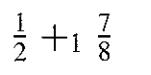
Compute the given expression using the indicated modular addition. 4 +2.7
Prove that the relation ≈ of being isomorphic, described in Definition 3. 7, is an equivalence relation on any set of binary structures. You may simply quote the results you were asked to prove in the preceding two exercises at appropriate places in your proof.Data from Definition 3.7Definition :
Give a careful proof for a skeptic that the indicated property of a binary structure (S, *) is indeed a structural property. (In Theorem 3.14, we did this for the property, "There is an identity element for*-") The operation* is commutative.Data from Theorem 3.14Theorem: Suppose (S, *) has an
Give a careful proof for a skeptic that the indicated property of a binary structure (S, *) is indeed a structural property. (In Theorem 3.14, we did this for the property, "There is an identity element for *.")The operation * is associative.Data from Theorem 3.14.Theorem: Suppose (S, *) has an
Give a one-sentence synopsis of the proof of Theorem 6.1.Theorem 6.1.Every cyclic group is abelian.Proof Let G be a cyclic group and let a be a generator of G so that G = (a) = {an| n ∈ Z}. If g1 and g2 are any two elements of G, there exist integers r ands such that g1 = ar and g2 =
Find the flaw in the following argument: "Condition 2 of Theorem 5.14 is redundant, since it can be derived from 1 and 3, for let a ∈ H. Then a-1 ∈ H by 3, and by 1, aa-1 = e is an element of H, proving 2."Data from 5.14 Theorem A subset H of a group G is a subgroup of G if and only
Find the number of elements in the indicated cyclic group.The cyclic subgroup (i) of the group C* of nonzero complex numbers under multiplication
Show that for n ≥ 3, there exists a nonabelian group with 2n elements that is generated by two elements of order 2.
Show that the power set of a set A, finite or infinite, has too many elements to be able to be put in a one-to-one correspondence with A. Explain why this intuitively means that there are an infinite number of infinite cardinal numbers. Is the set of everything a logically acceptable concept? Why
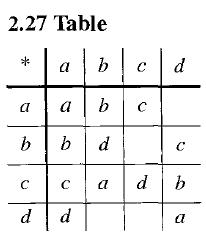
Complete Table 2.27 so as to define a commutative binary operation * on S = {a, b, c, d}. 2.27 Table * D b C a b b C dd d D с d C b a
In Exercises, decide whether the object described is indeed a set (is well defined). Give an alternate description of each set.{n ∈ Z | n2 < 0}
Determine whether the given map ∅ is an isomorphism of the first binary structure with the second. If it is not an isomorphism, why not?(R •) with (R •) where ∅(x) = x3 for x ∈ R.
In Exercises, decide whether the object described is indeed a set (is well defined). Give an alternate description of each set.{x ∈ Q | x is almost an integer}
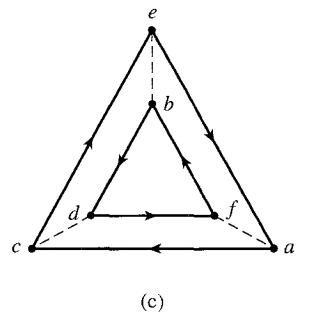
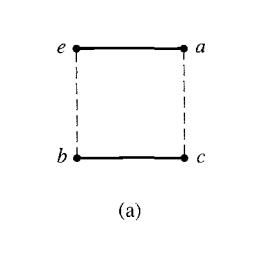
Give the table for the group having the indicated digraph. In each digraph, take e as identity element. List the identity e first in your table, and list the remaining elements alphabetically, so that your answers will be easy to check.The digraph in Fig. 7.13(c) e (c) 102
Determine whether the given set of invertible n x n matrices with real number entries is a subgroup of GL(n, R).The upper-triangular n x n matrices with no zeros on the diagonal
Determine whether the binary operation * defined is commutative and whether * is associative.* defined on z+ by letting a * b = 2ab
Find the number of generators of a cyclic group having the given order.12
List the elements in {a, b, c} x {l, 2, c}.
Find |6 + 4i |.
How can we tell from a Cayley digraph whether or not the corresponding group is commutative?
Determine whether the given set of matrices under the specified operation, matrix addition or multiplication, is a group. Recall that a diagonal matrix is a square matrix whose only nonzero entries lie on the main diagonal, from the upper left to the lower right comer. An upper-triangular matrix is
Let F be the set of all functions f mapping R. into R. that have derivatives of all orders. Follow the instructions for Exercises 2 through 10.(F, +) with (F, +) where ∅(f)= f', the derivative of f
Determine whether the given set of invertible n x n matrices with real number entries is a subgroup of GL(n, R).The n x n matrices with determinant -1
Find the number of generators of a cyclic group having the given order.60
Determine whether the binary operation * defined is commutative and whether * is associative.* defined on Z+ by letting a * b = ab
Determine whether the given set of matrices under the specified operation, matrix addition or multiplication, is a group. Recall that a diagonal matrix is a square matrix whose only nonzero entries lie on the main diagonal, from the upper left to the lower right comer. An upper-triangular matrix is
Let A be a finite set, and let IAI = s. Based oh the preceding exercise, make a conjecture about the value of |P(A)|. Then try to prove your conjecture.For any set A, we denote by P (A) the collection of all subsets of A. For example, if A = {a, b, c, d}, then {a, b, d} ∈ P(A). The set P(A) is
Correct the definition of the italicized term without reference to the text, if correction is needed, so that it is in a form acceptable for publication.A subset H of a set S is closed under a binary operation * on S if and only if ( a * b) ∈ H for all a, b ∈ S.
An isomorphism of a group with itself is an automorphism of the group. Find the number of automorphisms of the given group.Z12
Let F be the set of all real-valued functions with domain R and let F̅ be the subset of F consisting of those functions that have a nonzero value at every point in R. Determine whether the given subset of F with the induced operation is (a) A subgroup of the group F under addition, (b) A
Let A= {l, 2, 3} and B = {2, 4, 6}. For each relation between A and B given as a subset of A x B, decide whether it is a function mapping A into B. If it is a function, decide whether it is one to one and whether it is onto B.a. {(1, 4), (2, 4), (3, 6)}b. {(l, 4), (2, 6), (3, 4)}c.
Write the given complex number z in the polar form |z|(p + qi) where |p +qi|= 1.3 - 4i
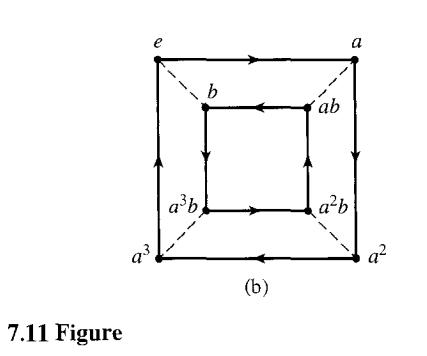
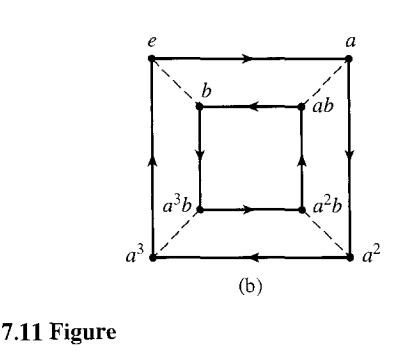
Referring to Exercise 11, determine whether the group corresponding to the Cayley digraph in Fig. 7.11(b) is commutative.Data from exercise 11How can we tell from a Cayley digraph whether or not the corresponding group is commutative?
Determine whether the given set of matrices under the specified operation, matrix addition or multiplication, is a group. Recall that a diagonal matrix is a square matrix whose only nonzero entries lie on the main diagonal, from the upper left to the lower right comer. An upper-triangular matrix is
Let F be the set of all functions f mapping R. into R. that have derivatives of all orders. Follow the instructions for Exercises 2 through 10.(F, +) with (R,+) where ∅(f) = f'(0)
Determine whether the given set of invertible n x n matrices with real number entries is a subgroup of GL(n, R).The n x n matrices with determinant -1 or 1
Let S be a set having exactly one element. How many different binary operations can be defined on S? Answer the question if S has exactly 2 elements; exactly 3 elements; exactly n elements.
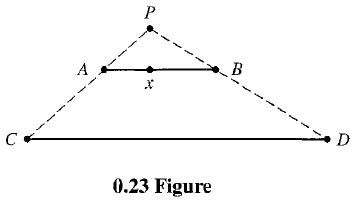
Illustrate geometrically that two line segments AB and CD of different length have the same number of points by indicating in Fig. 0.23 what pointy of CD might be paired with point x of AB. C A P 0.23 Figure B D
An isomorphism of a group with itself is an automorphism of the group. Find the number of automorphisms of the given group.Z2
Write the given complex number z in the polar form |z|(p + qi) where |p +qi|= 1.-l + i
Find all solutions in CC of the given equation.Z4 = 1
Write at least 5 elements of each of the following cyclic groups.a. 25Z under additionb. c. {πn | n E Z} under multiplication {(½)" | n ≤ Z} under multiplication
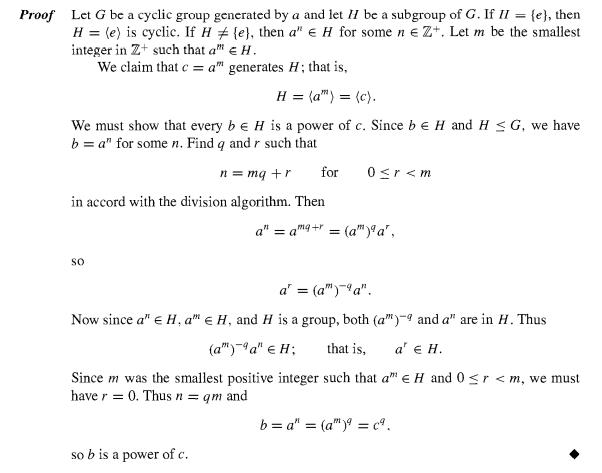
Give at most a three-sentence synopsis of the proof of Theorem 6.6.6.6 Theorem A subgroup of a cyclic group is cyclic. Proof Let G be a cyclic group generated by a and let II be a subgroup of G. If II = {e}, then H = (e) is cyclic. If H integer in Z+ such that a" (e), then a" H for some n €
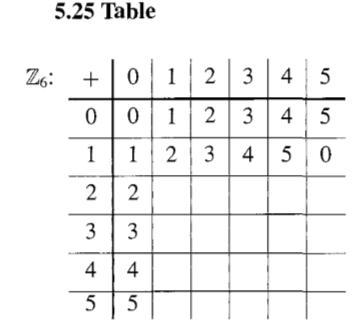
a. Complete Table 5.25 to give the group Z6 of 6 elements. b. Compute the subgroups (0), (1), (2), (3), (4), and (5) of the group Z6 given in part (a). c. Which elements are generators for the group Z6 of part (a)? d. Give the subgroup diagram for the part (b) subgroups of Z6. 5.25
Find the order of the cyclic subgroup of the given group generated by the indicated element. The subgroup of U6 generated by cos+ i sin
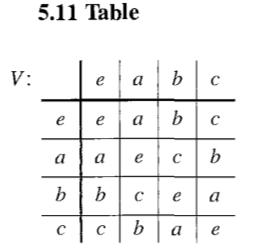
Find the order of the cyclic subgroup of the given group generated by the indicated element.The subgroup of V generated by c (see Table 5.11) V: 5.11 Table e a b e e a b C C | a al b|c a bc b ec C e a b a e
Compute the given expression using the indicated modular addition. +1 ~100
Find all subgroups of the given group, and draw the subgroup diagram for the subgroups. Z12
Mark each of the following true or false. ___ a. Every cyclic group is abelian. ___ b. Every abelian group is cyclic. ___ c. Q under addition is a cyclic group. ___ d. Every element of every cyclic group generates the group. ___ e. There is at least one abelian group of
Mark each of the following true or false. ___ a. The associative law holds in every group.___ b. There may be a group in which the cancellation law fails. ___ c. Every group is a subgroup of itself. ___ d. Every group has exactly two improper subgroups. ___ e. In every cyclic
Determine whether the given map ∅ is an isomorphism of the first binary structure with the second. If it is not an isomorphism, why not?(R, +) with (R+, •) where ∅(r) = 0.5r for r ∈ R.
Let n be a positive integer and let nZ = {nm |m E Z}.a. Show that (nZ, +) is a group. b. Show that (nZ, +) ≈ (Z, +).
Determine whether the binary operation * defined is commutative and whether * is associative.* defined on Z by letting a * b = a - b
In Exercises, decide whether the object described is indeed a set (is well defined). Give an alternate description of each set.{n ∈ Z | 39 < n3 < 57}
For the group described in Example 7.12 compute these products, using Fig. 7.11(b). a. (a2b)a3b. (ab)(a3b) c. b(a2b) 7.11 Figure a3 ab b (b) ab alb a a?
Compute the given arithmetic expression and give the answer in the form a + bi for a, b ∈ R.(2 - 3i)(4 + i) + (6 - 5i)
Determine whether the binary operation * gives a group structure on the given set. If no group results, give the first axiom in the order G1, G2, G3 from Definition 4.1 that does not hold.Let * be defined on R+ by letting a * b = √ab.
Determine whether the given subset of the complex numbers is a subgroup of the group CC of complex numbers under addition.7Z
Find the quotient and remainder, according to the division algorithm, when n is divided by m.n = -50, m = 8
List the elements of the subgroup generated by the given subset.The subset {12, 30} of Z36
Determine whether the given subset of the complex numbers is a subgroup of the group CC of complex numbers under addition.The set iR of pure imaginary numbers including 0
List the elements of the subgroup generated by the given subset.The subset {12, 42} of Z
Determine whether the binary operation * gives a group structure on the given set. If no group results, give the first axiom in the order G1, G2, G3 from Definition 4.1 that does not hold.Let* be defined on the set R * of nonzero real numbers by letting a* b = a/b.
Compute the given arithmetic expression and give the answer in the form a + bi for a, b ∈ R.(8 + 2i) (3 - i)
List the elements of the subgroup generated by the given subset.The subset {18, 24, 39} of Z
Determine whether the binary operation * gives a group structure on the given set. If no group results, give the first axiom in the order G1, G2, G3 from Definition 4.1 that does not hold.Let* be defined on C by letting a * b = |ab|.
Determine whether the given map ∅ is an isomorphism of the first binary structure with the second. If it is not an isomorphism, why not?(Q, •) with (Q, •) where ∅(x) = x2 for x ∈ Q
Determine whether the given subset of the complex numbers is a subgroup of the group CC of complex numbers under addition.The set {πn | n ∈ Z}
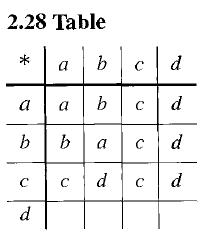
Table 2.28 can be completed to define an associative binary operation * on S = {a, b, c, d}. Assume this is possible and compute the missing entries. 2.28 Table * a b C d ab с a bac d C b C d d d d C
Find the greatest common divisor of the two integers.48 and 88
Find the greatest common divisor of the two integers.360 and 420
Compute the given arithmetic expression and give the answer in the form a + bi for a, b ∈ R.(1 + i)3
Give the table for the group having the indicated digraph. In each digraph, take e as identity element. List the identity e first in your table, and list the remaining elements alphabetically, so that your answers will be easy to check. The digraph in Fig. 7.13(a) b (a) 1 a
We can also consider multiplication •n modulo n in Zn • For example, 5 .7 6 = 2 in Z7 because 5 • 6 = 30 = 4(7) + 2. The set { 1, 3, 5, 7} with multiplication •8 modulo 8 is a group. Give the table for this group.
Determine whether the given map ∅ is an isomorphism of the first binary structure with the second. If it is not an isomorphism, why not?(M2(R), •) with (R., •) where ∅(A) is the determinant of matrix A
Determine whether the given set of invertible n x n matrices with real number entries is a subgroup of GL(n, R).The n x n matrices with determinant 2
In Exercises, decide whether the object described is indeed a set (is well defined). Give an alternate description of each set.{x ∈ Q| x may be written with denominator greater than 100}
Showing 1300 - 1400
of 1629
First
3
4
5
6
7
8
9
10
11
12
13
14
15
16
17
Step by Step Answers

 Get 50% OFF
Claim Now
Get 50% OFF
Claim Now