New Semester
Started
Get
50% OFF
Study Help!
--h --m --s
Claim Now
Question Answers
Textbooks
Find textbooks, questions and answers
Oops, something went wrong!
Change your search query and then try again
S
Books
FREE
Study Help
Expert Questions
Accounting
General Management
Mathematics
Finance
Organizational Behaviour
Law
Physics
Operating System
Management Leadership
Sociology
Programming
Marketing
Database
Computer Network
Economics
Textbooks Solutions
Accounting
Managerial Accounting
Management Leadership
Cost Accounting
Statistics
Business Law
Corporate Finance
Finance
Economics
Auditing
Tutors
Online Tutors
Find a Tutor
Hire a Tutor
Become a Tutor
AI Tutor
AI Study Planner
NEW
Sell Books
Search
Search
Sign In
Register
study help
mathematics
a first course in abstract algebra
A First Course In Abstract Algebra 7th Edition John Fraleigh - Solutions
Describe Ci(X), Zi(X), Bi(X), and Hi(X) for the space X consisting of the I-simplex P1P2.
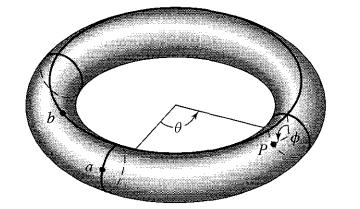
In a computation analogous to Examples 44. 9 and 44.12 of the text, find the relative homology groups Hn( X, a) for the torus X with subcomplex a, as shown in Figs. 42.13 and Fig. 42.14.Data from in Example 44.9Let X be the simplicial complex consisting of the edges (excluding the inside) of the
Mark each of the following true or false. ___a. Every homology group of a contractible space is the trivial group of one element. ___b. A continuous map from a simplicial complex X into a simplicial complex Y induces a homomorphism of Hn(X) into Hn(Y). ___ c. All homology groups are
Mark each of the following true or false. ___ a. Every boundary is a cycle. ___ b. Every cycle is a boundary. ___ c. Cn(X) is always a free abelian group.___ d. Bn(X) is always a free abelian group. ___ e. Zn(X) is always a free abelian group. ___ f. Hn(X) is always
Mark each of the following true or false. ___ a. Homeomorphic simplicial complexes have isomorphic homology groups. ___ b. If two simplicial complexes have isomorphic homology groups, then the spaces are homeomorphic. ___ c. sn is homeomorphic to En. ___ d. Hn(X) is trivial for
For the simplicial complex X and subcomplex a of Exercise 6, form the exact homology sequence of the pair (X, a) and verify by direct computation that this sequence is exact.Data from Exercises 6In a computation analogous to Examples 44. 9 and 44.12 of the text, find the relative homology groups
Continuing the idea of Exercise 7, what would be an easy way to answer a question asking you to define Cn(X), ∂n : Cn(X) → Cn-1(X), Zn(X), and Bn(X) for a simplicial complex X perhaps containing some simplexes of dimension greater than 3?Data from Exercise 7Define the following concepts so as
Compute the homology groups of the space consisting of two stacked torus surfaces, stacked as one would stack two inner tubes.
For the simplicial complex X and subcomplex a of Exercise 8, form the exact homology sequence of the pair (X, a) and verify by direct computation that this sequence is exact.Data from Exercises 8Repeat Exercise 6 with X the Klein bottle of Fig. 43.2 and Fig. 43.4. Figure 43.2
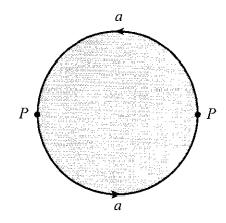
The circular disk shown in Fig. 43.14 can be deformed topologically to appear as a 2-sphere with a hole in it, as shown in Fig. 43.15. We form the real projective plane from this configuration by sewing up the hole in such a way that only diametrically opposite points on the rim of the hole are
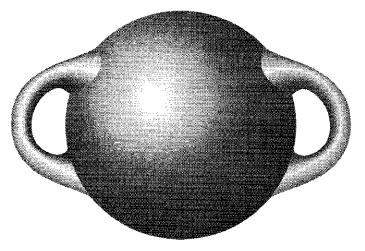
Compute the homology groups of the space consisting of a torus tangent to a 2-sphere at all points of a great circle of the 2-sphere, i.e., a balloon wearing an inner tube.
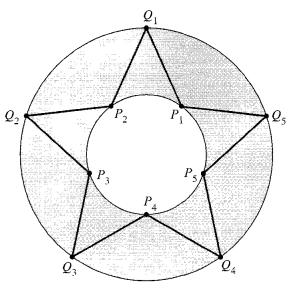
Find the relative homology groups Hn(X, Y), where X is the annular region of Fig. 42.11 and Y is the subcomplex consisting of the two boundary circles.Figure 42.11 오고 03 P2 의 P Psy 오
Let X be a simplicial complex. For an (oriented) n-simplex σ of X, the coboundary δn(σ) of σ is the (n + 1) chain ∑τ, where the sum is taken over all (n + 1)-simplexes τ that have σ as a face. That is, the simplexes τ appearing in the sum are precisely those that have σ as a summand of
With reference to Exercise 10, the torus X can be mapped onto its circle b (which is homeomorphic to S1) by a variety of maps. For each such map f : X → b given below, describe the homomorphism f*n : Hn(X) → Hn(b) for n = 0, 1, and 2, by describing the image of generators of Hn(X) as in
Compute the homology groups of the surface consisting of a 2-sphere with two handles (see Fig. 42.18). Figure 42.18
For the simplicial complex X and subcomplex Y of Exercise 10, form the exact homology sequence of the pair (X, Y) and verify by direct computation that this sequence is exact. Data from Exercises 10Find the relative homology groups Hn(X, Y), where X is the annular region of Fig. 42.11 and Y is
Following the idea of Exercise 10, let X be a simplicial complex, and let the group C(n)(X) of n-cochains be the same as the group Cn(X). a. Define δ(n) : C(n)(X) → C(n+1)(X) in a way analogous to the way we defined ∂n: Cn(X) → Cn-1(X). b. Show that ∂2 = 0, that is, that
Compute the homology groups of the surface consisting of a 2-sphere with n handles.
Following the ideas of Exercises 10 and 11, define the group Z(n)(X) of n-cocycles of X, the group B(n)(X) of n-coboundaries of X, and show that B(n)(X) ≤ Z(n)(X).Data from Exercise 10Let X be a simplicial complex. For an (oriented) n-simplex σ of X, the coboundary δn(σ) of σ is the (n
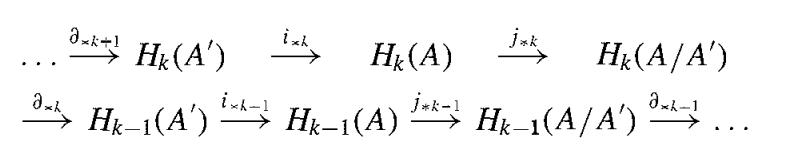
Prove Lemma 44.16 Data from Lemma 44.16The map ∂*k : Hk(A/A') → Hk-1(A'), which we have just defined, is well defined, and is a homomorphism of Hk(A/A') into Hk-1(A').Proof We leave this proof to the exercises (see Exercise 13). Let i*k be the map of Example 44.6. We now can
Prove Lemma 44.14 Let A' be a subcomplex of a chain complex A. Let j be the collection of natural homomorphisms jk : Ak → (Ak/A'K). Then jk = 1∂k ∂̅kjk that is, j commutes with ∂.
Consider the map f of the Klein bottle in Fig. 43.2 given by mapping a point Q of the rectangle in Fig. 43.2 onto the point of b directly opposite ( closest to) it. Note that b is topologically a I-sphere. Compute the induced maps f*n : Hn(X) → Hn(b) for n = 0, 1, and 2, by describing images of
Repeat Exercise 11, but view the map f as a map of the torus X into itself, inducing maps f*n : Hn(X) → Hn(X).Data from Exercises 11With reference to Exercise 10, the torus X can be mapped onto its circle b (which is homeomorphic to S1) by a variety of maps. For each such map f : X → b
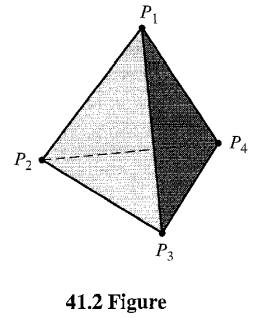
Following the ideas of Exercises 10, 11, and 12, define the n-dimensional cohomology group H(n)(X) of X. Compute H(n)(S) for the surface S of the tetrahedron of Fig. 41.2. Data from Exercise 10Let X be a simplicial complex. For an (oriented) n-simplex σ of X, the coboundary δn(σ) of σ is
Prove Theorem 44.19 by means of the following steps. a. Show (image i*k) ⊆ (kernel j*k).b. Show (kernel j*k) ⊆ (image i*k). c. Show (image j*k) ⊆ (kernel a*k). d. Show (kernel a*k) ⊆ (image j*k). e. Show (image a*k) ⊆ (kernel i*k-1). f. Show (kernel i*k-1) ⊆
Let (A, ∂) and (A', ∂') be chain complexes, and let f and g be collections of homomorphisms fk : Ak → Ak' and gk : Ak → Ak' such that both f and g commute with ∂. An algebraic homotopy between f and g is a collection D of homomorphisms Dk : Ak →A~+i such that for all c ∈ Ak, we have
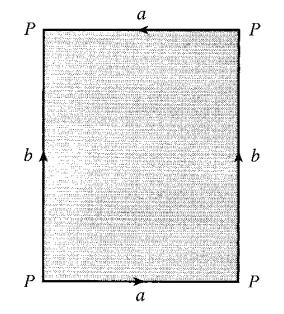
We can form the topological real projective plane X, using Fig. 43.14, by joining the semicircles a so that diametrically opposite points come together and the directions of the arrows match up. This cannot be done in Euclidean 3-space R3. One must go to R4 Triangulate this space X, starting with
Repeat Exercise 6 with X the Klein bottle of Fig. 43.2 and Fig. 43.4. Figure 43.2Data from Exercises 6In a computation analogous to Examples 44. 9 and 44.12 of the text, find the relative homology groups Hn( X, a) for the torus X with subcomplex a, as shown in Figs. 42.13 and Fig. 42.14.
Compute the homology groups of the space consisting of two torus surfaces having no points in common.
Define the following concepts so as to generalize naturally the definitions in the text given for dimensions 0. 1, 2, and 3.a. An oriented n-simplex b. The boundary of an oriented n-simplex c. A face of an oriented n-simplex
Give isomorphic refinements of the two series.{(0, 0)} < (60Z) x Z < (l0Z) x Z < Z x Z and {(0, 0)} < Z x (80Z) < Z x (20Z) < Z x Z
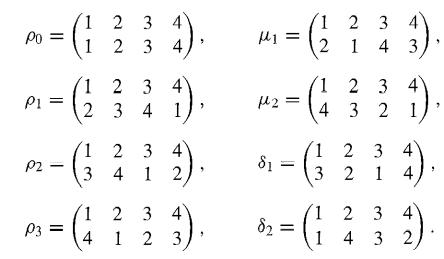
Let D4 be the group of symmetries of the square in Example 8.10. a. Find the decomposition of D4 into conjugate classes. b. Write the class equation for D4 .Data from Example 8.10Let us form the dihedral group D4 of permutations corresponding to the ways that two copies of a square with
Give a presentation of Z4 involving one generator; involving two generators; involving three generators.
Give isomorphic refinements of the two series.{0} < l0Z < Z and {0} < 25Z < Z
Find the reduced form and the inverse of the reduced form of each of the following words. a. a²b-1b³a³c-¹c4b-2b. a²a-³b³a4c4c²a-¹
In using the three isomorphism theorems, it is often necessary to know the actual correspondence given by the isomorphism and not just the fact that the groups are isomorphic. Let Z12 → Z3 be the homomorphism such that ∅(1) = 2. a. Find the kernel K of p. b. List the cosets in
Find a basis {(a1, a2 , a3), (b1, b2 , b3), (c1, c2, c3)} for Z x Z x Z with all ai ≠ 0, all bi ≠ 0, and all ci ≠ 0.
Give a presentation of S3 involving three generators.
Give isomorphic refinements of the two series.{0} < 60Z < 20Z < Z and {0} < 245Z < 49Z < Z
By arguments similar to those used in the examples of this section, convince yourself that every nontrivial group of order not a prime and less than 60 contains a nontrivial proper normal subgroup and hence is not simple. You need not write out the details.
Compute the products given in parts (a) and (b) of Exercise 1 in the case that {a, b, c} is a set of generators forming a basis for a free abelian group. Find the inverse of these products. Data from Exercise 1Find the reduced form and the inverse of the reduced form of each of the following
In using the three isomorphism theorems, it is often necessary to know the actual correspondence given by the isomorphism and not just the fact that the groups are isomorphic. Let ∅: Z18 →Z12 be the homomorphism where ∅(1) = 10.a. Find the kernel K of ∅. b. List the cosets in
Fill in the blanks.A Sylow 3-subgroup of a group of order 54 has order ______·
Is { (2, 1), (3, 1)} a basis for Z x Z? Prove your assertion.
Give the tables for both the octic group (a, b: a4 = 1, b2 = 1, ba = a3b) and the quaternion group (a, b: a4 = 1, b2 = a2 , ba = a3b). In both cases, write the elements in the order 1, a, a2, a3, b, ab, a2 b, a3b.
Give isomorphic refinements of the two series.{0} < (3) < Z24 and {0} < (8) < Z24
Mark each of the following true or false. ___ a. Every group of order 159 is cyclic. ___ b. Every group of order 102 has a nontrivial proper normal subgroup. ___ c. Every solvable group is of prime-power order. ___ d. Every group of prime-power order is solvable. ___ e. It
How many different homomorphisms are there of a free group of rank 2 into a. Z4? b. Z6? c. S3?
In using the three isomorphism theorems, it is often necessary to know the actual correspondence given by the isomorphism and not just the fact that the groups are isomorphic. In the group Z24 , let H = (4) and N = (6). a. List the elements in H N ( which we might write H + N for these
Fill in the blanks.A group of order 24 must have either ___ or ___ Sylow 2-subgroups.
Is {(2, 1), (4, 1)} a basis for Z x Z? Prove your assertion.
Determine all groups of order 14 up to isomorphism.
Give isomorphic refinements of the two series.{0} < (18) < (3) < Z72 and {0} < (24) < (12) < Z72
Prove that every group of order (5)(7)(47) is abelian and cyclic.
How many different homomorphisms are there of a free group of rank 2 onto a. Z4? b. Z6? c. S3?
In using the three isomorphism theorems, it is often necessary to know the actual correspondence given by the isomorphism and not just the fact that the groups are isomorphic. Repeat Exercise 3 for the group Z36 with H = (6) and N = (9).Data from Exercise 3In the group Z24 , let H = (4) and N
Fill in the blanks.A group of order 255 = (3)(5)(17) must have either ___ or ___ Sylow 3-subgroups and ___ or ___ Sylow 5-subgroups.
In using the three isomorphism theorems, it is often necessary to know the actual correspondence given by the isomorphism and not just the fact that the groups are isomorphic. In the group G = Z24, let H = (4) and K = (8). a. List the cosets in G/H, showing the elements in each
Find conditions on a, b, c, d ∈ Z for { (a, b), (c, d)} to be a basis for Z x Z.
Determine all groups of order 21 up to isomorphism.
In using the three isomorphism theorems, it is often necessary to know the actual correspondence given by the isomorphism and not just the fact that the groups are isomorphic. Repeat Exercise 5 for the group G = Z36 with H = (9) and K = (18).Data from Exercise 5In the group G = Z24, let H =
Prove that no group of order 96 is simple.
How many different homomorphisms are there of a free abelian group of rank 2 into a. Z4? b. Z6? c. S3?
Find all Sylow 3-subgroups of S4 and demonstrate that they are all conjugate.
Correct the definition of the italicized term without reference to the text, if correction is needed, so that it is in a form acceptable for publication.The rank of a free abelian group G is the number of elements in a generating set for G.
Correct the definition of the italicized term without reference to the text, if correction is needed so that it is in a form acceptable for publication.A consequence of the set of relators is any finite product of relators raised to powers.
Find all composition series of Z60 and show that they are isomorphic.
Prove that no group of order 160 is simple.
How many different homomorphisms are there of a free abelian group of rank 2 onto a. Z4? b. Z6? c. S3?
Find two Sylow 2-subgroups of S4 and show that they are conjugate.
Correct the definition of the italicized term without reference to the text, if correction is needed, so that it is in a form acceptable for publication.A basis for a nonzero abelian group G is a generating set X ⊆ G such that n1x1 + n2x2 + · · · + nmXm = 0 for distinct xi ∈ X and ni ∈ Z
Correct the definition of the italicized term without reference to the text, if correction is needed so that it is in a form acceptable for publication.Two group presentations are isomorphic if and only if there is a one-to-one correspondence of the generators of the first presentation with the
Find all composition series of Z48 and show that they are isomorphic.
Show that every group of order 30 contains a subgroup of order 15.
Correct the definition of the italicized term without reference to the text, if correction is needed. so that it is in a form acceptable for publication.A reduced word is one in which there are no appearances in juxtaposition of two syllables having the same letter and also no appearances of a
Show directly from the definition of a normal subgroup that if H and N are subgroups of a group G, and N is normal in G, then H ∩ N is normal in H.
Correct the definition of the italicized term without reference to the text, if correction is needed, so that it is in a form acceptable for publication.Let p be a prime. A p-group is a group with the property that every element has order p.
Show by example that it is possible for a proper subgroup of a free abelian group of finite rank r also to have rank r.
Mark each of the following true or false. ___ a. Every group has a presentation. ___ b. Every group has many different presentations. ___ c. Every group has two presentations that are not isomorphic. ___ d. Every group has a finite presentation. ___ e. Every group with a
Find all composition series of Z5 x Z5.
This exercise determines the conjugate classes of Sn for every integer n ≥ 1. a. Show that if a = (a1, a2 , · · · ·, am) is a cycle in Sn and τ is any element of Sn then τστ-1 = (ra1, ra2,· · · ·,ram).b. Argue from (a) that any two cycles in Sn of the same length are
Correct the definition of the italicized term without reference to the text, if correction is needed. so that it is in a form acceptable for publication.The rank of a free group is the number of elements in a set of generators for the group.
Let H, K, and L be normal subgroups of G with H < K < L. Let A= G/ H, B = K/ H, and C = L/ H. a. Show that B and C are normal subgroups of A, and B < C. b. To what factor group of G is (A/B)/(C/B) isomorphic?
Correct the definition of the italicized term without reference to the text, if correction is needed, so that it is in a form acceptable for publication.The normalizer N[H] of a subgroup H of a group G is the set of all inner automorphisms that carry H onto itself.
Mark each of the following true or false. ___ a. Every free abelian group is torsion free. ___ b. Every finitely generated torsion-free abelian group is a free abelian group. ___ c. There exists a free abelian group of every positive integer rank. ___ d. A finitely generated
Use the methods of this section and Exercise 13, part (b ), to show that there are no nonabelian groups of order 15.Data from Exercise 13Let S = {aibj|0 ≤ i < m, 0 ≤ j < n}, that is, S consists of all formal products aibj starting with a0b0 and ending with am-1bn-1. Let r be a
Find all composition series of S3 x Z2.
Find the conjugate classes and the class equation for S4.
Take one of the instances in this section in which the phrase "It would seem obvious that" was used and discuss your reaction in that instance.
Let K and L be normal subgroups of G with K v L = G, and K ∩ L = {e}. Show that G/ K ≈ L and G/L ≈ K.
Correct the definition of the italicized term without reference to the text, if correction is needed, so that it is in a form acceptable for publication.Let G be a group whose order is divisible by a prime p. The Sylow p-subgroup of a group is the largest subgroup P of G with the property that P
Complete the proof of Theorem 38.5Data from Theorem 38.5If G is a nonzero free abelian group with a basis of r elements, then G is isomorphic to Z x Z x ··· x Z for r factors. It is a fact that any two bases of a free abelian group G contain the same number of elements. We shall prove this
Show that a free abelian group contains no nonzero elements of finite order.
Find all composition series of Z2 x Z5 x Z7.
Find the class equation for S5 and S6.
Mark each of the following true or false. ___ a. Every proper subgroup of a free group is a free group. ___ b. Every proper subgroup of every free abelian group is a free group. ___ c. A homomorphic image of a free group is a free group. ___ d. Every free abelian group has a
Mark each of the following true or false. ___ a. Any two Sylow p-subgroups of a finite group are conjugate. ___ b. Theorem 36.11 shows that a group of order 15 has only one Sylow 5-subgroup. ___ c. Every Sylow p-subgroup of a finite group has order a power of p. ___ d. Every
Show that if G and G' are free abelian groups, then G x G' is free abelian.
Show that the presentation (a, b : a3 = 1, b2 = 1, ba = a2b) of Exercise 10 gives (up to isomorphism) the only nonabelian group of order 6, and hence gives a group isomorphic to S3.Data from Exercise 10Show, using Exercise 13, that (a, b: a3 = 1 b2 = 1, ba = a2b) gives a group of order 6. Show that
Find the center of S3 x Z4.
Showing 300 - 400
of 1629
1
2
3
4
5
6
7
8
9
10
11
12
13
14
15
Last
Step by Step Answers

 Get 50% OFF
Claim Now
Get 50% OFF
Claim Now