New Semester
Started
Get
50% OFF
Study Help!
--h --m --s
Claim Now
Question Answers
Textbooks
Find textbooks, questions and answers
Oops, something went wrong!
Change your search query and then try again
S
Books
FREE
Study Help
Expert Questions
Accounting
General Management
Mathematics
Finance
Organizational Behaviour
Law
Physics
Operating System
Management Leadership
Sociology
Programming
Marketing
Database
Computer Network
Economics
Textbooks Solutions
Accounting
Managerial Accounting
Management Leadership
Cost Accounting
Statistics
Business Law
Corporate Finance
Finance
Economics
Auditing
Tutors
Online Tutors
Find a Tutor
Hire a Tutor
Become a Tutor
AI Tutor
AI Study Planner
NEW
Sell Books
Search
Search
Sign In
Register
study help
mathematics
calculus 10th edition
Calculus 10th Edition Ron Larson, Bruce H. Edwards - Solutions
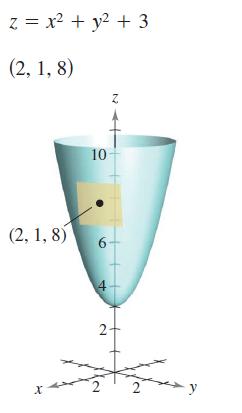
Find an equation of the tangent plane to the surface at the given point. z = x² + y² + 3 (2, 1, 8) (2, 1, 8) X 10 Z ++ 4 2+ 2 →y
Find dw/dt(a) By using the appropriate Chain Rule (b) By converting w to a function of t before differentiatingw = xy + xz + yz, x = t - 1, y = t² - 1, z = t
Find and simplify the function values.ƒ(x, y) = xey(a) (5, 0)(b) (3, 2)(c) (2, -1)(d) (5, y)(e) (x, 2)(f) (t, t)
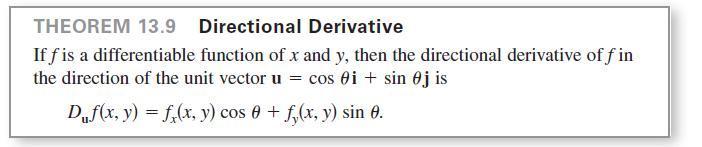
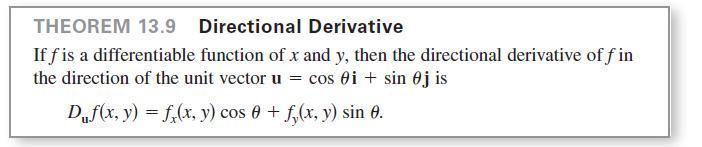
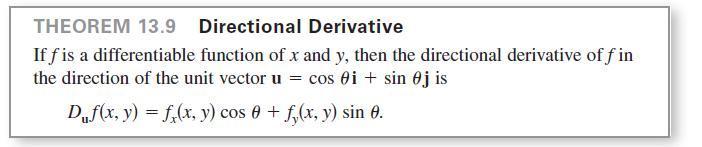
Use Theorem 13.9 to find the directional derivative of the function at P in the direction of Q.Data from in Theorem 13.9 THEOREM 13.9 Directional Derivative If f is a differentiable function of x and y, then the directional derivative of fin the direction of the unit vector u = cos i + sin 0j
A home improvement contractor is painting the walls and ceiling of a rectangular room. The volume of the room is 668.25 cubic feet. The cost of wall paint is $0.06 per square foot and the cost of ceiling paint is $0.11 per square foot. Find the room dimensions that result in a minimum cost for the
Examine the function for relative extrema and saddle points.g(x,y) = xy
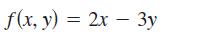
(a) Evaluate ƒ(2, 1) and ƒ(2.1, 1.05) and calculate Δz(b) Use the total differential dz to approximate Δz. f(x, y) = 2x - Зу
Find the total differential.w = 2z³y sin x
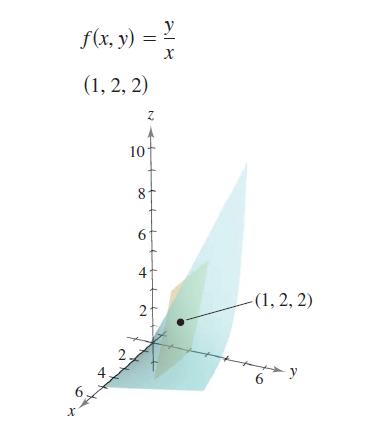
Find an equation of the tangent plane to the surface at the given point. f(x, y) = 6 X (1, 2, 2) 10 8 6 Z 4 2 y X -(1, 2, 2) 6
Find both first partial derivatives.ƒ(x, y) = 4x³y-2
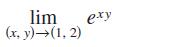
Find the limit and discuss the continuity of the function. lim exy (x, y)→(1, 2)
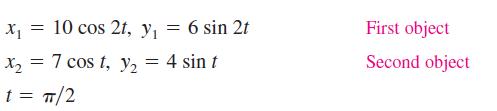
The parametricequations for the paths of two projectiles are given. At whatrate is the distance between the two objects changing at thegiven value of t? = 10 cos 2t, y₁ = 6 sin 2t x₂ = 7 cos t, y₂ = 4 sin t t = π/2 First object Second object
Find dw/dt(a) By using the appropriate Chain Rule (b) By converting w to a function of t before differentiatingw = xy² + x²z + yz², x = t², y = 2t, z = 2
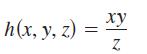
Find and simplify the function values.(a) (2, 3, 9) (b) (1, 0, 1) (c) (-2, 3, 4) (d) (5, 4, -6) h(x, y, z) = ху Z
Use Theorem 13.9 to find the directional derivative of the function at P in the direction of Q.Data from in Theorem 13.9 THEOREM 13.9 Directional Derivative If f is a differentiable function of x and y, then the directional derivative of fin the direction of the unit vector u = cos i + sin 0j
Find and simplify the function values.g(x, y) = In|x + y|(a) (1, 0) (b) (0, -1)(c) (0, e)(d) (1, 1) (e) (e, e/2) (f) (2,5)
The material for constructing the base of an open box costs 1.5 times as much per unit area as the material for constructing the sides. For a fixed amount of money C, find the dimensions of the box of largest volume that can be made.
Examine the function for relative extrema and saddle points.h(x, y) = x² - 3xy - y²
Find the total differential.w = x²yz²+ sin yz
Find both first partial derivatives.z = x√y
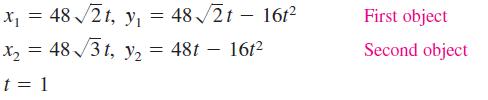
The parametric equations for the paths of two projectiles are given. At what rate is the distance between the two objects changing at the given value of t? y₁ = 48√√√2t - 16t² x₁ = 48 √√2t, x₂ = 48√3t, y₂ = 48t - 16t² t = 1 First object Second object
Find an equation of the tangent plane to the surface at the given point. Z z = √√√x² + y², (3, 4, 5)
Find and simplify the function values.(a) (0,5, 4) (b) (6, 8, -3)(c) (4, 6, 2) (d) (10, -4, -3) f(x, y, z) = ) = √√√√x + y + z
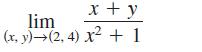
Find the limit and discuss the continuity of the function. x + y lim (x, y) (2, 4) x² + 1
Show that a rectangular box of given volume and minimum surface area is a cube.
Find an equation of the tangent plane to the surface at the given point. g(x, y) = arctan x (1, 0, 0)
Examine the function for relative extrema and saddle points.ƒ(x, y) = -3x² − 2y² + 3x – 4y + 5
Use Theorem 13.9 to find the directional derivative of the function at P in the direction of Q.Data from in Theorem 13.9 THEOREM 13.9 Directional Derivative If f is a differentiable function of x and y, then the directional derivative of fin the direction of the unit vector u = cos i + sin 0j
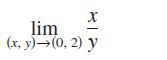
Find the limit and discuss the continuity of the function. lim (x, y)→(0, X 2) y
Find both first partial derivatives.z = 2y²√x
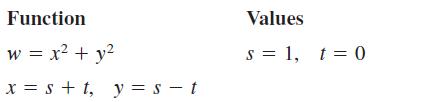
Find∂w/∂s and ∂w/∂t using the appropriate Chain Rule. Evaluateeach partial derivative at the given values of s and t. Function w = x² + y² x = s + t, y=s - t Values S = 1, t = 0
Show that the rectangular box of maximum volume inscribed in a sphere of radius r is a cube.
Examine the function for relative extrema and saddle points.ƒ(x, y) = 2x² + 2xy + y² + 2x - 3
(a) Evaluate ƒ(2, 1) and ƒ(2.1, 1.05) and calculate Δz(b) Use the total differential dz to approximate Δz.ƒ(x, y) = 16 -x² - y²
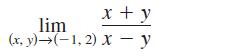
Find the limit and discuss the continuity of the function. x + y lim (x, y) (1, 2) X - y
Find both first partial derivatives.z = x² - 4xy + 3y²
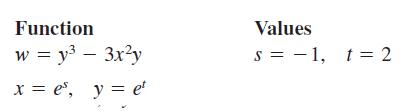
Find ∂w/∂s and ∂w/∂t using the appropriate Chain Rule. Evaluate each partial derivative at the given values of s and t. Function w = y³ - 3x²y x = es, y = et Values s = 1, t = 2
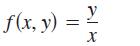
(a) Evaluate ƒ(2, 1) and ƒ(2.1, 1.05) and calculate Δz(b) Use the total differential dz to approximate Δz. f(x, y) = Y X
Find and simplify the function values.ƒ(x, y) = x sin y(a) (2, π/4) (b) (3, 1) (c) (-3, π/3) (d) (4, π/2)
A corporation manufactures candles at two locations. The cost of producing x1 units at location 1 isand the cost of producing x₂ units at location 2 isThe candles sell for $15 per unit. Find the quantity that should be produced at each location to maximize the profit P = 15(x₁ + x₂) - C₁ -
Find the gradient of the function at the given point.ƒ(x, y) = 3x + 5y² + 1, (2, 1)
A company manufactures running shoes and basketball shoes. The total revenue from x1 units of running shoes and x2 units of basketball shoes isR = -5x²1 - 8x2² - 2x₁x₂ + 42x₁ + 102x₂where x₁ and x₂ are in thousands of units. Find x1 and x₂ so as to maximize the revenue.
Examine the function for relative extrema and saddle points.z = x² + xy + 1/2y² - 2x + y
Find an equation of the tangent plane to the surface at the given point.g(x, y) = x² + y², (1,-1, 2)
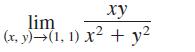
Find the limit and discuss the continuity of the function. ху lim (x,y)(1,1) x² + y2
Find both first partial derivatives.Z = y³ 2xy² - 1
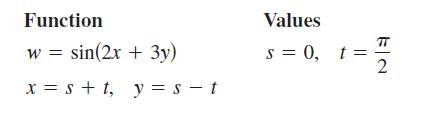
Find ∂w/∂s and ∂w/∂t using the appropriate Chain Rule. Evaluate each partial derivative at the given values of s and t. Function w = sin(2x + 3y) x = s + t, y = st Values s = 0, t= 2
Find and simplify the function values.V(r, h) = πr²h(a) (3, 10) (b) (5, 2) (c) (4, 8) (d) (6,4)
Find the gradient of the function at the given point.g(x, y) = 2xey/x, (2, 0)
Find an equation of the tangent plane to the surface at the given point. 2 h(x, y) = In √√√x² + y², (3, 4, In 5)
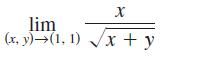
Find the limit and discuss the continuity of the function. X lim (x, y) (1.1)√√√x + y
Examine the function for relative extrema and saddle points.z = -5x² + 4xy - y² + 16x + 10
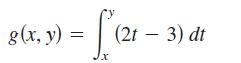
Find and simplify the function values.(a) (4, 0) (b) (4, 1) (c) (4, 3/2) (d) (3/2, 0) J = (4²1) 8 (2t - 3) dt
(a) Evaluate ƒ(2, 1) and ƒ(2.1, 1.05) and calculate Δz(b) Use the total differential dz to approximate Δz.ƒ(x, y)= yex
Find both first partial derivatives.z = exy
Examine the function for relative extrema and saddle points.ƒ(x, y) = √x² + y²
Find the gradient of the function at the given point.z = ln(x² - y), (2, 3)
(a) Evaluate ƒ(2, 1) and ƒ(2.1, 1.05) and calculate Δz(b) Use the total differential dz to approximate Δz.ƒ(x, y) = x cos y
Find both first partial derivatives.z = ex/y
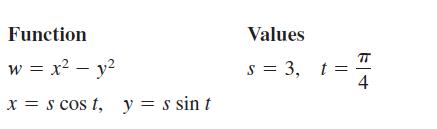
Find ∂w/∂s and ∂w/∂t using the appropriate Chain Rule. Evaluate each partial derivative at the given values of s and t. Function w = x² - y² x = s cost, y = s sin t Values S = 3, t 4
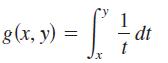
Find and simplify the function values.(a) (4, 1) (b) (6, 3) (c) (2,5) (d) (1/2, 7) g(x, y) = f x = - dt
Examine the function for relative extrema and saddle points.h(x, y) = (x² + y²)¹/3 + 2
Two particles travel along the space curves r(t) and u(t). If r(t) and u(t) intersect, will the particles collide?
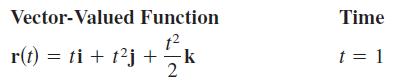
Find T(t), N(t), aT, and a at the given time t for the space curve r(t). Function 1² -k 2 Vector-Valued r(t) = ti + t²j+ Time t = 1
Use the model for projectile motion, assuming there is no air resistance. [a(t) = 32 feet per second per second or a(t) = -9.8 meters per second per second]A projectile is fired from ground level with an initial velocity of 84 feet per second at an angle of 30° with the horizontal. Find the range
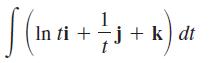
Find the indefinite integral. Jim In ti + j + kdt t
Consider a particle moving on a circular path of radius b described by r(t) = b cos ωti + b sin ωtj, where ω = du/dt is the constant angular velocity.(a) Show that the speed of the particle is bω.(b) Use a graphing utility in parametric mode to graph the circle for b = 6. Try different values
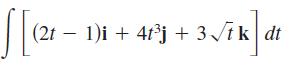
Find the indefinite integral. √ [₁2₁- (2t - 1)i + 4t³j + 3√tk dt
Represent the plane curve by a vector valued function.2x -3y + 5 = 0
Find the curvature and radius of curvature of the plane curve at the given value of x.y = e³x, x = 0
Describe the motion of a particle when the tangential component of acceleration is 0.
Evaluate the definite integral. π/4 [(sec t tan t)i + (tan t)j + (2 sin t cos t)k] dt
Find the principal unit normal vector to the curve at the specified value of the parameter.r(t) = 2ti + 3t²j, t = 1
Consider a particle moving on a circular path of radius b described by r(t) = b cos ωti + b sin ωtj, where ω = du/dt is the constant angular velocity.Find the acceleration vector and show that its direction is always toward the center of the circle.
A particle moves along a path modeled bywhere b is a positive constant.(a) Show that the path of the particle is a hyperbola.(b) Show that a(t) = b² r(t). r(t) = cosh(bt)i + sinh(bt)j
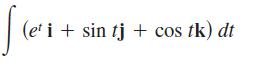
Find the indefinite integral. fe (et i sin tj + cos tk) dt
Represent the plane curve by a vector valued function.y = (x - 2)²
Find the curvature and radius of curvature of the plane curve at the given value of x.y = x³, x = 2
An object moves along the path given by r(t) = 3ti + 4tj. Find v(t), a(t), T(t), and N(t) (if it exists). What is the form of the path? Is the speed of the object constant or changing?
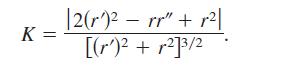
Show that the formula for the curvature of a polar curve r = ƒ(θ) given in Exercise 71reduces to K = 2/|r'| for the curvature at the pole.Data from in Exercise 71A curve C is given by the polar equation r = ƒ(θ). Show that the curvature K at the point (r, θ) is K = 12(r)² rr" +
In Exercises use the result of Exercise 74 to find the curvature of the rose curve at the pole.Data from in Exercise 74A curve C is given by the polar equation r = ƒ(θ). Show that the curvature K at the point (r, θ) is r = 4 sin 2θ K = 12(r)² rr" + r²| [(r')² + r²]3/2 -
Find the principal unit normal vector to the curve at the specified value of the parameter.r(t) = ti + In tj, t = 2
Consider a particle moving on a circular path of radius b described by r(t) = b cos ωti + b sin ωtj, where ω = du/dt is the constant angular velocity. Show that the magnitude of the acceleration vector is bω2.
In Exercises consider the vector-valued functionWrite a vector-valued function s(t) that is the specified transformation of r.A vertical translation three units upward r(t) = t²i + (t− 3)j + tk.
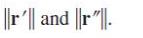
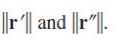
A particle moves in the xy-plane along the curve represented by the vector-valued function r(t) = (t - sin t)i + (1 - cos t)j.(a) Use a graphing utility to graph r. Describe the curve.(b) Find the minimum and maximum values of ||r´|| and ||r”||.
A particle moves in the yz-plane along the curve represented by the vector-valued function r(t) = (2 cos t)j + (3 sin t)k.(a) Describe the curve.(b) Find the minimum and maximum values of ||r' and r'||.
Determine whether the statement is true or false. If it is false, explain why or give an example that shows it is false. If a particle moves along a straight line, then the velocity and acceleration vectors are orthogonal.
Consider the vector-valued functionWrite a vector-valued function s(t) that is the specified transformation of r.A vertical translation four units downward r(t) = t²i + (t− 3)j + tk.
Prove that the principal unit normal vector N points toward the concave side of a plane curve.
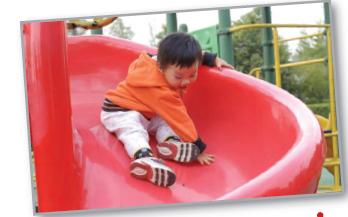
The outer edge of a playground slide is in the shape of a helix of radius 1.5 meters. The slide has a height of 2 meters and makes one complete revolution from top to bottom. Find a vector-valued function for the helix. Use a computer algebra system to graph your function.
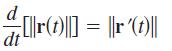
Determine whether the statement is true or false. If it is false, explain why or give an example that shows it is false. |||(4) || = [(¹|| AP P
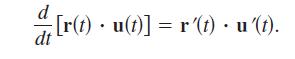
Determine whether the statement is true or false. If it is false, explain why or give an example that shows it is false.If r and u are differentiable vector-valued functions of t then d dt [r(t) · u(t)] = r'(t) · u '(t).
Let r(t) and u(t) be vector-valued functions whose limits exist as t → c. Prove that lim [r(t) = u(t)] = lim r(t) × lim u(t). t-c t-c t-c
Let r(t) and u(t) be vector-valued functions whose limits exist as t → c. Prove that lim [r(t) u(t)] = lim r(t) · lim u(t). t-c t-c t-c
A 5500-pound vehicle is driven at a speed of 30 miles per hour on a circular interchange of radius 100 feet. To keep the vehicle from skidding off course, what frictional force must the road surface exert on the tires?
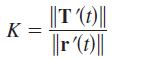
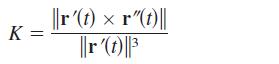
Use the definition of curvature in space,to verify each formula.(a)(b)(c) K = ||T '(s)|| = ||r"(s)||,
A 6400-pound vehicle is driven at a speed of 35 miles per hour on a circular interchange of radius 250 feet. To keep the vehicle from skidding off course, what frictional force must the road surface exert on the tires?
Verify that the curvature at any point (x, y) on the graph of y = cosh x is 1/y².
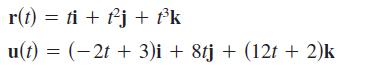
Two particles travel along the space curves r(t) and u(t). A collision will occur at the point of intersection P when both particles are at P at the same time. Do the particles collide? Do their paths intersect? r(t) = ti + f²j + f³k u(t)= (-2t + 3)i + 8tj + (12t + 2)k
Prove that if r is a vector-valued function that is continuous at c, then ||r|| is continuous at c.
Showing 2200 - 2300
of 9867
First
16
17
18
19
20
21
22
23
24
25
26
27
28
29
30
Last
Step by Step Answers

 Get 50% OFF
Claim Now
Get 50% OFF
Claim Now