New Semester
Started
Get
50% OFF
Study Help!
--h --m --s
Claim Now
Question Answers
Textbooks
Find textbooks, questions and answers
Oops, something went wrong!
Change your search query and then try again
S
Books
FREE
Study Help
Expert Questions
Accounting
General Management
Mathematics
Finance
Organizational Behaviour
Law
Physics
Operating System
Management Leadership
Sociology
Programming
Marketing
Database
Computer Network
Economics
Textbooks Solutions
Accounting
Managerial Accounting
Management Leadership
Cost Accounting
Statistics
Business Law
Corporate Finance
Finance
Economics
Auditing
Tutors
Online Tutors
Find a Tutor
Hire a Tutor
Become a Tutor
AI Tutor
AI Study Planner
NEW
Sell Books
Search
Search
Sign In
Register
study help
mathematics
calculus 10th edition
Calculus 10th Edition Ron Larson, Bruce H. Edwards - Solutions
Find the domain of the vector-valued function. r(t) 1 t+1 -i + - 3tk -
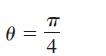
Find an equation in rectangular coordinates for the equation given in spherical coordinates, and sketch its graph. e= 4
Find the unit tangent vector to the curve at the specified value of the parameter.r(t) = t²i + 2tj, t = 1
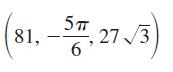
Convert the point from cylindrical coordinates to spherical coordinates. . - 81, 5 п 6 27 3
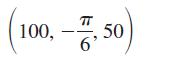
Convert the point from cylindrical coordinates to spherical coordinates. (100, ---- 6' 50
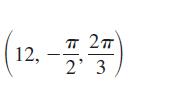
Convert the point from spherical coordinates to cylindrical coordinates. 12, ㅠㅠ 꽃 2 2' 3
Find an equation in rectangular coordinates for the equation given in spherical coordinates, and sketch its graph.p = 3 cos Ø
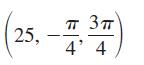
Convert the point from spherical coordinates to cylindrical coordinates. 25, п 3п 4' 4 Т
Find an equation in rectangular coordinates for the equation given in cylindrical coordinates, and sketch its graph.z = 4
Find an equation in rectangular coordinates for the equation given in cylindrical coordinates, and sketch its graph.r = 5 cos θ
Convert the rectangular equation to an equation in(a) Cylindrical coordinates (b) Spherical coordinatesx² + y² + z² = 16
Find a unit vector(a) parallel to (b) perpendicular to the graph of ƒ at the given point. Then sketch the graph of ƒ and sketch the vectors at the given point. f(x) = x³, (1, 1)
Convert the rectangular equation to an equation in(a) Cylindrical coordinates (b) Spherical coordinatesx² - y² = 2z
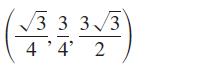
Convert the point from rectangular coordinates to(a) Cylindrical coordinates (b) Spherical coordinates √√333√3 4'4' 2
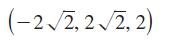
Convert the point from rectangular coordinates to(a) Cylindrical coordinates (b) Spherical coordinates (-2√2,2√2, 2)
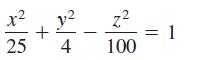
Describe and sketch the surface. y² 25 4 z² 100 = 1
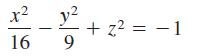
Describe and sketch the surface. x² 16 9 +z² = -1
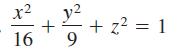
Describe and sketch the surface. x2 16 + y2 9 + z² = 1
Find an equation for the surface of revolution formed by revolving the curve 2x + 3z = 1 in the xz-plane about the x-axis.
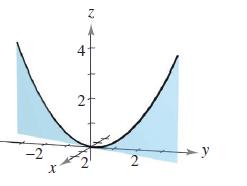
Find an equation for the surface of revolution formed by revolving the curve z² = 2y in the yz-plane about the y-axis.
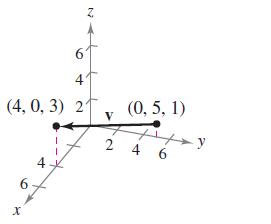
In Exercises(a) Find the component form of the vector v(b) Write the vector using standard unit vector notation(c) Sketch the vector with its initial point at the origin 41 (4, 0, 3) 21 X V (0, 5, 1) 2 46
Describe and sketch the surface.y2 + z2 = 16
Describe and sketch the surface.x2 + z2 = 4
Find T(t), N(t), aT, and an at the given time t for the plane curve r(t). r(t) = f²i + 2tj, t=1
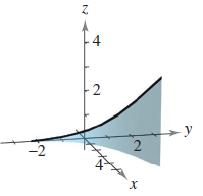
Match the equation with its graph. [The graphs are labeled (a), (b), (c), and (d).](a)(b)(c)(d) -2 N -2 A 2 X y
Find(a) r'(t)(b) r"(t)(c) r'(t) · r"(t). r(t) = (t² + t)i + (t²-t)j
Describe and sketch the surface.16x² + 16y² -9z² = 0
Prove thatu × (v × w) = (u . w) v - (u . v) w.
Describe and sketch the surface.y = cos z
Prove the property of the cross product.u × v is orthogonal to both u and v.
Find(a) r'(t)(b) r"(t)(c) r'(t) . r"(t)(d) r'(t) × r”(t). r(t) = 2t³i+ 4tj - f²k
Find(a) r'(t)(b) r"(t)(c) r'(t) · r"(t). r(t) = t³i + t²j
Find(a) r'(t) (b) r"(t)(c) r'(t) . r"(t). r(t) = 5 cos ti + 2 sin tj
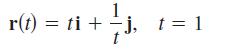
Find T(t), N(t), aT, and an at the given time t for the plane curve r(t). 1 r(t) = tij, t = 1
Use the given acceleration vector to find the velocity and position vectors. Then find the position at time t = 2.a(t) = -32k, v(0) = 3i - 2j + k, r(0) = 5j + 2k
Match the equation with its graph. [The graphs are labeled (a), (b), (c), and (d).](a)(b)(c)(d) -2 N -2 A 2 X y
Find the curvature of the curve, where s is the arc length parameter.r(t) = (2 cos t, 2 sin t, t)
Match the equation with its graph. [The graphs are labeled (a), (b), (c), and (d).](a)(b)(c)(d) -2 N -2 A 2 X y
Find the principal unit normal vector to the curve at the specified value of the parameter. r(t) = cos 3ti + 2 sin 3tj + k, t = π
Find the curvature of the curve, where s is the arc length parameter. (最-1) + (+1)= r(s)
Use the given acceleration vector to find the velocity and position vectors. Then find the position at time t = 2.a(t) = tj + tk, v(1) = 5j, r(1) = 0
Find(a) r'(t) (b) r"(t)(c) r'(t) . r"(t). r(t) = (t² + 4t) i - 3t²j
Find the curvature of the curve, where s is the arc length parameter.r(s) = (3 + s)i + j
Find the principal unit normal vector to the curve at the specified value of the parameter. r(t) = 6 cos ti + 6 sin tj + k, t = 3πT 4
In Exercises find r'(t).r(t) = (arcsin t, arccos t, 0)
Use the given acceleration vector to find the velocity and position vectors. Then find the position at time t = 2.a(t) = 2i + 3k, v(0) = 4j, r(0) = 0
Find r'(t).r(t) = (t sin t, t cos t, t)
Find the limit. lim 1-0 sin 2t. t i+e¹j+e' k
Match the equation with its graph. [The graphs are labeled (a), (b), (c), and (d).](a)(b)(c)(d) -2 N -2 A 2 X y
Repeat Exercise 17 for the curve represented by the vector-valued functionData from in Exercise 17Consider the helix represented by the vector-valued function r(t) = (2 cos t, 2 sin t, t).(a) Write the length of the arc s on the helix as a function of t by evaluating the integral(b) Solve for t in
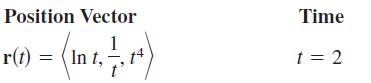
The position vector r describes the path of an object moving in space.(a) Find the velocity vector, speed, and acceleration vector of the object.(b) Evaluate the velocity vector and acceleration vector of the object at the given value of t. Position r(t) = (In t, Vector 1 - Time t = 2
Find the principal unit normal vector to the curve at the specified value of the parameter. r(t) = √√2ti + e¹j+e¹k, t = 0
Use the given acceleration vector to find the velocity and position vectors. Then find the position at time t = 2.a(t) = i + j + k, v(0) = 0, r(0) = 0
Find r(t) . u(t). Is the result a vector-valued function? Explain. r(t) = (3 cos t, 2 sin t, t - 2), u(t) = (4 sin t, -6 cos t, t²)
Find the principal unit normal vector to the curve at the specified value of the parameter. r(t) = ti + f²j + In tk, t = 1
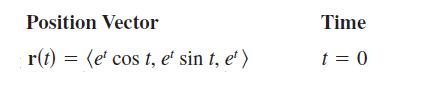
The position vector r describes the path of an object moving in space.(a) Find the velocity vector, speed, and acceleration vector of the object.(b) Evaluate the velocity vector and acceleration vector of the object at the given value of t. Position Vector r(t) = = (et cos t, et sin t, e¹) Time t
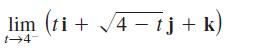
Find the limit. lim (ti + √√4 - tj + k) t-4-
Consider the helix represented by the vector-valued function r(t) = (2 cos t, 2 sin t, t).(a) Write the length of the arc s on the helix as a function of tby evaluating the integral(b) Solve for t in the relationship derived in part (a), and substitute the result into the original set of parametric
Find r'(t).r(t) = (t³, cos 3t, sin 3t)
Find r(t) . u(t). Is the result a vector-valued function? Explain. r(t) = (3t − 1)i + ¼t³j + 4k, u(t) = t²i – 8j + t³k
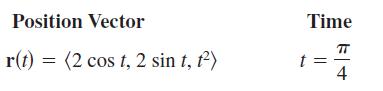
The position vector r describes the path of an object moving in space.(a) Find the velocity vector, speed, and acceleration vector of the object.(b) Evaluate the velocity vector and acceleration vector of the object at the given value of t. Position Vector r(t) = (2 cos t, 2 sin t, 1²) Time TT 4 t
Find r'(t).r(t) = e-t i + 4j + 5tetk
Find the principal unit normal vector to the curve at the specified value of the parameter. TT r(t) = π cos ti + π sin tj, t = 6
Represent the line segment from P to Q by a vector-valued function and by a set of parametric equations. P(1, -6, 8), Q(-3, -2,5)
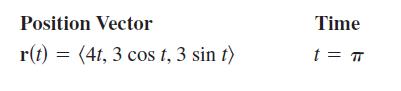
The position vector r describes the path of an object moving in space.(a) Find the velocity vector, speed, and acceleration vector of the object.(b) Evaluate the velocity vector and acceleration vector of the object at the given value of t. Position Vector r(t) = (4t, 3 cos t, 3 sin t) Time t = π
Find the principal unit normal vector to the curve at the specified value of the parameter. r(t) = In ti + (t + 1)j, t = 2
Sketch the space curve represented by the intersection of the surfaces. Use the parameter x = t to find a vector-valued function for the space curve.x² + z² = 4, x - y = 0
Repeat Exercise 15 for the vector-valued function r(t) = 6 cos(πt/4)i + 2 sin(πt/4)j + tk.Data from in Exercise 15Consider the graph of the vector-valued function r(t) = ti + (4 − t²)j + t³ k on the interval [0, 2].(a) Approximate the length of the curve by finding the length of the line
Find r'(t).r(t) = 4√ti + t²√t j + In t²k
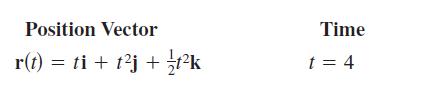
The position vector r describes the path of an object moving in space.(a) Find the velocity vector, speed, and acceleration vector of the object.(b) Evaluate the velocity vector and acceleration vector of the object at the given value of t. Position Vector r(t) = t²i + tj + 21³/2k Time t = 4
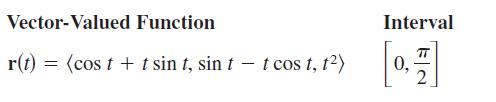
Sketch the space curve and find its length over the given interval. Vector-Valued Function r(t) = (cost + t sin t, sin t - t cos t, t²) Interval 0,
Represent the line segment from P to Q by a vector-valued function and by a set of parametric equations. P(-2, 5, -3), Q(-1, 4, 9)
Sketch the space curve represented by the intersection of the surfaces. Use the parameter x = t to find a vector-valued function for the space curve.z = x² + y², x + y = 0
Find the principal unit normal vector to the curve at the specified value of the parameter. 6 r(t) = tij, t = 3
Consider the graph of the vector-valued function r(t) = ti + (4 − t²)j + t³ k on the interval [0, 2].(a) Approximate the length of the curve by finding the length of the line segment connecting its endpoints.(b) Approximate the length of the curve by summing the lengths of the line segments
Find r'(t).r(t) = a cos³ ti + a sin³ tj + k
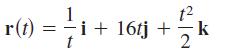
Find r'(t). r(t) = 4/1 = i + 16tj + t 2 k
Represent the line segment from P to Q by a vector-valued function and by a set of parametric equations. P(0, 2, -1), Q(4,7, 2)
Represent the plane curve by a vector-valued function. (There are many correct answers.)y = 9 - x²
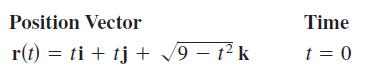
The position vector r describes the path of an object moving in space.(a) Find the velocity vector, speed, and acceleration vector of the object.(b) Evaluate the velocity vector and acceleration vector of the object at the given value of t. Position Vector r(t) = ti + tj + √9-1² k Time t = 0
Find the principal unit normal vector to the curve at the specified value of the parameter. r(t) = ti + ½t²j, t = 2
Sketch the space curve and find its length over the given interval. Vector-Valued Function r(t) = a cos ti + a sin tj + bt k Interval [0, 2π]
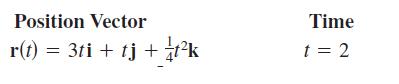
The position vector r describes the path of an object moving in space.(a) Find the velocity vector, speed, and acceleration vector of the object.(b) Evaluate the velocity vector and acceleration vector of the object at the given value of t. Position Vector r(t) = 3ti + tj + t²k Time t = 2
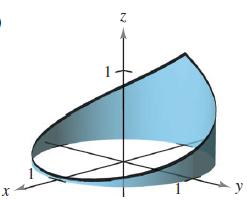
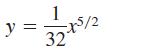
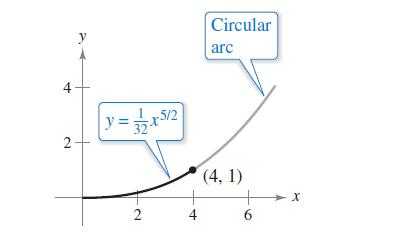
A highway has an exit ramp that begins at the origin of a coordinate system and follows the curveto the point (4, 1) (see figure). Then it follows a circular path whose curvature is that given by the curve at (4, 1). What is the radius of the circular arc? Explain why the curve and the circular are
Represent the line segment from P to Q by a vector-valued function and by a set of parametric equations. P(0, 0, 0), Q(3, 1, 2)
Represent the plane curve by a vector-valued function. (There are many correct answers.)3x + 4y - 12 = 0
Find r'(t).r(t) = 6ti - 7t²j + t³k
Evaluate (if possible) the vector-valued function at each given value of t.(a) r(0) (b) r(4) (c) r(c + 2)(d) r(9+ Δt) -r(9) r(t) = √ti + 1³/²j + e-¹/4 k
Sketch the space curve and find its length over the given interval. Vector-Valued Function r(t) = (2 sin t, 5t, 2 cos t) Interval [0, π]
Find the unit tangent vector T(t) and find a set of parametric equations for the line tangent to the space curve at point P. r(t) = (2 sin t, 2 cos t, 4 sin² t), P(1, √√3, 1)
Sketch the curve represented by the vector-valued function and give the orientation of the curve.r(t) = 2 cos ti + tj + 2 sin tk
The position vector r describes the path of an object moving in space.(a) Find the velocity vector, speed, and acceleration vector of the object.(b) Evaluate the velocity vector and acceleration vector of the object at the given value of t. Position Vector r(t) = ti + t²j + t²k Time t = 4
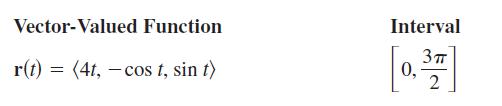
Sketch the space curve and find its length over the given interval. Vector-Valued Function r(t) = (4t, -cos t, sin t) Interval 3 TT 2 0,
The position vector r describes the path of an object moving in space.(a) Find the velocity vector, speed, and acceleration vector of the object.(b) Evaluate the velocity vector and acceleration vector of the object at the given value of t. Position Vector r(t) = 4ti + 4tj + 2tk Time t = 3
Find r'(t).r(t) = (t cos t, -2 sin t)
Find the unit tangent vector T(t) and find a set of parametric equations for the line tangent to the space curve at point P. r(t) = (2 cos t, 2 sin t, 4), P√√2, √√2, 4)
Evaluate (if possible) the vector-valued function at each given value of t.(a) r(2) (b) r(-3)(c) r(t - 4)(d) r(1 + Δt) -r(1) 1 r(t) = In ti + + j j + 3tk
Sketch the space curve and find its length over the given interval. Vector-Valued Function r(t) = i + t²j + f³k Interval [0, 2]
Sketch the curve represented by the vector-valued function and give the orientation of the curve.r(t) = (t + 1)i + (3t − 1)j + 2tk
Use the binormal vector defined by the equation B = T × N.Find the unit tangent, unit normal, and binormal vectors for the curve at t = π/4. Sketch the curve together with these three mutual orthogonal unit vectors. r(t) = cos ti + sin tj - k
Showing 2500 - 2600
of 9867
First
19
20
21
22
23
24
25
26
27
28
29
30
31
32
33
Last
Step by Step Answers

 Get 50% OFF
Claim Now
Get 50% OFF
Claim Now