New Semester
Started
Get
50% OFF
Study Help!
--h --m --s
Claim Now
Question Answers
Textbooks
Find textbooks, questions and answers
Oops, something went wrong!
Change your search query and then try again
S
Books
FREE
Study Help
Expert Questions
Accounting
General Management
Mathematics
Finance
Organizational Behaviour
Law
Physics
Operating System
Management Leadership
Sociology
Programming
Marketing
Database
Computer Network
Economics
Textbooks Solutions
Accounting
Managerial Accounting
Management Leadership
Cost Accounting
Statistics
Business Law
Corporate Finance
Finance
Economics
Auditing
Tutors
Online Tutors
Find a Tutor
Hire a Tutor
Become a Tutor
AI Tutor
AI Study Planner
NEW
Sell Books
Search
Search
Sign In
Register
study help
mathematics
calculus 10th edition
Calculus 10th Edition Ron Larson, Bruce H. Edwards - Solutions
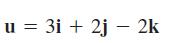
Find the direction cosines and angles of, and demonstrate that the sum of the squares of the direction cosines is 1. u = 3i + 2j - 2k
Find the magnitude of v.v = -3i
The triangle in Exercise 27 is translated five units upward along the z-axis. Determine the coordinates of the translated triangle.Data from in Exercise 27In Exercises find the lengths of the sides of the triangle with the indicated vertices, and determine whether the triangle is a right triangle,
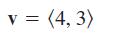
Find the magnitude of v. v = (4,3)
Convert the point from rectangular coordinates to spherical coordinates.(-4, 0, 0)
Find two vectors in opposite directions that are orthogonal to the vector u = (5, 6, (5, 6, -3).
Determine whether the lines intersect, and if so, find the point of intersection and the cosine of the angle of intersection. 3 -y-2 - 1 z + 1, x-1 4 = y + 2 = 3 + 3 붸 -3
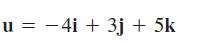
Find the direction cosines and angles of, and demonstrate that the sum of the squares of the direction cosines is 1. u = −4i + 3j + 5k
The triangle in Exercise 28 is translated three units to the right along the y-axis. Determine the coordinates of the translated triangle.Data from in Exercise 28In Exercises find the lengths of the sides of the triangle with the indicated vertices, and determine whether the triangle is a right
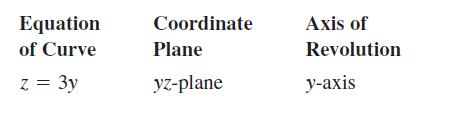
Find an equation for the surface of revolution formed by revolving the curve in the indicated coordinate plane about the given axis. Equation of Curve z = 3y Coordinate Plane yz-plane Axis of Revolution y-axis.
Determine whether the lines intersect, and if so, find the point of intersection and the cosine of the angle of intersection. x= 2 _ y = 2. - -3 6 z - 3, = Z r- * z 3 =y+5= L 2 2 4
Convert the point from rectangular coordinates to spherical coordinates.(-2, 2√3, 4)
Find the magnitude of v. V = (12,-5)
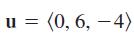
Find the direction cosines and angles of, and demonstrate that the sum of the squares of the direction cosines is 1. u= (0, 6, 4)
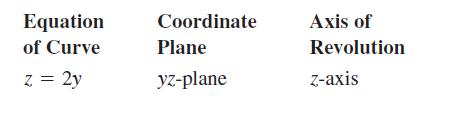
Find an equation for the surface of revolution formed by revolving the curve in the indicated coordinate plane about the given axis. Equation of Curve z = 2y Coordinate Plane yz-plane Axis of Revolution z-axis
An object is pulled 8 feet across a floor using a force of 75 pounds. The direction of the force is 30° above the horizontal. Find the work done.
Convert the point from rectangular coordinates to spherical coordinates.(2, 2, 4√2)
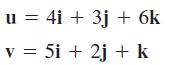
Find(a) u x v(b) v × u(c) v × v u = 4i + 3j + 6k v = 5i +2j + k
Determine whether the plane passes through each point.(a) (-7, 2, -1)(b) (5, 2, 2) x + 2y4z 1 = 0
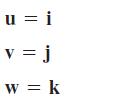
Find u . (v x w). u = i v = j W = k
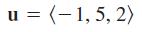
Find the direction cosines and angles of, and demonstrate that the sum of the squares of the direction cosines is 1. u = (-1, 5, 2)
Find the coordinates of the midpoint of the line segment joining the points.(3, 4, 6), (1, 8, 0)
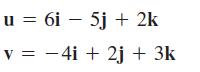
Find (a) u x v(b) v × u(c) v × v u = 6i - 5j + 2k V v = −4i + 2j + 3k
Find the magnitude of v.v = 6i - 5j
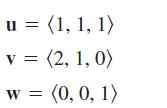
Find u . (v x w). u = (1, 1, 1) v = (2, 1, 0) w = (0, 0, 1)
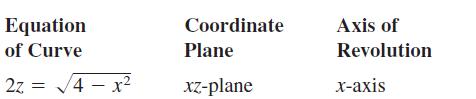
Find an equation for the surface of revolution formed by revolving the curve in the indicated coordinate plane about the given axis. Equation of Curve 2z = √√4x² 2 Coordinate Plane xz-plane Axis of Revolution x-axis
Convert the point from rectangular coordinates to spherical coordinates.(√3, 1, 2√3)
Find the coordinates of the midpoint of the line segment joining the points.(7, 2, 2), (-5, -2, -3)
Determine whether the plane passes through each point.(a) (3, 6, -2)(b) (-1, 5, -1) 2x + y + 3z6=0
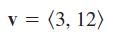
Find the unit vector in the direction of and verify that it has length 1. V v = (3, 12)
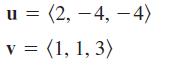
Find(a) u x v(b) v × u(c) v × v u =(2, -4,-4) v = (1, 1, 3)
In Exercises (a) Find the projection of u onto v(b) Find the vectorcomponent of u orthogonal to v u = (6, 7), v = (1,4)
Find the magnitude of v.v = - 10i + 3j
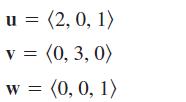
Find u . (v x w). u = (2, 0, 1) v = (0,3,0) w = (0, 0, 1)
Find an equation for the surface of revolution formed by revolving the curve in the indicated coordinate plane about the given axis. Equation of Curve xy = 2 Coordinate Plane xy-plane Axis of Revolution x-axis
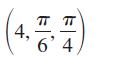
Convert the point from spherical coordinates to rectangular coordinates. 4, 6'4
Find an equation of the plane passing through the point perpendicular to the given vector or line. Point (1, 3, -7) Perpendicular to n = j
Convert the point from rectangular coordinates to spherical coordinates.(-1, 2, 1)
Find the coordinates of the midpoint of the line segment joining the points.(5, -9, 7), (-2, 3, 3)
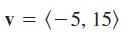
Find the unit vector in the direction of and verify that it has length 1. v = (-5, 15)
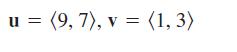
In Exercises (a) Find the projection of u onto v(b) Find the vector component of u orthogonal to v u = (9,7), v = (1, 3)
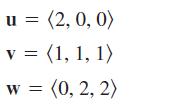
Find u . (v x w). u = (2, 0, 0) v = (1, 1, 1) w = (0, 2, 2)
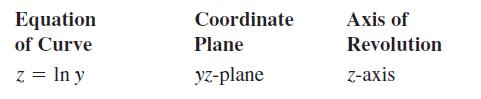
Find an equation for the surface of revolution formed by revolving the curve in the indicated coordinate plane about the given axis. Equation of Curve z = ln y Coordinate Plane yz-plane Axis of Revolution z-axis
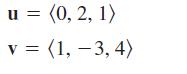
Find(a) u x v(b) v × u(c) v × v u = (0, 2, 1) V v = (1, -3, 4)
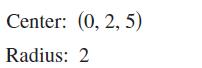
Find the standard equation of the sphere. Center: (0, 2, 5) Radius: 2
Find the unit vector in the direction of and verify that it has length 1. V = = 信
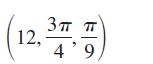
Convert the point from spherical coordinates to rectangular coordinates. 12, Зп п ol s 4'9
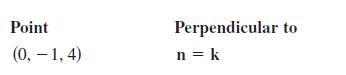
Find an equation of the plane passing through the point perpendicular to the given vector or line. Point (0, -1, 4) Perpendicular to n = k
Find the coordinates of the midpoint of the line segment joining the points.(4, 0, -6), (8, 8, 20)
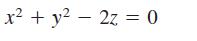
Find an equation of a generating curve given the equation of its surface of revolution. x² + y² = 2z = 0
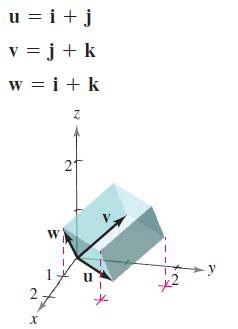
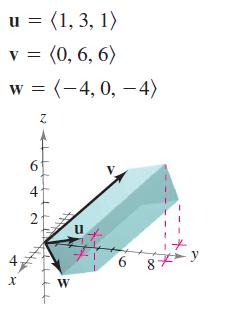
Use the triple scalar product to find the volume of the parallelepiped having adjacent edges u, v, and w. u = i + j v=j+ k w = i + k 2 X W Z 21 u
In Exercises (a) Find the projection of u onto v(b) Find the vector component of u orthogonal to v u = 2i + 3j, v = 5i + j
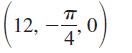
Convert the point from spherical coordinates to rectangular coordinates. 12,
Find an equation of the plane passing through the point perpendicular to the given vector or line. Point (3, 2, 2) Perpendicular to n = 2i + 3j - k
In Exercises (a) Find the projection of u onto v(b) Find the vector component of u orthogonal to v u = 2i 3j, v = 3i + 2j
Find the standard equation of the sphere. Center: (4, 1, 1) Radius: 5
Find the unit vector in the direction of and verify that it has length 1. v = (-6.2, 3.4)
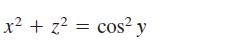
Find an equation of a generating curve given the equation of its surface of revolution. x² + z² = cos² y
Find an equation of the plane passing through the point perpendicular to the given vector or line. Point (0, 0, 0) Perpendicular to n = -3i + 2k
Use the triple scalar product to find the volume of the parallelepiped having adjacent edges u, v, and w. u = (1, 3, 1) v = (0, 6, 6) w = (-4, 0, -4) X 6 4 N 2 W
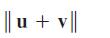
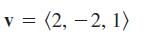
Find the following.(a)(b)(c)(d)(e)(f) || n ||
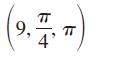
Convert the point from spherical coordinates to rectangular coordinates. TT
In Exercises (a) Find the projection of u onto v(b) Find the vector component of u orthogonal to v u = (0, 3, 3), v = (-1, 1, 1)
Find the area of the parallelogram that has the vectors u = (3, 1, 5) and v = (2, -4, 1) as adjacent sides.
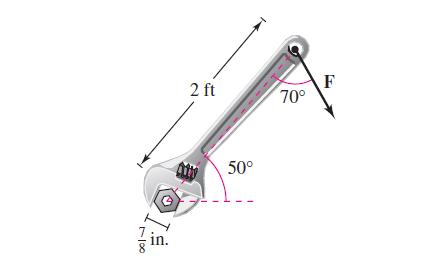
The specifications for a tractor state that the torque on a bolt with head size 7/8 inch cannot exceed 200 foot-pounds. Determine the maximum force ||F|| that can be applied to the wrench in the figure. 718 2 ft 50° 70° F
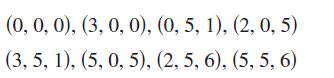
Find the volume of the parallelepiped with the given vertices. (0, 0, 0), (3, 0, 0), (0, 5, 1), (2, 0, 5) (3, 5, 1), (5, 0, 5), (2, 5, 6), (5, 5, 6)
Find the volume of the parallelepiped with the given vertices. (0, 0, 0), (0, 4, 0), (-3, 0, 0), (-1,1,5) (-3, 4, 0), (-1, 5, 5), (-4, 1, 5), (-4, 5, 5)
Find the standard equation of the sphere.Endpoints of a diameter: (2, 0, 0), (0, 6, 0)
Use the shell method to find the volume of the solid below the surface of revolution and above the xy-plane. The curve z = 4x - x² in the xz-plane is revolved about the Z-axis.
Find the distance between the planes 5x - 3y + z = 2 and 5x - 3y + z = -3.
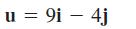
Find two vectors in opposite directions that are orthogonal to the vector u. (The answers are not unique.) u = 9i - 4j
Find an equation in rectangular coordinates for the equation given in spherical coordinates, and sketch its graph.ρ = 2 sec Ø
Find an equation of the plane that contains all the points that are equidistant from the given points.(1, 0, 2), (2, 0, 1)
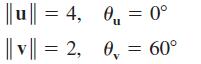
Find the component form of u + v given the lengths of u and v and the angles that u and v make with the positive x-axis. ||u|| = 4, ||v|| = 2, 0₁ 0° = u 0, = 60°
Find the distance between the point (-5, 1, 3) and the line given by x = 1 + t, y = 3 - 2t, and z = 5 - t.
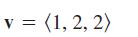
Find each scalar multiple of v and sketch its graph.(a) 2v (b) -V(c) 3/2v (d) 0v V v = (1, 2, 2)
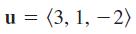
Find two vectors in opposite directions that are orthogonal to the vector u. (The answers are not unique.) u = (3, 1, -2)
Find an equation in rectangular coordinates for the equation given in spherical coordinates, and sketch its graph.ρ = csc Ø
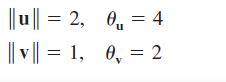
Find the component form of u + v given the lengths of u and v and the angles that u and v make with the positive x-axis. |||u|| = 2, 0₁ = 4 |v||= 1, 0, = 2
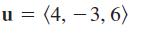
Find two vectors in opposite directions that are orthogonal to the vector u. (The answers are not unique.) u = (4, -3, 6)
Find an equation of the plane that contains all the points that are equidistant from the given points.(1, 0, 2), (2, 0, 1)
Find each scalar multiple of v and sketch its graph.(a) - v(b) 2v(c) 1/2v (d) 5/2v V v = (2, -2, 1)
Find an equation in rectangular coordinates for the equation given in spherical coordinates, and sketch its graph.ρ = 4 csc Ø sec θ
Find an equation of the plane that contains all the points that are equidistant from the given points.(-5, 1, -3), (2, -1, 6)
Find the projection of onto v. u = (1, -1, 1), v = (2,0, 2)
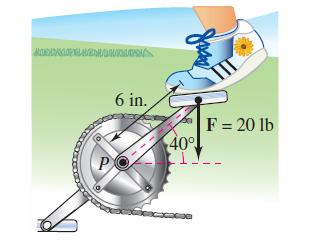
A child applies the brakes on a bicycle by applying a downward force of 20 pounds on the pedal when the crank makes a 40° angle with the horizontal (see figure). The crank is 6 inches in length. Find the torque at P. SHA
Find sets of (a) Parametric equations (b) Symmetric equations of the line through the two points.(For each line, write the direction numbers as integers.) (3, 0, 2), (9, 11, 6)
In Exercises (a) Find the projection of u onto v(b) Find the vector component of u orthogonal to v u = i + 4k, v = 3i + 2k
Find an equation in spherical coordinates for the equation given in rectangular coordinates.y = 2
Find the following.(a)(b)(c)(d)(e)(f) || n ||
Find an equation of the plane. The plane passes through (3, -1, 2), (2, 1, 5), and (1, -2, -2).
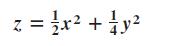
Analyze the trace when the surfaceis intersected by the indicated planes.Find the coordinates of the focus of the parabola formed when the surface is intersected by the planes given by(a) y = 4(b) x = 2 2. = x + Hy
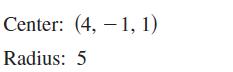
Complete the square to write the equation of the sphere in standard form. Find the center and radius.x² + y² + z² + 9x - 2y + 10z + 19 = 0
Analyze the trace when the surfaceis intersected by the indicated planes.Find the lengths of the major and minor axes and the coordinates of the foci of the ellipse generated when the surface is intersected by the planes given by(a) z = 2 (b) z = 8 2. = x + Hy
Find the following.(a)(b)(c)(d)(e)(f) || n ||
Complete the square to write the equation of the sphere in standard form. Find the center and radius.x² + y² + z² - 2x + 6y + 8z + 1 = 0
Find an equation of the plane.The plane passes through (0, 0, 0), (2, 0, 3), and (-3, -1, 5).
In Exercises (a) Find the projection of u onto v(b) Find the vector component of u orthogonal to v u = 2i + j + 2k, v = 3j + 4k
Find an equation of the plane passing through the point perpendicular to the given vector or line. Point (3, 2, 2) Perpendicular to x − 1 = y + 2 - = 4 z + 3 -3
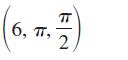
Convert the point from spherical coordinates to rectangular coordinates. 6, п, TT 2
Showing 2700 - 2800
of 9867
First
21
22
23
24
25
26
27
28
29
30
31
32
33
34
35
Last
Step by Step Answers

 Get 50% OFF
Claim Now
Get 50% OFF
Claim Now