New Semester
Started
Get
50% OFF
Study Help!
--h --m --s
Claim Now
Question Answers
Textbooks
Find textbooks, questions and answers
Oops, something went wrong!
Change your search query and then try again
S
Books
FREE
Study Help
Expert Questions
Accounting
General Management
Mathematics
Finance
Organizational Behaviour
Law
Physics
Operating System
Management Leadership
Sociology
Programming
Marketing
Database
Computer Network
Economics
Textbooks Solutions
Accounting
Managerial Accounting
Management Leadership
Cost Accounting
Statistics
Business Law
Corporate Finance
Finance
Economics
Auditing
Tutors
Online Tutors
Find a Tutor
Hire a Tutor
Become a Tutor
AI Tutor
AI Study Planner
NEW
Sell Books
Search
Search
Sign In
Register
study help
mathematics
calculus 10th edition
Calculus 10th Edition Ron Larson, Bruce H. Edwards - Solutions
In Exercises sketch the space curve represented by the intersection of the surfaces. Then represent the curve by a vector-valued function using the given parameter. Surfaces z = x² + y², z = 4 Parameter x = 2 cos t
In Exercises sketch the plane curve and find its length over the given interval. Vector-Valued Function r(t) = t²i + 2tk Interval [0, 3]
Prove that when an object is traveling at a constant speed, its velocity and acceleration vectors are orthogonal.
In Exercises(a) Find the point on the curve at which the curvature K is a maximum(b) Find the limit of K as x → ∞.y = ln x
In Exercises find the vectors T and N, and the binormal vector B = T × N, for the vector-valued function r(t) at the given value of t. r(t) = 2e¹i e cos tj + e' sin tk, to = 0
In Exercises sketch the space curve represented by the intersection of the surfaces. Then represent the curve by a vector-valued function using the given parameter. Surfaces x² + y² = 4, z = x² Parameter x = 2 sin t
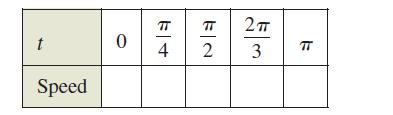
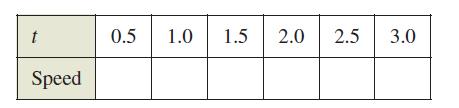
Investigation A particle moves on an elliptical path given by the vector-valued function r(t) = 6 cos ti + 3 sin tj.(a) Find(b) Use a graphing utility to complete the table.(c) Graph the elliptical path and the velocity and acceleration vectors at the values of given in the table in part (b).(d)
Prove that an object moving in a straight line at a constant speed has an acceleration of 0.
In Exercises(a) Find the point on the curve at which the curvature K is a maximum(b) Find the limit of K as x → ∞.y = ex
In Exercises find the vectors T and N, and the binormal vector B = T × N, for the vector-valued function r(t) at the given value of t. r(t) = 4 sin ti + 4 cos tj + 2tk, to || E|M
In Exercises sketch the plane curve and find its length over the given interval. Vector-Valued Function r(t) = 10 cos³ ti + 10 sin³ tj Interval [0, 2π]
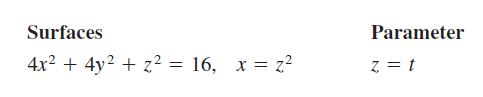
In Exercises sketch the space curve represented by the intersection of the surfaces. Then represent the curve by a vector-valued function using the given parameter. Surfaces 4x² + 4y² + z² = 16, x = z² Parameter z = t
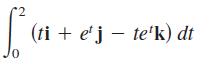
In Exercises evaluate the definite integral. (ti + ej te'k) dt
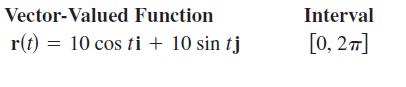
In Exercises sketch the plane curve and find its length over the given interval. Vector-Valued Function r(t) = 10 cos ti + 10 sin tj Interval [0, 2π]
In Exercises sketch the space curve and find its length over the given interval. Vector-Valued Function r(t) = -3ti + 2tj + 4tk Interval [0, 3]
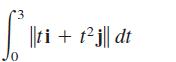
In Exercises evaluate the definite integral. So ||ti + t²j| dt
In Exercises find all points on the graph of the function such that the curvature is zero.y = 1 - x³
In Exercises find r(t) that satisifies the initial condition(s). r'(t) = 4e²¹i + 3e'j, r(0) = 2i
In Exercises find the vectors T and N, and the binormal vector B = T × N, for the vector-valued function r(t) at the given value of t. r(t) = 3 cos 2ti + 3 sin 2tj + tk, to || 4
In Exercises sketch the space curve represented by the intersection of the surfaces. Then represent the curve by a vector-valued function using the given parameter. Surfaces x² + y² + z² = 4, x + z = 2 Parameter x = 1 + sin t
In Exercises sketch the space curve represented by the intersection of the surfaces. Then represent the curve by a vector-valued function using the given parameter. Surfaces x² + y² + z² = 10, x + y = 4 Parameter x = 2 + sin t
Consider a particle moving on an elliptical path described by r(t) = a cos ωti + b sin ωtj, where ω = dθ/dt is the constant angular velocity.(a) Find the velocity vector. What is the speed of the particle?(b) Find the acceleration vector and show that its direction is always toward the center
In Exercises find all points on the graph of the function such that the curvature is zero.y = (x - 1)³ + 3
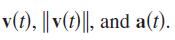
In Exercises use the vector-valued function r(t) to find the principal unit normal vector N(t) using the alternative formula N = (vv)a (va)v ||(vv)a (va)v||*
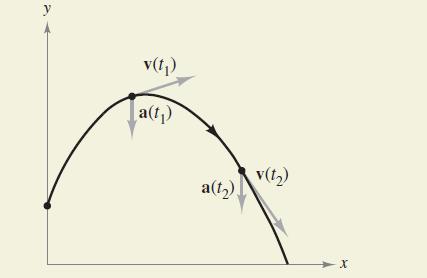
The graph shows the path of a projectile and the velocity and acceleration vectors at times t1 and t₂. Classify the angle between the velocity vector and the acceleration vector at times t1 and t₂. Is the speed increasing or decreasing at times t1 and t₂? Explain your reasoning.
When t = 0, an object is at the point (0, 1) and has a velocity vector v(0) = -i. It moves with an acceleration of a(t) = sin ti - cos tj. Show that the path of the object is a circle.
In Exercises find all points on the graph of the function such that the curvature is zero.y = cos x
In Exercises find r(t) that satisifies the initial condition(s). r'(t) = 3t²j + 6 √tk, r(0) = i + 2j
In Exercises use the vector-valued function r(t) to find the principal unit normal vector N(t) using the alternative formula N = (vv)a ||(vv)a (v a)v (va)v||*
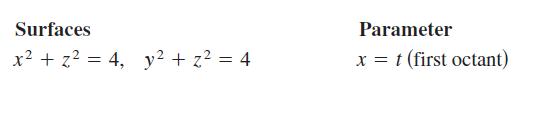
In Exercises sketch the space curve represented by the intersection of the surfaces. Then represent the curve by a vector-valued function using the given parameter. Surfaces x² + z² = 4, y² + z² = 4 Parameter x = t (first octant)
In Exercises use the vector-valued function r(t) to find the principal unit normal vector N(t) using the alternative formula N = (vv)a ||(vv)a (v a)v (va)v||*
In Exercises sketch the space curve represented by the intersection of the surfaces. Then represent the curve by a vector-valued function using the given parameter. Surfaces x² + y² + z² = 16, xy = 4 Parameter x = t (first octant)
In Exercises find r(t) that satisifies the initial condition(s). r"(t) = -32j, r'(0) = 600√3i+ 600j, r(0) = 0
In Exercises find all points on the graph of the function such that the curvature is zero.y = sin x
In Exercises find r(t) that satisifies the initial condition(s). r"(t) = -4 cos tj - 3 sin tk, r'(0) = 3k, r(0) = 4j
In Exercises sketch the space curve and find its length over the given interval. Vector-Valued Function r(t) = (2(sin t t cos t), 2(cost + t sin t), t) Interval 0, 2
Give the formula for the arc length of a smooth curve in space.
In Exercises use the vector-valued function r(t) to find the principal unit normal vector N(t) using the alternative formula N = (vv)a ||(vv)a (v a)v (va)v||*
In Exercises determine whether the statement is true or false. If it is false, explain why or give an example that shows it is false.The velocity of an object is the derivative of the position.
In Exercises find r(t) that satisifies the initial condition(s). r'(t) = te−¹²i – e¯¹j+ k, r(0) = ¹⁄i − j + k
Give the formulas for curvature in the plane and in space.
Show that the vector-valued function r(t) = ti + 2t cos tj + 2t sin tk lies on the cone 4x² = y2² + z². Sketch the curve.
In Exercises find the curvature K of the curve.r(t) = 3ti + 2tj
In Exercises determine whether the statement is true or false. If it is false, explain why or give an example that shows it is false.The velocity vector points in the direction of motion.
In Exercises find r(t) that satisifies the initial condition(s). r'(t) 1 1 + f² - / / ₁ + 1/ / k₁ + + k, r(1) = 2i
Describe the graph of a vector-valued function for which the curvature is 0 for all values of t in its domain.
Find the tangential and normal components of acceleration for a projectile fired at an angle θ with the horizontal at an initial speed of v0. What are the components when the projectile is at its maximum height?
In Exercises find the limit (if it exists). lim (ti + cos tj + sin tk) 1-T
Show that the vector-valued function r(t) = e-t cos ti + e-t sin tj + e-tk lies on the conez² = x² + y². Sketch the curve.
In Exercises find the curvature K of the curve.r(t) = 2√ti + 3tj
Given a twice-differentiable function y = ƒ(x), determine its curvature at a relative extremum.Can the curvature ever be greater than it is at a relativeextremum? Why or why not?
In Exercises find the limit (if it exists). lim 3ti + 1-2 1² 2 1 +=k t j +
Use your results from Exercise 61 to find the tangential and normal components of acceleration for a projectile fired at an angle of 45° with the horizontal at an initial speed of 150 feet per second. What are the components when the projectile is at its maximum height?
In Exercises find the curvature K of the curve.r(t) = 2ti + 1/2t²j + t²k
State the definition of the derivative of a vector-valued function. Describe how to find the derivative of a vector-valued function and give its geometric interpretation.
Consider the function ƒ(x) = x4 - x².(a) Use a computer algebra system to find the curvature K of the curve as a function of x.(b) Use the result of part (a) to find the circles of curvature to the graph of ƒ when x = 0 and x = 1. Use a computer algebra system to graph the function and the two
In Exercises find the curvature K of the curve.r(t) = 2ti + 5 cos tj + 5 sin tk
Projectile Motion A projectile is launched with an initial velocity of 220 feet per second at a height of 4 feet and at an angle of 45° with the horizontal. (a) Determine the vector-valued function for the path of the projectile. (b) Use a graphing utility to graph the path and
In Exercises find the curvature K of the curve at the point P. r(t) = ²¹i + tj + ³k, P(1, 1, 3)
Find all a and b such that the two curves given byintersect at only one point and have a common tangent line and equal curvature at that point. Sketch a graph for each set of values of a and b. y₁ = ax(bx) and ₂ X x + 2
In Exercises find the limit (if it exists). lim t²i+ 3tj + 1-0 1 - cos t t k
How do you find the integral of a vector-valued function?
A particle moves along the plane curve C described by r(t) = ti + t²j.(a) Find the length of C on the interval 0 ≤ t ≤ 2.(b) Find the curvature K of the plane curve at t = 0, t = 1, and t = 2.(c) Describe the curvature of C as t changes from t = 0 to t = 2.
Because of a storm, ground controllers instruct the pilot of a plane flying at an altitude of 4 miles to make a 90º turn and climb to an altitude of 4.2 miles. The model for the path of the plane during this maneuver iswhere t is the time in hours and r is the distance in miles.(a) Determine the
In Exercises find the limit (if it exists). In t 1 lim (√+1₁+ k) ti j 1-1 - t - 1
In Exercises find the curvature K of the curve at the point P. r(t) = 4 cos ti + 3 sin tj + tk, P(-4, 0, π)
The three components of the derivative of the vector-valued function u are positive at t = t0. Describe the behavior of u at t = t0.
In Exercises find the limit (if it exists). t lim (e ¹₁ + - j + ² + ₁ k) 1
In Exercises find the limit (if it exists). sin t t lime¹i + j+e¹k 1-0
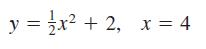
In Exercises find the curvature and radius of curvature of the plane curve at the given value of x. y = x² + 2, x = 4
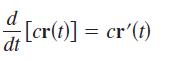
In Exercises prove the property. In each case, assume r, u, and v are differentiable vector-valued functions of t in space, w is a differentiable real-valued function of t, and c is a scalar. d dt [cr(t)] = cr'(t)
In Exercises prove the property. In each case, assume r, u, and v are differentiable vector-valued functions of t in space, w is a differentiable real-valued function of t, and c is a scalar. d[r(1) [r(t) ± u(t)] = r'(t) ± u' (t)
The z-component of the derivative of the vector-valued function u is 0 for t in the domain of the function. What does this imply about the graph of u?
A plane flying at an altitude of 36,000 feet at a speed of 600 miles per hour releases a bomb. Find the tangential and normal components of acceleration acting on the bomb.
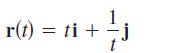
In Exercises determine the interval(s) on which the vector-valued function is continuous. 1 r(t) = ti + - j
A sphere of radius 4 is dropped into the paraboloid given by z = x² + y². (a) How close will the sphere come to the vertex of the paraboloid?(b) What is the radius of the largest sphere that will touch the vertex?
In Exercises prove the property. In each case, assume r, u, and v are differentiable vector-valued functions of t in space, w is a differentiable real-valued function of t, and c is a scalar. d [w(t)r(t)] = w(t)r'(t) + w'(t)r(t) dt
In Exercises find the curvature and radius of curvature of the plane curve at the given value of x.y = e-x/2, x = 0
In Exercises determine the interval(s) on which the vector-valued function is continuous. r(t) = √ti + √t - 1 j
In Exercises use the result of to find the speed necessary for the given circular orbit around Earth. Let GM = 9.56 × 10⁴ cubic miles per second per second, and assume the radius of Earth is 4000 miles.The orbit of the International Space Station 255 miles above the surface of Earth
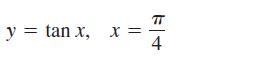
In Exercises find the curvature and radius of curvature of the plane curve at the given value of x. y = tan x, x X = TT 4
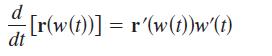
In Exercises prove the property. In each case, assume r, u, and v are differentiable vector-valued functions of t in space, w is a differentiable real-valued function of t, and c is a scalar. d [r(w(t))] = r'(w(t))w'(t) dt
In Exercises prove the property. In each case, assume r, u, and v are differentiable vector-valued functions of t in space, w is a differentiable real-valued function of t, and c is a scalar. (1)n × (1), + (1),n × (1) = [(2)n (1)1 = [(1)n × × (1)]- (1)¹] ² P
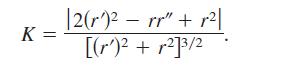
A curve C is given by the polar equation r = ƒ(θ). Show that the curvature K at the point (r, θ) is K = 12(r)² rr" + r²| [(r')² + r²]3/2 -
In Exercises find the curvature and radius of curvature of the plane curve at the given value of x.y = ln x, x = 1
In Exercises determine the interval(s) on which the vector-valued function is continuous. r(t) = ti + arcsin tj + (1 - 1)k
In Exercises determine the interval(s) on which the vector-valued function is continuous. r(t) = 2e ¹i+ e¯¹j + ln(t − 1)k
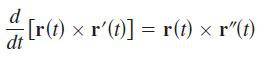
In Exercises prove the property. In each case, assume r, u, and v are differentiable vector-valued functions of t in space, w is a differentiable real-valued function of t, and c is a scalar. - [r(t) × r'(t)] = r(t) × r”(t) dt
In Exercises use the result of to find the speed necessary for the given circular orbit around Earth. Let GM = 9.56 × 10⁴ cubic miles per second per second, and assume the radius of Earth is 4000 miles.The orbit of the Hubble telescope 360 miles above the surface of Earth
In Exercises use the result of to find the speed necessary for the given circular orbit around Earth. Let GM = 9.56 × 10⁴ cubic miles per second per second, and assume the radius of Earth is 4000 miles.The orbit of a heat capacity mapping satellite 385 miles above the surface of Earth
A 7200-pound vehicle is driven at a speed of 25 miles per hour on a circular interchange of radius 150 feet. To keep the vehicle from skidding off course, what frictional force must the road surface exert on the tires?
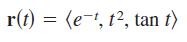
In Exercises determine the interval(s) on which the vector-valued function is continuous. r(t) = (e-t, t², tan t)
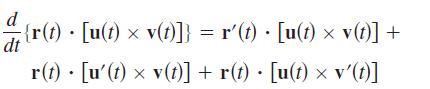
In Exercises prove the property. In each case, assume r, u, and v are differentiable vector-valued functions of t in space, w is a differentiable real-valued function of t, and c is a scalar. {r(t) · [u(t) × v(t)]} = r'(t) · [u(t) × v(t)] + r(t) [u' (t) x v(t)] + r(t) · [u(t) × v'(t)]
In Exercises use the result of to find the speed necessary for the given circular orbit around Earth. Let GM = 9.56 × 10⁴ cubic miles per second per second, and assume the radius of Earth is 4000 miles.The orbit of a communications satellite r miles above the surface of Earth that is in
In Exercises determine whether the statement is true or false. If it is false, explain why or give an example that shows it is false.If a car’s speedometer is constant, then the car cannot be accelerating.
Given the polar curve r = eaθ, a > 0, find thecurvature K and determine the limit of K as (a) θ → ∞(b) a → ∞.
In Exercises determine the interval(s) on which the vector-valued function is continuous. r(t) = (8, √t, 3√t)
In Exercises determine whether the statement is true or false. If it is false, explain why or give an example that shows it is false.If aN = 0 for a moving object, then the object is moving in a straight line.
In Exercises prove the property. In each case, assume r, u, and v are differentiable vector-valued functions of t in space, w is a differentiable real-valued function of t, and c is a scalar.If r(t) . r(t) is a constant, then r(t) . r'(t) = 0.
Find r'(t), r(t0), and r'(t0) for the given value of t0. Thensketch the plane curve represented by the vector-valuedfunction, and sketch the vectors r(t0) and r'(t0). Position thevectors such that the initial point of r(t0) is at the origin and theinitial point of r'(t0) is at the terminal point of
Showing 2400 - 2500
of 9867
First
18
19
20
21
22
23
24
25
26
27
28
29
30
31
32
Last
Step by Step Answers

 Get 50% OFF
Claim Now
Get 50% OFF
Claim Now