New Semester
Started
Get
50% OFF
Study Help!
--h --m --s
Claim Now
Question Answers
Textbooks
Find textbooks, questions and answers
Oops, something went wrong!
Change your search query and then try again
S
Books
FREE
Study Help
Expert Questions
Accounting
General Management
Mathematics
Finance
Organizational Behaviour
Law
Physics
Operating System
Management Leadership
Sociology
Programming
Marketing
Database
Computer Network
Economics
Textbooks Solutions
Accounting
Managerial Accounting
Management Leadership
Cost Accounting
Statistics
Business Law
Corporate Finance
Finance
Economics
Auditing
Tutors
Online Tutors
Find a Tutor
Hire a Tutor
Become a Tutor
AI Tutor
AI Study Planner
NEW
Sell Books
Search
Search
Sign In
Register
study help
mathematics
calculus 10th edition
Calculus 10th Edition Ron Larson, Bruce H. Edwards - Solutions
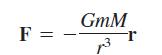
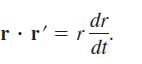
You are asked to verify Kepler's Laws of Planetary Motion. For these exercises, assume that each planet moves in an orbit given by the vector- valued function r. Let r = ||r||, let G represent the universal gravitational constant, let M represent the mass of the sun, and let m represent the mass of
Determine whether the statement is true or false. If it is false, explain why or give an example that shows it is false.The arc length of a space curve depends on the parametrization.
Verify that the converse of Exercise 85 is not true by finding a vector-valued function r such that ||r|| is continuous at c but r is not continuous at c.Data from in Exercise 85Prove that if r is a vector-valued function that is continuous at c, then ||r|| is continuous at c.
You are asked to verify Kepler's Laws of Planetary Motion. For these exercises, assume that each planet moves in an orbit given by the vector- valued function r. Let r = ||r||, let G represent the universal gravitational constant, let M represent the mass of the sun, and let m represent the mass of
Determine whether the statement is true or false. If it is false, explain why or give an example that shows it is false.The curvature of a circle is the same as its radius.
Determine whether the statement is true or false. If it is false, explain why or give an example that shows it is false.The curvature of a line is 0.
Find the open interval(s) on which the curve given by the vector-valued function is smooth. r(t) = √ti + (t²- 1)j + tk
Determine whether the statement is true or false. If it is false, explain why or give an example that shows it is false.The normal component of acceleration is a function of both speed and curvature.
Sketch the curve represented by the vector-valued function and give the orientation of the curve. r(t) = (cost + t sin t, sin t t cos t, t)
Two particles travel along the space curves r(t) and u(t). If the particles collide, do their paths r(t) and u(t) intersect?
Find T(t), N(t), aT, and a at the given time t for the space curve r(t). Vector-Valued Function r(t) = = cos ti+ sin tj + 2tk Time πT 3
Determine whether the statement is true or false. If it is false, explain why or give an example that shows it is false.If ƒ, g, and h are first-degree polynomial functions, then thecurve given by x = ƒ(t), y = g(t), and z = h(t) is a line.
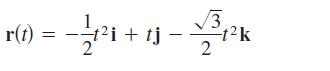
Use a computer algebra system to graph the vector-valued function and identify the common curve. r(f) = i + 1j - — f2i 3 2 f2k
Find the angles at which an object must be thrown to obtain(a) The maximum range (b) The maximum height
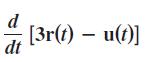
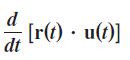
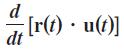
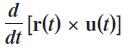
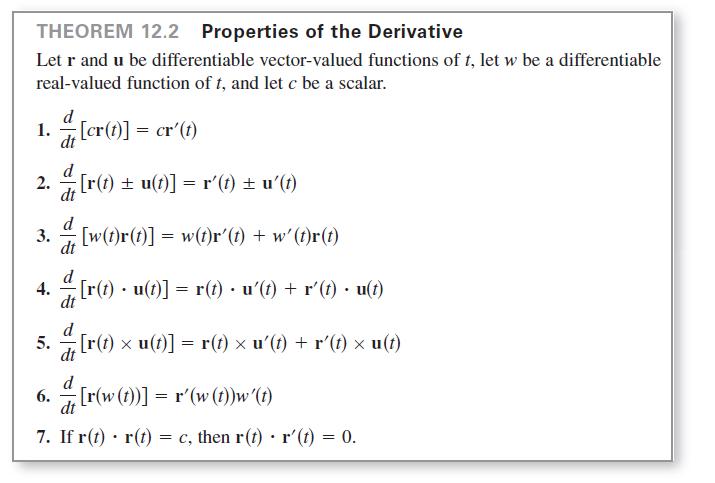
Use the properties of the derivative to find the following.(a) r'(t)(b)(c)(d)(e)(f) d dt [3r(t) = u(t)]
Find the curvature K of the curve at the point P. r(t) = ti + f²j + − k, P(2, 4, 2) 4
Find the curvature K of the curve at the point P.r(t) = eti + 4tj, P(1, 0)
Use the properties of the derivative to find the following.(a) r'(t)(b)(c)(d)(e)(f) d dt [3r(t) = u(t)]
Use the model for projectile motion, assuming there is no air resistance. [g = -9.8 meters per second per second]Determine the maximum height and range of a projectile fired at a height of 1.5 meters above the ground with an initial velocity of 100 meters per second and at an angle of 30° above
Use a computer algebra system to graph the vector-valued function and identify the common curve. r(t) = ti - 3 92j + 12 2
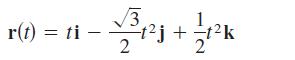
Find(a)(b)in two different ways.(i) Find the product first, then differentiate.(ii) Apply the properties of Theorem 12.2.Data from in Theorem 12.2 [(1)n. (1)¹] dt P
Use the model for projectile motion, assuming there is no air resistance. [a(t) = 32 feet per second per second or a(t) = -9.8 meters per second per second]A baseball is hit from a height of 3.5 feet above the ground with an initial velocity of 120 feet per second and at an angle of 30° above the
Find T(t), N(t), aT, and a at the given time t for the space curve r(t). Vector-Valued Function r(t) et sin ti + e' cos tj + e¹k Time t = 0
The path of a shot thrown at an angle θ iswhere v0 is the initial speed, h is the initial height, t is the time in seconds, and g is the acceleration due to gravity. Verify that the shot will remain in the air for a total ofand will travel a horizontal distance of r(t) = (vo cos 0)ti+h+ (vo sin
Use the model for projectile motion, assuming there is no air resistance. [g = -9.8 meters per second per second]A projectile is fired from ground level at an angle of 8° with the horizontal. The projectile is to have a range of 50 meter Find the minimum initial velocity necessary.
Use a computer algebra system to graph the vector-valued function and identify the common curve. r(t) = sin ti + 3 2 COS t 1 ä j+ 2 (3 cost + 3 2 k
A shot is thrown from a height of h = 6 feet with an initial speed of V0 = 45 feet per second and at an angle of θ = 42.5° with the horizontal. Use the result of Exercise 41 to find the total time of travel and the total horizontal distance traveled.Data from in Exercise 41The path of a shot
Find the curvature K of the curve at the point P.r(t) = et cos ti + et sin tj + etk, P(1, 0, 1)
Use the model for projectile motion, assuming there is no air resistance. [a(t) = 32 feet per second per second or a(t) = -9.8 meters per second per second]A projectile is fired from ground level at an angle of 20° with the horizontal. The projectile has a range of 95 meters. Find the minimum
Use a computer algebra system to graph the vector-valued function and identify the common curve. r(t) -√2 sin ti + 2 cos tj + √2 sin tk
Consider the motion of a point (or particle) on the circumference of a rolling circle. As the circle rolls, it generates the cycloidwhere ω is the constant angular velocity of the circle and b is the radius of the circle.Find the velocity and acceleration vectors of the particle. Use the
Find(a)(b)in two different ways.(i) Find the product first, then differentiate.(ii) Apply the properties of Theorem 12.2.Data from in Theorem 12.2 [(1)n. (1)¹] dt P
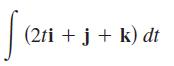
Find the indefinite integral. S (2ti + j + k) dt
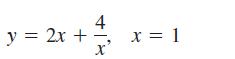
Find the curvature and radius of curvature of the plane curve at the given value of x. y = 2x + 4 X x = 1
Find the curvature and radius of curvature of the plane curve at the given value of x.y = 3x - 2, x = a
Find T(t), N(t), aT, and a at the given time t for the space curve r(t). Vector-Valued Function r(t) = e'i + 2tj + e ¹k Time t = 0
Use the model for projectile motion, assuming there is no air resistance. [a(t) = 32 feet per second per second or a(t) = -9.8 meters per second per second]Use a graphing utility to graph the paths of a projectile for V0 = 20 meters per second, h = 0 and (a) θ = 30°(b) θ = 45°(c) θ =
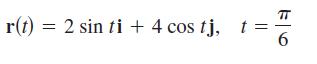
Find the unit tangent vector to the curve at the specified value of the parameter. r(t) = 2 sin ti + 4 cos tj, t = 6
Use a computer algebra system to graph the vector-valued function r(t). For each u(t), make a conjecture about the transformation (if any) of the graph of r(t). Use a computer algebra system to verify your conjecture.(a)(b)(c)(d)(e) r(t) = 2 cos ti + 2 sin tj + ½ tk
Use a computer algebra system to graph the vector-valued function r(t). For each u(t), make a conjecture about the transformation (if any) of the graph of r(t). Use a computer algebra system to verify your conjecture.(a)(b)(c)(d)(e) r(t) = ti + t²j+t³k
Find the curvature and radius of curvature of the plane curve at the given value of x. 0 = x zx-91/^=
Find the unit tangent vector to the curve at the specified value of the parameter.r(t) = 3ti + 3t³j, t = 1
Consider the motion of a point (or particle) on the circumference of a rolling circle. As the circle rolls, it generates the cycloidwhere ω is the constant angular velocity of the circle and b is the radius of the circle.Find the maximum speed of a point on the circumference of an automobile
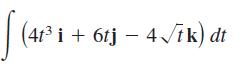
Find the indefinite integral. (4t³ i + 6tj - 4√tk) dt
Find the curvature and radius of curvature of the plane curve at the given value of x.y = 2х² + 3, x = -1
Find the unit tangent vector T(t) and find a set of parametric equations for the line tangent to the space curve at point P. r(t) = 2 cos ti + 2 sin tj + tk, P1, √3,- 3
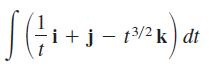
Find the indefinite integral. SG i+j-t3/2 k dt 2 k) dt
Find the unit tangent vector T(t) and find a set of parametric equations for the line tangent to the space curve at point P. 16 r(t) = ti + t²j + ³k, P(2, 4, 5) 3
How is the unit tangent vector related to the orientation of a curve? Explain.
Consider a particle moving on a circular path of radius b described by r(t) = b cos ωti + b sin ωtj, where ω = du/dt is the constantangular velocity.Find the velocity vector and show that it is orthogonal to r(t).
Represent the plane curve by a vector valued function.y = x + 5
Find the curvature and radius of curvature of the plane curve at the given value of x.y = cos 2x, x = 2π
Describe the motion of a particle when the normal component of acceleration is 0.
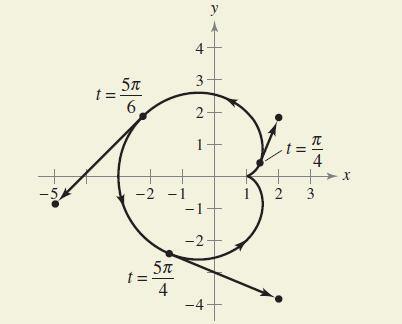
The graph shows a vector-valued function r(t) for 0 ≤ t ≤ 2π and its derivative r'(t) for several values of t.(a) For each derivative shown in the graph, determine whether each component is positive or negative.(b) Is the curve smooth on the interval [0, π]? Explain. t= 5개 6 -2
Consider the vector-valued functionWrite a vector-valued function s(t) that is the specified transformation of r.A horizontal translation five units in the direction of the positive y-axis r(t) = t²i + (t− 3)j + tk.
For a smooth curve given by the parametric equations x = ƒ(t) and y = g(t), prove that the curvature is given by K = [ƒ'(t)g"(t) — g'(t)ƒ"(t)[ {[f'(t)]²+ [g'(t)]²}³/2.
Consider the vector-valued function r(t) = (et sin t)i + (et cos t)j. Show that r(t) and r"(t) are always perpendicular to each other.
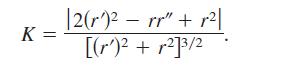
Use the result of Exercise 74 to find the curvature of the rose curve at the pole.Data from in Exercise 74A curve C is given by the polar equation r = ƒ(θ). Show that the curvature K at the point (r, θ) is r = 6 cos 3θ K = 12(r)² rr" + r²| [(r')² + r²]3/2 -
Consider the vector-valued functionWrite a vector-valued function s(t) that is the specified transformation of r.A horizontal translation two units in the direction of the negative x-axis r(t) = t²i + (t− 3)j + tk.
Use the result of Exercise 77 to find the curvature K of the curve represented by the parametric equations x(t) = t³ and y(t) = 1/2t². Use a graphing utility to graph K and determine any horizontal asymptotes. Interpret the asymptotes in the context of the problem.Data from in Exercise 77For a
State the definition of continuity of a vector-valued function. Give an example of a vector-valued function that is defined but not continuous at t = 2.
Use the result of Exercise 77 to find the curvature K of the cycloid represented by the parametric equationsWhat are the minimum and maximum values of K?Data from in Exercise 77For a smooth curve given by the parametric equations x = ƒ(t) and y = g(t), prove that the curvature is given by x(0) =
Determine whether the statement is true or false. If it is false, explain why or give an example that shows it is false.If a particle moves along a sphere centered at the origin, then its derivative vector is always tangent to the sphere.
A particle of unit mass moves on a straight line under the action of a force which is a function ƒ(v) of the velocity vof the particle, but the form of this function is not known.A motion is observed, and the distance x covered in time tis found to be connected with t by the formulax = at + bt² +
Determine whether the statement is true or false. If it is false, explain why or give an example that shows it is false.The definite integral of a vector-valued function is a real number.
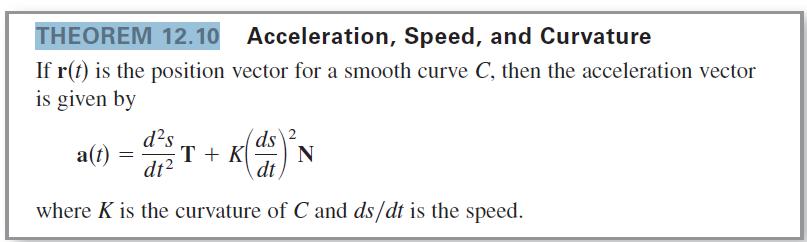
Use Theorem 12.10 to find aT, and aN for each curve given by the vector-valued function.(a)(b)Data from in Theorem 12.10 r(t) = 3t² i + (3t - t³)j
In Exercises sketch the space curve and find its length over the given interval. Vector-Valued Function r(t) = ti + t2j + 2tk Interval [0, 2]
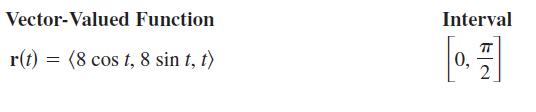
In Exercises sketch the space curve and find its length over the given interval. Vector-Valued Function r(t) = (8 cos t, 8 sin t, t) Interval 0, 2
In Exercises determine whether the statement is true or false. If it is false, explain why or give an example that shows it is false.The acceleration of an object is the derivative of the speed.
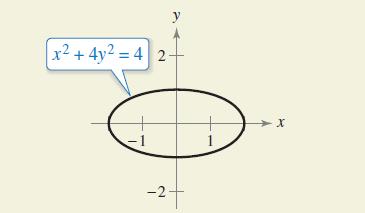
Using the graph of the ellipse, at what point(s) is the curvature the least and the greatest? y x2 + 4y2=4 2- -2- X
Centripetal Acceleration An object is spinning at a constant speed on the end of a string, according to the position vector given in(a) When the angular velocity ω is doubled, how is the centripetal component of acceleration changed?(b) When the angular velocity is unchanged but the length ofthe
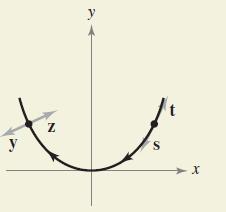
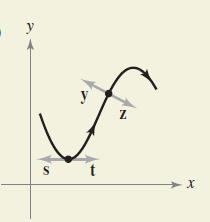
The figures show the paths of two particles.(i)(ii)(a) Which vector, s or t, represents the unit tangent vector?(b) Which vector, y or z, represents the principal unitnormal vector? Explain. y Z y S X
In Exercises find the principal unit normal vector to the curve at the specified value of the parameter. r(t) = 3 cos 2ti + 3 sin 2tj + 3k, t =
In Exercises find the principal unit normal vector to the curve at the specified value of the parameter. 2TT r(t) = 4 cos ti + 4 sin tj + k, t = 3
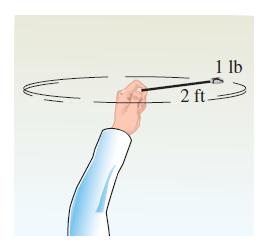
A stone weighing 1 pound is attached to a two-foot string and is whirled horizontally (see figure). The string will break under a force of 10 pounds. Find the maximum speed the stone can attain without breaking the string. (Use F = ma, where m = 1/32.) 1 lb 2 ft-
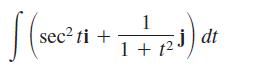
In Exercises find the indefinite integral. 1 [ (sex³si + ₁ + ₁³) de jdt 1 1²
In Exercises represent the plane curve by a vector valued function.y = 4 - x²
In Exercises find the curvature and radius of curvature of the plane curve at the given value of x.y = xn, x = 1, n ≥ 2=
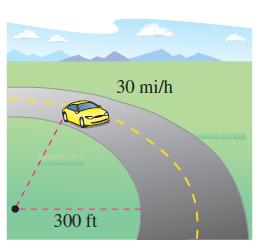
A 3400-pound automobile is negotiating a circular interchange of radius 300 feet at 30 miles per hour (see figure). Assuming the roadway is level, find the force between the tires and the road such that the car stays on the circular path and does not skid. (Use F = ma, where m = 3400/32.) Find the
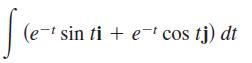
In Exercises find the indefinite integral. [(e-18 (et sin ti + et cos tj) dt
In Exercises represent the plane curve by a vector valued function.x² + y² = 25
In Exercises(a) Find thepoint on the curve at which the curvature K is a maximum(b) Find the limit of K as x → ∞.y = (x - 1)² + 3
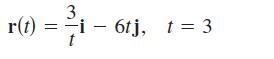
In Exercises find T(t), N(t), at, and a at the given time t for the plane curve r(t). r(t) -3³₁-6 = -i 6tj, t = 3
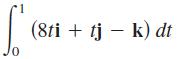
In Exercises evaluate the definite integral. S (8ti + tjk) dt
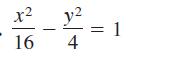
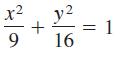
In Exercises represent the plane curve by a vector valued function. x² 16 y2 4 = 1
In Exercises represent the plane curve by a vector valued function.(x - 2)² + y² = 4
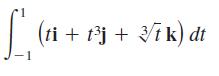
In Exercises evaluate the definite integral. -1 (ti + t³j + √√t k) dt
In Exercises find the vectors T and N, and the binormal vector B = T × N, for thevector-valued function r(t) at the given value of t. r(t) = 2 cos ti + 2 sin tj + 2 -k, to || TT 2
In Exercises(a) Find the point on the curve at which the curvature K is a maximum(b) Find the limit of K as x → ∞.y = x³
In Exercises(a) Find the point on the curve at which the curvature K is a maximum(b) Find the limit of K as x → ∞. y 1 X
In Exercises find T(t), N(t), at, and a at the given time t for the plane curve r(t). r(t) = 3 cos 2ti + 3 sin 2tj, t || = 6
In your own words, explain the difference between the velocity of an object and its speed.
In Exercises represent the plane curve by a vector valued function. x² y² + 9 16 1
In Exercises(a) Find the point on the curve at which the curvature K is a maximum(b) Find the limit of K as x → ∞.y = x²/3
In Exercises find the vectors T and N, and the binormal vector B = T × N, for the vector-valued function r(t) at the given value of t. 1³ r(t) = ti + t²j+k, to = 1 3
In Exercises sketch the space curve represented by the intersection of the surfaces. Then represent the curve by a vector-valued function using the given parameter. Surfaces z = x² + y², x + y = 0 Parameter x = t
Consider a particle that is moving on the path r1(t) = x(t)i + y(t)j + z(t)k.(a) Discuss any changes in the position, velocity, acceleration of the particle when its position is given by the vector-valued function r₂(t) = r₁(2t).(b) Generalize the results for the vector-valued functionr3(t) =
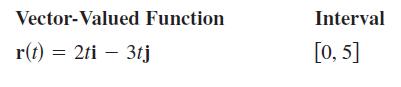
In Exercises sketch the plane curve and find its length over the given interval. Vector-Valued Function r(t) = 2ti - 3tj Interval [0, 5]
In Exercises find the vectors T and N, and the binormal vector B = T × N, for the vector-valued function r(t) at the given value of t. r(t) = i + sin tj + cos tk, to || 4
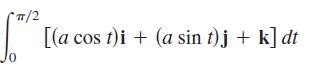
In Exercises evaluate the definite integral. TT/2 [(a cos t)i + (a sin t)j + k] dt
Showing 2300 - 2400
of 9867
First
17
18
19
20
21
22
23
24
25
26
27
28
29
30
31
Last
Step by Step Answers

 Get 50% OFF
Claim Now
Get 50% OFF
Claim Now