New Semester
Started
Get
50% OFF
Study Help!
--h --m --s
Claim Now
Question Answers
Textbooks
Find textbooks, questions and answers
Oops, something went wrong!
Change your search query and then try again
S
Books
FREE
Study Help
Expert Questions
Accounting
General Management
Mathematics
Finance
Organizational Behaviour
Law
Physics
Operating System
Management Leadership
Sociology
Programming
Marketing
Database
Computer Network
Economics
Textbooks Solutions
Accounting
Managerial Accounting
Management Leadership
Cost Accounting
Statistics
Business Law
Corporate Finance
Finance
Economics
Auditing
Tutors
Online Tutors
Find a Tutor
Hire a Tutor
Become a Tutor
AI Tutor
AI Study Planner
NEW
Sell Books
Search
Search
Sign In
Register
study help
mathematics
calculus 10th edition
Calculus 10th Edition Ron Larson, Bruce H. Edwards - Solutions
Sketch the surface given by the function. f(x, y) Jxy, 0, x ≥ 0, y ≥ 0 x
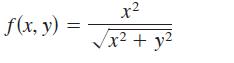
A function ƒ is homogeneous of degree n when ƒ(tx, ty) = tnƒ(x, y).(a) Show that the function is homogeneous and determine n(b) Show that xƒx(x, y) + yƒy(x, y) = nƒ(x, y). f(x, y) = x² x² + y²
Use the limit definition of partial derivatives to find ƒx(x, y) and ƒy(x, y).ƒ(x, y) = x² - 2xy + y²
Find the critical points of the function and, from the form of the function, determine whether a relative maximum or a relative minimum occurs at each point.ƒ(x, y, z) = 9 [x(y - 1)(z + 2)]²-
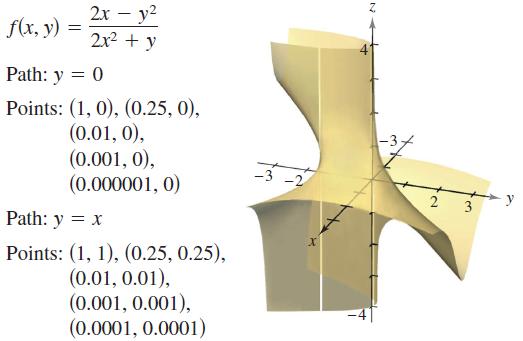
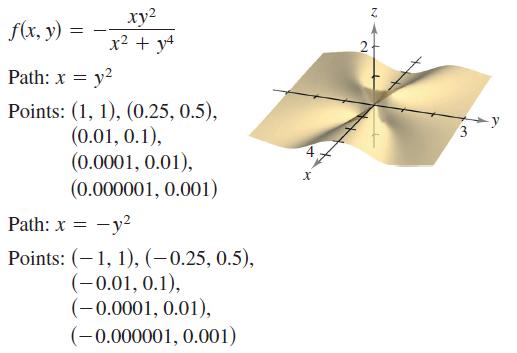
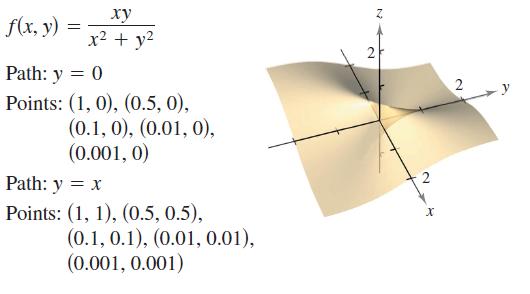
Use a graphing utility to make a table showing the values of ƒ(x, y) at the given points for each path. Use the result to make a conjecture about the limit of ƒ(x, y) as (x, y) → (0, 0). Determine analytically whether the limit exists and discuss the continuity of the function. f(x,
Show that the function is differentiable by finding values of ε1 and ε2 as designated in the definition of differentiability, and verify that both ε1 and ε2 approach 0 as (Δx, Δy) → (0, 0).ƒ(x, y) = x² + y²
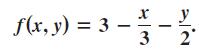
Consider the function(a) v = i + j(b) v = -3i - 4j(c) v is the vector from (1, 2) to (-2, 6).(d) v is the vector from (3, 2) to (4, 5). f(x, y) = 3 X -- 3 2
Find the angle of inclination θ of the tangent plane to the surface at the given point.x² + y² = 5, (2, 1, 3)
A meteorologist measures the atmospheric pressure P (in kilograms per square meter) at altitude h (in kilometers). The data are shown below.(a) Use the regression capabilities of a graphing utility to find a least squares regression line for the points (h, In P).(b) The result in part (a) is an
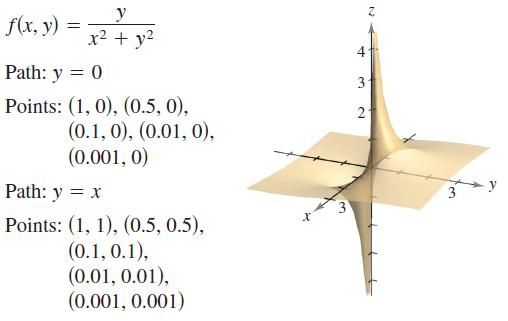
Use a graphing utility to make a table showing the values of ƒ(x, y) at the given points for each path. Use the result to make a conjecture about the limit of ƒ(x, y) as (x, y) → (0, 0). Determine analytically whether the limit exists and discuss the continuity of the function. f(x,
Consider the functionFind Duƒ(3, 2), where u = cos θi+ sin θj, using each given value of θ.(a)(b)(c)(d) f(x, y) = 3 X -- 3 2
Sketch the surface given by the function.ƒ(x, y) = e-x
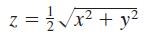
Sketch the surface given by the function. z = 1/² √√√x² + y²
A function ƒ is homogeneous of degree n when ƒ(tx, ty) = tnƒ(x, y).(a) Show that the function is homogeneous and determine n(b) Show that xƒx(x, y) + yƒy(x, y) = nƒ(x, y).ƒ(x, y) = ex/y
Use the limit definition of partial derivatives to find ƒx(x, y) and ƒy(x, y).ƒ(x, y) = 3x + 2y
Find the critical points of the function and, from the form of the function, determine whether a relative maximum or a relative minimum occurs at each point.ƒ(x, y, z) = x² + (y - 3)² + (z + 1)²
Use a graphing utility to make a table showing the values of ƒ(x, y) at the given points for each path. Use the result to make a conjecture about the limit of ƒ(x, y) as (x, y) → (0, 0). Determine analytically whether the limit exists and discuss the continuity of the function. f(x, y)
The table shows the world populations y (in billions) for five different years. Let x = 3 represent the year 2003.(a) Use the regression capabilities of a graphing utility to find the least squares regression line for the data.(b) Use the regression capabilities of a graphing utility to find the
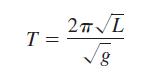
The period T of a pendulum of length L iswhere g is the acceleration due to gravity. A pendulum is moved from the Canal Zone, where g = 32.09 feet per second per second, to Greenland, where g = 32.23 feet per second per second. Because of the change in temperature, the length of the pendulum
Show that the functionis differentiable by finding values of ε1 and ε2 as designated in the definition of differentiability, and verify that both ε1 and ε2 approach 0 as (Δx, Δy) → (0, 0).ƒ(x, y) = x² - 2x + y
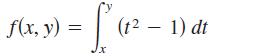
Find both first partial derivatives. f(x, y) f + f¢ (2t + 1) dt + (2t - 1) dt
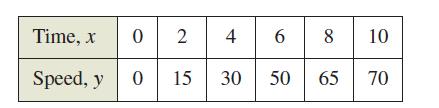
After a new turbocharger for an automobile engine was developed, the following experimental data were obtained for speed y in miles per hour at two-second time intervals x.(a) Find a least squares regression quadratic for the data. Use a graphing utility to confirm your results.(b) Use a graphing
Find the angle of inclination θ of the tangent plane to the surface at the given point.x² - y² + z = 0, (1, 2, 3)
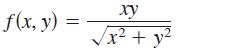
A function ƒ is homogeneous of degree n when ƒ(tx, ty) = tnƒ(x, y).(a) Show that the function is homogeneous and determine n(b) Show that xƒx(x, y) + yƒy(x, y) = nƒ(x, y). f(x, y) = ху x2+y2
A function ƒ is homogeneous of degree n when ƒ(tx, ty) = tnƒ(x, y).(a) Show that the function is homogeneous and determine n(b) Show that xƒx(x, y) + yƒy(x, y) = nƒ(x, y).ƒ(x, y) = x³ - 3ху2 + y3
Use a graphing utility to make a table showing the values of ƒ(x, y) at the given points for each path. Use the result to make a conjecture about the limit of ƒ(x, y) as (x, y) → (0, 0). Determine analyticallywhether the limit exists and discuss the continuity of the function. f(x,
Consider the functionSketch the graph of ƒ in the first octant and plot the point(3, 2, 1) on the surface. f(x, y) = 3 X -- 3 2
(a) Find the critical points(b) Test for relative extrema(c) List the critical points for which the Second Partials Test fails(d) Use a computer algebra system to graph the function, labeling any extrema and saddle pointsƒ(x, y) =(x² + y2)2/3
Find the angle of inclination θ of the tangent plane to the surface at the given point.2xy - z³ = 0, (2, 2, 2)
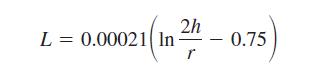
The inductance straight nonmagnetic L (in microhenrys) of a wire in free space iswhere h is the length of the wire in millimeters and r is the radius of a circular cross section. Approximate L when r = 2 ± 1/16 millimeters and h = 100 ± 1/100 millimeters. 2h L = 0.00021 In- - 0.75
Find both first partial derivatives. f(x, y) » J = (t²-1)dt
Sketch the surface given by the function.z = - x2 - y2
(a) Find the critical points(b) Test for relative extrema(c) List the critical points for which the Second Partials Test fails(d) Use a computer algebra system to graph the function, labeling any extrema and saddle pointsƒ(x, y) = x²/3 + y2/3
Use the result of Exercise 31 to find the least squares regression quadratic for the given points. Use the regression capabilities of a graphing utility to confirm your results. Use the graphing utility to plot the points and graph the least squares regression quadratic.(0, 10), (1, 9), (2, 6), (3,
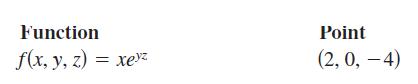
Find the gradient of the function and the maximum value of the directional derivative at the given point. Function f(x, y, z) = xeyz Point (2, 0, -4)
Find the angle of inclination θ of the tangent plane to the surface at the given point.3x² + 2y² - z = 15, (2, 2, 5)
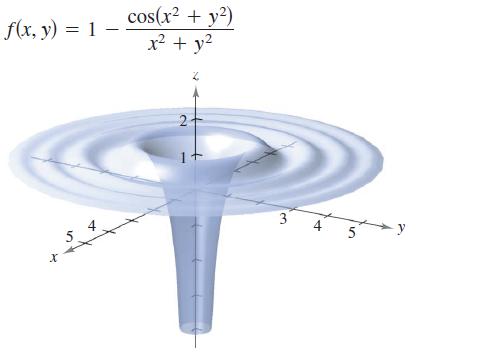
Discuss the continuity of the function and evaluate the limit of ƒ(x, y) (if it exists) as (x, y) → (0, 0). f(x, y) = 1 - x 5 cos(x² + y²) x² + y² 2+ 3 5 y
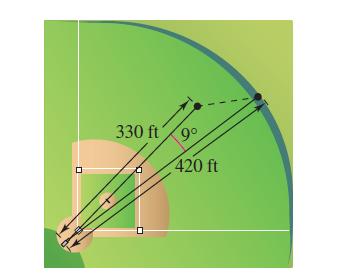
A baseball player in center field is playing approximately 330 feet from a television camera that is behind home plate. A batter hits a fly ball that goes to the wall 420 feet from the camera (see figure).(a) The camera turns 9° to follow the play. Approximate the number of feet that the center
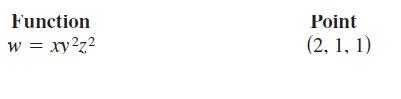
Find the gradient of the function and the maximum value of the directional derivative at the given point. Function w = xy²z² Point (2, 1, 1)
Sketch the surface given by the function.g(x, y) = 1/2y
Differentiate implicitly to find the first partial derivatives of w.W - √x - y - √y - z = 0
Use the result of Exercise 31 to find the least squares regression quadratic for the given points. Use the regression capabilities of a graphing utility to confirm your results. Use the graphing utility to plot the points and graph the least squares regression quadratic.(0, 0), (2, 2), (3, 6), (4,
(a) Find the critical points(b) Test for relative extrema(c) List the critical points for which the Second Partials Test fails(d) Use a computer algebra system to graph the function, labeling any extrema and saddle pointsƒ(x, y) = √(x - 1)² + (y + 2)²
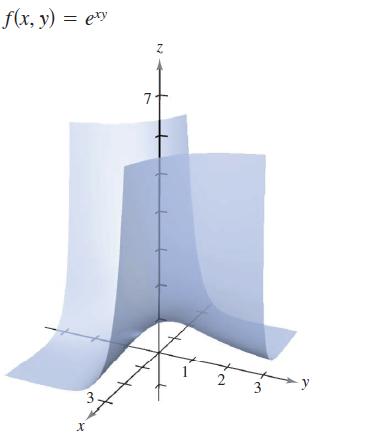
Discuss the continuity of the function and evaluate the limit of ƒ(x, y) (if it exists) as(x, y) → (0, 0). f(x, y) = exy N 71 2 3 - y
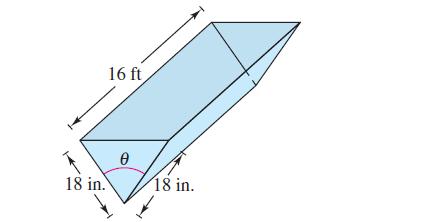
A trough is 16 feet long (see figure). Its cross sections are isosceles triangles with each of the two equal sides measuring 18 inches. The angle between the two equal sides is θ.(a) Write the volume of the trough as a function of and determine the value of such that the volume is a
Find both first partial derivatives.z = cosh xy²
(a) Find a set of symmetric equations for the tangent line to the curve of intersection of the surfaces at the given point(b) Find the cosine of the angle between the gradient vectors at this point. State whether the surfaces are orthogonal at the point of intersection.z = x² + y², x + y + 6z =
Find the gradient of the function and the maximum value of the directional derivative at the given point. Function W 1 2 √1x² - y²z² Point (0, 0, 0)
Sketch the surface given by the function.ƒ(x, y) = y²
Differentiate implicitly to find the first partial derivatives of w.cos xy + sin yz + wz = 20
Use the result of Exercise 31 to find the least squares regression quadratic for the given points. Use the regression capabilities of a graphing utility to confirm your results. Use the graphing utility to plot the points and graph the least squares regression quadratic.(-4, 5), (-2, 6), (2, 6),
(a) Find the critical points(b) Test for relative extrema(c) List the critical points for which the Second Partials Test fails(d) Use a computer algebra system to graph the function, labeling any extrema and saddle pointsƒ(x, y) = (x - 1)²(y + 4)²
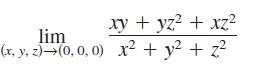
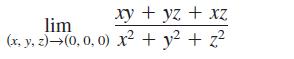
Find the limit (if it exists). If the limit does not exist, explain why. lim (x, y, z) (0,0,0) xy + yz² + xz² x² + y² + z²
Find both first partial derivatives.z = sinh(2x + 3y)
(a) Find a set of symmetric equations for the tangent line to the curve of intersection of the surfaces at the given point(b) Find the cosine of the angle between the gradient vectors at this point. State whether the surfaces are orthogonal at the point of intersection.x² + y² + z² = 14, x - y -
Use the result of Exercise 31 to find the least squares regression quadratic for the given points. Use the regression capabilities of a graphing utility to confirm your results. Use the graphing utility to plot the points and graph the least squares regression quadratic.(-2, 0), (-1, 0), (0, 1),
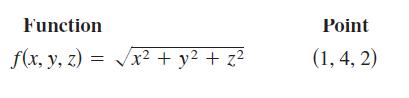
Find the gradient of the function and the maximum value of the directional derivative at the given point. Function f(x, y, z)=√x² + y² + z² Point (1,4, 2)
Sketch the surface given by the function.ƒ(x,y) = 6 - 2х - 3у
Differentiate implicitly to find the first partial derivatives of w.x² + y² + z² - 5yw + 10w² = 2
(a) Find the critical points(b) Test for relative extrema(c) List the critical points for which the Second Partials Test fails(d) Use a computer algebra system to graph the function, labeling any extrema and saddle pointsƒ(x, y) = x³ + y³ - 6x² +9y² + 12x + 27y + 19
Find the limit (if it exists). If the limit does not exist, explain why. xy + yz + xz lim (x, y, z) (0,0,0) x² + y² + z²
The centripetal acceleration of a particle moving in a circle is a = v²/r, where v is the velocity and r is the radius of the circle. Approximate the maximum percent error in measuring the acceleration due to errors of 3% in v and 2% in r.
Find both first partial derivatives.z = cos (x2 + y2)
(a) Find a set of symmetric equations for the tangent line to the curve of intersection of the surfaces at the given point(b) Find the cosine of the angle between the gradient vectors at this point. State whether the surfaces are orthogonal at the point of intersection.z = √x² + y², 5x - 2y +
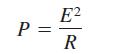
Electrical power P is given bywhere E is voltage and R is resistance. Approximate the maximum percent error in calculating power when 120 volts is applied to a 2000-ohm resistor and the possible percent errors in measuring E and R are 3% and 4%, respectively. P = E2 R
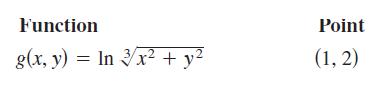
Find the gradient of the function and the maximum value of the directional derivative at the given point. Function g(x, y) = In 3√x² + y² Point (1, 2)
Sketch the surface given by the function.ƒ(x, y) = 4
Differentiate implicitly to find the first partialderivatives of w.xy + yz - wz + wx = 5
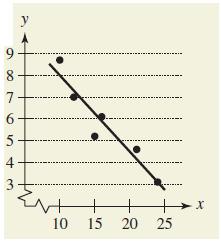
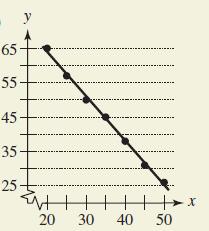
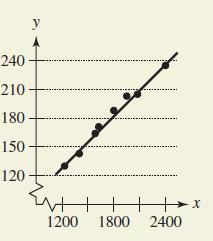
Match the regression equation with the appropriate graph. Explain your reasoning.(a) y = 0.22x - 7.5(b) y = -0.35x + 11.5(c) y = 0.09x + 19.8(d) y = -1.29x + 89.8(i)(ii)(iii)(iv) a∞t ontm 9 8 7 6 5 4 y 10 + 15 + + 20 25
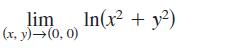
Find the limit (if it exists). If the limit does not exist, explain why. lim (x, y)→(0, 0) In(x² + y²)
(a) Find the critical points(b) Test for relativeextrema(c) List the critical points for which the SecondPartials Test fails(d) Use a computer algebra system tograph the function, labeling any extrema and saddle pointsƒ(x, y) = x³ + y³
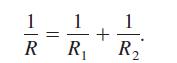
The total resistance R (in ohms) of two resistors connected in parallel is given byApproximate the change in R as R1 is increased from 10 ohms to 10.5 ohms and R₂ is decreased from 15 ohms to 13 ohms. -| R || R₁ + R₂
Find both first partial derivatives.z = ey sin xy
(a) Find a set of symmetric equations for the tangent line to the curve of intersection of the surfaces at the given point(b) Find the cosine of the angle between the gradient vectors at this point. State whether the surfaces are orthogonal at the point of intersection.x² + z² = 25, y² + z² =
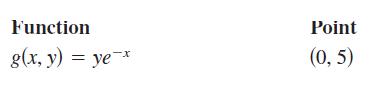
Find the gradient of the function and the maximum value of the directional derivative at the given point. Function g(x, y) = yex Point (0,5)
Differentiate implicitly to find the first partial derivatives of z.x ln y + y²z + z² = 8
Find a system of equations whose solution yields the coefficients a, b, and c for the least squares regression quadraticfor the points (x₁, y₁), (x₂, Y₂),..., (xn, yn) by minimizing thesum y = ax² + bx + c
A function ƒ hascontinuous second partial derivatives on an open regioncontaining the critical point (a, b). If ƒxx(a, b) and ƒyy(a, b) haveopposite signs, what is implied? Explain.
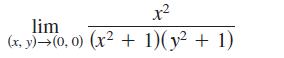
Find the limit (if it exists). If the limit does not exist, explain why. x² lim (x, y) (0,0) (x² + 1)(y² + 1)
The formula for wind chill C (in degrees Fahrenheit) is given bywhere v is the wind speed in miles per hour and T is the temperature in degrees Fahrenheit. The wind speed is 23 ± 3 miles per hour and the temperature is 8° ± 1°. Use dC to estimate the maximum possible propagated error and
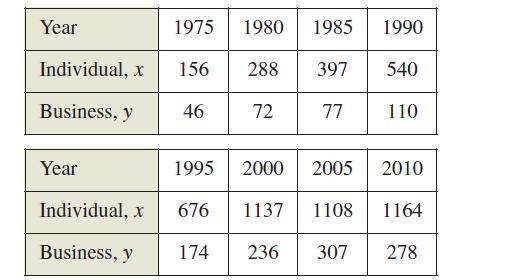
The table shows the gross income tax collections (in billions of dollars) by the Internal Revenue Service for individuals x and businesses y.(a) Use the regression capabilities of a graphing utility to find the least squares regression line for the data.(b) Use the model to estimate the business
Find both first partial derivatives.z = sin 5x cos 5y
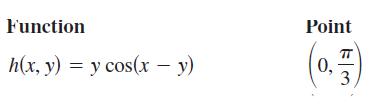
Find the gradient of the function and the maximum value of the directional derivative at the given point. Function h(x, y) = y cos(x - y) Point 0,
(a) Find a set of symmetric equations for the tangent line to the curve of intersection of the surfaces at the given point(b) Find the cosine of the angle between the gradient vectors at this point. State whether the surfaces are orthogonal at the point of intersection.z = x² + y², z = 4 - y, (2,
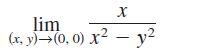
Find the limit (if it exists). If the limit does not exist, explain why. X lim (x, y) (0,0) x² - y²
A function ƒ hascontinuous second partial derivatives on an open regioncontaining the critical point (3, 7). The function has a minimumat (3, 7), and d > 0 for the Second Partials Test. Determine theinterval forƒxy(3, 7) when ƒxx(3, 7) = 2 and ƒyy(3, 7) = 8.
Find both first partial derivatives.z = tan(2x - y)
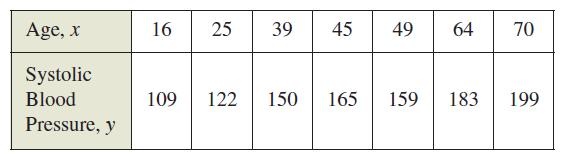
The ages x (in years) and systolic blood pressures y of seven men are shown in the table.(a) Use the regression capabilities of a graphing utility to find the least squares regression line for the data.(b) Use the model to approximate the change in systolic blood pressure for each one-year increase
Find the domain and range of the function.ƒ(x, y) = In(xy - 6)
Differentiate implicitly to find the first partial derivatives of z.z = ex sin(y + z)
Determine whether there is a relative maximum, a relative minimum, a saddle point, or insufficient information to determine the nature of the function ƒ(x, y) at the critical point (x0, y0).ƒxx(X0, Y0) = 25, ƒyy(X0, Y0) = 8, ƒxy(X0, Y0)= 10
The possible error involved in measuring each dimension of a right circular cylinder is ±0.05 centimeter. The radius is 3 centimeters and the height is 10 centimeters. Approximate the propagated error and the relative error in the calculated volume of the cylinder.
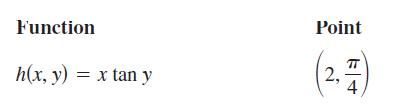
Find the gradient of the function and the maximum value of the directional derivative at the given point. Function h(x, y) = x tan y Point (2.)
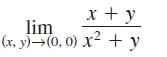
Find the limit (if it exists). If the limit does not exist, explain why. x + y lim (x, y) (0,0) x² + y
Find both first partial derivatives.z = sin(x + 2y)
Find an equation of the tangent plane and find a set of symmetric equations for the normal line to the surface at the given point.y ln xz² = 2, (e, 2, 1)
Find the domain and range of the function.ƒ(x, y) = In(4- x - y)
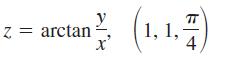
Find an equation of the tangent plane and find a set of symmetric equations for the normal line to the surface at the given point. 2 = arctan 1, 1, TT 4
Differentiate implicitly to find the first partial derivatives of z.tan(x + y) + tan(y + z) = 1
Determine whether there is a relative maximum, a relative minimum, a saddle point, or insufficient information to determine the nature of the function ƒ(x, y) at the critical point (x0, y0).ƒxx(X0, Y0) = -9, ƒyy(X0, Y0) = 6, ƒxy(X0, Y0) = 10
Showing 1800 - 1900
of 9867
First
12
13
14
15
16
17
18
19
20
21
22
23
24
25
26
Last
Step by Step Answers

 Get 50% OFF
Claim Now
Get 50% OFF
Claim Now