New Semester
Started
Get
50% OFF
Study Help!
--h --m --s
Claim Now
Question Answers
Textbooks
Find textbooks, questions and answers
Oops, something went wrong!
Change your search query and then try again
S
Books
FREE
Study Help
Expert Questions
Accounting
General Management
Mathematics
Finance
Organizational Behaviour
Law
Physics
Operating System
Management Leadership
Sociology
Programming
Marketing
Database
Computer Network
Economics
Textbooks Solutions
Accounting
Managerial Accounting
Management Leadership
Cost Accounting
Statistics
Business Law
Corporate Finance
Finance
Economics
Auditing
Tutors
Online Tutors
Find a Tutor
Hire a Tutor
Become a Tutor
AI Tutor
AI Study Planner
NEW
Sell Books
Search
Search
Sign In
Register
study help
mathematics
calculus 4th
Calculus 4th Edition Jon Rogawski, Colin Adams, Robert Franzosa - Solutions
Use induction to prove that \(n !>2^{n}\) for \(n \geq 4\).Let \(\left\{F_{n}ight\}\) be the Fibonacci sequence, defined by the recursion formula\[F_{n}=F_{n-1}+F_{n-2}, \quad F_{1}=F_{2}=1\]
Use induction to prove the identity.\(F_{1}+F_{2}+\cdots+F_{n}=F_{n+2}-1\)
Use induction to prove the identity.\(F_{1}^{2}+F_{2}^{2}+\cdots+F_{n}^{2}=F_{n+1} F_{n}\)
Use induction to prove the identity.\(F_{n}=\frac{R_{+}^{n}-R_{-}^{n}}{\sqrt{5}}\), where \(R_{ \pm}=\frac{1 \pm \sqrt{5}}{2}\)
Use induction to prove the identity.\(F_{n+1} F_{n-1}=F_{n}^{2}+(-1)^{n}\). For the induction step, show that\[\begin{aligned}F_{n+2} F_{n} & =F_{n+1} F_{n}+F_{n}^{2} \\F_{n+1}^{2} & =F_{n+1} F_{n}+F_{n+1} F_{n-1}\end{aligned}\]
Use induction to prove that \(f(n)=8^{n}-1\) is divisible by 7 for all natural numbers \(n\). For the induction step, show that\[8^{k+1}-1=7 \cdot 8^{k}+\left(8^{k}-1ight)\]
Use induction to prove that \(n^{3}-n\) is divisible by 3 for all natural numbers \(n\).
Use induction to prove that \(5^{2 n}-4^{n}\) is divisible by 7 for all natural numbers \(n\).
Use Pascal's Triangle to write out the expansions of \((a+b)^{6}\) and \((a-b)^{4}\)
Expand the \(\left(x+x^{-1}ight)^{4}\).
What is the coefficient of \(x^{9}\) in \(\left(x^{3}+xight)^{5}\) ?
Let \(S(n)=\sum_{k=0}^{n}\left(\begin{array}{l}n \\ k\end{array}ight)\).(a) Use Pascal's Triangle to compute \(S(n)\) for \(n=1,2,3,4\).(b) Prove that \(S(n)=2^{n}\) for all \(n \geq 1\). Expand \((a+b)^{n}\) and evaluate at \(a=b=1\).
Let \(T(n)=\sum_{k=0}^{n}(-1)^{k}\left(\begin{array}{l}n \\ k\end{array}ight)\).(a) Use Pascal's Triangle to compute \(T(n)\) for \(n=1,2,3,4\).(b) Prove that \(T(n)=0\) for all \(n \geq 1\). Expand \((a+b)^{n}\) and evaluate at \(a=1, b=-1\).
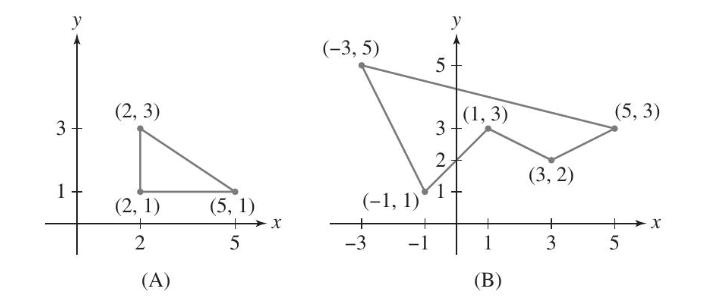
Area of a Polygon Green's Theorem leads to a convenient formula for the area of a polygon.(a) Let \(C\) be the line segment joining \(\left(x_{1}, y_{1}ight)\) to \(\left(x_{2}, y_{2}ight)\). Show that\[\frac{1}{2} \int_{C}-y d x+x d y=\frac{1}{2}\left(x_{1} y_{2}-x_{2} y_{1}ight)\](b) Prove that
Use the result of Exercise 36 to compute the areas of the polygons in Figure 28. Check your result for the area of the triangle in \((\mathrm{A})\) using geometry.Data From Exercise 36Area of a Polygon Green's Theorem leads to a convenient formula for the area of a polygon.(a) Let \(C\) be the line
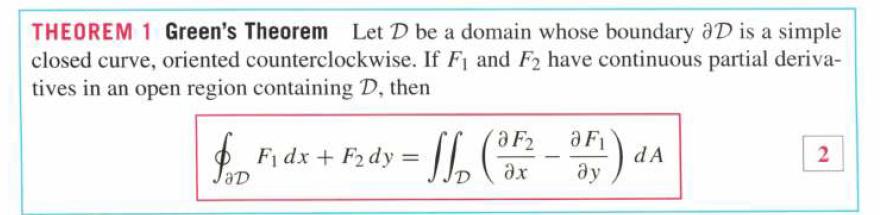
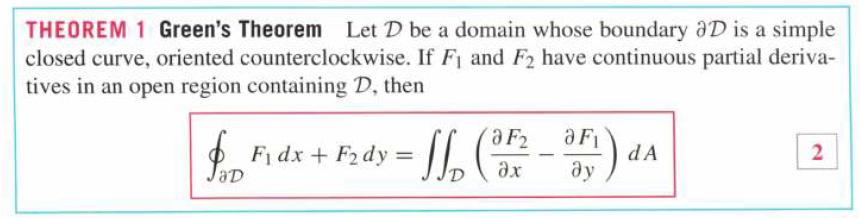
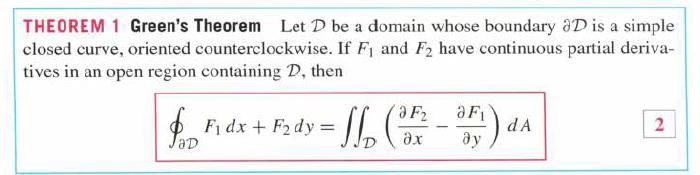
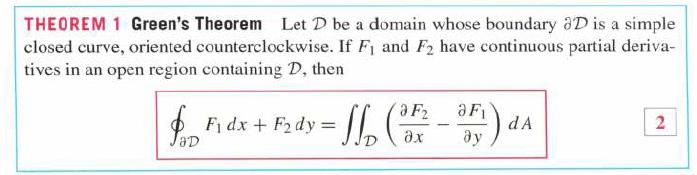
Compute the flux \(\oint \mathbf{F} \cdot \mathbf{n} d\) s of \(\mathbf{F}\) across the curve \(C\) for the given vector field and curve using the vector form of Green's Theorem.\(\mathbf{F}(x, y)=\langle 3 x, 2 yangle\) across the circle given by \(x^{2}+y^{2}=9\) THEOREM 1 Green's Theorem Let D
Compute the flux \(\oint \mathbf{F} \cdot \mathbf{n} d\) s of \(\mathbf{F}\) across the curve \(C\) for the given vector field and curve using the vector form of Green's Theorem.\(\mathbf{F}(x, y)=\langle x y, x-yangle\) across the boundary of the square \(-1 \leq x \leq 1,-1 \leq y \leq 1\)
Compute the flux \(\oint \mathbf{F} \cdot \mathbf{n} d\) s of \(\mathbf{F}\) across the curve \(C\) for the given vector field and curve using the vector form of Green's Theorem.\(\mathbf{F}(x, y)=\left\langle x^{2}, y^{2}ightangle\) across the boundary of the triangle with vertices
Compute the flux \(\oint \mathbf{F} \cdot \mathbf{n} d\) s of \(\mathbf{F}\) across the curve \(C\) for the given vector field and curve using the vector form of Green's Theorem.\(\mathbf{F}(x, y)=\left\langle x^{2}, y^{2}ightangle\) across the boundary of the triangle with vertices
Compute the flux \(\oint \mathbf{F} \cdot \mathbf{n} d\) s of \(\mathbf{F}\) across the curve \(C\) for the given vector field and curve using the vector form of Green's Theorem.\(\mathbf{F}(x, y)=\langle\cos y, \sin yangle\) across the boundary of the square \(0 \leq x \leq 2,0 \leq y \leq
Compute the flux \(\oint \mathbf{F} \cdot \mathbf{n} d\) s of \(\mathbf{F}\) across the curve \(C\) for the given vector field and curve using the vector form of Green's Theorem.\(\mathbf{F}(x, y)=\left\langle x y^{2}+2 x, x^{2} y-2 yightangle\) across the simple closed curve that is the boundary
If \(\mathbf{v}\) is the velocity field of a fluid, the flux of \(\mathbf{v}\) across \(C\) is equal to the flow rate (amount of fluid flowing across \(C\) in square meters per second). Find the flow rate across the circle of radius 2 centered at the origin if
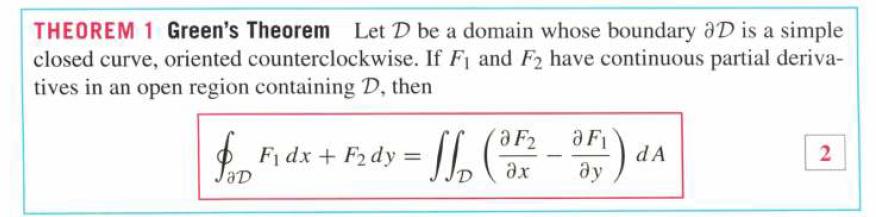
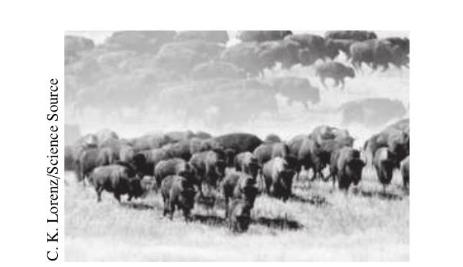
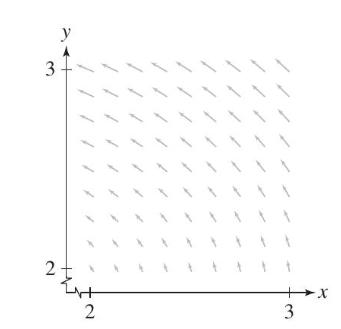
A buffalo stampede (Figure 29) is described by a velocity vector field F = (xy — y3, x2 + y) kilometers per hour in the region 7, defined by 2 THEOREM 1 Green's Theorem Let D be a domain whose boundary 3D is a simple closed curve, oriented counterclockwise. If F and F2 have continuous partial
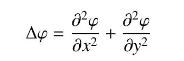
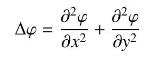
The Laplace operator \(\Delta\) is defined by\[\Delta \varphi=\frac{\partial^{2} \varphi}{\partial x^{2}}+\frac{\partial^{2} \varphi}{\partial y^{2}}\]For any vector field \(\mathbf{F}=\left\langle F_{1}, F_{2}ightangle\), define the conjugate vector field \(\mathbf{F}^{*}=\left\langle-F_{2},
The Laplace operator \(\Delta\) is defined by\[\Delta \varphi=\frac{\partial^{2} \varphi}{\partial x^{2}}+\frac{\partial^{2} \varphi}{\partial y^{2}}\]For any vector field \(\mathbf{F}=\left\langle F_{1}, F_{2}ightangle\), define the conjugate vector field \(\mathbf{F}^{*}=\left\langle-F_{2},
The Laplace operator \(\Delta\) is defined by\[\Delta \varphi=\frac{\partial^{2} \varphi}{\partial x^{2}}+\frac{\partial^{2} \varphi}{\partial y^{2}}\]For any vector field \(\mathbf{F}=\left\langle F_{1}, F_{2}ightangle\), define the conjugate vector field \(\mathbf{F}^{*}=\left\langle-F_{2},
The Laplace operator \(\Delta\) is defined by\[\Delta \varphi=\frac{\partial^{2} \varphi}{\partial x^{2}}+\frac{\partial^{2} \varphi}{\partial y^{2}}\]For any vector field \(\mathbf{F}=\left\langle F_{1}, F_{2}ightangle\), define the conjugate vector field \(\mathbf{F}^{*}=\left\langle-F_{2},
Let \(\mathcal{D}\) be the region bounded by a simple closed curve \(C\). A function \(\varphi(x, y)\) on \(\mathcal{D}\) (whose second-order partial derivatives exist and are continuous) is called harmonic if \(\Delta \varphi=0\), where \(\Delta \varphi\) is the Laplace operator defined in
Let \(\mathcal{D}\) be the region bounded by a simple closed curve \(C\). A function \(\varphi(x, y)\) on \(\mathcal{D}\) (whose second-order partial derivatives exist and are continuous) is called harmonic if \(\Delta \varphi=0\), where \(\Delta \varphi\) is the Laplace operator defined in
What is the definition of a vector potential?
Which of the following statements is correct?(a) The flux of \(\operatorname{curl}(\mathbf{A})\) through every oriented surface is zero.(b) The flux of \(\operatorname{curl}(\mathbf{A})\) through every closed, oriented surface is zero.
Which condition on \(\mathbf{F}\) guarantees that the flux through \(\mathcal{S}_{1}\) is equal to the flux through \(\mathcal{S}_{2}\) for any two oriented surfaces \(\mathcal{S}_{1}\) and \(\mathcal{S}_{2}\) with the same oriented boundary?
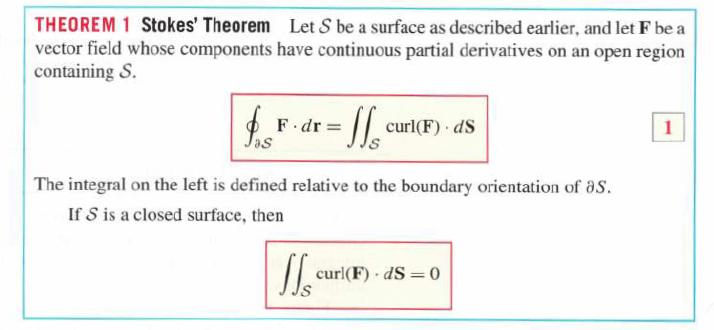
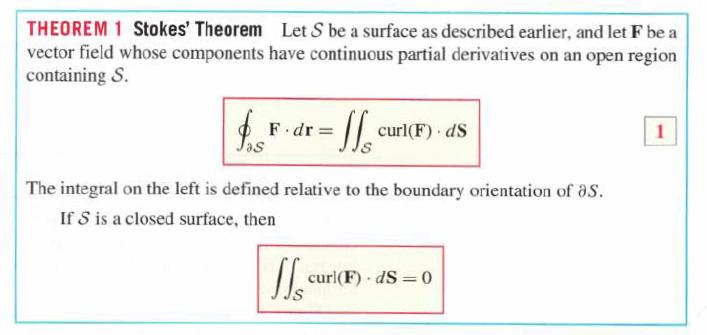
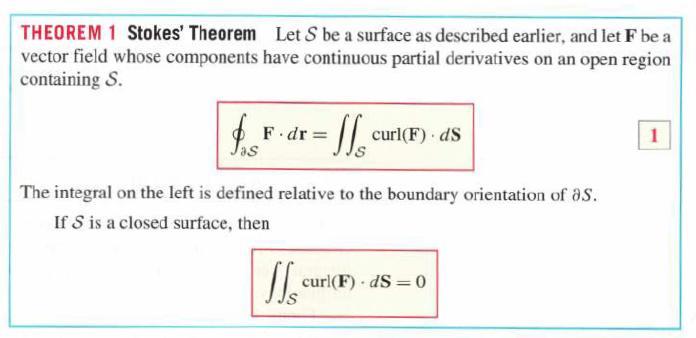
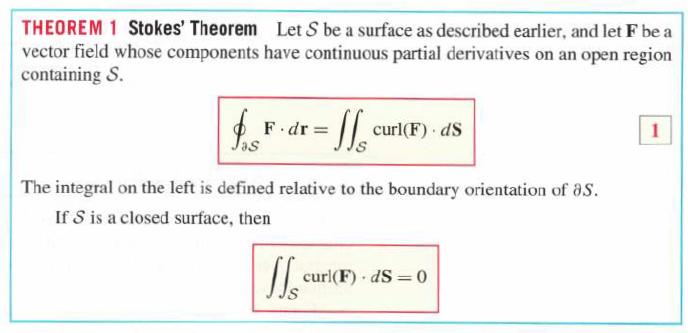
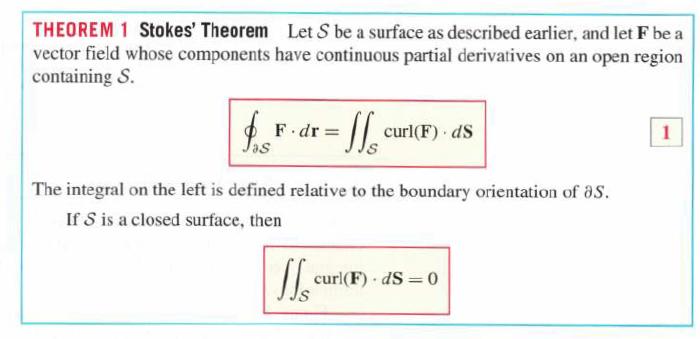
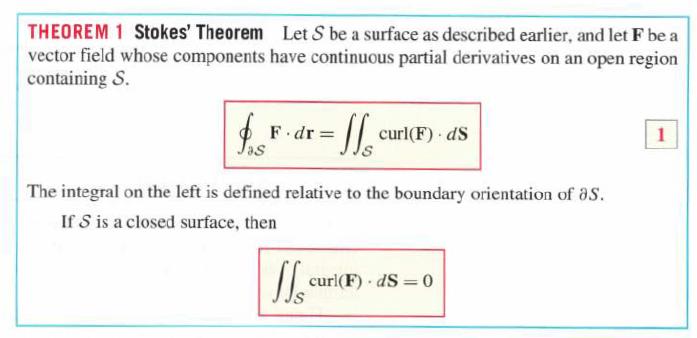
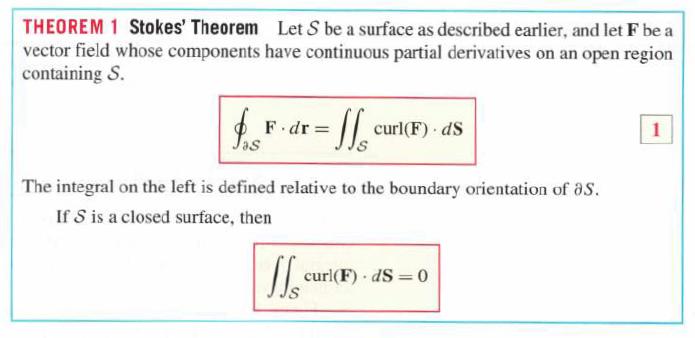
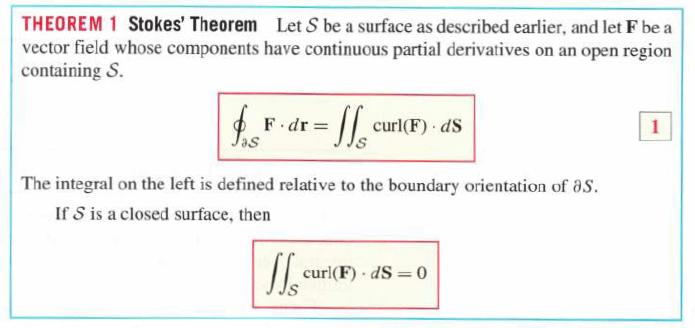
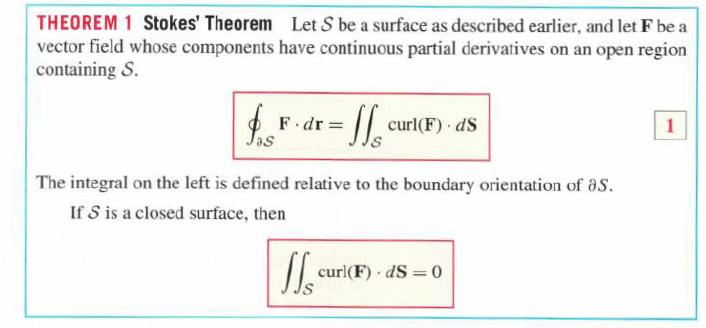
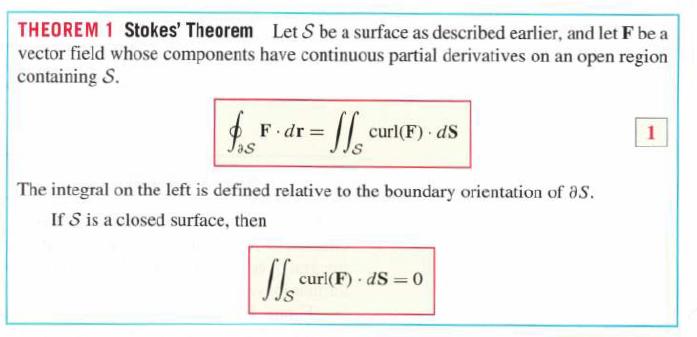
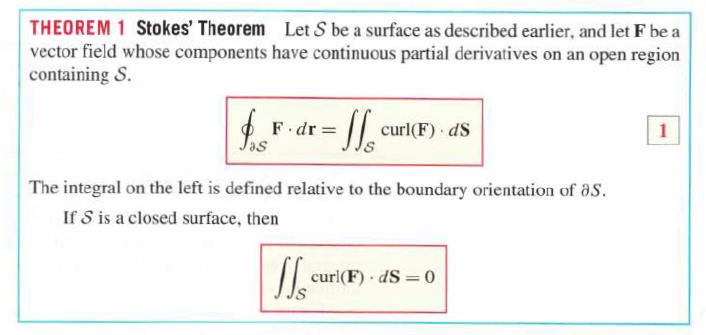
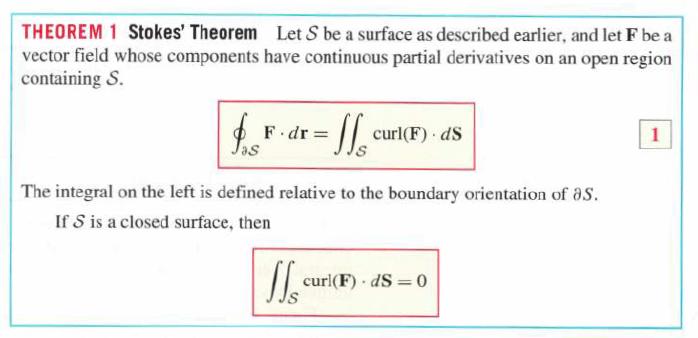
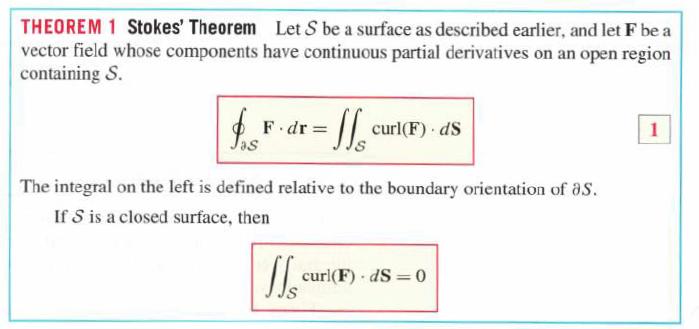
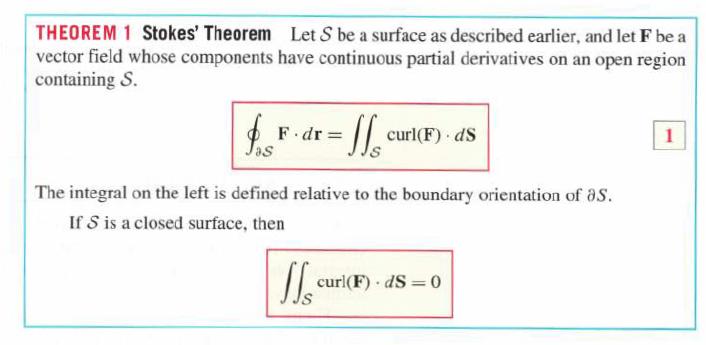
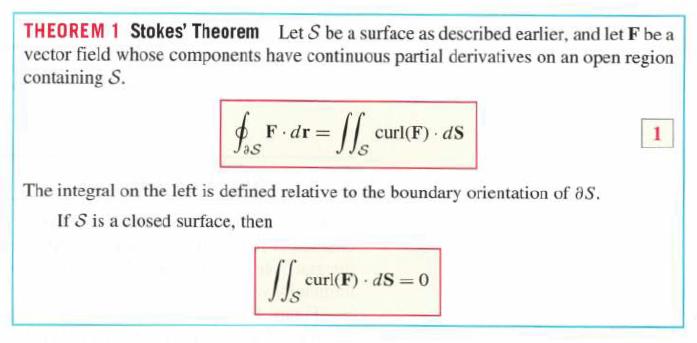
Verify Stokes' Theorem for the given vector field and surface, oriented with an upwardpointing normal.\(\mathbf{F}=\langle 2 x y, x, y+zangle\), the surface \(z=1-x^{2}-y^{2}\) for \(x^{2}+y^{2} \leq 1\) THEOREM 1 Stokes' Theorem Let S be a surface as described earlier, and let F be a vector field
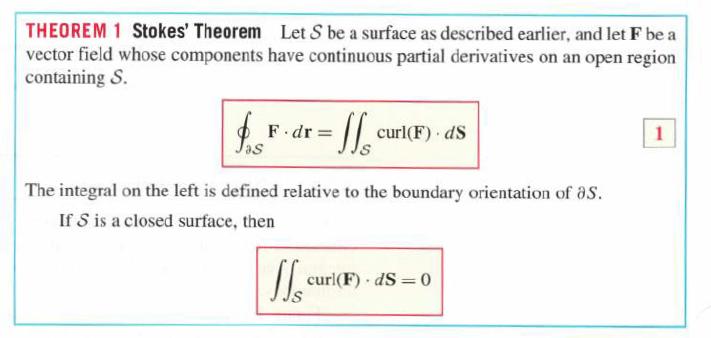
Verify Stokes' Theorem for the given vector field and surface, oriented with an upwardpointing normal.\(\mathbf{F}=\langle y z, 0, xangle, \quad\) the portion of the plane \(\frac{x}{2}+\frac{y}{3}+z=1\), where \(x, y, z \geq 0\) THEOREM 1 Stokes' Theorem Let S be a surface as described earlier,
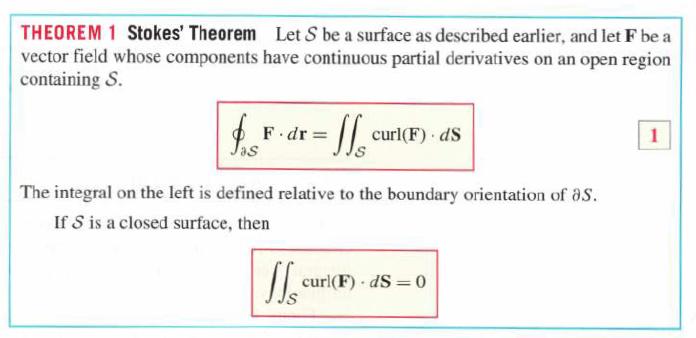
Verify Stokes' Theorem for the given vector field and surface, oriented with an upwardpointing normal.\(\mathbf{F}=\left\langle e^{y-z}, 0,0ightangle\), the square with vertices \((1,0,1),(1,1,1),(0,1,1)\), and \((0,0,1)\) THEOREM 1 Stokes' Theorem Let S be a surface as described earlier, and let F
Verify Stokes' Theorem for the given vector field and surface, oriented with an upwardpointing normal.\(\mathbf{F}=\left\langle y, x, x^{2}+y^{2}ightangle\), the upper hemisphere \(x^{2}+y^{2}+z^{2}=1, z \geq 0\) THEOREM 1 Stokes' Theorem Let S be a surface as described earlier, and let F be a
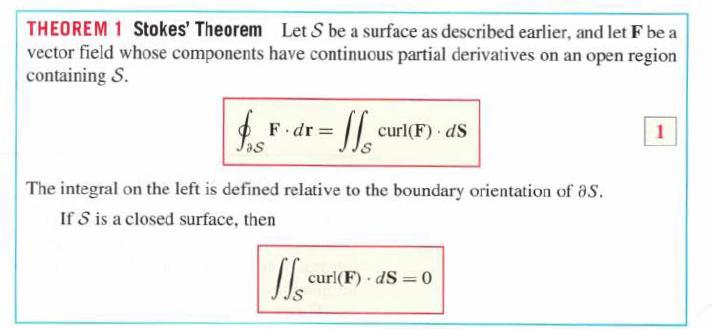
Calculate curl(F) and then apply Stokes' Theorem to compute the flux of \(\operatorname{curl}(\mathbf{F})\) through the given surface using a line integral.\(\mathbf{F}=\left\langle e^{z^{2}}-y, e^{z^{3}}+x, \cos (x z)ightangle\), the upper half of the unit sphere \(x^{2}+y^{2}+z^{2}=1, z \geq 0\)
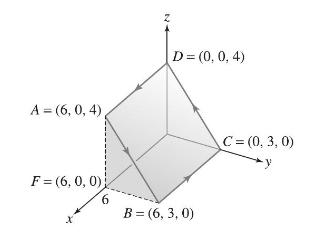
Calculate curl(F) and then apply Stokes' Theorem to compute the flux of curl(F)curl(F) through the given surface using a line integral.\(\left.\mathbf{F}=\left\langle x+y, z^{2}-4, x \sqrt{y^{2}+1}ight)ightangle\), surface of the wedge-shaped box in Figure 15 (bottom included, top excluded) with
Calculate curl(F) and then apply Stokes' Theorem to compute the flux of \(\operatorname{curl}(\mathbf{F})\) through the given surface using a line integral.\(\mathbf{F}=\langle 3 z, 5 x,-2 yangle\), that part of the paraboloid \(z=x^{2}+y^{2}\) that lies below the plane \(z=4\) with upwardpointing
Calculate curl(F) and then apply Stokes' Theorem to compute the flux of \(\operatorname{curl}(\mathbf{F})\) through the given surface using a line integral.\(\mathbf{F}=\left\langle y z,-x z, z^{3}ightangle\), that part of the cone \(z=\sqrt{x^{2}+y^{2}}\) that lies between the two planes \(z=1\)
Calculate curl(F) and then apply Stokes' Theorem to compute the flux of \(\operatorname{curl}(\mathbf{F})\) through the given surface using a line integral.\(\mathbf{F}=\langle y z, x z, x yangle\), that part of the cylinder \(x^{2}+y^{2}=1\) that lies between the two planes \(z=1\) and \(z=4\)
Calculate curl(F) and then apply Stokes' Theorem to compute the flux of \(\operatorname{curl}(\mathbf{F})\) through the given surface using a line integral.\(\mathbf{F}=\left\langle 2 y, e^{z},-\arctan xightangle\), that part of the paraboloid \(z=4-x^{2}-y^{2}\) cut off by the \(x y\)-plane with
Apply Stokes' Theorem to evaluate \(\oint_{C} \mathbf{F} \cdot d \mathbf{r}\) by finding the flux of \(\operatorname{curl}(\mathbf{F})\) across an appropriate surface.\(\mathbf{F}=\langle 3 y,-2 x, 3 yangle, \quad C\) is the circle \(x^{2}+y^{2}=9, z=2\), oriented counterclockwise as viewed from
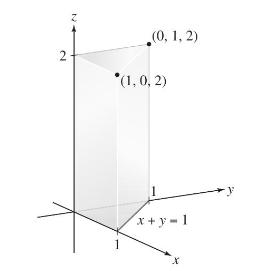
Apply Stokes' Theorem to evaluate \(\oint_{C} \mathbf{F} \cdot d \mathbf{r}\) by finding the flux of \(\operatorname{curl}(\mathbf{F})\) across an appropriate surface.\(\mathbf{F}=\langle y z, x y, x zangle, \quad C\) is the square with vertices \((0,0,2),(1,0,2),(1,1,2)\), and \((0,1,2)\),
Apply Stokes' Theorem to evaluate \(\oint_{C} \mathbf{F} \cdot d \mathbf{r}\) by finding the flux of \(\operatorname{curl}(\mathbf{F})\) across an appropriate surface.\(\mathbf{F}=\langle x z, x y, y zangle, \quad C\) is the rectangle with vertices \((0,0,0),(0,0,2),(3,0,2)\), and \((3,0,0)\),
Apply Stokes' Theorem to evaluate \(\oint_{C} \mathbf{F} \cdot d \mathbf{r}\) by finding the flux of \(\operatorname{curl}(\mathbf{F})\) across an appropriate surface.\(\mathbf{F}=\langle y+2 x, 2 x+5 z, 7 y+8 xangle, \quad C\) is the circle with radius 5 , center at \((2,0,0)\), in the plane
Apply Stokes' Theorem to evaluate \(\oint_{C} \mathbf{F} \cdot d \mathbf{r}\) by finding the flux of \(\operatorname{curl}(\mathbf{F})\) across an appropriate surface.\(\mathbf{F}=\langle y, z, xangle, \quad C\) is the triangle with vertices \((0,0,0),(3,0,0)\), and \((0,3,3)\), oriented
Apply Stokes' Theorem to evaluate \(\oint_{C} \mathbf{F} \cdot d \mathbf{r}\) by finding the flux of \(\operatorname{curl}(\mathbf{F})\) across an appropriate surface.\(\mathbf{F}=\langle y,-2 z, 4 xangle, \quad C\) is the boundary of that portion of the plane \(x+2 y+3 z=1\) that is in the first
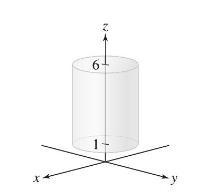
Let \(\mathcal{S}\) be the surface of the cylinder (not including the top and bottom) of radius 2 for \(1 \leq z \leq 6\), oriented with outward-pointing normal (Figure 16).(a) Indicate with an arrow the orientation of \(\partial \mathcal{S}\) (the top and bottom circles).(b) Verify Stokes' Theorem
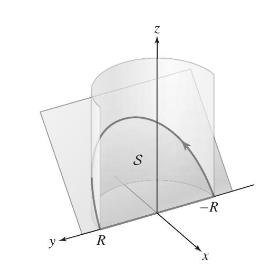
Let \(\mathcal{S}\) be the portion of the plane \(z=x\) contained in the half-cylinder of radius \(R\) depicted in Figure 17. Use Stokes' Theorem to calculate the circulation of \(\mathbf{F}=\langle z, x, y+2 zangle\) around the boundary of \(\mathcal{S}\) (a halfellipse) in the counterclockwise
Let \(I\) be the flux of \(\mathbf{F}=\left\langle e^{y}, 2 x e^{x^{2}}, z^{2}ightangle\) through the upper hemisphere \(\mathcal{S}\) of the unit sphere.(a) Let \(\mathbf{G}=\left\langle e^{y}, 2 x e^{x^{2}}, 0ightangle\). Find a vector field \(\mathbf{A}\) such that
Let \(\mathbf{F}=\langle 0,-z, 1angle\). Let \(\mathcal{S}\) be the spherical cap \(x^{2}+y^{2}+z^{2} \leq 1\), where \(z \geq \frac{1}{2}\). Evaluate \(\iint_{\mathcal{S}} \mathbf{F} \cdot d \mathbf{S}\) directly as a surface integral. Then verify that
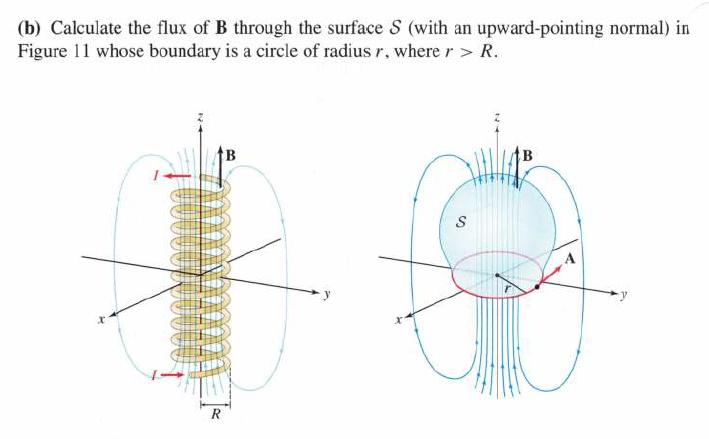
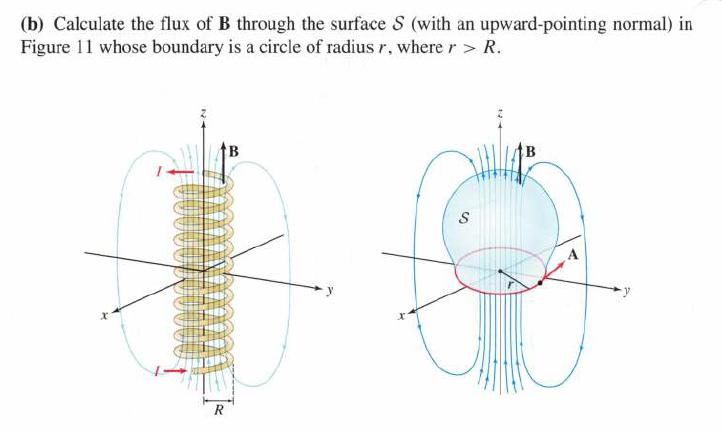
Let \(\mathbf{A}\) be the vector potential and \(\mathbf{B}\) the magnetic field of the infinite solenoid of radius \(R\) in Example 4 . Use Stokes' Theorem to compute:(a) The flux of \(\mathbf{B}\) through a circle in the \(x y\)-plane of radius \(r(b) The circulation of \(\mathbf{A}\) around the
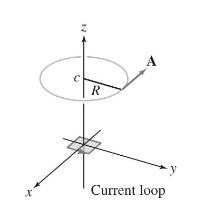
The magnetic field \(\mathbf{B}\) due to a small current loop (which we place at the origin) is called a magnetic dipole (Figure 18). For \(ho\) large, \(\mathbf{B}=\operatorname{curl}(\mathbf{A})\), where\[\mathbf{A}=\left\langle-\frac{y}{ho^{3}}, \frac{x}{ho^{3}}, 0ightangle \text { and }
A uniform magnetic field \(\mathbf{B}\) has constant strength \(b\) in the \(z\)-direction [i.e., \(\mathbf{B}=\langle 0,0, bangle\) ].(a) Verify that \(\mathbf{A}=\frac{1}{2} \mathbf{B} \times \mathbf{r}\) is a vector potential for \(\mathbf{B}\), where \(\mathbf{r}=\langle x, y, 0angle\).(b)
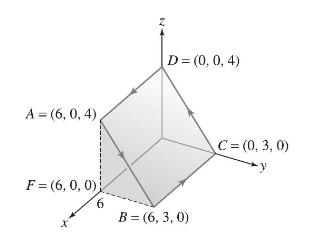
Let \(\mathbf{F}=\left\langle-x^{2} y, x, 0ightangle\). Referring to Figure 19 , let \(C\) be the closed path \(A B C D\). Use Stokes' Theorem to evaluate \(\int_{C} \mathbf{F} \cdot d \mathbf{r}\) in two ways. First, regard \(C\) as the boundary of the rectangle with vertices \(A, B, C\), and
Let \(\mathbf{F}=\left\langle y^{2}, 2 z+x, 2 y^{2}ightangle\). Use Stokes' Theorem to find a plane with equation \(a x+b y+c z=0\) (where \(a, b, c\) are not all zero) such that \(\oint_{C} \mathbf{F} \cdot d \mathbf{r}=0\) for every closed \(C\) lying in the plane. Hint: Choose \(a, b, c\) so
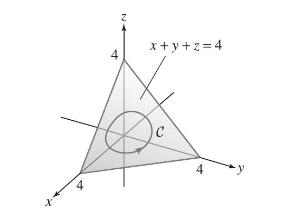
Let \(\mathbf{F}=\left\langle-z^{2}, 2 z x, 4 y-x^{2}ightangle\), and let \(C\) be a simple closed curve in the plane \(x+y+z=4\) that encloses a region of area 16 (Figure 20). Calculate \(\oint_{C} \mathbf{F} \cdot d \mathbf{r}\), where \(C\) is oriented in the counterclockwise direction (when
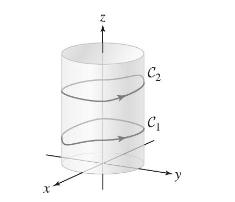
Let \(\mathbf{F}=\left\langle y^{2}, x^{2}, z^{2}ightangle\). Show that\[\int_{C_{1}} \mathbf{F} \cdot d \mathbf{r}=\int_{C_{2}} \mathbf{F} \cdot d \mathbf{r}\]for any two closed curves going around a cylinder whose central axis is the z-axis as shown in Figure 21. N C C
The curl of a vector field \(\mathbf{F}\) at the origin is \(\mathbf{v}_{0}=\langle 3,1,4angle\). Estimate the circulation around the small parallelogram spanned by the vectors \(\mathbf{A}=\left\langle 0, \frac{1}{2}, \frac{1}{2}ightangle\) and \(\mathbf{B}=\left\langle 0,0, \frac{1}{3}ightangle\).
You know two things about a vector field \(\mathbf{F}\) :(i) \(\mathbf{F}\) has a vector potential \(\mathbf{A}\) (but \(\mathbf{A}\) is unknown).(ii) The circulation of \(\mathbf{A}\) around the unit circle (oriented counterclockwise) is 25 .Determine the flux of \(\mathbf{F}\) through the surface
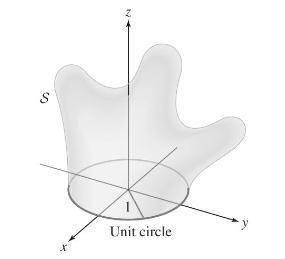
Suppose that \(\mathbf{F}\) has a vector potential and that \(\mathbf{F}(x, y, 0)=\mathbf{k}\). Find the flux of \(\mathbf{F}\) through the surface \(\mathcal{S}\) in Figure 22, oriented with an upward-pointing normal. S N Unit circle
Prove that \(\operatorname{curl}(f \mathbf{a})=abla f \times \mathbf{a}\), where \(f\) is a differentiable function and \(\mathbf{a}\) is a constant vector.
Show that \(\operatorname{curl}(\mathbf{F})=\mathbf{0}\) if \(\mathbf{F}\) is radial, meaning that \(\mathbf{F}=f(ho)\langle x, y, zangle\) for some function \(f(ho)\), where \(ho=\sqrt{x^{2}+y^{2}+z^{2}}\). Hint: It is enough to show that one component of \(\operatorname{curl}(\mathbf{F})\) is
Prove the following Product Rule:\[\operatorname{curl}(f \mathbf{F})=f \operatorname{curl}(\mathbf{F})+abla f \times \mathbf{F}\]
Assume that \(f\) and \(g\) have continuous partial derivatives of order 2. Prove that\[\oint_{\partial \mathcal{S}} f abla g \cdot d \mathbf{r}=\iint_{\mathcal{S}} abla f \times abla g \cdot d \mathbf{S}\]
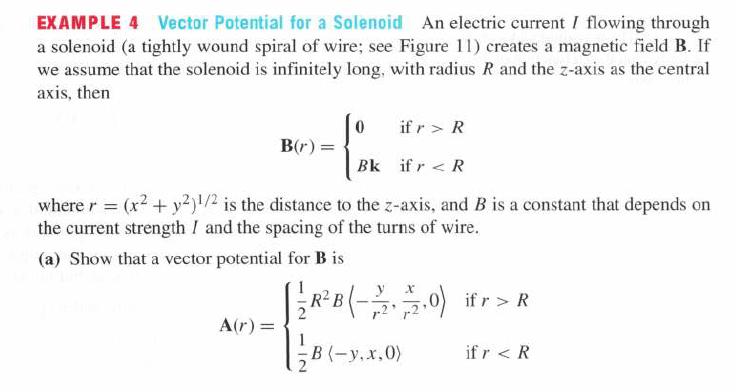
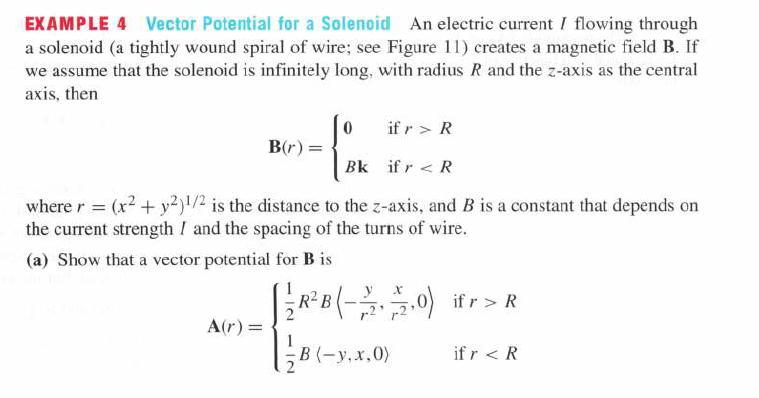
Verify that \(\mathbf{B}=\operatorname{curl}(\mathbf{A})\) for \(r>R\) in the setting of Example 4. EXAMPLE 4 Vector Potential for a Solenoid An electric current I flowing through a solenoid (a tightly wound spiral of wire; see Figure 11) creates a magnetic field B. If we assume that the
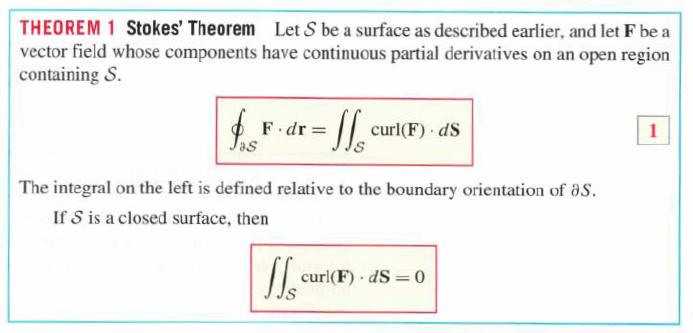
Explain carefully why Green's Theorem is a special case of Stokes' Theorem. THEOREM 1 Stokes' Theorem Let S be a surface as described earlier, and let F be a vector field whose components have continuous partial derivatives on an open region containing S. = [[ k F.dr= curl(F). dS The integral on
In this exercise, we use the notation of the proof of Theorem 1 and prove\[\oint_{C} F_{3}(x, y, z) \mathbf{k} \cdot d \mathbf{r}=\iint_{\mathcal{S}} \operatorname{curl}\left(F_{3}(x, y, z) \mathbf{k}ight) \cdot d \mathbf{S}\]In particular, \(\mathcal{S}\) is the graph of \(z=f(x, y)\) over a
Let \(\mathbf{F}\) be a continuously differentiable vector field in \(\mathbf{R}^{3}, Q\) a point, and \(\mathcal{S}\) a plane containing \(Q\) with unit normal vector e. Let \(C_{r}\) be a circle of radius \(r\) centered at \(Q\) in \(\mathcal{S}\), and let \(\mathcal{S}_{r}\) be the disk enclosed
What is the flux of \(\mathbf{F}=\langle 1,0,0angle\) through a closed surface?
Justify the following statement: The flux of \(\mathbf{F}=\left\langle x^{3}, y^{3}, z^{3}ightangle\) through every closed surface is positive.
Which of the following expressions are meaningful (where \(\mathbf{F}\) is a vector field and \(f\) is a function)? Of those that are meaningful, which are automatically zero?(a) \(\operatorname{div}(abla f)\)(b) \(\operatorname{curl}(abla f)\)(c) \(abla \operatorname{curl}(f)\)(d)
Which of the following statements is correct (where \(\mathbf{F}\) is a continuously differentiable vector field defined everywhere)?(a) The flux of \(\operatorname{curl}(\mathbf{F})\) through all surfaces is zero.(b) If \(\mathbf{F}=abla \varphi\), then the flux of \(\mathbf{F}\) through all
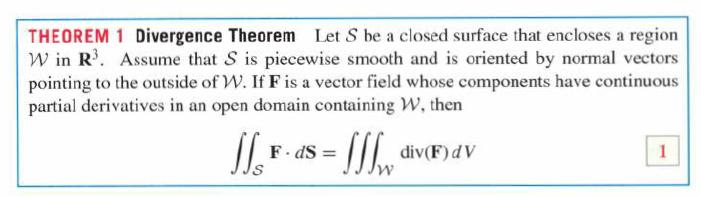
How does the Divergence Theorem imply that the flux of the vector field \(\mathbf{F}=\left\langle x^{2}, y-e^{z}, y-2 z xightangle\) through a closed surface is equal to the enclosed volume?
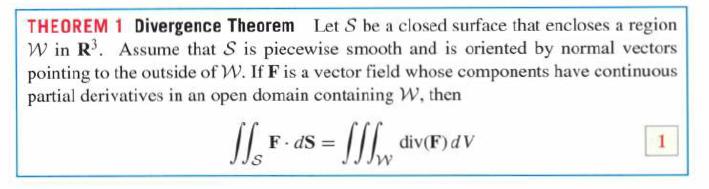
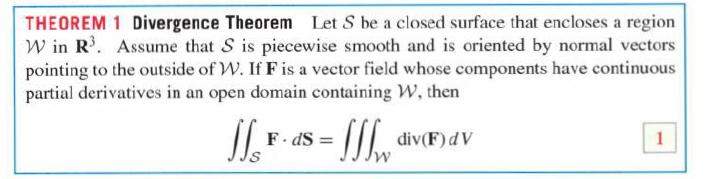
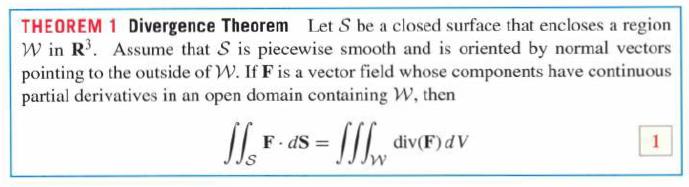
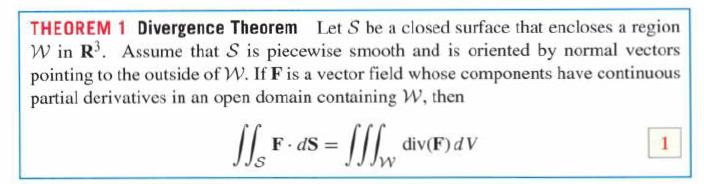
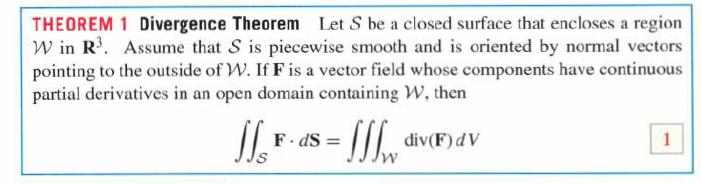
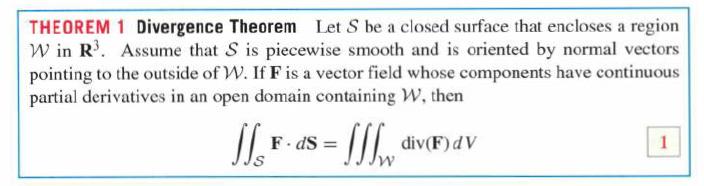
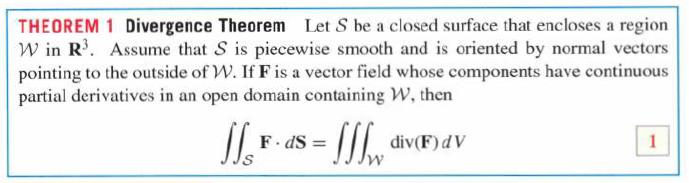
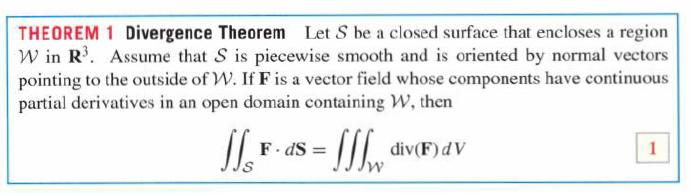
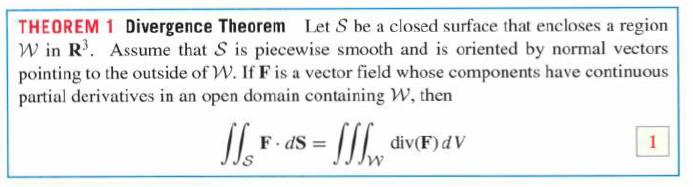
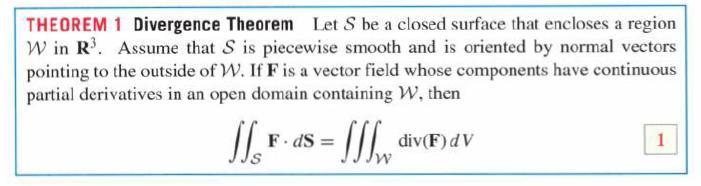
Verify the Divergence Theorem for the vector field and region.\(\mathbf{F}(x, y, z)=\langle z, x, yangle\), the box \([0,4] \times[0,2] \times[0,3]\) THEOREM 1 Divergence Theorem Let S be a closed surface that encloses a region W in R. Assume that S is piecewise smooth and is oriented by normal
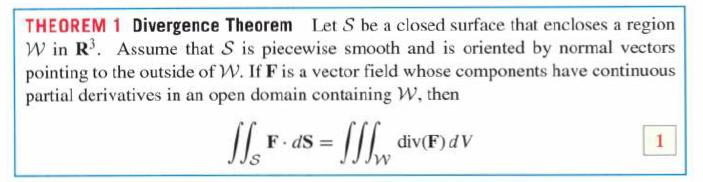
Verify the Divergence Theorem for the vector field and region.\(\mathbf{F}(x, y, z)=\langle y, x, zangle\), the region \(x^{2}+y^{2}+z^{2} \leq 4\) THEOREM 1 Divergence Theorem Let S be a closed surface that encloses a region W in R. Assume that S is piecewise smooth and is oriented by normal
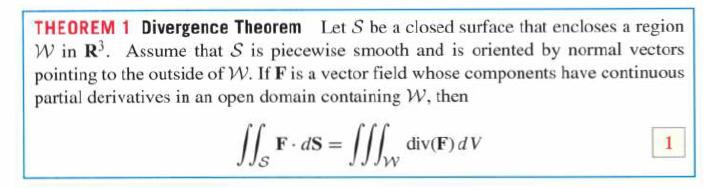
Verify the Divergence Theorem for the vector field and region.\(\mathbf{F}(x, y, z)=\langle 2 x, 3 z, 3 yangle\), the region \(x^{2}+y^{2} \leq 1,0 \leq z \leq 2\) THEOREM 1 Divergence Theorem Let S be a closed surface that encloses a region W in R. Assume that S is piecewise smooth and is oriented
Verify the Divergence Theorem for the vector field and region.\(\mathbf{F}(x, y, z)=\langle x, 0,0angle\), the region \(x^{2}+y^{2} \leq z \leq 4\) THEOREM 1 Divergence Theorem Let S be a closed surface that encloses a region W in R. Assume that S is piecewise smooth and is oriented by normal
Use the Divergence Theorem to evaluate the flux \(\iint_{\mathcal{S}} \mathbf{F} \cdot d \mathbf{S}\).\(\mathbf{F}(x, y, z)=\left\langle 0,0, z^{3} / 3ightangle, \mathcal{S}\) is the sphere \(x^{2}+y^{2}+z^{2}=1\). THEOREM 1 Divergence Theorem Let S be a closed surface that encloses a region W in
Use the Divergence Theorem to evaluate the flux \(\iint_{\mathcal{S}} \mathbf{F} \cdot d \mathbf{S}\).\(\mathbf{F}(x, y, z)=\langle y, z, xangle, \mathcal{S}\) is the sphere \(x^{2}+y^{2}+z^{2}=1\). THEOREM 1 Divergence Theorem Let S be a closed surface that encloses a region W in R. Assume that S
Use the Divergence Theorem to evaluate the flux \(\iint_{\mathcal{S}} \mathbf{F} \cdot d \mathbf{S}\).\(\mathbf{F}(x, y, z)=\left\langle x y^{2}, y z^{2}, z x^{2}ightangle, \mathcal{S}\) is the boundary of the cylinder given by \(x^{2}+y^{2} \leq 4,0 \leq z \leq 3\). THEOREM 1 Divergence Theorem
Use the Divergence Theorem to evaluate the flux \(\iint_{\mathcal{S}} \mathbf{F} \cdot d \mathbf{S}\).\(\mathbf{F}(x, y, z)=\left\langle x^{2} z, y x, x y zightangle, \mathcal{S}\) is the boundary of the tetrahedron given by \(x+y+z \leq 1,0 \leq x, 0 \leq y, 0 \leq z\). THEOREM 1 Divergence
Use the Divergence Theorem to evaluate the flux \(\iint_{\mathcal{S}} \mathbf{F} \cdot d \mathbf{S}\).\(\mathbf{F}(x, y, z)=\left\langle x+z^{2}, x z+y^{2}, z x-yightangle, \mathcal{S}\) is the surface that bounds the solid region with boundary given by the parabolic cylinder \(z=1-x^{2}\), and the
Use the Divergence Theorem to evaluate the flux \(\iint_{\mathcal{S}} \mathbf{F} \cdot d \mathbf{S}\).\(\mathbf{F}(x, y, z)=\left\langle z x, y x^{3}, x^{2} zightangle, \mathcal{S}\) is the surface that bounds the solid region with boundary given by \(y=\) \(4-x^{2}-z^{2}, y=0\). THEOREM 1
Use the Divergence Theorem to evaluate the flux \(\iint_{\mathcal{S}} \mathbf{F} \cdot d \mathbf{S}\).\(\mathbf{F}(x, y, z)=\left\langle x^{3}, 0, z^{3}ightangle, \mathcal{S}\) is the boundary of the region in the first octant of space given by \(x^{2}+y^{2}+z^{2} \leq 4\), \(x \geq 0, y \geq 0, z
Use the Divergence Theorem to evaluate the flux \(\iint_{\mathcal{S}} \mathbf{F} \cdot d \mathbf{S}\).\(\mathbf{F}(x, y, z)=\left\langle e^{x+y}, e^{x+z}, e^{x+y}ightangle, \mathcal{S}\) is the boundary of the unit cube \(0 \leq x \leq 1,0 \leq y \leq 1,0 \leq z \leq 1\). THEOREM 1 Divergence
Use the Divergence Theorem to evaluate the flux \(\iint_{\mathcal{S}} \mathbf{F} \cdot d \mathbf{S}\).\(\mathbf{F}(x, y, z)=\left\langle x, y^{2}, z+yightangle, \mathcal{S}\) is the boundary of the region contained in the cylinder \(x^{2}+y^{2}=4\) between the planes \(z=x\) and \(z=8\). THEOREM 1
Use the Divergence Theorem to evaluate the flux \(\iint_{\mathcal{S}} \mathbf{F} \cdot d \mathbf{S}\).\(\mathbf{F}(x, y, z)=\left\langle x^{2}-z^{2}, e^{z^{2}}-\cos x, y^{3}ightangle, \mathcal{S}\) is the boundary of the region bounded by \(x+2 y+4 z=12\) and the coordinate planes in the first
Use the Divergence Theorem to evaluate the flux \(\iint_{\mathcal{S}} \mathbf{F} \cdot d \mathbf{S}\).\(\mathbf{F}(x, y, z)=\langle x+y, z, z-xangle, \mathcal{S}\) is the boundary of the region between the paraboloid \(z=9-x^{2}-y^{2}\) and the \(x y\)-plane. THEOREM 1 Divergence Theorem Let S be a
Use the Divergence Theorem to evaluate the flux \(\iint_{\mathcal{S}} \mathbf{F} \cdot d \mathbf{S}\).\(\mathbf{F}(x, y, z)=\left\langle e^{z^{2}}, 2 y+\sin \left(x^{2} zight), 4 z+\sqrt{x^{2}+9 y^{2}}ightangle, \mathcal{S}\) is the region \(x^{2}+y^{2} \leq z \leq 8-x^{2}-y^{2}\). THEOREM 1
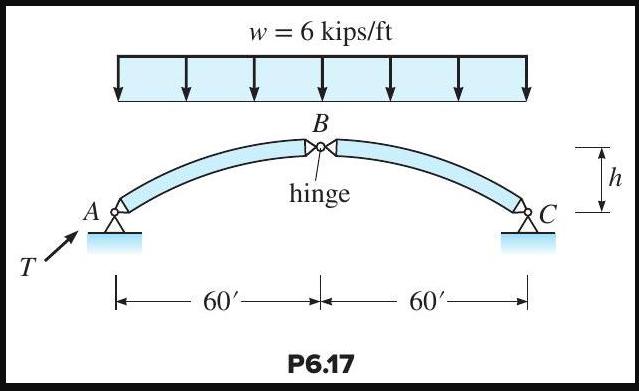
For the arch and loading in Figure P6.18, compute the reactions and determine the height of each point. The maximum height permitted at any point along the arch, \(h_{z \max }\), is \(20 \mathrm{~m}\).
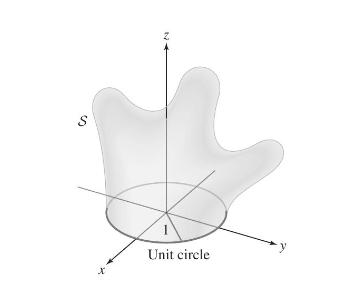
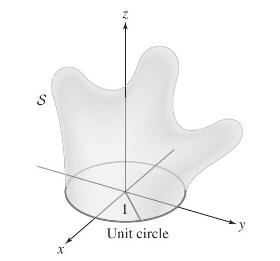
Let \(\mathcal{S}_{1}\) be the closed surface consisting of \(\mathcal{S}\) in Figure 18 together with the unit disk. Find the volume enclosed by \(\mathcal{S}_{1}\), assuming that\[\iint_{\mathcal{S}_{1}}\langle x, 2 y, 3 zangle \cdot d \mathbf{S}=72\] S X 1 Unit circle
Let \(\mathcal{S}\) be the half-cylinder \(x^{2}+y^{2}=1, x \geq 0,0 \leq z \leq 1\). Assume that \(\mathbf{F}\) is a horizontal vector field (the \(z\)-component is zero) such that \(\mathbf{F}(0, y, z)=z y^{2} \mathbf{i}\). Let \(\mathcal{W}\) be the solid region enclosed by \(\mathcal{S}\), and
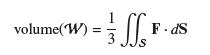
Volume as a Surface Integral Let \(\mathbf{F}(x, y, z)=\langle x, y, zangle\). Prove that if \(\mathcal{W}\) is a region in \(\mathbf{R}^{3}\) with a smooth boundary \(\mathcal{S}\), then\[\operatorname{volume}(\mathcal{W})=\frac{1}{3} \iint_{\mathcal{S}} \mathbf{F} \cdot d \mathbf{S}\]
Use Eq. (9) to calculate the volume of the unit ball as a surface integral over the unit sphere.Eq. (9) volume(W) 3. JfF.ds dS S
Verify that Eq. (9) applied to the box \([0, a] \times[0, b] \times[0, c]\) yields the volume \(V=a b c\).
Let WW be the region in Figure 19 bounded by the cylinder x2+y2=4x2+y2=4, the plane z=x+1z=x+1, and the xyxy-plane. Use the Divergence Theorem to compute the flux of F(x,y,z)=⟨z,x,y+z2⟩F(x,y,z)=⟨z,x,y+z2⟩ through the boundary of WW.
Let \(I=\iint_{\mathcal{S}} \mathbf{F} \cdot d \mathbf{S}\), where\[\mathbf{F}(x, y, z)=\left\langle\frac{2 y z}{r^{2}},-\frac{x z}{r^{2}},-\frac{x y}{r^{2}}ightangle\]\(\left(r=\sqrt{x^{2}+y^{2}+z^{2}}ight)\) and \(\mathcal{S}\) is the boundary of a region \(\mathcal{W}\).(a) Check that
The velocity field of a fluid \(\mathbf{v}\) (in meters per second) has divergence \(\operatorname{div}(\mathbf{v})(P)=3\) at the point \(P=\) \((2,2,2)\). Estimate the flow rate out of the sphere of radius 0.5 centered at \(P\).
Showing 100 - 200
of 8339
1
2
3
4
5
6
7
8
9
10
11
12
13
14
15
Last
Step by Step Answers

 Get 50% OFF
Claim Now
Get 50% OFF
Claim Now