New Semester
Started
Get
50% OFF
Study Help!
--h --m --s
Claim Now
Question Answers
Textbooks
Find textbooks, questions and answers
Oops, something went wrong!
Change your search query and then try again
S
Books
FREE
Study Help
Expert Questions
Accounting
General Management
Mathematics
Finance
Organizational Behaviour
Law
Physics
Operating System
Management Leadership
Sociology
Programming
Marketing
Database
Computer Network
Economics
Textbooks Solutions
Accounting
Managerial Accounting
Management Leadership
Cost Accounting
Statistics
Business Law
Corporate Finance
Finance
Economics
Auditing
Tutors
Online Tutors
Find a Tutor
Hire a Tutor
Become a Tutor
AI Tutor
AI Study Planner
NEW
Sell Books
Search
Search
Sign In
Register
study help
mathematics
calculus 4th
Calculus 4th Edition Jon Rogawski, Colin Adams, Robert Franzosa - Solutions
A hose feeds into a small screen box of volume \(10 \mathrm{~cm}^{3}\) that is suspended in a swimming pool. Water flows across the surface of the box at a rate of \(12 \mathrm{~cm}^{3} / \mathrm{s}\). Estimate \(\operatorname{div}(\mathbf{v})(P)\), where \(\mathbf{v}\) is the velocity field of the
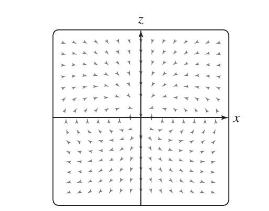
The electric field due to a unit electric dipole oriented in the \(\mathbf{k}\)-direction is \(\mathbf{E}=abla\left(z / r^{3}ight)\), where \(r=\) \(\left(x^{2}+y^{2}+z^{2}ight)^{1 / 2}\) (Figure 20). Let \(\mathbf{e}_{r}=r^{-1}\langle x, y, zangle\).(a) Show that \(\mathbf{E}=r^{-3} \mathbf{k}-3 z
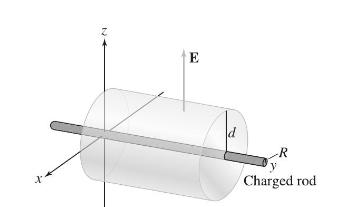
Let \(\mathbf{E}\) be the electric field due to a long, uniformly charged rod of radius \(R\) with charge density \(\delta\) per unit length (Figure 21). By symmetry, we may assume that \(\mathbf{E}\) is everywhere perpendicular to the rod and its magnitude \(E(d)\) depends only on the distance
Let \(\mathcal{W}\) be the region between the sphere of radius 4 and the cube of side 1, both centered at the origin. What is the flux through the boundary \(\mathcal{S}=\partial \mathcal{W}\) of a vector field \(\mathbf{F}\) whose divergence has the constant value
Let \(\mathcal{W}\) be the region between the sphere of radius 3 and the sphere of radius 2 , both centered at the origin. Use the Divergence Theorem to calculate the flux of \(\mathbf{F}=x \mathbf{i}\) through the boundary \(\mathcal{S}=\partial \mathcal{W}\).
Let \(f\) be a scalar function and \(\mathbf{F}\) be a vector field. Prove the following Product Rule for Divergence:\[\operatorname{div}(f \mathbf{F})=f \operatorname{div}(\mathbf{F})+abla f \cdot \mathbf{F}\]
Let \(\mathbf{F}\) and \(\mathbf{G}\) be vector fields. Prove the the following Product Rule for Divergence:\[\operatorname{div}(\mathbf{F} \times \mathbf{G})=\operatorname{curl}(\mathbf{F}) \cdot \mathbf{G}-\mathbf{F} \cdot \operatorname{curl}(\mathbf{G})\]
A vector field \(\mathbf{F}\) is incompressible if \(\operatorname{div}(\mathbf{F})=0\) and is irrotational if \(\operatorname{curl}(\mathbf{F})=\mathbf{0}\).Let \(\mathbf{F}\) be an incompressible vector field that is everywhere tangent to level surfaces of \(f\). Prove that \(f \mathbf{F}\) is
A vector field \(\mathbf{F}\) is incompressible if \(\operatorname{div}(\mathbf{F})=0\) and is irrotational if \(\operatorname{curl}(\mathbf{F})=\mathbf{0}\).Prove that the cross product of two irrotational vector fields is incompressible, and explain why this implies that the cross product of two
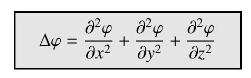
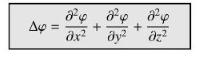
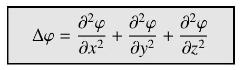
\(\Delta\) denotes the Laplace operator defined byProve the identity = + dx2 +
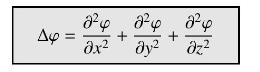
\(\Delta\) denotes the Laplace operator defined byProve the identity\[\operatorname{curl}(\operatorname{curl}(\mathbf{F}))=abla(\operatorname{div}(\mathbf{F}))-\Delta \mathbf{F}\]where \(\Delta \mathbf{F}\) denotes \(\left\langle\Delta F_{1}, \Delta F_{2}, \Delta F_{3}ightangle\). 0x2 ' ' +
\(\Delta\) denotes the Laplace operator defined byA function \(\varphi\) satisfying \(\Delta \varphi=0\) is called harmonic.(a) Show that \(\Delta \varphi=\operatorname{div}(abla \varphi)\) for any function \(\varphi\).(b) Show that \(\varphi\) is harmonic if and only if \(\operatorname{div}(abla
\(\Delta\) denotes the Laplace operator defined byLet \(\mathbf{F}=r^{n} \mathbf{e}_{r}\), where \(n\) is any number, \(r=\left(x^{2}+y^{2}+z^{2}ight)^{1 / 2}\), and \(\mathbf{e}_{r}=r^{-1}\langle x, y, zangle\) is the unit radial vector.(a) Calculate \(\operatorname{div}(\mathbf{F})\).(b)
Let \(\mathcal{S}\) be the boundary surface of a region \(\mathcal{W}\) in \(\mathbf{R}^{3}\), and let \(D_{\mathbf{n}} \varphi\) denote the directional derivative of \(\varphi\), where \(\mathbf{n}\) is the outward unit normal vector. Let \(\Delta\) be the Laplace operator defined earlier.(a) Use
Assume that \(\varphi\) is harmonic. Show that \(\operatorname{div}(\varphi abla \varphi)=\|abla \varphi\|^{2}\) and conclude that\[\iint_{\mathcal{S}} \varphi D_{\mathbf{n}} \varphi d S=\iiint_{\mathcal{W}}\|abla \varphi\|^{2} d V\]
Let \(\mathbf{F}=\langle P, Q, Rangle\) be a vector field defined on \(\mathbf{R}^{3}\) such that \(\operatorname{div}(\mathbf{F})=0\). Use the following steps to show that \(\mathbf{F}\) has a vector potential.(a) Let \(\mathbf{A}=\langle f, 0, gangle\). Show
Show that\[\mathbf{F}(x, y, z)=\left\langle 2 y-1,3 z^{2}, 2 x yightangle\]has a vector potential and find one.
Show that\[\mathbf{F}(x, y, z)=\left\langle 2 y e^{z}-x y, y, y z-zightangle\]has a vector potential and find one.
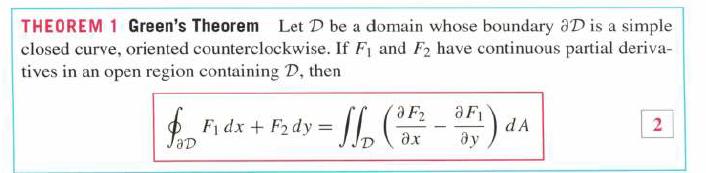
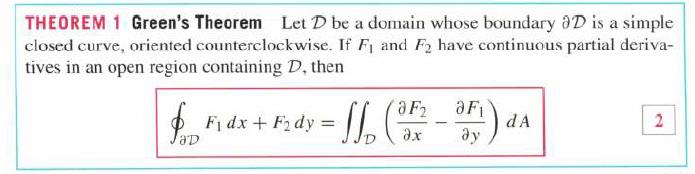
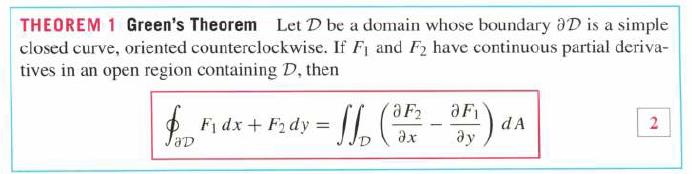
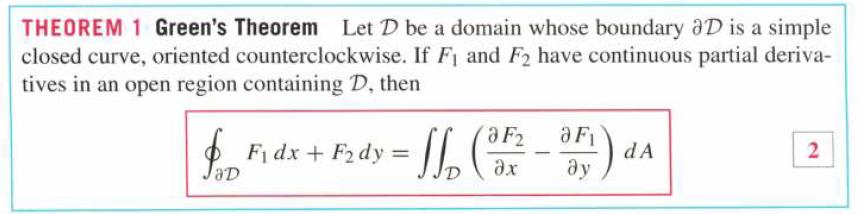
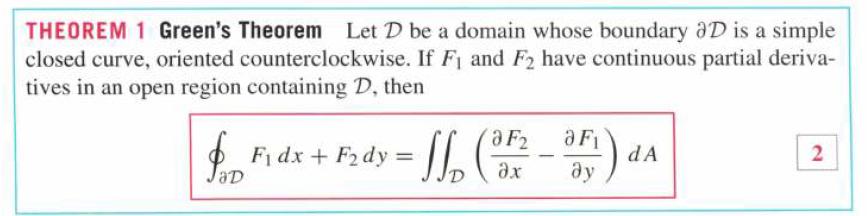
Let \(\mathbf{F}(x, y)=\left\langle x+y^{2}, x^{2}-yightangle\), and let \(C\) be the unit circle, oriented counterclockwise. Evaluate \(\oint_{C} \mathbf{F} \cdot d \mathbf{r}\) directly as a line integral and using Green's Theorem. THEOREM 1 Green's Theorem Let D be a domain whose boundary
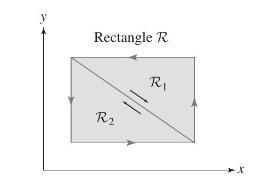
Let \(\partial \mathcal{R}\) be the boundary of the rectangle in Figure 1, and let \(\partial \mathcal{R}_{1}\) and \(\partial \mathcal{R}_{2}\) be the boundaries of the two triangles, all oriented counterclockwise.(a) Determine \(\oint_{\partial \mathcal{R}_{1}} \mathbf{F} \cdot d \mathbf{r}\) if
Calculate the flux of the vector field \(\mathbf{E}(x, y, z)=\langle 0,0, xangle\) through the part of the ellipsoid\[4 x^{2}+9 y^{2}+z^{2}=36\]where \(z \geq 3, x \geq 0, y \geq 0\). Hint: Use the parametrization\[\Phi(r, \theta)=\left(3 r \cos \theta, 2 r \sin \theta, 6 \sqrt{1-r^{2}}ight)\]
Which vector field \(\mathbf{F}\) is being integrated in the line integral \(\oint x^{2} d y-e^{y} d x\) ?
Indicate which of the following vector fields possess this property: For every simple closed curve \(C\),\(\oint_{C} \mathbf{F} \cdot d \mathbf{r}\) is equal to the area enclosed by \(C\).(a) \(\mathbf{F}(x, y)=\langle-y, 0angle\)(b) \(\mathbf{F}(x, y)=\langle x, yangle\)(c) \(\mathbf{F}(x,
Let \(A\) be the area enclosed by a simple closed curve \(C\), and assume that \(C\) is oriented counterclockwise. Indicate whether the value of each integral is \(0,-A\), or \(A\).(a) \(\oint_{C} x d x\)(b) \(\oint_{C} y d x\)(c) \(\oint_{C} y d y\)(d) \(\oint_{C} x d y\)
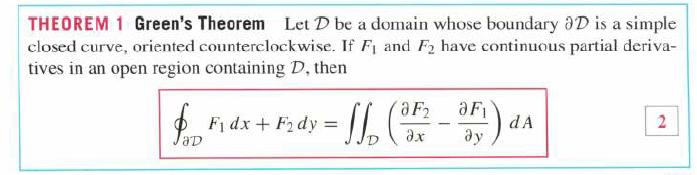
Verify Green's Theorem for the line integral \(\oint_{C} x y d x+y d y\), where \(C\) is the unit circle, oriented counterclockwise. THEOREM 1 Green's Theorem Let D be a domain whose boundary ID is a simple closed curve, oriented counterclockwise. If F and F2 have continuous partial deriva- tives
Let \(I=\oint_{C} \mathbf{F} \cdot d \mathbf{r}\), where \(\mathbf{F}(x, y)=\left\langle y+\sin x^{2}, x^{2}+e^{y^{2}}ightangle\) and \(C\) is the circle of radius 4 centered at the origin.(a) Which is easier, evaluating \(I\) directly or using Green's Theorem?(b) Evaluate \(I\) using the easier
Use Green's Theorem to evaluate the line integral. Orient the curve counterclockwise unless otherwse indicated.\(\oint_{C} y^{2} d x+x^{2} d y\), where \(C\) is the boundary of the square that is given by \(0 \leq x \leq 1,0 \leq y \leq 1\) THEOREM 1 Green's Theorem Let D be a domain whose boundary
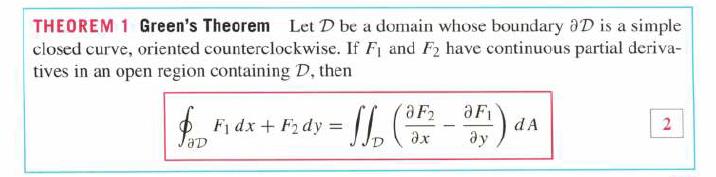
Use Green's Theorem to evaluate the line integral. Orient the curve counterclockwise unless otherwse indicated.\(\oint_{C} y^{2} d x+x^{2} d y\), where \(C\) is the boundary of the square \(-1 \leq x \leq 1,-1 \leq y \leq 1\) THEOREM 1 Green's Theorem Let D be a domain whose boundary 3D is a simple
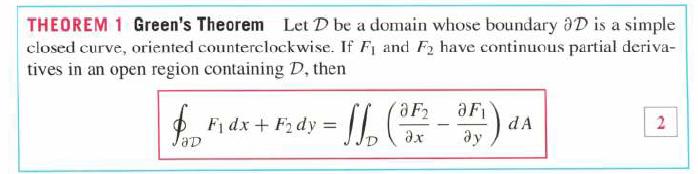
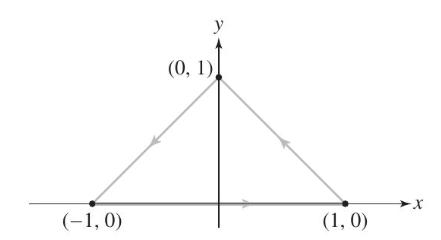
Use Green's Theorem to evaluate the line integral. Orient the curve counterclockwise unless otherwse indicated.\(\oint_{C} 5 y d x+2 x d y\), where \(C\) is the triangle with vertices \((-1,0),(1,0)\), and \((0,1)\) THEOREM 1 Green's Theorem Let D be a domain whose boundary 3D is a simple closed
Use Green's Theorem to evaluate the line integral. Orient the curve counterclockwise unless otherwse indicated.\(\oint_{C} e^{2 x+y} d x+e^{-y} d y\), where \(C\) is the triangle with vertices \((0,0),(1,0)\), and \((1,1)\) THEOREM 1 Green's Theorem Let D be a domain whose boundary 3D is a simple
Use Green's Theorem to evaluate the line integral. Orient the curve counterclockwise unless otherwse indicated.\(\oint_{C} x^{2} y d x\), where \(C\) is the unit circle centered at the origin THEOREM 1 Green's Theorem Let D be a domain whose boundary 3D is a simple closed curve, oriented
Use Green's Theorem to evaluate the line integral. Orient the curve counterclockwise unless otherwse indicated.\(\oint_{C} \mathbf{F} \cdot d \mathbf{r}\), where \(\mathbf{F}(x, y)=\left\langle x+y, x^{2}-yightangle\) and \(C\) is the boundary of the region enclosed by \(y=x^{2}\) and
Use Green's Theorem to evaluate the line integral. Orient the curve counterclockwise unless otherwse indicated.\(\oint_{C} \mathbf{F} \cdot d \mathbf{r}\), where \(\mathbf{F}(x, y)=\left\langle x^{2}, x^{2}ightangle\) and \(C\) consists of the arcs \(y=x^{2}\) and \(y=x\) for \(0 \leq x \leq 1\)
Use Green's Theorem to evaluate the line integral. Orient the curve counterclockwise unless otherwse indicated.\(\oint_{C}(\ln x+y) d x-x^{2} d y\), where \(C\) is the rectangle with vertices \((1,1),(3,1),(1,4)\), and \((3,4)\) THEOREM 1 Green's Theorem Let D be a domain whose boundary 3D is a
Use Green's Theorem to evaluate the line integral. Orient the curve counterclockwise unless otherwse indicated.The line integral of \(\mathbf{F}(x, y)=\left\langle e^{x+y}, e^{x-y}ightangle\) along the curve (oriented clockwise) consisting of the line segments by joining the points
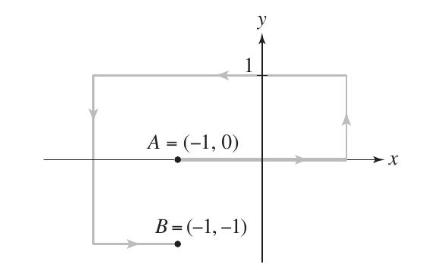
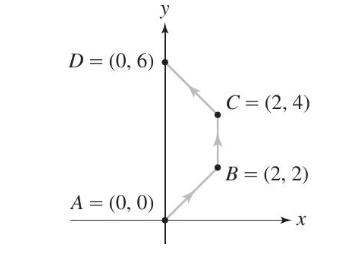
Use Green's Theorem to evaluate the line integral. Orient the curve counterclockwise unless otherwse indicated.∫Cxydx+(x2+x)dy∫Cxydx+(x2+x)dy, where CC is the path in Figure 17 THEOREM 1 Green's Theorem Let D be a domain whose boundary 3D is a simple closed curve, oriented counterclockwise. If
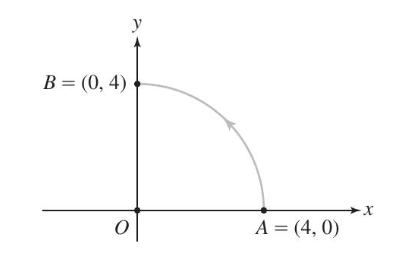
Use Green's Theorem to evaluate the line integral. Orient the curve counterclockwise unless otherwse indicated.Let \(\mathbf{F}(x, y)=\left\langle 2 x e^{y}, x+x^{2} e^{y}ightangle\) and let \(C\) be the quarter-circle path from \(A\) to \(B\) in Figure 18. Evaluate \(I=\oint_{C} \mathbf{F} \cdot d
Compute the line integral of \(\mathbf{F}(x, y)=\left\langle x^{3}, 4 xightangle\) along the path from \(A\) to \(B\) in Figure 19. To save work, use Green's Theorem to relate this line integral to the line integral along the vertical path from \(B\) to \(A\). THEOREM 1 Green's Theorem Let D be a
Evaluate \(I=\int_{C}(\sin x+y) d x+(3 x+y) d y\) for the nonclosed path \(A B C D\) in Figure 20. Use the method of Exercise 14.Data From Exercise 14Compute the line integral of \(\mathbf{F}(x, y)=\left\langle x^{3}, 4 xightangle\) along the path from \(A\) to \(B\) in Figure 19. To save work, use
Use \(\oint_{C} y d x\) to compute the area of the ellipse \(\left(\frac{x}{a}ight)^{2}+\left(\frac{y}{b}ight)^{2}=1\).
Use \(\frac{1}{2} \oint_{C} x d y-y d x\) to compute the area of the ellipse \(\left(\frac{x}{a}ight)^{2}+\left(\frac{y}{b}ight)^{2}=1\).
Use one of the formulas in Eq. (6) to calculate the area of the given region.The circle of radius 3 centered at the origin = fxdy = f-ydx = 1/ fxdy - ydx 2 area enclosed by C =
Use one of the formulas in Eq. (6) to calculate the area of the given region.The triangle with vertices \((0,0),(1,0)\), and \((1,1)\) = fxdy = fydx = 1 fxdy - ydx 2 area enclosed by C =
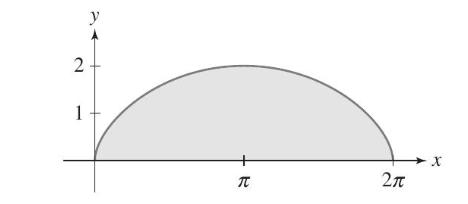
Use one of the formulas in Eq. (6) to calculate the area of the given region.The region between the \(x\)-axis and the cycloid parametrized by \(\mathbf{r}(t)=\langle t-\sin t, 1-\cos tangle\) for \(0 \leq t \leq 2 \pi\) (Figure 21) = fxdy = fydx = 1 fxdy - ydx 2 area enclosed by C =
Use one of the formulas in Eq. (6) to calculate the area of the given region.The region between the graph of \(y=x^{2}\) and the \(x\)-axis for \(0 \leq x \leq 2\) = fxdy = fydx = 1 fxdy - ydx 2 area enclosed by C =
A square with vertices \((1,1),(-1,1),(-1,-1)\), and \((1,-1)\) has area 4 . Calculate this area three times using the formulas in Eq. (6). = fxdy = f -y dx = 1 f xdy - ydx 2 area enclosed by C =
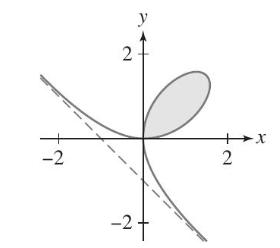
Let \(x^{3}+y^{3}=3 x y\) be the folium of Descartes (Figure 22).(a) Show that the folium has a parametrization in terms of \(t=y / x\) given by\[x=\frac{3 t}{1+t^{3}}, \quad y=\frac{3 t^{2}}{1+t^{3}} \quad(-\infty\](b) Show that\[x d y-y d x=\frac{9 t^{2}}{\left(1+t^{3}ight)^{2}} d t\]By the
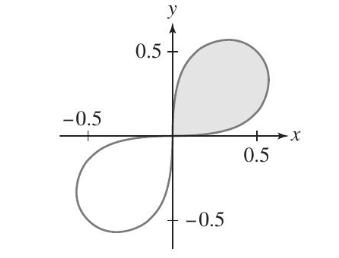
Find a parametrization of the lemniscate \(\left(x^{2}+y^{2}ight)^{2}=x y\) (see Figure 23) by using \(t=y / x\) as a parameter (see Exercise 23). Then use Eq. (6) to find the area of one loop of the lemniscate.Data From Exercise 23Let \(x^{3}+y^{3}=3 x y\) be the folium of Descartes (Figure 22).
The Centroid via Boundary Measurements The centroid (see Section 15.5) of a domain \(\mathcal{D}\) enclosed by a simple closed curve \(C\) is the point with coordinates \((\bar{x}, \bar{y})=\left(M_{y} / M, M_{x} / Might)\), where \(M\) is the area of \(\mathcal{D}\) and the moments are defined
Use the result of Exercise 25 to compute the moments of the semicircle x2+y2=R2,y≥0x2+y2=R2,y≥0 as line integrals. Verify that the centroid is (0,4R/(3π))(0,4R/(3π)).Data From Exercise 25The Centroid via Boundary Measurements The centroid (see Section 15.5) of a domain \(\mathcal{D}\)
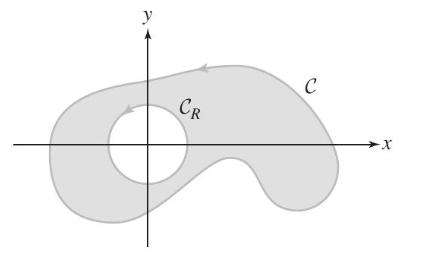
Let \(C_{R}\) be the circle of radius \(R\) centered at the origin. Use the general form of Green's Theorem to determine \(\oint_{C_{2}} \mathbf{F} \cdot d \mathbf{r}\), where \(\mathbf{F}\) is a vector field such that \(\oint_{\mathcal{C}_{1}} \mathbf{F} \cdot d \mathbf{r}=9\) and \(\frac{\partial
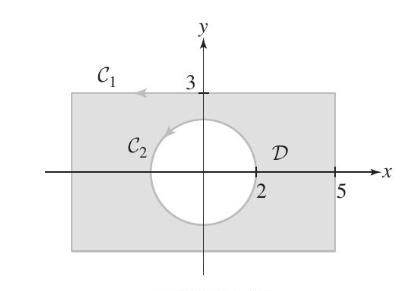
Referring to Figure 24 , suppose that \(\oint_{C_{2}} \mathbf{F} \cdot d \mathbf{r}=12\). Use Green's Theorem to determine \(\oint_{C_{1}} \mathbf{F} \cdot d \mathbf{r}\), assuming that \(\frac{\partial F_{2}}{\partial x}-\frac{\partial F_{1}}{\partial y}=-3\) in \(\mathcal{D}\). C C2 y 3 2 D 5 -X
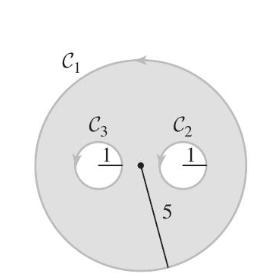
Referring to Figure 25, suppose that\[\oint_{C_{2}} \mathbf{F} \cdot d \mathbf{r}=3 \pi, \quad \oint_{C_{3}} \mathbf{F} \cdot d \mathbf{r}=4 \pi\]Use Green's Theorem to determine the circulation of \(\mathbf{F}\) around \(C_{1}\), assuming that \(\frac{\partial F_{2}}{\partial x}-\frac{\partial
Let \(\mathbf{F}\) be the vector field\[\mathbf{F}(x, y)=\left\langle\frac{x}{x^{2}+y^{2}}, \frac{y}{x^{2}+y^{2}}ightangle\]and assume that \(C_{R}\) is the circle of radius \(R\) centered at the origin and oriented counterclockwise.(a) Show that \(\frac{\partial F_{2}}{\partial x}-\frac{\partial
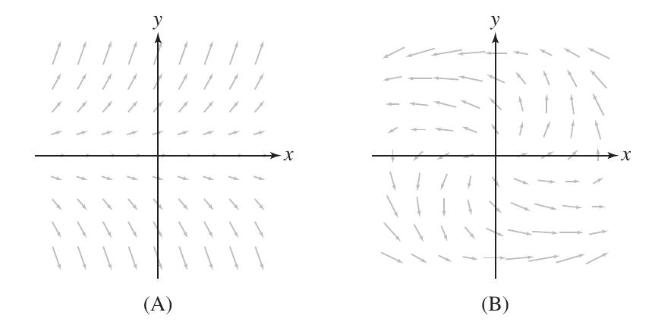
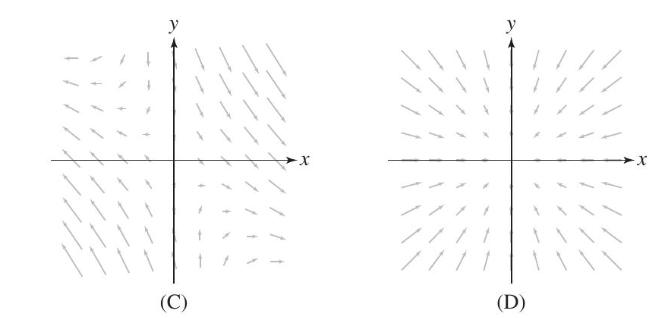
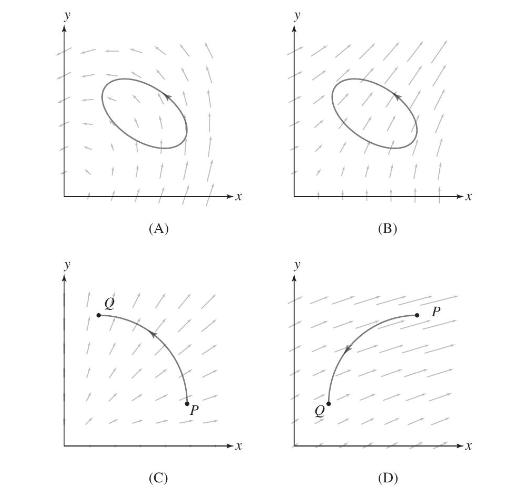
We refer to the integrand that occurs in Green's Theorem and that appears as\[\operatorname{curl}_{z}(\mathbf{F})=\frac{\partial F_{2}}{\partial x}-\frac{\partial F_{1}}{\partial y}\]For the vector fields (A)-(D) in Figure 27, state whether \(\operatorname{curl}_{z}\) at the origin appears to be
We refer to the integrand that occurs in Green's Theorem and that appears as\[\operatorname{curl}_{z}(\mathbf{F})=\frac{\partial F_{2}}{\partial x}-\frac{\partial F_{1}}{\partial y}\]Estimate the circulation of a vector field \(\mathbf{F}\) around a circle of radius \(R=0.1\), assuming that
We refer to the integrand that occurs in Green's Theorem and that appears as\[\operatorname{curl}_{z}(\mathbf{F})=\frac{\partial F_{2}}{\partial x}-\frac{\partial F_{1}}{\partial y}\]Estimate ∮CF⋅dr∮CF⋅dr, where F(x,y)=⟨x+0.1y2,y−0.1x2⟩F(x,y)=⟨x+0.1y2,y−0.1x2⟩ and CC encloses a
We refer to the integrand that occurs in Green's Theorem and that appears ascurlz(F)=∂F2∂x−∂F1∂ycurlz(F)=∂F2∂x−∂F1∂yLet FF be a velocity field. Estimate the circulation of FF around a circle of radius R=0.05R=0.05 with center PP, assuming that
Let \(C_{R}\) be the circle of radius \(R\) centered at the origin. Use Green's Theorem to find the value of \(R\) that maximizes \(\oint_{C_{R}} y^{3} d x+x d y\).
Calculate \(\operatorname{div}(\mathbf{F})\) and \(\operatorname{curl}(\mathbf{F})\).\(\mathbf{F}=\left\langle e^{x+y}, e^{y+z}, x y zightangle\)
Calculate \(\operatorname{div}(\mathbf{F})\) and \(\operatorname{curl}(\mathbf{F})\).\(\mathbf{F}=abla\left(e^{-x^{2}-y^{2}-z^{2}}ight)\)
Calculate \(\operatorname{div}(\mathbf{F})\) and \(\operatorname{curl}(\mathbf{F})\).\(\mathbf{e}_{r}=r^{-1}\langle x, y, zangle\left(r=\sqrt{x^{2}+y^{2}+z^{2}}ight)\)
Show that if \(F_{1}, F_{2}\), and \(F_{3}\) are differentiable functions of one variable, then\[\operatorname{curl}\left(\left\langle F_{1}(x), F_{2}(y), F_{3}(z)ightangleight)=\mathbf{0}\]Use this to calculate the curl of\[\mathbf{F}(x, y, z)=\left\langle x^{2}+y^{2}, \ln y+z^{2}, z^{3} \sin
Give an example of a nonzero vector field \(\mathbf{F}\) such that \(\operatorname{curl}(\mathbf{F})=\mathbf{0}\) and \(\operatorname{div}(\mathbf{F})=0\).
Verify the identity \(\operatorname{div}(\operatorname{curl} \mathbf{F})=0\) for the vector fields \(\mathbf{F}=\left\langle x z, y e^{x}, y zightangle\) and \(\mathbf{G}=\left\langle z^{2}, x y^{3}, x^{2} yightangle\).
Determine whether the vector field is conservative, and if so, find a potential function.\(\mathbf{F}(x, y)=\left\langle x^{2} y, y^{2} xightangle\)
Determine whether the vector field is conservative, and if so, find a potential function.\(\mathbf{F}(x, y)=\left\langle 4 x^{3} y^{5}, 5 x^{4} y^{4}ightangle\)
Determine whether the vector field is conservative, and if so, find a potential function.\(\mathbf{F}(x, y, z)=\left\langle\sin x, e^{y}, zightangle\)
Determine whether the vector field is conservative, and if so, find a potential function.\(\mathbf{F}(x, y, z)=\left\langle 2,4, e^{z}ightangle\)
Determine whether the vector field is conservative, and if so, find a potential function.\(\mathbf{F}(x, y, z)=\left\langle x y z, \frac{1}{2} x^{2} z, 2 z^{2} yightangle\)
Determine whether the vector field is conservative, and if so, find a potential function.\(\mathbf{F}(x, y)=\left\langle y^{4} x^{3}, x^{4} y^{3}ightangle\)
Determine whether the vector field is conservative, and if so, find a potential function.\(\mathbf{F}(x, y, z)=\left\langle\frac{y}{1+x^{2}}, \tan ^{-1} x, 2 zightangle\)
Determine whether the vector field is conservative, and if so, find a potential function.\(\mathbf{F}(x, y, z)=\left\langle\frac{2 x y}{x^{2}+z}, \ln \left(x^{2}+zight), \frac{y}{x^{2}+z}ightangle\)
Determine whether the vector field is conservative, and if so, find a potential function.\(\mathbf{F}(x, y, z)=\left\langle x e^{2 x}, y e^{2 z}, z e^{2 y}ightangle\)
Find a conservative vector field of the form \(\mathbf{F}=\langle g(y), h(x)angle\) such that \(\mathbf{F}(0,0)=\langle 1,1angle\), where \(g(y)\) and \(h(x)\) are differentiable functions. Determine all such vector fields.
Compute the line integral \(\int_{C} f(x, y) d s\) for the given function and path or curve.\(f(x, y)=x y\), the path \(\mathbf{r}(t)=\langle t, 2 t-1angle\) for \(0 \leq t \leq 1\)
Compute the line integral \(\int_{C} f(x, y) d s\) for the given function and path or curve.\(f(x, y)=x-y\), the unit semicircle \(x^{2}+y^{2}=1, y \geq 0\)
Compute the line integral \(\int_{C} f(x, y) d s\) for the given function and path or curve.\(f(x, y, z)=e^{x}-\frac{y}{2 \sqrt{2} z}, \quad\) the path \(\mathbf{r}(t)=\left\langle\ln t, \sqrt{2} t, \frac{1}{2} t^{2}ightangle\) for \(1 \leq t \leq 2\)
Compute the line integral \(\int_{C} f(x, y) d s\) for the given function and path or curve.\(f(x, y, z)=x+2 y+z\), the helix \(\mathbf{r}(t)=\langle\cos t, \sin t, tangle\) for \(0 \leq t \leq \pi / 2\)
Find the total mass of an \(\mathrm{L}\)-shaped rod consisting of the segments \((2 t, 2)\) and \((2,2-2 t)\) for \(0 \leq t \leq 1\) (length in centimeters) with mass density \(\delta(x, y)=x^{2} y \mathrm{~g} / \mathrm{cm}\).
Calculate \(\mathbf{F}=abla f\), where \(f(x, y, z)=x y e^{z}\), and compute \(\int_{C} \mathbf{F} \cdot d \mathbf{r}\), where:(a) \(C\) is any curve from \((1,1,0)\) to \((3, e,-1)\).(b) \(C\) is the boundary of the square \(0 \leq x \leq 1,0 \leq y \leq 1\) oriented counterclockwise.
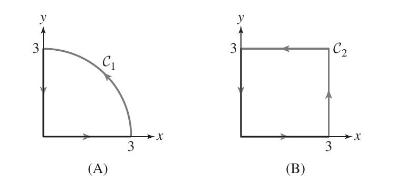
Calculate \(\int_{C_{1}} y d x+x^{2} y d y\), where \(C_{1}\) is the oriented curve in Figure 1(A). 3 C (A) 3 -X y 3 (B) C 3 -X
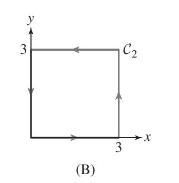
Let F(x,y)=⟨9y−y3,e√y(x2−3x)⟩F(x,y)=⟨9y−y3,ey(x2−3x)⟩, and let C2C2 be the oriented curve in Figure 1(B).(a) Show that FF is not conservative.(b) Show that ∫C2F⋅dr=0∫C2F⋅dr=0 without explicitly computing the integral. Hint: Show that FF is orthogonal to the edges along the
Compute the line integral \(\int_{\mathbf{c}} \mathbf{F} \cdot d \mathbf{r}\) for the given vector field and path.\(\mathbf{F}(x, y)=\left\langle\frac{2 y}{x^{2}+4 y^{2}}, \frac{x}{x^{2}+4 y^{2}}ightangle\), the path \(\mathbf{r}(t)=\left\langle\cos t, \frac{1}{2} \sin tightangle\) for \(0 \leq t
Compute the line integral \(\int_{\mathbf{c}} \mathbf{F} \cdot d \mathbf{r}\) for the given vector field and path.\(\mathbf{F}(x, y)=\left\langle 2 x y, x^{2}+y^{2}ightangle\), the part of the unit circle in the first quadrant oriented counterclockwise
Compute the line integral \(\int_{\mathbf{c}} \mathbf{F} \cdot d \mathbf{r}\) for the given vector field and path.\(\mathbf{F}(x, y)=\left\langle x^{2} y, y^{2} z, z^{2} xightangle\), the path \(\mathbf{r}(t)=\left\langle e^{-t}, e^{-2 t}, e^{-3 t}ightangle\) for \(0 \leq t
Compute the line integral \(\int_{\mathbf{c}} \mathbf{F} \cdot d \mathbf{r}\) for the given vector field and path.\(\mathbf{F}=abla f\), where \(f(x, y, z)=4 x^{2} \ln \left(1+y^{4}+z^{2}ight), \quad\) the path \(\mathbf{r}(t)=\left\langle t^{3}, \ln \left(1+t^{2}ight), e^{t}ightangle\) for \(0
Consider the line integrals \(\int_{C} \mathbf{F} \cdot d \mathbf{r}\) for the vector fields \(\mathbf{F}\) and paths \(\mathbf{r}\) in Figure 2. Which two of the line integrals appear to have a value of zero? Which of the other two appears to have a negative value? 1 1 1 (A) (C) + x (B) (D)
Calculate the work required to move an object from \(P=(1,1,1)\) to \(Q=(3,-4,-2)\) against the force field \(\mathbf{F}(x, y, z)=-12 r^{-4}\langle x, y, zangle\) (distance in meters, force in newtons), where \(r=\sqrt{x^{2}+y^{2}+z^{2}}\). Find a potential function for \(\mathbf{F}\).
Find constants \(a, b, c\) such that\[\Phi(u, v)=(u+a v, b u+v, 2 u-c)\]parametrizes the plane \(3 x-4 y+z=5\). Calculate \(\mathbf{T}_{u}, \mathbf{T}_{v}\), and \(\mathbf{N}(u, v)\).
Calculate the integral of \(f(x, y, z)=e^{z}\) over the portion of the plane \(x+2 y+2 z=3\), where \(x, y, z \geq 0\).
Compute \(\iint_{\mathcal{S}} \mathbf{F} \cdot d \mathbf{S}\) for the given oriented surface or parametrized surface.\(\mathbf{F}(x, y, z)=\left\langle z, 0, z^{2}ightangle, \quad \Phi(u, v)=(v \cosh u, v \sinh u, v), 0 \leq u \leq 1,0 \leq v \leq 1, \quad\) upward-pointing normal
Let \(\mathcal{S}\) be the surface parametrized by\[\Phi(u, v)=\left(2 u \sin \frac{v}{2}, 2 u \cos \frac{v}{2}, 3 vight)\]for \(0 \leq u \leq 1\) and \(0 \leq v \leq 2 \pi\)(a) Calculate the tangent vectors \(\mathbf{T}_{u}\) and \(\mathbf{T}_{v}\) and the normal vector \(\mathbf{N}(u, v)\) at
Plot the surface with parametrization\[\Phi(u, v)=(u+4 v, 2 u-v, 5 u v)\]for \(-1 \leq v \leq 1,-1 \leq u \leq 1\). Express the surface area as a double integral and use a computer algebra system to compute the area numerically.
Express the surface area of the surface \(z=10-x^{2}-y^{2}\) for \(-1 \leq x \leq 1,-3 \leq y \leq 3\) as a double integral. Evaluate the integral numerically using a CAS.
Evaluate \(\iint_{\mathcal{S}} x^{2} y d S\), where \(\mathcal{S}\) is the surface \(z=\sqrt{3} x+y^{2},-1 \leq x \leq 1,0 \leq y \leq 1\)
Calculate \(\iint_{\mathcal{S}}\left(x^{2}+y^{2}ight) e^{-z} d S\), where \(\mathcal{S}\) is the cylinder with equation \(x^{2}+y^{2}=9\) for \(0 \leq z \leq 10\).
Let SS be the upper hemisphere x2+y2+z2=1,z≥0x2+y2+z2=1,z≥0. For each of the functions (a)-(d), determine whether \(\iint_{\mathcal{S}} f d S\) is positive, zero, or negative (without evaluating the integral). Explain your reasoning.(a) \(f(x, y, z)=y^{3}\)(b) \(f(x, y, z)=z^{3}\)(c) \(f(x, y,
Let \(\mathcal{S}\) be a small patch of surface with a parametrization \(\Phi(u, v)\) for \(0 \leq u \leq 0.1,0 \leq v \leq 0.1\) such that the normal vector \(\mathbf{N}(u, v)\) for \((u, v)=(0,0)\) is \(\mathbf{N}=\langle 2,-2,4angle\). Use Eq. (3) in Section 16.4 to estimate the surface area of
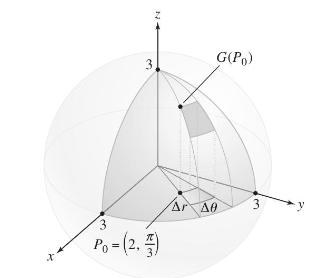
The upper half of the sphere \(x^{2}+y^{2}+z^{2}=9\) has parametrization \(\Phi(r, \theta)=\left(r \cos \theta, r \sin \theta, \sqrt{9-r^{2}}ight)\) in cylindrical coordinates (Figure 3).(a) Calculate the normal vector \(\mathbf{N}=\mathbf{T}_{r} \times \mathbf{T}_{\theta}\) at the point
Showing 200 - 300
of 8339
1
2
3
4
5
6
7
8
9
10
11
12
13
14
15
Last
Step by Step Answers

 Get 50% OFF
Claim Now
Get 50% OFF
Claim Now