New Semester
Started
Get
50% OFF
Study Help!
--h --m --s
Claim Now
Question Answers
Textbooks
Find textbooks, questions and answers
Oops, something went wrong!
Change your search query and then try again
S
Books
FREE
Study Help
Expert Questions
Accounting
General Management
Mathematics
Finance
Organizational Behaviour
Law
Physics
Operating System
Management Leadership
Sociology
Programming
Marketing
Database
Computer Network
Economics
Textbooks Solutions
Accounting
Managerial Accounting
Management Leadership
Cost Accounting
Statistics
Business Law
Corporate Finance
Finance
Economics
Auditing
Tutors
Online Tutors
Find a Tutor
Hire a Tutor
Become a Tutor
AI Tutor
AI Study Planner
NEW
Sell Books
Search
Search
Sign In
Register
study help
mathematics
calculus 4th
Calculus 4th Edition Jon Rogawski, Colin Adams, Robert Franzosa - Solutions
Calculate \(\iint_{\mathcal{S}} f(x, y, z) d S\) for the given surface and function.Part of the unit sphere centered at the origin, where \(x \geq 0\) and \(|y| \leq x ; \quad f(x, y, z)=x\)
A surface \(\mathcal{S}\) has a parametrization \(\Phi(u, v)\) with rectangular domain \(0 \leq u \leq 2,0 \leq v \leq 4\) such that the following partial derivatives are constant:\[\frac{\partial \Phi}{\partial u}=\langle 2,0,1angle, \quad \frac{\partial \Phi}{\partial v}=\langle 4,0,3angle\]What
Let \(S\) be the sphere of radius \(R\) centered at the origin. Explain using symmetry:\[\iint_{S} x^{2} d S=\iint_{S} y^{2} d S=\iint_{S} z^{2} d S\]Then show that \(\iint_{S} x^{2} d S=\frac{4}{3} \pi R^{4}\) by adding the integrals.
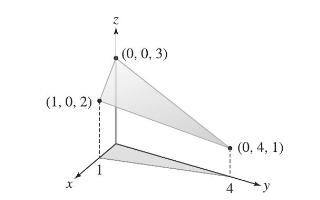
Calculate \(\iint_{\mathcal{S}}\left(x y+e^{z}ight) d S\), where \(\mathcal{S}\) is the triangle in Figure 18 with vertices \((0,0,3),(1,0,2)\), and \((0,4,1)\). (1, 0, 2) X 1 3 .(0, 0,3) 4 (0, 4, 1)
Use spherical coordinates to compute the surface area of a sphere of radius \(R\).
Use cylindrical coordinates to compute the surface area of a sphere of radius \(R\).
EAS Let \(\mathcal{S}\) be the surface with parametrization\[\Phi(u, v)=((3+\sin v) \cos u,(3+\sin v) \sin u, v)\]for \(0 \leq u \leq 2 \pi, 0 \leq v \leq 2 \pi\). Using a computer algebra system:(a) plot \(\mathcal{S}\) from several different viewpoints. Is \(\mathcal{S}\) best described as a
CBS Let \(\mathcal{S}\) be the surface \(z=\ln \left(5-x^{2}-y^{2}ight)\) for \(0 \leq x \leq 1,0 \leq y \leq 1\). Using a computer algebra system:(a) calculate the surface area of \(\mathcal{S}\) to four decimal places.(b) calculate \(\iint_{\mathcal{S}} x^{2} y^{3} d S\) to four decimal places.
Find the area of the portion of the plane \(2 x+3 y+4 z=28\) lying above the rectangle \(1 \leq x \leq 3,2 \leq y \leq 5\) in the \(x y\)-plane.
Use a surface integral to compute the area of that part of the plane \(a x+b y+c z=d\) corresponding to \(0 \leq x, y \leq 1\).
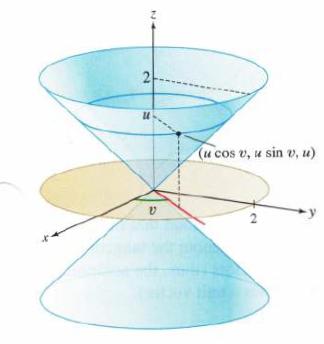
Find the surface area of the part of the cone \(x^{2}+y^{2}=z^{2}\) between the planes \(z=2\) and \(z=5\).
Find the surface area of the portion \(S\) of the cone \(z^{2}=x^{2}+y^{2}\), where \(z \geq 0\), contained within the cylinder \(y^{2}+z^{2} \leq 1\).
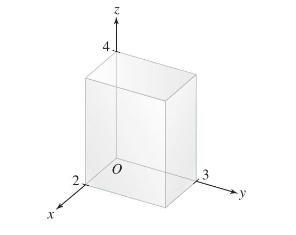
Calculate the integral of \(z e^{2 x+y}\) over the surface of the box in Figure 19. X 4 0
Calculate \(\iint_{\mathcal{S}} x^{2} z d S\), where \(\mathcal{S}\) is the cylinder (including the top and bottom) \(x^{2}+y^{2}=4,0 \leq z \leq 3\).
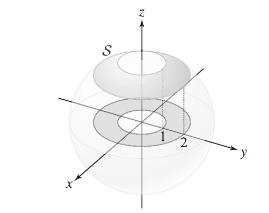
Let \(\mathcal{S}\) be the portion of the sphere \(x^{2}+y^{2}+z^{2}=9\), where \(1 \leq x^{2}+y^{2} \leq 4\) and \(z \geq 0\) (Figure 20). Find a parametrization of \(S\) in polar coordinates and use it to compute:(a) The area of \(\mathcal{S}\)(b) \(\iint_{\mathcal{S}} z^{-1} d S\) S N
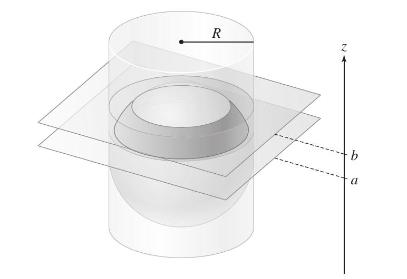
Prove a famous result of Archimedes: The surface area of the portion of the sphere of radius \(R\) between two horizontal planes \(z=a\) and \(z=b\) is equal to the surface area of the corresponding portion of the circumscribed cylinder (Figure 21).. R b (
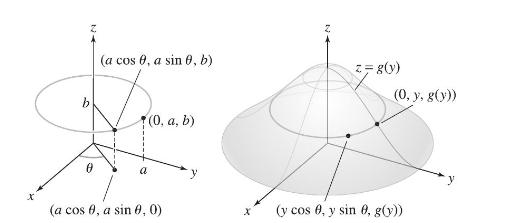
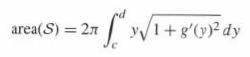
Surfaces of Revolution Let \(\mathcal{S}\) be the surface formed by rotating the region under the \(\operatorname{graph} z=g(y)\) in the \(y z\)-plane for \(c \leq y \leq d\) about the \(z\)-axis, where \(c \geq 0\) (Figure 22).(a) Show that the circle generated by rotating a point \((0, a, b)\)
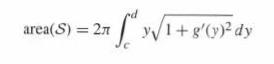
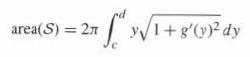
Use Eq. (14) to compute the surface area of \(z=4-y^{2}\) for \(0 \leq y \leq 2\) rotated about the \(z\)-axis. [T+ 1+g'(y) dy area(S) = 2n
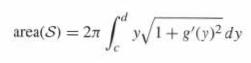
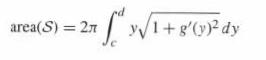
Describe the upper half of the cone \(x^{2}+y^{2}=z^{2}\) for \(0 \leq z \leq d\) as a surface of revolution (Figure 6) and use Eq. (14) to compute its surface area. area(S) = 2n /1+g'(y) dy
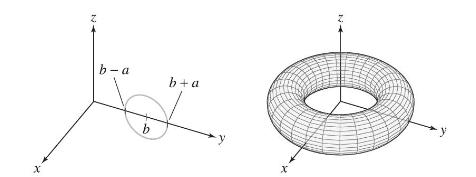
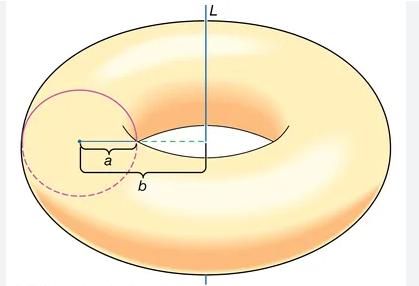
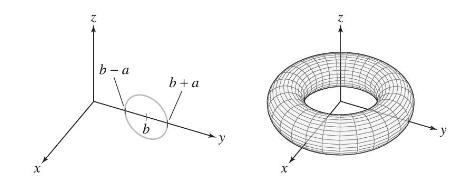
Area of a Torus Let \(\mathcal{T}\) be the torus obtained by rotating the circle in the \(y z\)-plane of radius \(a\) centered at \((0, b, 0)\) about the \(z\)-axis (Figure 23). We assume that \(b>a>0\).(a) Use Eq. (14) to show that\[\operatorname{area}(\mathcal{T})=4 \pi \int_{b-a}^{b+a}
Pappus's Theorem (also called Guldin's Rule), which we introduced in Section 8.4 , states that the area of a surface of revolution \(\mathcal{S}\) is equal to the length \(L\) of the generating curve times the distance traversed by the center of mass. Use Eq. (14) to prove Pappus's Theorem. If
Compute the surface area of the torus in Exercise 45 using Pappus's Theorem.Data From Exercise 45Area of a Torus Let \(\mathcal{T}\) be the torus obtained by rotating the circle in the \(y z\)-plane of radius \(a\) centered at \((0, b, 0)\) about the \(z\)-axis (Figure 23). We assume that
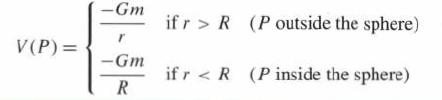
Potential Due to a Uniform Sphere Let \(\mathcal{S}\) be a hollow sphere of radius \(R\) with its center at the origin with a uniform mass distribution of total mass \(m\) [since \(\mathcal{S}\) has surface area \(4 \pi R^{2}\), the mass density is \(\left.\delta=m /\left(4 \pi R^{2}ight)ight]\).
Calculate the gravitational potential \(V\) for a hemisphere of radius \(R\) with uniform mass distribution.
The surface of a cylinder of radius \(R\) and length \(L\) has a uniform mass distribution \(\delta\) (the top and bottom of the cylinder are excluded). Use Eq. (11) to find the gravitational potential at a point \(P\) located along the axis of the cylinder. V(P)=-G V(P) = off 8(x, y, z) ds IP - QI
Let \(S\) be the part of the graph \(z=g(x, y)\) lying over a domain \(\mathcal{D}\) in the \(x y\)-plane. Let \(\phi=\phi(x, y)\) be the angle between the normal to \(S\) and the vertical. Prove the formula\[\operatorname{area}(S)=\iint_{\mathcal{D}} \frac{d A}{|\cos \phi|}\]
Let \(\mathbf{F}\) be a vector field and \(\Phi(u, v)\) a parametrization of a surface \(\mathcal{S}\), and set \(\mathbf{N}=\mathbf{T}_{u} \times \mathbf{T}_{v}\). Which of the following is the normal component of \(\mathbf{F}\) ?(a) \(\mathbf{F} \cdot \mathbf{N}\)(b) \(\mathbf{F} \cdot
The vector surface integral \(\iint_{\mathcal{S}} \mathbf{F} \cdot d \mathbf{S}\) is equal to the scalar surface integral of the function (choose the correct answer):(a) \(\|\mathbf{F}\|\).(b) \(\mathbf{F} \cdot \mathbf{N}\), where \(\mathbf{N}\) is a normal vector.(c) \(\mathbf{F} \cdot
\(\iint_{\mathcal{S}} \mathbf{F} \cdot d \mathbf{S}\) is zero if (choose the correct answer):(a) \(\mathbf{F}\) is tangent to \(\mathcal{S}\) at every point.(b) \(\mathbf{F}\) is perpendicular to \(\mathcal{S}\) at every point.
If \(\mathbf{F}(P)=\mathbf{n}(P)\) at each point on \(\mathcal{S}\), then \(\iint_{\mathcal{S}} \mathbf{F} \cdot d \mathbf{S}\) is equal to which of the following?(a) Zero(b) \(\operatorname{Area}(\mathcal{S})\)(c) Neither
Let \(\mathcal{S}\) be the disk \(x^{2}+y^{2} \leq 1\) in the \(x y\)-plane oriented with normal in the positive \(z\)-direction. Determine \(\iint_{\mathcal{S}} \mathbf{F} \cdot d \mathbf{S}\) for each of the following vector constant fields:(a) \(\mathbf{F}=\langle 1,0,0angle\)(b)
Estimate \(\iint_{\mathcal{S}} \mathbf{F} \cdot d \mathbf{S}\), where \(\mathcal{S}\) is a tiny oriented surface of area 0.05 and the value of \(\mathbf{F}\) at a sample point
A small surface \(\mathcal{S}\) is divided into three pieces of area 0.2. Estimate \(\iint_{\mathcal{S}} \mathbf{F} \cdot d \mathbf{S}\) if \(\mathbf{F}\) is a unit vector field making angles of \(85^{\circ}, 90^{\circ}\), and \(95^{\circ}\) with the normal at sample points in these three pieces.
Let \(\mathbf{F}=\langle z, 0, yangle\), and let \(\mathcal{S}\) be the oriented surface parametrized by \(\Phi(u, v)=\left(u^{2}-v, u, v^{2}ight)\) for \(0 \leq u \leq 2\), \(-1 \leq v \leq 4\). Calculate:(a) \(\mathbf{N}\) and \(\mathbf{F} \cdot \mathbf{N}\) as functions of \(u\) and \(v\)(b) The
Let \(\mathbf{F}=\left\langle y,-x, x^{2}+y^{2}ightangle\), and let \(\mathcal{S}\) be the portion of the paraboloid \(z=x^{2}+y^{2}\) where \(x^{2}+y^{2} \leq 3\).(a) Show that if \(\mathcal{S}\) is parametrized in polar variables \(x=r \cos \theta, y=r \sin \theta\), then \(\mathbf{F} \cdot
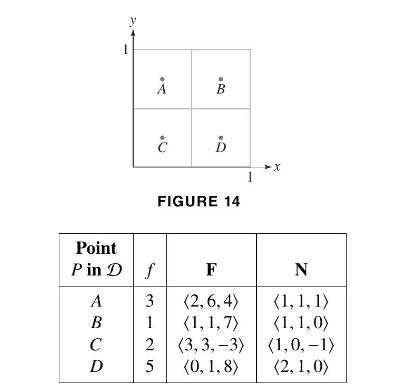
Suppose that \(\mathcal{S}\) is a surface in \(\mathbf{R}^{3}\) with a parametrization \(\Phi\) whose domain \(\mathcal{D}\) is the square in Figure 14. The values of a function \(f\), a vector field \(\mathbf{F}\), and the normal vector \(\mathbf{N}=\mathbf{T}_{u} \times \mathbf{T}_{v}\) at
Compute \(\iint_{\mathcal{S}} \mathbf{F} \cdot d \mathbf{S}\) for the given oriented surface.\(\mathbf{F}=\langle y, z, xangle\), plane \(3 x-4 y+z=1\), \(0 \leq x \leq 1,0 \leq y \leq 1\), upward-pointing normal
Compute \(\iint_{\mathcal{S}} \mathbf{F} \cdot d \mathbf{S}\) for the given oriented surface.\(\mathbf{F}=\left\langle e^{z}, z, xightangle, \quad \Phi(r, s)=(r s, r+s, r)\), \(0 \leq r \leq 1,0 \leq s \leq 1, \quad\) oriented by \(\mathbf{T}_{r} \times \mathbf{T}_{s}\)
Compute \(\iint_{\mathcal{S}} \mathbf{F} \cdot d \mathbf{S}\) for the given oriented surface.\(\mathbf{F}=\langle 0,3, xangle\), part of sphere \(x^{2}+y^{2}+z^{2}=9\), where \(x \geq 0, y \geq 0, z \geq 0\), outward-pointing normal
Compute \(\iint_{\mathcal{S}} \mathbf{F} \cdot d \mathbf{S}\) for the given oriented surface.\(\mathbf{F}=\langle x, y, zangle, \quad\) part of sphere \(x^{2}+y^{2}+z^{2}=1\), where \(\frac{1}{2} \leq z \leq \frac{\sqrt{3}}{2}, \quad\) inward-pointing normal
Compute \(\iint_{\mathcal{S}} \mathbf{F} \cdot d \mathbf{S}\) for the given oriented surface.\(\mathbf{F}=\langle z, z, xangle, \quad z=9-x^{2}-y^{2}, x \geq 0, y \geq 0, z \geq 0, \quad\) upward-pointing normal
Compute \(\iint_{\mathcal{S}} \mathbf{F} \cdot d \mathbf{S}\) for the given oriented surface.\(\mathbf{F}=\langle\sin y, \sin z, y zangle\), rectangle \(0 \leq y \leq 2,0 \leq z \leq 3\) in the \((y, z)\)-plane, normal pointing in negative \(x\)-direction
Compute \(\iint_{\mathcal{S}} \mathbf{F} \cdot d \mathbf{S}\) for the given oriented surface.\(\mathbf{F}=y^{2} \mathbf{i}+2 \mathbf{j}-x \mathbf{k}\), portion of the plane \(x+y+z=1\) in the octant \(x, y, z \geq 0\), upward-pointing normal
Compute \(\iint_{\mathcal{S}} \mathbf{F} \cdot d \mathbf{S}\) for the given oriented surface.\(\mathbf{F}=\left\langle x, y, e^{z}ightangle\), cylinder \(x^{2}+y^{2}=4,1 \leq z \leq 5\), outward-pointing normal
Compute \(\iint_{\mathcal{S}} \mathbf{F} \cdot d \mathbf{S}\) for the given oriented surface.\(\mathbf{F}=\left\langle x z, y z, z^{-1}ightangle, \quad\) disk of radius 3 at height 4 parallel to the \(x y\)-plane, upward-pointing normal
Compute \(\iint_{\mathcal{S}} \mathbf{F} \cdot d \mathbf{S}\) for the given oriented surface.\(\mathbf{F}=\langle x y, y, 0angle, \quad\) cone \(z^{2}=x^{2}+y^{2}, x^{2}+y^{2} \leq 4, z \geq 0, \quad\) downward-pointing normal
Compute \(\iint_{\mathcal{S}} \mathbf{F} \cdot d \mathbf{S}\) for the given oriented surface.\(\mathbf{F}=\left\langle 0,0, e^{y+z}ightangle, \quad\) boundary of unit cube \(0 \leq x \leq 1,0 \leq y \leq 1,0 \leq z \leq 1\), outward-pointing normal
Compute \(\iint_{\mathcal{S}} \mathbf{F} \cdot d \mathbf{S}\) for the given oriented surface.\(\mathbf{F}=\left\langle 0,0, z^{2}ightangle, \quad \Phi(u, v)=(u \cos v, u \sin v, v), 0 \leq u \leq 1,0 \leq v \leq 2 \pi, \quad\) upward-pointing normal
Compute \(\iint_{\mathcal{S}} \mathbf{F} \cdot d \mathbf{S}\) for the given oriented surface.\(\mathbf{F}=\langle y, z, 0angle, \quad \Phi(u, v)=\left(u^{3}-v, u+v, v^{2}ight), 0 \leq u \leq 2,0 \leq v \leq 3\), downward-pointing normal
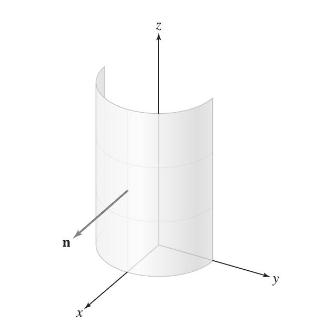
Let \(\mathcal{S}\) be the oriented half-cylinder in Figure 15. In (a)-(f), determine whether \(\iint_{\mathcal{S}} \mathbf{F} \cdot d \mathbf{S}\) is positive, negative, or zero. Explain your reasoning.(a) \(\mathbf{F}=\mathbf{i}\)(b) \(\mathbf{F}=\mathbf{j}\)(c) \(\mathbf{F}=\mathbf{k}\)(d)
Let \(\mathbf{e}_{\mathbf{r}}=\langle x / r, y / r, z / rangle\) be the unit radial vector, where \(r=\sqrt{x^{2}+y^{2}+z^{2}}\). Calculate the integral of \(\mathbf{F}=\) \(e^{-r} \mathbf{e}_{\mathbf{r}}\) over:(a) the upper hemisphere of \(x^{2}+y^{2}+z^{2}=9\), outward-pointing normal.(b) the
Show that the flux of \(\mathbf{F}=\frac{\mathbf{e}_{r}}{r^{2}}\) through a sphere centered at the origin does not depend on the radius of the sphere.
The electric field due to a point charge located at the origin in \(\mathbf{R}^{3}\) is \(\mathbf{E}=k \frac{\mathbf{e}_{r}}{r^{2}}\), where \(r=\sqrt{x^{2}+y^{2}+z^{2}}\) and \(k\) is a constant. Calculate the flux of \(\mathbf{E}\) through the disk \(D\) of radius 2 parallel to the \(x y\)-plane
Let \(\mathcal{S}\) be the ellipsoid \(\left(\frac{x}{4}ight)^{2}+\left(\frac{y}{3}ight)^{2}+\left(\frac{z}{2}ight)^{2}=1\). Calculate the flux of \(\mathbf{F}=z \mathbf{i}\) over the portion of \(\mathcal{S}\) where \(x, y, z \leq 0\) with upward-pointing normal. Hint: Parametrize \(\mathcal{S}\)
Let \(\mathbf{v}=z \mathbf{k}\) be the velocity field (in meters per second) of a fluid in \(\mathbf{R}^{3}\). Calculate the flow rate (in cubic meters per second) through the upper hemisphere \((z \geq 0)\) of the sphere \(x^{2}+y^{2}+z^{2}=1\).
Calculate the flow rate of a fluid with velocity field \(\mathbf{v}=\left\langle x, y, x^{2} yightangle\) (in meters per second) through the portion of the ellipse \(\left(\frac{x}{2}ight)^{2}+\left(\frac{y}{3}ight)^{2}=1\) in the \(x y\)-plane, where \(x, y \geq 0\), oriented with the normal in
A net is dipped in a river. Determine the flow rate of water across the net if the velocity vector field for the river is given by \(\mathbf{v}\) and the net is described by the given equations.\(\mathbf{v}=\left\langle x-y, z+y+4, z^{2}ightangle\), net given by \(x^{2}+z^{2} \leq 1, y=0\),
A net is dipped in a river. Determine the flow rate of water across the net if the velocity vector field for the river is given by \(\mathbf{v}\) and the net is described by the given equations.\(\mathbf{v}=\left\langle x-y, z+y+4, z^{2}ightangle\), net given by \(y=1-x^{2}-z^{2}, y \geq 0\),
A net is dipped in a river. Determine the flow rate of water across the net if the velocity vector field for the river is given by \(\mathbf{v}\) and the net is described by the given equations.\(\mathbf{v}=\left\langle x-y, z+y+4, z^{2}ightangle\), net given by \(y=\sqrt{1-x^{2}-z^{2}}, y \geq
A net is dipped in a river. Determine the flow rate of water across the net if the velocity vector field for the river is given by \(\mathbf{v}\) and the net is described by the given equations.\(\mathbf{v}=\langle z y, x z, x yangle\), net given by \(y=1-x-z\), for \(x, y, z \geq 0\) oriented in
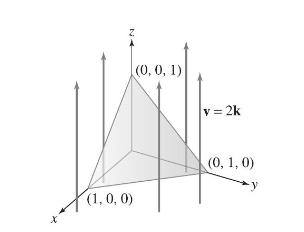
Let \(\mathcal{T}\) be the triangular region with vertices \((1,0,0),(0,1,0)\), and \((0,0,1)\) oriented with upward-pointing normal vector (Figure 16). Assume distances are in meters.A fluid flows with constant velocity field \(\mathbf{v}=2 \mathbf{k}\) (meters per second). Calculate:(a) the flow
Let \(\mathcal{T}\) be the triangular region with vertices \((1,0,0),(0,1,0)\), and \((0,0,1)\) oriented with upward-pointing normal vector (Figure 16). Assume distances are in meters.Calculate the flow rate through \(\mathcal{T}\) if \(\mathbf{v}=-\mathbf{j} \mathrm{m} / \mathrm{s}\). X (1,0,0)
Prove that if \(\mathcal{S}\) is the part of a graph \(z=g(x, y)\) lying over a domain \(\mathcal{D}\) in the \(x y\)-plane, then\[\iint_{\mathcal{S}} \mathbf{F} \cdot d \mathbf{S}=\iint_{\mathcal{D}}\left(-F_{1} \frac{\partial g}{\partial x}-F_{2} \frac{\partial g}{\partial y}+F_{3}ight) d x d y\]
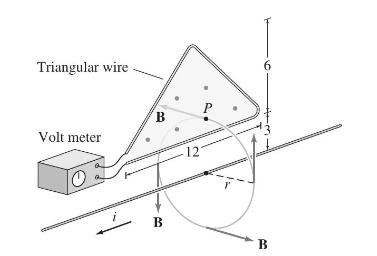
A varying current i(t) flows through a long, straight wire in the xy-plane as in Example 5. The current produces a magnetic field \(\mathbf{B}\) whose magnitude at a distance \(r\) from the wire is \(B=\frac{\mu_{0} i}{2 \pi r} T\), where \(\mu_{0}=4 \pi \cdot 10^{-7} \mathrm{~T}-\mathrm{m} /\) A.
Assume that \(i=10 e^{-0.1 t} \mathrm{~A}(t\) in seconds). Calculate the flux \(\Phi(t)\), at time \(t\), of \(\mathbf{B}\) through the isosceles triangle of base \(12 \mathrm{~cm}\) and height \(6 \mathrm{~cm}\) whose bottom edge is \(3 \mathrm{~cm}\) from the wire, as in Figure 17. Assume the
A solid material that has thermal conductivity \(K\) in kilowatts per meter-kelvin and temperature given at each point by \(w(x, y, z)\) has heat flow given by the vector field \(\mathbf{F}=-K abla w\) and rate of heat flow across a surface \(\mathcal{S}\) within the solid given by \(-K
A solid material that has thermal conductivity KK in kilowatts per meter-kelvin and temperature given at each point by w(x,y,z)w(x,y,z) has heat flow given by the vector field F=−K∇wF=−K∇w and rate of heat flow across a surface SS within the solid given by −K∬S∇wdS−K∬S∇wdS.An
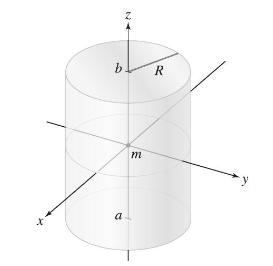
A point mass \(m\) is located at the origin. Let \(Q\) be the flux of the gravitational field \(\mathbf{F}=-G m \frac{\mathbf{e}_{r}}{r^{2}}\) through the cylinder \(x^{2}+y^{2}=R^{2}\) for \(a \leq z \leq b\), including the top and bottom (Figure 18). Show that \(Q=-4 \pi G m\) if \(a b a m R
Let \(\mathcal{S}\) be the surface with parametrization\[\Phi(u, v)=\left(\left(1+v \cos \frac{u}{2}ight) \cos u,\left(1+v \cos \frac{u}{2}ight) \sin u, v \sin \frac{u}{2}ight)\]for \(0 \leq u \leq 2 \pi,-\frac{1}{2} \leq v \leq \frac{1}{2}\)CBS Use a computer algebra system.(a) Plot
- \(A 5\) We cannot integrate vector fields over \(\mathcal{S}\) because \(\mathcal{S}\) is not orientable, but it is possible to integrate functions over \(\mathcal{S}\). Using a computer algebra system:(a) Verify that \[\|\mathbf{N}(u, v)\|^{2}=1+\frac{3}{4} v^{2}+2 v \cos \frac{u}{2}+\frac{1}{2}
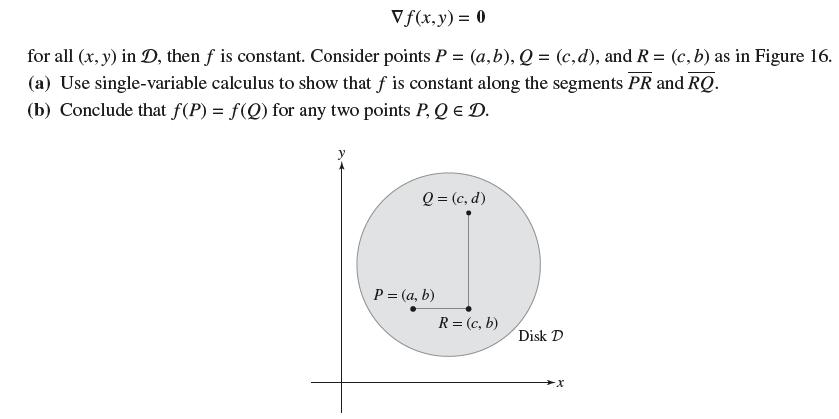
Let D be a disk in R2. This exercise shows that if Vf(x, y) = 0 for all (x, y) in D, then f is constant. Consider points P = (a,b), Q = (c,d), and R = (c, b) as in Figure 16. (a) Use single-variable calculus to show that f is constant along the segments PR and RQ. (b) Conclude that f(P) = f(Q) for
Let ϕ = ln r, where r = √x2 + y2. Express ∇ϕ in terms of the unit radial vector er in R2.
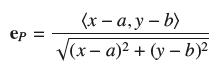
For P = (a, b), we define the unit radial vector field based at P:(a) Verify that eP is a unit vector field.(b) Calculate eP(1, 1) for P = (3, 2).(c) Find a potential function for eP. ep = (x-a,y - b) (x-a)+(y-b)
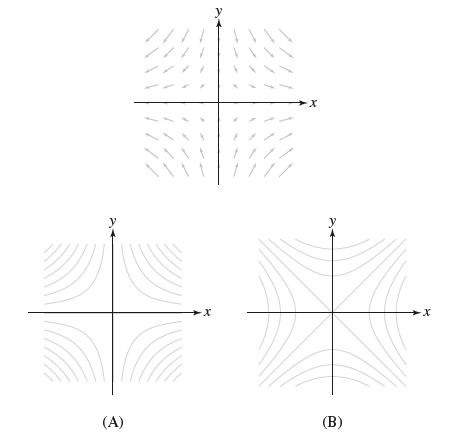
Which of (A) or (B) in Figure 12 is the contour plot of a potential function for the vector field F? Recall that the gradient vectors are perpendicular to the level curves. y (A) X y > X y (B) x
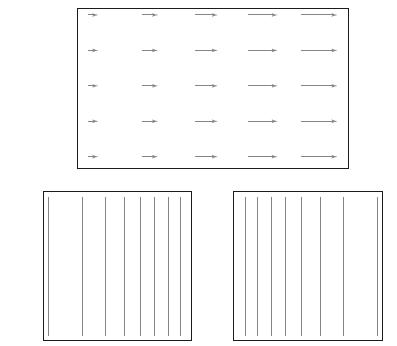
Which of (A) or (B) in Figure 13 is the contour plot of a potential function for the vector field F?
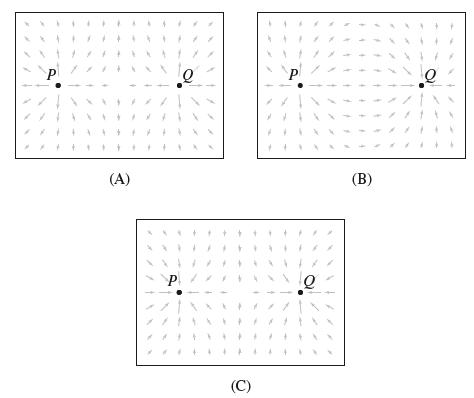
Match each of these descriptions with a vector field in Figure 14.(a) The gravitational field created by two planets of equal mass located at P and Q(b) The electrostatic field created by two equal and opposite charges located at P and Q (representing the force on a negative test charge; opposite
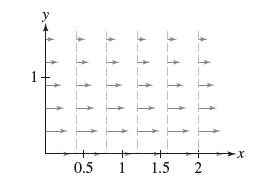
In this exercise, we show that the vector field F in Figure 15 is not conservative. Explain the following statements:(a) If a potential function ƒ for F exists, then the level curves of ƒ must be vertical lines.(b) If a potential function ƒ for F exists, then the level curves of ƒ must grow
Show that any vector field of the form F = (ƒ(x), g(y), h(z)) has a potential function. Assume that ƒ, g, and h are continuous.
What is the line integral of the constant function ƒ(x, y, z) = 10 over a curve C of length 5?
Which of the following have a zero line integral over the vertical segment from (0, 0) to (0, 1)? (a) f(x, y) = x (c) F = (x, 0) (e) F = (0, x) (b) f(x, y) = y (d) F = (y,0) (f) F = (0, y)
State whether each statement is true or false. If the statement is false, give the correct statement.(a) The scalar line integral does not depend on how you parametrize the curve.(b) If you reverse the orientation of the curve, neither the vector line integral nor the scalar line integral changes
Suppose that C has length 5. What is the value of (a) F(P) is normal to C at all points P on C?(b) F(P) is a unit vector pointing in the negative direction along the curve? So F. dr if:
Let \(f(x, y, z)=x+y z\), and let \(C\) be the line segment from \(P=(0,0,0)\) to \((6,2,2)\).(a) Calculate \(f(\mathbf{r}(t))\) and \(d s=\left\|\mathbf{r}^{\prime}(t)ight\| d t\) for the parametrization \(\mathbf{r}(t)=\langle 6 t, 2 t, 2 tangle\) for \(0 \leq t \leq 1\).(b) Evaluate \(\int_{C}
Repeat Exercise 1 with the parametrization \(\mathbf{r}(t)=\left\langle 3 t^{2}, t^{2}, t^{2}ightangle\) for \(0 \leq t \leq \sqrt{2}\).Data From Exercise 1Let \(f(x, y, z)=x+y z\), and let \(C\) be the line segment from \(P=(0,0,0)\) to \((6,2,2)\).(a) Calculate \(f(\mathbf{r}(t))\) and \(d
Let \(\mathbf{F}=\left\langle y^{2}, x^{2}ightangle\), and let \(C\) be the curve \(y=x^{-1}\) for \(1 \leq x \leq 2\), oriented from left to right.(a) Calculate \(\mathbf{F}(\mathbf{r}(t))\) and \(d \mathbf{r}=\mathbf{r}^{\prime}(t) d t\) for the parametrization of \(C\) given by
Let \(\mathbf{F}(x, y, z)=\left\langle z^{2}, x, yightangle\), and let \(C\) be the curve that is given by \(\mathbf{r}(t)=\left\langle 3+5 t^{2}, 3-t^{2}, tightangle\) for \(0 \leq t \leq 2\).(a) Calculate \(\mathbf{F}(\mathbf{r}(t))\) and \(d \mathbf{r}=\mathbf{r}^{\prime}(t) d t\).(b) Calculate
Compute the integral of the scalar function or vector field over \(\mathbf{r}(t)=\langle\cos t, \sin t, tangle\) for \(0 \leq t \leq \pi\).\(f(x, y, z)=x^{2}+y^{2}+z^{2}\)
Compute the integral of the scalar function or vector field over \(\mathbf{r}(t)=\langle\cos t, \sin t, tangle\) for \(0 \leq t \leq \pi\).\(f(x, y, z)=x y+z\)
Compute the integral of the scalar function or vector field over \(\mathbf{r}(t)=\langle\cos t, \sin t, tangle\) for \(0 \leq t \leq \pi\).\(\mathbf{F}(x, y, z)=\left\langle x, y, z^{2}ightangle\)
Compute the integral of the scalar function or vector field over \(\mathbf{r}(t)=\langle\cos t, \sin t, tangle\) for \(0 \leq t \leq \pi\).\(\mathbf{F}(x, y, z)=\left\langle x y, 2, z^{3}ightangle\)
Compute \(\int_{C} f d s\) for the curve specified.\(f(x, y)=\sqrt{1+9 x y}, \quad y=x^{3}\) for \(0 \leq x \leq 2\)
Compute \(\int_{C} f d s\) for the curve specified.\(f(x, y)=\frac{y^{3}}{x^{7}}, \quad y=\frac{1}{4} x^{4}\) for \(1 \leq x \leq 2\)
Compute \(\int_{C} f d s\) for the curve specified.\(f(x, y, z)=z^{2}, \quad \mathbf{r}(t)=\langle 2 t, 3 t, 4 tangle\) for \(0 \leq t \leq 2\)
Compute \(\int_{C} f d s\) for the curve specified.\(f(x, y, z)=3 x-2 y+z, \quad \mathbf{r}(t)=\langle 2+t, 2-t, 2 tangle\) for \(-2 \leq t \leq 1\)
Compute \(\int_{C} f d s\) for the curve specified.\(f(x, y, z)=x e^{z^{2}}\), piecewise linear path from \((0,0,1)\) to \((0,2,0)\) to \((1,1,1)\)
Compute \(\int_{C} f d s\) for the curve specified.\(f(x, y, z)=x^{2} z, \quad \mathbf{r}(t)=\left\langle e^{t}, \sqrt{2} t, e^{-t}ightangle\) for \(0 \leq t \leq 1\)
Compute \(\int_{C} f d s\) for the curve specified.\(f(x, y, z)=2 x^{2}+8 z, \quad \mathbf{r}(t)=\left\langle e^{t}, t^{2}, tightangle, \quad 0 \leq t \leq 1\)
Compute \(\int_{C} f d s\) for the curve specified.\(f(x, y, z)=6 x z-2 y^{2}, \quad \mathbf{r}(t)=\left\langle t, \frac{t^{2}}{\sqrt{2}}, \frac{t^{3}}{3}ightangle, \quad 0 \leq t \leq 2\)
Calculate \(\int_{C} 1 d s\), where the curve \(C\) is parametrized by \(\mathbf{r}(t)=\langle 4 t,-3 t, 12 tangle\) for \(2 \leq t \leq 5\). What does this integral represent?
Calculate \(\int_{C} 1 d s\), where the curve \(C\) is parametrized by \(\mathbf{r}(t)=\left\langle e^{t}, \sqrt{2} t, e^{-t}ightangle\) for \(0 \leq t \leq 2\).
Showing 400 - 500
of 8339
1
2
3
4
5
6
7
8
9
10
11
12
13
14
15
Last
Step by Step Answers

 Get 50% OFF
Claim Now
Get 50% OFF
Claim Now