New Semester
Started
Get
50% OFF
Study Help!
--h --m --s
Claim Now
Question Answers
Textbooks
Find textbooks, questions and answers
Oops, something went wrong!
Change your search query and then try again
S
Books
FREE
Study Help
Expert Questions
Accounting
General Management
Mathematics
Finance
Organizational Behaviour
Law
Physics
Operating System
Management Leadership
Sociology
Programming
Marketing
Database
Computer Network
Economics
Textbooks Solutions
Accounting
Managerial Accounting
Management Leadership
Cost Accounting
Statistics
Business Law
Corporate Finance
Finance
Economics
Auditing
Tutors
Online Tutors
Find a Tutor
Hire a Tutor
Become a Tutor
AI Tutor
AI Study Planner
NEW
Sell Books
Search
Search
Sign In
Register
study help
mathematics
calculus early transcendentals
Calculus Early Transcendentals 2nd edition William L. Briggs, Lyle Cochran, Bernard Gillett - Solutions
For the following functions f, find the antiderivative F that satisfies the given condition.f(x) = 8x3 - 2x-2; F(1) = 5
Sketch a curve with the following properties.f' < 0 and f" < 0, for x < -1f' < 0 and f" > 0, for -1 < x < 2f' > 0 and f" > 0, for 2 < x < 8f' > 0 and f" < 0, for 8 < x < 10f' > 0 and f" > 0, for x > 10
Sketch a complete graph of the following functions. Use analytical methods and a graphing utility together in a complementary way.f(x) = 3x4 - 44x3 + 60x2 (Two different graphing windows may be needed.)
Determine the intervals on which the following functions are concave up or concave down. Identify any inflection points.g(t) = ln (3t2 + 1)
Determine whether Rolle’s Theorem applies to the following functions on the given interval. If so, find the point(s) that are guaranteed to exist by Rolle’s Theorem.f(x) = sin 2x; [0, π/2]
a. Find the critical points of f on the given interval.b. Determine the absolute extreme values of f on the given interval.c. Use a graphing utility to confirm your conclusions.f(x) = x/√x - 4 on [6, 12]
Determine which of the two functions grows faster or state that they have comparable growth rates.√x and ln10 x
Of all rectangles with a fixed area A, which one has the minimum perimeter? (Give the dimensions in terms of A.)
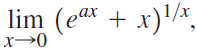
Evaluate the following limits or explain why they do not exist. Check your results by graphing.for a constant a lim (ex + x), 1/x х—0
A simple model for travel costs involves the cost of gasoline and the cost of a driver. Specifically, assume that gasoline costs $ p/gallon and the vehicle gets g miles per gallon. Also assume that the driver earns $ w/hour. a. A plausible function to describe how gas mileage (in mi/gal)
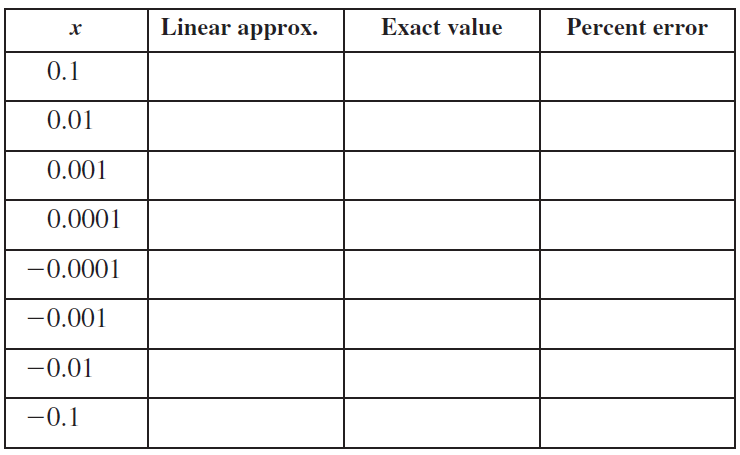
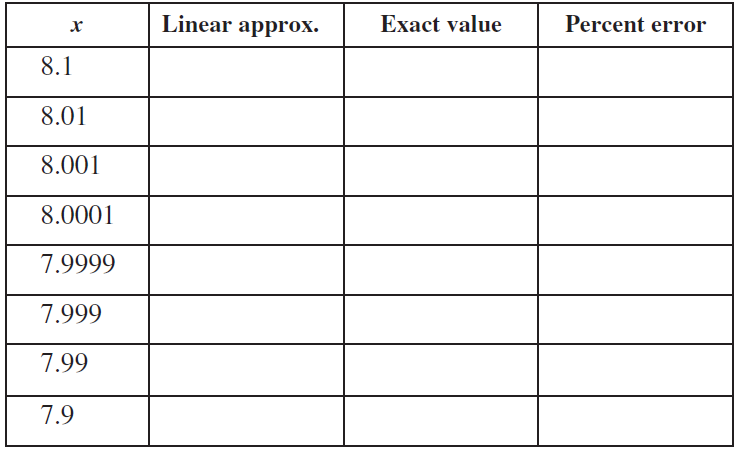
Suppose f(x) = 1/(1 + x) is to be approximated near x = 0. Find the linear approximation to f at 0. Then complete the following table showing the errors in various approximations. Use a calculator to obtain the exact values. The percent error is 100|approximation - exact|/|exact|. Comment on the
Explain why the form 1∞ is indeterminate and cannot be evaluated by substitution. Explain how the competing functions behave.
For the following functions f, find the antiderivative F that satisfies the given condition.f(x) = (4√x + 6/√x)/x2; F(1) = 4
Use the linear approximation given in Example 1 to answer the following questions.If you travel one mile in 59 seconds, what is your approximate average speed? What is your exact speed?
Give the antiderivatives of 1/x.
Sketch a complete graph of the following functions. Use analytical methods and a graphing utility together in a complementary way.f(x) = 3 4√x - √x - 2
Determine the intervals on which the following functions are concave up or concave down. Identify any inflection points.f(x) = 2x2 ln x - 5x2
a. Find the critical points of f on the given interval.b. Determine the absolute extreme values of f on the given interval.c. Use a graphing utility to confirm your conclusions.f(x) = x ln (x/5) on [0.1, 5]
Determine which of the two functions grows faster or state that they have comparable growth rates.ln x and log10 x
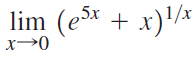
Evaluate the following limits or explain why they do not exist. Check your results by graphing. 1/x lim (ex + x)/ х—0
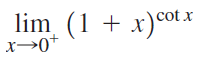
Evaluate the following limits or explain why they do not exist. Check your results by graphing. lim (1 + x)°otx cot x x→0+ х-
Write the formula for Newton’s method and use the given initial approximation to compute the approximations x1 and x2.f(x) = e-x - x; x0 = ln 2
What is an inflection point?
Sketch the graph of a function f that has a local maximum value at a point c where f'(c) = 0.
Find the critical points of the following functions on the given intervals. Identify the absolute maximum and minimum values (if they exist). Graph the function to confirm your conclusions.f(x) = 2x3 - 3x2 - 36x + 12 on (-∞, ∞)
Sketch a curve with the following properties.f' < 0 and f" < 0, for x < 3f' < 0 and f" > 0, for x > 3
Determine whether Rolle’s Theorem applies to the following functions on the given interval. If so, find the point(s) that are guaranteed to exist by Rolle’s Theorem.f(x) = x(x - 1)2; [0, 1]
Of all rectangles of area 100, which one has the minimum perimeter?
Give an example of a limit of the form ∞/∞ as x → 0.
Does the differential dy represent the change in f or the change in the linear approximation to f ? Explain.
Give the antiderivatives of e-x.
Write the formula for Newton’s method and use the given initial approximation to compute the approximations x1 and x2.f(x) = x2 - 2x - 3; x0 = 2
Sketch a function that changes from concave up to concave down as x increases. Describe how the second derivative of this function changes.
What is a critical point of a function?
Find the critical points of the following functions on the given intervals. Identify the absolute maximum and minimum values (if they exist). Graph the function to confirm your conclusions.f(x) = sin 2x + 3 on [-π, π]
Describe the possible end behavior of a polynomial.
At what points c does the conclusion of the Mean Value Theorem hold for f(x) = x3 on the interval [-10, 10]?
Of all rectangles with a fixed perimeter of P, which one has the maximum area? (Give the dimensions in terms of P.)
Explain how to convert a limit of the form 0 · ∞ to a limit of the form 0/0 or ∞/∞.
Given a function f that is differentiable on its domain, write and explain the relationship between the differentials dx and dy.
For what values of p does your answer apply?
Write the formula for Newton’s method and use the given initial approximation to compute the approximations x1 and x2.f(x) = x2 - 6; x0 = 3
Suppose f" exists and is positive on an interval I. Describe the relationship between the graph of f and its tangent lines on the interval I.
Sketch the graph of a function that has an absolute maximum, a local minimum, but no absolute minimum on [0, 3].
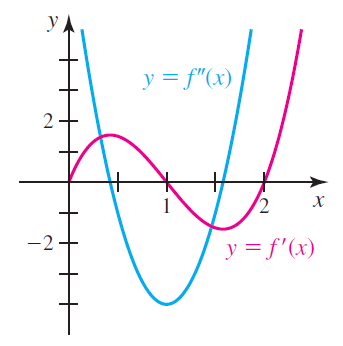
Given the graphs of f' and f", sketch a possible graph of f.
How do you find the absolute maximum and minimum values of a function that is continuous on a closed interval?
Draw the graph of a function for which the conclusion of the Mean Value Theorem does not hold.
Of all rectangles with a perimeter of 10, which one has the maximum area? (Give the dimensions.)
To which indeterminate forms does l’Hôpital’s Rule apply directly?
How can linear approximation be used to approximate the change in y = f(x) given a change in x?
Give the formula for Newton’s method for the functionf(x) = x2 - 5.
Explain how to apply the Second Derivative Test.
Sketch the graph of a function that is continuous on an open interval (a, b) but has neither an absolute maximum nor an absolute minimum value on (a, b).
Sketch the graph of a function continuous on the given interval that satisfies the following conditions.f is continuous on (-∞, ∞); f'(x) < 0 and f"(x) < 0 on (-∞, 0); f'(x) > 0 and f"(x) > 0 on (0, ∞).
Where are the vertical asymptotes of a rational function located?
Explain the Mean Value Theorem with a sketch.
Suppose you wish to minimize a continuous objective function on a closed interval, but you find that it has only a single local maximum. Where should you look for the solution to the problem?
a. What is the length of the longest pole that can be carried horizontally around a corner at which a 3-ft corridor and a 4-ft corridor meet at right angles?b. What is the length of the longest pole that can be carried horizontally around a corner at which a corridor that is a feet wide and a
Explain the steps used to apply l’Hôpital’s Rule to a limit of the form 0/0.
Suppose f(x) = 3√x is to be approximated near x = 8. Find the linear approximation to f at 8. Then complete the following table, showing the errors in various approximations. Use a calculator to obtain the exact values. The percent error is 100|approximation - exact|/ |exact|. Comment on the
For the following functions f, find the antiderivative F that satisfies the given condition.f(v) = sec v tan v; F(0) = 2
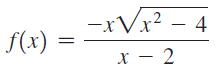
Sketch a complete graph of the following functions. Use analytical methods and a graphing utility together in a complementary way. -xVx? – 4 f(x) .2 2
Determine the intervals on which the following functions are concave up or concave down. Identify any inflection points.f(x) = ex(x - 3)
a. What point on the line y = 3x + 4 is closest to the origin?b. What point on the parabola y = 1 - x2 is closest to the point (1, 1)?c. Find the point on the graph of y = √x that is nearest the point (p, 0) if (i) p > 1/2(ii) 0 < p < 1/2.Express the answer in terms of p.
a. Find the critical points of f on the given interval.b. Determine the absolute extreme values of f on the given interval.c. Use a graphing utility to confirm your conclusions.f(x) = x3e-x on [-1, 5]
Determine which of the two functions grows faster or state that they have comparable growth rates.x1/2 and x1/3
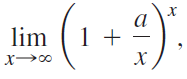
Evaluate the following limits or explain why they do not exist. Check your results by graphing.for a constant a х lim X- х
Show that the function T(x) = 60 D(60 + x)-1 gives the time in minutes required to drive D miles at 60 + x miles per hour.
For the following functions f, find the antiderivative F that satisfies the given condition.f(t) = sec2 t; F(π/4) = 1
Sketch a continuous function f on some interval that has the properties described.The function f has the same finite limit as x→±∞and has exactly one absolute minimum and one absolute maximum.
Determine the intervals on which the following functions are concave up or concave down. Identify any inflection points.f(x) = 1/1 + x2
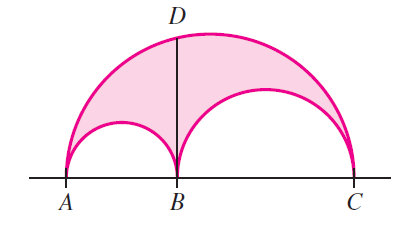
An arbelos is the region enclosed by three mutually tangent semicircles; it is the region inside the larger semicircle and outside the two smaller semicircles (see figure).a. Given an arbelos in which the diameter of the largest circle is 1, what positions of point B maximize the area of the
a. Find the critical points of f on the given interval.b. Determine the absolute extreme values of f on the given interval.c. Use a graphing utility to confirm your conclusions.f(x) = x1/3 (x + 4) on [-27, 27]
Determine which of the two functions grows faster or state that they have comparable growth rates.x100 and 1.1x
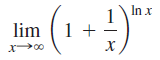
Evaluate the following limits or explain why they do not exist. Check your results by graphing. In x lim 1+
Consider again the average speed s(x) and its linear approximation L(x) discussed in Example 1. The error in using L(x) to approximates s(x) is given by E(x) = |L(x) - s(x)|. Use a graphing utility to determine the (approximate) values of x for which E(x) ≤ 1. What does your answer say about the
For the following functions f, find the antiderivative F that satisfies the given condition.f(x) = x5 - 2x-2 + 1; F(1) = 0
Sketch a continuous function f on some interval that has the properties described.The function f satisfies f'(-2) = 2, f'(0) = 0, f'(1) = -3, and f'(4) = 1.
Determine the intervals on which the following functions are concave up or concave down. Identify any inflection points.f(x) = 5x4 - 20x3 + 10
Suppose you are standing in a field near a straight section of railroad tracks just as the locomotive of a train passes the point nearest to you, which is 1/4 mi away. The train, with length 13 mi, is traveling at 20 mi/hr. If you start running in a straight line across the field, how slowly can
a. Find the critical points of f on the given interval.b. Determine the absolute extreme values of f on the given interval.c. Use a graphing utility to confirm your conclusions.f(x) = sec x on [-π/4, π/4]
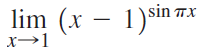
Evaluate the following limits. Check your results by graphing. lim (x – 1)sin TX
The pressure P, temperature T, and volume V of an ideal gas are related by PV = nRT, where n is the number of moles of the gas and R is the universal gas constant. For the purposes of this exercise, let nR = 1; therefore P = T/V.a. Suppose that the volume is held constant and the temperature
Sketch a continuous function f on some interval that has the properties described.The function f has three real zeros and exactly two local minima.
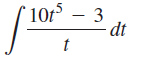
Determine the following indefinite integrals. Check your work by differentiation. 10t – 3 dt ,5
Determine the intervals on which the following functions are concave up or concave down. Identify any inflection points.f(x) = -x4 - 2x3 + 12x2
A window consists of a rectangular pane of clear glass surmounted by a semicircular pane of tinted glass. The clear glass transmits twice as much light per unit of surface area as the tinted glass. Of all such windows with a fixed perimeter P, what are the dimensions of the window that transmits
How is linear approximation used to approximate the value of a function f near a point at which f and f' are easily evaluated?
Describe the set of antiderivatives of f(x) = 1.
a. Find the critical points of f on the given interval.b. Determine the absolute extreme values of f on the given interval.c. Use a graphing utility to confirm your conclusions.f(x) = x1/2 (x2/5 - 4) on [0, 4]
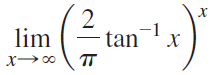
Evaluate the following limits. Check your results by graphing. 2 lim -1 - tanx х- т
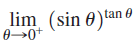
Evaluate the following limits or explain why they do not exist. Check your results by graphing. lim (sin 0)tan
a. Write an equation of the line that represents the linear approximation to the following functions at a.b. Graph the function and the linear approximation at a.c. Use the linear approximation to estimate the given quantity.f(x) = e-x; a = 0; e-0.03
Sketch a continuous function f on some interval that has the properties described.The function f has one inflection point but no local extrema.
Determine the following indefinite integrals. Check your work by differentiation.∫(ex + 2 dx
Determine the intervals on which the following functions are concave up or concave down. Identify any inflection points.f(x) = x4 - 2x3 + 1
A house is located at each corner of a square with side lengths of 1 mi. What is the length of the shortest road system with straight roads that connects all of the houses by roads (that is, a road system that allows one to drive from any house to any other house)? Place two points inside the
How do you decide when to terminate Newton’s method?
a. Find the critical points of f on the given interval.b. Determine the absolute extreme values of f on the given interval.c. Use a graphing utility to confirm your conclusions.f(x) = 2x sin x on [-2, 6]
Sketch the graph of a function that has neither a local maximum nor a local minimum at a point where f'(x) = 0.
Showing 4700 - 4800
of 6775
First
41
42
43
44
45
46
47
48
49
50
51
52
53
54
55
Last
Step by Step Answers

 Get 50% OFF
Claim Now
Get 50% OFF
Claim Now